The problem
I’ve been working with a student and we have identified that they may have a weakness in identifying candidate moves – both for himself and the opponent – thereby overlooking some important opportunities for both players.
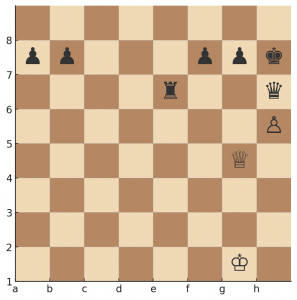
Here’s a striking example, from a different player, played long ago:
White can force a win here, but had to be told after the game by a chess engine. It doesn’t really matter what the solution is, the point is that
- the first move of the solution (Bd5+) is the first move most players offered when shown the position, and
- the player of the White pieces never considered it!
[This position – with some musings which overlap with this essay – is to be found here: https://exeterchessclub.org.uk/content/tactical-surprises]
Clearly, this type of oversight can often appear very early in the thinking process – at the very first move.
So, how can we work to make it more likely that we include the best moves for both sides in our thinking?
A related problem: blunders
A chess blunder is overlooking something very important – usually something tactical – for yourself or your opponent. Undoubtedly the blunderer has failed to consider the most important move or idea in the position. A failure of candidate move choice is clearly similar, but with less severe punishment. But perhaps we can get some ideas about how to improve our selection of candidate moves through consideration of how to reduce the number of blunders we make.
A course of treatment for blunders might look like:
- Doing lots of tactical puzzles to become familiar with the most common ideas and learn how to analyse a couple of moves deep to implement these ideas in real positions
- Checking for tactical shots after your opponent moves, and after you have chosen your move (but before you make it!). Keep it simple – look as if ‘through the eyes of a patzer’ (Blumenfeld)
I have a few things to add to that treatment plan here https://devonjuniorchess.co.uk/wp/drdaveexeter/2025/12/25/blunderproofing-your-chess/ , but the heart of it is right. [The trouble with puzzles is that you know there is something to find, so you can find it, and even be sloppy about it. If you don’t know what you are looking for, or even if there is something to find, then that’s harder![1]]
So, by analogy, a course of treatment for narrow-mindedness might be:
- Doing some puzzles of all types to become familiar with the most common tactical and other ideas in chess
- Learn how to analyse and visualise sufficiently deeply and accurately to implement the ideas in real positions
- Checking for oversights of all sorts after your opponent moves, and after you have chosen your move (but before you make it!)
One of the omissions in that plan is that, while it will help you find things that are the same or similar to things you have seen before, it doesn’t seem likely to help you broaden your scope, or your imagination. But it’s a start.
Also, I think the advice for spotting tactics is familiar and straightforward: the clues are loose pieces and vulnerable kings, and the mechanics will likely involve checks, captures and ‘threats’ (a move that intends a check or a capture next move). What is the equivalent advice for spotting relevant candidate moves?
Tactics and the imagination
Max Euwe was very clear about how to develop our imagination in chess:
“Let us repeat once more the methods by which we can increase our combinative skill:
“(1) by careful examination of the different types and by a clear understanding of their motives and their premises
“(2) By memorising a number of outstanding as well as of common examples and solutions
“(3) Frequent repetition (in thought, if possible) of important combinations, so as to develop the imagination.”
– Euwe, Strategy and Tactics in Chess
So, for Euwe, tactical imagination did not come out of nowhere but through active rehearsal of tactical patterns.
By having these perhaps familiar patterns live in recent memory, they should be more available to you when thinking and you would be able to come up with something that fitted the current position when choosing a move.
Later, Hays’ Winning Chess Problems for Juniors and Smith & Tikkanen’s Woodpecker Method made Euwe’s insight more widely known and understood.
I think we can go a little further than Euwe with this approach, to broaden it to all types of moves, not just familiar tactics:
- We can review and rehearse in our minds successful unusual tactical blows
- We can review and rehearse moves which adhere to common positional themes
- We can review and rehearse moves which adhere to uncommon positional themes
- We can review and rehearse types of moves which are hard to spot https://lichess.org/study/PsuOgnJL
In this way we move beyond the common advice about developing our tactical skill and avoiding tactical oversights, to developing our active vocabulary of types of candidate moves and thus, we trust, avoiding oversights of all kinds.
Things to think about
Shipwrecks
There may be some benefit in looking at these failures of thinking in the hope of improving our own.
“Let the shipwrecks of others be your sea marks.” – Danish proverb
And you may find that you too have a hidden talent:
“I was born with a priceless gift: the ability to laugh at the misfortunes of others.” – Dame Edna Everage (Barry Humphries)
- Blunders by Devon juniors and GMs: I have a small collection here
- van Perlo has collected a splendid collection of endgame positions in which the key move (line, idea) was missed by one or both players: https://www.newinchess.com/endgame-tactics-new-improved-and-expanded-edition
- Dvoretsky likewise has his own collection: https://forwardchess.com/product/tragicomedy-in-the-endgame
- Find the wrong move (John Nunn’s Puzzle Book) https://lichess.org/study/lKdZosue
- If you don’t consider the wrong move, you are perhaps thinking too narrowly
- If you don’t consider the right reply, you are definitely thinking too narrowly!
Your own failures of thinking will of course be more revealing, and give you more tips for next time.
Towards a more inclusive thinking process
Jacob Aagaard often exhorts us:
“On every turn, consider more than one move”
We might re-frame our task when it is our move, to find, not the best move, but to ask ourselves, what is our choice of moves (from which we will pick the best one).
And if we are always considering more than one move we are halfway to follow the widely-quoted advice of Emanuel Lasker, which is:
“When you see a good move, stop – don’t play it – look for a better one”
[I’m not sure Lasker ever said that, but Damiano did.]
So often the thinking process is – think of a likely move – check it – play it. But that means that you will always play the first move you think of, unless you discover it’s a mistake. OK for blitz, but not if you want to consider more moves, and thus make fewer oversights.
Going beyond “Good natural moves”
It’s often said that
“The good is the enemy of the best.”
If we are satisfied with something which is merely good, we will never reach for the very best that we can achieve.
Another way of phrasing this in a chess context, which I very often use myself, is to
“Contrast natural moves with accurate moves.”
Some moves come very easily to the mind or to the hand, particularly those which fit with known goals – for example, developing a minor piece to a decent square, moving a rook to an open file or to the seventh rank. These moves– these good, natural moves – are so appealing they prevent us from considering the best move – the accurate move.
The Natural History Of Candidate Moves
Aagaard is fond of admonishing us:
“You cannot see if you do not look.”
I might add:
You cannot see what you do not know about.
Tactics in chess have acquired a helpful vocabulary: forks, pins, discoveries, and so on. Positional elements also have a vocabulary: seventh rank, doubled pawn, weak square… All of these should be learned and become part of your active vocabulary – somewhere beyond I’ve heard of it, to more like I know how to make use of that in a game.
“The technician, whose vocabulary has been doubled by Dr. Euwe, will find that White could have saved his soul by a desperado combination. Had this failure anything to do with the fact that Dr. Euwe’s terminology was not yet existent at that time!?” — Reinfeld, to Thomas-Euwe, Carlsbad 1929.[2]
Manoeuvres sometimes have handy names, and Hans Kmoch tried to extend our vocabulary of hand-to-hand pawn combat with things like the sweeper-sealer-twist, and the manoeuvres if not the names need to be absorbed.
John Nunn offers a short but helpful list of ‘hard moves to see’ in his Secrets of Practical Chess – they include switchback moves, collinear moves, and hesitation moves. These categories are mostly about the geometry and mechanics of the moves, and the vocabulary draws on problem terminology.
I might add to his list some common oversights for the rest of us, at a much more basic level:
- long moves
- backwards moves (especially when attacking)
- intermezzi
- creeping moves
- sacrifices in general
- ‘silent’ (non-capturing) sacrifices
- Previously impossible moves
- Previously unreasonable moves
- Moving the apparently immovable – e.g. pinned pieces and backward pawns.
In fact, we can find examples of Grandmasters missing all these types of moves, as well as club players…
When thinking about candidate moves, we might be able to agree a list of easy types of move to spot and include in our thinking (ignoring the geometry of the move for the moment — whether the move is long or short, backwards or forwards):
- natural move (especially a recapture)
- seen it before
- fits with general rules (connect your Rooks, avoid doubled pawns)
- keeps material balance
- on the side of the board that seems most actively contested/critical etc.
Hard moves to spot, irrespective of the geometry of the board, might include anything:
- unnatural
- breaks the rules e.g. undeveloping, abandoning castling
- on a distant or neglected part of the board
- novel
- etc.[3]
And some good tips for generating candidate moves might include:
- What is a possible drawback of my opponent’s last move?
- Looking as if through the eyes of a slightly better patzer
- Andersson’s Rule: Improve your worst-placed piece (including: open a file for your Rooks)
- Working backwards from your goal/plan: what helps?
- Can you ignore a threat and play your move/plan anyway?
- Prophylaxis (or avoids counterplay)
Jacob Aagaard started out with 9 prompts/questions with which to poke his students, but more recently has settled on just three:
1. What are the weaknesses? (potential targets)
2. What is the worst piece? (improve position)
3. What is my opponent intending? (prophylaxis)
And some good tips for deciding among candidate moves might be (assuming a brief bit of analysis doesn’t turn up anything useful):
- Be a scientist not a lawyer — you’re trying to find the best move among alternatives, not to prove one move works. Look at all moves briefly at the outset — you may hit on the best move, or see an idea in the context of one variation that makes a different move work
- Use The process of elimination (e.g. if one method of escaping check is hopeless, you can play the alternative without hesitation — example in Chess for Tigers by Simon Webb)
- Comparison method (this move is in no variation worse and often better than an alternative)
- Doing the urgent first
- Doing the less committal first
- If you are considering a commitment (piece sacrifice?), do you have an emergency exit (e.g. perpetual check)?
- Taking the clearest or safest path
- Have a sense of what the evaluation of your current position is, and what it is after the best move you have considered so far – if it matches (e.g. keeps a small edge), it’s good enough
- Playing with move orders
- Which move is easier for your side to play, or which suits your style better, or which is psychologically unpleasant for your opponent (e.g. if they are short of time, a non-forcing move that limits their activity might make their heart sink)
- A bird in the hand… Short, concrete plans are better than longer, vaguer ones (which tend to get derailed by your opponent’s short concrete plans).
- And always: consider your opponent’s best reply, and think of less obvious moves for them as well as you, and consider particularly their options right at the start of the analysis — have you made an unwarranted assumption?
All rather abstract… Some examples of unusual candidate moves might help?
There is a simple example in one of the best-known opening traps, moving the apparently immobile:
A non-tactical example: a backwards, un-developing move in the opening, breaking all the rules!
Working backwards from a goal
This is easy enough to understand when you have hit on a plan – which moves contribute to that plan, and which are the ones you should start with?
The following game features a remarkable 25th move by Korchnoi – the Novotny problem theme in a real game.
Seeing it after it’s played, we can understand how it works.
So, by understanding what we want to work, can we see it and then play it?
That is, from the position after White’s 25th move, can we work backwards from what we want to work, to the solution?
- The weak back rank should shout at you – if only we can distract or block the Bishop (or Queen) from the defence of the f1 square, we would have mate in two
- The Rook on d6 is handily in reach – attacked once and defended once – so if we distract or block the Rd2 from its defence, we win a Rook
- Now, if you know the Novotny theme – by its function if not its name – then I expect …Bd3 turns up fairly easily. But what if you haven’t seen it before? Novotny interference is a double interference, so if you know about interference, you should be able to get to the double version.
Breaking the Rules
Neil McDonald has written a whole book about breaking chess rules.
I once had the privilege of watching Neil address a group of promising England juniors one day, and he gave this game as an example:
We are all I’m sure familiar with the idea of playing a minority attack from the Karlsbad pawn structure. Here Korchnoi took on Karpov in a Karlsbad structure position, where he ignored the familiar approved plan in favour of something all his own – using the extra space to invade with his King.
This was more about finding an unusual plan than an unusual move, but point is made I hope.
For more examples, see Neil’s book!
vOther notable successes in the selection of candidate moves
Some well-known examples that still might be striking: first, something very concrete and tactical.
There’s a really fine example from Richard Reti who was playing a consultation game with Capablanca:
“A position was arrived at here in which the opportunity presented itself to develop a hitherto undeveloped piece and indeed with an attack. The move 14…Re8 would have had that effect and was in accordance with the principles prevailing when I grew up and which corresponded almost entirely with Morphy’s principles (for he would, without considering, have chosen that move). To my great astonishment Capablanca would not even consider the move at all. Finally, he discovered the following manoeuvre by means of which he forced a deterioration of White’s Pawn position and thereby later on his defeat.” Richard Reti
https://chessforallages.blogspot.com/2006/09/rti-learns-lesson-from-capablanca.html
Capablanca again, an example which has stayed with me for many years:
Here’s a modest example from Mikhail Tal followed by a more striking one:
A well-known example of prioritising the initiative from Alekhin: play along and see how many of those opening moves you would have made!
Nunn comments on Alekhin:
“I first came across Alekhine’s collection of games when I was about 11 years old. Up to that point, I had been quite successful in junior events and I had the feeling that chess wasn’t really a very difficult game. After playing over all 220 games in the first two volumes (covering the periods 1905-23 and 1924-37), I thought “How can anyone play like this? It’s just impossible to see so much during a game”. I was particularly struck by his game against Rubinstein from Semmering, 1926 (game 42 in this book), and the move 15…Nxf2! in particular. It seemed incredible that there might be a stronger move than the obvious recapture on c3, but after having checked the analysis several times, I had to admit that taking on 12 was a forced win. But how did this move even enter Alekhine’s head? Today, finding this combination doesn’t seem so totally impossible as it did then, but it remains an enormously impressive game. In my opinion Alekhine’s special genius lay in his ability to discover unexpected twists in positions where a lesser player would have made an automatic, conventional move. Other examples of such twists, in addition to the 15…Nxf2 mentioned above, are the move 19 Qc7! in game 31 and the idea of 18 dxe5 and 19 Qf4! in game 47.” John Nunn
Evolution and imagination
I like very much the writing of Daniel Dennett. I don’t know if he ever wrote about chess, but he did talk a lot about creativity. And creativity, for him, is not a flash of genius from an unexplainable source, but the result of a process of selection operating on diverse generated possibilities – rather like the process of Darwinian evolution: random variation followed by natural selection. Creative chess is about generating possibilities.
I recall (but now can’t find) a story from Mark Dvoretsky, who was among a group of players that had the opportunity to show some of their games/positions to Mikhail Tal. Dvoretsky chose several from among his most boring and uninspiring games: Tal, upon seeing them, came up with all sorts of creative, attacking and sacrificial ideas. I don’t know if any of them actually worked, but it shows that there probably are more possibilities worth thinking about on the chessboard than we usually consider (reference, anyone?).
Things you can do
Chess tactics puzzles that might help with broadening move selection
Recent years have seen an abundance of tactical puzzles becoming available, free and paid, offline and online – of course, computers have made the identification and collation of real-life examples relatively straightforward. Quantity is not a problem – quality may be.
A very nice curated selection of problems is Burgess’ The Gambit Book of Instructive Chess Puzzles. Chapter 1, I hope anyone could tackle, but they do get harder…
Aagaard is of course one of the most accomplished and thoughtful chess trainers, and he has written about candidate moves more than once: Excelling at Chess Calculation has a whole chapter discussing them.
In his later Grandmaster Preparation series, essentially a collection of training puzzles, the volume on Chess Calculation also has a whole chapter entitled Candidate Moves – tackling these may be both a way of improving and a measure of your progress!
Depending on your skill level, I imagine that this is a good place to start for better players. Here is his first position:
If that one is beyond you, you might need to look elsewhere.
Puzzles with unusual Solutions
Something that requires little effort and can offer a great deal of pleasure is to browse a collection of unusual moves. In 1998, Alexei Shirov played a move against Topalov which was regarded as possibly the most brilliant move ever played.
Such a claim inevitably led to many people in the chess community popping up to remind us of previous brilliant moves, and one happy result of this discussion was that John Emms put together a collection of “The most amazing chess moves ever played” (or at least played up until that point – I would very much enjoy seeing this book brought up to date). Tim Krabbe has his own (overlapping) collection of amazing moves.
https://timkr.home.xs4all.nl/chess/fant100.htm
You can use these as puzzles, of course.
I’m sure tackling these will help develop your imagination and include more relevant candidate moves.
Non-tactical puzzles
Angus Dunnington’s Can You Be A Positional Chess Genius? was a great step in the right direction, although computers have since shown several of his confident judgements to be mistaken.
I was impressed with the idea of Ray Cheng’s Practical Chess Exercises, where no clue is given as to the type of position it is.
For similar reasons, I like very much Igor Khmelnitzky’s Chess Exam, which has been widely used for the testing of chess engines, and contains puzzles of all types – attacking and defending, opening and endgame, etc..
These days we can find computer-checked positional and strategical puzzles, including two eponymous volumes from Aagaard’s Grandmaster Preparation series.
How Good is Your Chess?
This is a type of exercise where you play along with a real chess game, and your choice of moves at each point is evaluated alongside the alternatives. The title comes from Leonard Barden’s exercises in Barry Wood’s old CHESS magazine. Barden put some of them in a book with the same title, and later Danny King published a selection of his own exercises in a similar book. There’s another book called The Chess Combat Simulator which has the same approach.
You can do this exercise for yourself, I expect – pick a game or player or opening that you are interested in, and play along. A computer engine will help you assign or deduct points as appropriate. I think that can’t help but improve your vision for relevant moves, if you pick suitable games.
What’s suitable? I suggest looking at the games of players who are known to be highly accurate – for example Capablanca – or who are known to find surprising moves, like Tal – or those who are known to work very hard at the chess board to find the most precise way of causing the opponent problems – for example, Alekhin and Korchnoi.
Guess the candidate moves
I wondered what a study exercise to look particularly at candidate moves might look like. I came up with the idea of going through a game in the play-along ‘How Good Is Your Chess?‘-style, with the task not of finding the best move, but of listing at each turn the short list of moves that you might consider during a game, with the goal of always including the actual move chosen.
The payoff from such an exercise is to see which moves you overlooked completely. How Good Is Your Chess? tests all your chess thinking skills, while this exercise focuses on just one, and is a lot easier to self-mark.
More resources
There are a few books which specifically refer to candidate moves
The concept was disseminated with Alexander Kotov’s book Think like a Grandmaster which, while it was a bit crude and widely criticized,…
“Do you think like a tree? I don’t think like a tree” – Jonathan Speelman
…I think the idea of candidate moves is rather useful. Kotov does add:
“Too many candidate moves is as bad as too few.”
Mark Dvoretsky often talks about candidate moves — the first chapter of Dvoretsky/Yusupov Secrets of Creative Play is useful, and overlaps with the first chapter of their Attack and Defence. His final word on the subject from his final book on Solving Problems might be:
“Having determined available opportunities (“the candidate moves”), try to listen to your feelings, to understand what you have to aim for in the first place, what changes in the position will be the most (or the least) desirable for you, and only then start to calculate emerging variations in search of either confirmation or refutation of what your intuition has told you. Or, start with calculation, but try to appreciate the resulting evaluations as early as possible. And then check your conclusions against mine. However, though most of the exercises are positional rather than tactical (even if they require checking of the ensuing variations), you will also have to deal with fragments of another kind, purely combinational ones.”
Christian Bauer has recently published a book entitled Candidate Moves, which I’m sure is splendid but I don’t think spends much time discussing how to come up with candidate moves. (Possibly the best book with the most misleading title I have ever come across!)
There is a recent book Find Your Next Move which I haven’t read but looks more useful, from New in Chess by Sipke Ernst & Karel van Delft, a preview of which is to be found here:
https://www.newinchess.com/media/wysiwyg/product_pdf/9279.pdf
Amatzia Avni wrote a book about Creative Chess another on Surprise in Chess. These are quite slight but the comments I think were good. They are difficult to obtain these days, having been out of print for some time, but there are some kicking about in the second-hand market:
- https://www.abebooks.co.uk/9781857442106/Surprise-Chess-Cadogan-series-Avni-1857442105/plp
- https://www.abebooks.co.uk/first-edition/Creative-Chess-Avni-Amatzia-Everyman-England/32303863531/bd
Problems and studies
Some trainers absolutely swear by studies as a way to learn to calculate, and if you like doing them, dive in.
Botvinnik said these are an exercise in pure tactics – strategy goes out the window – and it’s all about exactly what moves are available in which order to make the thing work.
“There are no positional assessments in studies” – Mikhail Botvinnik
But as well as calculation, I would guess they are also a useful way to stimulate the imagination, because they often include variously unusual, surprising, and/or counter-intuitive moves, and to solve them always requires a little bit of lateral thinking.
A very recent excursion into the world of creative chess puzzles is this AI-driven effort to produce a booklet of novel problems
- the booklet is to be found here with some commentary: https://arxiv.org/pdf/2510.23772
- and the process of developing the puzzles is given a full account here : https://arxiv.org/pdf/2510.23881
Worth spending a bit of time with?
Imagination in chess
This is actually the title of a couple of books: one very recent one by Gaprindashvili, which is quite high-level and well-received:
from which Eric Rosen offers five random positions: https://lichess.org/study/GfPUFDbK/iZ2lXiM5
and one very much older by Locock, which is a collection of problems long out of print, but the collection itself I think has been compiled and made available here:
Other resources
Strategic imagination
http://www.gambitbooks.com/pdfs/Creative_Chess_Strategy.pdf
P.S. While writing this piece, I came across this: https://lichess.org/@/NDpatzer/blog/science-of-chess-candidate-moves-david-marr-and-why-its-so-hard-to-be-good/9NeSflea
And a sort of P.S. : Jonathan Tisdall in Improve your chess now, rather piddles on the whole idea of candidate moves, let alone Kotov’s original explication of it.
P.P.S. Having got to the end of this piece, and feeling sort of happy with it, I then looked a bit deeper into the Chessable book, and found this rather more thorough review of the territory:
https://www.chessable.com/blog/wp-content/uploads/2024/04/Candidate-Moves-Research-Paper-final-version-April-15-2024-Chessable-science-team.pdf
[1] See also Search Image Formation in the Blue Jay (Cyanocitta cristata)
By A T Pietrewicz, A C Kamil (1979) Science 204(4399):1332-3 https://pubmed.ncbi.nlm.nih.gov/17813172/
[2]
cf.:
” Muscular dystrophy … was never seen until Duchenne described it in the 1850s. By 1860, after his original description, many hundreds of cases had been recognised and described, so much so that Charcot said: ‘How is it that a disease so common, so widespread, and so recognisable at a glance – a disease which has doubtless always existed – how is it that it is recognised only now? Why did we need M. Duchenne to open our eyes?’ ” — Oliver Sachs, in The man who mistook his wife for a hat.
[3] In fact, Afek and Neiman’s Invisible Chess Moves offers a gigantic list, as below:
-
The position is extremely complex, and calculating is difficult.
-
The outcome of a variation is difficult to imagine or to evaluate.
-
Quiet moves and intermediate moves (including desperados) are not expected.
-
Non-forcing moves are more difficult to see than forcing moves.
-
Backwards moves are more difficult to see than forward moves.
-
Forward moves in defence and backward attacking moves.
-
Horizontal moves are harder to find than forward moves.
-
Pieces played along a line controlled by the opponent are difficult to see (Nunn’s collinear moves).
-
Circuits of a piece which makes several moves in different directions.
-
Changing wings: difficult to see the whole board simultaneously.
-
Pins, self-pins and cross-pins.
-
Sticking to old maxims ‘A knight on the rim is dim’ and general ‘wisdom’ (a king should not be exposed, pawn structures should be solid, etc.) , without looking at concrete variations.
-
Moves that don’t fit in a player’s plan.
-
Moves that don’t fit in the expected outcome of a game.
-
Forgetting the rules e.g. the opponent isn’t allowed to castle anymore, or castling is still possible.
-
Overlooking tactics in quiet positions: If you don’t expect something, you won’t look for it.
-
Using general considerations, without considering study-like paradoxical exceptions.
-
Unconventional patterns and unusual positions of pieces.
-
Self-perception: feeling invincible, or depressed.
-
Trusting your opponent too much: could they blunder?
They go on to give advice about spotting invisible moves(!),l which overlaps with mine above:
-
During play:
- Mindset: expect the unexpected, stay relaxed. Challenge your own assumptions and evaluations.
- Use your time well, especially in critical situations.
- Look for more candidate moves, look from the perspective of the opponent.
- Look for unprotected pieces (loose pieces) and king’s safety.
- Board vision: consider the whole board.
- Double check variations also through the eyes of a patzer via forced moves, and the perspective of the opponent.
-
Training:
-
Analyse your games.
-
Create a database of invisible moves and analyse the themes.
-
Study books with invisible moves explained.
-
Solve regular tactical combinations pattern recognition, feeding intuition.
-
Solve endgame studies full of paradoxes.