Or, The Thirty-Third
Piece
A. Introduction
Chess is played not with 32 pieces, but 33: the handling of the
extra piece, the clock, sometimes being the deciding factor.
Time trouble is the most obvious manifestation of clock
difficulties but there are other symptoms: I remember Brian Hewson
being irritated just on principle that I had played an automatic
move in a tense position – after the game it became clear that I
had missed a mate in three at that point.
So, below I’ll talk around time trouble but also time
management in general, and what you might want to do about it.
Often, simply diagnosing a problem is to start curing it.
- B1. Causes of time trouble
- Inadequate theoretical preparation
- Inadequate practical preparation
- A genuinely complicated game
- Conscious entry into time trouble
- Doubts concerning analysis
- Doubts linked to own style
- Doubts linked to opponent’s style
- Doubts linked to importance of the
game - Doubts linked to previous course of the
game - Doubts linked to own experience
- B2. Effects of time trouble
- B3. Treatment of time trouble
- C1. Regis, Hampton, 1993 (Game 2)<h2><a name=”RTFToC2″ id=”RTFToC2″>Or, The Thirty-Third
Piece</a></h2>
<hr />
<H1><a name=”RTFToC3″ id=”RTFToC3″>A. Introduction</a></h1>
Chess is played not with 32 pieces, but 33: the handling of the
extra piece, the clock, sometimes being the deciding factor.
<p> Time trouble is the most obvious manifestation of clock
difficulties but there are other symptoms: I remember Brian Hewson
being irritated just on principle that I had played an automatic
move in a tense position – after the game it became clear that I
had missed a mate in three at that point.</p>
<p> So, below I’ll talk around time trouble but also time
management in general, and what you might want to do about it.
Often, simply diagnosing a problem is to start curing it.</p>
<ul>
<li><a href=”#RTFToC3″>A. Introduction</a></li>
<li><a href=”#RTFToC4″>B. Time trouble</a></li>
</ul>
<ul>
<li><a href=”#RTFToC5″>B1. Causes of time trouble</a>
<ul>
<li><a href=”#RTFToC6″>Inadequate theoretical preparation</a></li>
<li><a href=”#RTFToC7″>Inadequate practical preparation</a></li>
<li><a href=”#RTFToC8″>A genuinely complicated game</a></li>
<li><a href=”#RTFToC9″>Conscious entry into time trouble</a></li>
<li><a href=”#RTFToC10″>Doubts concerning analysis</a></li>
<li><a href=”#RTFToC11″>Doubts linked to own style</a></li>
<li><a href=”#RTFToC12″>Doubts linked to opponent’s style</a></li>
<li><a href=”#RTFToC13″>Doubts linked to importance of the
game</a></li>
<li><a href=”#RTFToC14″>Doubts linked to previous course of the
game</a></li>
<li><a href=”#RTFToC15″>Doubts linked to own experience</a></li>
</ul>
</li>
<li><a href=”#RTFToC16″>B2. Effects of time trouble</a>
<ul>
<li><a href=”#RTFToC17″>Failure to react to changes in the
position</a></li>
<li><a href=”#RTFToC18″>Inclination towards obvious moves</a></li>
<li><a href=”#RTFToC19″>Seeking exchanges</a></li>
<li><a href=”#RTFToC20″>Postponing decisions</a></li>
<li><a href=”#RTFToC21″>Playing safe and solid moves</a></li>
<li><a href=”#RTFToC22″>Reliance on constant elements of the
position</a></li>
<li><a href=”#RTFToC23″>Less strategy, more tactics</a></li>
<li><a href=”#RTFToC24″>Temptation to blitz the time-troubled
opponent</a></li>
</ul>
</li>
<li><a href=”#RTFToC25″>B3. Treatment of time trouble</a></li>
</ul>
<ul>
<li><a href=”#RTFToC26″>C. Time management</a></li>
</ul>
<ul>
<li><a href=”#RTFToC27″>C1. Regis, Hampton, 1993 (Game 2)</a></li>
<li><a href=”#RTFToC28″>C2. Tal-Bronstein 1960 (Game 6)</a></li>
<li><a href=”#RTFToC29″>C3. Botvinnik-Tal 1960 (Game 7)</a></li>
<li><a href=”#RTFToC30″>D. References</a>
<div class=”c1″>
<ul>
<li><a href=”#RTFToC31″>Game 1: (59) Korchnoi – Suetin [C83] Moscow
(XXVII USSR Ch.), 1960</a></li>
<li><a href=”#RTFToC32″>Game 2: Regis,D (1935) – Hampton,M (1900)
[E91]</a></li>
<li><a href=”#RTFToC33″>Game 3: Botvinnik ,M – Tal ,M [E10]: Match,
Moscow (Russia) Match, Moscow (Russia) (8), 1960</a></li>
<li><a href=”#RTFToC34″>Game 4: Gligoric,S – Tal,M [A78] Yugoslavia
ct Yugoslavia ct (4), 1959</a></li>
<li><a href=”#RTFToC35″>Game 5: Blackstock,L – Webb,S [C09]
Borehamwood, 1977</a></li>
<li><a href=”#RTFToC36″>Game 6: Tal, Mikhail, Bronstein, David,
Baku ch-SU, 1961</a></li>
<li><a href=”#RTFToC37″>Game 7: Botvinnik,M (2500) – Tal,M [E69] WM
Moskau, 1960</a></li>
</ul>
</div>
<hr />
<H1><a name=”RTFToC4″ id=”RTFToC4″>B. Time trouble</a></h1>
Time trouble is time pressure that you cannot bear or want to be
rid of: different players have different views about what is
tolerable. The Grandmaster and psychologist Krogius gives a horror
show of time trouble examples in his book on chess psychology. He
classifies the examples as follows:
<hr />
<h2><a name=”RTFToC5″ id=”RTFToC5″>B1. Causes of time
trouble</a></h2>
<hr />
<h3><a name=”RTFToC6″ id=”RTFToC6″>Inadequate theoretical
preparation</a></h3>
<u>Cures</u>: better theoretical preparation (duh) but also
improved experience: with more experience of different types of
position you will have improved general assessment/intuition. It is
an unrealistic goal to set yourself to be able to play any type of
position, but if you have a weakness, work on it.
<p> On the other hand it is not a complete cure: Bronstein
has encyclopaedic knowledge, wonderful intuition… and a marked
time trouble habit.</p>
<hr />
<h3><a name=”RTFToC7″ id=”RTFToC7″>Inadequate practical
preparation</a></h3>
<u>Cures</u>: more practice, practice at speed chess
<hr />
<h3><a name=”RTFToC8″ id=”RTFToC8″>A genuinely complicated
game</a></h3>
“<em>This is ‘normal’ time trouble and I have no intention of
giving it up</em>.” – Botvinnik.
<p> There is no doubt that some good players are prepared to
put in a good half-hour or so in the early middlegame in the belief
that the position deserves it and the expectation that it will be
rewarded by an easier – maybe winning – game later.</p>
<p> I remember when Kramnik beat Kasparov on the Black side
of a Semi-Slav he criticised Kasparov for making a move after only
quarter of an hour or so. He said that this was too fast, and that
he would have taken what the position deserved – “<em>maybe one
hour</em>”(!).</p>
<hr />
<h3><a name=”RTFToC9″ id=”RTFToC9″>Conscious entry into time
trouble</a></h3>
In order to upset the normal run of events. – See Game 1.
<hr />
<h3><a name=”RTFToC10″ id=”RTFToC10”>Doubts concerning
analysis</a></h3>
“<em>Do not search for objectively the best move because frequently
there is no such move. In most cases it is simply a matter of taste
– simply look for a good move!</em>” – Spielmann
<p> In a complex position, do not always try to resolve it
tactically, but maybe just play a good positional move.
(Nimzovitch)</p>
<p><u>Cure</u>: Have confidence in your own judgement and
ability, at least the courage to learn from any mistake you might
be making.</p>
<hr />
<h3><a name=”RTFToC11″ id=”RTFToC11″>Doubts linked to own
style</a></h3>
In World Championship matches Botvinnik very often fell into time
trouble in complex, dynamic positions conjured up by those wizards
of the chessboard, Bronstein and Tal. Bronstein’s time trouble, by
contrast, was in relatively simple positions where Botvinnik had a
small – maybe insignificant – positional advantage.
<p><u>Cure</u>: Go for positions you feel at home in; study
positions you need to feel at home in.</p>
<hr />
<h3><a name=”RTFToC12″ id=”RTFToC12″>Doubts linked to opponent’s
style</a></h3>
e.g. against opponent who has a large plus score against you.
<p><u>Cure</u>: win a game…!</p>
<hr />
<h3><a name=”RTFToC13″ id=”RTFToC13″>Doubts linked to importance of
the game</a></h3>
e.g. this move is too important, I must be 110% sure…
<p><u>Cure</u>: put such thoughts aside if you can; play the
board.</p>
<hr />
<h3><a name=”RTFToC14″ id=”RTFToC14″>Doubts linked to previous
course of the game</a></h3>
e.g. I should have won earlier: see Game 2
<p><u>Cure</u>: think about the position in front of
you!</p>
<hr />
<h3><a name=”RTFToC15″ id=”RTFToC15″>Doubts linked to own
experience</a></h3>
e.g. a little knowledge dangerously distracting you from your own
judgement
<p><u>Cure</u>: Have confidence in your own judgement and
ability, at least the courage to learn from any mistake you might
be making.</p>
<hr />
<h2><a name=”RTFToC16″ id=”RTFToC16″>B2. Effects of time
trouble</a></h2>
<hr />
<h3><a name=”RTFToC17″ id=”RTFToC17″>Failure to react to changes in
the position</a><br />
<a name=”RTFToC18″ id=”RTFToC18″>Inclination towards obvious
moves</a></h3>
<u>Cure</u>: Think if you can for a moment longer, try not to get
in a rut of thinking.
<hr />
<h3><a name=”RTFToC19″ id=”RTFToC19″>Seeking exchanges</a><br />
<a name=”RTFToC20″ id=”RTFToC20″>Postponing decisions</a><br />
<a name=”RTFToC21″ id=”RTFToC21″>Playing safe and solid
moves</a><br />
<a name=”RTFToC22″ id=”RTFToC22″>Reliance on constant elements of
the position</a></h3>
e.g grabbing back material too soon
<p><u>Cure</u>: To combat all of these tendencies, try to
play the move that you think best meets the requirements of the
position, not the requirements of your nerves.</p>
<hr />
<h3><a name=”RTFToC23″ id=”RTFToC23″>Less strategy, more
tactics</a></h3>
<u>Cure</u>: You do need to check for concrete traps, but as Nimzo
says, you can sometimes short-circuit analysis of variations by a
good positional move. This is appropriate even in quickplay
finishes where you do not want to prolong the game.
<hr />
<h3><a name=”RTFToC24″ id=”RTFToC24″>Temptation to blitz the
time-troubled opponent</a></h3>
Game 3: “<em>I made the last move instantaneously – as if seized by
the time pressure of my opponent. I had formerly seen that I would
win the exchange, but I had but to think a little; then I would
have come up with the absolutely correct idea: the other Rook must
go to c8 (winning the exchange but keeping the b7 Pawn</em>.)” –
TAL
<p> [“<em>Here it is: the hypnotic power of ‘natural’
moves!”</em> – Krogius]</p>
<p> “<em>It could be noticed from my opponent’s expression
that he had been rather surprised by the unexpected turn of events,
but in spite of intense time pressure he successfully responded to
the reversal of the conditions and immediately found the best
continuation</em>.” – Tal</p>
<p><u>Cure</u>:</p>
<p> “<em>Instead, thoroughly analyse a plan several moves
deep and play the moves rapidly</em>” – Krogius</p>
<p> “<em>Set a trap and play the moves rapidly</em>.” –
Webb</p>
<p> It is even possible to use your opponent’s propensity to
time trouble: see Games 4 and 5</p>
<hr />
<h2><a name=”RTFToC25″ id=”RTFToC25″>B3. Treatment of time
trouble</a></h2>
“<em>Time trouble is a completely surmountable difficulty… not
only (through) training in chess technique, but chiefly with
psychological training</em>.” – Krogius
<p> Self-control is often a key to success in chess.</p>
<p> Follow the principal rules about chess thinking: what is
my opponent’s idea?</p>
<p> Diagnose your own causes of time trouble, and make a
conscious attempt to develop your decisions and resilience in those
circumstances.</p>
<p> Use your opponent’s time: work out a provisional reply
for each move, and use your opponent’s time for looking at the
clock</p>
<p> Botvinnik recommends playing training games where what
you are trying to improve is use of time – making it more even or
at least more appropriate to the position. He says that 90% of time
trouble addicts can be cured using this method, although Averbakh
adds “<em>if so, then it seems I am among the remaining 10%… and
perhaps so is the author of the method…”</em></p>
<hr />
<H1><a name=”RTFToC26″ id=”RTFToC26”>C. Time management</a></h1>
You do see a variety of strategies for the use of time in club
play: players who routinely use too much or too little time,
players who have a marked “stop-go” cycle, and players who seem to
be just haphazard in their use of time.
<p> Undoubtedly you can’t comment on this without respect to
the position, but it is worth reflecting on your own patterns of
chess play. I have routinely marked the times taken by myself and
my opponent for years – a minor additional distraction and I have
found it valuable food for thought. I believe it has led to me
making better use of the clock, which is to say, to use time when I
need to use it, and get on with it when I don’t.</p>
<p> There are marked differences in the way people use the
clock, but I might be permitted a general observation or two:</p>
<p><strong><em>Better players use more of their time than
worse ones</em></strong>. Moral: chess is hard, and the longer you
think the better, provided you have something to think with – that
is, you have an understanding of that type of position and have
ideas about the issues at stake.</p>
<p><strong><em>Better players think when they are supposed
to</em></strong>: that is, when there is something to think about –
as opposed to just dithering in a level position. They are better
at judging the critical moments and turning points of a game, so
that when they are short of time later, the moves may be easy to
find because the game is decided by that point.</p>
<p> Here are a few natural histories of the chess clock:</p>
<hr />
<h2><a name=”RTFToC27″ id=”RTFToC27″>C1. Regis, Hampton, 1993 (Game
2)</a></h2>
<img alt=”[Graph of Clock Times (1)]” src=”/wp/chessx/clock1.gif” />
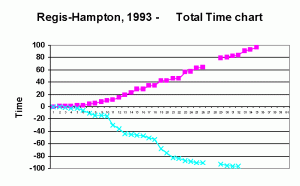
<p> White’s total elapsed time is shown above, and Black’s
below; control at 40 moves in 100 minutes. White lost on time at
move 39.</p>
<p> This is the only game I have ever lost on time, and some
of the reasons are to be found in the notes. It was quite in
Krogius’ class of <strong><em>doubts linked to the earlier course
of the game</em></strong>.</p>
<p> </p>
<p> But on the graph you can also see some interesting
features of the use of time: Black having some periods of slow
play, followed by fast play, whereas White’s use is much more even
– however, White was unable to speed up at the end of the game when
approaching the time control. It may be the ideal style is more
even than Black’s and less even than White’s!</p>
<hr />
<h2><a name=”RTFToC28″ id=”RTFToC28″>C2. Tal-Bronstein 1960 (Game
6)</a></h2>
<img alt=”[Graph of Clock Times (2)]” src=”/wp/chessx/clock2.gif” />
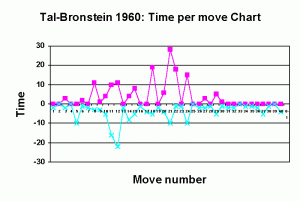
<p><em>This chart shows the time taken for each move rather
than total time, and is taken from the Furstenburg/Bronstein title
“<strong>The Sorcerer’s Apprentice</strong>”. White above the line
and Black below. Who won?</em></p>
<p><em>”…Tal played the first seven moves with great
confidence, accepting my Pawn sacrifice. With his next five moves
he tried to justify his decision.”</em></p>
<p><em>”With hindsight one can see that from moves 18 to 24
Tal used a lot of time, trying to reduce the pressure of the Black
pieces, but it was in vain. It would have been better to use this
amount of time, about one hour, to play the opening more
carefully.”</em></p>
<p><em>”This is only one example and the reader who is
interested in this aspect of chess should start recording times; it
might well be that his chess improves immediately.”</em></p>
<p> </p>
<hr />
<h2><a name=”RTFToC29″ id=”RTFToC29″>C3. Botvinnik-Tal 1960 (Game
7)</a></h2>
<img alt=”[Graph of Clock Times (3)]” src=”/wp/chessx/clock3.gif” />
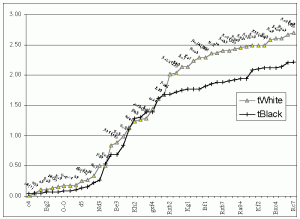
<p> Move by move, with notes by Tal:</p>
<p> W13: “The text move is the most precise, but the time
spent in thinking about it proved that Botvinnik had not played
competitively for some time. Why was it necessary to waste ten
minutes out of an allotted two and one-half hours to play the most
evident and surely the strongest continuation of the previous
move?”</p>
<p> </p>
<p> B14: “Black took a long time to choose which plan he
would use in the middle game.”</p>
<p> B18: “A rather long think for this move – sixteen
minutes. Black was calculating whether or not he should temporarily
pass on his idea and carry it our later.”</p>
<p> B23: “It is interesting that Black spent fifteen minutes
thinking about the move that immediately followed the piece
sacrifice. … This is but a confirmation, if it can be
expressed this way, of an intuitive sacrifice, a confirmation of
the fact that Black did not calculate all of the variations
beginning with the sacrifice and ending with mate.”</p>
<p> B28: “(After disturbance by spectators) I consciously
chose the less strong but safer continuation.”</p>
<p> B36: “Beginning with the 26th move, Black has been
playing lightning chess.”</p>
<p> B41: “Forty moves had been made but the opponents
remained in their places. Obviously, Botvinnik considered that
since Black was playing at such a rapid speed, he must have made a
mistake somewhere, and as for me, I was still full of energy.”</p>
<hr />
<h2><a name=”RTFToC30″ id=”RTFToC30″>D. References</a></h2>
FURSTENBURG/BRONSTEIN – The Sorcerer’s Apprentice.
<p> KROGIUS – Psychology in Chess.</p>
<p> TAL – Tal-Botvinnik 1960: Match for the World
Championship 1960.</p>
<p> WEBB – Chess For Tigers.</p>
<hr />
<h5><a name=”RTFToC31″ id=”RTFToC31″>Game 1: (59) Korchnoi – Suetin
[C83] Moscow (XXVII USSR Ch.), 1960</a></h5>
<strong>1.e4 e5 2.Nf3 Nc6 3.Bb5 a6 4.Ba4 Nf6 5.0-0 Nxe4 6.d4 b5
7.Bb3 d5 8.dxe5 Be6 9.Qe2 Be7 10.c3 0-0 11.Nd4 Qd7 12.f3 Nc5 13.Bc2
f6 14.exf6 Bxf6 15.Nxe6 Qxe6 16.Qxe6+ Nxe6 17.Bb3 Rad8 18.Rd1 Ne7
19.Nd2 Kf7 20.Rf1 c5u</strong>
<p class=”chessboard”><img alt=”+—————–+” src=”/wp/chessx/tx.gif” /><br />
<img alt=”|” src=”/wp/chessx/lx.gif” /><img alt=”.” src=
“/wp/chessx/w.gif” /><img alt=”+” src=”/wp/chessx/b.gif” /><img alt=”.” src=
“/wp/chessx/w.gif” /><img alt=”4″ src=”/wp/chessx/brd.gif” /><img alt=”.”
src=”/wp/chessx/w.gif” /><img alt=”4″ src=”/wp/chessx/brd.gif” /><img alt=”.”
src=”/wp/chessx/w.gif” /><img alt=”+” src=”/wp/chessx/b.gif” /><img alt=”|”
src=”/wp/chessx/rx.gif” /><br />
<img alt=”|” src=”/wp/chessx/lx.gif” /><img alt=”+” src=
“/wp/chessx/b.gif” /><img alt=”.” src=”/wp/chessx/w.gif” /><img alt=”+” src=
“/wp/chessx/b.gif” /><img alt=”.” src=”/wp/chessx/w.gif” /><img alt=”h” src=
“/wp/chessx/bnd.gif” /><img alt=”k” src=”/wp/chessx/bkl.gif” /><img alt=”0″
src=”/wp/chessx/bpd.gif” /><img alt=”p” src=”/wp/chessx/bpl.gif” /><img alt=
“|” src=”/wp/chessx/rx.gif” /><br />
<img alt=”|” src=”/wp/chessx/lx.gif” /><img alt=”p” src=
“/wp/chessx/bpl.gif” /><img alt=”+” src=”/wp/chessx/b.gif” /><img alt=”.”
src=”/wp/chessx/w.gif” /><img alt=”+” src=”/wp/chessx/b.gif” /><img alt=”n”
src=”/wp/chessx/bnl.gif” /><img alt=”g” src=”/wp/chessx/bbd.gif” /><img alt=
“.” src=”/wp/chessx/w.gif” /><img alt=”+” src=”/wp/chessx/b.gif” /><img alt=
“|” src=”/wp/chessx/rx.gif” /><br />
<img alt=”|” src=”/wp/chessx/lx.gif” /><img alt=”+” src=
“/wp/chessx/b.gif” /><img alt=”p” src=”/wp/chessx/bpl.gif” /><img alt=”0″
src=”/wp/chessx/bpd.gif” /><img alt=”p” src=”/wp/chessx/bpl.gif” /><img alt=
“+” src=”/wp/chessx/b.gif” /><img alt=”.” src=”/wp/chessx/w.gif” /><img alt=
“+” src=”/wp/chessx/b.gif” /><img alt=”.” src=”/wp/chessx/w.gif” /><img alt=
“|” src=”/wp/chessx/rx.gif” /><br />
<img alt=”|” src=”/wp/chessx/lx.gif” /><img alt=”.” src=
“/wp/chessx/w.gif” /><img alt=”+” src=”/wp/chessx/b.gif” /><img alt=”.” src=
“/wp/chessx/w.gif” /><img alt=”+” src=”/wp/chessx/b.gif” /><img alt=”.” src=
“/wp/chessx/w.gif” /><img alt=”+” src=”/wp/chessx/b.gif” /><img alt=”.” src=
“/wp/chessx/w.gif” /><img alt=”+” src=”/wp/chessx/b.gif” /><img alt=”|” src=
“/wp/chessx/rx.gif” /><br />
<img alt=”|” src=”/wp/chessx/lx.gif” /><img alt=”+” src=
“/wp/chessx/b.gif” /><img alt=”B” src=”/wp/chessx/wbl.gif” /><img alt=”)”
src=”/wp/chessx/wpd.gif” /><img alt=”.” src=”/wp/chessx/w.gif” /><img alt=”+”
src=”/wp/chessx/b.gif” /><img alt=”P” src=”/wp/chessx/wpl.gif” /><img alt=”+”
src=”/wp/chessx/b.gif” /><img alt=”.” src=”/wp/chessx/w.gif” /><img alt=”|”
src=”/wp/chessx/rx.gif” /><br />
<img alt=”|” src=”/wp/chessx/lx.gif” /><img alt=”P” src=
“/wp/chessx/wpl.gif” /><img alt=”)” src=”/wp/chessx/wpd.gif” /><img alt=”.”
src=”/wp/chessx/w.gif” /><img alt=”H” src=”/wp/chessx/wnd.gif” /><img alt=”.”
src=”/wp/chessx/w.gif” /><img alt=”+” src=”/wp/chessx/b.gif” /><img alt=”P”
src=”/wp/chessx/wpl.gif” /><img alt=”)” src=”/wp/chessx/wpd.gif” /><img alt=
“|” src=”/wp/chessx/rx.gif” /><br />
<img alt=”|” src=”/wp/chessx/lx.gif” /><img alt=”$” src=
“/wp/chessx/wrd.gif” /><img alt=”.” src=”/wp/chessx/w.gif” /><img alt=”G”
src=”/wp/chessx/wbd.gif” /><img alt=”.” src=”/wp/chessx/w.gif” /><img alt=”+”
src=”/wp/chessx/b.gif” /><img alt=”R” src=”/wp/chessx/wrl.gif” /><img alt=”I”
src=”/wp/chessx/wkd.gif” /><img alt=”.” src=”/wp/chessx/w.gif” /><img alt=”|”
src=”/wp/chessx/rx.gif” /><br />
<img alt=”+—————–+” src=”/wp/chessx/bx.gif” /></p><p>
Suetin has gained the advantage and steadily increases the
pressure. Korchnoi was able to divert his opponent from the
measured tempo if his play only by provoking his own time
trouble.</p>
<p><strong>21.f4 c4 22.Bd1 Nc6 23.Nf3 d4 24.Ng5+ Bxg5
25.fxg5+ Ke7 26.Re1 Kd6 27.cxd4 Nexd4 28.Bd2 Rde8 29.Rc1 Kd5 30.b3
Rxe1+ 31.Bxe1 Ne5 32.bxc4+ bxc4 33.Rb1 Rc8 34.Bc3 Nb5 35.Ba1 c3
36.a4 Nd6 37.Bb3+ Ke4 38.Re1+ Kf5 39.Bc2+ Ke6 40.Bb3+ Kf5 41.Bc2+
Ke6 42.Re3 Ndc4 43.Rxc3 Rd8 44.h3 g6 45.Bb3 Kf5 46.Kh2 Rc8 47.Rc2
Rc6 48.Re2 Rb6 49.Bc2+ Ke6 50.Bd4 Rd6 51.Bc3 Rb6 52.Kg3 Kd5 53.Kf4
Nc6 54.Re1 Rb7 55.Be4+ Kc5 56.Rc1 Rb3 57.Bg7 Nb4 58.Bf8+ Kd4
59.Rd1+ Nd3+ 60.Rxd3+ Rxd3 61.Bg7+ 1-0</strong></p>
<p> Suetin incorrectly believed that he had the chance of an
early win, began to hurry, committed some serious errors and
lost.This game decided first place in the championship.</p>
<hr />
<h5><a name=”RTFToC32″ id=”RTFToC32″>Game 2: Regis,D (1935) –
Hampton,M (1900) [E91]</a></h5>
Clock control: Devon vs. Wilts devon vs. wilts, 1993
<p><strong>1.e4 0m 1…g6 0m 2.d4 1m 2…Bg7 0m 3.c4
1m</strong></p>
<p> Black was visibly upset by this move.</p>
<p> I know from playing the Modern myself that few 1. e4
players will transfer to a Queen’s-side opening, but that’s always
been where my heart is.</p>
<p><strong>3…d6</strong> 1m <strong>4.Nc3</strong> 1m
<strong>4…Nf6</strong> 2mThe game is now more or less a King’s
Indian… <em>[4…Nc6 Keeps in independent ‘Modern’
lines.]</em></p>
<p><strong>5.Be2</strong> 2m <strong>5…0-0</strong> 2m
<strong>6.Nf3</strong> 2m <strong>6…c5</strong> 6m</p>
<p> …or a Benoni. <em>[6…e5 is the King’s
Indian]</em></p>
<p><strong>7.d5</strong> 5m <strong>7…Bg4</strong> 10m
<strong>8.Nd2</strong> 6mOver-eager.In any event, Black now starts
a phase of thinking for a long while over his moves.</p>
<p><em>[8.Ng1 Bxe2 9.Ngxe2]</em></p>
<p><strong>8…Bxe2</strong> 14m <strong>9.Qxe2</strong> 8m
<strong>9…Nfd7</strong> 14m <strong>10.0-0</strong> 10m
<strong>10…Na6</strong> 15m <strong>11.f4</strong> 11m
<strong>11…Qa5</strong> 30m <strong>12.Nf3</strong> 15m</p>
<p> I was feeling quite pleased here: that I had both a chess
and a psychological initiative out of the opening. I don’t think I
have played Benonis any more often than my opponent but have looked
at this type of position and felt at ease with it.
<strong>12…Nc7</strong> 36m</p>
<p><em>[12…Bxc3 13.bxc3 Qxc3 14.Bb2 Qa5 15.e5]</em></p>
<p><strong>13.e5</strong> 20m <strong>13…a6</strong> 44m
<strong>14.Bd2</strong> 23m <strong>14…Qb6</strong> 45m
<strong>15.e6</strong> 29m looks good but perhaps I was not
sufficiently developed for this…</p>
<p><em>[15.b3]</em></p>
<p><strong>15…fxe6</strong> 46m <strong>16.dxe6</strong>
29m <strong>16…Nf6</strong> 47m</p>
<p> Black now has another long thinking phase, which leaves
him in time trouble for the rest of the game.
<strong>17.Ng5</strong> 35m</p>
<p><em>[17.Rae1 or 17 b3 17…Qxb2 18.Rb1 Qc2 19.Rxb7 Nfe8
20.Rc1 Qf5 21.Nd5]</em></p>
<p><strong>17…d5</strong> 51m <strong>18.cxd5</strong> 35m
<strong>18…Nfxd5</strong> 53m <strong>19.Qf3</strong> 42m
<strong>19…Nxc3</strong> 68m <strong>20.Bxc3</strong> 43m
<strong>20…Bxc3</strong> 75m <strong>21.bxc3</strong> 46m
<em>[21.Qxc3 Rf6 22.Qh3 h5 23.f5 c4+ 24.Kh1 Raf8 25.Nf7]</em>
<strong>21…c4+</strong> 83m <strong>22.Kh1</strong> 46m
<strong>22…h6</strong> 84m <strong>23.Nf7</strong> 56m
<strong>23…Nxe6</strong> 87m <em>[23…Kg7 24.f5]</em>
<strong>24.Nxh6+</strong> 58m <strong>24…Kh7</strong> 88m
<strong>25.f5</strong> 63m</p>
<p> [25.Qh3 Nxf4 26.Rxf4 Rxf4 27.Nf7+ <em>(27.Re1 Kg7 28.Ng4
Rf7 29.Qh6+ Kg8-+;</em></p>
<p><em>27.Nf5+ Kg8 28.Nxe7+ Kg7 29.Nd5 Qb2 30.Rd1u)</em>
27…Kg8 28.Qh8+ Kxf7[[threesuperior]] 29.Qxa8]</p>
<p><strong>25…Kxh6</strong> 91m <strong>26.Qh3+</strong>
64m <strong>26…Kg7</strong> 91m <strong>27.fxe6</strong> ?m saves
the pawn but now Black has a strong initiative.</p>
<p> White now starts to consume time in great forkfuls: I
remember finding it very hard to forget the earlier part of the
game where I thought I had done enough to win, and couldn’t get on
and defend.</p>
<p><strong>27…Rxf1+</strong> m <strong>28.Rxf1</strong> ?m
<strong>28…Rf8</strong> m <strong>29.Rg1</strong> 79m <em>[29.Re1
Qf2]</em> <strong>29…Rf2</strong> 93m <strong>30.Qh4</strong> 81m
<strong>30…Qc5</strong> 95m <strong>31.a4</strong> 83m
<strong>31…b5</strong> 96m <strong>32.a5</strong> 84m which made
me think …b5 was wrong <strong>32…Re2</strong> 97m
<strong>33.Re1</strong> 91m <strong>33…Rf2</strong> m
<strong>34.h3</strong> 93m <strong>34…Rf6</strong> m
<strong>35.Qe4</strong> 96m <strong>35…Qf2</strong> m
<strong>36.Rg1</strong> ?m <em>[36.Qe5 Qf5]</em>
<strong>36…Qf5</strong> m <strong>37.Qb7</strong> ?m
<strong>37…Rxe6</strong> m <strong>38.Rd1</strong> ?m
<strong>38…Qe5</strong> m <strong>39.Qd7</strong> ?m
<strong>39…Qe2</strong> m <strong>White lost on time</strong>; I
had even put 36…Qf5 down as a White move and was one out!
<em>[39…Qe2 40.Qd4+]</em> <strong>0-1</strong></p>
<hr />
<h5><a name=”RTFToC33″ id=”RTFToC33″>Game 3: Botvinnik ,M – Tal ,M
[E10]: Match, Moscow (Russia) Match, Moscow (Russia) (8),
1960</a></h5>
<strong>1.d4 Nf6 2.c4 e6 3.Nf3 c5 4.d5 exd5 5.cxd5 g6 6.Nc3 Bg7
7.Bg5 0-0 8.e3 Re8 9.Nd2 d6 10.Be2 a6 11.a4 Nbd7 12.0-0 Qc7 13.Qc2
Nb6 14.Bf3 c4 15.Bxf6 Bxf6 16.a5 Nd7 17.Nce4 Be5 18.Qxc4 Qd8 19.Qa2
f5 20.Nc3 g5 21.Nc4 g4 22.Be2 Qf6 23.Na4 Kh8 24.g3 h5 25.f4 Bd4
26.Qa3 Rb8 27.Nab6 h4 28.Rad1 Bxb6 29.axb6 Nc5 30.gxh4 Bd7 31.Qc3
Qxc3 32.bxc3 Bb5 33.Rfe1 Ne4</strong>
<p class=”chessboard”><img alt=”+—————–+” src=”/wp/chessx/tx.gif” /><br />
<img alt=”|” src=”/wp/chessx/lx.gif” /><img alt=”.” src=
“/wp/chessx/w.gif” /><img alt=”4″ src=”/wp/chessx/brd.gif” /><img alt=”.”
src=”/wp/chessx/w.gif” /><img alt=”+” src=”/wp/chessx/b.gif” /><img alt=”r”
src=”/wp/chessx/brl.gif” /><img alt=”+” src=”/wp/chessx/b.gif” /><img alt=”.”
src=”/wp/chessx/w.gif” /><img alt=”i” src=”/wp/chessx/bkd.gif” /><img alt=”|”
src=”/wp/chessx/rx.gif” /><br />
<img alt=”|” src=”/wp/chessx/lx.gif” /><img alt=”+” src=
“/wp/chessx/b.gif” /><img alt=”p” src=”/wp/chessx/bpl.gif” /><img alt=”+”
src=”/wp/chessx/b.gif” /><img alt=”.” src=”/wp/chessx/w.gif” /><img alt=”+”
src=”/wp/chessx/b.gif” /><img alt=”.” src=”/wp/chessx/w.gif” /><img alt=”+”
src=”/wp/chessx/b.gif” /><img alt=”.” src=”/wp/chessx/w.gif” /><img alt=”|”
src=”/wp/chessx/rx.gif” /><br />
<img alt=”|” src=”/wp/chessx/lx.gif” /><img alt=”p” src=
“/wp/chessx/bpl.gif” /><img alt=”)” src=”/wp/chessx/wpd.gif” /><img alt=”.”
src=”/wp/chessx/w.gif” /><img alt=”0″ src=”/wp/chessx/bpd.gif” /><img alt=”.”
src=”/wp/chessx/w.gif” /><img alt=”+” src=”/wp/chessx/b.gif” /><img alt=”.”
src=”/wp/chessx/w.gif” /><img alt=”+” src=”/wp/chessx/b.gif” /><img alt=”|”
src=”/wp/chessx/rx.gif” /><br />
<img alt=”|” src=”/wp/chessx/lx.gif” /><img alt=”+” src=
“/wp/chessx/b.gif” /><img alt=”b” src=”/wp/chessx/bbl.gif” /><img alt=”+”
src=”/wp/chessx/b.gif” /><img alt=”P” src=”/wp/chessx/wpl.gif” /><img alt=”+”
src=”/wp/chessx/b.gif” /><img alt=”p” src=”/wp/chessx/bpl.gif” /><img alt=”+”
src=”/wp/chessx/b.gif” /><img alt=”.” src=”/wp/chessx/w.gif” /><img alt=”|”
src=”/wp/chessx/rx.gif” /><br />
<img alt=”|” src=”/wp/chessx/lx.gif” /><img alt=”.” src=
“/wp/chessx/w.gif” /><img alt=”+” src=”/wp/chessx/b.gif” /><img alt=”N” src=
“/wp/chessx/wnl.gif” /><img alt=”+” src=”/wp/chessx/b.gif” /><img alt=”n”
src=”/wp/chessx/bnl.gif” /><img alt=”)” src=”/wp/chessx/wpd.gif” /><img alt=
“p” src=”/wp/chessx/bpl.gif” /><img alt=”)” src=
“/wp/chessx/wpd.gif” /><img alt=”|” src=”/wp/chessx/rx.gif” /><br />
<img alt=”|” src=”/wp/chessx/lx.gif” /><img alt=”+” src=
“/wp/chessx/b.gif” /><img alt=”.” src=”/wp/chessx/w.gif” /><img alt=”)” src=
“/wp/chessx/wpd.gif” /><img alt=”.” src=”/wp/chessx/w.gif” /><img alt=”)”
src=”/wp/chessx/wpd.gif” /><img alt=”.” src=”/wp/chessx/w.gif” /><img alt=”+”
src=”/wp/chessx/b.gif” /><img alt=”.” src=”/wp/chessx/w.gif” /><img alt=”|”
src=”/wp/chessx/rx.gif” /><br />
<img alt=”|” src=”/wp/chessx/lx.gif” /><img alt=”.” src=
“/wp/chessx/w.gif” /><img alt=”+” src=”/wp/chessx/b.gif” /><img alt=”.” src=
“/wp/chessx/w.gif” /><img alt=”+” src=”/wp/chessx/b.gif” /><img alt=”B” src=
“/wp/chessx/wbl.gif” /><img alt=”+” src=”/wp/chessx/b.gif” /><img alt=”.”
src=”/wp/chessx/w.gif” /><img alt=”)” src=”/wp/chessx/wpd.gif” /><img alt=”|”
src=”/wp/chessx/rx.gif” /><br />
<img alt=”|” src=”/wp/chessx/lx.gif” /><img alt=”+” src=
“/wp/chessx/b.gif” /><img alt=”.” src=”/wp/chessx/w.gif” /><img alt=”+” src=
“/wp/chessx/b.gif” /><img alt=”R” src=”/wp/chessx/wrl.gif” /><img alt=”$”
src=”/wp/chessx/wrd.gif” /><img alt=”.” src=”/wp/chessx/w.gif” /><img alt=”I”
src=”/wp/chessx/wkd.gif” /><img alt=”.” src=”/wp/chessx/w.gif” /><img alt=”|”
src=”/wp/chessx/rx.gif” /><br />
<img alt=”+—————–+” src=”/wp/chessx/bx.gif” /></p><p>
<strong>34.Rc1 Rbc8??</strong> “<em>I made the last move
instantaneously – as if seized by the time pressure of my opponent.
I had formerly seen that I would win the exchange, but I had but to
think a little; then I would have come up with the absolutely
correct idea: the other Rook must go to c8 (winning the exchange
but keeping the b7 Pawn</em>).” – TAL</p>
<p> [“Here it is: the hypnotic power of ‘natural’ moves!” –
Krogius]</p>
<p><em>[34…Rec8]</em></p>
<p><strong>35.Na5 Bxe2 36.Rxe2 Nxc3</strong> “<em>It could
be noticed from my opponent’s expression that he had been rather
surprised by the unexpected turn of events, but in spite of intense
time pressure he successfully responded to the reversal of the
conditions and immediately found the best continuation</em>.” – Tal
<strong>37.Rxc3!</strong></p>
<p><em>[37.Ree1 Ne2+]</em></p>
<p><strong>37…Rxc3 38.Nxb7</strong> “<em>Black decided he
still had chances to win</em>…” – Tal
<strong>38…Rcxe3</strong></p>
<p><em>[38…Rexe3 is given in some sources]</em></p>
<p><strong>39.Rxe3 Rxe3 40.Nxd6 Rd3?</strong></p>
<p class=”chessboard”><img alt=”+—————–+” src=”/wp/chessx/tx.gif” /><br />
<img alt=”|” src=”/wp/chessx/lx.gif” /><img alt=”.” src=
“/wp/chessx/w.gif” /><img alt=”+” src=”/wp/chessx/b.gif” /><img alt=”.” src=
“/wp/chessx/w.gif” /><img alt=”+” src=”/wp/chessx/b.gif” /><img alt=”.” src=
“/wp/chessx/w.gif” /><img alt=”+” src=”/wp/chessx/b.gif” /><img alt=”.” src=
“/wp/chessx/w.gif” /><img alt=”i” src=”/wp/chessx/bkd.gif” /><img alt=”|”
src=”/wp/chessx/rx.gif” /><br />
<img alt=”|” src=”/wp/chessx/lx.gif” /><img alt=”+” src=
“/wp/chessx/b.gif” /><img alt=”.” src=”/wp/chessx/w.gif” /><img alt=”+” src=
“/wp/chessx/b.gif” /><img alt=”.” src=”/wp/chessx/w.gif” /><img alt=”+” src=
“/wp/chessx/b.gif” /><img alt=”.” src=”/wp/chessx/w.gif” /><img alt=”+” src=
“/wp/chessx/b.gif” /><img alt=”.” src=”/wp/chessx/w.gif” /><img alt=”|” src=
“/wp/chessx/rx.gif” /><br />
<img alt=”|” src=”/wp/chessx/lx.gif” /><img alt=”p” src=
“/wp/chessx/bpl.gif” /><img alt=”)” src=”/wp/chessx/wpd.gif” /><img alt=”.”
src=”/wp/chessx/w.gif” /><img alt=”H” src=”/wp/chessx/wnd.gif” /><img alt=”.”
src=”/wp/chessx/w.gif” /><img alt=”+” src=”/wp/chessx/b.gif” /><img alt=”.”
src=”/wp/chessx/w.gif” /><img alt=”+” src=”/wp/chessx/b.gif” /><img alt=”|”
src=”/wp/chessx/rx.gif” /><br />
<img alt=”|” src=”/wp/chessx/lx.gif” /><img alt=”+” src=
“/wp/chessx/b.gif” /><img alt=”.” src=”/wp/chessx/w.gif” /><img alt=”+” src=
“/wp/chessx/b.gif” /><img alt=”P” src=”/wp/chessx/wpl.gif” /><img alt=”+”
src=”/wp/chessx/b.gif” /><img alt=”p” src=”/wp/chessx/bpl.gif” /><img alt=”+”
src=”/wp/chessx/b.gif” /><img alt=”.” src=”/wp/chessx/w.gif” /><img alt=”|”
src=”/wp/chessx/rx.gif” /><br />
<img alt=”|” src=”/wp/chessx/lx.gif” /><img alt=”.” src=
“/wp/chessx/w.gif” /><img alt=”+” src=”/wp/chessx/b.gif” /><img alt=”.” src=
“/wp/chessx/w.gif” /><img alt=”+” src=”/wp/chessx/b.gif” /><img alt=”.” src=
“/wp/chessx/w.gif” /><img alt=”)” src=”/wp/chessx/wpd.gif” /><img alt=”p”
src=”/wp/chessx/bpl.gif” /><img alt=”)” src=”/wp/chessx/wpd.gif” /><img alt=
“|” src=”/wp/chessx/rx.gif” /><br />
<img alt=”|” src=”/wp/chessx/lx.gif” /><img alt=”+” src=
“/wp/chessx/b.gif” /><img alt=”.” src=”/wp/chessx/w.gif” /><img alt=”+” src=
“/wp/chessx/b.gif” /><img alt=”r” src=”/wp/chessx/brl.gif” /><img alt=”+”
src=”/wp/chessx/b.gif” /><img alt=”.” src=”/wp/chessx/w.gif” /><img alt=”+”
src=”/wp/chessx/b.gif” /><img alt=”.” src=”/wp/chessx/w.gif” /><img alt=”|”
src=”/wp/chessx/rx.gif” /><br />
<img alt=”|” src=”/wp/chessx/lx.gif” /><img alt=”.” src=
“/wp/chessx/w.gif” /><img alt=”+” src=”/wp/chessx/b.gif” /><img alt=”.” src=
“/wp/chessx/w.gif” /><img alt=”+” src=”/wp/chessx/b.gif” /><img alt=”.” src=
“/wp/chessx/w.gif” /><img alt=”+” src=”/wp/chessx/b.gif” /><img alt=”.” src=
“/wp/chessx/w.gif” /><img alt=”)” src=”/wp/chessx/wpd.gif” /><img alt=”|”
src=”/wp/chessx/rx.gif” /><br />
<img alt=”|” src=”/wp/chessx/lx.gif” /><img alt=”+” src=
“/wp/chessx/b.gif” /><img alt=”.” src=”/wp/chessx/w.gif” /><img alt=”+” src=
“/wp/chessx/b.gif” /><img alt=”.” src=”/wp/chessx/w.gif” /><img alt=”+” src=
“/wp/chessx/b.gif” /><img alt=”.” src=”/wp/chessx/w.gif” /><img alt=”I” src=
“/wp/chessx/wkd.gif” /><img alt=”.” src=”/wp/chessx/w.gif” /><img alt=”|”
src=”/wp/chessx/rx.gif” /><br />
<img alt=”+—————–+” src=”/wp/chessx/bx.gif” /></p><p>
“<em>Adjourned. At first I was extremely optimistic</em>…” –
Tal</p>
<p> [40…Kg8 “<em>was better, but Black was under the
erroneous impression that all was in order</em>”]</p>
<p><strong>41.Nf7+</strong> (sealed) “<em>I immediately
resigned</em>.” <strong>1-0</strong></p>
<p> [41.b7 “<em>during the game I was convinced that this
guaranteed a win for Black</em>” 41…Rb3 42.Nf7+ Kh7! 43.Nd8 a5
44.d6 a4 45.d7 a3 46.Ne6 a2-+;</p>
<p> 41.Nf7+! Kg7 but now <em>(41…Kh7? 42.d6!)</em> 42.b7
Rb3 43.Nd8 a5 44.d6 a4 45.d7 a3 46.Ne6+!+- “<em>Upon returning home
my trainer and I had only to investigate the subtleties of this
rather simple analysis. We began to play through the game and in
the process of analysis we simultaneously we discovered that Black
could have forced his win on his 34th move. There was nothing to
say and we didn’t sleep a wink the whole night</em>.”]</p>
<hr />
<h5><a name=”RTFToC34″ id=”RTFToC34″>Game 4: Gligoric,S – Tal,M
[A78] Yugoslavia ct Yugoslavia ct (4), 1959</a></h5>
<strong>1.d4 Nf6 2.c4 c5 3.d5 e6 4.Nc3 exd5 5.cxd5 d6 6.e4 g6 7.Nf3
Bg7 8.Be2 0-0 9.0-0 Re8 10.Nd2 Na6 11.Rb1 Bd7 12.Re1 Rb8 13.b3 b5
14.Bb2 Nc7 15.Qc2 Qe7 16.Nd1 Bh6 17.f3 Nh5 18.Nf1 Nxd5 19.exd5 Bf5
20.Qc3 Bg7 21.Qc1 Bxb1 22.Bxg7 Kxg7 23.Qxb1 Nf4 24.Nfe3
Qe5</strong>
<p class=”chessboard”><img alt=”+—————–+” src=”/wp/chessx/tx.gif” /><br />
<img alt=”|” src=”/wp/chessx/lx.gif” /><img alt=”.” src=
“/wp/chessx/w.gif” /><img alt=”4″ src=”/wp/chessx/brd.gif” /><img alt=”.”
src=”/wp/chessx/w.gif” /><img alt=”+” src=”/wp/chessx/b.gif” /><img alt=”r”
src=”/wp/chessx/brl.gif” /><img alt=”+” src=”/wp/chessx/b.gif” /><img alt=”.”
src=”/wp/chessx/w.gif” /><img alt=”+” src=”/wp/chessx/b.gif” /><img alt=”|”
src=”/wp/chessx/rx.gif” /><br />
<img alt=”|” src=”/wp/chessx/lx.gif” /><img alt=”0″ src=
“/wp/chessx/bpd.gif” /><img alt=”.” src=”/wp/chessx/w.gif” /><img alt=”+”
src=”/wp/chessx/b.gif” /><img alt=”.” src=”/wp/chessx/w.gif” /><img alt=”+”
src=”/wp/chessx/b.gif” /><img alt=”p” src=”/wp/chessx/bpl.gif” /><img alt=”i”
src=”/wp/chessx/bkd.gif” /><img alt=”p” src=”/wp/chessx/bpl.gif” /><img alt=
“|” src=”/wp/chessx/rx.gif” /><br />
<img alt=”|” src=”/wp/chessx/lx.gif” /><img alt=”.” src=
“/wp/chessx/w.gif” /><img alt=”+” src=”/wp/chessx/b.gif” /><img alt=”.” src=
“/wp/chessx/w.gif” /><img alt=”0″ src=”/wp/chessx/bpd.gif” /><img alt=”.”
src=”/wp/chessx/w.gif” /><img alt=”+” src=”/wp/chessx/b.gif” /><img alt=”p”
src=”/wp/chessx/bpl.gif” /><img alt=”+” src=”/wp/chessx/b.gif” /><img alt=”|”
src=”/wp/chessx/rx.gif” /><br />
<img alt=”|” src=”/wp/chessx/lx.gif” /><img alt=”+” src=
“/wp/chessx/b.gif” /><img alt=”p” src=”/wp/chessx/bpl.gif” /><img alt=”0″
src=”/wp/chessx/bpd.gif” /><img alt=”P” src=”/wp/chessx/wpl.gif” /><img alt=
“1” src=”/wp/chessx/bqd.gif” /><img alt=”.” src=
“/wp/chessx/w.gif” /><img alt=”+” src=”/wp/chessx/b.gif” /><img alt=”.” src=
“/wp/chessx/w.gif” /><img alt=”|” src=”/wp/chessx/rx.gif” /><br />
<img alt=”|” src=”/wp/chessx/lx.gif” /><img alt=”.” src=
“/wp/chessx/w.gif” /><img alt=”+” src=”/wp/chessx/b.gif” /><img alt=”.” src=
“/wp/chessx/w.gif” /><img alt=”+” src=”/wp/chessx/b.gif” /><img alt=”.” src=
“/wp/chessx/w.gif” /><img alt=”h” src=”/wp/chessx/bnd.gif” /><img alt=”.”
src=”/wp/chessx/w.gif” /><img alt=”+” src=”/wp/chessx/b.gif” /><img alt=”|”
src=”/wp/chessx/rx.gif” /><br />
<img alt=”|” src=”/wp/chessx/lx.gif” /><img alt=”+” src=
“/wp/chessx/b.gif” /><img alt=”P” src=”/wp/chessx/wpl.gif” /><img alt=”+”
src=”/wp/chessx/b.gif” /><img alt=”.” src=”/wp/chessx/w.gif” /><img alt=”H”
src=”/wp/chessx/wnd.gif” /><img alt=”P” src=”/wp/chessx/wpl.gif” /><img alt=
“+” src=”/wp/chessx/b.gif” /><img alt=”.” src=”/wp/chessx/w.gif” /><img alt=
“|” src=”/wp/chessx/rx.gif” /><br />
<img alt=”|” src=”/wp/chessx/lx.gif” /><img alt=”P” src=
“/wp/chessx/wpl.gif” /><img alt=”+” src=”/wp/chessx/b.gif” /><img alt=”.”
src=”/wp/chessx/w.gif” /><img alt=”+” src=”/wp/chessx/b.gif” /><img alt=”B”
src=”/wp/chessx/wbl.gif” /><img alt=”+” src=”/wp/chessx/b.gif” /><img alt=”P”
src=”/wp/chessx/wpl.gif” /><img alt=”)” src=”/wp/chessx/wpd.gif” /><img alt=
“|” src=”/wp/chessx/rx.gif” /><br />
<img alt=”|” src=”/wp/chessx/lx.gif” /><img alt=”+” src=
“/wp/chessx/b.gif” /><img alt=”Q” src=”/wp/chessx/wql.gif” /><img alt=”+”
src=”/wp/chessx/b.gif” /><img alt=”N” src=”/wp/chessx/wnl.gif” /><img alt=”$”
src=”/wp/chessx/wrd.gif” /><img alt=”.” src=”/wp/chessx/w.gif” /><img alt=”I”
src=”/wp/chessx/wkd.gif” /><img alt=”.” src=”/wp/chessx/w.gif” /><img alt=”|”
src=”/wp/chessx/rx.gif” /><br />
<img alt=”+—————–+” src=”/wp/chessx/bx.gif” /></p><p>
Black has a small advantage, difficult to exploit with regular
means against an opponent with such a clear logical head.
<strong>25.Bxb5 Rxb5 26.Nf5+ gxf5!?</strong> Tal chooses a sharp
hazardous continuation, probably not the strongest but Gligoric
became confused, thought for a long while, got into time trouble,
made serious mistakes and lost.</p>
<p><em>[26…Qxf5 27.Qxf5 gxf5 28.Rxe8
Nxd5[[threesuperior]]]</em></p>
<p><strong>27.Rxe5 Rxe5 28.g3 Ne2+ 29.Kf2 Kg8
30.Ne3?</strong></p>
<p><em>[30.f4! Re8 31.Qxf5]</em></p>
<p><strong>30…Nd4 31.f4 Re4 32.g4!? Rxf4+ 33.Kg2 fxg4-+
34.Nc4 Nf3 35.Qc1 Rf6 36.Qe3 Kf8 37.Qe4 Rb8 38.Qxh7 Re8 39.Qh8+ Ke7
40.Qg7 Nh4+ 41.Kg1 Nf3+ 42.Kg2 Rg6 43.Qc3 Nd4 44.b4 Kf8 45.Ne3 g3
46.h3 Rf6 0-1</strong></p>
<hr />
<h5><a name=”RTFToC35″ id=”RTFToC35″>Game 5: Blackstock,L – Webb,S
[C09] Borehamwood, 1977</a></h5>
<strong>1.e4 e6 2.d4 d5 3.Nd2 c5 4.exd5 exd5 5.Ngf3 Nc6 6.Bb5 Bd6
7.dxc5 Bxc5 8.0-0 Nge7 9.Nb3 Bb6 10.Re1 0-0 11.Be3 Bf5 12.c3
Be4</strong>
<p class=”chessboard”><img alt=”+—————–+” src=”/wp/chessx/tx.gif” /><br />
<img alt=”|” src=”/wp/chessx/lx.gif” /><img alt=”r” src=
“/wp/chessx/brl.gif” /><img alt=”+” src=”/wp/chessx/b.gif” /><img alt=”.”
src=”/wp/chessx/w.gif” /><img alt=”1″ src=”/wp/chessx/bqd.gif” /><img alt=”.”
src=”/wp/chessx/w.gif” /><img alt=”4″ src=”/wp/chessx/brd.gif” /><img alt=”k”
src=”/wp/chessx/bkl.gif” /><img alt=”+” src=”/wp/chessx/b.gif” /><img alt=”|”
src=”/wp/chessx/rx.gif” /><br />
<img alt=”|” src=”/wp/chessx/lx.gif” /><img alt=”0″ src=
“/wp/chessx/bpd.gif” /><img alt=”p” src=”/wp/chessx/bpl.gif” /><img alt=”+”
src=”/wp/chessx/b.gif” /><img alt=”.” src=”/wp/chessx/w.gif” /><img alt=”h”
src=”/wp/chessx/bnd.gif” /><img alt=”p” src=”/wp/chessx/bpl.gif” /><img alt=
“0” src=”/wp/chessx/bpd.gif” /><img alt=”p” src=
“/wp/chessx/bpl.gif” /><img alt=”|” src=”/wp/chessx/rx.gif” /><br />
<img alt=”|” src=”/wp/chessx/lx.gif” /><img alt=”.” src=
“/wp/chessx/w.gif” /><img alt=”g” src=”/wp/chessx/bbd.gif” /><img alt=”n”
src=”/wp/chessx/bnl.gif” /><img alt=”+” src=”/wp/chessx/b.gif” /><img alt=”.”
src=”/wp/chessx/w.gif” /><img alt=”+” src=”/wp/chessx/b.gif” /><img alt=”.”
src=”/wp/chessx/w.gif” /><img alt=”+” src=”/wp/chessx/b.gif” /><img alt=”|”
src=”/wp/chessx/rx.gif” /><br />
<img alt=”|” src=”/wp/chessx/lx.gif” /><img alt=”+” src=
“/wp/chessx/b.gif” /><img alt=”B” src=”/wp/chessx/wbl.gif” /><img alt=”+”
src=”/wp/chessx/b.gif” /><img alt=”p” src=”/wp/chessx/bpl.gif” /><img alt=”+”
src=”/wp/chessx/b.gif” /><img alt=”.” src=”/wp/chessx/w.gif” /><img alt=”+”
src=”/wp/chessx/b.gif” /><img alt=”.” src=”/wp/chessx/w.gif” /><img alt=”|”
src=”/wp/chessx/rx.gif” /><br />
<img alt=”|” src=”/wp/chessx/lx.gif” /><img alt=”.” src=
“/wp/chessx/w.gif” /><img alt=”+” src=”/wp/chessx/b.gif” /><img alt=”.” src=
“/wp/chessx/w.gif” /><img alt=”+” src=”/wp/chessx/b.gif” /><img alt=”b” src=
“/wp/chessx/bbl.gif” /><img alt=”+” src=”/wp/chessx/b.gif” /><img alt=”.”
src=”/wp/chessx/w.gif” /><img alt=”+” src=”/wp/chessx/b.gif” /><img alt=”|”
src=”/wp/chessx/rx.gif” /><br />
<img alt=”|” src=”/wp/chessx/lx.gif” /><img alt=”+” src=
“/wp/chessx/b.gif” /><img alt=”N” src=”/wp/chessx/wnl.gif” /><img alt=”)”
src=”/wp/chessx/wpd.gif” /><img alt=”.” src=”/wp/chessx/w.gif” /><img alt=”G”
src=”/wp/chessx/wbd.gif” /><img alt=”N” src=”/wp/chessx/wnl.gif” /><img alt=
“+” src=”/wp/chessx/b.gif” /><img alt=”.” src=”/wp/chessx/w.gif” /><img alt=
“|” src=”/wp/chessx/rx.gif” /><br />
<img alt=”|” src=”/wp/chessx/lx.gif” /><img alt=”P” src=
“/wp/chessx/wpl.gif” /><img alt=”)” src=”/wp/chessx/wpd.gif” /><img alt=”.”
src=”/wp/chessx/w.gif” /><img alt=”+” src=”/wp/chessx/b.gif” /><img alt=”.”
src=”/wp/chessx/w.gif” /><img alt=”)” src=”/wp/chessx/wpd.gif” /><img alt=”P”
src=”/wp/chessx/wpl.gif” /><img alt=”)” src=”/wp/chessx/wpd.gif” /><img alt=
“|” src=”/wp/chessx/rx.gif” /><br />
<img alt=”|” src=”/wp/chessx/lx.gif” /><img alt=”$” src=
“/wp/chessx/wrd.gif” /><img alt=”.” src=”/wp/chessx/w.gif” /><img alt=”+”
src=”/wp/chessx/b.gif” /><img alt=”Q” src=”/wp/chessx/wql.gif” /><img alt=”$”
src=”/wp/chessx/wrd.gif” /><img alt=”.” src=”/wp/chessx/w.gif” /><img alt=”I”
src=”/wp/chessx/wkd.gif” /><img alt=”.” src=”/wp/chessx/w.gif” /><img alt=”|”
src=”/wp/chessx/rx.gif” /><br />
<img alt=”+—————–+” src=”/wp/chessx/bx.gif” /></p><p>
“A non-forcing position: there is little to choose between several
moves, and Black has such a wide choice of moves that it’s
impossible to analyse definite lines.”</p>
<p> “White thought for about half-an-hour here”.</p>
<p><strong>13.Bxb6 Qxb6 14.Nfd4</strong></p>
<p> “Again this took him a while – re-thinking what he’d
thought about on the previous move.”</p>
<p><strong>14…Nxd4 15.Nxd4 Nc6</strong></p>
<p><em>[15…a6 16.f3]</em></p>
<p><strong>16.Bxc6= bxc6 17.Qb3 Qc7</strong></p>
<p> “It’s better to keep the Queens on anyway, but this is
also leaves White without a clear plan.”</p>
<p> “White has used about on hour of his 1 hour 45 to reach
move 48″.</p>
<p><strong>18.Qa3 c5 19.Nb3 Rac8 20.Re2</strong></p>
<p class=”chessboard”><img alt=”+—————–+” src=”/wp/chessx/tx.gif” /><br />
<img alt=”|” src=”/wp/chessx/lx.gif” /><img alt=”.” src=
“/wp/chessx/w.gif” /><img alt=”+” src=”/wp/chessx/b.gif” /><img alt=”r” src=
“/wp/chessx/brl.gif” /><img alt=”+” src=”/wp/chessx/b.gif” /><img alt=”.”
src=”/wp/chessx/w.gif” /><img alt=”4″ src=”/wp/chessx/brd.gif” /><img alt=”k”
src=”/wp/chessx/bkl.gif” /><img alt=”+” src=”/wp/chessx/b.gif” /><img alt=”|”
src=”/wp/chessx/rx.gif” /><br />
<img alt=”|” src=”/wp/chessx/lx.gif” /><img alt=”0″ src=
“/wp/chessx/bpd.gif” /><img alt=”.” src=”/wp/chessx/w.gif” /><img alt=”1″
src=”/wp/chessx/bqd.gif” /><img alt=”.” src=”/wp/chessx/w.gif” /><img alt=”+”
src=”/wp/chessx/b.gif” /><img alt=”p” src=”/wp/chessx/bpl.gif” /><img alt=”0″
src=”/wp/chessx/bpd.gif” /><img alt=”p” src=”/wp/chessx/bpl.gif” /><img alt=
“|” src=”/wp/chessx/rx.gif” /><br />
<img alt=”|” src=”/wp/chessx/lx.gif” /><img alt=”.” src=
“/wp/chessx/w.gif” /><img alt=”+” src=”/wp/chessx/b.gif” /><img alt=”.” src=
“/wp/chessx/w.gif” /><img alt=”+” src=”/wp/chessx/b.gif” /><img alt=”.” src=
“/wp/chessx/w.gif” /><img alt=”+” src=”/wp/chessx/b.gif” /><img alt=”.” src=
“/wp/chessx/w.gif” /><img alt=”+” src=”/wp/chessx/b.gif” /><img alt=”|” src=
“/wp/chessx/rx.gif” /><br />
<img alt=”|” src=”/wp/chessx/lx.gif” /><img alt=”+” src=
“/wp/chessx/b.gif” /><img alt=”.” src=”/wp/chessx/w.gif” /><img alt=”0″ src=
“/wp/chessx/bpd.gif” /><img alt=”p” src=”/wp/chessx/bpl.gif” /><img alt=”+”
src=”/wp/chessx/b.gif” /><img alt=”.” src=”/wp/chessx/w.gif” /><img alt=”+”
src=”/wp/chessx/b.gif” /><img alt=”.” src=”/wp/chessx/w.gif” /><img alt=”|”
src=”/wp/chessx/rx.gif” /><br />
<img alt=”|” src=”/wp/chessx/lx.gif” /><img alt=”.” src=
“/wp/chessx/w.gif” /><img alt=”+” src=”/wp/chessx/b.gif” /><img alt=”.” src=
“/wp/chessx/w.gif” /><img alt=”+” src=”/wp/chessx/b.gif” /><img alt=”b” src=
“/wp/chessx/bbl.gif” /><img alt=”+” src=”/wp/chessx/b.gif” /><img alt=”.”
src=”/wp/chessx/w.gif” /><img alt=”+” src=”/wp/chessx/b.gif” /><img alt=”|”
src=”/wp/chessx/rx.gif” /><br />
<img alt=”|” src=”/wp/chessx/lx.gif” /><img alt=”!” src=
“/wp/chessx/wqd.gif” /><img alt=”N” src=”/wp/chessx/wnl.gif” /><img alt=”)”
src=”/wp/chessx/wpd.gif” /><img alt=”.” src=”/wp/chessx/w.gif” /><img alt=”+”
src=”/wp/chessx/b.gif” /><img alt=”.” src=”/wp/chessx/w.gif” /><img alt=”+”
src=”/wp/chessx/b.gif” /><img alt=”.” src=”/wp/chessx/w.gif” /><img alt=”|”
src=”/wp/chessx/rx.gif” /><br />
<img alt=”|” src=”/wp/chessx/lx.gif” /><img alt=”P” src=
“/wp/chessx/wpl.gif” /><img alt=”)” src=”/wp/chessx/wpd.gif” /><img alt=”.”
src=”/wp/chessx/w.gif” /><img alt=”+” src=”/wp/chessx/b.gif” /><img alt=”R”
src=”/wp/chessx/wrl.gif” /><img alt=”)” src=”/wp/chessx/wpd.gif” /><img alt=
“P” src=”/wp/chessx/wpl.gif” /><img alt=”)” src=
“/wp/chessx/wpd.gif” /><img alt=”|” src=”/wp/chessx/rx.gif” /><br />
<img alt=”|” src=”/wp/chessx/lx.gif” /><img alt=”$” src=
“/wp/chessx/wrd.gif” /><img alt=”.” src=”/wp/chessx/w.gif” /><img alt=”+”
src=”/wp/chessx/b.gif” /><img alt=”.” src=”/wp/chessx/w.gif” /><img alt=”+”
src=”/wp/chessx/b.gif” /><img alt=”.” src=”/wp/chessx/w.gif” /><img alt=”I”
src=”/wp/chessx/wkd.gif” /><img alt=”.” src=”/wp/chessx/w.gif” /><img alt=”|”
src=”/wp/chessx/rx.gif” /><br />
<img alt=”+—————–+” src=”/wp/chessx/bx.gif” /></p><p>
“It’s still very difficult for White to decide what he should be
doing, e.g. which file for which Rook? There’s not much to choose
between them, but it gives him a nice harmless way of using up
time.”</p>
<p><strong>20…Bf5! 21.Rae1 Be6</strong></p>
<p> “Good all round: securing the d-Pawn and prolonging the
position where White can’t decide what to do.”</p>
<p><strong>22.Rd2 h6!</strong></p>
<p> “Continuing to do nothing until he gets really short of
time… but a move like …Kh8 would have been a bit obvious!”</p>
<p><strong>23.Red1 Rfd8 24.h3</strong></p>
<p> “Les now has about 1 minute left for 24 moves, is
concentrating hard, and is ready to meet ‘nothing’ moves with
‘nothing’ replies – so now is the time to start doing
something.”</p>
<p><strong>24…Rd6 25.Qa4 Rb6 26.Nc1 Qb7</strong></p>
<p class=”chessboard”><img alt=”+—————–+” src=”/wp/chessx/tx.gif” /><br />
<img alt=”|” src=”/wp/chessx/lx.gif” /><img alt=”.” src=
“/wp/chessx/w.gif” /><img alt=”+” src=”/wp/chessx/b.gif” /><img alt=”r” src=
“/wp/chessx/brl.gif” /><img alt=”+” src=”/wp/chessx/b.gif” /><img alt=”.”
src=”/wp/chessx/w.gif” /><img alt=”+” src=”/wp/chessx/b.gif” /><img alt=”k”
src=”/wp/chessx/bkl.gif” /><img alt=”+” src=”/wp/chessx/b.gif” /><img alt=”|”
src=”/wp/chessx/rx.gif” /><br />
<img alt=”|” src=”/wp/chessx/lx.gif” /><img alt=”0″ src=
“/wp/chessx/bpd.gif” /><img alt=”q” src=”/wp/chessx/bql.gif” /><img alt=”+”
src=”/wp/chessx/b.gif” /><img alt=”.” src=”/wp/chessx/w.gif” /><img alt=”+”
src=”/wp/chessx/b.gif” /><img alt=”p” src=”/wp/chessx/bpl.gif” /><img alt=”0″
src=”/wp/chessx/bpd.gif” /><img alt=”.” src=”/wp/chessx/w.gif” /><img alt=”|”
src=”/wp/chessx/rx.gif” /><br />
<img alt=”|” src=”/wp/chessx/lx.gif” /><img alt=”.” src=
“/wp/chessx/w.gif” /><img alt=”4″ src=”/wp/chessx/brd.gif” /><img alt=”.”
src=”/wp/chessx/w.gif” /><img alt=”+” src=”/wp/chessx/b.gif” /><img alt=”b”
src=”/wp/chessx/bbl.gif” /><img alt=”+” src=”/wp/chessx/b.gif” /><img alt=”.”
src=”/wp/chessx/w.gif” /><img alt=”0″ src=”/wp/chessx/bpd.gif” /><img alt=”|”
src=”/wp/chessx/rx.gif” /><br />
<img alt=”|” src=”/wp/chessx/lx.gif” /><img alt=”+” src=
“/wp/chessx/b.gif” /><img alt=”.” src=”/wp/chessx/w.gif” /><img alt=”0″ src=
“/wp/chessx/bpd.gif” /><img alt=”p” src=”/wp/chessx/bpl.gif” /><img alt=”+”
src=”/wp/chessx/b.gif” /><img alt=”.” src=”/wp/chessx/w.gif” /><img alt=”+”
src=”/wp/chessx/b.gif” /><img alt=”.” src=”/wp/chessx/w.gif” /><img alt=”|”
src=”/wp/chessx/rx.gif” /><br />
<img alt=”|” src=”/wp/chessx/lx.gif” /><img alt=”Q” src=
“/wp/chessx/wql.gif” /><img alt=”+” src=”/wp/chessx/b.gif” /><img alt=”.”
src=”/wp/chessx/w.gif” /><img alt=”+” src=”/wp/chessx/b.gif” /><img alt=”.”
src=”/wp/chessx/w.gif” /><img alt=”+” src=”/wp/chessx/b.gif” /><img alt=”.”
src=”/wp/chessx/w.gif” /><img alt=”+” src=”/wp/chessx/b.gif” /><img alt=”|”
src=”/wp/chessx/rx.gif” /><br />
<img alt=”|” src=”/wp/chessx/lx.gif” /><img alt=”+” src=
“/wp/chessx/b.gif” /><img alt=”.” src=”/wp/chessx/w.gif” /><img alt=”)” src=
“/wp/chessx/wpd.gif” /><img alt=”.” src=”/wp/chessx/w.gif” /><img alt=”+”
src=”/wp/chessx/b.gif” /><img alt=”.” src=”/wp/chessx/w.gif” /><img alt=”+”
src=”/wp/chessx/b.gif” /><img alt=”P” src=”/wp/chessx/wpl.gif” /><img alt=”|”
src=”/wp/chessx/rx.gif” /><br />
<img alt=”|” src=”/wp/chessx/lx.gif” /><img alt=”P” src=
“/wp/chessx/wpl.gif” /><img alt=”)” src=”/wp/chessx/wpd.gif” /><img alt=”.”
src=”/wp/chessx/w.gif” /><img alt=”$” src=”/wp/chessx/wrd.gif” /><img alt=”.”
src=”/wp/chessx/w.gif” /><img alt=”)” src=”/wp/chessx/wpd.gif” /><img alt=”P”
src=”/wp/chessx/wpl.gif” /><img alt=”+” src=”/wp/chessx/b.gif” /><img alt=”|”
src=”/wp/chessx/rx.gif” /><br />
<img alt=”|” src=”/wp/chessx/lx.gif” /><img alt=”+” src=
“/wp/chessx/b.gif” /><img alt=”.” src=”/wp/chessx/w.gif” /><img alt=”H” src=
“/wp/chessx/wnd.gif” /><img alt=”R” src=”/wp/chessx/wrl.gif” /><img alt=”+”
src=”/wp/chessx/b.gif” /><img alt=”.” src=”/wp/chessx/w.gif” /><img alt=”I”
src=”/wp/chessx/wkd.gif” /><img alt=”.” src=”/wp/chessx/w.gif” /><img alt=”|”
src=”/wp/chessx/rx.gif” /><br />
<img alt=”+—————–+” src=”/wp/chessx/bx.gif” /></p><p>
<strong>27.b3? d4! 28.cxd4?</strong></p>
<p> With more time White might have found a better move. But
if he had played a better move here, Black had planned 28…Bxh3!
“which is impossible to meet with less than a minute for 20
moves”.</p>
<p><em>[28.b4!? dxc3 29.Rd8+ Rxd8 30.Rxd8+ Kh7 31.Qc2+ g6
32.Qxc3;</em></p>
<p><em>28.Qa3!?]</em></p>
<p><strong>28…Ra6 0-1</strong></p>
<hr />
<h5><a name=”RTFToC36″ id=”RTFToC36″>Game 6: Tal, Mikhail,
Bronstein, David, Baku ch-SU, 1961</a></h5>
<strong>1.e4</strong>{0m}<strong>d5</strong>{2m}<strong>2.exd5</strong>{0m}<strong>Nf6</strong>{0m}<strong>3.c4</strong>
{3m}<strong>c6</strong>{2m}<strong>4.d4</strong>{0m}<strong>cxd5</strong>{0m}<strong>5.Nc3</strong>
{0m}<strong>g6</strong>{10m}<strong>6.Qb3</strong>{2m}<strong>Bg7</strong>{1m}<strong>7.cxd5</strong>
{0m}<strong>O-O</strong>{2m}<strong>8.Nf3</strong>{11m}<strong>Nbd7</strong>{3m}<strong>9.Bg5</strong>
{1m}<strong>Nb6</strong>{3m}<strong>10.Bc4</strong>{4m}<strong>Bf5</strong>{5m}<strong>11.Rd1</strong>
{10m} <strong>Ne4!</strong> {16m} <strong>12. O-O</strong> {11m}
<strong>Nxc3</strong> {22m} <strong>13. bxc3</strong>
{0m}<strong>Rc8</strong>{2m}<strong>14.Bb5</strong>{4m}<strong>h6!</strong>{8m}<strong>15.Bh4</strong>
{8m}<strong>g5!</strong>{5m}<strong>16.Bg3</strong>{0m}<strong>Qxd5</strong>{1m}<strong>17.Qb4</strong>
{0m}<strong>Bg4</strong>{4m}<strong>18.Rfe1</strong>{19m}<strong>Bxf3</strong>{5m}<strong>19.gxf3</strong>
{0m} <strong>e6!</strong> {2m
<p> “Probably the winning move” – DB}</p>
<p>
<strong>20.Bd3</strong>{6m}<strong>Qxf3</strong>{4m}<strong>21.Rd2</strong>{28m}<strong>Rfd8</strong>{10m}<strong>22.Re3</strong>{18m}<strong>Qc6</strong>{1m}<strong>23.Bb5</strong>{0m}<strong>Qd5</strong>{1m}<strong>24.
Rde2</strong> {15m} <strong>Nc4</strong> {10m} <strong>25.
Bxc4</strong> {0m} <strong>Rxc4</strong> {0m} <strong>26.
Qb2</strong>{0m}<strong>Rdc8</strong>{2m}<strong>27.Be5</strong>{3m}<strong>Bxe5</strong>{2m}<strong>28.Rxe5</strong>
{0m}<strong>Qc6</strong>{1m}<strong>29.R2e3</strong>{5m}<strong>b6</strong>{5m}<strong>30.Qa3</strong>
{1m}<strong>Rxc3</strong>{1m}<strong>31.Qxa7</strong>{0m}<strong>Rxe3</strong>{2m}<strong>32.Rxe3</strong>
{0m}<strong>Ra8</strong>{2m}<strong>33.Rc3</strong>{0m}<strong>Qe4</strong>{0m}<strong>34.Qc7</strong>
{0m}<strong>Rxa2</strong>{1m}<strong>35.Rc1</strong>{0m}<strong>Qxd4</strong>{1m}<strong>36.Qg3</strong>
{0m}<strong>Kg7</strong>{2m}<strong>37.h4</strong>{0m}<strong>Qxh4</strong>{5m}<strong>38.Qc3+</strong>
{0m}<strong>Kg6</strong>{1m}<strong>39.Qd3+</strong>{0m}<strong>Kh5</strong>{0m}<strong>40.Qe3</strong>
{0m} <strong>Ra4</strong> {4m} <strong>0-1</strong></p>
<hr />
<h5><a name=”RTFToC37″ id=”RTFToC37″>Game 7: Botvinnik,M (2500) –
Tal,M [E69] WM Moskau, 1960</a></h5>
<strong>1.c4</strong> (0h:00) <strong>1…Nf6</strong> (0h:02)
<strong>2.Nf3</strong> (0h:03) <strong>2…g6</strong> (0h:03)
<strong>3.g3</strong> (0h:06) <strong>3…Bg7</strong> (0h:03)
<strong>4.Bg2</strong> (0h:06)<strong>4…0-0</strong> (0h:04)
<strong>5.d4</strong> (0h:08) <strong>5…d6</strong> (0h:04)
<strong>6.Nc3</strong> (0h:09) <strong>6…Nbd7</strong> (0h:04)
<strong>7.0-0</strong> (0h:10) <strong>7…e5</strong> (0h:05)
<strong>8.e4</strong> (0h:10) <strong>8…c6</strong> (0h:05)
<strong>9.h3</strong> (0h:11)<strong>9…Qb6</strong> (0h:06)
<strong>10.d5</strong> (0h:15) <strong>10…cxd5</strong> (0h:08)
<strong>11.cxd5</strong> (0h:16) <strong>11…Nc5</strong> (0h:09)
<strong>12.Ne1</strong> (0h:20) <strong>12…Bd7</strong> (0h:13)
<strong>13.Nd3</strong> (0h:30) <strong>13…Nxd3</strong> (0h:16)
<strong>14.Qxd3</strong> (0h:30) <strong>14…Rfc8</strong> (0h:32)
<strong>15.Rb1</strong> (0h:50) <strong>15…Nh5</strong> (0h:41)
<strong>16.Be3</strong> (0h:53) <strong>16…Qb4</strong> (0h:41)
<strong>17.Qe2</strong> (0h:59) <strong>17…Rc4</strong> (0h:50)
<strong>18.Rfc1</strong> (1h:08) <strong>18…Rac8</strong> (1h:06)
<strong>19.Kh2</strong> (1h:14) <strong>19…f5</strong> (1h:17)
<strong>20.exf5</strong> (1h:16) <strong>20…Bxf5</strong> (1h:18)
<strong>21.Ra1</strong> (1h:17) <strong>21…Nf4</strong> (1h:23)
<p class=”chessboard”><img alt=”+—————–+” src=”/wp/chessx/tx.gif” /><br />
<img alt=”|” src=”/wp/chessx/lx.gif” /><img alt=”.” src=
“/wp/chessx/w.gif” /><img alt=”+” src=”/wp/chessx/b.gif” /><img alt=”r” src=
“/wp/chessx/brl.gif” /><img alt=”+” src=”/wp/chessx/b.gif” /><img alt=”.”
src=”/wp/chessx/w.gif” /><img alt=”+” src=”/wp/chessx/b.gif” /><img alt=”k”
src=”/wp/chessx/bkl.gif” /><img alt=”+” src=”/wp/chessx/b.gif” /><img alt=”|”
src=”/wp/chessx/rx.gif” /><br />
<img alt=”|” src=”/wp/chessx/lx.gif” /><img alt=”0″ src=
“/wp/chessx/bpd.gif” /><img alt=”p” src=”/wp/chessx/bpl.gif” /><img alt=”+”
src=”/wp/chessx/b.gif” /><img alt=”.” src=”/wp/chessx/w.gif” /><img alt=”+”
src=”/wp/chessx/b.gif” /><img alt=”.” src=”/wp/chessx/w.gif” /><img alt=”g”
src=”/wp/chessx/bbd.gif” /><img alt=”p” src=”/wp/chessx/bpl.gif” /><img alt=
“|” src=”/wp/chessx/rx.gif” /><br />
<img alt=”|” src=”/wp/chessx/lx.gif” /><img alt=”.” src=
“/wp/chessx/w.gif” /><img alt=”+” src=”/wp/chessx/b.gif” /><img alt=”.” src=
“/wp/chessx/w.gif” /><img alt=”0″ src=”/wp/chessx/bpd.gif” /><img alt=”.”
src=”/wp/chessx/w.gif” /><img alt=”+” src=”/wp/chessx/b.gif” /><img alt=”p”
src=”/wp/chessx/bpl.gif” /><img alt=”+” src=”/wp/chessx/b.gif” /><img alt=”|”
src=”/wp/chessx/rx.gif” /><br />
<img alt=”|” src=”/wp/chessx/lx.gif” /><img alt=”+” src=
“/wp/chessx/b.gif” /><img alt=”.” src=”/wp/chessx/w.gif” /><img alt=”+” src=
“/wp/chessx/b.gif” /><img alt=”P” src=”/wp/chessx/wpl.gif” /><img alt=”0″
src=”/wp/chessx/bpd.gif” /><img alt=”b” src=”/wp/chessx/bbl.gif” /><img alt=
“+” src=”/wp/chessx/b.gif” /><img alt=”.” src=”/wp/chessx/w.gif” /><img alt=
“|” src=”/wp/chessx/rx.gif” /><br />
<img alt=”|” src=”/wp/chessx/lx.gif” /><img alt=”.” src=
“/wp/chessx/w.gif” /><img alt=”1″ src=”/wp/chessx/bqd.gif” /><img alt=”r”
src=”/wp/chessx/brl.gif” /><img alt=”+” src=”/wp/chessx/b.gif” /><img alt=”.”
src=”/wp/chessx/w.gif” /><img alt=”h” src=”/wp/chessx/bnd.gif” /><img alt=”.”
src=”/wp/chessx/w.gif” /><img alt=”+” src=”/wp/chessx/b.gif” /><img alt=”|”
src=”/wp/chessx/rx.gif” /><br />
<img alt=”|” src=”/wp/chessx/lx.gif” /><img alt=”+” src=
“/wp/chessx/b.gif” /><img alt=”.” src=”/wp/chessx/w.gif” /><img alt=”H” src=
“/wp/chessx/wnd.gif” /><img alt=”.” src=”/wp/chessx/w.gif” /><img alt=”G”
src=”/wp/chessx/wbd.gif” /><img alt=”.” src=”/wp/chessx/w.gif” /><img alt=”)”
src=”/wp/chessx/wpd.gif” /><img alt=”P” src=”/wp/chessx/wpl.gif” /><img alt=
“|” src=”/wp/chessx/rx.gif” /><br />
<img alt=”|” src=”/wp/chessx/lx.gif” /><img alt=”P” src=
“/wp/chessx/wpl.gif” /><img alt=”)” src=”/wp/chessx/wpd.gif” /><img alt=”.”
src=”/wp/chessx/w.gif” /><img alt=”+” src=”/wp/chessx/b.gif” /><img alt=”Q”
src=”/wp/chessx/wql.gif” /><img alt=”)” src=”/wp/chessx/wpd.gif” /><img alt=
“B” src=”/wp/chessx/wbl.gif” /><img alt=”I” src=
“/wp/chessx/wkd.gif” /><img alt=”|” src=”/wp/chessx/rx.gif” /><br />
<img alt=”|” src=”/wp/chessx/lx.gif” /><img alt=”$” src=
“/wp/chessx/wrd.gif” /><img alt=”.” src=”/wp/chessx/w.gif” /><img alt=”$”
src=”/wp/chessx/wrd.gif” /><img alt=”.” src=”/wp/chessx/w.gif” /><img alt=”+”
src=”/wp/chessx/b.gif” /><img alt=”.” src=”/wp/chessx/w.gif” /><img alt=”+”
src=”/wp/chessx/b.gif” /><img alt=”.” src=”/wp/chessx/w.gif” /><img alt=”|”
src=”/wp/chessx/rx.gif” /><br />
<img alt=”+—————–+” src=”/wp/chessx/bx.gif” /></p><p>
<strong>22.gxf4</strong> (1h:26) <strong>22…exf4</strong> (1h:23)
<strong>23.Bd2</strong> (1h:36)<strong>23…Qxb2</strong> (1h:37)
<strong>24.Rab1</strong> (1h:40) <strong>24…f3</strong> (1h:41)
<strong>25.Rxb2</strong> (2h:01) <strong>25…fxe2</strong> (1h:41)
<strong>26.Rb3</strong> (2h:02) <strong>26…Rd4</strong> (1h:43)
<strong>27.Be1</strong> (2h:08) <strong>27…Be5+</strong> (1h:45)
<strong>28.Kg1</strong> (2h:08) <strong>28…Bf4</strong> (1h:46)
<strong>29.Nxe2</strong> (2h:14) <strong>29…Rxc1</strong> (1h:46)
<strong>30.Nxd4</strong> (2h:17) <strong>30…Rxe1+</strong>
(1h:46) <strong>31.Bf1</strong> (2h:17) <strong>31…Be4</strong>
(1h:49) <strong>32.Ne2</strong> (2h:21) <strong>32…Be5</strong>
(1h:51) <strong>33.f4</strong> (2h:22) <strong>33…Bf6</strong>
(1h:53) <strong>34.Rxb7</strong> (2h:24) <strong>34…Bxd5</strong>
(1h:53) <strong>35.Rc7</strong> (2h:24) <strong>35…Bxa2</strong>
(1h:54) <strong>36.Rxa7</strong> (2h:26) <strong>36…Bc4</strong>
(1h:55) <strong>37.Ra8+</strong> (2h:27) <strong>37…Kf7</strong>
(1h:56) <strong>38.Ra7+</strong> (2h:28) <strong>38…Ke6</strong>
(1h:56) <strong>39.Ra3</strong> (2h:29) <strong>39…d5</strong>
(2h:05) <strong>40.Kf2</strong> (2h:29) <strong>40…Bh4+</strong>
(2h:06) <strong>41.Kg2</strong> (2h:29) <strong>41…Kd6</strong>
(2h:07) <strong>42.Ng3</strong> (2h:35) <strong>42…Bxg3</strong>
(2h:07) <strong>43.Bxc4</strong> (2h:36) <strong>43…dxc4</strong>
(2h:07) <strong>44.Kxg3</strong> (2h:36) <strong>44…Kd5</strong>
(2h:08) <strong>45.Ra7</strong> (2h:40) <strong>45…c3</strong>
(2h:12) <strong>46.Rc7</strong> (2h:42) <strong>46…Kd4</strong>
(2h:13) <strong>0-1</strong></p></li></ul>
- C2. Tal-Bronstein 1960 (Game 6)
- C3. Botvinnik-Tal 1960 (Game 7)
- D. References
- Game 1: (59) Korchnoi – Suetin [C83] Moscow
(XXVII USSR Ch.), 1960 - Game 2: Regis,D (1935) – Hampton,M (1900)
[E91] - Game 3: Botvinnik ,M – Tal ,M [E10]: Match,
Moscow (Russia) Match, Moscow (Russia) (8), 1960 - Game 4: Gligoric,S – Tal,M [A78] Yugoslavia
ct Yugoslavia ct (4), 1959 - Game 5: Blackstock,L – Webb,S [C09]
Borehamwood, 1977 - Game 6: Tal, Mikhail, Bronstein, David,
Baku ch-SU, 1961 - Game 7: Botvinnik,M (2500) – Tal,M [E69] WM
Moskau, 1960
B. Time trouble
Time trouble is time pressure that you cannot bear or want to be
rid of: different players have different views about what is
tolerable. The Grandmaster and psychologist Krogius gives a horror
show of time trouble examples in his book on chess psychology. He
classifies the examples as follows:
B1. Causes of time
trouble
Inadequate theoretical
preparationCures: better theoretical preparation (duh) but also
improved experience: with more experience of different types of
position you will have improved general assessment/intuition. It is
an unrealistic goal to set yourself to be able to play any type of
position, but if you have a weakness, work on it.On the other hand it is not a complete cure: Bronstein
has encyclopaedic knowledge, wonderful intuition… and a marked
time trouble habit.
Inadequate practical
preparationCures: more practice, practice at speed chess
A genuinely complicated
game“This is ‘normal’ time trouble and I have no intention of
giving it up.” – Botvinnik.There is no doubt that some good players are prepared to
put in a good half-hour or so in the early middlegame in the belief
that the position deserves it and the expectation that it will be
rewarded by an easier – maybe winning – game later.I remember when Kramnik beat Kasparov on the Black side
of a Semi-Slav he criticised Kasparov for making a move after only
quarter of an hour or so. He said that this was too fast, and that
he would have taken what the position deserved – “maybe one
hour“(!).
Conscious entry into time
troubleIn order to upset the normal run of events. – See Game 1.
Doubts concerning
analysis“Do not search for objectively the best move because frequently
there is no such move. In most cases it is simply a matter of taste
– simply look for a good move!” – SpielmannIn a complex position, do not always try to resolve it
tactically, but maybe just play a good positional move.
(Nimzovitch)Cure: Have confidence in your own judgement and
ability, at least the courage to learn from any mistake you might
be making.
Doubts linked to own
styleIn World Championship matches Botvinnik very often fell into time
trouble in complex, dynamic positions conjured up by those wizards
of the chessboard, Bronstein and Tal. Bronstein’s time trouble, by
contrast, was in relatively simple positions where Botvinnik had a
small – maybe insignificant – positional advantage.Cure: Go for positions you feel at home in; study
positions you need to feel at home in.
Doubts linked to opponent’s
stylee.g. against opponent who has a large plus score against you.
Cure: win a game…!
Doubts linked to importance of
the gamee.g. this move is too important, I must be 110% sure…
Cure: put such thoughts aside if you can; play the
board.
Doubts linked to previous
course of the gamee.g. I should have won earlier: see Game 2
Cure: think about the position in front of
you!
Doubts linked to own
experiencee.g. a little knowledge dangerously distracting you from your own
judgementCure: Have confidence in your own judgement and
ability, at least the courage to learn from any mistake you might
be making.
B2. Effects of time
trouble
Failure to react to changes in
the position
Inclination towards obvious
movesCure: Think if you can for a moment longer, try not to get
in a rut of thinking.
Seeking exchanges
Postponing decisions
Playing safe and solid
moves
Reliance on constant elements of
the positione.g grabbing back material too soon
Cure: To combat all of these tendencies, try to
play the move that you think best meets the requirements of the
position, not the requirements of your nerves.
Less strategy, more
tacticsCure: You do need to check for concrete traps, but as Nimzo
says, you can sometimes short-circuit analysis of variations by a
good positional move. This is appropriate even in quickplay
finishes where you do not want to prolong the game.
Temptation to blitz the
time-troubled opponentGame 3: “I made the last move instantaneously – as if seized by
the time pressure of my opponent. I had formerly seen that I would
win the exchange, but I had but to think a little; then I would
have come up with the absolutely correct idea: the other Rook must
go to c8 (winning the exchange but keeping the b7 Pawn.)” –
TAL[“Here it is: the hypnotic power of ‘natural’
moves!” – Krogius]“It could be noticed from my opponent’s expression
that he had been rather surprised by the unexpected turn of events,
but in spite of intense time pressure he successfully responded to
the reversal of the conditions and immediately found the best
continuation.” – TalCure:
“Instead, thoroughly analyse a plan several moves
deep and play the moves rapidly” – Krogius“Set a trap and play the moves rapidly.” –
WebbIt is even possible to use your opponent’s propensity to
time trouble: see Games 4 and 5
B3. Treatment of time
trouble“Time trouble is a completely surmountable difficulty… not
only (through) training in chess technique, but chiefly with
psychological training.” – KrogiusSelf-control is often a key to success in chess.
Follow the principal rules about chess thinking: what is
my opponent’s idea?Diagnose your own causes of time trouble, and make a
conscious attempt to develop your decisions and resilience in those
circumstances.Use your opponent’s time: work out a provisional reply
for each move, and use your opponent’s time for looking at the
clockBotvinnik recommends playing training games where what
you are trying to improve is use of time – making it more even or
at least more appropriate to the position. He says that 90% of time
trouble addicts can be cured using this method, although Averbakh
adds “if so, then it seems I am among the remaining 10%… and
perhaps so is the author of the method…”
C. Time management
You do see a variety of strategies for the use of time in club
play: players who routinely use too much or too little time,
players who have a marked “stop-go” cycle, and players who seem to
be just haphazard in their use of time.Undoubtedly you can’t comment on this without respect to
the position, but it is worth reflecting on your own patterns of
chess play. I have routinely marked the times taken by myself and
my opponent for years – a minor additional distraction and I have
found it valuable food for thought. I believe it has led to me
making better use of the clock, which is to say, to use time when I
need to use it, and get on with it when I don’t.There are marked differences in the way people use the
clock, but I might be permitted a general observation or two:Better players use more of their time than
worse ones. Moral: chess is hard, and the longer you
think the better, provided you have something to think with – that
is, you have an understanding of that type of position and have
ideas about the issues at stake.Better players think when they are supposed
to: that is, when there is something to think about –
as opposed to just dithering in a level position. They are better
at judging the critical moments and turning points of a game, so
that when they are short of time later, the moves may be easy to
find because the game is decided by that point.Here are a few natural histories of the chess clock:
C1. Regis, Hampton, 1993 (Game
2)
White’s total elapsed time is shown above, and Black’s
below; control at 40 moves in 100 minutes. White lost on time at
move 39.This is the only game I have ever lost on time, and some
of the reasons are to be found in the notes. It was quite in
Krogius’ class of doubts linked to the earlier course
of the game.But on the graph you can also see some interesting
features of the use of time: Black having some periods of slow
play, followed by fast play, whereas White’s use is much more even
– however, White was unable to speed up at the end of the game when
approaching the time control. It may be the ideal style is more
even than Black’s and less even than White’s!
C2. Tal-Bronstein 1960 (Game
6)
This chart shows the time taken for each move rather
than total time, and is taken from the Furstenburg/Bronstein title
“The Sorcerer’s Apprentice“. White above the line
and Black below. Who won?“…Tal played the first seven moves with great
confidence, accepting my Pawn sacrifice. With his next five moves
he tried to justify his decision.”“With hindsight one can see that from moves 18 to 24
Tal used a lot of time, trying to reduce the pressure of the Black
pieces, but it was in vain. It would have been better to use this
amount of time, about one hour, to play the opening more
carefully.”“This is only one example and the reader who is
interested in this aspect of chess should start recording times; it
might well be that his chess improves immediately.”
C3. Botvinnik-Tal 1960 (Game
7)
Move by move, with notes by Tal:
W13: “The text move is the most precise, but the time
spent in thinking about it proved that Botvinnik had not played
competitively for some time. Why was it necessary to waste ten
minutes out of an allotted two and one-half hours to play the most
evident and surely the strongest continuation of the previous
move?”B14: “Black took a long time to choose which plan he
would use in the middle game.”B18: “A rather long think for this move – sixteen
minutes. Black was calculating whether or not he should temporarily
pass on his idea and carry it our later.”B23: “It is interesting that Black spent fifteen minutes
thinking about the move that immediately followed the piece
sacrifice. … This is but a confirmation, if it can be
expressed this way, of an intuitive sacrifice, a confirmation of
the fact that Black did not calculate all of the variations
beginning with the sacrifice and ending with mate.”B28: “(After disturbance by spectators) I consciously
chose the less strong but safer continuation.”B36: “Beginning with the 26th move, Black has been
playing lightning chess.”B41: “Forty moves had been made but the opponents
remained in their places. Obviously, Botvinnik considered that
since Black was playing at such a rapid speed, he must have made a
mistake somewhere, and as for me, I was still full of energy.”
D. References
FURSTENBURG/BRONSTEIN – The Sorcerer’s Apprentice.
KROGIUS – Psychology in Chess.
TAL – Tal-Botvinnik 1960: Match for the World
Championship 1960.WEBB – Chess For Tigers.
Game 1: (59) Korchnoi – Suetin
[C83] Moscow (XXVII USSR Ch.), 19601.e4 e5 2.Nf3 Nc6 3.Bb5 a6 4.Ba4 Nf6 5.0-0 Nxe4 6.d4 b5
7.Bb3 d5 8.dxe5 Be6 9.Qe2 Be7 10.c3 0-0 11.Nd4 Qd7 12.f3 Nc5 13.Bc2
f6 14.exf6 Bxf6 15.Nxe6 Qxe6 16.Qxe6+ Nxe6 17.Bb3 Rad8 18.Rd1 Ne7
19.Nd2 Kf7 20.Rf1 c5u


Suetin has gained the advantage and steadily increases the
pressure. Korchnoi was able to divert his opponent from the
measured tempo if his play only by provoking his own time
trouble.21.f4 c4 22.Bd1 Nc6 23.Nf3 d4 24.Ng5+ Bxg5
25.fxg5+ Ke7 26.Re1 Kd6 27.cxd4 Nexd4 28.Bd2 Rde8 29.Rc1 Kd5 30.b3
Rxe1+ 31.Bxe1 Ne5 32.bxc4+ bxc4 33.Rb1 Rc8 34.Bc3 Nb5 35.Ba1 c3
36.a4 Nd6 37.Bb3+ Ke4 38.Re1+ Kf5 39.Bc2+ Ke6 40.Bb3+ Kf5 41.Bc2+
Ke6 42.Re3 Ndc4 43.Rxc3 Rd8 44.h3 g6 45.Bb3 Kf5 46.Kh2 Rc8 47.Rc2
Rc6 48.Re2 Rb6 49.Bc2+ Ke6 50.Bd4 Rd6 51.Bc3 Rb6 52.Kg3 Kd5 53.Kf4
Nc6 54.Re1 Rb7 55.Be4+ Kc5 56.Rc1 Rb3 57.Bg7 Nb4 58.Bf8+ Kd4
59.Rd1+ Nd3+ 60.Rxd3+ Rxd3 61.Bg7+ 1-0Suetin incorrectly believed that he had the chance of an
early win, began to hurry, committed some serious errors and
lost.This game decided first place in the championship.
Game 2: Regis,D (1935) –
Hampton,M (1900) [E91]Clock control: Devon vs. Wilts devon vs. wilts, 1993
1.e4 0m 1…g6 0m 2.d4 1m 2…Bg7 0m 3.c4
1mBlack was visibly upset by this move.
I know from playing the Modern myself that few 1. e4
players will transfer to a Queen’s-side opening, but that’s always
been where my heart is.3…d6 1m 4.Nc3 1m
4…Nf6 2mThe game is now more or less a King’s
Indian… [4…Nc6 Keeps in independent ‘Modern’
lines.]5.Be2 2m 5…0-0 2m
6.Nf3 2m 6…c5 6m…or a Benoni. [6…e5 is the King’s
Indian]7.d5 5m 7…Bg4 10m
8.Nd2 6mOver-eager.In any event, Black now starts
a phase of thinking for a long while over his moves.[8.Ng1 Bxe2 9.Ngxe2]
8…Bxe2 14m 9.Qxe2 8m
9…Nfd7 14m 10.0-0 10m
10…Na6 15m 11.f4 11m
11…Qa5 30m 12.Nf3 15mI was feeling quite pleased here: that I had both a chess
and a psychological initiative out of the opening. I don’t think I
have played Benonis any more often than my opponent but have looked
at this type of position and felt at ease with it.
12…Nc7 36m[12…Bxc3 13.bxc3 Qxc3 14.Bb2 Qa5 15.e5]
13.e5 20m 13…a6 44m
14.Bd2 23m 14…Qb6 45m
15.e6 29m looks good but perhaps I was not
sufficiently developed for this…[15.b3]
15…fxe6 46m 16.dxe6
29m 16…Nf6 47mBlack now has another long thinking phase, which leaves
him in time trouble for the rest of the game.
17.Ng5 35m[17.Rae1 or 17 b3 17…Qxb2 18.Rb1 Qc2 19.Rxb7 Nfe8
20.Rc1 Qf5 21.Nd5]17…d5 51m 18.cxd5 35m
18…Nfxd5 53m 19.Qf3 42m
19…Nxc3 68m 20.Bxc3 43m
20…Bxc3 75m 21.bxc3 46m
[21.Qxc3 Rf6 22.Qh3 h5 23.f5 c4+ 24.Kh1 Raf8 25.Nf7]
21…c4+ 83m 22.Kh1 46m
22…h6 84m 23.Nf7 56m
23…Nxe6 87m [23…Kg7 24.f5]
24.Nxh6+ 58m 24…Kh7 88m
25.f5 63m[25.Qh3 Nxf4 26.Rxf4 Rxf4 27.Nf7+ (27.Re1 Kg7 28.Ng4
Rf7 29.Qh6+ Kg8-+;27.Nf5+ Kg8 28.Nxe7+ Kg7 29.Nd5 Qb2 30.Rd1u)
27…Kg8 28.Qh8+ Kxf7[[threesuperior]] 29.Qxa8]25…Kxh6 91m 26.Qh3+
64m 26…Kg7 91m 27.fxe6 ?m saves
the pawn but now Black has a strong initiative.White now starts to consume time in great forkfuls: I
remember finding it very hard to forget the earlier part of the
game where I thought I had done enough to win, and couldn’t get on
and defend.27…Rxf1+ m 28.Rxf1 ?m
28…Rf8 m 29.Rg1 79m [29.Re1
Qf2] 29…Rf2 93m 30.Qh4 81m
30…Qc5 95m 31.a4 83m
31…b5 96m 32.a5 84m which made
me think …b5 was wrong 32…Re2 97m
33.Re1 91m 33…Rf2 m
34.h3 93m 34…Rf6 m
35.Qe4 96m 35…Qf2 m
36.Rg1 ?m [36.Qe5 Qf5]
36…Qf5 m 37.Qb7 ?m
37…Rxe6 m 38.Rd1 ?m
38…Qe5 m 39.Qd7 ?m
39…Qe2 m White lost on time; I
had even put 36…Qf5 down as a White move and was one out!
[39…Qe2 40.Qd4+] 0-1
Game 3: Botvinnik ,M – Tal ,M
[E10]: Match, Moscow (Russia) Match, Moscow (Russia) (8),
19601.d4 Nf6 2.c4 e6 3.Nf3 c5 4.d5 exd5 5.cxd5 g6 6.Nc3 Bg7
7.Bg5 0-0 8.e3 Re8 9.Nd2 d6 10.Be2 a6 11.a4 Nbd7 12.0-0 Qc7 13.Qc2
Nb6 14.Bf3 c4 15.Bxf6 Bxf6 16.a5 Nd7 17.Nce4 Be5 18.Qxc4 Qd8 19.Qa2
f5 20.Nc3 g5 21.Nc4 g4 22.Be2 Qf6 23.Na4 Kh8 24.g3 h5 25.f4 Bd4
26.Qa3 Rb8 27.Nab6 h4 28.Rad1 Bxb6 29.axb6 Nc5 30.gxh4 Bd7 31.Qc3
Qxc3 32.bxc3 Bb5 33.Rfe1 Ne4


34.Rc1 Rbc8?? “I made the last move
instantaneously – as if seized by the time pressure of my opponent.
I had formerly seen that I would win the exchange, but I had but to
think a little; then I would have come up with the absolutely
correct idea: the other Rook must go to c8 (winning the exchange
but keeping the b7 Pawn).” – TAL[“Here it is: the hypnotic power of ‘natural’ moves!” –
Krogius][34…Rec8]
35.Na5 Bxe2 36.Rxe2 Nxc3 “It could
be noticed from my opponent’s expression that he had been rather
surprised by the unexpected turn of events, but in spite of intense
time pressure he successfully responded to the reversal of the
conditions and immediately found the best continuation.” – Tal
37.Rxc3![37.Ree1 Ne2+]
37…Rxc3 38.Nxb7 “Black decided he
still had chances to win…” – Tal
38…Rcxe3[38…Rexe3 is given in some sources]
39.Rxe3 Rxe3 40.Nxd6 Rd3?
“Adjourned. At first I was extremely optimistic…” –
Tal[40…Kg8 “was better, but Black was under the
erroneous impression that all was in order“]41.Nf7+ (sealed) “I immediately
resigned.” 1-0[41.b7 “during the game I was convinced that this
guaranteed a win for Black” 41…Rb3 42.Nf7+ Kh7! 43.Nd8 a5
44.d6 a4 45.d7 a3 46.Ne6 a2-+;41.Nf7+! Kg7 but now (41…Kh7? 42.d6!) 42.b7
Rb3 43.Nd8 a5 44.d6 a4 45.d7 a3 46.Ne6+!+- “Upon returning home
my trainer and I had only to investigate the subtleties of this
rather simple analysis. We began to play through the game and in
the process of analysis we simultaneously we discovered that Black
could have forced his win on his 34th move. There was nothing to
say and we didn’t sleep a wink the whole night.”]
Game 4: Gligoric,S – Tal,M
[A78] Yugoslavia ct Yugoslavia ct (4), 19591.d4 Nf6 2.c4 c5 3.d5 e6 4.Nc3 exd5 5.cxd5 d6 6.e4 g6 7.Nf3
Bg7 8.Be2 0-0 9.0-0 Re8 10.Nd2 Na6 11.Rb1 Bd7 12.Re1 Rb8 13.b3 b5
14.Bb2 Nc7 15.Qc2 Qe7 16.Nd1 Bh6 17.f3 Nh5 18.Nf1 Nxd5 19.exd5 Bf5
20.Qc3 Bg7 21.Qc1 Bxb1 22.Bxg7 Kxg7 23.Qxb1 Nf4 24.Nfe3
Qe5


Black has a small advantage, difficult to exploit with regular
means against an opponent with such a clear logical head.
25.Bxb5 Rxb5 26.Nf5+ gxf5!? Tal chooses a sharp
hazardous continuation, probably not the strongest but Gligoric
became confused, thought for a long while, got into time trouble,
made serious mistakes and lost.[26…Qxf5 27.Qxf5 gxf5 28.Rxe8
Nxd5[[threesuperior]]]27.Rxe5 Rxe5 28.g3 Ne2+ 29.Kf2 Kg8
30.Ne3?[30.f4! Re8 31.Qxf5]
30…Nd4 31.f4 Re4 32.g4!? Rxf4+ 33.Kg2 fxg4-+
34.Nc4 Nf3 35.Qc1 Rf6 36.Qe3 Kf8 37.Qe4 Rb8 38.Qxh7 Re8 39.Qh8+ Ke7
40.Qg7 Nh4+ 41.Kg1 Nf3+ 42.Kg2 Rg6 43.Qc3 Nd4 44.b4 Kf8 45.Ne3 g3
46.h3 Rf6 0-1
Game 5: Blackstock,L – Webb,S
[C09] Borehamwood, 19771.e4 e6 2.d4 d5 3.Nd2 c5 4.exd5 exd5 5.Ngf3 Nc6 6.Bb5 Bd6
7.dxc5 Bxc5 8.0-0 Nge7 9.Nb3 Bb6 10.Re1 0-0 11.Be3 Bf5 12.c3
Be4
“A non-forcing position: there is little to choose between several
moves, and Black has such a wide choice of moves that it’s
impossible to analyse definite lines.”“White thought for about half-an-hour here”.
13.Bxb6 Qxb6 14.Nfd4
“Again this took him a while – re-thinking what he’d
thought about on the previous move.”14…Nxd4 15.Nxd4 Nc6
[15…a6 16.f3]
16.Bxc6= bxc6 17.Qb3 Qc7
“It’s better to keep the Queens on anyway, but this is
also leaves White without a clear plan.”“White has used about on hour of his 1 hour 45 to reach
move 48”.18.Qa3 c5 19.Nb3 Rac8 20.Re2

“It’s still very difficult for White to decide what he should be
doing, e.g. which file for which Rook? There’s not much to choose
between them, but it gives him a nice harmless way of using up
time.”20…Bf5! 21.Rae1 Be6
“Good all round: securing the d-Pawn and prolonging the
position where White can’t decide what to do.”22.Rd2 h6!
“Continuing to do nothing until he gets really short of
time… but a move like …Kh8 would have been a bit obvious!”23.Red1 Rfd8 24.h3
“Les now has about 1 minute left for 24 moves, is
concentrating hard, and is ready to meet ‘nothing’ moves with
‘nothing’ replies – so now is the time to start doing
something.”24…Rd6 25.Qa4 Rb6 26.Nc1 Qb7

27.b3? d4! 28.cxd4?
With more time White might have found a better move. But
if he had played a better move here, Black had planned 28…Bxh3!
“which is impossible to meet with less than a minute for 20
moves”.[28.b4!? dxc3 29.Rd8+ Rxd8 30.Rxd8+ Kh7 31.Qc2+ g6
32.Qxc3;28.Qa3!?]
28…Ra6 0-1
Game 6: Tal, Mikhail,
Bronstein, David, Baku ch-SU, 19611.e4{0m}d5{2m}2.exd5{0m}Nf6{0m}3.c4
{3m}c6{2m}4.d4{0m}cxd5{0m}5.Nc3
{0m}g6{10m}6.Qb3{2m}Bg7{1m}7.cxd5
{0m}O-O{2m}8.Nf3{11m}Nbd7{3m}9.Bg5
{1m}Nb6{3m}10.Bc4{4m}Bf5{5m}11.Rd1
{10m} Ne4! {16m} 12. O-O {11m}
Nxc3 {22m} 13. bxc3
{0m}Rc8{2m}14.Bb5{4m}h6!{8m}15.Bh4
{8m}g5!{5m}16.Bg3{0m}Qxd5{1m}17.Qb4
{0m}Bg4{4m}18.Rfe1{19m}Bxf3{5m}19.gxf3
{0m} e6! {2m“Probably the winning move” – DB}
20.Bd3{6m}Qxf3{4m}21.Rd2{28m}Rfd8{10m}22.Re3{18m}Qc6{1m}23.Bb5{0m}Qd5{1m}24.
Rde2 {15m} Nc4 {10m} 25.
Bxc4 {0m} Rxc4 {0m} 26.
Qb2{0m}Rdc8{2m}27.Be5{3m}Bxe5{2m}28.Rxe5
{0m}Qc6{1m}29.R2e3{5m}b6{5m}30.Qa3
{1m}Rxc3{1m}31.Qxa7{0m}Rxe3{2m}32.Rxe3
{0m}Ra8{2m}33.Rc3{0m}Qe4{0m}34.Qc7
{0m}Rxa2{1m}35.Rc1{0m}Qxd4{1m}36.Qg3
{0m}Kg7{2m}37.h4{0m}Qxh4{5m}38.Qc3+
{0m}Kg6{1m}39.Qd3+{0m}Kh5{0m}40.Qe3
{0m} Ra4 {4m} 0-1
Game 7: Botvinnik,M (2500) –
Tal,M [E69] WM Moskau, 19601.c4 (0h:00) 1…Nf6 (0h:02)
2.Nf3 (0h:03) 2…g6 (0h:03)
3.g3 (0h:06) 3…Bg7 (0h:03)
4.Bg2 (0h:06)4…0-0 (0h:04)
5.d4 (0h:08) 5…d6 (0h:04)
6.Nc3 (0h:09) 6…Nbd7 (0h:04)
7.0-0 (0h:10) 7…e5 (0h:05)
8.e4 (0h:10) 8…c6 (0h:05)
9.h3 (0h:11)9…Qb6 (0h:06)
10.d5 (0h:15) 10…cxd5 (0h:08)
11.cxd5 (0h:16) 11…Nc5 (0h:09)
12.Ne1 (0h:20) 12…Bd7 (0h:13)
13.Nd3 (0h:30) 13…Nxd3 (0h:16)
14.Qxd3 (0h:30) 14…Rfc8 (0h:32)
15.Rb1 (0h:50) 15…Nh5 (0h:41)
16.Be3 (0h:53) 16…Qb4 (0h:41)
17.Qe2 (0h:59) 17…Rc4 (0h:50)
18.Rfc1 (1h:08) 18…Rac8 (1h:06)
19.Kh2 (1h:14) 19…f5 (1h:17)
20.exf5 (1h:16) 20…Bxf5 (1h:18)
21.Ra1 (1h:17) 21…Nf4 (1h:23)
22.gxf4 (1h:26) 22…exf4 (1h:23)
23.Bd2 (1h:36)23…Qxb2 (1h:37)
24.Rab1 (1h:40) 24…f3 (1h:41)
25.Rxb2 (2h:01) 25…fxe2 (1h:41)
26.Rb3 (2h:02) 26…Rd4 (1h:43)
27.Be1 (2h:08) 27…Be5+ (1h:45)
28.Kg1 (2h:08) 28…Bf4 (1h:46)
29.Nxe2 (2h:14) 29…Rxc1 (1h:46)
30.Nxd4 (2h:17) 30…Rxe1+
(1h:46) 31.Bf1 (2h:17) 31…Be4
(1h:49) 32.Ne2 (2h:21) 32…Be5
(1h:51) 33.f4 (2h:22) 33…Bf6
(1h:53) 34.Rxb7 (2h:24) 34…Bxd5
(1h:53) 35.Rc7 (2h:24) 35…Bxa2
(1h:54) 36.Rxa7 (2h:26) 36…Bc4
(1h:55) 37.Ra8+ (2h:27) 37…Kf7
(1h:56) 38.Ra7+ (2h:28) 38…Ke6
(1h:56) 39.Ra3 (2h:29) 39…d5
(2h:05) 40.Kf2 (2h:29) 40…Bh4+
(2h:06) 41.Kg2 (2h:29) 41…Kd6
(2h:07) 42.Ng3 (2h:35) 42…Bxg3
(2h:07) 43.Bxc4 (2h:36) 43…dxc4
(2h:07) 44.Kxg3 (2h:36) 44…Kd5
(2h:08) 45.Ra7 (2h:40) 45…c3
(2h:12) 46.Rc7 (2h:42) 46…Kd4
(2h:13) 0-1 - Game 1: (59) Korchnoi – Suetin [C83] Moscow