Tartakower on the English

A fine addition to my collection of wonderful annotations (H/T Edward Winter)

Click […] for list of games

Tartakower annotated White’s first move as follows (H/T Edward Winter):

“An opening which the master from Bremen has been playing, almost without exception, for about 30 years.

Just recently, however, I learned that in annotating the game Eliskases v L. Steiner, which Black won prettily …, the German master and journalist Leonhardt expressed his joy that this tortuous opening, which comes from the Eastern Jews (Ost-Juden) Nimzowitsch and Tartakower, will lose some of its worth.

With such remarks, Leonhardt is certainly doing his homeland a disservice. His hope of flattering official circles may well backfire and he may well be “corrected” for publishing assertions which are:

1. untrue, since the opening was introduced by the Englishman Staunton;

2. maladroit, since the system was developed by the German Carls;

3. ridiculous, since in the game in question, Eliskases v L. Steiner, the move 1.c4 was played by a good Tyrolean, whereas it was refuted by a Semitic player;

4. preposterous, since in chess we take pleasure in seeking truth, without players’ personalities playing any role;

5. unhealthy, since in chess we prefer to be rid of political, ethnological, etc. discussions; and finally;

6. harmful, since the German authorities recommend their citizens not to make attacks on foreigners.”

ChatGPT can make mistakes.

Skip to content

Book recommendations

I was recently asked for some book recommendations, and thought easy-peasy, I’ll  point them to something online.  Then I looked at some lists, and thought I’d write my own…  Just books, not videos or Chessable courses.  Lots of really great books
omitted.  The ChessDojo list isn’t too bad.

Openings Tactics Strategy Endgames Praxis Bonus
Beginner HERTAN. Basic Chess Openings for Kids GILLAM Simple Chess Tactics and Checkmates CHERNEV The Most Instructive Games of Chess
Ever Played(*)
KOSTEN Winning Endgames del GIOCONDO A first book of Morphy WEBB Chess for Tigers
D EMMS Discovering Chess Openings CHERNEV/REINFELD Winning Chess(*) STEAM Simple Chess(*)
EMMS Simple Chess
CHERNEV Capablanca’s 60 Best Chess Endgames HARTSTON Kings of Chess
RETI Masters of the Chessboard(*)
C One-volume basic opening repertoire e.g.
COLLINS Simple Chess Repertoire
MacDONALD Starting Out: French
AAGAARD/LUND Meeting 1.d4 (Tarrasch Defence)
SEIRAWAN Winning Chess Tactics
VUKOVIC The Art of Attack
EMMS More Simple Chess
SEIRAWAN/SILMAN Winning Chess Strategy
SEIRAWAN Winning Chess Endgames FISCHER My 60 Memorable Games TAL Life and Games
B Picking a style e.g.
EMMS Attacking with 1.e4
WATSON A Strategic Opening Repertoire for White
GALLAGHER Play the King’s Indian
EMMS Easy Guide to the Nimzo-Indian
WATSON Play the French
GOLUBEV Easy Guide to the Dragon
BURGESS Instructive Chess Puzzles SILMAN Reassess Your Chess
HANSEN Improve your Positional Chess
SILMAN Complete Endgame Course (first few
chapters)
BOTVINNIK My Best Chess Games 1940-67 ROWSON The Seven Deadly Chess Sins
A WATSON Mastering the Chess Openings 1-4 JACOBS Analyse to Win WATSON Chess Strategy in Action van PERLO Endgame Tactics NUNN Secrets of Grandmaster Play ROWSON Chess for Zebras
CM AAGAARD Grandmaster Preparation: Calculation AAGAARD Grandmaster Preparation: Positional
play
AAGAARD Grandmaster Preparation: Endgames STOHL Modern Chess Masterpieces KASPAROV My Great Predecessors 1-5

(*) Originally in Descriptive but Algebraic available

Juniors: start with my books with Tim Onions, then graduate to the Gambit books ‘for  Kids’, apart from their Opening one, which is a boring catalogue.

P.S. Compilers of chess book lists: do split your list by level, and don’t recommend books available only in Descriptive, or My System.  I know, My System is a great book, but there are better books to learn that stuff from now.  When I was a boy, it was literally in a class by itself, but not now.  See also: Bobby Fischer Teaches Chess, Chess Fundamentals, Ideas behind the chess openings etc etc

Why chess books don’t work

Nate Solon has just provoked with a blog on Lichess:
Why Chess Books Don’t Work

He has some point — I mean, if books made you a better chess player, I should be world champion by now…

But I commented, crossly:

To the extent that Chessable has a theory of learning, it’s a very impoverished one.

I believe Pillsbury was once challenged to remember a list of obscure words, starting Antiphlogistine, Madjesoomalops etc
Spaced repetition/recall seems perfect for this task where any meaning in the content is irrelevant.

A book will have, as you suggest, an implicit theory of learning, but I suspect will be richer than you give it credit for, perhaps having several on one page. I don’t know if you know the book Winning Chess by Chernev and Reinfeld — I suspect both authors would struggle to articulate a ‘theory of learning’ of the sort you seem to think is required, but what a great pair of teachers.

I know many books from Everyman which use the Socratic method, of presenting a question before giving an explanation.
Others engage with wit, colourful language, striking examples, slogans, scaffolded exercises etc. Implicit maybe but Ford save us all from learning opening lines by rote.

Good-quality verbal explanations in books can unlock a whole opening system for you, as can a good example.

The right book at the right time can produce a step-wise improvement — I can remember two or three from my early playing days (Winning Chess Chernev/Reinfeld, Middle Game I & II Euwe/Kramer, Secrets of Practical Chess Nunn).

Perhaps the reason most books don’t ‘work’ is because most books are not good books — or not good for you at the time.

I can remember acquiring, on Silman’s recommendation, the book on Combinations by Znosko-Borovsky. I learned nothing from it, as Chernev/Reinfeld had done their job well. I also learned next to nothing from Fine’s Basic Chess Endings — it was far too advanced for me when I picked it up.

CHRISTMAS BOOK REVIEW: last minute gifts for the unimproved player

Some tips when choosing a Christmas gift for the chess player in your life.

The Ideas Behind Modern Chess Publishing (Gravy Train)

We must first note the misleading title: this is in fact a study of a typical club-players’  bad habits in the opening, which mostly encourages them. Once you have got past the cover, you will find a very brisk and practical approach has been taken here. The reader is shown just the positive points of various opening systems, without confusing them with any tiresome negative features. Black’s best defences, of course, are also carefully given no space at all, thus avoiding unnecessary complications, and even some of the basic replies that you might expect club players to know (or even stumble upon by accident) are omitted. Makes it all look incredibly easy, and created a very strong impression on this reviewer.

P.O.O.R. Chess (Moswhini).

P.O.O.R. Chess of course stands for Pennies Obtained for Old Rope, and this is very much the home ground of our Grandmaster-ringmaster-entertainer-instructor. And R.O.P.E., we discover, stands for Religion, Opinion, Platitudes and Exclamations!! Many readers will find the cutesy tone off-putting, but stick with it, and you may discover some of God’s most wonderful gifts to us, like the ability to skim a book like this through the air like a frisbee (S.A.B.L.T.T.T.A.L.A.F.), to land in the compost heap of a neighbour, maybe two streets away. Perhaps even that is not far enough.

Bluff like a Grandmaster (Putya Koton, trans. Koldout).

This was the book that blew the lid off the secret Soviet training methods, and showed them to be a tissue of lies. A classic, which continues to catch people out.

School of Chess Effluence (Vols.1-19) – (Forgetitsky and Yushudev).

Igor Forgetitsky has for many years been the go-to guy for top-level, in-depth, high-falutin and over-analytical chess training. His famous card indexes of training positions had become over-full during his years in Eastern Europe, and in the West he found a heaven-sent opportunity to capitalise on this rich resource. Indeed, there can hardly be a scrap of material remaining that has not found its way into a book in this extensive series.

The exercises themselves are amazingly detailed and difficult, so much so that you may sometimes forget whatever the point of the chapter was supposed to be, or indeed what is the point of chess study in the first place, or, in some instances, whether life itself has any purpose at all.

A major event in chess publishing. We can all look forward to more of this sort of thing.

The Idiot’s Mind (Sillyman).

This book gives the reader the rare chance to eavesdrop on a celebrated minor master shouting at his dimwitted students. I’m sure we can all identify with their slow, stumbling progress, and their inability to understand the most OBVIOUS things about a position, even when it is explained OVER and OVER again, in PAINFUL detail, you moron! EVERYTHING you think about at the board must be the most basic, the most concrete, and the most rational. What are you, born under an airhead sign or something? No, don’t tell me… Capricorn, you’re a Capricorn, right? Or a Taurus? I’m sure I can smell Taurus somewhere… Perhaps you’re a Cancer? Wait, come back…

Chess for Blokes: A 12-part DVD training guide (Devious, published by ChimpBase).

Some good, plain-speaking, gritty, practical advice from someone who got out of chess years ago to earn some proper money. He’s now realised the potential that exists in the chess DVD market, and is back to show us how it’s done.

You won’t find other Grandmasters giving most of these openings a second thought, so we are truly fortunate to watch Nigel Devious bluster his way past all the theoretical obstacles they they seem to think are so important in their fancy-dan tournaments. And it’s astonishing how even-handed this comprehensive series this is: the Colle is described as a good practical weapon in one DVD and yet is easy to deal with in another; it’s vital to play proper openings one day, but then you should play some corny old club nonsense on the next. And of course, our Northern host has a well-balanced chip on each shoulder. Perhaps only those able to afford the full selection will realise the true value of what’s on offer here.

It’s mostly about openings, of course, because that’s where the quick returns can be made, but Devious also offers DVDs on the practical side of chess playing. So, in other titles, he covers how to play juniors, elders, betters, how to get your own back in a post mortem and how to get the advantage without actually cheating. His study of the ancient Eastern philosophies on the Internet has led him to some surprising conclusions, like, there’s some Indian guy who apparently can survive without food or water for months on end. It’s true, I saw it myself, he’s being tested by scientists and everything. Wait, come back…

Starting out in Publishing Opening Guides (Everyminute Publishing, Onebourne).

The publisher here has re-thought the way chess opening books have been published, and come up with their own revolutionary scheme. For literally hundreds of years, the small square chess diagram has forced a two-column layout upon chess books, minimising the distance between a diagrams and its accompanying text, and minimising the amount of white space in a book. All that has been swept away with refreshing vigour in this groundbreaking series, so you will find much less in these books than you might have feared at first. Also, the exercise in flipping between pages to find the right diagram will keep you very much on your toes.

Although common wisdom suggests that most club players can stumble through no more than a half-dozen moves before forgetting what they have been told, the authors have all been instructed to give whole games here. So, as well as being given a whizz through some of the simpler ideas in an opening, you can look forward to playing over many many more moves in the example games, way past the point where you lose any hope of understanding what the Grandmaster opponents were thinking or indeed past any real interest in the outcome of the game. Thankfully, these long sequences are given mostly without notes, so you have all the excuse you need to omit them.

It will be a poor player who fails to get anything out of these books. And, as the publishers have no doubt realised, there are millions more such players than those who can see through this whole charade.

FOR JUNIORS: The Ten Ways to Succeed in Publishing series (Otiose and Rigid)

The authors have done a remarkable thing here, reducing what the young player needs to know to the absolute bare minimum necessary to survive, then throwing half of that away. Large text and ample spacing means that these books aren’t as small or as cheap as you might expect, and additional space is taken up with some child-friendly cartoons, drawn it seems by a friendly child.

JUST PUBLISHED: Lexicographer’s Lists (Neissman).

Subtitled: the Big Five, the Medium Fifteen, the Tiny Twenty, the Swift Half, and 4978 other Crucial Things you have to Keep In Mind at all Times. These are the few thousand most basic and important of chess tips, culled from decades of work with students, regurgitated onto the Internet, and now re-organised into the most complicated schemes imaginable.

This book should occupy a vital place in anyone’s chess coaching collection: for me, it’s jammed underneath my tottering bookcase, stopping the whole thing falling forwards.


Inspiration: Kingpin.

William Ewart Napier

Lockdown and subsequent restrictions have given me time to browse the dustier reaches of my chess library, including Napier’s Paul Morphy and the Golden Age of Chess, a compilation of his three booklets Amenities and Background of Chess, each a
selection of 100 lightly annotated games to amuse and provide an educative ABC. Horowitz edited this combined work and commented:

“Among the bright and pleasurable writings on chess, perhaps the brightest of all were the three booklets which W. E. Napier produced on his Amenities and Background of Chess-play.  The overall impression of these booklets is one of intense artistry: the games are artistic gems; his reflections on them have verve and profundity; his anecdotes are fascinating; yet none of these surpass the felicity of his language.”

Something not apparent from the Dover edition is Napier’s extraordinary feat of providing thrughout the original booklets a justified column of text using a mono-spaced typeface.  If the import of that isn’t clear, have a look here:

https://www.chesshistory.com/winter/extra/napier.html

To do so at all is quite an achievement; in such graceful prose is very remarkable.

Winter (linked above) gives several toothsome quotations; I rather liked his remark in the Introduction (given in full at ChessGames) about the unappreciated chessplayer:

“twice afflicted–like those Puritan women who endured the same hardships as the men, and, intrepidly, had also to endure the men.”

As well as his own wit, Napier sprinkles bon mots by other players, among whom Teichmann clearly had a splendid twinkle in his remaining eye.

Napier was of master strength, and I guess Grandmaster strength, coming ahead of many of the great masters of his day, although for many years I knew him only as the man who lost a brilliant game to Lasker (who remarked, “It was your brilliancy, but I won it”).

Bobby Fischer against the world

Just been to see Bobby Fischer Against the World at the Exeter PictureHouse.

Lots to say about it (I’m a Fischer nut, but there were loads of stills I hadn’t seen, and live footage) but I mentioned one error I thought I noticed:

The breakthrough Game 3 of Spassky-Fischer was indeed notable for its unusual opening play by Fischer, but it was a defence he had played before, contrary to what I think people were saying in the film.

Not until Liz Garbus makes a film about trains or stamps will she find a more
nitpicking audience, I expect.

Trailer: http://www.youtube.com/watch?v=5sWuhpsG2aU
Interview with Director Liz Garbus: http://www.pastemagazine.com/articles/2011/06/catching-up-with-liz-garbu…
Review: http://www.guardian.co.uk/film/2011/jul/14/bobby-fischer-against-the-wor…
Long profile of Fischer: http://www.theatlantic.com/magazine/archive/2002/12/bobby-fischer-rsquo-…

Otherwise good books…

Otherwise Good Books with a Confidence-Sapping Error in the Very First Diagram:

Gerzadowicz, S – Thinker’s Chess (Thinker’s Press)

McDonald, N – Defence in Chess (Master Class)

Otherwise Good Books with a Confidence-Sapping Cover (before you ever get to a Diagram):

My current favourite is Play Anti-Indian Systems by Egon Varnusz, cover by Pintail Design for Maxwell Macmillan Chess (published in 1991).

Of course, the WHITE Knight is the Indian, and the BLACK Knight is the 7th Cavalry…

A late entry from New in Chess: the spine seen on Sosonko’s Russsian Silhouettes seems superfluously sibilant.

Perhaps the best ever was Batsford’s reprint of Golombek’s book on Reti, which failed to spell correctly the name of the author.


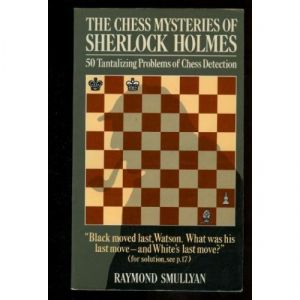
It’s not obvious what is wrong with this one:

Of itself it isn’t a mistake, but the author refers on page xii to “the problem on the front cover”… (authors, what do they know, eh?)

The original cover:

There are actually two problems there: one with bottom right square = h1, one BRS=a8

[If you aren’t sure that either way round it is a problem, see content/going-back-time]

Lastly, I’m not sure if modesty should forbid or compel, but…

It’s ES Tinsley, in fact.

Otherwise OK Books with a Confidence-Sapping Error on the contents page:

The London System by Andrew Soltis advertises a line of the Advance French on the contents page!

Otherwise OK Books with a Confidence-Sapping Error on the title page:


Any more? Or similar?

[I exclude Eric Schiller’s oeuvre from consideration, on fish-barrel-shooting grounds. My esteemed colleague Simon says that dyslexia is the cause, which may be the reason, but does not suffice as an excuse.]

About Dr Dave

Featured

drdave_sheu

Dr Dave Regis is a researcher in health education working in Exeter, Devon.

He does a bit of chess coaching (in person, over the Internet or by phone), chess publishing and other projects on the side.

He has been talking to adults and children about chess for 20 years and the session notes and free materials that have resulted are all online elsewhere; a couple of examples are on this site.

English Chess Federation Accredited Coach: http://www.englishchess.org.uk/coaches-2/

[If you don’t think the header photo is very good, click on it for another one.]

as-Suli’s Diamond

From Wikipedia (English):

The problem called “as-Suli’s Diamond” went unsolved for over a thousand years. In shatranj, the “queen” (counsellor) is a very weak piece, able to move only a single square diagonally. It is also possible to win in shatranj by capturing all pieces except the king.

as-Suli commented:

“This ancient position is so difficult that there is no one in the world who would be able to solve it, except those I have taught to do so. I doubt whether anyone did this before me. This was said by al-Suli.”

David Hooper and Ken Whyld studied this problem in the mid-1980s but were unable to crack it. It was finally solved by Russian Grandmaster Yuri Averbakh.

as-Suli gave the first move of the solution (1.Kb4) which was the same as Averbakh’s solution; Averbakh was impressed with the obvious prowess of the Arab master.

Solution (from the German Wikipedia) is in the comments. You have 1000 years, starting NOW…
Continue reading →