Endgames are worth taking seriously – you can get extra points and
half-points by improving your endgame play.
Some endgames turn up rather often, certainly more often than some
of the odd bits of opening theory we end up looking at sometimes.
There are bits of theory to know, but as always the thing is to test
your understanding and practise.
The things you need to know are widely available, not least from our
website, so I won’t trot through it all, just give some examples.
Endgame Theory: PRQNB
Here’s a basic K+P endgame, where you should know enough to win it
for White.
And here’s a basic R+P endgame – same again.
There are a couple of essential positions for each type of ending: PRNBQ…
As you gain more experience, you can add to your range of ‘solved’ positions.
See also:
http://exeterchessclub.org.uk/content/queen-against-pawn
http://exeterchessclub.org.uk/content/rook-endings-theory
http://exeterchessclub.org.uk/content/bishop-endgames
http://exeterchessclub.org.uk/content/double-bishop-endgames
Endgame Tactics: PRQNB
Rooks and Queens lend themselves to tactical shots. Here are a
few:
It’s not easy to be as definitive about essential tactical knowledge; each peculiar position may harbour a new trick, or a new spin on an old one.
Endgame studies
These are pure tactics, always good for sharpening your awareness of tactical possibilities.
One of the most famous, and most instructive, is this one:
http://en.wikipedia.org/wiki/Saavedra_position#History
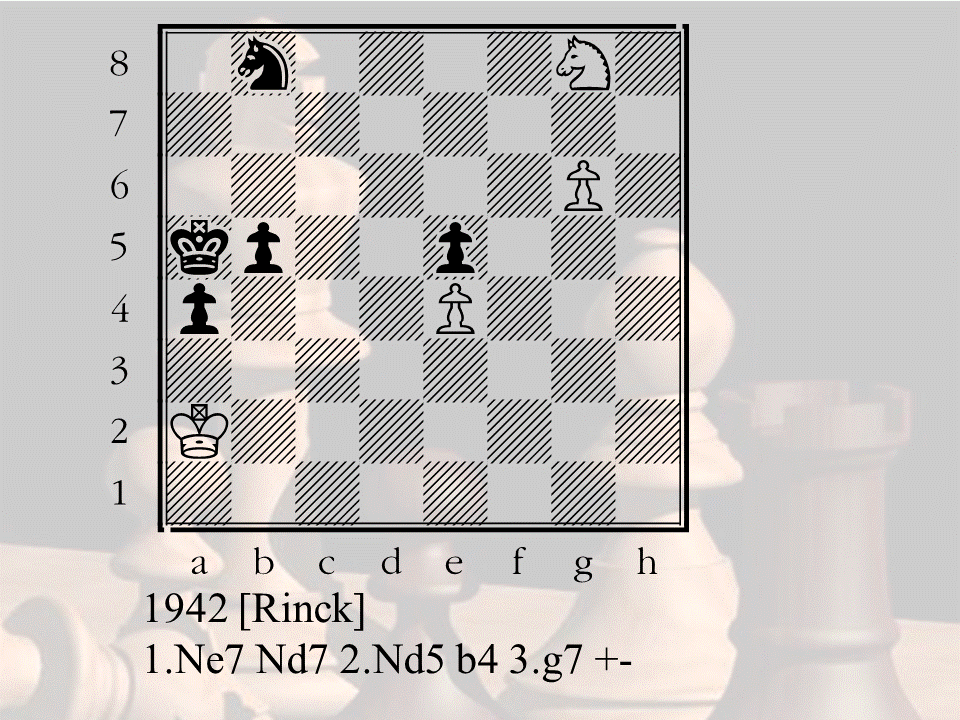
And another, showing the wonderful co-operation between Queen and Knight:
Endgame Strategy: PRQNB
There are some general endgame principles which you should know:
3 principles (Fine)
- Without pawns, you must be at least a Rook ahead in order to force mate (exceptions: R+R wins against two minor pieces; four minor pieces win against a Queen)
If you are two or more Pawns ahead the win should be routine by advancing the Pawns
With only one Pawn advantage, you will win if you can use it to gain more material – it is not usually enough just to advance the Pawn. Often one Pawn advantage is thought to be a theoretical draw, although the practical difficulties may be very great. Winning by the advance of the Pawn may be won because it allows entry with the King, or causes distraction from one vulnerable side, or allows simplification into a known won ending.
15 general laws (Fine again)
- Doubled, isolated and blockaded pawns are weak: avoid them!
Passed pawns should be advanced as rapidly as possible.
If you are one or two pawns ahead, exchange pieces but not pawns.
If you are one or two pawns behind, exchange pawns but not pieces.
If you have an advantage, leave pawns on both sides of the board.
If you are just one pawn ahead, in 99 cases out of 100 the game is drawn if there are pawns on only one side of the board.
The easiest endings to win are pure King+Pawn endings.
The easiest endings to draw are those with opposite coloured bishops.
The King is a strong piece: use it!
Do not place pawns on the colour of your bishop.
Bishops are better than knights in all except blocked pawn positions
Two bishops vs. B&N or N&N are usually a real advantage.
Passed pawns should not be blockaded by the king: the only piece which is not much harmed by watching over an opponent’s pawn is the knight.
A rook on the seventh rank is worth a pawn.
Rooks belong behind passed pawns, of your own or the opponent.
See also:
http://exeterchessclub.org.uk/content/outside-passed-pawns
http://exeterchessclub.org.uk/content/two-weaknesses
With this under your belt, you should then work your way through
these examples:
http://exeterchessclub.org.uk/content/planning-endgame
Endgame Training: PRQNB
If you’ve got a computer or a chess-playing friend, then make use of
the opportunity. I’ve just been working with an A-level
student who spent a lot of her time ‘revising’, ie. reading and
making notes, without seeing if she could get any of that
information out in the right format ie. doing past exam.
questions. You must combine the two.
Your best single resource is the Iceland Endgame Challenge, which I
can offer you in PGN/CBV formats as well as a worksheet. Don’t
agonise over the mate with B+N!
Everything in one book:
Yuri Averbakh, Chess Endgames: Essential Knowledge
Glenn Flear, Improve your Endgame Play *
Glenn Flear, Mastering the Endgame *
Steve Giddins, 101 Endgame Tips
Ian Snape, Chess Endings Made Simple *
Paul Keres, Practical Chess Endings
Endgame theory: [br style=”font-weight: bold;”]
Iceland Endgame Challenge *
Bruce Pandolfini, Pandolfini’s Endgame Course *
Jeremy Silman, Silman’s Complete Endgame Course *
Jonathan Speelman et al. Batsford Chess Endgames
Mark Dvoretzky, Dvoretzky’s Endgame Manual (also a ChessBase CD)
Karsten Mueller Chess Endgames 1: Basic Knowledge for Beginners (DVD)
Endgame tactics:
Irving Chernev, Practical Chess Endgames *
AA Troitzky, 360 Brilliant and instructive endgames *
John Nunn, Tactical Chess Endings*
GC van Perlo, Endgame Tactics
Endgame strategy:
MI Shereshevsky, Endgame Strategy
Endgame training:
Iceland Endgame Challenge: Bronze, Silver, Gold *
Bernd Rosen, Chess Endgame Training *
- Additional positions for playing out:
Irving Chernev, Capablanca’s 60 Best Chess Endgames
Vasily Smyslov, Endgame Virtuoso
Karolyi & Alpin, Endgame Virtuoso: Anatoly Karpov
Giddins, Greatest Ever Chess Endgames
* including test exercises
How to play out exercises against a computer
1. Set ‘play against Fritz’ (ALT_A).
2. Set up a position (S)
3. Go!
Or:
1. Load a position from a database.
2. Click ‘Move Now’ (SPACEBAR)
I think this works in Fritz 5.32 and Fritz 11, although my copy of 5.32 is NBG at the moment.