Lessons from Bobby Fischer

His book, My 60 Memorable Games, was one of the first adult books on chess I bought, and while it was far too hard for me at the time (and still is, I fear) there is much to be mined in its pages. Each time I come back to it I learn something new, and I have selected some positions below which have taught me something in each phase of the game.

Lessons in the Opening

Fischer,Robert J – Celle,O (Davis sim) [C51] opening attack, 1964

In an old-style opening Fischer gives a terrific display of attacking power against an uncastled King – just the sort of thing you want to see at a simultaneous display.
1. e4 e5 2. Nf3 Nc6 3. Bc4 Bc5 4. b4

Evans’ Gambit, an old favourite.

4… Bxb4 5. c3 Be7 6. d4 d6 7. dxe5 Nxe5 8. Nxe5 dxe5 9. Qh5 g6 10. Qxe5 Nf6 11. Ba3 Rf8 12. O-O Ng4 13. Qg3 Bxa3 14. Nxa3 Qe7!

White has a lead in development, but how can he take advantage of it?

15. Bb5+! c6 (x d6) 16. Nc4 Qe6

17. Rad1!

[17. Qc7 Qd7 18. Nd6+ Ke7 19. Nxc8+ Raxc8 20. Qxd7+ Kxd7]

17… cxb5 18. Qc7 Bd7 19. Nd6+ Ke7 20. Nf5+!

“Material is not what counts now, but open lines”

20… gxf5 21. exf5 Rac8 22. Rxd7+ Qxd7 23. f6+ Nxf6 24. Re1+ Ne4 25. Rxe4+ Kf6 26. Qxd7 Rfd8 27. Qg4 1-0

Petrosian,Tigran – Fischer,Robert (Buenos Aires m [A06] opening, 1971

Many years ago Reti described “Americanism” in the chess of Pillsbury and others, a sort of full-blooded practical-minded style – and in Fischer’s play it is easy to see a parallel.
1. Nf3 c5 2. b3 d5 3. Bb2 f6


Now that’s what I call a move. Having been reared on Chernev’s adulation of Capablanca, I got the idea that you should play in the opening only the most natural and harmonious of moves. Now here is Fischer, in the Candidate’s Final to qualify to play Spassky, and he is declaring his intention to refute his opponent’s opening using three Pawn moves as Black.

This game had a terrible effect on me, I often still can’t resist trying to refute my opponent’s odd moves immediately. Although Petrosian fumbles at the end you can see how Fischer’s grip on the game never relaxes.

4. c4 d4! 5. d3 e5 6. e3 Ne7 7. Be2 Nec6! 8. Nbd2 Be7 9. O-O O-O 10. e4 a6 11. Ne1 b5 12. Bg4 Bxg4 13. Qxg4 Qc8 14. Qe2 Nd7 15. Nc2 Rb8 16. Rfc1 Qe8 17. Ba3 Bd6 18. Ne1 g6 19. cxb5 axb5 20. Bb2 Nb6 21. Nef3 Ra8 22. a3 Na5 23. Qd1 Qf7 24. a4 bxa4 25. bxa4 c4 26. dxc4 Nbxc4 27. Nxc4 Nxc4 28. Qe2 Nxb2 29. Qxb2 Rfb8 30. Qa2 Bb4 31. Qxf7+ Kxf7 32. Rc7+ Ke6 33. g4 Bc3 34. Ra2 Rc8 35. Rxc8 Rxc8 36. a5 Ra8 37. a6 Ra7 38. Kf1 g5 39. Ke2 Kd6 40. Kd3 Kc5 41. Ng1 Kb5 42. Ne2 Ba5 43. Rb2+ Kxa6 44. Rb1 Rc7 45. Rb2 Be1 46. f3 Ka5 47. Rc2 Rb7 48. Ra2+ Kb5 49. Rb2+ Bb4 50. Ra2 Rc7 51. Ra1 Rc8 52. Ra7 Ba5 53. Rd7 Bb6 54. Rd5+ Bc5 55. Nc1 Ka4 56. Rd7 Bb4 57. Ne2 Kb3 58. Rb7 Ra8 59. Rxh7 Ra1 60. Nxd4+ exd4 61. Kxd4 Rd1+ 62. Ke3 Bc5+ 63. Ke2 Rh1 64. h4 Kc4 65. h5 Rh2+ 66. Ke1 Kd3 0-1

Middlegame

Fischer,Robert – Robatsch,Karl (Varna ol final R) [B01] middlegame attack 1, 1962

In one of his games, Fischer describes having the attack on the fianchettoed Black King’s position down to a science: open the h-file, “sac, sac, …mate!”
Once you see it done, you can imitate it with effect. It is less usual for these straightforward attacks to be successful at master level, but among club players my money is on the player with a plan they understand.

1. e4 d5 2. exd5 Qxd5 3. Nc3 Qd8!? 4. d4 g6!?

Two !?s sometimes add up to a ?, sometimes a !

Robatsch’s ideas have a hard reception here.

5. Bf4! Bg7 6. Qd2! Nf6 7. O-O-O c6

8. Bh6 O-O? 9. h4 Qa5 10. h5! gxh5

“Horrible, but Black must keep the h-file closed”

11. Bd3 Nbd7 12. Nge2 Rd8 13. g4! Nf8 14. gxh5 Ne6 15. Rdg1 Kh8 16. Bxg7+ Nxg7 17. Qh6 Rg8 18. Rg5 Qd8 19. Rhg1 Nf5?

[19… Qf8 20. d5! Bd7 21. d6 Nf5 22. Qxf8 Rgxf8

[22… Raxf8 23. Bxf5 Rxg5 24. Rxg5 h6 25. dxe7 Rb8 26. Rg3 Bxf5 27. Rf3]

23. Bxf5 h6 24. dxe7 Rfb8 25. Rg7 Bxf5 26. Rxf7]

20. Bxf5 1-0

Fischer,R – Stein,L (Sousse izt) [C92] middlegame attack, 1967

A far more complex attacking game. Lasker once said that no-one can hope to master chess who does not take on the Ruy Lopez in all its manifestations; Fischer’s games feature many striking successes in a surprising variety of lines, from the Exchange to the Steinitz, and as below, what we now call the Zaitsev, played by the then Soviet Champion.
1. e4 e5 2. Nf3 Nc6 3. Bb5 a6 4. Ba4 Nf6 5. O-O Be7 6. Re1 b5 7. Bb3 d6 8. c3 O-O 9. h3

9… Bb7

[9… Na5 10. Bc2 c5 Tchigorin]

[9… Nb8 10. d4 Breyer]

10. d4 Na5

Heading for d7, the long way round

[10… Nb8 11. dxe5 dxe5 12. Qxd8 and now 12… Bxd8 is best, but awkward]

11. Bc2 Nc4 12. b3 Nb6 13. Nbd2 Nbd7


Made it! But it has taken a lot of time.

14. b4! exd4

going for counterplay, rather than hanging on to e5

15. cxd4 a5 16. bxa5 c5 17. e5! dxe5 18. dxe5 Nd5 19. Ne4 Nb4! 20. Bb1 Rxa5 21. Qe2!

21… Nb6?

A piece possibly better reserved for defending the King.

[21… Re8]

22. Nfg5!

“The threats are beginning to jell.”

22… Bxe4!

[22… h6 23. Nh7!! Kxh7

[23… Re8 24. Nhf6+ Bxf6 25. Nxf6+ Qxf6

[25… gxf6 26. Qg4+ Kf8 27. Bxh6+ Ke7 28. e6 Kd6 29. Qg3+ Kc6 30. Be4+ N4d5 31. exf7 Rh8 32. Bxd5+ Nxd5+- ]

26. exf6 Rxe2 27. Rxe2]

24. Nxc5+ Kg8 25. Nxb7]

23. Qxe4 g6 24. Qh4 h5 25. Qg3 Nc4 26. Nf3?

[26. e6]

26… Kg7 27. Qf4 Rh8 28. e6! f5 29. Bxf5! Qf8

30. Be4?

[30. Nh4! Littlewood 30… Bxh4 31. Qxh4 Qxf5

[31… gxf5 32. Qg5+ Kh7 33. e7 Qe8 34. Re6]

[31… Qf6 32. Qg3]

32. Qe7+ Kg8 33. Qd8+ Kg7 34. Qc7+ Kg8 35. e7]

30… Qxf4 31. Bxf4 Re8?

[31… Rxa2 32. Rxa2

[32. Rad1 Ra7]

32… Nxa2 33. Ne5 g5 34. Bg3 with some initiative but no win yet]

32. Rad1 Ra6 33. Rd7

[33. Bb7!]

33… Rxe6 34. Ng5 Rf6

[34… Ra6 35. Bb1 Kf6 36. Ne4+ Kf7 37. Nxc5]

35. Bf3 Rxf4 36. Ne6+ Kf6 37. Nxf4 Ne5 38. Rb7 Bd6 39. Kf1


winning

39… Nc2 40. Re4 Nd4 41. Rb6 Rd8 42. Nd5+ Kf5 43. Ne3+ (sealed) 43… Ke6 44. Be2! Kd7 45. Bxb5+ Nxb5 46. Rxb5 Kc6 47. a4 Bc7 48. Ke2 g5 49. g3 Ra8 50. Rb2 Rf8 51. f4 gxf4 52. gxf4 Nf7 53. Re6+ Nd6 54. f5 Ra8 55. Rd2! Rxa4 56. f6 1-0

Endgame

Gligoric,Svetozar – Fischer,Robert (Yugoslavia ct ) [B99] endgame, 1959

This was an interesting game for me. I’d got the hang of Pawn weakness and while I knew that having a weakness didn’t mean you should resign, I think it’s fair to say I was much more impressed with Pawns than pieces!
1. e4 c5 2. Nf3 d6 3. d4 cxd4 4. Nxd4 Nf6 5. Nc3 a6 6. Bg5 e6 7. f4 Be7 8. Qf3 Qc7 9. O-O-O Nbd7 10. g4 b5 11. Bxf6 gxf6 12. f5 Ne5 13. Qh3 O-O

“Black’s “ugly” defence is based on sound positional considerations: once he can consolidate, there is strong potential in the two Bishops coupled with the beautifully posted Knight and compact Pawn mass. These assets, in the long run, hopefully should outweigh the temporary weakness of his King and the immobile target on e6. ”

14. Nce2 Kh8 15. Nf4 Rg8 16. Rg1 d5 17. fxe6 dxe4 18. Nd5 Qc5 19. Nxe7 Qxe7 20. Nf5 Qxe6 21. Qh6 Bd7 22. Rd6 Nxg4 23. Rxg4 Qxf5 24. Rxg8+?

[24. Rf4]

24… Rxg8?

[24… Kxg8]

25. Rxf6 Qd5 26. Rd6 Qf5 27. Rf6 Qg5+ 28. Qxg5 Rxg5 29. Rxf7 Bg4 30. Kd2 Bf3 31. Ke3 Rg1 32. Bh3 Re1+ 33. Kf4 Bd1


“Playing, as Dr.Tarrasch wryly put it, “for the loss”. Nowadays I would know better than to try to squeeze a win out of such a simplified position. ”

34. Ke5!

Inviting Fischer to overextend.

[34. Re7 Bxc2 35. Bf5= ]

34… e3 35. Bf5 Rg1 36. Rxh7+ Kg8 37. Rc7 Bg4?

[37… e2 38. Kf6 Kh8 39. Rh7+ Kg8 40. Rc7 Kh8= ]

38. Bxg4 Rxg4 39. Rc3 e2 40. Re3


“Fortunately, Black can still hold the draw”

40… Rg2

[40… Rg7? 41. Kd4]

41. Kd4 e1=Q!

[41… Rxh2 42. Kd3+- ]

42. Rxe1 Rxc2 43. Rb1

43… Kf7!

[43… Rxh2 44. Kc5]

44. a3 Ke6 45. b3 Rxh2 46. Kc5 Kd7 47. Kb6 Ra2 48. Kxa6 Rxa3+ 49. Kb7 Kd6 50. Kb6 Kd7 51. b4 Rh3 52. Rc1

52… Rh8?

“After the game, Olafsson scolded me: “How can you play an ending like this so fast?” (I’d only been taking a few seconds a move for the last dozen moves or so.) “Because there’s no danger. It’s a dead draw,” I replied. ”

[52… Rh5 53. Rc5 Rxc5 54. Kxc5

[54. bxc5?? b4-+ ]

54… Kc7 55. Kxb5 Kb7


with the opposition, a book draw and easy to hold]

53. Kxb5?

“As Olafsson showed me, White can win with 53. Rc7+! It’s hard to believe. I stayed up all night analysing, finally convincing myself and, incidentally, learning a lot about Rook and Pawn endings in the process.”

(Gligoric failed to point it out in his notes to the Bled tournament book.)

[53. Rc7+! This helps keep the Black King away, so the White King can control the Queening square. If the Black Rook checks, White will interpose the Rook. 53… Kd6

[53… Kd8 54. Rc5 Kd7 55. Kb7! Kd6 56. Rxb5]

54. Rc6+ Kd7

[54… Kd5 55. Kxb5 Rb8+ 56. Rb6]

55. Kxb5 Rb8+ 56. Rb6 Rh8 57. Rb7+ Kc8 58. Ka6 Rh6+ 59. Ka7+- ]

53… Rb8+ 54. Ka4 Ra8+ 55. Kb3 Rc8 56. Rxc8 Kxc8 57. Kc4 Kb8!


holding the “distant opposition”

[57… Kb7 58. Kb5 Kc7 59. Ka6 Kb8 60. Kb6 Ka8 61. Kc7 Ka7 62. b5 Ka8 63. Kb6 Kb8 64. Ka6 Ka8

[64… Kc7 65. Ka7]

65. b6 Kb8 66. b7

If you can play to the seventh without check, it’s a win, because the King is on the queening square, and has to move off.

66… Kc7 67. Ka7 Kc6 68. b8=Q]

[now 57… Kb8! 58. Kc5

[58. Kd5 Kb7]

58… Kc7 59. Kb5 Kb7]

1/2-1/2

Fischer,R – Euwe,M (Leipzig ol) [B13] endgame, 1960

1. e4 c6 2. d4 d5 3. exd5 cxd5 4. c4 Nf6 5. Nc3 Nc6 6. Nf3 Bg4 7. cxd5 Nxd5 8. Qb3 Bxf3 9. gxf3 e6 10. Qxb7 Nxd4 11. Bb5+ Nxb5 12. Qc6+ Ke7 13. Qxb5 Nxc3 14. bxc3 Qd7

15. Rb1!

“…Horrible as White’s Pawn structure may be, Black can’t exploit it because he’ll be unable to develop his King’s-side normally. It’s the little quirks like this that could make life difficult for a chess machine.”

15… Rd8?

[15… Qxb5 16. Rxb5 Kd6 17. Rb7 f6 18. Ke2 Kc6 19. Rf7 a5 20. Be3 +/-]

16. Be3 Qxb5 17. Rxb5 Rd7 18. Ke2 f6 19. Rd1! Rxd1 20. Kxd1

20… Kd7 21. Rb8 Kc6 22. Bxa7 g5 23. a4 Bg7 24. Rb6+ Kd5 25. Rb7 Bf8 26. Rb8 Bg7 27. Rb5+ Kc6 28. Rb6+ Kd5 29. a5 f5 30. Bb8

30… Rc8 31. a6 Rxc3 32. Rb5+ Kc4

[32… Kc6 33. Ra5 Bd4 34. Be5?

[34. Ke2]

34… Rc4!= ]

33. Rb7 Bd4

34. Rc7+ Kd3 35. Rxc3+ Kxc3

36. Be5 1-0

Lessons from Morphy

Paul Morphy is the perfect model for improving players — lots of fast development, vigorous attacking play, bright tactics, and killer instinct in the finish.  His brisk disposal of two toffs at the opera has been an inspiration to generations.


Clock control

Or, The Thirty-Third
Piece


A. Introduction

Chess is played not with 32 pieces, but 33: the handling of the
extra piece, the clock, sometimes being the deciding factor.

Time trouble is the most obvious manifestation of clock
difficulties but there are other symptoms: I remember Brian Hewson
being irritated just on principle that I had played an automatic
move in a tense position – after the game it became clear that I
had missed a mate in three at that point.

So, below I’ll talk around time trouble but also time
management in general, and what you might want to do about it.
Often, simply diagnosing a problem is to start curing it.

  • C1. Regis, Hampton, 1993 (Game 2)<h2><a name=”RTFToC2″ id=”RTFToC2″>Or, The Thirty-Third

    Piece</a></h2>

    <hr />

    <H1><a name=”RTFToC3″ id=”RTFToC3″>A. Introduction</a></h1>

    Chess is played not with 32 pieces, but 33: the handling of the

    extra piece, the clock, sometimes being the deciding factor.

    <p>&nbsp; Time trouble is the most obvious manifestation of clock

    difficulties but there are other symptoms: I remember Brian Hewson

    being irritated just on principle that I had played an automatic

    move in a tense position – after the game it became clear that I

    had missed a mate in three at that point.</p>

    <p>&nbsp; So, below I’ll talk around time trouble but also time

    management in general, and what you might want to do about it.

    Often, simply diagnosing a problem is to start curing it.</p>

    <ul>

    <li><a href=”#RTFToC3″>A. Introduction</a></li>

    <li><a href=”#RTFToC4″>B. Time trouble</a></li>

    </ul>

    <ul>

    <li><a href=”#RTFToC5″>B1. Causes of time trouble</a>

    <ul>

    <li><a href=”#RTFToC6″>Inadequate theoretical preparation</a></li>

    <li><a href=”#RTFToC7″>Inadequate practical preparation</a></li>

    <li><a href=”#RTFToC8″>A genuinely complicated game</a></li>

    <li><a href=”#RTFToC9″>Conscious entry into time trouble</a></li>

    <li><a href=”#RTFToC10″>Doubts concerning analysis</a></li>

    <li><a href=”#RTFToC11″>Doubts linked to own style</a></li>

    <li><a href=”#RTFToC12″>Doubts linked to opponent’s style</a></li>

    <li><a href=”#RTFToC13″>Doubts linked to importance of the

    game</a></li>

    <li><a href=”#RTFToC14″>Doubts linked to previous course of the

    game</a></li>

    <li><a href=”#RTFToC15″>Doubts linked to own experience</a></li>

    </ul>

    </li>

    <li><a href=”#RTFToC16″>B2. Effects of time trouble</a>

    <ul>

    <li><a href=”#RTFToC17″>Failure to react to changes in the

    position</a></li>

    <li><a href=”#RTFToC18″>Inclination towards obvious moves</a></li>

    <li><a href=”#RTFToC19″>Seeking exchanges</a></li>

    <li><a href=”#RTFToC20″>Postponing decisions</a></li>

    <li><a href=”#RTFToC21″>Playing safe and solid moves</a></li>

    <li><a href=”#RTFToC22″>Reliance on constant elements of the

    position</a></li>

    <li><a href=”#RTFToC23″>Less strategy, more tactics</a></li>

    <li><a href=”#RTFToC24″>Temptation to blitz the time-troubled

    opponent</a></li>

    </ul>

    </li>

    <li><a href=”#RTFToC25″>B3. Treatment of time trouble</a></li>

    </ul>

    <ul>

    <li><a href=”#RTFToC26″>C. Time management</a></li>

    </ul>

    <ul>

    <li><a href=”#RTFToC27″>C1. Regis, Hampton, 1993 (Game 2)</a></li>

    <li><a href=”#RTFToC28″>C2. Tal-Bronstein 1960 (Game 6)</a></li>

    <li><a href=”#RTFToC29″>C3. Botvinnik-Tal 1960 (Game 7)</a></li>

    <li><a href=”#RTFToC30″>D. References</a>

    <div class=”c1″>

    <ul>

    <li><a href=”#RTFToC31″>Game 1: (59) Korchnoi – Suetin [C83] Moscow

    (XXVII USSR Ch.), 1960</a></li>

    <li><a href=”#RTFToC32″>Game 2: Regis,D (1935) – Hampton,M (1900)

    [E91]</a></li>

    <li><a href=”#RTFToC33″>Game 3: Botvinnik ,M – Tal ,M [E10]: Match,

    Moscow (Russia) Match, Moscow (Russia) (8), 1960</a></li>

    <li><a href=”#RTFToC34″>Game 4: Gligoric,S – Tal,M [A78] Yugoslavia

    ct Yugoslavia ct (4), 1959</a></li>

    <li><a href=”#RTFToC35″>Game 5: Blackstock,L – Webb,S [C09]

    Borehamwood, 1977</a></li>

    <li><a href=”#RTFToC36″>Game 6: Tal, Mikhail, Bronstein, David,

    Baku ch-SU, 1961</a></li>

    <li><a href=”#RTFToC37″>Game 7: Botvinnik,M (2500) – Tal,M [E69] WM

    Moskau, 1960</a></li>

    </ul>

    </div>

    <hr />

    <H1><a name=”RTFToC4″ id=”RTFToC4″>B. Time trouble</a></h1>

    Time trouble is time pressure that you cannot bear or want to be

    rid of: different players have different views about what is

    tolerable. The Grandmaster and psychologist Krogius gives a horror

    show of time trouble examples in his book on chess psychology. He

    classifies the examples as follows:

    <hr />

    <h2><a name=”RTFToC5″ id=”RTFToC5″>B1. Causes of time

    trouble</a></h2>

    <hr />

    <h3><a name=”RTFToC6″ id=”RTFToC6″>Inadequate theoretical

    preparation</a></h3>

    <u>Cures</u>: better theoretical preparation (duh) but also

    improved experience: with more experience of different types of

    position you will have improved general assessment/intuition. It is

    an unrealistic goal to set yourself to be able to play any type of

    position, but if you have a weakness, work on it.

    <p>&nbsp; On the other hand it is not a complete cure: Bronstein

    has encyclopaedic knowledge, wonderful intuition… and a marked

    time trouble habit.</p>

    <hr />

    <h3><a name=”RTFToC7″ id=”RTFToC7″>Inadequate practical

    preparation</a></h3>

    <u>Cures</u>: more practice, practice at speed chess

    <hr />

    <h3><a name=”RTFToC8″ id=”RTFToC8″>A genuinely complicated

    game</a></h3>

    “<em>This is ‘normal’ time trouble and I have no intention of

    giving it up</em>.” – Botvinnik.

    <p>&nbsp; There is no doubt that some good players are prepared to

    put in a good half-hour or so in the early middlegame in the belief

    that the position deserves it and the expectation that it will be

    rewarded by an easier – maybe winning – game later.</p>

    <p>&nbsp; I remember when Kramnik beat Kasparov on the Black side

    of a Semi-Slav he criticised Kasparov for making a move after only

    quarter of an hour or so. He said that this was too fast, and that

    he would have taken what the position deserved – “<em>maybe one

    hour</em>”(!).</p>

    <hr />

    <h3><a name=”RTFToC9″ id=”RTFToC9″>Conscious entry into time

    trouble</a></h3>

    In order to upset the normal run of events. – See Game 1.

    <hr />

    <h3><a name=”RTFToC10″ id=”RTFToC10”>Doubts concerning

    analysis</a></h3>

    “<em>Do not search for objectively the best move because frequently

    there is no such move. In most cases it is simply a matter of taste

    – simply look for a good move!</em>” – Spielmann

    <p>&nbsp; In a complex position, do not always try to resolve it

    tactically, but maybe just play a good positional move.

    (Nimzovitch)</p>

    <p><u>Cure</u>: Have confidence in your own judgement and

    ability, at least the courage to learn from any mistake you might

    be making.</p>

    <hr />

    <h3><a name=”RTFToC11″ id=”RTFToC11″>Doubts linked to own

    style</a></h3>

    In World Championship matches Botvinnik very often fell into time

    trouble in complex, dynamic positions conjured up by those wizards

    of the chessboard, Bronstein and Tal. Bronstein’s time trouble, by

    contrast, was in relatively simple positions where Botvinnik had a

    small – maybe insignificant – positional advantage.

    <p><u>Cure</u>: Go for positions you feel at home in; study

    positions you need to feel at home in.</p>

    <hr />

    <h3><a name=”RTFToC12″ id=”RTFToC12″>Doubts linked to opponent’s

    style</a></h3>

    e.g. against opponent who has a large plus score against you.

    <p><u>Cure</u>: win a game…!</p>

    <hr />

    <h3><a name=”RTFToC13″ id=”RTFToC13″>Doubts linked to importance of

    the game</a></h3>

    e.g. this move is too important, I must be 110% sure…

    <p><u>Cure</u>: put such thoughts aside if you can; play the

    board.</p>

    <hr />

    <h3><a name=”RTFToC14″ id=”RTFToC14″>Doubts linked to previous

    course of the game</a></h3>

    e.g. I should have won earlier: see Game 2

    <p><u>Cure</u>: think about the position in front of

    you!</p>

    <hr />

    <h3><a name=”RTFToC15″ id=”RTFToC15″>Doubts linked to own

    experience</a></h3>

    e.g. a little knowledge dangerously distracting you from your own

    judgement

    <p><u>Cure</u>: Have confidence in your own judgement and

    ability, at least the courage to learn from any mistake you might

    be making.</p>

    <hr />

    <h2><a name=”RTFToC16″ id=”RTFToC16″>B2. Effects of time

    trouble</a></h2>

    <hr />

    <h3><a name=”RTFToC17″ id=”RTFToC17″>Failure to react to changes in

    the position</a><br />

    <a name=”RTFToC18″ id=”RTFToC18″>Inclination towards obvious

    moves</a></h3>

    <u>Cure</u>: Think if you can for a moment longer, try not to get

    in a rut of thinking.

    <hr />

    <h3><a name=”RTFToC19″ id=”RTFToC19″>Seeking exchanges</a><br />

    <a name=”RTFToC20″ id=”RTFToC20″>Postponing decisions</a><br />

    <a name=”RTFToC21″ id=”RTFToC21″>Playing safe and solid

    moves</a><br />

    <a name=”RTFToC22″ id=”RTFToC22″>Reliance on constant elements of

    the position</a></h3>

    e.g grabbing back material too soon

    <p><u>Cure</u>: To combat all of these tendencies, try to

    play the move that you think best meets the requirements of the

    position, not the requirements of your nerves.</p>

    <hr />

    <h3><a name=”RTFToC23″ id=”RTFToC23″>Less strategy, more

    tactics</a></h3>

    <u>Cure</u>: You do need to check for concrete traps, but as Nimzo

    says, you can sometimes short-circuit analysis of variations by a

    good positional move. This is appropriate even in quickplay

    finishes where you do not want to prolong the game.

    <hr />

    <h3><a name=”RTFToC24″ id=”RTFToC24″>Temptation to blitz the

    time-troubled opponent</a></h3>

    Game 3: “<em>I made the last move instantaneously – as if seized by

    the time pressure of my opponent. I had formerly seen that I would

    win the exchange, but I had but to think a little; then I would

    have come up with the absolutely correct idea: the other Rook must

    go to c8 (winning the exchange but keeping the b7 Pawn</em>.)” –

    TAL

    <p>&nbsp; [“<em>Here it is: the hypnotic power of ‘natural’

    moves!”</em> – Krogius]</p>

    <p>&nbsp; “<em>It could be noticed from my opponent’s expression

    that he had been rather surprised by the unexpected turn of events,

    but in spite of intense time pressure he successfully responded to

    the reversal of the conditions and immediately found the best

    continuation</em>.” – Tal</p>

    <p><u>Cure</u>:</p>

    <p>&nbsp; “<em>Instead, thoroughly analyse a plan several moves

    deep and play the moves rapidly</em>” – Krogius</p>

    <p>&nbsp; “<em>Set a trap and play the moves rapidly</em>.” –

    Webb</p>

    <p>&nbsp; It is even possible to use your opponent’s propensity to

    time trouble: see Games 4 and 5</p>

    <hr />

    <h2><a name=”RTFToC25″ id=”RTFToC25″>B3. Treatment of time

    trouble</a></h2>

    “<em>Time trouble is a completely surmountable difficulty… not

    only (through) training in chess technique, but chiefly with

    psychological training</em>.” – Krogius

    <p>&nbsp; Self-control is often a key to success in chess.</p>

    <p>&nbsp; Follow the principal rules about chess thinking: what is

    my opponent’s idea?</p>

    <p>&nbsp; Diagnose your own causes of time trouble, and make a

    conscious attempt to develop your decisions and resilience in those

    circumstances.</p>

    <p>&nbsp; Use your opponent’s time: work out a provisional reply

    for each move, and use your opponent’s time for looking at the

    clock</p>

    <p>&nbsp; Botvinnik recommends playing training games where what

    you are trying to improve is use of time – making it more even or

    at least more appropriate to the position. He says that 90% of time

    trouble addicts can be cured using this method, although Averbakh

    adds “<em>if so, then it seems I am among the remaining 10%… and

    perhaps so is the author of the method…”</em></p>

    <hr />

    <H1><a name=”RTFToC26″ id=”RTFToC26”>C. Time management</a></h1>

    You do see a variety of strategies for the use of time in club

    play: players who routinely use too much or too little time,

    players who have a marked “stop-go” cycle, and players who seem to

    be just haphazard in their use of time.

    <p>&nbsp; Undoubtedly you can’t comment on this without respect to

    the position, but it is worth reflecting on your own patterns of

    chess play. I have routinely marked the times taken by myself and

    my opponent for years – a minor additional distraction and I have

    found it valuable food for thought. I believe it has led to me

    making better use of the clock, which is to say, to use time when I

    need to use it, and get on with it when I don’t.</p>

    <p>&nbsp; There are marked differences in the way people use the

    clock, but I might be permitted a general observation or two:</p>

    <p><strong><em>Better players use more of their time than

    worse ones</em></strong>. Moral: chess is hard, and the longer you

    think the better, provided you have something to think with – that

    is, you have an understanding of that type of position and have

    ideas about the issues at stake.</p>

    <p><strong><em>Better players think when they are supposed

    to</em></strong>: that is, when there is something to think about –

    as opposed to just dithering in a level position. They are better

    at judging the critical moments and turning points of a game, so

    that when they are short of time later, the moves may be easy to

    find because the game is decided by that point.</p>

    <p>&nbsp; Here are a few natural histories of the chess clock:</p>

    <hr />

    <h2><a name=”RTFToC27″ id=”RTFToC27″>C1. Regis, Hampton, 1993 (Game

    2)</a></h2>

    <img alt=”[Graph of Clock Times (1)]” src=”/wp/chessx/clock1.gif” />

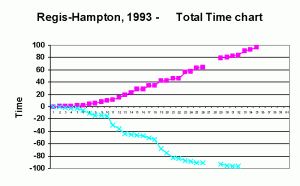
    <p>&nbsp; White’s total elapsed time is shown above, and Black’s

    below; control at 40 moves in 100 minutes. White lost on time at

    move 39.</p>

    <p>&nbsp; This is the only game I have ever lost on time, and some

    of the reasons are to be found in the notes. It was quite in

    Krogius’ class of <strong><em>doubts linked to the earlier course

    of the game</em></strong>.</p>

    <p>&nbsp;</p>

    <p>&nbsp; But on the graph you can also see some interesting

    features of the use of time: Black having some periods of slow

    play, followed by fast play, whereas White’s use is much more even

    – however, White was unable to speed up at the end of the game when

    approaching the time control. It may be the ideal style is more

    even than Black’s and less even than White’s!</p>

    <hr />

    <h2><a name=”RTFToC28″ id=”RTFToC28″>C2. Tal-Bronstein 1960 (Game

    6)</a></h2>

    <img alt=”[Graph of Clock Times (2)]” src=”/wp/chessx/clock2.gif” />

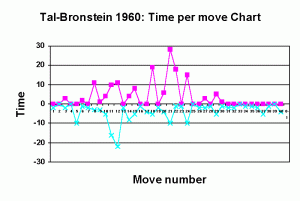
    <p><em>This chart shows the time taken for each move rather

    than total time, and is taken from the Furstenburg/Bronstein title

    “<strong>The Sorcerer’s Apprentice</strong>”. White above the line

    and Black below. Who won?</em></p>

    <p><em>”…Tal played the first seven moves with great

    confidence, accepting my Pawn sacrifice. With his next five moves

    he tried to justify his decision.”</em></p>

    <p><em>”With hindsight one can see that from moves 18 to 24

    Tal used a lot of time, trying to reduce the pressure of the Black

    pieces, but it was in vain. It would have been better to use this

    amount of time, about one hour, to play the opening more

    carefully.”</em></p>

    <p><em>”This is only one example and the reader who is

    interested in this aspect of chess should start recording times; it

    might well be that his chess improves immediately.”</em></p>

    <p>&nbsp;</p>

    <hr />

    <h2><a name=”RTFToC29″ id=”RTFToC29″>C3. Botvinnik-Tal 1960 (Game

    7)</a></h2>

    <img alt=”[Graph of Clock Times (3)]” src=”/wp/chessx/clock3.gif” />

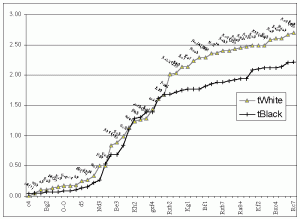
    <p>&nbsp; Move by move, with notes by Tal:</p>

    <p>&nbsp; W13: “The text move is the most precise, but the time

    spent in thinking about it proved that Botvinnik had not played

    competitively for some time. Why was it necessary to waste ten

    minutes out of an allotted two and one-half hours to play the most

    evident and surely the strongest continuation of the previous

    move?”</p>

    <p>&nbsp;</p>

    <p>&nbsp; B14: “Black took a long time to choose which plan he

    would use in the middle game.”</p>

    <p>&nbsp; B18: “A rather long think for this move – sixteen

    minutes. Black was calculating whether or not he should temporarily

    pass on his idea and carry it our later.”</p>

    <p>&nbsp; B23: “It is interesting that Black spent fifteen minutes

    thinking about the move that immediately followed the piece

    sacrifice. &hellip; This is but a confirmation, if it can be

    expressed this way, of an intuitive sacrifice, a confirmation of

    the fact that Black did not calculate all of the variations

    beginning with the sacrifice and ending with mate.”</p>

    <p>&nbsp; B28: “(After disturbance by spectators) I consciously

    chose the less strong but safer continuation.”</p>

    <p>&nbsp; B36: “Beginning with the 26th move, Black has been

    playing lightning chess.”</p>

    <p>&nbsp; B41: “Forty moves had been made but the opponents

    remained in their places. Obviously, Botvinnik considered that

    since Black was playing at such a rapid speed, he must have made a

    mistake somewhere, and as for me, I was still full of energy.”</p>

    <hr />

    <h2><a name=”RTFToC30″ id=”RTFToC30″>D. References</a></h2>

    FURSTENBURG/BRONSTEIN – The Sorcerer’s Apprentice.

    <p>&nbsp; KROGIUS – Psychology in Chess.</p>

    <p>&nbsp; TAL – Tal-Botvinnik 1960: Match for the World

    Championship 1960.</p>

    <p>&nbsp; WEBB – Chess For Tigers.</p>

    <hr />

    <h5><a name=”RTFToC31″ id=”RTFToC31″>Game 1: (59) Korchnoi – Suetin

    [C83] Moscow (XXVII USSR Ch.), 1960</a></h5>

    <strong>1.e4 e5 2.Nf3 Nc6 3.Bb5 a6 4.Ba4 Nf6 5.0-0 Nxe4 6.d4 b5

    7.Bb3 d5 8.dxe5 Be6 9.Qe2 Be7 10.c3 0-0 11.Nd4 Qd7 12.f3 Nc5 13.Bc2

    f6 14.exf6 Bxf6 15.Nxe6 Qxe6 16.Qxe6+ Nxe6 17.Bb3 Rad8 18.Rd1 Ne7

    19.Nd2 Kf7 20.Rf1 c5u</strong>

    <p class=”chessboard”><img alt=”+—————–+” src=”/wp/chessx/tx.gif” /><br />

    <img alt=”|” src=”/wp/chessx/lx.gif” /><img alt=”.” src=

    “/wp/chessx/w.gif” /><img alt=”+” src=”/wp/chessx/b.gif” /><img alt=”.” src=

    “/wp/chessx/w.gif” /><img alt=”4″ src=”/wp/chessx/brd.gif” /><img alt=”.”

    src=”/wp/chessx/w.gif” /><img alt=”4″ src=”/wp/chessx/brd.gif” /><img alt=”.”

    src=”/wp/chessx/w.gif” /><img alt=”+” src=”/wp/chessx/b.gif” /><img alt=”|”

    src=”/wp/chessx/rx.gif” /><br />

    <img alt=”|” src=”/wp/chessx/lx.gif” /><img alt=”+” src=

    “/wp/chessx/b.gif” /><img alt=”.” src=”/wp/chessx/w.gif” /><img alt=”+” src=

    “/wp/chessx/b.gif” /><img alt=”.” src=”/wp/chessx/w.gif” /><img alt=”h” src=

    “/wp/chessx/bnd.gif” /><img alt=”k” src=”/wp/chessx/bkl.gif” /><img alt=”0″

    src=”/wp/chessx/bpd.gif” /><img alt=”p” src=”/wp/chessx/bpl.gif” /><img alt=

    “|” src=”/wp/chessx/rx.gif” /><br />

    <img alt=”|” src=”/wp/chessx/lx.gif” /><img alt=”p” src=

    “/wp/chessx/bpl.gif” /><img alt=”+” src=”/wp/chessx/b.gif” /><img alt=”.”

    src=”/wp/chessx/w.gif” /><img alt=”+” src=”/wp/chessx/b.gif” /><img alt=”n”

    src=”/wp/chessx/bnl.gif” /><img alt=”g” src=”/wp/chessx/bbd.gif” /><img alt=

    “.” src=”/wp/chessx/w.gif” /><img alt=”+” src=”/wp/chessx/b.gif” /><img alt=

    “|” src=”/wp/chessx/rx.gif” /><br />

    <img alt=”|” src=”/wp/chessx/lx.gif” /><img alt=”+” src=

    “/wp/chessx/b.gif” /><img alt=”p” src=”/wp/chessx/bpl.gif” /><img alt=”0″

    src=”/wp/chessx/bpd.gif” /><img alt=”p” src=”/wp/chessx/bpl.gif” /><img alt=

    “+” src=”/wp/chessx/b.gif” /><img alt=”.” src=”/wp/chessx/w.gif” /><img alt=

    “+” src=”/wp/chessx/b.gif” /><img alt=”.” src=”/wp/chessx/w.gif” /><img alt=

    “|” src=”/wp/chessx/rx.gif” /><br />

    <img alt=”|” src=”/wp/chessx/lx.gif” /><img alt=”.” src=

    “/wp/chessx/w.gif” /><img alt=”+” src=”/wp/chessx/b.gif” /><img alt=”.” src=

    “/wp/chessx/w.gif” /><img alt=”+” src=”/wp/chessx/b.gif” /><img alt=”.” src=

    “/wp/chessx/w.gif” /><img alt=”+” src=”/wp/chessx/b.gif” /><img alt=”.” src=

    “/wp/chessx/w.gif” /><img alt=”+” src=”/wp/chessx/b.gif” /><img alt=”|” src=

    “/wp/chessx/rx.gif” /><br />

    <img alt=”|” src=”/wp/chessx/lx.gif” /><img alt=”+” src=

    “/wp/chessx/b.gif” /><img alt=”B” src=”/wp/chessx/wbl.gif” /><img alt=”)”

    src=”/wp/chessx/wpd.gif” /><img alt=”.” src=”/wp/chessx/w.gif” /><img alt=”+”

    src=”/wp/chessx/b.gif” /><img alt=”P” src=”/wp/chessx/wpl.gif” /><img alt=”+”

    src=”/wp/chessx/b.gif” /><img alt=”.” src=”/wp/chessx/w.gif” /><img alt=”|”

    src=”/wp/chessx/rx.gif” /><br />

    <img alt=”|” src=”/wp/chessx/lx.gif” /><img alt=”P” src=

    “/wp/chessx/wpl.gif” /><img alt=”)” src=”/wp/chessx/wpd.gif” /><img alt=”.”

    src=”/wp/chessx/w.gif” /><img alt=”H” src=”/wp/chessx/wnd.gif” /><img alt=”.”

    src=”/wp/chessx/w.gif” /><img alt=”+” src=”/wp/chessx/b.gif” /><img alt=”P”

    src=”/wp/chessx/wpl.gif” /><img alt=”)” src=”/wp/chessx/wpd.gif” /><img alt=

    “|” src=”/wp/chessx/rx.gif” /><br />

    <img alt=”|” src=”/wp/chessx/lx.gif” /><img alt=”$” src=

    “/wp/chessx/wrd.gif” /><img alt=”.” src=”/wp/chessx/w.gif” /><img alt=”G”

    src=”/wp/chessx/wbd.gif” /><img alt=”.” src=”/wp/chessx/w.gif” /><img alt=”+”

    src=”/wp/chessx/b.gif” /><img alt=”R” src=”/wp/chessx/wrl.gif” /><img alt=”I”

    src=”/wp/chessx/wkd.gif” /><img alt=”.” src=”/wp/chessx/w.gif” /><img alt=”|”

    src=”/wp/chessx/rx.gif” /><br />

    <img alt=”+—————–+” src=”/wp/chessx/bx.gif” /></p><p>

    Suetin has gained the advantage and steadily increases the

    pressure. Korchnoi was able to divert his opponent from the

    measured tempo if his play only by provoking his own time

    trouble.</p>

    <p><strong>21.f4 c4 22.Bd1 Nc6 23.Nf3 d4 24.Ng5+ Bxg5

    25.fxg5+ Ke7 26.Re1 Kd6 27.cxd4 Nexd4 28.Bd2 Rde8 29.Rc1 Kd5 30.b3

    Rxe1+ 31.Bxe1 Ne5 32.bxc4+ bxc4 33.Rb1 Rc8 34.Bc3 Nb5 35.Ba1 c3

    36.a4 Nd6 37.Bb3+ Ke4 38.Re1+ Kf5 39.Bc2+ Ke6 40.Bb3+ Kf5 41.Bc2+

    Ke6 42.Re3 Ndc4 43.Rxc3 Rd8 44.h3 g6 45.Bb3 Kf5 46.Kh2 Rc8 47.Rc2

    Rc6 48.Re2 Rb6 49.Bc2+ Ke6 50.Bd4 Rd6 51.Bc3 Rb6 52.Kg3 Kd5 53.Kf4

    Nc6 54.Re1 Rb7 55.Be4+ Kc5 56.Rc1 Rb3 57.Bg7 Nb4 58.Bf8+ Kd4

    59.Rd1+ Nd3+ 60.Rxd3+ Rxd3 61.Bg7+ 1-0</strong></p>

    <p>&nbsp; Suetin incorrectly believed that he had the chance of an

    early win, began to hurry, committed some serious errors and

    lost.This game decided first place in the championship.</p>

    <hr />

    <h5><a name=”RTFToC32″ id=”RTFToC32″>Game 2: Regis,D (1935) –

    Hampton,M (1900) [E91]</a></h5>

    Clock control: Devon vs. Wilts devon vs. wilts, 1993

    <p><strong>1.e4 0m 1…g6 0m 2.d4 1m 2…Bg7 0m 3.c4

    1m</strong></p>

    <p>&nbsp; Black was visibly upset by this move.</p>

    <p>&nbsp; I know from playing the Modern myself that few 1.&nbsp;e4

    players will transfer to a Queen’s-side opening, but that’s always

    been where my heart is.</p>

    <p><strong>3…d6</strong> 1m <strong>4.Nc3</strong> 1m

    <strong>4…Nf6</strong> 2mThe game is now more or less a King’s

    Indian… <em>[4…Nc6 Keeps in independent ‘Modern’

    lines.]</em></p>

    <p><strong>5.Be2</strong> 2m <strong>5…0-0</strong> 2m

    <strong>6.Nf3</strong> 2m <strong>6…c5</strong> 6m</p>

    <p>&nbsp; …or a Benoni. <em>[6…e5 is the King’s

    Indian]</em></p>

    <p><strong>7.d5</strong> 5m <strong>7…Bg4</strong> 10m

    <strong>8.Nd2</strong> 6mOver-eager.In any event, Black now starts

    a phase of thinking for a long while over his moves.</p>

    <p><em>[8.Ng1 Bxe2 9.Ngxe2]</em></p>

    <p><strong>8…Bxe2</strong> 14m <strong>9.Qxe2</strong> 8m

    <strong>9…Nfd7</strong> 14m <strong>10.0-0</strong> 10m

    <strong>10…Na6</strong> 15m <strong>11.f4</strong> 11m

    <strong>11…Qa5</strong> 30m <strong>12.Nf3</strong> 15m</p>

    <p>&nbsp; I was feeling quite pleased here: that I had both a chess

    and a psychological initiative out of the opening. I don’t think I

    have played Benonis any more often than my opponent but have looked

    at this type of position and felt at ease with it.

    <strong>12…Nc7</strong> 36m</p>

    <p><em>[12…Bxc3 13.bxc3 Qxc3 14.Bb2 Qa5 15.e5]</em></p>

    <p><strong>13.e5</strong> 20m <strong>13…a6</strong> 44m

    <strong>14.Bd2</strong> 23m <strong>14…Qb6</strong> 45m

    <strong>15.e6</strong> 29m looks good but perhaps I was not

    sufficiently developed for this…</p>

    <p><em>[15.b3]</em></p>

    <p><strong>15…fxe6</strong> 46m <strong>16.dxe6</strong>

    29m <strong>16…Nf6</strong> 47m</p>

    <p>&nbsp; Black now has another long thinking phase, which leaves

    him in time trouble for the rest of the game.

    <strong>17.Ng5</strong> 35m</p>

    <p><em>[17.Rae1 or 17 b3 17…Qxb2 18.Rb1 Qc2 19.Rxb7 Nfe8

    20.Rc1 Qf5 21.Nd5]</em></p>

    <p><strong>17…d5</strong> 51m <strong>18.cxd5</strong> 35m

    <strong>18…Nfxd5</strong> 53m <strong>19.Qf3</strong> 42m

    <strong>19…Nxc3</strong> 68m <strong>20.Bxc3</strong> 43m

    <strong>20…Bxc3</strong> 75m <strong>21.bxc3</strong> 46m

    <em>[21.Qxc3 Rf6 22.Qh3 h5 23.f5 c4+ 24.Kh1 Raf8 25.Nf7]</em>

    <strong>21…c4+</strong> 83m <strong>22.Kh1</strong> 46m

    <strong>22…h6</strong> 84m <strong>23.Nf7</strong> 56m

    <strong>23…Nxe6</strong> 87m <em>[23…Kg7 24.f5]</em>

    <strong>24.Nxh6+</strong> 58m <strong>24…Kh7</strong> 88m

    <strong>25.f5</strong> 63m</p>

    <p>&nbsp; [25.Qh3 Nxf4 26.Rxf4 Rxf4 27.Nf7+ <em>(27.Re1 Kg7 28.Ng4

    Rf7 29.Qh6+ Kg8-+;</em></p>

    <p><em>27.Nf5+ Kg8 28.Nxe7+ Kg7 29.Nd5 Qb2 30.Rd1u)</em>

    27…Kg8 28.Qh8+ Kxf7[[threesuperior]] 29.Qxa8]</p>

    <p><strong>25…Kxh6</strong> 91m <strong>26.Qh3+</strong>

    64m <strong>26…Kg7</strong> 91m <strong>27.fxe6</strong> ?m saves

    the pawn but now Black has a strong initiative.</p>

    <p>&nbsp; White now starts to consume time in great forkfuls: I

    remember finding it very hard to forget the earlier part of the

    game where I thought I had done enough to win, and couldn’t get on

    and defend.</p>

    <p><strong>27…Rxf1+</strong> m <strong>28.Rxf1</strong> ?m

    <strong>28…Rf8</strong> m <strong>29.Rg1</strong> 79m <em>[29.Re1

    Qf2]</em> <strong>29…Rf2</strong> 93m <strong>30.Qh4</strong> 81m

    <strong>30…Qc5</strong> 95m <strong>31.a4</strong> 83m

    <strong>31…b5</strong> 96m <strong>32.a5</strong> 84m which made

    me think …b5 was wrong <strong>32…Re2</strong> 97m

    <strong>33.Re1</strong> 91m <strong>33…Rf2</strong> m

    <strong>34.h3</strong> 93m <strong>34…Rf6</strong> m

    <strong>35.Qe4</strong> 96m <strong>35…Qf2</strong> m

    <strong>36.Rg1</strong> ?m <em>[36.Qe5 Qf5]</em>

    <strong>36…Qf5</strong> m <strong>37.Qb7</strong> ?m

    <strong>37…Rxe6</strong> m <strong>38.Rd1</strong> ?m

    <strong>38…Qe5</strong> m <strong>39.Qd7</strong> ?m

    <strong>39…Qe2</strong> m <strong>White lost on time</strong>; I

    had even put 36…Qf5 down as a White move and was one out!

    <em>[39…Qe2 40.Qd4+]</em> <strong>0-1</strong></p>

    <hr />

    <h5><a name=”RTFToC33″ id=”RTFToC33″>Game 3: Botvinnik ,M – Tal ,M

    [E10]: Match, Moscow (Russia) Match, Moscow (Russia) (8),

    1960</a></h5>

    <strong>1.d4 Nf6 2.c4 e6 3.Nf3 c5 4.d5 exd5 5.cxd5 g6 6.Nc3 Bg7

    7.Bg5 0-0 8.e3 Re8 9.Nd2 d6 10.Be2 a6 11.a4 Nbd7 12.0-0 Qc7 13.Qc2

    Nb6 14.Bf3 c4 15.Bxf6 Bxf6 16.a5 Nd7 17.Nce4 Be5 18.Qxc4 Qd8 19.Qa2

    f5 20.Nc3 g5 21.Nc4 g4 22.Be2 Qf6 23.Na4 Kh8 24.g3 h5 25.f4 Bd4

    26.Qa3 Rb8 27.Nab6 h4 28.Rad1 Bxb6 29.axb6 Nc5 30.gxh4 Bd7 31.Qc3

    Qxc3 32.bxc3 Bb5 33.Rfe1 Ne4</strong>

    <p class=”chessboard”><img alt=”+—————–+” src=”/wp/chessx/tx.gif” /><br />

    <img alt=”|” src=”/wp/chessx/lx.gif” /><img alt=”.” src=

    “/wp/chessx/w.gif” /><img alt=”4″ src=”/wp/chessx/brd.gif” /><img alt=”.”

    src=”/wp/chessx/w.gif” /><img alt=”+” src=”/wp/chessx/b.gif” /><img alt=”r”

    src=”/wp/chessx/brl.gif” /><img alt=”+” src=”/wp/chessx/b.gif” /><img alt=”.”

    src=”/wp/chessx/w.gif” /><img alt=”i” src=”/wp/chessx/bkd.gif” /><img alt=”|”

    src=”/wp/chessx/rx.gif” /><br />

    <img alt=”|” src=”/wp/chessx/lx.gif” /><img alt=”+” src=

    “/wp/chessx/b.gif” /><img alt=”p” src=”/wp/chessx/bpl.gif” /><img alt=”+”

    src=”/wp/chessx/b.gif” /><img alt=”.” src=”/wp/chessx/w.gif” /><img alt=”+”

    src=”/wp/chessx/b.gif” /><img alt=”.” src=”/wp/chessx/w.gif” /><img alt=”+”

    src=”/wp/chessx/b.gif” /><img alt=”.” src=”/wp/chessx/w.gif” /><img alt=”|”

    src=”/wp/chessx/rx.gif” /><br />

    <img alt=”|” src=”/wp/chessx/lx.gif” /><img alt=”p” src=

    “/wp/chessx/bpl.gif” /><img alt=”)” src=”/wp/chessx/wpd.gif” /><img alt=”.”

    src=”/wp/chessx/w.gif” /><img alt=”0″ src=”/wp/chessx/bpd.gif” /><img alt=”.”

    src=”/wp/chessx/w.gif” /><img alt=”+” src=”/wp/chessx/b.gif” /><img alt=”.”

    src=”/wp/chessx/w.gif” /><img alt=”+” src=”/wp/chessx/b.gif” /><img alt=”|”

    src=”/wp/chessx/rx.gif” /><br />

    <img alt=”|” src=”/wp/chessx/lx.gif” /><img alt=”+” src=

    “/wp/chessx/b.gif” /><img alt=”b” src=”/wp/chessx/bbl.gif” /><img alt=”+”

    src=”/wp/chessx/b.gif” /><img alt=”P” src=”/wp/chessx/wpl.gif” /><img alt=”+”

    src=”/wp/chessx/b.gif” /><img alt=”p” src=”/wp/chessx/bpl.gif” /><img alt=”+”

    src=”/wp/chessx/b.gif” /><img alt=”.” src=”/wp/chessx/w.gif” /><img alt=”|”

    src=”/wp/chessx/rx.gif” /><br />

    <img alt=”|” src=”/wp/chessx/lx.gif” /><img alt=”.” src=

    “/wp/chessx/w.gif” /><img alt=”+” src=”/wp/chessx/b.gif” /><img alt=”N” src=

    “/wp/chessx/wnl.gif” /><img alt=”+” src=”/wp/chessx/b.gif” /><img alt=”n”

    src=”/wp/chessx/bnl.gif” /><img alt=”)” src=”/wp/chessx/wpd.gif” /><img alt=

    “p” src=”/wp/chessx/bpl.gif” /><img alt=”)” src=

    “/wp/chessx/wpd.gif” /><img alt=”|” src=”/wp/chessx/rx.gif” /><br />

    <img alt=”|” src=”/wp/chessx/lx.gif” /><img alt=”+” src=

    “/wp/chessx/b.gif” /><img alt=”.” src=”/wp/chessx/w.gif” /><img alt=”)” src=

    “/wp/chessx/wpd.gif” /><img alt=”.” src=”/wp/chessx/w.gif” /><img alt=”)”

    src=”/wp/chessx/wpd.gif” /><img alt=”.” src=”/wp/chessx/w.gif” /><img alt=”+”

    src=”/wp/chessx/b.gif” /><img alt=”.” src=”/wp/chessx/w.gif” /><img alt=”|”

    src=”/wp/chessx/rx.gif” /><br />

    <img alt=”|” src=”/wp/chessx/lx.gif” /><img alt=”.” src=

    “/wp/chessx/w.gif” /><img alt=”+” src=”/wp/chessx/b.gif” /><img alt=”.” src=

    “/wp/chessx/w.gif” /><img alt=”+” src=”/wp/chessx/b.gif” /><img alt=”B” src=

    “/wp/chessx/wbl.gif” /><img alt=”+” src=”/wp/chessx/b.gif” /><img alt=”.”

    src=”/wp/chessx/w.gif” /><img alt=”)” src=”/wp/chessx/wpd.gif” /><img alt=”|”

    src=”/wp/chessx/rx.gif” /><br />

    <img alt=”|” src=”/wp/chessx/lx.gif” /><img alt=”+” src=

    “/wp/chessx/b.gif” /><img alt=”.” src=”/wp/chessx/w.gif” /><img alt=”+” src=

    “/wp/chessx/b.gif” /><img alt=”R” src=”/wp/chessx/wrl.gif” /><img alt=”$”

    src=”/wp/chessx/wrd.gif” /><img alt=”.” src=”/wp/chessx/w.gif” /><img alt=”I”

    src=”/wp/chessx/wkd.gif” /><img alt=”.” src=”/wp/chessx/w.gif” /><img alt=”|”

    src=”/wp/chessx/rx.gif” /><br />

    <img alt=”+—————–+” src=”/wp/chessx/bx.gif” /></p><p>

    <strong>34.Rc1 Rbc8??</strong> “<em>I made the last move

    instantaneously – as if seized by the time pressure of my opponent.

    I had formerly seen that I would win the exchange, but I had but to

    think a little; then I would have come up with the absolutely

    correct idea: the other Rook must go to c8 (winning the exchange

    but keeping the b7 Pawn</em>).” – TAL</p>

    <p>&nbsp; [“Here it is: the hypnotic power of ‘natural’ moves!” –

    Krogius]</p>

    <p><em>[34…Rec8]</em></p>

    <p><strong>35.Na5 Bxe2 36.Rxe2 Nxc3</strong> “<em>It could

    be noticed from my opponent’s expression that he had been rather

    surprised by the unexpected turn of events, but in spite of intense

    time pressure he successfully responded to the reversal of the

    conditions and immediately found the best continuation</em>.” – Tal

    <strong>37.Rxc3!</strong></p>

    <p><em>[37.Ree1 Ne2+]</em></p>

    <p><strong>37…Rxc3 38.Nxb7</strong> “<em>Black decided he

    still had chances to win</em>…” – Tal

    <strong>38…Rcxe3</strong></p>

    <p><em>[38…Rexe3 is given in some sources]</em></p>

    <p><strong>39.Rxe3 Rxe3 40.Nxd6 Rd3?</strong></p>

    <p class=”chessboard”><img alt=”+—————–+” src=”/wp/chessx/tx.gif” /><br />

    <img alt=”|” src=”/wp/chessx/lx.gif” /><img alt=”.” src=

    “/wp/chessx/w.gif” /><img alt=”+” src=”/wp/chessx/b.gif” /><img alt=”.” src=

    “/wp/chessx/w.gif” /><img alt=”+” src=”/wp/chessx/b.gif” /><img alt=”.” src=

    “/wp/chessx/w.gif” /><img alt=”+” src=”/wp/chessx/b.gif” /><img alt=”.” src=

    “/wp/chessx/w.gif” /><img alt=”i” src=”/wp/chessx/bkd.gif” /><img alt=”|”

    src=”/wp/chessx/rx.gif” /><br />

    <img alt=”|” src=”/wp/chessx/lx.gif” /><img alt=”+” src=

    “/wp/chessx/b.gif” /><img alt=”.” src=”/wp/chessx/w.gif” /><img alt=”+” src=

    “/wp/chessx/b.gif” /><img alt=”.” src=”/wp/chessx/w.gif” /><img alt=”+” src=

    “/wp/chessx/b.gif” /><img alt=”.” src=”/wp/chessx/w.gif” /><img alt=”+” src=

    “/wp/chessx/b.gif” /><img alt=”.” src=”/wp/chessx/w.gif” /><img alt=”|” src=

    “/wp/chessx/rx.gif” /><br />

    <img alt=”|” src=”/wp/chessx/lx.gif” /><img alt=”p” src=

    “/wp/chessx/bpl.gif” /><img alt=”)” src=”/wp/chessx/wpd.gif” /><img alt=”.”

    src=”/wp/chessx/w.gif” /><img alt=”H” src=”/wp/chessx/wnd.gif” /><img alt=”.”

    src=”/wp/chessx/w.gif” /><img alt=”+” src=”/wp/chessx/b.gif” /><img alt=”.”

    src=”/wp/chessx/w.gif” /><img alt=”+” src=”/wp/chessx/b.gif” /><img alt=”|”

    src=”/wp/chessx/rx.gif” /><br />

    <img alt=”|” src=”/wp/chessx/lx.gif” /><img alt=”+” src=

    “/wp/chessx/b.gif” /><img alt=”.” src=”/wp/chessx/w.gif” /><img alt=”+” src=

    “/wp/chessx/b.gif” /><img alt=”P” src=”/wp/chessx/wpl.gif” /><img alt=”+”

    src=”/wp/chessx/b.gif” /><img alt=”p” src=”/wp/chessx/bpl.gif” /><img alt=”+”

    src=”/wp/chessx/b.gif” /><img alt=”.” src=”/wp/chessx/w.gif” /><img alt=”|”

    src=”/wp/chessx/rx.gif” /><br />

    <img alt=”|” src=”/wp/chessx/lx.gif” /><img alt=”.” src=

    “/wp/chessx/w.gif” /><img alt=”+” src=”/wp/chessx/b.gif” /><img alt=”.” src=

    “/wp/chessx/w.gif” /><img alt=”+” src=”/wp/chessx/b.gif” /><img alt=”.” src=

    “/wp/chessx/w.gif” /><img alt=”)” src=”/wp/chessx/wpd.gif” /><img alt=”p”

    src=”/wp/chessx/bpl.gif” /><img alt=”)” src=”/wp/chessx/wpd.gif” /><img alt=

    “|” src=”/wp/chessx/rx.gif” /><br />

    <img alt=”|” src=”/wp/chessx/lx.gif” /><img alt=”+” src=

    “/wp/chessx/b.gif” /><img alt=”.” src=”/wp/chessx/w.gif” /><img alt=”+” src=

    “/wp/chessx/b.gif” /><img alt=”r” src=”/wp/chessx/brl.gif” /><img alt=”+”

    src=”/wp/chessx/b.gif” /><img alt=”.” src=”/wp/chessx/w.gif” /><img alt=”+”

    src=”/wp/chessx/b.gif” /><img alt=”.” src=”/wp/chessx/w.gif” /><img alt=”|”

    src=”/wp/chessx/rx.gif” /><br />

    <img alt=”|” src=”/wp/chessx/lx.gif” /><img alt=”.” src=

    “/wp/chessx/w.gif” /><img alt=”+” src=”/wp/chessx/b.gif” /><img alt=”.” src=

    “/wp/chessx/w.gif” /><img alt=”+” src=”/wp/chessx/b.gif” /><img alt=”.” src=

    “/wp/chessx/w.gif” /><img alt=”+” src=”/wp/chessx/b.gif” /><img alt=”.” src=

    “/wp/chessx/w.gif” /><img alt=”)” src=”/wp/chessx/wpd.gif” /><img alt=”|”

    src=”/wp/chessx/rx.gif” /><br />

    <img alt=”|” src=”/wp/chessx/lx.gif” /><img alt=”+” src=

    “/wp/chessx/b.gif” /><img alt=”.” src=”/wp/chessx/w.gif” /><img alt=”+” src=

    “/wp/chessx/b.gif” /><img alt=”.” src=”/wp/chessx/w.gif” /><img alt=”+” src=

    “/wp/chessx/b.gif” /><img alt=”.” src=”/wp/chessx/w.gif” /><img alt=”I” src=

    “/wp/chessx/wkd.gif” /><img alt=”.” src=”/wp/chessx/w.gif” /><img alt=”|”

    src=”/wp/chessx/rx.gif” /><br />

    <img alt=”+—————–+” src=”/wp/chessx/bx.gif” /></p><p>

    “<em>Adjourned. At first I was extremely optimistic</em>…” –

    Tal</p>

    <p>&nbsp; [40…Kg8 “<em>was better, but Black was under the

    erroneous impression that all was in order</em>”]</p>

    <p><strong>41.Nf7+</strong> (sealed) “<em>I immediately

    resigned</em>.” <strong>1-0</strong></p>

    <p>&nbsp; [41.b7 “<em>during the game I was convinced that this

    guaranteed a win for Black</em>” 41…Rb3 42.Nf7+ Kh7! 43.Nd8 a5

    44.d6 a4 45.d7 a3 46.Ne6 a2-+;</p>

    <p>&nbsp; 41.Nf7+! Kg7 but now <em>(41…Kh7? 42.d6!)</em> 42.b7

    Rb3 43.Nd8 a5 44.d6 a4 45.d7 a3 46.Ne6+!+- “<em>Upon returning home

    my trainer and I had only to investigate the subtleties of this

    rather simple analysis. We began to play through the game and in

    the process of analysis we simultaneously we discovered that Black

    could have forced his win on his 34th move. There was nothing to

    say and we didn’t sleep a wink the whole night</em>.”]</p>

    <hr />

    <h5><a name=”RTFToC34″ id=”RTFToC34″>Game 4: Gligoric,S – Tal,M

    [A78] Yugoslavia ct Yugoslavia ct (4), 1959</a></h5>

    <strong>1.d4 Nf6 2.c4 c5 3.d5 e6 4.Nc3 exd5 5.cxd5 d6 6.e4 g6 7.Nf3

    Bg7 8.Be2 0-0 9.0-0 Re8 10.Nd2 Na6 11.Rb1 Bd7 12.Re1 Rb8 13.b3 b5

    14.Bb2 Nc7 15.Qc2 Qe7 16.Nd1 Bh6 17.f3 Nh5 18.Nf1 Nxd5 19.exd5 Bf5

    20.Qc3 Bg7 21.Qc1 Bxb1 22.Bxg7 Kxg7 23.Qxb1 Nf4 24.Nfe3

    Qe5</strong>

    <p class=”chessboard”><img alt=”+—————–+” src=”/wp/chessx/tx.gif” /><br />

    <img alt=”|” src=”/wp/chessx/lx.gif” /><img alt=”.” src=

    “/wp/chessx/w.gif” /><img alt=”4″ src=”/wp/chessx/brd.gif” /><img alt=”.”

    src=”/wp/chessx/w.gif” /><img alt=”+” src=”/wp/chessx/b.gif” /><img alt=”r”

    src=”/wp/chessx/brl.gif” /><img alt=”+” src=”/wp/chessx/b.gif” /><img alt=”.”

    src=”/wp/chessx/w.gif” /><img alt=”+” src=”/wp/chessx/b.gif” /><img alt=”|”

    src=”/wp/chessx/rx.gif” /><br />

    <img alt=”|” src=”/wp/chessx/lx.gif” /><img alt=”0″ src=

    “/wp/chessx/bpd.gif” /><img alt=”.” src=”/wp/chessx/w.gif” /><img alt=”+”

    src=”/wp/chessx/b.gif” /><img alt=”.” src=”/wp/chessx/w.gif” /><img alt=”+”

    src=”/wp/chessx/b.gif” /><img alt=”p” src=”/wp/chessx/bpl.gif” /><img alt=”i”

    src=”/wp/chessx/bkd.gif” /><img alt=”p” src=”/wp/chessx/bpl.gif” /><img alt=

    “|” src=”/wp/chessx/rx.gif” /><br />

    <img alt=”|” src=”/wp/chessx/lx.gif” /><img alt=”.” src=

    “/wp/chessx/w.gif” /><img alt=”+” src=”/wp/chessx/b.gif” /><img alt=”.” src=

    “/wp/chessx/w.gif” /><img alt=”0″ src=”/wp/chessx/bpd.gif” /><img alt=”.”

    src=”/wp/chessx/w.gif” /><img alt=”+” src=”/wp/chessx/b.gif” /><img alt=”p”

    src=”/wp/chessx/bpl.gif” /><img alt=”+” src=”/wp/chessx/b.gif” /><img alt=”|”

    src=”/wp/chessx/rx.gif” /><br />

    <img alt=”|” src=”/wp/chessx/lx.gif” /><img alt=”+” src=

    “/wp/chessx/b.gif” /><img alt=”p” src=”/wp/chessx/bpl.gif” /><img alt=”0″

    src=”/wp/chessx/bpd.gif” /><img alt=”P” src=”/wp/chessx/wpl.gif” /><img alt=

    “1” src=”/wp/chessx/bqd.gif” /><img alt=”.” src=

    “/wp/chessx/w.gif” /><img alt=”+” src=”/wp/chessx/b.gif” /><img alt=”.” src=

    “/wp/chessx/w.gif” /><img alt=”|” src=”/wp/chessx/rx.gif” /><br />

    <img alt=”|” src=”/wp/chessx/lx.gif” /><img alt=”.” src=

    “/wp/chessx/w.gif” /><img alt=”+” src=”/wp/chessx/b.gif” /><img alt=”.” src=

    “/wp/chessx/w.gif” /><img alt=”+” src=”/wp/chessx/b.gif” /><img alt=”.” src=

    “/wp/chessx/w.gif” /><img alt=”h” src=”/wp/chessx/bnd.gif” /><img alt=”.”

    src=”/wp/chessx/w.gif” /><img alt=”+” src=”/wp/chessx/b.gif” /><img alt=”|”

    src=”/wp/chessx/rx.gif” /><br />

    <img alt=”|” src=”/wp/chessx/lx.gif” /><img alt=”+” src=

    “/wp/chessx/b.gif” /><img alt=”P” src=”/wp/chessx/wpl.gif” /><img alt=”+”

    src=”/wp/chessx/b.gif” /><img alt=”.” src=”/wp/chessx/w.gif” /><img alt=”H”

    src=”/wp/chessx/wnd.gif” /><img alt=”P” src=”/wp/chessx/wpl.gif” /><img alt=

    “+” src=”/wp/chessx/b.gif” /><img alt=”.” src=”/wp/chessx/w.gif” /><img alt=

    “|” src=”/wp/chessx/rx.gif” /><br />

    <img alt=”|” src=”/wp/chessx/lx.gif” /><img alt=”P” src=

    “/wp/chessx/wpl.gif” /><img alt=”+” src=”/wp/chessx/b.gif” /><img alt=”.”

    src=”/wp/chessx/w.gif” /><img alt=”+” src=”/wp/chessx/b.gif” /><img alt=”B”

    src=”/wp/chessx/wbl.gif” /><img alt=”+” src=”/wp/chessx/b.gif” /><img alt=”P”

    src=”/wp/chessx/wpl.gif” /><img alt=”)” src=”/wp/chessx/wpd.gif” /><img alt=

    “|” src=”/wp/chessx/rx.gif” /><br />

    <img alt=”|” src=”/wp/chessx/lx.gif” /><img alt=”+” src=

    “/wp/chessx/b.gif” /><img alt=”Q” src=”/wp/chessx/wql.gif” /><img alt=”+”

    src=”/wp/chessx/b.gif” /><img alt=”N” src=”/wp/chessx/wnl.gif” /><img alt=”$”

    src=”/wp/chessx/wrd.gif” /><img alt=”.” src=”/wp/chessx/w.gif” /><img alt=”I”

    src=”/wp/chessx/wkd.gif” /><img alt=”.” src=”/wp/chessx/w.gif” /><img alt=”|”

    src=”/wp/chessx/rx.gif” /><br />

    <img alt=”+—————–+” src=”/wp/chessx/bx.gif” /></p><p>

    Black has a small advantage, difficult to exploit with regular

    means against an opponent with such a clear logical head.

    <strong>25.Bxb5 Rxb5 26.Nf5+ gxf5!?</strong> Tal chooses a sharp

    hazardous continuation, probably not the strongest but Gligoric

    became confused, thought for a long while, got into time trouble,

    made serious mistakes and lost.</p>

    <p><em>[26…Qxf5 27.Qxf5 gxf5 28.Rxe8

    Nxd5[[threesuperior]]]</em></p>

    <p><strong>27.Rxe5 Rxe5 28.g3 Ne2+ 29.Kf2 Kg8

    30.Ne3?</strong></p>

    <p><em>[30.f4! Re8 31.Qxf5]</em></p>

    <p><strong>30…Nd4 31.f4 Re4 32.g4!? Rxf4+ 33.Kg2 fxg4-+

    34.Nc4 Nf3 35.Qc1 Rf6 36.Qe3 Kf8 37.Qe4 Rb8 38.Qxh7 Re8 39.Qh8+ Ke7

    40.Qg7 Nh4+ 41.Kg1 Nf3+ 42.Kg2 Rg6 43.Qc3 Nd4 44.b4 Kf8 45.Ne3 g3

    46.h3 Rf6 0-1</strong></p>

    <hr />

    <h5><a name=”RTFToC35″ id=”RTFToC35″>Game 5: Blackstock,L – Webb,S

    [C09] Borehamwood, 1977</a></h5>

    <strong>1.e4 e6 2.d4 d5 3.Nd2 c5 4.exd5 exd5 5.Ngf3 Nc6 6.Bb5 Bd6

    7.dxc5 Bxc5 8.0-0 Nge7 9.Nb3 Bb6 10.Re1 0-0 11.Be3 Bf5 12.c3

    Be4</strong>

    <p class=”chessboard”><img alt=”+—————–+” src=”/wp/chessx/tx.gif” /><br />

    <img alt=”|” src=”/wp/chessx/lx.gif” /><img alt=”r” src=

    “/wp/chessx/brl.gif” /><img alt=”+” src=”/wp/chessx/b.gif” /><img alt=”.”

    src=”/wp/chessx/w.gif” /><img alt=”1″ src=”/wp/chessx/bqd.gif” /><img alt=”.”

    src=”/wp/chessx/w.gif” /><img alt=”4″ src=”/wp/chessx/brd.gif” /><img alt=”k”

    src=”/wp/chessx/bkl.gif” /><img alt=”+” src=”/wp/chessx/b.gif” /><img alt=”|”

    src=”/wp/chessx/rx.gif” /><br />

    <img alt=”|” src=”/wp/chessx/lx.gif” /><img alt=”0″ src=

    “/wp/chessx/bpd.gif” /><img alt=”p” src=”/wp/chessx/bpl.gif” /><img alt=”+”

    src=”/wp/chessx/b.gif” /><img alt=”.” src=”/wp/chessx/w.gif” /><img alt=”h”

    src=”/wp/chessx/bnd.gif” /><img alt=”p” src=”/wp/chessx/bpl.gif” /><img alt=

    “0” src=”/wp/chessx/bpd.gif” /><img alt=”p” src=

    “/wp/chessx/bpl.gif” /><img alt=”|” src=”/wp/chessx/rx.gif” /><br />

    <img alt=”|” src=”/wp/chessx/lx.gif” /><img alt=”.” src=

    “/wp/chessx/w.gif” /><img alt=”g” src=”/wp/chessx/bbd.gif” /><img alt=”n”

    src=”/wp/chessx/bnl.gif” /><img alt=”+” src=”/wp/chessx/b.gif” /><img alt=”.”

    src=”/wp/chessx/w.gif” /><img alt=”+” src=”/wp/chessx/b.gif” /><img alt=”.”

    src=”/wp/chessx/w.gif” /><img alt=”+” src=”/wp/chessx/b.gif” /><img alt=”|”

    src=”/wp/chessx/rx.gif” /><br />

    <img alt=”|” src=”/wp/chessx/lx.gif” /><img alt=”+” src=

    “/wp/chessx/b.gif” /><img alt=”B” src=”/wp/chessx/wbl.gif” /><img alt=”+”

    src=”/wp/chessx/b.gif” /><img alt=”p” src=”/wp/chessx/bpl.gif” /><img alt=”+”

    src=”/wp/chessx/b.gif” /><img alt=”.” src=”/wp/chessx/w.gif” /><img alt=”+”

    src=”/wp/chessx/b.gif” /><img alt=”.” src=”/wp/chessx/w.gif” /><img alt=”|”

    src=”/wp/chessx/rx.gif” /><br />

    <img alt=”|” src=”/wp/chessx/lx.gif” /><img alt=”.” src=

    “/wp/chessx/w.gif” /><img alt=”+” src=”/wp/chessx/b.gif” /><img alt=”.” src=

    “/wp/chessx/w.gif” /><img alt=”+” src=”/wp/chessx/b.gif” /><img alt=”b” src=

    “/wp/chessx/bbl.gif” /><img alt=”+” src=”/wp/chessx/b.gif” /><img alt=”.”

    src=”/wp/chessx/w.gif” /><img alt=”+” src=”/wp/chessx/b.gif” /><img alt=”|”

    src=”/wp/chessx/rx.gif” /><br />

    <img alt=”|” src=”/wp/chessx/lx.gif” /><img alt=”+” src=

    “/wp/chessx/b.gif” /><img alt=”N” src=”/wp/chessx/wnl.gif” /><img alt=”)”

    src=”/wp/chessx/wpd.gif” /><img alt=”.” src=”/wp/chessx/w.gif” /><img alt=”G”

    src=”/wp/chessx/wbd.gif” /><img alt=”N” src=”/wp/chessx/wnl.gif” /><img alt=

    “+” src=”/wp/chessx/b.gif” /><img alt=”.” src=”/wp/chessx/w.gif” /><img alt=

    “|” src=”/wp/chessx/rx.gif” /><br />

    <img alt=”|” src=”/wp/chessx/lx.gif” /><img alt=”P” src=

    “/wp/chessx/wpl.gif” /><img alt=”)” src=”/wp/chessx/wpd.gif” /><img alt=”.”

    src=”/wp/chessx/w.gif” /><img alt=”+” src=”/wp/chessx/b.gif” /><img alt=”.”

    src=”/wp/chessx/w.gif” /><img alt=”)” src=”/wp/chessx/wpd.gif” /><img alt=”P”

    src=”/wp/chessx/wpl.gif” /><img alt=”)” src=”/wp/chessx/wpd.gif” /><img alt=

    “|” src=”/wp/chessx/rx.gif” /><br />

    <img alt=”|” src=”/wp/chessx/lx.gif” /><img alt=”$” src=

    “/wp/chessx/wrd.gif” /><img alt=”.” src=”/wp/chessx/w.gif” /><img alt=”+”

    src=”/wp/chessx/b.gif” /><img alt=”Q” src=”/wp/chessx/wql.gif” /><img alt=”$”

    src=”/wp/chessx/wrd.gif” /><img alt=”.” src=”/wp/chessx/w.gif” /><img alt=”I”

    src=”/wp/chessx/wkd.gif” /><img alt=”.” src=”/wp/chessx/w.gif” /><img alt=”|”

    src=”/wp/chessx/rx.gif” /><br />

    <img alt=”+—————–+” src=”/wp/chessx/bx.gif” /></p><p>

    “A non-forcing position: there is little to choose between several

    moves, and Black has such a wide choice of moves that it’s

    impossible to analyse definite lines.”</p>

    <p>&nbsp; “White thought for about half-an-hour here”.</p>

    <p><strong>13.Bxb6 Qxb6 14.Nfd4</strong></p>

    <p>&nbsp; “Again this took him a while – re-thinking what he’d

    thought about on the previous move.”</p>

    <p><strong>14…Nxd4 15.Nxd4 Nc6</strong></p>

    <p><em>[15…a6 16.f3]</em></p>

    <p><strong>16.Bxc6= bxc6 17.Qb3 Qc7</strong></p>

    <p>&nbsp; “It’s better to keep the Queens on anyway, but this is

    also leaves White without a clear plan.”</p>

    <p>&nbsp; “White has used about on hour of his 1 hour 45 to reach

    move 48″.</p>

    <p><strong>18.Qa3 c5 19.Nb3 Rac8 20.Re2</strong></p>

    <p class=”chessboard”><img alt=”+—————–+” src=”/wp/chessx/tx.gif” /><br />

    <img alt=”|” src=”/wp/chessx/lx.gif” /><img alt=”.” src=

    “/wp/chessx/w.gif” /><img alt=”+” src=”/wp/chessx/b.gif” /><img alt=”r” src=

    “/wp/chessx/brl.gif” /><img alt=”+” src=”/wp/chessx/b.gif” /><img alt=”.”

    src=”/wp/chessx/w.gif” /><img alt=”4″ src=”/wp/chessx/brd.gif” /><img alt=”k”

    src=”/wp/chessx/bkl.gif” /><img alt=”+” src=”/wp/chessx/b.gif” /><img alt=”|”

    src=”/wp/chessx/rx.gif” /><br />

    <img alt=”|” src=”/wp/chessx/lx.gif” /><img alt=”0″ src=

    “/wp/chessx/bpd.gif” /><img alt=”.” src=”/wp/chessx/w.gif” /><img alt=”1″

    src=”/wp/chessx/bqd.gif” /><img alt=”.” src=”/wp/chessx/w.gif” /><img alt=”+”

    src=”/wp/chessx/b.gif” /><img alt=”p” src=”/wp/chessx/bpl.gif” /><img alt=”0″

    src=”/wp/chessx/bpd.gif” /><img alt=”p” src=”/wp/chessx/bpl.gif” /><img alt=

    “|” src=”/wp/chessx/rx.gif” /><br />

    <img alt=”|” src=”/wp/chessx/lx.gif” /><img alt=”.” src=

    “/wp/chessx/w.gif” /><img alt=”+” src=”/wp/chessx/b.gif” /><img alt=”.” src=

    “/wp/chessx/w.gif” /><img alt=”+” src=”/wp/chessx/b.gif” /><img alt=”.” src=

    “/wp/chessx/w.gif” /><img alt=”+” src=”/wp/chessx/b.gif” /><img alt=”.” src=

    “/wp/chessx/w.gif” /><img alt=”+” src=”/wp/chessx/b.gif” /><img alt=”|” src=

    “/wp/chessx/rx.gif” /><br />

    <img alt=”|” src=”/wp/chessx/lx.gif” /><img alt=”+” src=

    “/wp/chessx/b.gif” /><img alt=”.” src=”/wp/chessx/w.gif” /><img alt=”0″ src=

    “/wp/chessx/bpd.gif” /><img alt=”p” src=”/wp/chessx/bpl.gif” /><img alt=”+”

    src=”/wp/chessx/b.gif” /><img alt=”.” src=”/wp/chessx/w.gif” /><img alt=”+”

    src=”/wp/chessx/b.gif” /><img alt=”.” src=”/wp/chessx/w.gif” /><img alt=”|”

    src=”/wp/chessx/rx.gif” /><br />

    <img alt=”|” src=”/wp/chessx/lx.gif” /><img alt=”.” src=

    “/wp/chessx/w.gif” /><img alt=”+” src=”/wp/chessx/b.gif” /><img alt=”.” src=

    “/wp/chessx/w.gif” /><img alt=”+” src=”/wp/chessx/b.gif” /><img alt=”b” src=

    “/wp/chessx/bbl.gif” /><img alt=”+” src=”/wp/chessx/b.gif” /><img alt=”.”

    src=”/wp/chessx/w.gif” /><img alt=”+” src=”/wp/chessx/b.gif” /><img alt=”|”

    src=”/wp/chessx/rx.gif” /><br />

    <img alt=”|” src=”/wp/chessx/lx.gif” /><img alt=”!” src=

    “/wp/chessx/wqd.gif” /><img alt=”N” src=”/wp/chessx/wnl.gif” /><img alt=”)”

    src=”/wp/chessx/wpd.gif” /><img alt=”.” src=”/wp/chessx/w.gif” /><img alt=”+”

    src=”/wp/chessx/b.gif” /><img alt=”.” src=”/wp/chessx/w.gif” /><img alt=”+”

    src=”/wp/chessx/b.gif” /><img alt=”.” src=”/wp/chessx/w.gif” /><img alt=”|”

    src=”/wp/chessx/rx.gif” /><br />

    <img alt=”|” src=”/wp/chessx/lx.gif” /><img alt=”P” src=

    “/wp/chessx/wpl.gif” /><img alt=”)” src=”/wp/chessx/wpd.gif” /><img alt=”.”

    src=”/wp/chessx/w.gif” /><img alt=”+” src=”/wp/chessx/b.gif” /><img alt=”R”

    src=”/wp/chessx/wrl.gif” /><img alt=”)” src=”/wp/chessx/wpd.gif” /><img alt=

    “P” src=”/wp/chessx/wpl.gif” /><img alt=”)” src=

    “/wp/chessx/wpd.gif” /><img alt=”|” src=”/wp/chessx/rx.gif” /><br />

    <img alt=”|” src=”/wp/chessx/lx.gif” /><img alt=”$” src=

    “/wp/chessx/wrd.gif” /><img alt=”.” src=”/wp/chessx/w.gif” /><img alt=”+”

    src=”/wp/chessx/b.gif” /><img alt=”.” src=”/wp/chessx/w.gif” /><img alt=”+”

    src=”/wp/chessx/b.gif” /><img alt=”.” src=”/wp/chessx/w.gif” /><img alt=”I”

    src=”/wp/chessx/wkd.gif” /><img alt=”.” src=”/wp/chessx/w.gif” /><img alt=”|”

    src=”/wp/chessx/rx.gif” /><br />

    <img alt=”+—————–+” src=”/wp/chessx/bx.gif” /></p><p>

    “It’s still very difficult for White to decide what he should be

    doing, e.g. which file for which Rook? There’s not much to choose

    between them, but it gives him a nice harmless way of using up

    time.”</p>

    <p><strong>20…Bf5! 21.Rae1 Be6</strong></p>

    <p>&nbsp; “Good all round: securing the d-Pawn and prolonging the

    position where White can’t decide what to do.”</p>

    <p><strong>22.Rd2 h6!</strong></p>

    <p>&nbsp; “Continuing to do nothing until he gets really short of

    time… but a move like …Kh8 would have been a bit obvious!”</p>

    <p><strong>23.Red1 Rfd8 24.h3</strong></p>

    <p>&nbsp; “Les now has about 1 minute left for 24 moves, is

    concentrating hard, and is ready to meet ‘nothing’ moves with

    ‘nothing’ replies – so now is the time to start doing

    something.”</p>

    <p><strong>24…Rd6 25.Qa4 Rb6 26.Nc1 Qb7</strong></p>

    <p class=”chessboard”><img alt=”+—————–+” src=”/wp/chessx/tx.gif” /><br />

    <img alt=”|” src=”/wp/chessx/lx.gif” /><img alt=”.” src=

    “/wp/chessx/w.gif” /><img alt=”+” src=”/wp/chessx/b.gif” /><img alt=”r” src=

    “/wp/chessx/brl.gif” /><img alt=”+” src=”/wp/chessx/b.gif” /><img alt=”.”

    src=”/wp/chessx/w.gif” /><img alt=”+” src=”/wp/chessx/b.gif” /><img alt=”k”

    src=”/wp/chessx/bkl.gif” /><img alt=”+” src=”/wp/chessx/b.gif” /><img alt=”|”

    src=”/wp/chessx/rx.gif” /><br />

    <img alt=”|” src=”/wp/chessx/lx.gif” /><img alt=”0″ src=

    “/wp/chessx/bpd.gif” /><img alt=”q” src=”/wp/chessx/bql.gif” /><img alt=”+”

    src=”/wp/chessx/b.gif” /><img alt=”.” src=”/wp/chessx/w.gif” /><img alt=”+”

    src=”/wp/chessx/b.gif” /><img alt=”p” src=”/wp/chessx/bpl.gif” /><img alt=”0″

    src=”/wp/chessx/bpd.gif” /><img alt=”.” src=”/wp/chessx/w.gif” /><img alt=”|”

    src=”/wp/chessx/rx.gif” /><br />

    <img alt=”|” src=”/wp/chessx/lx.gif” /><img alt=”.” src=

    “/wp/chessx/w.gif” /><img alt=”4″ src=”/wp/chessx/brd.gif” /><img alt=”.”

    src=”/wp/chessx/w.gif” /><img alt=”+” src=”/wp/chessx/b.gif” /><img alt=”b”

    src=”/wp/chessx/bbl.gif” /><img alt=”+” src=”/wp/chessx/b.gif” /><img alt=”.”

    src=”/wp/chessx/w.gif” /><img alt=”0″ src=”/wp/chessx/bpd.gif” /><img alt=”|”

    src=”/wp/chessx/rx.gif” /><br />

    <img alt=”|” src=”/wp/chessx/lx.gif” /><img alt=”+” src=

    “/wp/chessx/b.gif” /><img alt=”.” src=”/wp/chessx/w.gif” /><img alt=”0″ src=

    “/wp/chessx/bpd.gif” /><img alt=”p” src=”/wp/chessx/bpl.gif” /><img alt=”+”

    src=”/wp/chessx/b.gif” /><img alt=”.” src=”/wp/chessx/w.gif” /><img alt=”+”

    src=”/wp/chessx/b.gif” /><img alt=”.” src=”/wp/chessx/w.gif” /><img alt=”|”

    src=”/wp/chessx/rx.gif” /><br />

    <img alt=”|” src=”/wp/chessx/lx.gif” /><img alt=”Q” src=

    “/wp/chessx/wql.gif” /><img alt=”+” src=”/wp/chessx/b.gif” /><img alt=”.”

    src=”/wp/chessx/w.gif” /><img alt=”+” src=”/wp/chessx/b.gif” /><img alt=”.”

    src=”/wp/chessx/w.gif” /><img alt=”+” src=”/wp/chessx/b.gif” /><img alt=”.”

    src=”/wp/chessx/w.gif” /><img alt=”+” src=”/wp/chessx/b.gif” /><img alt=”|”

    src=”/wp/chessx/rx.gif” /><br />

    <img alt=”|” src=”/wp/chessx/lx.gif” /><img alt=”+” src=

    “/wp/chessx/b.gif” /><img alt=”.” src=”/wp/chessx/w.gif” /><img alt=”)” src=

    “/wp/chessx/wpd.gif” /><img alt=”.” src=”/wp/chessx/w.gif” /><img alt=”+”

    src=”/wp/chessx/b.gif” /><img alt=”.” src=”/wp/chessx/w.gif” /><img alt=”+”

    src=”/wp/chessx/b.gif” /><img alt=”P” src=”/wp/chessx/wpl.gif” /><img alt=”|”

    src=”/wp/chessx/rx.gif” /><br />

    <img alt=”|” src=”/wp/chessx/lx.gif” /><img alt=”P” src=

    “/wp/chessx/wpl.gif” /><img alt=”)” src=”/wp/chessx/wpd.gif” /><img alt=”.”

    src=”/wp/chessx/w.gif” /><img alt=”$” src=”/wp/chessx/wrd.gif” /><img alt=”.”

    src=”/wp/chessx/w.gif” /><img alt=”)” src=”/wp/chessx/wpd.gif” /><img alt=”P”

    src=”/wp/chessx/wpl.gif” /><img alt=”+” src=”/wp/chessx/b.gif” /><img alt=”|”

    src=”/wp/chessx/rx.gif” /><br />

    <img alt=”|” src=”/wp/chessx/lx.gif” /><img alt=”+” src=

    “/wp/chessx/b.gif” /><img alt=”.” src=”/wp/chessx/w.gif” /><img alt=”H” src=

    “/wp/chessx/wnd.gif” /><img alt=”R” src=”/wp/chessx/wrl.gif” /><img alt=”+”

    src=”/wp/chessx/b.gif” /><img alt=”.” src=”/wp/chessx/w.gif” /><img alt=”I”

    src=”/wp/chessx/wkd.gif” /><img alt=”.” src=”/wp/chessx/w.gif” /><img alt=”|”

    src=”/wp/chessx/rx.gif” /><br />

    <img alt=”+—————–+” src=”/wp/chessx/bx.gif” /></p><p>

    <strong>27.b3? d4! 28.cxd4?</strong></p>

    <p>&nbsp; With more time White might have found a better move. But

    if he had played a better move here, Black had planned 28…Bxh3!

    “which is impossible to meet with less than a minute for 20

    moves”.</p>

    <p><em>[28.b4!? dxc3 29.Rd8+ Rxd8 30.Rxd8+ Kh7 31.Qc2+ g6

    32.Qxc3;</em></p>

    <p><em>28.Qa3!?]</em></p>

    <p><strong>28…Ra6 0-1</strong></p>

    <hr />

    <h5><a name=”RTFToC36″ id=”RTFToC36″>Game 6: Tal, Mikhail,

    Bronstein, David, Baku ch-SU, 1961</a></h5>

    <strong>1.e4</strong>{0m}<strong>d5</strong>{2m}<strong>2.exd5</strong>{0m}<strong>Nf6</strong>{0m}<strong>3.c4</strong>

    {3m}<strong>c6</strong>{2m}<strong>4.d4</strong>{0m}<strong>cxd5</strong>{0m}<strong>5.Nc3</strong>

    {0m}<strong>g6</strong>{10m}<strong>6.Qb3</strong>{2m}<strong>Bg7</strong>{1m}<strong>7.cxd5</strong>

    {0m}<strong>O-O</strong>{2m}<strong>8.Nf3</strong>{11m}<strong>Nbd7</strong>{3m}<strong>9.Bg5</strong>

    {1m}<strong>Nb6</strong>{3m}<strong>10.Bc4</strong>{4m}<strong>Bf5</strong>{5m}<strong>11.Rd1</strong>

    {10m} <strong>Ne4!</strong> {16m} <strong>12. O-O</strong> {11m}

    <strong>Nxc3</strong> {22m} <strong>13. bxc3</strong>

    {0m}<strong>Rc8</strong>{2m}<strong>14.Bb5</strong>{4m}<strong>h6!</strong>{8m}<strong>15.Bh4</strong>

    {8m}<strong>g5!</strong>{5m}<strong>16.Bg3</strong>{0m}<strong>Qxd5</strong>{1m}<strong>17.Qb4</strong>

    {0m}<strong>Bg4</strong>{4m}<strong>18.Rfe1</strong>{19m}<strong>Bxf3</strong>{5m}<strong>19.gxf3</strong>

    {0m} <strong>e6!</strong> {2m

    <p>&nbsp; “Probably the winning move” – DB}</p>

    <p>&nbsp;

    <strong>20.Bd3</strong>{6m}<strong>Qxf3</strong>{4m}<strong>21.Rd2</strong>{28m}<strong>Rfd8</strong>{10m}<strong>22.Re3</strong>{18m}<strong>Qc6</strong>{1m}<strong>23.Bb5</strong>{0m}<strong>Qd5</strong>{1m}<strong>24.

    Rde2</strong> {15m} <strong>Nc4</strong> {10m} <strong>25.

    Bxc4</strong> {0m} <strong>Rxc4</strong> {0m} <strong>26.

    Qb2</strong>{0m}<strong>Rdc8</strong>{2m}<strong>27.Be5</strong>{3m}<strong>Bxe5</strong>{2m}<strong>28.Rxe5</strong>

    {0m}<strong>Qc6</strong>{1m}<strong>29.R2e3</strong>{5m}<strong>b6</strong>{5m}<strong>30.Qa3</strong>

    {1m}<strong>Rxc3</strong>{1m}<strong>31.Qxa7</strong>{0m}<strong>Rxe3</strong>{2m}<strong>32.Rxe3</strong>

    {0m}<strong>Ra8</strong>{2m}<strong>33.Rc3</strong>{0m}<strong>Qe4</strong>{0m}<strong>34.Qc7</strong>

    {0m}<strong>Rxa2</strong>{1m}<strong>35.Rc1</strong>{0m}<strong>Qxd4</strong>{1m}<strong>36.Qg3</strong>

    {0m}<strong>Kg7</strong>{2m}<strong>37.h4</strong>{0m}<strong>Qxh4</strong>{5m}<strong>38.Qc3+</strong>

    {0m}<strong>Kg6</strong>{1m}<strong>39.Qd3+</strong>{0m}<strong>Kh5</strong>{0m}<strong>40.Qe3</strong>

    {0m} <strong>Ra4</strong> {4m} <strong>0-1</strong></p>

    <hr />

    <h5><a name=”RTFToC37″ id=”RTFToC37″>Game 7: Botvinnik,M (2500) –

    Tal,M [E69] WM Moskau, 1960</a></h5>

    <strong>1.c4</strong> (0h:00) <strong>1…Nf6</strong> (0h:02)

    <strong>2.Nf3</strong> (0h:03) <strong>2…g6</strong> (0h:03)

    <strong>3.g3</strong> (0h:06) <strong>3…Bg7</strong> (0h:03)

    <strong>4.Bg2</strong> (0h:06)<strong>4…0-0</strong> (0h:04)

    <strong>5.d4</strong> (0h:08) <strong>5…d6</strong> (0h:04)

    <strong>6.Nc3</strong> (0h:09) <strong>6…Nbd7</strong> (0h:04)

    <strong>7.0-0</strong> (0h:10) <strong>7…e5</strong> (0h:05)

    <strong>8.e4</strong> (0h:10) <strong>8…c6</strong> (0h:05)

    <strong>9.h3</strong> (0h:11)<strong>9…Qb6</strong> (0h:06)

    <strong>10.d5</strong> (0h:15) <strong>10…cxd5</strong> (0h:08)

    <strong>11.cxd5</strong> (0h:16) <strong>11…Nc5</strong> (0h:09)

    <strong>12.Ne1</strong> (0h:20) <strong>12…Bd7</strong> (0h:13)

    <strong>13.Nd3</strong> (0h:30) <strong>13…Nxd3</strong> (0h:16)

    <strong>14.Qxd3</strong> (0h:30) <strong>14…Rfc8</strong> (0h:32)

    <strong>15.Rb1</strong> (0h:50) <strong>15…Nh5</strong> (0h:41)

    <strong>16.Be3</strong> (0h:53) <strong>16…Qb4</strong> (0h:41)

    <strong>17.Qe2</strong> (0h:59) <strong>17…Rc4</strong> (0h:50)

    <strong>18.Rfc1</strong> (1h:08) <strong>18…Rac8</strong> (1h:06)

    <strong>19.Kh2</strong> (1h:14) <strong>19…f5</strong> (1h:17)

    <strong>20.exf5</strong> (1h:16) <strong>20…Bxf5</strong> (1h:18)

    <strong>21.Ra1</strong> (1h:17) <strong>21…Nf4</strong> (1h:23)

    <p class=”chessboard”><img alt=”+—————–+” src=”/wp/chessx/tx.gif” /><br />

    <img alt=”|” src=”/wp/chessx/lx.gif” /><img alt=”.” src=

    “/wp/chessx/w.gif” /><img alt=”+” src=”/wp/chessx/b.gif” /><img alt=”r” src=

    “/wp/chessx/brl.gif” /><img alt=”+” src=”/wp/chessx/b.gif” /><img alt=”.”

    src=”/wp/chessx/w.gif” /><img alt=”+” src=”/wp/chessx/b.gif” /><img alt=”k”

    src=”/wp/chessx/bkl.gif” /><img alt=”+” src=”/wp/chessx/b.gif” /><img alt=”|”

    src=”/wp/chessx/rx.gif” /><br />

    <img alt=”|” src=”/wp/chessx/lx.gif” /><img alt=”0″ src=

    “/wp/chessx/bpd.gif” /><img alt=”p” src=”/wp/chessx/bpl.gif” /><img alt=”+”

    src=”/wp/chessx/b.gif” /><img alt=”.” src=”/wp/chessx/w.gif” /><img alt=”+”

    src=”/wp/chessx/b.gif” /><img alt=”.” src=”/wp/chessx/w.gif” /><img alt=”g”

    src=”/wp/chessx/bbd.gif” /><img alt=”p” src=”/wp/chessx/bpl.gif” /><img alt=

    “|” src=”/wp/chessx/rx.gif” /><br />

    <img alt=”|” src=”/wp/chessx/lx.gif” /><img alt=”.” src=

    “/wp/chessx/w.gif” /><img alt=”+” src=”/wp/chessx/b.gif” /><img alt=”.” src=

    “/wp/chessx/w.gif” /><img alt=”0″ src=”/wp/chessx/bpd.gif” /><img alt=”.”

    src=”/wp/chessx/w.gif” /><img alt=”+” src=”/wp/chessx/b.gif” /><img alt=”p”

    src=”/wp/chessx/bpl.gif” /><img alt=”+” src=”/wp/chessx/b.gif” /><img alt=”|”

    src=”/wp/chessx/rx.gif” /><br />

    <img alt=”|” src=”/wp/chessx/lx.gif” /><img alt=”+” src=

    “/wp/chessx/b.gif” /><img alt=”.” src=”/wp/chessx/w.gif” /><img alt=”+” src=

    “/wp/chessx/b.gif” /><img alt=”P” src=”/wp/chessx/wpl.gif” /><img alt=”0″

    src=”/wp/chessx/bpd.gif” /><img alt=”b” src=”/wp/chessx/bbl.gif” /><img alt=

    “+” src=”/wp/chessx/b.gif” /><img alt=”.” src=”/wp/chessx/w.gif” /><img alt=

    “|” src=”/wp/chessx/rx.gif” /><br />

    <img alt=”|” src=”/wp/chessx/lx.gif” /><img alt=”.” src=

    “/wp/chessx/w.gif” /><img alt=”1″ src=”/wp/chessx/bqd.gif” /><img alt=”r”

    src=”/wp/chessx/brl.gif” /><img alt=”+” src=”/wp/chessx/b.gif” /><img alt=”.”

    src=”/wp/chessx/w.gif” /><img alt=”h” src=”/wp/chessx/bnd.gif” /><img alt=”.”

    src=”/wp/chessx/w.gif” /><img alt=”+” src=”/wp/chessx/b.gif” /><img alt=”|”

    src=”/wp/chessx/rx.gif” /><br />

    <img alt=”|” src=”/wp/chessx/lx.gif” /><img alt=”+” src=

    “/wp/chessx/b.gif” /><img alt=”.” src=”/wp/chessx/w.gif” /><img alt=”H” src=

    “/wp/chessx/wnd.gif” /><img alt=”.” src=”/wp/chessx/w.gif” /><img alt=”G”

    src=”/wp/chessx/wbd.gif” /><img alt=”.” src=”/wp/chessx/w.gif” /><img alt=”)”

    src=”/wp/chessx/wpd.gif” /><img alt=”P” src=”/wp/chessx/wpl.gif” /><img alt=

    “|” src=”/wp/chessx/rx.gif” /><br />

    <img alt=”|” src=”/wp/chessx/lx.gif” /><img alt=”P” src=

    “/wp/chessx/wpl.gif” /><img alt=”)” src=”/wp/chessx/wpd.gif” /><img alt=”.”

    src=”/wp/chessx/w.gif” /><img alt=”+” src=”/wp/chessx/b.gif” /><img alt=”Q”

    src=”/wp/chessx/wql.gif” /><img alt=”)” src=”/wp/chessx/wpd.gif” /><img alt=

    “B” src=”/wp/chessx/wbl.gif” /><img alt=”I” src=

    “/wp/chessx/wkd.gif” /><img alt=”|” src=”/wp/chessx/rx.gif” /><br />

    <img alt=”|” src=”/wp/chessx/lx.gif” /><img alt=”$” src=

    “/wp/chessx/wrd.gif” /><img alt=”.” src=”/wp/chessx/w.gif” /><img alt=”$”

    src=”/wp/chessx/wrd.gif” /><img alt=”.” src=”/wp/chessx/w.gif” /><img alt=”+”

    src=”/wp/chessx/b.gif” /><img alt=”.” src=”/wp/chessx/w.gif” /><img alt=”+”

    src=”/wp/chessx/b.gif” /><img alt=”.” src=”/wp/chessx/w.gif” /><img alt=”|”

    src=”/wp/chessx/rx.gif” /><br />

    <img alt=”+—————–+” src=”/wp/chessx/bx.gif” /></p><p>

    <strong>22.gxf4</strong> (1h:26) <strong>22…exf4</strong> (1h:23)

    <strong>23.Bd2</strong> (1h:36)<strong>23…Qxb2</strong> (1h:37)

    <strong>24.Rab1</strong> (1h:40) <strong>24…f3</strong> (1h:41)

    <strong>25.Rxb2</strong> (2h:01) <strong>25…fxe2</strong> (1h:41)

    <strong>26.Rb3</strong> (2h:02) <strong>26…Rd4</strong> (1h:43)

    <strong>27.Be1</strong> (2h:08) <strong>27…Be5+</strong> (1h:45)

    <strong>28.Kg1</strong> (2h:08) <strong>28…Bf4</strong> (1h:46)

    <strong>29.Nxe2</strong> (2h:14) <strong>29…Rxc1</strong> (1h:46)

    <strong>30.Nxd4</strong> (2h:17) <strong>30…Rxe1+</strong>

    (1h:46) <strong>31.Bf1</strong> (2h:17) <strong>31…Be4</strong>

    (1h:49) <strong>32.Ne2</strong> (2h:21) <strong>32…Be5</strong>

    (1h:51) <strong>33.f4</strong> (2h:22) <strong>33…Bf6</strong>

    (1h:53) <strong>34.Rxb7</strong> (2h:24) <strong>34…Bxd5</strong>

    (1h:53) <strong>35.Rc7</strong> (2h:24) <strong>35…Bxa2</strong>

    (1h:54) <strong>36.Rxa7</strong> (2h:26) <strong>36…Bc4</strong>

    (1h:55) <strong>37.Ra8+</strong> (2h:27) <strong>37…Kf7</strong>

    (1h:56) <strong>38.Ra7+</strong> (2h:28) <strong>38…Ke6</strong>

    (1h:56) <strong>39.Ra3</strong> (2h:29) <strong>39…d5</strong>

    (2h:05) <strong>40.Kf2</strong> (2h:29) <strong>40…Bh4+</strong>

    (2h:06) <strong>41.Kg2</strong> (2h:29) <strong>41…Kd6</strong>

    (2h:07) <strong>42.Ng3</strong> (2h:35) <strong>42…Bxg3</strong>

    (2h:07) <strong>43.Bxc4</strong> (2h:36) <strong>43…dxc4</strong>

    (2h:07) <strong>44.Kxg3</strong> (2h:36) <strong>44…Kd5</strong>

    (2h:08) <strong>45.Ra7</strong> (2h:40) <strong>45…c3</strong>

    (2h:12) <strong>46.Rc7</strong> (2h:42) <strong>46…Kd4</strong>

    (2h:13) <strong>0-1</strong></p></li></ul>

  • C2. Tal-Bronstein 1960 (Game 6)
  • C3. Botvinnik-Tal 1960 (Game 7)
  • D. References

    B. Time trouble

    Time trouble is time pressure that you cannot bear or want to be
    rid of: different players have different views about what is
    tolerable. The Grandmaster and psychologist Krogius gives a horror
    show of time trouble examples in his book on chess psychology. He
    classifies the examples as follows:


    B1. Causes of time
    trouble


    Inadequate theoretical
    preparation

    Cures: better theoretical preparation (duh) but also
    improved experience: with more experience of different types of
    position you will have improved general assessment/intuition. It is
    an unrealistic goal to set yourself to be able to play any type of
    position, but if you have a weakness, work on it.

    On the other hand it is not a complete cure: Bronstein
    has encyclopaedic knowledge, wonderful intuition… and a marked
    time trouble habit.


    Inadequate practical
    preparation

    Cures: more practice, practice at speed chess


    A genuinely complicated
    game

    “This is ‘normal’ time trouble and I have no intention of
    giving it up
    .” – Botvinnik.

    There is no doubt that some good players are prepared to
    put in a good half-hour or so in the early middlegame in the belief
    that the position deserves it and the expectation that it will be
    rewarded by an easier – maybe winning – game later.

    I remember when Kramnik beat Kasparov on the Black side
    of a Semi-Slav he criticised Kasparov for making a move after only
    quarter of an hour or so. He said that this was too fast, and that
    he would have taken what the position deserved – “maybe one
    hour
    “(!).


    Conscious entry into time
    trouble

    In order to upset the normal run of events. – See Game 1.


    Doubts concerning
    analysis

    “Do not search for objectively the best move because frequently
    there is no such move. In most cases it is simply a matter of taste
    – simply look for a good move!
    ” – Spielmann

    In a complex position, do not always try to resolve it
    tactically, but maybe just play a good positional move.
    (Nimzovitch)

    Cure: Have confidence in your own judgement and
    ability, at least the courage to learn from any mistake you might
    be making.


    Doubts linked to own
    style

    In World Championship matches Botvinnik very often fell into time
    trouble in complex, dynamic positions conjured up by those wizards
    of the chessboard, Bronstein and Tal. Bronstein’s time trouble, by
    contrast, was in relatively simple positions where Botvinnik had a
    small – maybe insignificant – positional advantage.

    Cure: Go for positions you feel at home in; study
    positions you need to feel at home in.


    Doubts linked to opponent’s
    style

    e.g. against opponent who has a large plus score against you.

    Cure: win a game…!


    Doubts linked to importance of
    the game

    e.g. this move is too important, I must be 110% sure…

    Cure: put such thoughts aside if you can; play the
    board.


    Doubts linked to previous
    course of the game

    e.g. I should have won earlier: see Game 2

    Cure: think about the position in front of
    you!


    Doubts linked to own
    experience

    e.g. a little knowledge dangerously distracting you from your own
    judgement

    Cure: Have confidence in your own judgement and
    ability, at least the courage to learn from any mistake you might
    be making.


    B2. Effects of time
    trouble


    Failure to react to changes in
    the position
    Inclination towards obvious
    moves

    Cure: Think if you can for a moment longer, try not to get
    in a rut of thinking.


    Seeking exchanges
    Postponing decisions
    Playing safe and solid
    moves
    Reliance on constant elements of
    the position

    e.g grabbing back material too soon

    Cure: To combat all of these tendencies, try to
    play the move that you think best meets the requirements of the
    position, not the requirements of your nerves.


    Less strategy, more
    tactics

    Cure: You do need to check for concrete traps, but as Nimzo
    says, you can sometimes short-circuit analysis of variations by a
    good positional move. This is appropriate even in quickplay
    finishes where you do not want to prolong the game.


    Temptation to blitz the
    time-troubled opponent

    Game 3: “I made the last move instantaneously – as if seized by
    the time pressure of my opponent. I had formerly seen that I would
    win the exchange, but I had but to think a little; then I would
    have come up with the absolutely correct idea: the other Rook must
    go to c8 (winning the exchange but keeping the b7 Pawn
    .)” –
    TAL

    [“Here it is: the hypnotic power of ‘natural’
    moves!”
    – Krogius]

    “It could be noticed from my opponent’s expression
    that he had been rather surprised by the unexpected turn of events,
    but in spite of intense time pressure he successfully responded to
    the reversal of the conditions and immediately found the best
    continuation
    .” – Tal

    Cure:

    “Instead, thoroughly analyse a plan several moves
    deep and play the moves rapidly
    ” – Krogius

    “Set a trap and play the moves rapidly.” –
    Webb

    It is even possible to use your opponent’s propensity to
    time trouble: see Games 4 and 5


    B3. Treatment of time
    trouble

    “Time trouble is a completely surmountable difficulty… not
    only (through) training in chess technique, but chiefly with
    psychological training
    .” – Krogius

    Self-control is often a key to success in chess.

    Follow the principal rules about chess thinking: what is
    my opponent’s idea?

    Diagnose your own causes of time trouble, and make a
    conscious attempt to develop your decisions and resilience in those
    circumstances.

    Use your opponent’s time: work out a provisional reply
    for each move, and use your opponent’s time for looking at the
    clock

    Botvinnik recommends playing training games where what
    you are trying to improve is use of time – making it more even or
    at least more appropriate to the position. He says that 90% of time
    trouble addicts can be cured using this method, although Averbakh
    adds “if so, then it seems I am among the remaining 10%… and
    perhaps so is the author of the method…”


    C. Time management

    You do see a variety of strategies for the use of time in club
    play: players who routinely use too much or too little time,
    players who have a marked “stop-go” cycle, and players who seem to
    be just haphazard in their use of time.

    Undoubtedly you can’t comment on this without respect to
    the position, but it is worth reflecting on your own patterns of
    chess play. I have routinely marked the times taken by myself and
    my opponent for years – a minor additional distraction and I have
    found it valuable food for thought. I believe it has led to me
    making better use of the clock, which is to say, to use time when I
    need to use it, and get on with it when I don’t.

    There are marked differences in the way people use the
    clock, but I might be permitted a general observation or two:

    Better players use more of their time than
    worse ones
    . Moral: chess is hard, and the longer you
    think the better, provided you have something to think with – that
    is, you have an understanding of that type of position and have
    ideas about the issues at stake.

    Better players think when they are supposed
    to
    : that is, when there is something to think about –
    as opposed to just dithering in a level position. They are better
    at judging the critical moments and turning points of a game, so
    that when they are short of time later, the moves may be easy to
    find because the game is decided by that point.

    Here are a few natural histories of the chess clock:


    C1. Regis, Hampton, 1993 (Game
    2)

    White’s total elapsed time is shown above, and Black’s
    below; control at 40 moves in 100 minutes. White lost on time at
    move 39.

    This is the only game I have ever lost on time, and some
    of the reasons are to be found in the notes. It was quite in
    Krogius’ class of doubts linked to the earlier course
    of the game
    .


    But on the graph you can also see some interesting
    features of the use of time: Black having some periods of slow
    play, followed by fast play, whereas White’s use is much more even
    – however, White was unable to speed up at the end of the game when
    approaching the time control. It may be the ideal style is more
    even than Black’s and less even than White’s!


    C2. Tal-Bronstein 1960 (Game
    6)

    This chart shows the time taken for each move rather
    than total time, and is taken from the Furstenburg/Bronstein title
    “The Sorcerer’s Apprentice“. White above the line
    and Black below. Who won?

    “…Tal played the first seven moves with great
    confidence, accepting my Pawn sacrifice. With his next five moves
    he tried to justify his decision.”

    “With hindsight one can see that from moves 18 to 24
    Tal used a lot of time, trying to reduce the pressure of the Black
    pieces, but it was in vain. It would have been better to use this
    amount of time, about one hour, to play the opening more
    carefully.”

    “This is only one example and the reader who is
    interested in this aspect of chess should start recording times; it
    might well be that his chess improves immediately.”


    C3. Botvinnik-Tal 1960 (Game
    7)

    Move by move, with notes by Tal:

    W13: “The text move is the most precise, but the time
    spent in thinking about it proved that Botvinnik had not played
    competitively for some time. Why was it necessary to waste ten
    minutes out of an allotted two and one-half hours to play the most
    evident and surely the strongest continuation of the previous
    move?”


    B14: “Black took a long time to choose which plan he
    would use in the middle game.”

    B18: “A rather long think for this move – sixteen
    minutes. Black was calculating whether or not he should temporarily
    pass on his idea and carry it our later.”

    B23: “It is interesting that Black spent fifteen minutes
    thinking about the move that immediately followed the piece
    sacrifice. … This is but a confirmation, if it can be
    expressed this way, of an intuitive sacrifice, a confirmation of
    the fact that Black did not calculate all of the variations
    beginning with the sacrifice and ending with mate.”

    B28: “(After disturbance by spectators) I consciously
    chose the less strong but safer continuation.”

    B36: “Beginning with the 26th move, Black has been
    playing lightning chess.”

    B41: “Forty moves had been made but the opponents
    remained in their places. Obviously, Botvinnik considered that
    since Black was playing at such a rapid speed, he must have made a
    mistake somewhere, and as for me, I was still full of energy.”


    D. References

    FURSTENBURG/BRONSTEIN – The Sorcerer’s Apprentice.

    KROGIUS – Psychology in Chess.

    TAL – Tal-Botvinnik 1960: Match for the World
    Championship 1960.

    WEBB – Chess For Tigers.


    Game 1: (59) Korchnoi – Suetin
    [C83] Moscow (XXVII USSR Ch.), 1960

    1.e4 e5 2.Nf3 Nc6 3.Bb5 a6 4.Ba4 Nf6 5.0-0 Nxe4 6.d4 b5
    7.Bb3 d5 8.dxe5 Be6 9.Qe2 Be7 10.c3 0-0 11.Nd4 Qd7 12.f3 Nc5 13.Bc2
    f6 14.exf6 Bxf6 15.Nxe6 Qxe6 16.Qxe6+ Nxe6 17.Bb3 Rad8 18.Rd1 Ne7
    19.Nd2 Kf7 20.Rf1 c5u

    +-----------------+
    |.+.4.4.+|
    |+.+.hk0p|
    |p+.+ng.+|
    |+p0p+.+.|
    |.+.+.+.+|
    |+B).+P+.|
    |P).H.+P)|
    |$.G.+RI.|
    +-----------------+

    Suetin has gained the advantage and steadily increases the
    pressure. Korchnoi was able to divert his opponent from the
    measured tempo if his play only by provoking his own time
    trouble.

    21.f4 c4 22.Bd1 Nc6 23.Nf3 d4 24.Ng5+ Bxg5
    25.fxg5+ Ke7 26.Re1 Kd6 27.cxd4 Nexd4 28.Bd2 Rde8 29.Rc1 Kd5 30.b3
    Rxe1+ 31.Bxe1 Ne5 32.bxc4+ bxc4 33.Rb1 Rc8 34.Bc3 Nb5 35.Ba1 c3
    36.a4 Nd6 37.Bb3+ Ke4 38.Re1+ Kf5 39.Bc2+ Ke6 40.Bb3+ Kf5 41.Bc2+
    Ke6 42.Re3 Ndc4 43.Rxc3 Rd8 44.h3 g6 45.Bb3 Kf5 46.Kh2 Rc8 47.Rc2
    Rc6 48.Re2 Rb6 49.Bc2+ Ke6 50.Bd4 Rd6 51.Bc3 Rb6 52.Kg3 Kd5 53.Kf4
    Nc6 54.Re1 Rb7 55.Be4+ Kc5 56.Rc1 Rb3 57.Bg7 Nb4 58.Bf8+ Kd4
    59.Rd1+ Nd3+ 60.Rxd3+ Rxd3 61.Bg7+ 1-0

    Suetin incorrectly believed that he had the chance of an
    early win, began to hurry, committed some serious errors and
    lost.This game decided first place in the championship.


    Game 2: Regis,D (1935) –
    Hampton,M (1900) [E91]

    Clock control: Devon vs. Wilts devon vs. wilts, 1993

    1.e4 0m 1…g6 0m 2.d4 1m 2…Bg7 0m 3.c4
    1m

    Black was visibly upset by this move.

    I know from playing the Modern myself that few 1. e4
    players will transfer to a Queen’s-side opening, but that’s always
    been where my heart is.

    3…d6 1m 4.Nc3 1m
    4…Nf6 2mThe game is now more or less a King’s
    Indian… [4…Nc6 Keeps in independent ‘Modern’
    lines.]

    5.Be2 2m 5…0-0 2m
    6.Nf3 2m 6…c5 6m

    …or a Benoni. [6…e5 is the King’s
    Indian]

    7.d5 5m 7…Bg4 10m
    8.Nd2 6mOver-eager.In any event, Black now starts
    a phase of thinking for a long while over his moves.

    [8.Ng1 Bxe2 9.Ngxe2]

    8…Bxe2 14m 9.Qxe2 8m
    9…Nfd7 14m 10.0-0 10m
    10…Na6 15m 11.f4 11m
    11…Qa5 30m 12.Nf3 15m

    I was feeling quite pleased here: that I had both a chess
    and a psychological initiative out of the opening. I don’t think I
    have played Benonis any more often than my opponent but have looked
    at this type of position and felt at ease with it.
    12…Nc7 36m

    [12…Bxc3 13.bxc3 Qxc3 14.Bb2 Qa5 15.e5]

    13.e5 20m 13…a6 44m
    14.Bd2 23m 14…Qb6 45m
    15.e6 29m looks good but perhaps I was not
    sufficiently developed for this…

    [15.b3]

    15…fxe6 46m 16.dxe6
    29m 16…Nf6 47m

    Black now has another long thinking phase, which leaves
    him in time trouble for the rest of the game.
    17.Ng5 35m

    [17.Rae1 or 17 b3 17…Qxb2 18.Rb1 Qc2 19.Rxb7 Nfe8
    20.Rc1 Qf5 21.Nd5]

    17…d5 51m 18.cxd5 35m
    18…Nfxd5 53m 19.Qf3 42m
    19…Nxc3 68m 20.Bxc3 43m
    20…Bxc3 75m 21.bxc3 46m
    [21.Qxc3 Rf6 22.Qh3 h5 23.f5 c4+ 24.Kh1 Raf8 25.Nf7]
    21…c4+ 83m 22.Kh1 46m
    22…h6 84m 23.Nf7 56m
    23…Nxe6 87m [23…Kg7 24.f5]
    24.Nxh6+ 58m 24…Kh7 88m
    25.f5 63m

    [25.Qh3 Nxf4 26.Rxf4 Rxf4 27.Nf7+ (27.Re1 Kg7 28.Ng4
    Rf7 29.Qh6+ Kg8-+;

    27.Nf5+ Kg8 28.Nxe7+ Kg7 29.Nd5 Qb2 30.Rd1u)
    27…Kg8 28.Qh8+ Kxf7[[threesuperior]] 29.Qxa8]

    25…Kxh6 91m 26.Qh3+
    64m 26…Kg7 91m 27.fxe6 ?m saves
    the pawn but now Black has a strong initiative.

    White now starts to consume time in great forkfuls: I
    remember finding it very hard to forget the earlier part of the
    game where I thought I had done enough to win, and couldn’t get on
    and defend.

    27…Rxf1+ m 28.Rxf1 ?m
    28…Rf8 m 29.Rg1 79m [29.Re1
    Qf2]
    29…Rf2 93m 30.Qh4 81m
    30…Qc5 95m 31.a4 83m
    31…b5 96m 32.a5 84m which made
    me think …b5 was wrong 32…Re2 97m
    33.Re1 91m 33…Rf2 m
    34.h3 93m 34…Rf6 m
    35.Qe4 96m 35…Qf2 m
    36.Rg1 ?m [36.Qe5 Qf5]
    36…Qf5 m 37.Qb7 ?m
    37…Rxe6 m 38.Rd1 ?m
    38…Qe5 m 39.Qd7 ?m
    39…Qe2 m White lost on time; I
    had even put 36…Qf5 down as a White move and was one out!
    [39…Qe2 40.Qd4+] 0-1


    Game 3: Botvinnik ,M – Tal ,M
    [E10]: Match, Moscow (Russia) Match, Moscow (Russia) (8),
    1960

    1.d4 Nf6 2.c4 e6 3.Nf3 c5 4.d5 exd5 5.cxd5 g6 6.Nc3 Bg7
    7.Bg5 0-0 8.e3 Re8 9.Nd2 d6 10.Be2 a6 11.a4 Nbd7 12.0-0 Qc7 13.Qc2
    Nb6 14.Bf3 c4 15.Bxf6 Bxf6 16.a5 Nd7 17.Nce4 Be5 18.Qxc4 Qd8 19.Qa2
    f5 20.Nc3 g5 21.Nc4 g4 22.Be2 Qf6 23.Na4 Kh8 24.g3 h5 25.f4 Bd4
    26.Qa3 Rb8 27.Nab6 h4 28.Rad1 Bxb6 29.axb6 Nc5 30.gxh4 Bd7 31.Qc3
    Qxc3 32.bxc3 Bb5 33.Rfe1 Ne4

    +-----------------+
    |.4.+r+.i|
    |+p+.+.+.|
    |p).0.+.+|
    |+b+P+p+.|
    |.+N+n)p)|
    |+.).).+.|
    |.+.+B+.)|
    |+.+R$.I.|
    +-----------------+

    34.Rc1 Rbc8?? “I made the last move
    instantaneously – as if seized by the time pressure of my opponent.
    I had formerly seen that I would win the exchange, but I had but to
    think a little; then I would have come up with the absolutely
    correct idea: the other Rook must go to c8 (winning the exchange
    but keeping the b7 Pawn
    ).” – TAL

    [“Here it is: the hypnotic power of ‘natural’ moves!” –
    Krogius]

    [34…Rec8]

    35.Na5 Bxe2 36.Rxe2 Nxc3 “It could
    be noticed from my opponent’s expression that he had been rather
    surprised by the unexpected turn of events, but in spite of intense
    time pressure he successfully responded to the reversal of the
    conditions and immediately found the best continuation
    .” – Tal
    37.Rxc3!

    [37.Ree1 Ne2+]

    37…Rxc3 38.Nxb7 “Black decided he
    still had chances to win
    …” – Tal
    38…Rcxe3

    [38…Rexe3 is given in some sources]

    39.Rxe3 Rxe3 40.Nxd6 Rd3?

    +-----------------+
    |.+.+.+.i|
    |+.+.+.+.|
    |p).H.+.+|
    |+.+P+p+.|
    |.+.+.)p)|
    |+.+r+.+.|
    |.+.+.+.)|
    |+.+.+.I.|
    +-----------------+

    “Adjourned. At first I was extremely optimistic…” –
    Tal

    [40…Kg8 “was better, but Black was under the
    erroneous impression that all was in order
    “]

    41.Nf7+ (sealed) “I immediately
    resigned
    .” 1-0

    [41.b7 “during the game I was convinced that this
    guaranteed a win for Black
    ” 41…Rb3 42.Nf7+ Kh7! 43.Nd8 a5
    44.d6 a4 45.d7 a3 46.Ne6 a2-+;

    41.Nf7+! Kg7 but now (41…Kh7? 42.d6!) 42.b7
    Rb3 43.Nd8 a5 44.d6 a4 45.d7 a3 46.Ne6+!+- “Upon returning home
    my trainer and I had only to investigate the subtleties of this
    rather simple analysis. We began to play through the game and in
    the process of analysis we simultaneously we discovered that Black
    could have forced his win on his 34th move. There was nothing to
    say and we didn’t sleep a wink the whole night
    .”]


    Game 4: Gligoric,S – Tal,M
    [A78] Yugoslavia ct Yugoslavia ct (4), 1959

    1.d4 Nf6 2.c4 c5 3.d5 e6 4.Nc3 exd5 5.cxd5 d6 6.e4 g6 7.Nf3
    Bg7 8.Be2 0-0 9.0-0 Re8 10.Nd2 Na6 11.Rb1 Bd7 12.Re1 Rb8 13.b3 b5
    14.Bb2 Nc7 15.Qc2 Qe7 16.Nd1 Bh6 17.f3 Nh5 18.Nf1 Nxd5 19.exd5 Bf5
    20.Qc3 Bg7 21.Qc1 Bxb1 22.Bxg7 Kxg7 23.Qxb1 Nf4 24.Nfe3
    Qe5

    +-----------------+
    |.4.+r+.+|
    |0.+.+pip|
    |.+.0.+p+|
    |+p0P1.+.|
    |.+.+.h.+|
    |+P+.HP+.|
    |P+.+B+P)|
    |+Q+N$.I.|
    +-----------------+

    Black has a small advantage, difficult to exploit with regular
    means against an opponent with such a clear logical head.
    25.Bxb5 Rxb5 26.Nf5+ gxf5!? Tal chooses a sharp
    hazardous continuation, probably not the strongest but Gligoric
    became confused, thought for a long while, got into time trouble,
    made serious mistakes and lost.

    [26…Qxf5 27.Qxf5 gxf5 28.Rxe8
    Nxd5[[threesuperior]]]

    27.Rxe5 Rxe5 28.g3 Ne2+ 29.Kf2 Kg8
    30.Ne3?

    [30.f4! Re8 31.Qxf5]

    30…Nd4 31.f4 Re4 32.g4!? Rxf4+ 33.Kg2 fxg4-+
    34.Nc4 Nf3 35.Qc1 Rf6 36.Qe3 Kf8 37.Qe4 Rb8 38.Qxh7 Re8 39.Qh8+ Ke7
    40.Qg7 Nh4+ 41.Kg1 Nf3+ 42.Kg2 Rg6 43.Qc3 Nd4 44.b4 Kf8 45.Ne3 g3
    46.h3 Rf6 0-1


    Game 5: Blackstock,L – Webb,S
    [C09] Borehamwood, 1977

    1.e4 e6 2.d4 d5 3.Nd2 c5 4.exd5 exd5 5.Ngf3 Nc6 6.Bb5 Bd6
    7.dxc5 Bxc5 8.0-0 Nge7 9.Nb3 Bb6 10.Re1 0-0 11.Be3 Bf5 12.c3
    Be4

    +-----------------+
    |r+.1.4k+|
    |0p+.hp0p|
    |.gn+.+.+|
    |+B+p+.+.|
    |.+.+b+.+|
    |+N).GN+.|
    |P).+.)P)|
    |$.+Q$.I.|
    +-----------------+

    “A non-forcing position: there is little to choose between several
    moves, and Black has such a wide choice of moves that it’s
    impossible to analyse definite lines.”

    “White thought for about half-an-hour here”.

    13.Bxb6 Qxb6 14.Nfd4

    “Again this took him a while – re-thinking what he’d
    thought about on the previous move.”

    14…Nxd4 15.Nxd4 Nc6

    [15…a6 16.f3]

    16.Bxc6= bxc6 17.Qb3 Qc7

    “It’s better to keep the Queens on anyway, but this is
    also leaves White without a clear plan.”

    “White has used about on hour of his 1 hour 45 to reach
    move 48”.

    18.Qa3 c5 19.Nb3 Rac8 20.Re2

    +-----------------+
    |.+r+.4k+|
    |0.1.+p0p|
    |.+.+.+.+|
    |+.0p+.+.|
    |.+.+b+.+|
    |!N).+.+.|
    |P).+R)P)|
    |$.+.+.I.|
    +-----------------+

    “It’s still very difficult for White to decide what he should be
    doing, e.g. which file for which Rook? There’s not much to choose
    between them, but it gives him a nice harmless way of using up
    time.”

    20…Bf5! 21.Rae1 Be6

    “Good all round: securing the d-Pawn and prolonging the
    position where White can’t decide what to do.”

    22.Rd2 h6!

    “Continuing to do nothing until he gets really short of
    time… but a move like …Kh8 would have been a bit obvious!”

    23.Red1 Rfd8 24.h3

    “Les now has about 1 minute left for 24 moves, is
    concentrating hard, and is ready to meet ‘nothing’ moves with
    ‘nothing’ replies – so now is the time to start doing
    something.”

    24…Rd6 25.Qa4 Rb6 26.Nc1 Qb7

    +-----------------+
    |.+r+.+k+|
    |0q+.+p0.|
    |.4.+b+.0|
    |+.0p+.+.|
    |Q+.+.+.+|
    |+.).+.+P|
    |P).$.)P+|
    |+.HR+.I.|
    +-----------------+

    27.b3? d4! 28.cxd4?

    With more time White might have found a better move. But
    if he had played a better move here, Black had planned 28…Bxh3!
    “which is impossible to meet with less than a minute for 20
    moves”.

    [28.b4!? dxc3 29.Rd8+ Rxd8 30.Rxd8+ Kh7 31.Qc2+ g6
    32.Qxc3;

    28.Qa3!?]

    28…Ra6 0-1


    Game 6: Tal, Mikhail,
    Bronstein, David, Baku ch-SU, 1961

    1.e4{0m}d5{2m}2.exd5{0m}Nf6{0m}3.c4
    {3m}c6{2m}4.d4{0m}cxd5{0m}5.Nc3
    {0m}g6{10m}6.Qb3{2m}Bg7{1m}7.cxd5
    {0m}O-O{2m}8.Nf3{11m}Nbd7{3m}9.Bg5
    {1m}Nb6{3m}10.Bc4{4m}Bf5{5m}11.Rd1
    {10m} Ne4! {16m} 12. O-O {11m}
    Nxc3 {22m} 13. bxc3
    {0m}Rc8{2m}14.Bb5{4m}h6!{8m}15.Bh4
    {8m}g5!{5m}16.Bg3{0m}Qxd5{1m}17.Qb4
    {0m}Bg4{4m}18.Rfe1{19m}Bxf3{5m}19.gxf3
    {0m} e6! {2m

    “Probably the winning move” – DB}

    20.Bd3{6m}Qxf3{4m}21.Rd2{28m}Rfd8{10m}22.Re3{18m}Qc6{1m}23.Bb5{0m}Qd5{1m}24.
    Rde2
    {15m} Nc4 {10m} 25.
    Bxc4
    {0m} Rxc4 {0m} 26.
    Qb2
    {0m}Rdc8{2m}27.Be5{3m}Bxe5{2m}28.Rxe5
    {0m}Qc6{1m}29.R2e3{5m}b6{5m}30.Qa3
    {1m}Rxc3{1m}31.Qxa7{0m}Rxe3{2m}32.Rxe3
    {0m}Ra8{2m}33.Rc3{0m}Qe4{0m}34.Qc7
    {0m}Rxa2{1m}35.Rc1{0m}Qxd4{1m}36.Qg3
    {0m}Kg7{2m}37.h4{0m}Qxh4{5m}38.Qc3+
    {0m}Kg6{1m}39.Qd3+{0m}Kh5{0m}40.Qe3
    {0m} Ra4 {4m} 0-1


    Game 7: Botvinnik,M (2500) –
    Tal,M [E69] WM Moskau, 1960

    1.c4 (0h:00) 1…Nf6 (0h:02)
    2.Nf3 (0h:03) 2…g6 (0h:03)
    3.g3 (0h:06) 3…Bg7 (0h:03)
    4.Bg2 (0h:06)4…0-0 (0h:04)
    5.d4 (0h:08) 5…d6 (0h:04)
    6.Nc3 (0h:09) 6…Nbd7 (0h:04)
    7.0-0 (0h:10) 7…e5 (0h:05)
    8.e4 (0h:10) 8…c6 (0h:05)
    9.h3 (0h:11)9…Qb6 (0h:06)
    10.d5 (0h:15) 10…cxd5 (0h:08)
    11.cxd5 (0h:16) 11…Nc5 (0h:09)
    12.Ne1 (0h:20) 12…Bd7 (0h:13)
    13.Nd3 (0h:30) 13…Nxd3 (0h:16)
    14.Qxd3 (0h:30) 14…Rfc8 (0h:32)
    15.Rb1 (0h:50) 15…Nh5 (0h:41)
    16.Be3 (0h:53) 16…Qb4 (0h:41)
    17.Qe2 (0h:59) 17…Rc4 (0h:50)
    18.Rfc1 (1h:08) 18…Rac8 (1h:06)
    19.Kh2 (1h:14) 19…f5 (1h:17)
    20.exf5 (1h:16) 20…Bxf5 (1h:18)
    21.Ra1 (1h:17) 21…Nf4 (1h:23)

    +-----------------+
    |.+r+.+k+|
    |0p+.+.gp|
    |.+.0.+p+|
    |+.+P0b+.|
    |.1r+.h.+|
    |+.H.G.)P|
    |P).+Q)BI|
    |$.$.+.+.|
    +-----------------+

    22.gxf4 (1h:26) 22…exf4 (1h:23)
    23.Bd2 (1h:36)23…Qxb2 (1h:37)
    24.Rab1 (1h:40) 24…f3 (1h:41)
    25.Rxb2 (2h:01) 25…fxe2 (1h:41)
    26.Rb3 (2h:02) 26…Rd4 (1h:43)
    27.Be1 (2h:08) 27…Be5+ (1h:45)
    28.Kg1 (2h:08) 28…Bf4 (1h:46)
    29.Nxe2 (2h:14) 29…Rxc1 (1h:46)
    30.Nxd4 (2h:17) 30…Rxe1+
    (1h:46) 31.Bf1 (2h:17) 31…Be4
    (1h:49) 32.Ne2 (2h:21) 32…Be5
    (1h:51) 33.f4 (2h:22) 33…Bf6
    (1h:53) 34.Rxb7 (2h:24) 34…Bxd5
    (1h:53) 35.Rc7 (2h:24) 35…Bxa2
    (1h:54) 36.Rxa7 (2h:26) 36…Bc4
    (1h:55) 37.Ra8+ (2h:27) 37…Kf7
    (1h:56) 38.Ra7+ (2h:28) 38…Ke6
    (1h:56) 39.Ra3 (2h:29) 39…d5
    (2h:05) 40.Kf2 (2h:29) 40…Bh4+
    (2h:06) 41.Kg2 (2h:29) 41…Kd6
    (2h:07) 42.Ng3 (2h:35) 42…Bxg3
    (2h:07) 43.Bxc4 (2h:36) 43…dxc4
    (2h:07) 44.Kxg3 (2h:36) 44…Kd5
    (2h:08) 45.Ra7 (2h:40) 45…c3
    (2h:12) 46.Rc7 (2h:42) 46…Kd4
    (2h:13) 0-1

Simple Chess

by Mark Blackmore

The aim of this session is to suggest some simple rules for how to get from 100 grade to the dizzy heights of 150. If applied firmly, I am convinced they will lead to better results without any extra study.

  This first game is more or less the opposite of how you ought to model your play: an unattainable standard of mayhem…


Ivanchuk,V – Yusupov,A [E67] (cm 1/4), 1991 [MB]

1.c4 e5 2.g3 d6 3.Bg2 g6 4.d4 Nd7 5.Nc3 Bg7 6.Nf3 Ngf6 7.0-0 0-0 8.Qc2 Re8 9.Rd1 c6 10.b3 Qe7 11.Ba3 e4 12.Ng5 e3 13.f4


|r+b+r+k+|
|0p+n1pgp|
|.+p0.hp+|
|+.+.+.H.|
|.+P).).+|
|GPH.0.).|
|P+Q+P+B)|
|$.+R+.I.|
+-----------------+

13…Nf8 14.b4 Bf5 15.Qb3 h6 16.Nf3 Ng4 17.b5 g5 18.bxc6 bxc6 19.Ne5 gxf4 20.Nxc6 Qg5 21.Bxd6 Ng6 22.Nd5 Qh5 23.h4 Nxh4 24.gxh4 Qxh4 25.Nde7+ Kh8 26.Nxf5 Qh2+


|r+.+r+.i|
|0.+.+pg.|
|.+NG.+.0|
|+.+.+N+.|
|.+P).0n+|
|+Q+.0.+.|
|P+.+P+B1|
|$.+R+.I.|
+-----------------+

That’s the first move I’ve expected so far!

27.Kf1 Re6 28.Qb7 Rg6 29.Qxa8+

  [29.Bxf4 Qxf4+ 30.Kg1 Qh2+ 31.Kf1 Qh1+ 32.Bxh1 Nh2+ 33.Ke1 Rg1#]

29…Kh7 30.Qg8+ Kxg8 31.Nce7+ Kh7 32.Nxg6 fxg6 33.Nxg7 Nf2 34.Bxf4 Qxf4 35.Ne6 Qh2 36.Rdb1 Nh3 37.Rb7+ Kh8 38.Rb8+ Qxb8 39.Bxh3 Qg3 0-1

  Wonderful, exciting chess – but not, I believe, the way to get results. In fact, not even Yusupov believes this is the way to get results – this was actually a quickplay tie-break where nerves count as much as chess. Normally, Yusupov prefers the bear-hug.

  Fischer, although very sharp, was also a very strong positional player, achieving good results with apparently straightforward means. As an example, we can cite:


Fischer – Panno, 1970

1.c4, Black resigns

  After a solid opening by White, Black found he was unable to organise a defence. This illustrates how you needn’t do anything very complicated to win games, just applying good sense may be enough.

  Let’s see that approach at work in a slightly longer game.


Fischer – Spassky WCh [D59] (we (6), 1972 [MB]

1.c4 e6 2.Nf3 d5 3.d4 Nf6 4.Nc3 Be7 5.Bg5 0-0 6.e3 h6 7.Bh4 b6 8.cxd5 Nxd5 9.Bxe7 Qxe7 10.Nxd5 exd5 11.Rc1 Be6 12.Qa4 c5 13.Qa3 Rc8 14.Bb5 a6 15.dxc5 bxc5 16.0-0 Ra7 17.Be2 Nd7 18.Nd4 Qf8


|.+r+.1k+|
|4.+n+p0.|
|p+.+b+.0|
|+.0p+.+.|
|.+.H.+.+|
|!.+.).+.|
|P).+B)P)|
|+.$.+RI.|
+-----------------+

19.Nxe6 fxe6 20.e4! d4 21.f4 Qe7 22.e5 Rb8 23.Bc4 Kh8 24.Qh3 Nf8 25.b3 a5 26.f5 exf5 27.Rxf5 Nh7 28.Rcf1 Qd8 29.Qg3 Re7 30.h4 Rbb7 31.e6 Rbc7 32.Qe5 Qe8 33.a4 Qd8 34.R1f2 Qe8 35.R2f3 Qd8 36.Bd3 Qe8 37.Qe4 Nf6 38.Rxf6 gxf6 39.Rxf6 Kg8 40.Bc4 Kh8 41.Qf4 1-0

  This game makes chess seem so smooth, so easy – even so attainable.

  If nothing else it should reinforce the importance of positional sense. Why did Gary Lane beat us all in the Simul., without seeming to do anything remarkable? I think one of the biggest obstacles to good positional play is muddy thinking – and I think there are three rules to avoid muddiness and improve your game.


Blackmore,M – Lane,P [C02] (Exeter Club Ch’p (6)), 1997 [MB]

The three rules of good positional play:

  (1) respect your opponent (don’t play for cheapos)

  (2) ask yourself: what will the reply be?

  (3) think about a move before you make it – not after (Taimanov).

  From Game 1 we can add Rule (0): don’t hack!

1.e4 e6 2.d4 d5 3.e5 c5 4.c3 Nc6 5.Nf3 Bd7 6.Bd3 Rc8 7.a3 f6 8.0-0 fxe5 9.Nxe5 Nf6

  Illustrating the importance of rules (1) and (2). Peter was never going to miss the cheapo, so what else would he play?

  [9…cxd4 10.cxd4 Nxd4 11.Qh5+]

10.Bg5 c4 11.Bxf6 Qxf6

  Rules (1) and (3): White sees an opportunity to prevent Black from castling.

12.Nxd7 Kxd7 13.Bc2 Bd6 14.f4

  Rule (2).

14…Kc7

  The Black King is perfectly OK here.

15.a4 Rule (2) again:

15…Rcf8 If White was hoping for …a5 he was disappointed.

16.Na3 Rule (2) again: what one-move threat does this move make, and what one-move reply is at least adequate?

16…a6 17.b4 Rule (2): White again is hopeful (…cxb3 e.p.)

17…Bxf4 18.Qg4 Rule (2): does this move really embarrass Black?

18…Be3+ 0-1

  Of course, you can argue that I was always going to lose to Pete, but I think my point stands. If I’d followed my own rules, I would at least have put up a better fight.


Ayress – Blackmore,M [C02] (5), 1997

The way to improve, I believe, is to do simple things well. Solid, harmonious moves, emphasising good piece play and good defence, provides the best basis for attacking and can win games just on its own merits. The ability to do this is, I am convinced, the main difference between a 100-grade and a 150-grade player.

1.e4 e5 2.Nf3 Nc6 3.c3 Nf6 4.d3 Be7 5.Be2 0-0 6.0-0 d6 7.Nbd2 Bg4 8.h3 Bh5 9.Nh2 Bxe2 10.Qxe2 d5 11.a3 dxe4 12.Nxe4 Nxe4 13.dxe4 Bc5 14.Be3 Qe7 15.Rad1 Rad8 16.Nf3 Kh8 17.Rd2 Rxd2 18.Nxd2 Rd8 19.Kh2 Bxe3 20.Qxe3 Qd7 21.Nb3


|.+.4.+.i|
|0p0q+p0p|
|.+n+.+.+|
|+.+.0.+.|
|.+.+P+.+|
|)N).!.+P|
|.).+.)PI|
|+.+.+R+.|
+-----------------+

Without trying at all hard, Black has been gained a nice juicy open file. 21…b6 22.f3 a5 23.Rf2 Qd1 24.Nc1 f6 25.Re2 a4 26.Re1 Qd7 27.Re2 Na5 Adding to his collection of advantages. 28.Qf2 h6 29.Qe3 Nc4 30.Qf2 Qd1 31.Na2 c5 32.Rc2 Rd7 33.Kg3


|.+.+.+.i|
|+.+r+.0.|
|.0.+.0.0|
|+.0.0.+.|
|p+n+P+.+|
|).).+PIP|
|N)R+.!P+|
|+.+q+.+.|
+-----------------+

33…Rd2 34.Rxd2 Nxd2 winning because of the embarrassed White Knight. But it gets better: 35.Kg4 Nxe4 36.Qe3 Qd7+ 37.Kh4 g5+ 38.Kh5 Ng3+ 0-1

  Now here I obeyed all the rules and the game fell into my lap. Do the same, along with plenty of practice and you’ll find you’ve picked up a lot of the basic positional stuff Dave keeps banging on about.

  I’m convinced your results will improve.

The ideas behind the Modern Defence

+-----------------+
|rhb1k+n4|
|0p0p0pgp|
|.+.+.+p+|
|+.+.+.+.|

References:

  BOTTERILL/KEENE The Modern Defence
(Batsford)

  DAVIES The Modern Defence (British
Internet Chess Server, Warwick)

  HORT The Modern Defence
(RHM)

  NORWOOD Winning with the Modern
(Batsford)

  NUNN The Pirc for the Tournament Player
(Batsford)

  NUNN The Complete Pirc (Batsford)

  NUNN New Ideas in the Pirc
(Batsford)

  SOLTIS Black to play and win with 1…g6
(Chess Digest)

The basic idea
behind the Modern Defence:

First Black allows White to set up a Pawn centre.


|.+.)P+.+|
|+.+.+.+.|
|P)P+.)P)|
|$NGQIBHR|
+-----------------+
(This is the simplest kind of Pawn centre that White can set
up.)

  Then Black hits back at it.

+-----------------+
|r+.1.4k+|
|0p0.+pgp|
|.+n0.hp+|
|+.+.0.+.|
|.+.)P+b+|
|+.H.+N+.|
Black’s pieces are all on good squares and Black even has a share
of the centre. White can try and grab more of the centre than this,
but the more White tries to grab, the bigger target you have
got!

  This is quite a fun idea and often leads to more
unbalanced battles than boring old 1. e4 e5 2. Nf3 Nc6 3.
Bc4 Bc5…

[I must add that there are lots of ways to unbalance
the old Italian game (4. c3, 4. b4) and you can always try
something else at move 3 (3. Bb5, 3. d4)]

Good points for Black about the Modern
Defence:

  • It is unusual and White may not have a clue how to behave
  • It is difficult and unbalanced and so is a good system to play
    for a win with.

Good points for White in the Modern
Defence:

  • White is given a free hand to set up the centre just as they
    like.
  • White holds the centre so it is much easier for White to get
    pieces from one side to the other.
  • White can use the big centre to attack down the middle of the
    board with e4-e5 or f4-f5
  • Black has weakened the King’s-side and White has a little start
    towards a King’s-side attack down the h-file.

Bad points about the Modern Defence:

The Modern Defence is one of the most difficult and awkward
defences played by Grandmasters, and you can often lose games
without ever understanding why you lost.

  Juniors and amateurs may have much more fun, and learn
much more about the basics of chess, when playing the familiar open
games beginning 1. e4 e5. One more caution:

Non-governmental
health warning

One of the first times I ever saw the Modern Defence played was in
1980 at the Cambridge Open. Local expert Erik Teichmann had the
Black pieces against an opponent, who, while a strong County
player, was graded far below Erik.

Game 1: Charity,A – Teichmann,E [B09]
(Cambridge Open), 05.1980

1.e4 g6 2.d4 Bg7 3.Nc3 d6 4.f4 Nf6 5.Nf3 0-0

+-----------------+
|rhb1.4k+|
|0p0.0pgp|
|.+.0.hp+|
|+.+.+.+.|
|.+.)P).+|
|+.H.+N+.|
|P)P+.+P)|
|$.GQIB+R|
+-----------------+
White plays a direct attacking line against Black’s hypermodern
opening.

6.Bd3 Nc6

  White breaks in the centre.

7.e5 dxe5 8.dxe5 Nd5 9.Bd2 Nb6 10.0-0
f6

  Black shouldn’t open lines on the King’s-side, that’s
just what White wants!

11.exf6 Bxf6 12.Ng5 e6

+-----------------+
|r+b1.4k+|
|0p0.+.+p|
|.hn+pgp+|
|+.+.+.H.|
|.+.+.).+|
|+.HB+.+.|
|P)PG.+P)|
|$.+Q+RI.|
+-----------------+
White plays a temporary sacrifice: White’s centralised pieces can
attack Black’s King while the Black Queen’s-side pieces cannot get
back to defend.

13.Nxh7! Kxh7 14.Qh5+ (at this point
Erik ceremoniously tore up his score sheet) 14…Kg8
15.Qxg6+ Bg7 16.Qh7+ Kf7 17.Bg6+ Ke7 18.Qxg7+ Kd6 19.Ne4+ Kd5
20.Qc3 Qe7 21.Qb3+ Nc4 22.Qb5+ Kd4 23.Bc3+
(Resigns)

  [23.Bc3+ Ke3 24.Rae1#]

1-0

  Rather an abrupt game. Now, most of your opponents can’t
play as well as Alec Charity, but if Erik can be blown away using
this defence so can you. What went wrong here? Well, if you think
about it, White’s most basic plan in the opening is:

1. Develop quickly and grab as much of the centre
as you can

2. Use your development and space advantage to
attack the opponent’s King

3. Attack by opening up lines for your better
pieces.

  Now, in the Modern Defence Black seems to help White do
all these things! All right, it isn’t quite that simple, but if
White is determined to attack Black it is very difficult to stop it
happening, and there are several sharp White systems which come
very close to delivering mate almost by force. All you need is one
little mistake and Black is finished.

  In playing the Modern Defence you are playing a very
risky, dangerous system with rules all of its own. To rub this
point in, I give below a few master games where strong Black
players just get smashed right out of the opening (Hue-Donner,
Hessmer-Haefner, Fischer-Udovcic
). You must be aware that this
can happen to you, and what the do’s and don’ts are of these
positions.

  Here’s Steve Haataja:


Good lines, in some sense, are ones that your usual
opponents cannot refute. If you are having trouble dealing with
early queen sorties, then your opponents are playing “good lines”
by bringing out the queen early. If handling this situation gives
you trouble, I suggest playing more offhand games against players
who do this, and trying it out some yourself. You will learn how to
deal with such situations by a combination of observing others
handle it and good old trial and error.

Here is a personal example. When I began playing the
Modern Defence, things went pretty well at first. But then I ran
into a fellow at the club who would quickly castle Queen’s-side,
play h2-h4, then h5. The h-file would open up and he’d checkmate me
in maybe fifteen more moves. These were five-minute games, BTW. He
did this to me several times that first night.

It became terribly frustrating. Nobody else attacked
as savagely as he did, and I did fine against less violent
variations. He went so far as to play 1.e4 g6 2.h4 (a slap in the
face) a couple times, with great success. But after about four
weeks of beatings, I finally timed the counter-punch in the centre
correctly (the general principle: counter a flank attack with play
in the centre). His attack lost steam and I won. He soon stopped
single-mindedly playing for checkmate down the h-file as I was
winning every such game. That was one of the best chess lessons I
ever learned. Quickly hitting back in the centre became an
instinctive reaction to the dreaded h2-h4. You can read the
principle 100 times in books, but until you actually experience it
firsthand, it’s just somebody else’s theory. — Steve
Haataja

White Pawn
centres

Classical centre

|.+.)P+.+|
|+.H.+N+.|
|P)P+.)P)|
|$.GQIB+R|
+-----------------+
This is the most modest centre that White can build up. Black can
easily get a share of the centre with …e7-e5 but that doesn’t do
the Bg7 any good, so Black must also be careful to keep White’s
pieces under control and look for any active play that is going.
It’s actually quite an annoying system to play against! (See
the games Cramling-Yrjola, and Kauranen-Richardson
)

Geller
system

|.+.)P+.+|
|+.).+N+.|
|P).+.)P)|
|$NGQIB+R|
+-----------------+
This is another quiet system – White does not bite off more than
can be chewed, and supports the d-Pawn against any pressure from
the Bg7. Black can play …c7-c5 and/or …e7-e5 which may open up
the long dark diagonal again. (See Filip-Bronstein).

Three-Pawn
centre

|.+.)P).+|
|+.).+.+.|
|P).+.+P)|
|$NGQIBHR|
+-----------------+
This centre takes a little while to set up but is quite solid and
can be dangerous once White gets some pieces behind it. Black must
hit back with moves like …c7- c5 and …e7-e5. (See the games
Stein-Suttles and Byrne-Donner below
.)

Pseudo-Austrian
centre

|.+.)P).+|
|+.H.+.+.|
|P)P+.+P)|
|$.GQIBHR|
+-----------------+
This is one of the most dangerous systems for White (as we saw
in Charity-Teichmann
), and many Black players try to move into
a solid Hippopotamus or Gurgenidze system in response (Games:
Hippopotamus: Barczay-Ivkov, Keres-Navarovsky, Engedal-Davies,
Gurgenidze: Herrera-Garcia
)

Pseudo-Samisch
centre

|.+.)P+.+|
|+.H.+P+.|
|P)P+.+P)|
|$.GQIBHR|
+-----------------+
White can play quietly behind this centre but can also use it to
launch a King’s-side Pawn storm with moves like g2-g4 and h2-h4.
Black must try to keep this storm under control while hitting back
in the centre or on the Queen’s-side.

Averbakh
centre

|.+P)P+.+|
|+.H.+.+.|
|P).+.)P)|
|$.GQIBHR|
+-----------------+
White can transfer the weight of the attack to the Queens’-side by
playing c1- c4 before developing the Queen’s Knight. This can be
very like – even become – lines of the King’s Indian Defence
(Games: Korchnoi-Fischer).

Ideas for
Black

Dark square strategy

+-----------------+
|r+.1.4k+|
|0p0.+pgp|
|.+n0.hp+|
|+.+.0.+.|
|.+.)P+b+|
|+.H.+N+.|
This is the most common sort of central counter-attack. Black must
be careful to get the King out of the way before opening up lines
in the centre. (Games: Kauranen-Richardson,
Cramling-Yrjola
)

Light square
blockade (Gurgenidze)

+-----------------+
|rhb1k+.4|
|0p+.0pg.|
|.+p+.+ph|
|+.+p).+p|
|.+.).).+|
This is a very solid system which Black players often play against
dangerous White systems like the Pseudo-Austrian. Black should aim
to hold things tight on the King’s-side and gradually move into
White’s Queen’s-side.

  This is almost a separate opening, and can actually arise
commonly from the Caro-Kann Defence. Below I give several whole
games to give you a feel for this way of playing, and if you want
to take up this strategy, I recommend you play over all of them
(as notes to Herrera-Garcia).

Queen’s-side
attack

+-----------------+
|rhb+k+n4|
|+.+.0pgp|
|.1p0.+p+|
|0p+.+.+.|
|.+.)P+.+|
|+.H.+N+.|
Black hopes to make trouble on the Queen’s-side – either opening a
file or nudging the Knight away from the defence of e4. Black must
be careful though, because White can also try to make use of open
lines there if White has not castled Queen’s-side. But if the White
King is to be found there, the Black Bg7 is already pointing
straight at him!

  (Games: Crawley-Hodgson, Nunn-Shirov,
Polajzer-Davies
)

Hippopotamus
strategy

+-----------------+
|r+.1k+.4|
|+b0nhpgp|
|p0.0p+p+|
|+.+.+.+.|
|.+.)P+.+|
Black can set this arrangement up against more or less any White
system. It is not a strategy in itself, just a way of waiting. It
is very flexible and Black can try to make a break at any point on
the board, but Black can get stuck without any active play because
Black cannot get enough pieces to any one spot on the board. White
can then pick a time and place to break through. So Black cannot
just curl up, but should aim to break up White’s centre with moves
like …c7-c5 (Games: Barczay-Ivkov, Keres-Navarovsky,
Engedal-Davies
).

Variations of
the Modern and Pirc Defences

Byrne variation: 1. e4 g6 2. d4 Bg7 3. Nc3
d6 4. Bg5

White can play with pieces or follow up with f2-f4.

System with Be3: 1. e4 g6 2. d4 Bg7 3. Nc3
d6 4. Be3

Usually White plays Qd2, maybe with a Samisch-style centre, maybe
not.

System with h3: 1. e4 g6 2. d4 Bg7 3. Nc3 d6
4. Nf3 Nf6 5. h3 O-O 6. Be37

One idea is to play a sort of classical variation with Bc4.

Classical variation: 1. e4 g6 2. d4 Bg7 3.
Nc3 d6 4. Nf3 Nf6 5. Be2

A modest system aiming for quick development and a small edge.

Austrian Attack: 1. e4 g6 2. d4 Bg7 3. Nc3
d6 4. f4

An aggressive line grabbing space in the centre and King’s-side.

Gurgenidze system: 1. e4 g6 2. d4 Bg7 3. Nc3
c6 4. f4 d5

A blockading line, useful against the Austrian Attack.

Monkey’s Bum: 1. e4 g6 2. d4 Bg7 3. Nc3 c6
4. Bc4 d6 5. Qf3

An anti-Gurgenidze idea: “If that works, then I’m a Monkey’s
Bum!
” (Nunn-Shirov)

System with Bc4: 1. e4 g6 2. d4 Bg7 3. Nc3
(or 3. Nf3) 3…d6 4. Bc4 Nf6 5. Qe2

White often follows with e4-e5; with early Nf3 White may play
quietly with c3

Geller’s system: 1. e4 g6 2. d4 Bg7 3. c3 d6
4. Nf3

Another modest system hoping to blot out the Bg7

King Fianchetto variation: 1. e4 g6 2. d4
Bg7 3. Nc3 d6 4. Nge2 Nf6 5. g3

A quiet line with slow play: Black can play standard moves.

Three Pawns attack: 1. e4 g6 2. d4 Bg7 3. c3
d6 4. f4

Another space-grabbing line, but not very good on piece
development.

Variations with an early Be2: 1. e4 g6 2. d4
Bg7 3. Nc3 d6 4. Be2

White intends to follow up with h2-h4 or g2-g4, hoping for an
attack.

Averbakh Variation: 1. e4 g6 2. d4 Bg7 3. c4
d6

A move towards Queen’s-side openings like the King’s Indian or
Benoni

P.S. The Modern
Defence and related openings.

The Modern Defence is just the fianchetto of the King’s Bishop
while delaying the development of the King’s Knight. If the King’s
Knight is played to f6 early on, we may have transposed into one of
two other openings: the Pirc Defence or the King’s Indian Defence.

  The Pirc Defence is usually played with
the move order 1. e4 d6 2. d4 Nf6 3. Nc3, which
stops White moving into a Queen’s-side opening with c2-c4. With a
Modern Defence move order White can play something like 1.
e4 g6 2. d4 Bg7 3. c4
when a later …Nf6 will transpose
into the King’s Indian Defence. This is a good
fighting defence to the Queen’s-side openings, which many
Grandmasters like to play, and usually begins 1. d4 Nf6 2.
c4 g6 3. Nc3 Bg7 4. e4
(see
Korchnoi-Fischer
).

  If you don’t like playing the King’s Indian Defence (it
is very complicated – whole books have been written about single
variations of the Defence!) but still want to play the Modern
Defence, you don’t have to play …Nf6 and instead you can find
some other move after 1. e4 g6 2. d4 Bg7 3. c4 d6 4.
Nc3,
like 4…Nc6, 4…Nd7 or even 4…f5. On the other
hand, Black’s side in these various lines of the Averbakh Variation
can be tricky to handle.

  One clever move order is 1. e4 g6 2. d4 d6 3.
c4
when 3…e5 is the idea. If White now
pushes on here with 4. d5 you can play 4…f5, and
if White plays 4. dxe5 dxe5 5. Qxd1+ Kxd1 then
your King’s Bishop can come out to c5 instead of being stuck on g7.
If you don’t want to White to be able to move over to a
Queen’s-side opening at all, you can always play the Pirc Defence
with an early …Nf6 and Nb1-c3.


Example games:


White’s King’s-side attack

Game 2: Liu Wen Hue – Donner H [B07] Buenos
Aires ol. FS, 1978

1.e4 d6 2.d4 Nf6 3.Nc3 g6 4.Be2 Bg7 5.g4 h6?

  Weakening the King’s-side even more; 5…c6 6. g5
Nfd7
is better, or 5…Na6 planning …c5.

  Oddly, in reply to 5. h4, Black
can reply 5…h5, because it is difficult
for White to open a file without creating weaknesses in White’s own
position. 5…c5, hitting back in the
centre, is also a good reply.

6.h3 c5 7.d5 0-0?

  Having weakened the King’s-side so much, that’s the last
place Black should put his King! Perhaps Jan thought that White had
given up the idea of a King’s-side attack after 6.h3, but…

8.h4! e6

+-----------------+
|RH.IQG.$|
|+.)B+P)P|
|.+.+.H.+|
|)P+P+.+.|
|.+.+P0.+|
|0php0.+.|
|.gp+.+p0|
|+k4.1bhr|
+-----------------+

9.g5 hxg5 10.hxg5 Ne8 11.Qd3 exd5 12.Nxd5 Nc6 13.Qg3 Be6
14.Qh4

+-----------------+
|RH.I.G.$|
|+.)B+P)P|
|.+.+.+.+|
|!.+P+.+.|
|.).+N0.+|
|+p+b0n+.|
|.gp+.+p0|
|+k4n1.+r|
+-----------------+

14…f5 15.Qh7+ Kf7 16.Qxg6+! Kxg6 17.Bh5+ Kh7 18.Bf7+
Bh6 19.g6+ Kg7 20.Bxh6+

  [20.Bxh6+ Kh8 21.Bxf8+ Qh4 22.Rxh4#]

1-0

Game 3: (75) Hessmer – Haefner Th. [B09]
Corr., 1986

1.e4 d6 2.d4 Nf6 3.Nc3 g6 4.f4 Bg7 5.Nf3 0-0 6.e5 Nfd7 7.h4
c5 8.h5 cxd4 9.hxg6

+-----------------+
|R+BIQG.$|
|+P+.+P)P|
|.+N+.H.+|
|+.).0.+.|
|.+.).+.+|
|+P+.0.+.|
|pgp0n+p0|
|+k4.1bhr|
+-----------------+

9…dxc3 10.gxf7+ Rxf7 11.e6 cxb2 This may win
by force but Black is taking an awful risk playing this way. This
game was played by correspondence, so he may have thought he could
find his way out of any trouble, or he may just have trusted his
books…

  [11…Rf6 12.exd7 Bxd7 13.Bd3 h6 14.bxc3
Nc6[[threesuperior]]]

12.exf7+ Kf8 13.Bxb2 Bxb2 14.Bc4 Qa5+ 15.Kf1 Nf6
16.Rb1 Qc3 17.Bb3!?

  [17.Ne5 Bf5; 17.Bd3 Bg4]

17…Bg4 “with great advantage to
Black
” – Botterill & Keene. 18.Ng5!
Bxd1

  [18…Qxb3 “better, but still winning for White”
– Nunn]

19.Rxh7 Nbd7 20.Ne6# 1-0

Game 4: (77) Fischer,R – Udovcic,M [B06]
Rovinj/Zagreb Rd: 12, 1970

1.e4 g6 2.d4 Bg7 3.Nc3 d6 4.f4 Nc6 5.Be3 Nf6 6.h3 0-0
7.g4

+-----------------+
|RHBIQ+.$|
|+.+.+P)P|
|P+.G.H.+|
|+P)P).+.|
|.+.+.+.+|
|+ph.0n+.|
|pgp0.0p0|
|+k4.1b+r|
+-----------------+

An enormously bold – even arrogant – way of playing. White
intends to swamp the Black King’s-side.

  The first rule of these positions is:

Hit back in the centre!

7…e5! 8.dxe5 dxe5 9.f5 gxf5 10.gxf5 Nd4

  Exchanging Queens first was safer! 11.Nf3 c5
12.Bg5 Qb6 13.Bxf6 Qxf6 14.Nd5 Nxf3+ 15.Qxf3 Qh4+ 16.Ke2 Be6 17.Ne3
Rad8 18.Rg1

+-----------------+
|.$B+.+.$|
|+.+K+P)P|
|P+QH.+.+|
|1.+P+.+.|
|.+P0.0.+|
|+.+b+.+.|
|pgp+.+p0|
|+k4.4.+.|
+-----------------+

Black has some ideas for counterplay, but is in too much trouble
on the open g-file. 18…Kh8 19.fxe6 fxe6 20.Qg3 Qf6
21.Qxg7+ Qxg7 22.Rxg7 Kxg7 23.Ng4 Rf4 24.Ke3 Rdf8 25.Be2 h5 26.Nxe5
Rh4 27.Rg1+ Kh7 28.Rh1 Rhf4 29.Nd3 R4f7 30.Nxc5 Rc8 31.Nxe6 1-0


Black’s dark-square strategy

Game 5: Kovacevic,V – Seirawan,Y [B07] Wijk,
1980

1.d4 g6 2.e4 d6 3.Nc3 Bg7 4.Be2 Nf6 5.g4 c6 6.g5 Nfd7 7.h4
b5 8.h5 Rg8 9.hxg6 hxg6 10.Nf3 b4 11.Nb1 a5 12.a4 c5 13.d5 Nb6
14.c4 Kd7 15.Nbd2 Rh8 16.Rg1 Kc7 17.Rb1 Rh3 18.b3 Qh8

+-----------------+
|.$.IQGR+|
|+.)BH.+.|
|r+N+.+P+|
|+.+P+P0P|
|.).+P0.0|
|+p+.0.h.|
|.gp0.i.+|
|1.+.+bhr|
+-----------------+

Black’s control of the dark squares is complete. 19.Nf1
N8d7 20.Bf4 Ne5 21.Nxe5 Bxe5 22.Bxe5 Qxe5

+-----------------+
|.$NIQ+R+|
|+.)B+.+.|
|r+.+.+P+|
|+.+P+P0P|
|.).1P0.0|
|+p+.0.h.|
|.+p0.i.+|
|+.+.+b+r|
+-----------------+

The disappearance of Black’s monster Bishop has not saved White,
the dark squares still belong to Black. 23.f3 Bd7 24.Qc2
Qd4 25.Rg2 Rh1 26.Rf2 Qh8 27.f4 Qh4 28.Rd1 f6 29.gxf6 exf6 30.e5
fxe5 31.fxe5 Rf8 32.exd6+ Kb7 33.Bd3 Re8+ 34.Be2 Rxf1+ 35.Kxf1 Qh1#
0-1

Game 6: Cramling,D – Yrjola,J [B08]
It shv., 1984

1.e4 g6 2.d4 Bg7 3.Nc3 d6 4.Nf3 Nf6 5.Be2

  [5.h3 0-0 6.Be3 a6 7.a4 b6 (7…Nc6; 7…d5!?)
]

5…0-0 6.0-0 Bg4

  [6…c6]

7.Be3 Nc6 8.Qd2 e5

+-----------------+
|.IR+.+.$|
|)P)B!P)P|
|.+NG.H.+|
|+b+P).+.|
|.+.0.+.+|
|+ph.0n+.|
|pgp+.0p0|
|+k4.1.+r|
+-----------------+

This standard position has been largely abandoned by White,
while bored Blacks have been experimenting with an early …c6.
9.dxe5

  [9.d5 Ne7 10.Rad1 Bd7 11.Ne1 b5! 12.a3 (12.Bxb5
Nxe4)
12…a5 13.Nd3 c6 14.dxc6 Bxc6 15.Bh6 b4 16.Bxg7 Kxg7
17.axb4 axb4 18.Nb1 Qb6 19.Kh1 Rab8 Barlov-Jansa, Bor 1985: Black
is at least equal, according to John Nunn]

9…dxe5 10.Rad1 Qc8 11.Qc1 Rd8 12.Rxd8+
Qxd8

  [12…Nxd8!?]

13.Rd1 Qf8 14.h3 Bxf3 15.Bxf3

+-----------------+
|.I.+R!.+|
|+P).+P)P|
|P+BG.H.+|
|+.+P+.+.|
|.+.0.+.+|
|+ph.+n+.|
|pgp+.0p0|
|+k1.+.+r|
+-----------------+

15…h5!? with the idea of exchanging the B on
h6. 16.Nb5 Rc8 17.c3

  [17.Nxa7 Nxa7 18.Bxa7 b6 and the Bishop is buried ]

17…Kh7 18.Na3 Bh6 19.Bxh6 Qxh6 20.Qxh6+ Kxh6
21.h4 Kg7 22.Nc4 a5 23.Kf1 Kf8

+-----------------+
|.+K+R+.+|
|+P).+.)P|
|.+B+.).+|
|).+P+N+.|
|p+.0.+.0|
|+ph.+n+.|
|.+p+.0p+|
|+.i.+r+.|
+-----------------+

This is quite OK for Black. 24.Ke2 Ke7 25.Ke3 b5 26.Na3
Na7 27.Be2 c6 28.Nb1 Ne8 29.Nd2 Nd6 30.g3 Rd8 31.f4 exf4+ 32.gxf4
Nac8 33.Nf3? Nc4+ 34.Kf2 Rxd1 35.Bxd1 Nxb2 36.Be2 Na4 37.c4 b4
38.Nd4 Kd7 0-1


Knocking out White’s big centre

Game 7: Stein ,L – Suttles,D [B06] Sousse
Tunisia, 1967

1.e4 g6 2.d4 Bg7 3.c3 d6 4.f4 c5

+-----------------+
|RHBIQGN$|
|)P+.+.)P|
|.+.+.).+|
|+.)P).+.|
|.+.+.0.+|
|+p+.0.+.|
|pgp0.+p0|
|4n+k1bhr|
+-----------------+

A bold but hopefully temporary Pawn sacrifice. 5.dxc5
Nf6!? 6.cxd6 exd6 7.e5

  [7.Nf3 0-0 8.Bd3 Black can exploit the act that he has
already castled: 8…Nxe4! 9.Bxe4 Re8]

7…dxe5 8.Qxd8+ Kxd8 9.fxe5 Re8
10.Nf3

+-----------------+
|R+BI.GN$|
|)P+.+.)P|
|.+N+.).+|
|+.+.+.+.|
|.+.).+.+|
|+ph.+.+.|
|pgp+.+p0|
|+.+ribhr|
+-----------------+

Duncan Suttles may have chosen wrongly here:
10…Nc6?

  [10…Ng4!? (Botterill/Keene) 11.Bg5+ f6 12.Bh4
(12.Bf4 fxe5 13.Bg5+ Kc7) 12…Nxe5 e.g. 13.Nxe5 Rxe5+
14.Kf2 Rf5+! with easy equality, since White has no good square for
his King.]

11.Bb5 Bd7 12.Bxc6 Bxc6 13.0-0 Ng4 14.Bg5+ Kc8
15.Nbd2 h6 16.Bf4 g5 17.Bg3 Ne3 18.Rf2 Nf5 19.Nc4 Bd5 20.Nfd2 Nxg3
21.Nd6+ Kd7 22.Nxe8 Rxe8 23.hxg3 Bxe5 24.Rd1 Kc6 25.Nb3 b6 26.Nd4+
Kc5 27.g4 Bf4 28.Nf5 Re5 29.g3 Rxf5 30.gxf5 Bxg3 31.Rfd2 Bf3 32.Rf1
Bf4 33.Rxf3 Bxd2 34.Rd3 Bf4 35.Rh3 Kd5 36.Rxh6 Ke5 37.Rh7 f6
38.Rxa7 Kxf5 39.Kf2 Bd6 40.Rb7 Bc5+ 41.Kg2 1-0

Game 8: Byrne ,R
– Donner ,J [B07] San Juan Puerto Rico, 1969

1.e4 g6 2.d4 Bg7 3.c3 d6 4.f4 Nf6 5.Bd3 e5 6.Nf3 exf4
7.Bxf4 0-0 8.0-0 c5 9.Nbd2 cxd4 10.cxd4 Nc6

+-----------------+
|.IR+Q+.$|
|)P+.H.)P|
|.+N+B+.+|
|+.GP).+.|
|.+.+.+.+|
|+ph.0n+.|
|pgp+.+p0|
|+k4.1b+r|
+-----------------+

White still has his centre but none of the advantages that can
go with it. Black has good development and an equal game.
11.Qb3 d5 12.e5 Ne4 13.Nxe4 dxe4 14.Bxe4 Nxd4 15.Qe3 Ne6
16.Bg3 Qb6 17.Qxb6 axb6 18.b4 b5 19.Rf2 Re8 20.Rc2
1/2../strong>

Game 9: Filip,M
– Bronstein,D [B07] Moskva, 1967

1.Nf3 g6 2.d4 Bg7 3.e4 d6 4.c3 Nf6 5.Nbd2 0-0 6.Be2
b6

+-----------------+
|R+.IQG.$|
|)P)BH.)P|
|.+N+.).+|
|+.+P).+.|
|.+.+.+.+|
|+ph.0.0.|
|pgp0.0.0|
|+k4.1bhr|
+-----------------+

Preparing …c5 7.0-0 e6 8.Re1 Bb7 9.Bd3 c5 10.dxc5 bxc5
11.e5 dxe5 12.Nxe5 Nc6 13.Ndc4 Nxe5 14.Nxe5 Qc7 15.Qe2
Rab8

+-----------------+
|.I.$.G.$|
|)P)Q+.)P|
|.+.+B).+|
|+.+.+.+.|
|.+.H.0.+|
|+php+.+.|
|pgp+.1b0|
|+k4.+.4.|
+-----------------+

Black’s split Pawns are not weak because White is not organised
to attack them – in fact, the half-open b-file gives Black a little
initiative. 16.Bd2 Ba8 17.Nc4 Nh5 18.Be4 Bd5 19.b3 Rfd8
20.Rad1 Nf6 21.Bc2 Qb7 22.Na5 Qb6 23.Nc4 Qa6 24.Ne3 Qxe2 25.Rxe2
Bc6 26.f3 a5 27.Be1 Rxd1 28.Nxd1 a4 29.bxa4 Ra8 30.Bf2 c4 31.Bd4
Nd5 32.Bxg7 Kxg7 33.Be4 Rxa4 34.Bxd5 Bxd5 35.Ne3 Bc6 36.Rc2 Kf6
37.Kf2 Ke7 38.Ke1 Kd6 39.Kd2 Kc5 40.Kc1 Ra8 41.Rd2 f5 42.Rd4 Ra4
43.Kb2 e5 44.Rd8 Ra8 45.Rxa8 Bxa8 46.Nd1 Bc6 47.Kc1 g5 48.Kd2 Bd7
49.Ke2 f4 50.Nb2 h5 51.Kf2 g4 52.g3 Bc6 53.fxg4 hxg4 54.gxf4 exf4
55.Kg1 Bf3 56.Kf2 Be4 57.Kg1 Bc2 58.Kf2 Bb1 59.a3 Bc2 60.Ke1 Kd5
61.Kf1 Bd3+ 62.Kf2 Bg6 63.Nd1 Be8 64.Nb2 Bb5 65.Ke2 Ke4 66.Kf2 Kf5
67.Kg1 Kg5 68.Nd1 Kh4 69.Kg2 Ba4 70.Nf2 g3 71.hxg3+ fxg3 72.Kg1 Bc2
73.Kf1 gxf2 74.Kxf2 Kg5 75.Ke3 Kf6 76.Kd4 Bb3 77.Kc5 Ke7 78.a4 Kd7
79.a5 Kc7 80.Kb5 Kb7 81.Kc5 Ka6 82.Kb4 Ba2 83.Ka4 Bb1 84.Kb4 Bd3
85.Ka4 Bc2+ 0-1


Black’s Queen’s-side play

Game 10: Nunn John D M,J – Shirov Alexei,A
[B06] Bundesliga, 1996

1.e4 g6 2.d4 Bg7 3.Nc3 c6 4.Bc4 d6 5.Qf3 e6 6.Nge2 b5 7.Bb3
a5 8.a3 Ba6 9.0-0 Nd7 10.Bf4 Qe7 11.Rad1 e5 12.Bg5 Ngf6

+-----------------+
|.IR+R+.+|
|)P)N+P).|
|.+Q+.HB)|
|+.+P).+.|
|.G.0.+p0|
|+ph.0p+b|
|pgp1n+.+|
|4.+k+.+r|
+-----------------+

Black insists on a share of the centre as well as a
counter-attack on the Queen’s-side. 13.d5 c5 14.a4 b4
15.Nb5 Nb6 16.Qd3 c4 17.Bxc4 Nxa4 18.Ra1 Nxb2 19.Qb3 Nxc4 20.Qxc4
Rc8 21.Qd3 Qd8 22.c4 0-0 23.Ra2

+-----------------+
|.IR+.+.+|
|)P)N+.+R|
|.+.+Q+.+|
|+.+P+P0.|
|.G.0P+N0|
|+ph.0.+b|
|pgp+.+.+|
|+k4.1r+.|
+-----------------+

A tense position where all the play is on the Queen’s-side, and
Black must be pleased with the two connected passed Pawns. Black
sacrifices the exchange to remove White’s last Queen’s-side Pawn…
23…Rxc4 24.Bxf6 Bxf6 25.Qxc4 Qb6 26.Qc7 Qxb5 27.Qxd6 Kg7
28.Rc1 Rd8 29.Qc6 b3 30.Rb2 Qd3 31.Rcb1 Rc8 32.Qa4 Rc2 33.Rxb3 Qxe2
34.Rf3 Bd3 35.Qd7 Bxe4 36.Rxf6 Kxf6 37.Qd6+ Kf5 38.Rf1 Bd3 39.Qd7+
Kf6

+-----------------+
|.IR+.+.+|
|)P)q+r+.|
|.+.+b+.+|
|+.+.+.+.|
|.+.0P+.0|
|+pi.+.+.|
|p+p+Q+.+|
|+.+.+.+.|
+-----------------+

Black has nibbled in a circle all the way around the board to
finish off the White King! 0-1

Game 11: Crawley
,G – Hodgson,J [B07] 1989

1.e4 d6 2.d4 Nf6 3.Nc3 c6 4.g3 g6 5.Bg2 Bg7 6.a4 0-0 7.h3
b6 8.Nge2 Bb7 9.0-0 Nbd7 10.Bg5 a6 11.Re1

+-----------------+
|.I.$Q+.$|
|+B)N+P).|
|P).+.H.+|
|+.+P).+P|
|.G.+.+.+|
|+ph.0p0p|
|pgp0n+b+|
|+k4.1.+r|
+-----------------+

An unusual opening by White: Black starts his Queen’s-side play
as usual.

11…b5 12.Qd2 b4 13.Nd1 a5 14.Bh6 e5 15.Bxg7
Kxg7 16.Ne3 c5 17.d5 Ba6 18.c4 bxc3 19.Nxc3 c4 20.Nb5 Nc5 21.Qc2
Rb8 22.Nxc4 Bxb5 23.axb5 Rxb5 24.Bf1 Nb3 25.Ra3 Nd4 26.Qc3
Qb8

+-----------------+
|.IB$.+.+|
|+.).+.).|
|P).+.!.$|
|+.+PhN+.|
|.+.0P+r0|
|+ph.0.+.|
|pip+.+.+|
|+.4.+.1.|
+-----------------+

Black has a comfortable initiative on the Queen’s-side.

27.Kg2 Rc8 28.Rxa5 Rb3 29.Qc1 Qb4 30.Ra6 Rxb2
31.Qxb2 Qxe1 32.f3 Nxf3 33.Ra1 Qxe4 34.Nxd6 Rc2+ 0-1


Black’s light-square blockade

Game 12: Herrera C – Garcia G [B15] Ch Cuba,
1989

1.e4 c6

  [1…g6 2.d4 Bg7 3.Nc3 c6 4.f4 (4.Bc4!? when 4…d6
may be best)
4…d5 5.e5 h5 is the Modern Defence move
order.]

2.d4 d5 3.Nc3 g6 4.e5 Bg7 5.f4 h5 6.Nf3
Nh6
(6…Bg4!?)

  cuuuuuuuuC

  (rhb1kDw4}

  70pDw0pgw}

  6wDpDwDph}

  5DwDp)wDp}

  &wDw)w)wD}

  3DwHwDNDw}

  2P)PDwDP)}

  %$wGQIBDR}

+-----------------+
7.Be3 Qb6

  [7…Bg4 is more usual: 8.Be2 (8.h3!?)

A) 8…e6 9.Qd2

(9.Bf2 Nf5 10.g3 Bf8 11.Qd3 Nd7 12.h3 Bxf3 13.Bxf3 c5
14.Ne2 Qb6 15.b3 Nxd4 16.Nxd4 cxd4 17.c3 Rc8 18.Bxd4 Bc5 19.0-0 Nb8
20.Rf2 Bxd4 21.cxd4 Nc6 22.Rd1 Kd7 23.Kg2 Ne7 24.g4 hxg4 25.hxg4
Rc6 26.Qe3 Qb4 27.Qd2 Qb6 28.Qe1 a6 29.Rfd2 Qb4 30.Qf2 Rc3 31.Rc2
Rxc2 32.Qxc2 Rc8 33.Qd2 Qxd2+ 34.Rxd2 Rc3 35.Kf2 Kc6 36.Be2 Kb6
37.Rd3 Rc2 38.a3 Ra2 39.b4 Kc7 40.Ke3 Kd7 41.Rc3 Nc6 42.b5
Nxd4
0-1 Aseev Konstantin N-Titov German/Kostroma Russia
1985)

  9…Nd7 10.g3 Nf5 11.Bf2 Bf8 12.h3 Bxf3 13.Bxf3 Bb4!

(13…h4!? 14.g4 Ng3!? with counterplay for the
Pawn that will be lost on g3. 15.Rg1 Qb6 16.0-0-0 Qa6 17.Qd3
Qxd3 18.Rxd3 c5 19.Nb5 c4 20.Rdd1 Rc8 21.Bxg3 hxg3 22.Rxg3 a6
23.Nc3 b5 24.Rh1 Rh4 25.Ne2 Nb6 26.g5 c3 27.b3 a5 28.Bg4 Bb4 29.Ng1
a4 30.Rh2 Ke7 31.Kd1 Ra8 32.Nf3 Rhh8 33.Ne1 Nd7 34.Nd3 axb3 35.cxb3
Ba5 36.Nc1 Nb8 37.a3 Bb6 38.Ra2 Rc8 39.Rd3 Nc6 40.Rxc3 Bxd4 41.Rd3
Bb6 42.b4 Nxb4 43.axb4 Rxc1+ 44.Kxc1 Rxa2
0-1 Arnason Jon
L-Christiansen Larry M/It open 1986)

  14.a3 Qa5! 15.g4 hxg4 16.hxg4 Rxh1+ 17.Bxh1 Ne7 18.Bh4
Nb6 at least equal if not better for Black: Pasman-Ciocaltea,
1982;

B) 8…Nd7;

C) 8…Nf5 9.Qd2 e6 10.Nd1 Nd7 11.0-0
Bh6 12.Nf2? Bxf3 13.Bxf3 Nxe5 14.dxe5 d4 15.Bxd4 Qxd4 16.Qxd4 Nxd4
17.Nd3 Nxc2 18.Rac1 Nd4 19.Kf2 0-0-0 20.Rfd1 Nxf3 21.Kxf3 Rd4 22.g3
Rhd8 23.Nf2 Bf8 24.Rxd4 Rxd4 25.Rc2 Kc7 26.Ke3 Rd5 27.Ne4 Be7
28.Rc1 a5 29.b3 b5 30.h3 a4 31.g4 h4 32.bxa4 b4 33.Rb1 Ra5 34.Nd6
Rxa4 35.Nxf7 Rxa2 36.Nh8 Bc5+ 37.Kd3 Ra3+ 38.Ke2 Re3+ 39.Kd2 Rxh3
40.Nxg6 Rg3 0-1 Morris-Norwood, 1990]

8.Rb1!? Bg4 9.Be2 e6 10.b4 Nf5 11.Bf2
Bf8

+-----------------+
|rh.+kg.4|
|0p+.+p+.|
|.1p+p+p+|
|+.+p)n+p|
|.).).)b+|
|+.H.+N+.|
|P+P+BGP)|
|+R+QI.+R|
+-----------------+
“Black has done everything right.” – Norwood. 12.0-0 Nd7
13.Na4 Qc7 14.c3 Be7 15.Nb2 a5 16.a3 Kf8 17.Ng5 Bxe2 18.Qxe2 Kg7
19.g3 Qd8 20.Qd2 axb4 21.axb4 Ra2 22.Kg2 Nb6!

+-----------------+
|.+.1.+.4|
|+p+.gpi.|
|.hp+p+p+|
|+.+p)nHp|
|.).).).+|
|+.).+.).|
|rH.!.GK)|
|+R+.+R+.|
+-----------------+
This is good for Black, White has no real idea what he can do next.
23.Qc1 Bxg5 24.fxg5 Nc4 25.h4 Qd7 26.Kh3 Re8 27.g4 hxg4+
28.Kxg4 Rh8 29.Rh1 Qd8 30.Rh3 Qg8 31.Nxc4 dxc4 32.Rb2 Rxb2 33.Qxb2
Qh7 34.Kf4 Qh5 35.Qd2 Ra8 36.Rh1 Ra3 37.Be1 Ne7 38.Kg3 Ra1 39.Rh2
Rd1 40.Qf2 Nf5+ 41.Kf4 Rd3 42.Qe2 Ne7 43.Qxh5 gxh5 44.Ke4 Nd5
45.Bd2 Kg6 0-1


The Hippopotamus

Game 13: Barczay Laszlo – Ivkov Borislav
[B06] Sousse Tunisia, 1967

1.e4 g6 2.d4 Bg7 3.Nf3 d6 4.Bc4 a6 5.0-0 e6 6.Bg5?!
Ne7
(Black was going to do this anyway) 7.Qd2 h6
8.Be3 Nd7 9.Nc3 b6 10.Rfe1 Bb7 11.a4

+-----------------+
|.I.$.+.$|
|)P).!P).|
|.+NG.H.+|
|+.+P)B+P|
|.+.+.+.+|
|0p+p0.0p|
|.gphn0b+|
|4.+k1.+r|
+-----------------+

Black may be crouching but his position is solid. White, having
achieved more or less complete development, just decides to try and
hack through straight away, but it all goes wrong …
11…Nf6 12.e5 Nfd5 13.Bf4 Nxc3 14.Qxc3

  [14.bxc3]

14…0-0 15.exd6 cxd6 16.Qa3

+-----------------+
|.I.$.+.$|
|)P).+P).|
|.+N+.+.!|
|+.G.)B+P|
|.+.+.+.+|
|0p+p0.0p|
|.gph.+b+|
|+k4.1.+r|
+-----------------+

White’s attack has produced a threat to the d-Pawn, but Black is
ready to counterattack. 16…Nf5 17.c3?

  [17.Rad1]

17…Bxf3 18.gxf3 e5! 19.Bg3

  [19.dxe5 dxe5 20.Bxe5 Bxe5 21.Rxe5 Qg5+ 22.Kh1 Qf4]

19…h5 20.dxe5 dxe5 21.Kh1 Qg5

  [21…Qg5 22.Rg1 (22.Bxe5 Bxe5 23.Rxe5 Qf4)
22…h4 23.Bxe5 Qh5]

0-1

Game 14: Keres,P
– Navarovsky [B06] Luhacovice (13), 1969

1.e4 g6 2.d4 Bg7 3.Nc3 d6 4.Nf3 a6 5.Bc4 e6 6.Bg5 Ne7 7.0-0
h6 8.Be3 Nd7 9.a4 b6 10.Re1 Bb7 11.Ra3

+-----------------+
|.I.$Q+.+|
|)P).+P).|
|.+NG.H.$|
|+.+P)B+P|
|.+.+.+.+|
|0p+p0.0p|
|.gphn0b+|
|4.+k1.+r|
+-----------------+

Paul Keres was one of the greatest attacking players of the
game, but grinds to a halt against the Hippopotamus… 11…Nf6
12.Bd3 0-0 13.h3 c5 14.dxc5 bxc5 15.e5 dxe5 16.Nxe5 Nfd5 17.Bxc5
Nxc3 18.Rxc3

+-----------------+
|.I.$Q+.+|
|+P).+P).|
|P+.+B$.+|
|+.+.+.+P|
|.+.H.G.+|
|0p+p+.+p|
|.gph.+b+|
|+k4.1.+r|
+-----------------+

A confused position where both sides have loose pieces.
18…Qd5 19.Bf1 Qxd1 20.Rxd1 Bd5 21.Bxe7 Rfe8 22.Rc5 Bb7
23.Rc7 Bd5 1/2../strong>

Game 15: (80)
Barczay Laszlo – Suttles Duncan [B06] Izt., 1967

1.e4 g6 2.d4 Bg7 3.Nf3 d6 4.Bc4 c6 5.Nc3 b5 6.Bb3 b4 7.Ne2
a5 8.c3 Nf6 9.e5 dxe5 10.Nxe5 0-0 11.0-0 Nfd7 12.Ng4?! a4! 13.Bc2
c5 14.Bh6 a3!

+-----------------+
|.IR+Q+.$|
|)P)N+B)P|
|.+.+.).0|
|+N+.).0.|
|.+.+.0.+|
|Gp+.+.+.|
|pgp0n+.+|
|+k4.1bhr|
+-----------------+

Black is determined to open up the long dark diagonal!
Nimzovitch always used to say that a Pawn chain should be attacked
at its base, which in this case is b2. 15.Bxg7 axb2
16.Rb1

  [16.Bxf8 bxa1Q 17.Qxa1 Nxf8 18.Nh6+ Kg7 19.cxb4 Kxh6
20.dxc5 Wade says this is better for Black.]

16…Kxg7 17.cxb4 Nb6 18.Ne5 cxd4 19.Bb3? f6
20.Nd3 e5 21.Rxb2 Nc6 22.a4 Qd6 23.Qc2 Bf5 24.Ng3 Bxd3 25.Qxd3 Nxb4
26.Qb5 Rfb8 27.Ne4 Qe7 28.a5 Nd7 29.Qc4 f5 30.Ng5 Qxg5 31.Qf7+ Kh6
32.Qxd7 Nd3 33.Rbb1 Nc5 34.Qd5 Rxa5 35.Bc4 Rxb1 36.Rxb1 Qe7 37.Bf1
Ra7 38.Re1 Rd7 39.Qg8 e4 40.Bc4 0-1


Black’s active pieces

Game 17: Povah Nigel – Nunn John [B08]
1977

1.e4 d6 2.d4 g6 3.Nc3 Bg7 4.Bc4 Nc6!?

  [4…Nf6 is a normal Pirc]

5.Nf3 Nf6 6.h3 0-0 7.Qe2 e5 8.dxe5 dxe5 9.0-0 Nd4
10.Qd3 Nd7 11.a4?! Nc5 12.Qd1 c6 13.b3 Nce6 14.Nb1 Qf6 15.Nh2 Nf4
16.c3 Nde6 17.Ng4 Qh4 18.Nd2 Ng5 19.f3

+-----------------+
|.IR+QG.$|
|+P+.H.+.|
|P+P+.)P+|
|1NhP+B+P|
|.h.0.+.+|
|+p+.+p+.|
|pgp+.+p0|
|+k4.+b+r|
+-----------------+

19…Ngxh3+

  [19…Ngxh3+ 20.gxh3 Qg3+ 21.Kh1 Qg2#]

0-1


Black’s King’s-side attack

Game 18: Kauranen,R – Richardson,K [B08] CC
WM 10,F FS 1978

This game was played in the world correspondence championship.

1.e4 g6 2.d4 Bg7 3.Nf3 d6 4.Be2 Nf6 5.Nc3 0-0
6.0-0 Bg4 7.Be3 Nc6 8.Qd3 e5 9.d5 Ne7 10.Rad1 Bd7

+-----------------+
|.IR+R+.+|
|)P)B+P)P|
|.+NGQH.+|
|+.+P+.+.|
|.+.0P+.+|
|+ph.0.+.|
|pgphb0p0|
|+k4.1.+r|
+-----------------+

Black wants to keep the ‘good’ light-squared Bishop on the
board. It’s not quite a King’s Indian but in this game Black
eventually fires off a classic KI-style King’s-side attack.
(Compare Korchnoi-Fischer 1970) 11.Nd2 Nh5 12.g3 a6 13.Bf3
b5 14.a3 Qe8 15.Qe2 Nf6 16.b4 h5 17.Nb3 Ng4 18.Nb1 f5 19.exf5
gxf5

+-----------------+
|.IR+R+N+|
|).)Q+P+.|
|.)BG.+N)|
|+n+.+.).|
|p+p0P+p+|
|+.+.0.+p|
|.g.hb0.+|
|+k4q+.+r|
+-----------------+

Recapturing with a Pawn leaves Black in control of lots of
central squares, and gives him the g-file to attack down.
20.Bg5 Bf6 21.Bxf6 Nxf6 22.Bg2 Qf7 23.Qd2 Kh7 24.Na5 Rg8
25.c4 bxc4 26.Nc3 h4 27.Kh1 Qh5 28.Qe2

+-----------------+
|K+R+R+.+|
|)B)Q+.+.|
|.).+.H.)|
|0.+.+p).|
|q+p0P+.H|
|+.h.0.+p|
|k+.hb0.+|
|+r+.+.+r|
+-----------------+

28…Ng4 29.Bf3 Qh6 30.Bxg4 Rxg4 31.f3 Rg7 32.gxh4 Rag8
33.Nxc4 Qxh4 34.Ne3 f4 35.Ng4 Nf5 0-1

Game 19:
Kortchnoi,V – Fischer,R [E97] 1970

This exciting game was played in a blitz tournament.

1.d4 Nf6 2.c4 g6 3.Nc3 Bg7 4.e4 d6 5.Be2 0-0
6.Nf3 e5 7.0-0 Nc6 8.d5 Ne7 9.Nd2 c5

+-----------------+
|.IR+QG.$|
|)P)BH.)P|
|.+.+.H.+|
|+.+P+P+.|
|.+.0P0.+|
|+ph.0.+.|
|pgph.+p0|
|+k4.1b+r|
+-----------------+

Black blocks the Queen’s-side so it is harder for White to
attack there. 10.a3 Ne8 The Knight gets out of the
way of the f-Pawn. 11.b4 b6 12.Rb1 f5 13.f3 f4 14.a4
g5

+-----------------+
|.IR+QGR+|
|)P+BH.+.|
|.+P+.H.+|
|+.0P+P)P|
|.0.0P0.+|
|+.+.0.0.|
|pg.h.+.0|
|+k4n1b+r|
+-----------------+

In this typical King’s Indian position with a blocked centre,
it’s as if each side has their own private arena for action.
15.a5 Rf6 16.bxc5 bxc5 17.Nb3 Rg6 18.Bd2 Nf6 19.Kh1 g4
20.fxg4 Nxg4 21.Rf3 Rh6 22.h3 Ng6 23.Kg1 Nf6

+-----------------+
|.I.+Q+R+|
|+P+BG.+.|
|P+R+.HN+|
|+.0P+P+.|
|.+.0P0.)|
|4nh.0.+.|
|pg.+.+.0|
|+k+.1b+r|
+-----------------+

24.Be1 Nh8 The real Grandmaster touch.
25.Rd3 Nf7 26.Bf3 Ng5 27.Qe2 Rg6 28.Kf1 Nxh3 29.gxh3 Bxh3+
30.Kf2 Ng4+ 31.Bxg4 Bxg4
It’s easy to see the appeal of
the KID after such a game. 0-1