Endgame ahoy!

A couple of members were struck by Simon’s discussion of
the [url=http://exeterchessclub.org.uk/content/ruy-lopez-exchange-variation-white-wins]Ruy Lopez Exchange Variation[/url]
during his talk about [url=http://exeterchessclub.org.uk/content/exchanging-king-endings]King and Pawn
endgames[/url].  That’s the best example of endgame thinking arising
in the opening, but it’s not the only one. 

There are [url=http://exeterchessclub.org.uk/content/middlegame-endings-and-endgame-openings]endgame
openings[/url],
where the
queens come off early and the players forget about mating
attacks, as recommended by Edmar Mednis. There is one more opening
where we see an early queen swap:
Lasker’s Petroff exchange variation of the Petroff.  Far from
choosing a
drawing variation, Lasker played it to win against selected opponents,
like Frank Marshall who might be expected to over-egg it.  One
simple win from him was:

Example Game: Emanuel Lasker – Richard
Teichmann 1-0 [C42]

Much more commonly, we see endgame thinking arise in
games where there is a [url=http://exeterchessclub.org.uk/content/pawn-formations]pawn
structure[/url] which will definitely get
better and better for one side as we approach the endgame — a familiar
example is the [url=http://exeterchessclub.org.uk/content/queens-gambit-acceptedisolated-queens-pawn]Isolated Queen’s Pawn[/url]. 

[blockquote]”[em]Before the endgame,
the
gods have placed the middlegame.[/em]” — Tarrasch. 
[/blockquote]
Couldn’t
agree more, but accepting a pawn weakness for attacking chances
immediately gives your opponent a winning plan, namely, survive, swap
and win the endgame …

Example Game: Emanuel Lasker – Siegbert
Tarrasch 1-0 [D34]

I’ve found a comparable example from the French Defence
…

Example Game: Hartman – Yanofsky 1-0
[C09]

,  and was immediately reminded of the same sort of
issue
with the
Backward Pawn you get in the same opening …

Example Game: Hunt Harriet – Song Yi 1-0 [C03]

The [url=”http://exeterchessclub.org.uk/content/whos-afraid-big-bad-minority-attack”]minority attack[/url]

in
the Queen’s Gambit Declined Exchange
Varation is all about saddling Black with a weakness that will persist
into the endgame:

Example Game: Evans – Opsahl 1-0 [D36]

In the games of Rubinstein and Capablanca we often see
opponents lured into losing endgames, lost because of weaknesses
acquired, if not in the opening, then certainly long ago; I gave a
couple of examples…

Example Game: Jose Capablanca – Abraham Kupchik 1-0 [C49]

Example Game: Jose Capablanca – Milan Vidmar sr [New York] 1-0 [C98]

…a couple of sessions ago, and offer today
another from Rubinstein …

Example Game: E. Cohn – A. Rubinstein
0-1 [D29]

Click on […] to see games list.

P.S. The famous Flohr-Capablanca game is here:

Example Game: flohr – moscow
capablanca 1/2 [D62]

Flohr did everything right – but couldn’t win!

Opening development and coordination

Summary

There are useful opening ‘rules’ (really, guidelines) which should be known and adopted at least until you know better.  Sadly, even strict obedience to the rules can lead to trouble, so you have to learn some specific opening lines.  You don’t have to know every opening, but you need at least one system for White and a couple as Black.  Which ones you choose depends on your style and your appetite for study.

Opening principles

It’s useful to review and rehearse the reasons for the ‘rules about opening development’, always remembering that there are exceptions.

* 10 Rules for the opening

  1. Get your pieces out into the centre quickly. The opening  is a race to see who can get their pieces out first while keeping at least a share of control of the centre.
    • This is the main point to remember; all the other rules are just footnotes to this one.  Sortez les pieces!

  2. Get a firm foothold in the centre – a pawn on one of the ‘little centre’ squares e4/e5/d5/d4 – and don’t give it up without good reason
  3. Move your king to safety at the side by castling
  4. Complete your development before moving a piece twice or starting an attack.  By move 12, you should have connected your Rooks, or be about to do so.
  5. More detail on winning the race:
    • move pieces not pawns, and
    • move them to their best squares in one move if you can, and also
    • try to gain time if you can by aggressive moves.
  6. Move your minor pieces out early on generally move Knights before Bishops, and generally straightaway to f3/c3 or f6/c6 (but probably not both, as White)
  7. Don’t move out your major pieces (Q+RR) where they will get chased around by the little guys and possibly trapped.
  8. Don’t grab pawns or attack if you haven’t completed developmen; especially, don’t charge around with your Queen trying to hoover up pawns.
  9. If one side gets ahead in development:

    • If you are ahead in development, start something going and open up lines for your better pieces
    • If you are behind in development, don’t start anything and keep things closed until you have caught up. This is especially true if you have not castled!
  10. Rooks are the hardest piece to develop: “openings should be judged on the prospects they offer to ambitious young Rooks” – PURDY.  To develop your Rooks, open a file; to open a file, bring pawns into a position to swap them off; so after 1.e4, plan to play d2-d4 or f2-f4 soon.
    • In fact, you have to attack the opponent’s centre with pawns to get much chance of an advantage as White (The Four Knights’ Game is next to Old Stodge in drawishness), so d2-d4 makes sense for more than one reason.

Your ideal piece placement might look like this:


--BPP---
--N-BN--
PPPQ-PPP
---RR-K-


* Games illustrating these points No.321 No.322 No.323 No.324 No.325 No.326 No.327 No.328 No.329 No.330 No.331 No.332 No.333 No.334 No.335 No.336 No.337

These are like little morality tales: greedy White grabs material but courageous Black wins in the end…

I leaned heavily for those notes on an excellent (although long out-of-print) book, How to Open a Chess Game, edited by Larry Evans, and with chapters by leading Grandmasters of the day (Larsen, Portisch, Petrosian, Keres…).  Evans described the basic rules, then the remaining chapters get progressively more advanced, so it’s a book you can put down for a while and pick up later and get more out of.

…Which should give you another clue about rules having exceptions, (greedy White grabs material, hangs on to it and wins the endgame…) but you have to start somewhere.  [I often think about the first description you give pupils about an atom, like a little solar system with the nucleus as a sun that planets (electrons) go around.  I’m not sure I understand what sort of pictures physicists are working with these days, but I am pretty sure it’s not very like the solar system.]

Coordination

This is a related issue.  Just plonking your pieces on sensible squares will be OK for a long while, but as you get better you need to play moves that fit together, so that your pieces support not just each other but also at least one plausible short-term plan.  Your opponent will be trying to achieve something in the position, and the least you can do is oppose their ideas, if not undertake something constructive yourself.

Lack of co-ordination is easy to identify.

I like to show this example:

* Ulvestad Variation 1.e4 e5 2.Nf3 Nc6 3.Bc4 Nf6 4.Ng5 d5 5.exd5 b5 6.Bxb5 Qxd5 …

Now, White is far from lost here, but you get the idea I hope.

Planless play can often lead to a position that looks OK but is going nowhere – that is oddly passive or has no potential to expand.

* Nunn-Olafsson 1982 1.e4 e5 2.Bc4 Nf6 3.d3 Nc6 4.Nf3 Bc5 5.0-0 d6 6.c3 Qe7 7.Nbd2 a6 8.Bb3 0-0 9.Re1 Be6 10.Nf1 Ba7 11.Bc2 …1-0 [GAME]

When your pieces are co-ordinated, ideas just flow.

* Steinitz-Tchigorin [GAME]

Co-ordination can trump development:

* Petrosian,T – Fischer,R (7) [A06] 1971 1.Nf3 c5 2.b3 d5 3.Bb2 f6 4.c4 d4 5.d3 e5 6.e3 Ne7 7.Be2 Nec6 … 0-1 [GAME]
* Spassky,B – Karpov,A (10) [C95] 1974 1.e4 e5 2.Nf3 Nc6 3.Bb5 a6 4.Ba4 Nf6 5.0-0 Be7 6.Re1 b5 7.Bb3 d6 8.c3 0-0 9.h3 Nb8 10.d4 Nbd7 11.Nbd2 Bb7 … ½-½

General and particular

It’s perfectly possible to follow the opening rules as laid down above, and still end up with a rotten position.  Old Stodge is an example.  General rules have to be tested in particular positions, and in some positions very plausible moves that meet all the criteria we know can be second-best, if not actually bad.  So after 1.e4 e5 2.Nf3 Nc6 3.d4 the ‘right’ move is to give up your stake in the centre with 3…exd4, as everything else is pretty duff.  In fact, Black cannot be prevented from playing …d5 soon, but you have to know that or work it out.  Hmm.

Here are some other lines where very sensible-looking play can lead to trouble:

* Two Knights’ Defence 1.e4 e5 2.Nf3 Nc6 3.Bc4 Nf6 4.Ng5 d5 5.exd5 Nxd5 All very sensible by Black 6.Nxf7!? That wasn’t supposed to happen! (6.d4 may be even better)

* Ruy Lopez Steinitz Defence Tarrasch Trap 1.e4 e5 2.Nf3 Nc6 3.Bb5 d6 Black plays to hold e5 and develop quietly 4.d4 Bd7 5.Nc3 Nf6 6.0-0 Be7 7.Re1 0-0 [7…exd4 Black must surrender the centre, which was not the idea of this variation] 8.Bxc6 Bxc6 9.dxe5 dxe5 10.Qxd8 Raxd8 [10…Rfxd8 allows 15 Kf1 – see later] 11.Nxe5 Bxe4 [11…Nxe4 12.Nxc6] 12.Nxe4 Nxe4 13.Nd3 f5 14.f3 Bc5+ 15.Nxc5 [15.Kf1? Bb6 16.fxe4 fxe4+] 15…Nxc5 16.Bg5 Rd5 [16…Rde8 17.Be7] 17.Be7 Re8 18.c4 1-0 Tarrasch-Marco 1892 [Tarrasch won this game AFTER publishing it as analysis!]  [It’s like a little course in tactics!]

* Modern Defence Averbakh Variation  1.d4 g6 2.c4 Bg7 3.e4 d6 4.Nc3 Nc6 5.Be3 e5 6.Nge2 exd4 7.Nxd4 Nge7 8.Be2 Impeccable development by White 8…f5 9.exf5 Bxd4! 10.Bxd4 Nxf5! 11.Be3 Nxe3 12.fxe3 Qg5 and Black is slightly better.

Unfair, perhaps, but real.

When this starts to happen, you need to get particular – you need to learn some proper opening variations and become aware of the exceptions in your chosen systems.

Putting together a repertoire

Most juniors when they start playing chess will play 1.e4 e5 and head for the safe ground of Old Stodge.

System for White System for Black
1.e4 e5 Old Stodge Old Stodge

This is pretty terrible – no fun and no good for your chess.  [Old Stodge is a Forbidden Opening at Exeter Junior Chess Club.]  I recommend playing something much livelier like the Scotch Gambit or Italian Game as White and the Two Knights’ Defence as Black.

System for White System for Black
1.e4 e5 Italian Game Two Knights’ Defence

Of course, if someone plays the Two Knights’ Defence against you, you can’t play the Italian Game.. As you get better, you will meet players who do not open 1.e4 as White and do not reply to your 1.e4 with 1…e5.  You find you need two opening systems (at least) as White and two as Black.  You might even decide that you want to be one of those players who do not reply 1…e5 to 1.e4.

For example, I had a go at this some years ago, and have a selection of handouts online:

White Black
1.e4 e5 Italian Game [handout]
1.e4 others Playing White against odd openings [handouts No.1 No.2] Playing Black against odd openings after 1.e4 [handout]
1.d4 d5 Playing Black against 1.d4 (and flank openings) [handout No.1 No.2 No.3]

There are plenty of other things on the site about other openings.

My latest efforts have been around sorting out something simple enough for juniors to absorb quickly, and I have changed my mind a little about what is most practical:


Systems for White Systems for Black
1.e4 e5 A. Scotch Gambit
1.e4 others B. IQP systems C. French Defence
1.d4 d5 D. Tarrasch Defence

This set of opening systems I have written up as a Junior Repertoire booklet, available as a [PDF] or a [PGN] file.

After a while, you might decide this selection doesn’t suit you completely.  You might learn about the opening systems that the top Grandmasters choose, and discover that they include none of the ones you play!  You might also want a deeper look at some of the openings you already know about.

Learning opening lines

Lots of things to say about this…  Here’s half-a-dozen or so little nuggets to ponder, and a bit more practical advice.

“Of my fifty-seven years I have applied at least thirty to forgetting most of what I have learned or read.  Since then, I have acquired a certain ease and cheer which I should never again like to be without.  (…)  I have stored little in my memory, but I can apply that little, and it is of use in many and varied emergencies.  I keep it in order, but resist every attempt to increase its dead weight.” — Emanuel Lasker

1. Is opening preparation mostly wasted in practical play?  A four-board match played away at Exmouth one Saturday…

The top boards each made a mistake on move 5: 1.c4 e5 2.g3 Nc6 3.Bg2 f5 4.Nc3 Nf6 now 5.e3(?) was possibly inaccurate, allowing 5…d5!? (highly recommended in Kosten#8217;s book, although NCO suggests White can still extract an advantage here) but Black didn’t play it, preferring 5…Be7.  Did the players know better?  I had the idea they didn’t know it at all, and were making it up as they went along.

Board 2, the players scampered along in the French Tarrasch: 1.e4 e6 2.d4 d5 3.Nd2 Nf6 4.e5 Nfd7 5.Bd3 c5 6.c3 Nc6 7.Ne2 cxd4 8.cxd4 Qb6 9.Nf3 f6 10.exf6 Nxf6 11.0-0 Bd6  This is the tabiya, where the real first choice lies for White, who followed the old main line: 12.Nc3 0-0 13.Be3 Bd7 14.Re1 Be8.  Now here all the books give this position as equal; although it is unbalanced I don’t know why White wants to learn and play this line, Black has so much counterplay…  [GMs at the time were playing 12.Bf4.] We than had 15.Ng5 (a very important move) and then 15…Bh5? which was the first deviation from theory… White can now get an instant plus with 16.Bxh7+! e.g. 16…Nxh7 17.Qxh5 Nxg5 18.Qxg5 Nxd4? 19.Nxd5! but it was not refuted by White’s chosen 16.Qb1?!  So White played into Black’s hands, Black didn’t know it and  made a mistake, and White couldn’t take advantage of it…

Board 3 was a bit less theoretical, although it has been played before: 1.Nf3 g6 2.e4 c5 3.Bc4 Bg7 4.0-0 e6 5.c3 Ne7 6.d4 cxd4 7.cxd4 d5 8.exd5 after which Black surely should not have played 8…exd5(?) but 8…Nxd5, when there is some sort of plan against the IQP instead of a ‘normal’ White small plus with no prospects for Black.

And Board 4 had the unlikely start 1.e4 c5 2.Nf3 d6 3.h3… Not a GM move, but an attempt to play the opponent, and not the GM author of the opponent’s latest book purchase.

So, opening preparation can be a complete waste of time!

2. We are often told: “Learn ideas not variations”.  This is a good starting point: there’s nothing sadder than watching a player trot out a move from a book in the wrong position, or even a move that leads to the right position, but the player doesn’t understand what to do in that position when the moves run out. [Common examples include: playing c2-c3 in the Colle [1.d4 2.Nf3 3.e3] when you aren’t forced to by Black’s …c7-c5; playing the Giuoco Pianissimo in every game but not having a clue what to do after 1.e4 e5 2.Nf3 Nc6 3.Bc4 Bc5 4.Nc3 Nf6 5.d3 d6 6.O-O O-O 7.Be3 Bb6, and then playing a3 or h3 or even b3; playing the Fried Liver sacrifice 1.e4 e5 2.Nf3 Nc6 3.Bc4 Nf6 4.Ng5 d5 6.exd5 Nxd5?! 6.Nxf7!? rather than the superior 6.d4!]

I got more out of reading Fine’s ” Ideas behind the chess openings” than reading any number of more detailed books; it’s terribly out of date now, but to anyone taking up the Queen’s Gambit or French Defence, I’d certainly recommend starting with Fine’s discussions there.  Tracing the history of ideas-led opening books, I can remember enjoying How to Play the Caro-Kann (Keene et al., RHM), where literally every move is discussed at some length, and How to Play the Sicilian Defence (Levy O’Connell, Batsford), which emphasised systems over variations.  Many modern opening books for club players use ways of explaining I associate with Bellin and Ponzetto in their ‘Mastering the…’ books, showing themes and piece placements related to structures as well as to variations.

3. “It may sound like a platitude, but openings have to be studied in accord with your own tastes. Another point is a little less obvious: in constructing an opening repertoire, you need to take your own powers of memory into account.  (…) I know from my own experience what an excruciating labour it is to memorise ‘theory’ before a game.  You have it all written down in notebooks, you have gone through it ten times before starting play, and you still can’t remember it.  If this is so, it may well be better to concentrate on what I call ‘opening schemes’ — logical systems with a smaller amount of theory, in which it is more important to understand the position and know about typical ideas and resources than to memorise specific details and precise move-orders.” — Mark DVORETSKY

At a minimum, you should have some key games in your memory: the most simple wins for each side, the central ideas, the most common tactical patterns, and, vitally, any traps that are around in your opening.  Dvoretsky says, keep a card index, but these days I guess you would use a computer.  Although modern computers have a huge capacity, treat them like Lasker treats his memory: keep any databases small and well-ordered.  Just having the games saved on your computer won’t transfer them magically to your brain; you need to go through them and see what is typical and untypical of each game, and what reason if any might explain the differences.

4. “Some players learn a lot of variations by heart and repeat them in play whenever possible.  But their opponents may by so  ignorant or unkind that they step ‘out of the book’ long before that wonderful advantage-for-me sign has been reached.  I remember a young player who said he lost three years of his life studying the Najdorf!  He realised that he had learned variations, not chess.”

“On the other hand, it is perhaps overly simple to say that you must learn the ideas behind the openings … But the trouble with chess is the opponent: if you know only the ‘ideas behind the variations’ and he knows the ideas and a lot of variations, he is likely to beat you.” — Bent LARSEN


5. “As Victor Korchnoi points out in his book of best games, when you study openings you don’t remember the variations. What happens is that the strategic motifs become familiar to you at a deeper level – which means getting the kind of positions in which you know what to do.” (…) “…It’s really better not to try to memorize anything – the only stuff that will stick are things that can be hung on hooks of deep understanding. If you have good abilities in calculation and vision, much can be worked out during the game; what is ‘theory’ anyway other than a collection of imperfect games which have, for the most part, been analyzed rather badly.” … ” You’re best forearmed by understanding the middlegame structures that come from your openings.” — Nigel DAVIES

I think the other significant ‘hooks’ to hang things on are your own games.  Make a card index or a database of all your own games, find out where you or your opponent diverged from what your book says, decide if it was a mistake or an improvement or just as good.  You should find that each time you play a line, the ‘tree’ of moves that you can recall grows.

6.

“What do most readers look for in an opening book? Unfortunately, something that they won’t get. TWIC readers, for example, apparently want pretty much what my own students keep asking for: a book which explains all the ‘ideas’ of an opening, but isn’t cluttered up with all sorts of nasty variations which one will never run into over the board anyway. I’m sorry to report that this is just a fantasy. Learning an opening by accumulating abstract ideas is a little like learning a language by reading a grammar book. Worse, actually, because generalizations in chess don’t apply with nearly the consistency or predictability of grammatical rules. If a chess opening could be learned by absorbing the opening’s ‘ideas’ (whatever those might be), the opening phase of the game would be universally mastered and of little interest. The fact is, no verbal description of what squares are important or where the pieces ‘usually’ go can describe the dynamic interplay of tactics and positional factors in any major opening. Whereas, by contrast, the straightforward study of enough examples will lead to a nuanced and practical knowledge of how to play that opening. In addition, by studying in context, you will automatically get a much better grasp on how those important squares and typical manoeuvres work than you would have from reading a general description.” (…)

“To summarize this lengthy review, then:

(a) openings can only be learned by study of numerous examples and variations, not by learning abstract ‘ideas’;

(b) books can use either the tree structure or the illustrative-game approach successfully, but the second choice often leads to the omission of key material;

(c) watch out for books which fail to attribute analysis–there’s a good chance that the material is copied from elsewhere;

(d) before you purchase a book, if you get the chance, compare a few variations in it (preferably ones you play) with what you have in your database. If a simple collection of database games gives you more information than what’s in the book, try to assess whether other qualities of the book (line selection, instruction, guidance) outweigh its lack of original information. Barring that approach, your best bet is to go by the company’s and author’s reputation, and hope for the best!”

— John WATSON

Well, Watson is an IM, and is perhaps telling us what we might need if we want to be an IM who plays ‘major’ openings.  Club players who don’t know much about any openings, major or minor, can’t acquire a lot of opening knowledge at once.  I would expect that we have to lay in the broad, rough pencil outlines of understanding before we can paint in each finesse.  I think all of the above quotes are probably true for different levels of player, with different amounts of study time available; what are your ambitions, what can you manage?

7. “Reading and nodding is not learning”, says Jonathan Rowson (after Nigel Davies), and he’s absolutely right.  You have to do something more deliberate to get the information in, and you have to practise getting it out, too.  Read and nod, yes, but put a line in the margin beside everything that is important, then take some notes, and see if you can get all the main points of a chapter down on one side of a piece of paper.  Shut the book and read your notes and see if they still make sense.  Then put aside your notes, get out a set and a board (or an empty game in a database) and see what you can recall.  Wait a day, then try writing it all down from memory, or, even better, explaining it to someone else and see when you dry up and which questions you can’t answer; go back to the book to patch up what you know.  Wait a week, and do the same.  Play a bunch of 15-move games, write the moves down, see where you or your opponent went wrong, see if there was a better way to take advantage of any mistakes.

8. Whatever the green lobby tell me, I always think that the natural resource in shortest supply is time.  There are ways to cut down the amount of theory you need to know:

Choosing non-confrontational openings: Purdy once said (re-published in Action Chess) you can learn all the opening theory you need “to get by” in 10 hours.  He recommended the Colle System (1.d4 2.Nf3 3.e3) as White, and the Rubinstein French ( 1.e4 e6 2.d4 d5 3.Nd2/Nc3 dxe4) as Black against 1.e4.  Against 1.d4 and other closed openings, he recommended you aim for a standard formation of …d5/…e6/…Nf6/…Be7/…b6/…Bb7/…c5, which, against the Queen’s Gambit, is called the Tartakower variation (first seen at the London 1922 tournament ).  He didn’t say these were great openings, just systems where there was a decent trade-off between strength and ease of use.  If you want to do more than “get by”, maybe you need to study more, but Purdy was very clear that spending 10 hours studying the middlegame or endgame would do more for your chess results than any 10 hours on the opening.

Choosing early deviations: “Is it possible to play the Ruy Lopez with just strategical ideas? Probably not. Is it possible to memorize all the lines? Probably not.” — Alexei SHIROV.  I liked Andrew Greet’s championing of the Worrall Attack in the Ruy Lopez, a deviation from the main line by 5.Qe2.  [He then rather spoiled things by writing a book large enough to act  as a shelter during inclement weather (or even nuclear attack), but  the  approach is sound.]  Retracing his steps, we might recommend the Ruy Lopez Exchange Variation (4.Bxc6), or the Scotch Game (3.d4), or Bishop’s Opening (2.Bc4), or even Bird’s Opening (1.f4) as ways of making it more likely that the battle takes place on ground of your choosing.  Then you have to learn less.

White and Black: You can adopt similar systems as White and Black; obvious examples include the King’s Indian Defence and the King’s Indian Attack, Bird’s Opening and the Dutch Defence, the English Opening and the Sicilian Defence, and so on.

Sister openings: You might think about playing the Semi-Slav (…d5/…e6/…c6) as Black against 1.d4, and perhaps the Caro-Kann (1…c6) or Scandinavian Defence (1…d5) as Black against 1.e4.  These openings share some features in common, and your pieces will often end up on similar squares.  These would form a decent set of openings to use if you play the Colle System as White.

Moving in the same street: rather than taking up an entirely new opening, you are better off using as much of your existing knowledge as possible, and moving to a different variation of the same opening.  So, if you already play the Ruy Lopez, you might prefer on move 5 to play the Centre Attack (5.d4), the Four Knights’ (5.Nc3), the Andersson-Steinitz line (5.d3), or some other variation where a lot of your homework will still prove useful.

Traps: I have no problem if people include lines in their repertoire where traps arise.  But you shouldn’t choose an opening just because it has a trap, and you may find that none of your rehearsed traps ever arise in practice.  Ask around… I know Ray has had some success with 1.e4 d5 2.exd5 Nf6 3.c4 e6!?, getting in a few standard tricks, while although I like very much to play the MacCutcheon French (1.e4 e6 2.d4 d5 3.Nc3 Nf6 4.Bg5 Bb4), I never get to play it, because White nearly always plays 4.e5 or 3.e5…  So everything I know about this line is just ‘dead weight’ in practice.

Wacky openings?: Grob’s Attack (1.g4 e.g. 1…d5 2.Bg2 Bxg4 3.c4) will always have a fan base, but it’s only a surprise once and antidotes can be found.  The trouble is, while any opening can be played with shallow ideas or deep ones, it’s easier to find a layer of deeper ideas in a mainstream opening.  You are then faced with learning the whole of a new opening, with your hours of study of the obscure lines of the Grob being wasted.  “…kids need to move on to real openings as quickly as possible…” opines Nigel Davies.

10. Learning from what?

Dvoretsky recommends building up your own card index; most of us I think would prefer to take a pencil and a stack of sticky notes to a book.

Books: There are different levels of book with different styles which might suit different levels and styles of player.  There are excellent books about things I couldn’t have imagined when I starting reading chess books… I guess there’s a ladder of difficulty which can be hinted at in the title: “Starting Out…” “Explained…” “Winning with…” “The Complete…” and even “The Ultimate…” represent some sort of hierarchy, and depending on your grade, memory and study habits, I expect you could decide what’s appropriate for you.  Some books have key ideas, some use a tree structure, others are based on complete games, some use a mix of approaches. Complete games undoubtedly help you remember themes, but are also undoubtedly used as padding.  It’s not enough that a book contains detail, it needs to be useful, organised and well-explained detail with a point.  So, even if you see detail, don’t assume it will do you any good.  As a rule, more elementary books use illustrative games, and more advanced books use ‘trees’ of variations, but Lev Psakhis arranged all his material in his monumental tetralogy on the French around illustrative games.

Show and tell: I’ve always thought that videos, DVDs and so on, however memorable, have a terribly small amount of content.  I’ve had to transcribe every video I’ve ever owned because (a) such a transcript wasn’t packaged with the product, and (b) it’s essential to compare the lines given with other sources, otherwise you have to keep zipping back and forth to find the position you are interested in.  And when you do this, you might find a video costing pound;15 has about a page of variations in it.  They really have to have a substantial accompanying booklet to be worth it.

Software: Most databases have all the features you need to organise a repertoire: trees, sort functions, training modes and so on.  There is even software ( BookUp) which is designed specifically to help you organise and test yourself on the openings you play, and boasts a transpositional feature which I haven’t heard about elsewhere.

Hybrid DVDs: The latest development seems to be a DVD bearing a database linked to videos of talking heads.  I haven’t seen many of these but if the talking heads are telling you important things, then it’s the same pain as with a video finding the part where they talk about the position you are interested in, and if they’re not telling you important things, well, it does beg the question, why the talking heads…

A thinking process

I often think, only a correspondence player has the luxury of adopting a genuinely consistent thinking process. The rest of us have to contend with the clock, our emotions, our laziness…

I have struggled with this issue all my life, it seems. There has to be something which balances the thorough with the realistic.

For juniors, I have been playing around with a THINking scheme, which was really driven by the need to correct some common errors; it goes:

  1. Look for your opponent’s threats.  If there is something you have to deal with it, use your dealing with threats routine (*1).
  2. Look for your own opportunities: examine every check and every capture, especially if there are clues that a combination(*2) might be around.  If there is one, play it.
  3. If you haven’t got a move yet, look for one of your pieces that isn’t doing much, and do something to improve the position of your worst-placed piece.
  4. If you can, play with a plan (*3).  Have some idea what you might be wanting to do next, over the next 5 moves.  You can get clues about  what you should be doing by looking at the position (*4).
  5. Check your move before you play it, in case it loses a piece or something.

Because I like acronymns as mnemonics, that works out as THINC (Threats, Hopes, Improvements, Next, Check)

  • (*1) Dealing with threats is ABCD: Avoid, Block, Capture, Defend (actually, it is ABCDX, but using X=counterattack can go badly wrong).
  • (*2) Combinations come in six flavours: MJFNPT (Mates, Jumps, Forks, Nets, Pins and Ties).  If it helps to go through it, you Might Just Find a Neat Powerful Tactic.
  • (*3) Making a plan comes in three stages: Ready, Aim and Fire.  The Ready bit is looking at the position(*4), the Aim bit is deciding what you should be doing, and Fire is finding a move that helps you do that.
  • (*4) Looking at the position comes in six stages: TKWPFLC (Tactics, King safety, Weaknesses, Piece placement, Forcing moves, Lines, Centre/space).  Again, if it helps: To Know What Plan to Follow, Look Carefully.

Beginners, I’m happy if they do just 123 and 5.  If they can’t manage that, then just 1 and 5 will do.  If they can’t manage that, then just do 3…    Anyone who regularly does every step between 1 and (*4) can probably outplay me.

Purdy suggests:

  1. First impressions (which may be left over from earlier thinking): what are my candidate moves?
  2. What did my opponent’s last move change?
  3. What is going on in the position? (he gives a list, which overlaps with mine above)
  4. Is there a combination? (he gives another list)
  5. What is my plan?
  6. Return to decide on a list of candidate moves, analyse and decide on one, then:
    1. Visualise it clearly on the board
    2. Do a safety check

Purdy adds: “Being unmethodical by nature, I have never been able to train myself to use my own system throughout a game!”  Although he adds, having made a list of errors after a tournament, he was convinced that at least half of them would have been avoided had he done so.

Dan Heisman regards organising your thinking as one of the Big Five things to get right.  He also, helpfully, provides us with an example, described in a dozen pages, which I summarise:

  1. Can I checkmate my opponent?
  2. What changed? (New threats or opportunities, Old threats or opportunities that disappeared)
  3. What am I threatened by? (deal with any threats, but until you’re pretty good, don’t counterattack)
  4. What are my candidate moves?
  5. Analyse each line until quiescence, i.e. the position settles down to manoevring, remember what the best move is so far.  Things that help with this include:
  •  does my opponent have a killer threat?
  •  what is my evaluation of the position? e.g. +=
  •  is my evaluation of the situation after my best move so far the same?  i.e. +=
  •  do I have something to achieve, a ‘mini-plan’?
  • Choose, but span style=”text-decoration: underline;”don’t play, your move.
  1. Is there something better?
  2. Try one last sanity check

This is quite a lot, for sure, but he reassures us that a lot of it becomes automatic — it’s not something you go through like military drill.

OK, this all may be too much advice by now.  How can you respond to all that?  In particular, how do you make sense of three overlapping but contradictory schemes?!

Some suggestions:

  1. Reflect on how you decide on a move in various positions. That sort of translates as: try and notice yourself thinking while you’re thinking. Also, reflect on your mistakes.
  • If you’re keen, make a recording of yourself thinking what to play
  • What do you do when you are thinking?  Is there any order to it at all?  Could you organise it better?
  • What’s missing?  Are there things suggested above that would be useful to include, for example, routine blunder-checking?  Try including one or two steps at once, get them rehearsed, build up your habits until your thinking process is complete.
  • Write down some sort of organised scheme for yourself to follow.  Compare it with the schemes above: what steps might you be missing out?  Don’t make it more complicated than you need.
  • Try and stick to this scheme in as much of as many of your games as you can manage.
  • Go back to 1 after a month or three of practice, see how you sound now.

Logical Chernev

I’ve just come across two splendid swipes at Irving
Chernev.

Here is John Nunn, in the introduction to his [i]Grandmaster Chess, Move by Move[/i]. He
quotes a very illuminating annotation by Alekhin, and then goes on to
say:

“Lesser annotators are often fond of propounding grand
general
principles, but these are often totally misleading. A typical
example occurs in [b]Logical Chess,
Move by Move [/b](Simon and Schuster, 1957) by Irving Chernev (I
have converted the descriptive notation to algebraic). His Game 3
…

…

goes [b]1 d4 d5 2 Nf3 Nf6 3 e3[/b]
and we read “Generally, it is dubious strategy to release one Bishop
while shutting in the other”. After [b]3…e6[/b] he says “This deserves
censure because it is a routine developing move which seems to take no
thought of crossing White’s plans”. Yet a little later Game 8
…

…

went [b]1 d4 Nf6 2 Nf3 e6[/b] (“Black
releases his King Bishop and does not commit himself to any specific
line of defence.”) [b]3 e3 d5[/b]
(“Black plants a pawn firmly in the centre.”) Now there is no
censure for Black’s play, only approval, but we have reached exactly
the same position as the earlier game. What then, can we make of
Chernev’s general principle on developing Bishops? Basically,
it’s wrong. Many common openings flout it, such as the Queen’s
Gambit Declined, the Closed Ruy Lopez, the French and several lines of
the Sicilian. Even in 1957, these openings were played by many
World Champions.

“If you are unlucky, the ‘general principle’ being put
forward
may not even apply to the specific position under discussion.
Referring again to [i]Logical Chess
Move by Move[/i], Game 12 goes
…

… [b]1 c4 e5 2 Nc3 Nf6 3 g3 d5! 4 cxd5 Nxd5 5 Bg2 Nb6! [/b](his
exclamation marks) and now we read

“There is another bit of subtlety
in the Knight’s move, one which the modern master frequently utilises.
The Knight takes advantage of the Bishop’s fianchetto development and
bears down heavily on c4, [i]a square
weakened by the Bishop’s absence[/i].” The italics are Chernev’s so he
obviously considered this point important. However, it is absurd. White
will inevitably play d3 (or possibly b3) to develop his c1-bishop, after
which the knight cannot move to c4. Even if it could, it wouldn’t attack
anything and would be instantly driven away again. The game continued
[b]6 Nf3 Nc6 7 0-0 Be7 8 d3 0-0[/b], reaching a standard position. The
d3-pawn covers c4 and did so for the remainder of the game, so this
isn’t even a case of annotation by hindsight. Chernev was trying to
formulate a general principle, this time on the defects of the
fianchetto development, but it’s not one that has any contact with
reality.

“A player of his strength is unlikely to discover new general
principles which somehow eluded great chess thinkers such as Tarrasch,
Nimzowitsch and Reti.

(…)

“Every chess move adheres to some general principles but contravenes
others.”

Ouch.

Exhibit B: here is Master Ron Wieck, in his Foreword to
Purdy’s [b]Action Chess[/b]:


[blockquote]
[ul class=”gm”]
[li]Scheve – Teichmann 0-1 [C53]
[/li]
[/ul]

[b]1. e4 e5 2. Nf3 Nc6 3. Bc4 Bc5 4. c3 Qe7 5. O-O d6 6. d4 Bb6 7. a4[/b]

“… Here Chernev writes,

“A tricky move, but an illogical one. White threatens an attack on
the bishop by 8.a5. If then 8…Bxa5, 9 d5 strikes at the Knight
protecting the Bishop. After the reply 9…Nd8, White captures by
10.Rxa5, winning a piece. Should Black, after 8.a5, play 8…Nxa5, the
continuation 9.Rxa5 Bxa5 10.Qa4+ nets White two pieces for a Rook.”
[b]7…a6[/b].

“Prepares a retreat for the Bishop.” (…) [b]8.a5[/b] “There is just a
wee chance that Black will be tempted to take the pawn.” [b]8…Ba7[/b]
“But Black does not bite!”

“All very charming. It’s as though an affectionate uncle took you by
the hand and made sure you didn’t miss anything.

“Later, however, you happen to pick up a copy of Tarrasch’s book on
the great tournament, St.Petersburg 1914. The game, [i]Gunsberg-Alekhin[/i], repeats these moves,
but on move 8, Alekhin bit: [b] 8… Nxa5 9. Rxa5 Bxa5 10. Qa4+ b5[/b]

(Oops. Maybe he was doing more than prepare a retreat) [b]11. Qxa5 bxc4[/b] … And White did not
have enough for the exchange.

“We return to [i]Logical
Chess[/i]
where Scheve had just played [b]9.h3[/b].

Chernev devotes half a page to castigating this move:

“A coffee-house move! (…)”

“He goes on and on, quoting Tarrasch and Alekhin,
delivering a sermon on the certain damnation that attends any pawn move
in front of a castled King.”

(…)

[p style=”font-weight: bold;”]9…Nf6 10. dxe5

“White exchanges, and opens lines for his pieces.
Unfortunately, this reacts in Black’s favor…” [b][/b]

“[b]10…Nxe5 11. Nxe5 Qxe5 12. Nd2 Bxh3 13. gxh3 Qg3+ … [/b]and the
finish should be fairly obvious.

“You buckle down to some study on the Italian Game and discover that
7.a4 is a perfectly good space-gaining move, and the blunder 8.a5? is
best replaced by the coffee-house 8.h3, a strong move which preserves
the tension in the centre to White’s advantage by preventing …Bg4,
which would strike indirectly at the square d4. White stands well after
8…Nf6 9 Re1, so in retrospect it is apparent that Scheve’s 10.dxe5 was
a terrible howler. The problem is, Chernev was utterly clueless about
the reason for White’s defeat, leaving the definite impression that h3
was the culprit. You end up wishing your patient uncle would take a hike
and learn something about chess.

“I have been terribly harsh with Irving Chernev … but I must insist
that you can’t teach what you don’t know. This is where Purdy is
different: he really understands the positions he discusses.”
[/blockquote]

Ouch squared.

On the other hand…

[b]1. Specifics[/b]

a. Well, we all know people who can’t teach even what they [b]do[/b] know, so I’m happy for people
who can teach to have a go. Chernev was far from a dead loss as a player
(he scored 6/15 in the US Championship in 1942, national master
strength), and if you want to find holes in published analysis, Chernev
isn’t the strongest player ever to leave one[*].

b. In the context of the game given, the move [b]7…a6[/b] [i]does[/i] seem to have been made to provide a
retreat, just as Chernev said (and just as von Scheve, Teichmann and
Gunsburg likely thought).

c. What did Alekhin say, exactly, that he could be quoted by Chernev
in support of his criticism of [b]9.h3[/b]?

“[em]Always try to keep the
three pawns in front of your castled king on their original squares as
long as possible.[/em]”

And indeed, when Alekhin had this position as White, twice, he did
not play 8.h3, but 8.Be3. So this would not be an example of Chernev
inventing a general principle that Alekhin overlooked, but Chernev
quoting and explaining what Alekhin wrote and played.

d. I’m happy to think that Ron Wieck knows players who might seek out
Tarrasch’s tournament book, or who might buckle down to research this
unusual line of the Giuoco Piano. But I have a feeling that Chernev is
instead addressing beginning players who might play as follows:

[ul]

[li][b]1 h3…[/b][/li]
[li][b]1 a3 2 h3…[/b][/li]
[li][b]1 e4 2 h3…[/b][/li]
[li][b]1 e4 2 Nf3 3 h3[/b]…[/li]
[li][b]1 e4 e5 2 Nf3 Nc6 3 Bc4 Bc5 4 d3 h6 5 Nc3 d6 6 h3 a6 7 a3 Nf6 8 b3…[/b][/li]

[/ul]

And if Chernev wants to spend half a page shouting about this habit,
I’m sympathetic, even if it was mistimed. My most detailed information
about the Giuoco Piano is the Batsford offering from Gufeld and Stetsko,
who, after trundling down the main line, comment:

[blockquote]”The h3-pawn is a reasonable place for Black to start
organizing an attack on the king…”[/blockquote]

e. Oh, and let us quote the whole of Chernev’s comment after dxe5:

[blockquote] “White exchanges, and opens lines for his pieces.
Unfortunately, this reacts in Black’s favor, in accordance with the rule
in these cases:

[i]Open lines are to the advantage of the
player whose development is superior.[/i]” [/blockquote]

Maybe mistaken, but not “clueless”. [Selective quoting isn’t fair. If
I wanted Chernev to look better, I would have left out all of Nunn’s
stuff about the English Opening in Game 12. But that wasn’t the whole of
the argument.]

f. Similarly, with regard to Nunn’s discussions of Chernev’s comments
on the Colle: Chernev’s full comment on Game 8 was

[blockquote]”Black plants a pawn firmly in the centre. This move,
together with …e6, blocks in the Bc8.” [/blockquote]

So, not quite so contradictory. I’m forever trying to get juniors to
stop getting unnecessarily cramped and passive positions by making moves
like d3/d6, blocking the lines of their Bishops. I’m going to guess that
Chernev had also seen enough games like:

[ul]

[li][b]1 e4 2 Nf3 3 d3 4
Be2…[/b][/li]
[li][b]1 e4 e5 2 Nf3 Nc6 3
Bc4
d6… [/b][/li]

[/ul]
…to want to encourage players to get the bishops out in a more
organised way. How would you phrase some advice for a
beginner who kept doing that, I don’t know, “[em]Don’t make a pawn move to
release one bishop
if you haven’t got a plan to develop the other one[/em]”? It
could
come out like Chernev’s formula, I guess. I’d
probably also quote Lasker’s (equally mistaken) advice “[i]Do
not move any pawns in the opening of a game but the
King and Queen pawns[/i].” Some other day, I might confuse beginners
with the many
exceptions to this rule … but today, that’s
good advice.

g. With this in mind, I too would prefer to
see my clubmates,
after [b]1 d4 d5 2 Nf3 Nf6 3 e3[/b],
play a move like [b]3…Bf5[/b],
crossing up White’s clockwork plan of Bd3 Nbd2 and e3-e4. [In the
other move order, in Game 8, the issue doesn’t arise.]

[b]2. General[/b]

[blockquote]”[i]”I remember chancing upon it as a frustrated, fumbling
teenage chess novice and being happily amazed to learn that chess
actually had underlying principles I could learn and use. This process
was aided by the simplicity and clarity with which Chernev explained
myriads of previously mystifying master moves and maneuvers. Reading it
was like a having a blindfold removed, waking up from a confused daze,
or having a light turned on in a dark room (not to mention having
several hundred points added to my rating).[/i]” — Taylor
Kingston[/blockquote]

I had exactly the same experience, and so have many
others. I think
Chernev’s book was only the second chess book I had read (the first one
being David Pritchard’s [i]The Right
Way to Play Chess[/i]); and as a second chess book, it was wonderful.

I ordered the book hoping to get maybe a catalogue of chess principles
which I could then apply. When the book arrived, I was actually
frustrated for a moment that this was nothing of the sort, because the
book seemed so flippant and unmethodical, but I was soon delighted and
charmed by what I read. Chernev is so engaging and enthusiastic, and I
have had so much pleasure from reading this and others of his books and
enjoying his selection of games and positions.

[blockquote]”[i]Nimzowitsch became then for me more or less the author
of the only book which could help me get away from these Euwe books,
which, I admit, are very good for the ordinary club player. But once
you’ve reached a certain strength you get the impression that everything
that Euwe writes is a lie.[/i]” — Bent LARSEN, in KEENE,
[b]Nimzowitsch: a reappraisal.[/b]
[/blockquote]

I think
that’s the
heart of it; Chernev is even more careless with the truth than Euwe,
but you have to start somewhere. It took Chernev yelling “Get
your pieces out!” six times a game for 33 games for me to remember it,
and he did so with such variety, with such a sense of wit and good
humour, that I didn’t realise I was being shouted at. You might
say that if I hadn’t started with such enthusiasm for Chernev, I would
be better than the barely-2000 ELO I am now, but GM Maurice Ashley
still
[echo]
recommends Logical Chess
[/echo]
and describes it as his favourite book. There are many other positive reviews online, and
Dan Heisman can’t stop recommending Chernev’s books.)

[/b]

I don’t know the Grandmaster way to coach beginners out of playing 1
a4 2 Ra3 and 1 h4 2 Rh3, but I do try and discourage it. You learn this,
but in fact you overlearn it… so that later (as Larsen pointed out),
you overlook opportunities to develop rooks in this way, when it may be
the most appropriate method. But you can get over these
over-generalisations. [I’m reminded of going into a science lesson for
11-year-olds, and the teacher saying, “[em]All matter is made of atoms,
but the atom also has a structure; here is the nucleus, here are
electrons going around it like the Earth goes around the Sun[/em]”… If
you have a more sophisticated education in science, each statement is
enough to reduce you to tears, but that was my first picture of how
atoms work, too, and it didn’t stop me acquiring a better picture
later.]

OK, yes, Chernev misses things, and yes, he’s over-fond of general
principles, but I’m very much at ease with Chernev being read by people
who haven’t yet done much work on their game. Chernev’s enthusiasm is
infectious, the games are inspiring and well-chosen (Chernev’s
selections have turned up ceaselessly in instructional books published
since), and, if you’re in need of some general principles, I can’t think
of a better way to acquire them. Unless you have ambitions to be a very
much better player than GM Ashley or even postal master Taylor, you
could do worse than make it your second chess book, too.

[*](Aside: I think that particular accolade must go to Garry Kasparov.

Lasker Em
– Steinitz W 1-0 [C62])

Chess and Maths

Our esteemed colleague Dan Frean asked me recently about teaching chess in Maths lessons. In the spirit of BBC’s Any Answers, I don’t think ignorance should be any barrier to trumpeting my ideas…  I’ll just dump the e-mail here, and add the links and the examples in later when I’ve got a bit more time.

I’m anxious not to use chess in a way that emphasises existing differences
in chess ability…

My all-purpose lesson plan for everything below is “1. Examine what you
have been given 2. Tackle the task 3. Review progress 4. Plenary” with
objective “Practise and reflect on problem-solving skills”.

In my mind, there is a general problem-solving process of (a) throwing
up ideas and (b) seeing if any of them work, and if not, can we learn
anything from the attempt. There’s also a distinction between problems
that can be solved by analysis (tactics), or brute force (traditional
problems) and those that require more general, abstract considerations.
And there are easy, one- step problems, deep problems that require
several elements to be brought into play (perhaps in a particular order)
and other problems where logic needs to be combined with some essential
insight. All of these problems can be offered raw, with hints or as
multiple choice; some require you to question your assumptions. Not sure
I could call to mind right now an example of a problem or situation
which could cater for each of those different combinations, but I bet I
could find one.

I’m sure your existing repertoire of group puzzle-solving or mini-games
is more than adequate — mini-games are things like hexapawn, or similar
variants?  And you’ve seen the repertoire of piece-specific puzzles,
like the Knight’s Tour? [LINK]  But here is a scatter of other
ideas:

I have some favourite chess puzzles, which I enclose, not all of which
need a lot of chess insight. I always find puzzles with a joke in them
appealing (to me and to youngsters): I have one where I tell them, it’s
mate in six, and if you can’t solve this, I’m going to have you thrown
out of the club! — which is of course a sequence of forced moves for
both players. I think the payoff for having fun with these is if the
pupils can reflect afterwards about their puzzle-solving skills, and if
any of them are more general problem-solving skills that they can use
elsewhere. So, you can follow the jokey #6 with a similar mate-in-six
where they have to lose a move (so, timing is important, and the direct
route does not always bring success). [ENCLOSED]

I have one or two exercises intended to flex particular chess muscles
which you might try [LINK: GetEyeIn]

Irving Chernev’s Practical Chess Endings is actually a series of
contrived endgame studies, and the simple ones at the start show some
graded difficulty which does not rely on chess ability. I’m sure
everyone could tick off the first few, your best in the class might
tackle the Saavedra or Lasker positions. [ENCLOSED]

As for proper chess, I’ve enjoyed using the Icelandic Endgame Medal
Series; when you know how to solve a problem, you have to play it out
against resistance by me (or someone who is on the next level).

You may know, and are welcome to borrow, Coakley’s books: the blue one
has an excellent series of questions to ask a class that aren’t about
pawn-takes-bishop, such as How many minor pieces does it take to
attack every square on a file?

You may know the Professor Chess materials, of which there is a free
sample enclosed.  Spotting attacks is half the art…

There are some construction tasks: create a position which has as many
examples of X as you can, the most gets a prize (most forks for one
side, most pins for both sides, most mates, most checks)… Create a
game which is the fastest mate, the fastest to reach 2 bare Kings, the
fastest stalemate… [some examples ENCLOSED]

Stephen Addison once wrote a book, “100 games to play on a chessboard”.
The general, abstract and strategic thinking can of course be applied at
the chess board but it always seems to me to be a nice approach to teach
a chess variant — first check chess, Kriegspiel, losing chess, Monster
chess, the Maharahah and the Sikhs, and so on. [The idea of using
unfamiliar games is to get reduce the salience of their existing chess
ability.] Having heard the rules, the class might suggest some
strategies for play, can try those strategies, and report back about
what worked well or not so well, and think about if they could have
worked any of the conclusions out from that out at the start. Some of
the games can be solved (first check chess is a forced win for the first
player, the Maharajah can be captured by the Sikhs) some can be solved
for certain conditions (1.e4 is a forced loss in losing chess) some you
can change your normal chess strategy and hope to survive and even
thrive (Kriegspiel) and some are intractable. Shatranj is a game which
has its own collection of pre-worked starting positions and a huge
variety of puzzles; do you know Dilaram’s Problem? [LINK] The class
might also enjoy working out the basic strategy of Go (I think a class
could come up with the “two-eyed immortal group” idea.)

Do you know Detective Chess? [Identify positions of KQRNB which may be
on squares d8 e1 f3 h4 or h8 by knowing the number of attacks made on
selected squares: c1 is attacked once, d7=1, d6=0, f2=2, h7=2]. That’s a
nice exercise in logic, not requiring chess ability, and lends itself to
strategic thinking. [ENCLOSED]

And my youngsters like Alex Bartashnikov’s sequence training game called
Alter Way [using Qd8, capture enemy pieces on a4 a8 c8 f3 f8 in no more
than 5 moves]. [ENCLOSED]

And I hope you have met Raymond Smullyan’s fantastic retro puzzles: a
couple of easy ones enclosed, one in the PGN file and the other as a
PDF. Exercises not in chess but in logic, good for questioning
assumptions, making deductions, looking for evidence…

Coaching for adults

I’ll be running some more coaching sessions over the summer, which might mean a poke around on the website.

When we first started running coaching sessions in the early 1990s, the set-up was a bit different.  We had lots of handouts on paper, we had a separate room to go and be noisy in, and there wasn’t an awful lot of help available.

Over a decade on, where are we?

Well, one thing that is going to be the same is the self-help feel of the sessions.  I’m not that good a player to pose as an expert and there are lots of skills and knowledge around the room that it would be foolish not to draw on.  Also, I can’t be an expert in what sort of chessplayer you are — only you can find that out — and so, we’re going to need you to take stock of your play and what you might want to work on.  The starting point for thinking about that still needs to be the study of your own games.

The big differences these days are:
1. we don’t have a separate room, so I won’t do sessions until the club championship has finished.

2. lots more people these days have computers and access to the Internet.

3. There is more help available; I couldn’t have imagined the explosion in chess publishing that seems to have happened, filling all sorts of niches that I had to struggle to find examples for.  Special mention must go to the ‘Starting Out…’ and ‘Improving…’ series of over-priced chess books, just the right sort of level in one place, and to Jonathan Rowson’s books about chess ‘The Seven Deadly Chess Sins’ and ‘Chess for Zebras’ (which flatteringly mentions this web site, although I think GM Rowson came here only to raid my quotes collection ).  My own interest in chess psychology for many years had to make do with only de Groot’s classic but rather austere thesis and Krogius’ wonderful collection of essays.  Now, there are more books just about chess psychology than most people ever buy on chess altogether.

4.Also, having plonked all the handouts on a web site thinking this was some sort of contribution, there are now fabulously many other web sites discussing chess improvement and offering materials and advice.  Special mention must go to:

To be honest, it would take me more time than I’ve got to find and assess and make recommendations from the wealth of material out there.  But if you find one you like, do let me know.

I think there are other changes, some of them in me.  In 1993, I was a sparky and ambitious 32 (that’s my age, OK, and not my grade).  In 2007, I am a fairly sparky 46, but my ambitions are distinctly more modest.  I had this secret agenda when running the earlier coaching sessions: I know the best way to learn something is to set yourself the task of teaching it to someone else.  So, I did rather hope for some sort of improvement in my own play.

…Nope.

I came across this discouraging graph recently, which may explain some of the reasons for that:

This would suggest that I’m lucky to have maintained my grade over 15 years, and not have it decline.  I think the other reason is being realistic about study time: my work seems to take more and more of my time and energy, and a lot of the energy I’ve had for chess I have put into producing chess books with Tim Onions and Hardinge Simpole.

I pinched that chart from Elo’s excellent exploration of his own rating system, The Ratings of Chessplayers Past and Present .  It also features this next chart, which is most interesting:

Steps, right?  Now, you would think that young Julian or his mentor at the time, Leonard Barden, could have given some sort of account as to what Julian realised or solved about chess play in order to make these distinct steps forward.  In fact, I think this is not the case, and therefore tells us something about the occasionally mysterious nature of chess improvement.  You may be told something one day, understand it later, put it into practice even later, and actually get the hang of it later still.  And you need to integrate it with whatever else you might be doing with your chess thinking at the time…  I think this should help you keep optimistic, even if you don’t see immediate benefits from your study and practice.

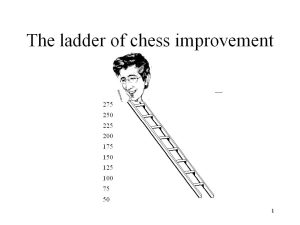
The ‘steps’ metaphor rather suggests a ladder, up which we can climb through study and practice.

I think Glenn Flear once decided when he was graded 170, that he just needed to improve 7 points each year for 10 years, and he’d be a GM.  And so he was…

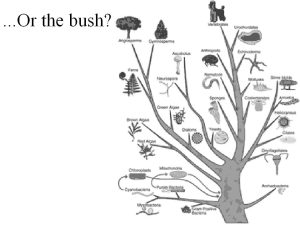
But as a former student of zoology, I am used to discarding ‘ladder’ models in favour of more realistic pictures showing the more complex and contradictory state of nature:

Where are you on the bush?  The ladder suggests that chess is only one thing and there’s only one main route to travel.  I think chess is more complex, and our routes through improvement are more elaborate, than the ladder model suggests.

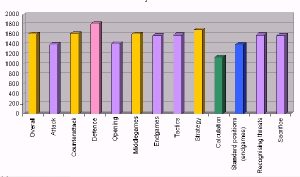
A more helpful model to think about your own chess I think is… Imagine a player graded BCF 100 [ELO 1700 or so? They changed the system and I no longer feel confident about translating grades].  I imagine they would have strengths and also some weaknesses.  In fact, they may perform better than your average 100-grade player at some things, and worse at others.  If there are a dozen or so things you need to get right to be a good chessplayer [*], we might be able to draw up a profile of our player:

So, our player excels at F, G and L, is most deficient in B and E, is far from wonderful at M, and doesn’t even know what J is.  [It may be that I don’t either, but it may be that it doesn’t matter at our level.]

In order to help you think about your own profile, try this:

List the three most important things you try to get right during a chess game, or the three things that you think you are best at.
1 …
2 …
3 …

Now list the three most important things you want to try and improve — perhaps thinking about the three most common reasons why you think you lose chess games.
1 …
2 …
3 …

OK, now compare your answers with those of other people.  Somewhere between you, you might have a list of a dozen things.  [Having looked at (and discussed) this list, you might want to change your mind about your initial two sets of triplets ]

Now take the scoresheets from your last dozen games — slow games, not blitz games on the Internet or against computers, but proper chess with a human opponent and a couple of hours’ thinking time — and think about each game against the list of a dozen things.  Then, come up with a your final sets of triplets, your three strengths and the three things you want to work on.

So, bring your list of things you want to work on to the session next week, and we’ll see if we have any overlap.  Then we can think about a programme.  See you there.

[* Although Dan Heisman says there are five: tactics, activity, time management, thought process, general principles.  Those headings are broad enough to be worth dividing up, I expect.]

Tactics: combinations and blunders

1. Chess is 99% tactics , said Richard Teichmann.nbsp; However, 90% of the time, there is no tactic for either side.nbsp; So, as well as any difficulty presented by a complicated position, we also have to counter our natural laziness in not looking out for a rare event, as if each move we are crossing the a quiet country road, and not bothering to check for oncoming traffic. When they think it’s a quiet position, even the best players miss things .

2. Tactical ability can be improved, says Dvoretsky. He described two elements: vision and analysis. Both can be developed by completing exercises. [An uncomfortable corollary: If you don’t exercise, don’t expect to get better!]

3. You need to have a good understanding of the varieties of tactics. There are different ways of classifying and naming this variety; Purdy gives six simple headings of:- Jumps, Mates, Forks, Nets, Pins and Ties. These building blocks can be fitted together to make a combination, a set of more or less forcing moves, often with a sacrifice, resulting in your advantage.

4. The more combinations you see, the more you will be able to see. Real examples are very helpful in developing your imagination, throwing up ideas that you can analyse. Euwe doesn’t call it imagination, he calls it combinational vision, but he and Dvoretsky both agree that looking at different problems helps. The most obvious thing that it helps, which you would expect, is that you can develop depth and accuracy the same way; keep pushing yourself on speed and depth.

5. Purdy also advises us, when searching for combinations: examine moves that smite! These are checks and captures; both are forcing moves which limit the range of reasonable responses. The move that is right when a tactic is available is usually the opposite of a ‘normal’ sensible move.

6. You should always examine every position for ‘accidental’ tactics, but look especially hard if you think you have an advantage (if your position is better, your better pieces are more likely to work up a combination between you) or if you notice the clues for a combination: an unsafe king or loose pieces.

7. You should also be aware that there is another, less well-known, list: the list of difficult moves to spot: Long moves, Backwards moves, Declining to capture, an intermezzo or Zwischenzug, False endings, Coming back from the dead, Quiet (‘creeping’)moves in noisy positions, Switchbacks, Hesitations, and in John Nunn’s uneuphonious coinage, Collinear moves (throwing yourself on the sword).

8. So much for the theory. You can be good at a lot of that stuff and still lose games because of tactics. You have two other pitfalls to avoid: [1] Going to sleep and ignoring an approaching fin until the shark bites your leg off, and [2] forcing the issue, trying to make combinations happen in positions which are not ripe. If you have the first problem, you need to become more paranoid: they really are out to get you!

9. I have been bellyaching for a while that books of puzzles don’t test you properly, because every position has a solution, and you can often guess what the answer is just because you know it has a solution. One author in particular has tried to get around this problem, namely Chris Ward; an example is Chess Choice Challenge 3, but even here, the vast majority of the 80 positions have a ! or !! solution.

10. The last thing you need to do is make checking for tactics and combinations part of whatever routine you have for choosing a move. I have written simply about a four-step THINKing process: [1] checking for threats (and dealing with them if you have to using ABCD), [2] checking for your own opportunities (and using them if you can), [3] think about how you can improve your position, and [4], if you can, play with a plan. Playing with a plan is hard, and your opponent will get in your way, but it is something to strive for.

11. I’ve been saying and writing things like the above for years. What’s new? Well, ten years ago, there we didn’t all own computers, and there wasn’t the online help available. There are online tactics servers, tactics databases, websites where you can download tactics tests, free database software which can administer tactical tests, and free analysis engines which can show you what mistakes happened in your games.

12. There are still many good exercises for the computer-free. In many magazines, you will find a feature like Spot the winning move; there are books full of these things. Another good thing to do is try analysing real games: Byron Jacobs and Graeme Buckley have both published books of tough analytical exercises which are quite different to the ‘spot the move’ variety. Another good idea is setting yourself 20 minutes to find all you can of some analysis in a known GM game which has been analysed; these rich positions are to be found in books by Kotov, Nunn and Dvoretsky.

13. Lastly, the best clues are always in your own games. For example, having just started playing the French, I notice that I’m very likely to overlook destructive combinations against my apparently solid pawn chain.

The mate with Bishop and Knight

Danny Sparkes and Norbert Friedrich.

Danny Sparkes recently took us through the technique here, and
had some fun at the expense of a range of computers and computer
programmes who seem generally clueless about t. I don’t have his
notes but I do have tucked away some similar notes by Norbert
Friedrich, who also has a mild dig at computer technique, and whose
notes I have expanded on a little below. (If you have ChessBase 6.0
or above, the database will show some helpful extra detail of the
patterns.)

Why bother?

(1) You might have to do it, and under pressure. Susan Lalic was
surprised by Galliamova recently, who headed for this endgame as a
reasonable drawing attempt. Susan made the mate – in 45!

(2) It also illustrates how to co-ordinate three slightly
awkward pieces – perhaps you may never have to prove the mate, but
you will have to co-ordinate the activity of your minor pieces, and
this is a suitable arena in which to rehearse.


(658) The basic technique [Norbert
Friedrich]

+-----------------+
|k+.+.+.+|
|+.H.+.+.|
|.+K+.+.+|
|+.+.+.+.|
|.+.G.+.+|
|+.+.+.+.|
|.+.+.+.+|
|+.+.+.+.|
+-----------------+

DRAWING A “W”: To win KBN-K you first have to force the king to
the 8th rank. If the king escapes to his safe corner then, “drawing
an W” is a useful help to remember. The knight moves like a “W”
(c7-d5-e7-f5-g7), the bishop does not allow Black’s escape to the
safe corner and the White king steps towards the winning corner on
the 6th rank. Finding the mate then should not create problems
anymore. 1.Nc7+ Kb8 2.Bc5 Kc8 3.Ba7 Kd8 4.Nd5 Ke8
Offers more resistance than Kc8

[4…Kc8 5.Ne7+ Kd8 6.Kd6 Ke8 7.Ke6 Kf8 (7…Kd8 8.Bb6+ Ke8
9.Ba5 Kf8 10.Nf5 Ke8 11.Ng7+ Kf8 12.Kf6 Kg8 13.Kg6 Kf8 14.Bb4+ Kg8
15.Bc5 Kh8
Now you must play a check to g8 with the Knight,
but not from f6! 16.Nf5 Kg8 17.Nh6+ Kh8 18.Bd4#) 8.Nf5 Ke8
9.Bb6 Kf8 10.Bc7 Ke8 11.Ng7+ Kf8 12.Kf6 Kg8 13.Kg6 Kf8 14.Bd6+ Kg8
15.Nf5 Kh8 16.Be7 Kg8 17.Nh6+ Kh8 18.Bf6#]

5.Kd6 Grit you teeth and allow the King to come
forward two squares… 5…Kf7 6.Ne7 Stops the
King coming to g6. 6…Kf6

[6…Kg7 7.Be3]

7.Be3!

+-----------------+
|.+.+.+.+|
|+.+.H.+.|
|.+.I.i.+|
|+.+.+.+.|
|.+.+.+.+|
|+.+.G.+.|
|.+.+.+.+|
|+.+.+.+.|
+-----------------+

The second detail to remember. The King covers the red squares
(ChessBase 6 format), the Knight covers the green squares, and the
Bishop covers the yellow squares, and the ‘net’ effect is a box
from which the Black King can only escape backwards. Neat, eh?
7…Kf7 8.Bd4 The net effect again.
8…Ke8 9.Ke6 Kd8 10.Bb6+ Again, the Bishop and
Knight cooperate to block off all the escape squares on the
c-file.. 10…Ke8 11.Nf5 Kf8 12.Bc7 Ke8 13.Ng7+ Kf8 14.Kf6
Kg8 15.Kg6 Kf8 16.Bd6+ Kg8

+-----------------+
|.+.+.+k+|
|+.+.+.H.|
|.+.G.+K+|
|+.+.+.+.|
|.+.+.+.+|
|+.+.+.+.|
|.+.+.+.+|
|+.+.+.+.|
+-----------------+

Now it’s mate in four: we must play check to g8, but not from
f6. 17.Nf5 Kh8 18.Be7 A tempo move.
18…Kg8 19.Nh6+ Kh8 20.Bf6# 1–0


(659) Endgame Data Bases [Norbert
Friedrich]

+-----------------+
|k+.+.+.+|
|+.+.+.+.|
|.GK+.+.+|
|+.+N+.+.|
|.+.+.+.+|
|+.+.+.+.|
|.+.+.+.+|
|+.+.+.+.|
+-----------------+

Any endgame database (Check those by Ken Thompson) will tell you
that there might be faster wins or better defenses. Its mysterious
move suggestions might be of scientific interest but are IMO hardly
of a practical value: The following was recently posted in
rec.games.chess.analysis by Steven Edwards. Note that the bishop is
on e3 and the knight on d5, though that should not create a
difference. Evaluation: Mate in 20 1.Bb6 Bc5 Bd4
Bf2 Bf4 Bg1 Nc7+

[After playing the following moves: 1.Nc7+ Kb8 2.Bb6 Kc8 3.Ba7
Kd8 4.Nd5 Kc8 … Evaluation: Mate in 13 5.Ne7+ Kd8 6.Kd6 Ke8 7.Ke6
Kd8 Kf8 8.Bb6+ Ke8 9.Nf5 Kf8 10.Bc5+ Bd4 Bd8 Be3 Bf2 (10.Be3
Ke8 11.Bg5 Kf8 12.Be7+ Kg8 13.Kf6 Kh7 14.Kf7 Kh8 15.Kg6 Kg8 16.Nh6+
Kh8 17.Bf6#)
10…Ke8

+-----------------+
|.+.+k+.+|
|+.+.+.+.|
|.+.+K+.+|
|+.G.+N+.|
|.+.+.+.+|
|+.+.+.+.|
|.+.+.+.+|
|+.+.+.+.|
+-----------------+

If letting the Black King off the back rank makes you nervous,
you will have to see the mate in 6, which starts by threatening
mate in one, by shielding the line of the Bishop. 11.Nd6+ Kf8
(11…Kd8 12.Bb6#) 12.Kf6 Kg8 13.Nf5 discovering an attack
on the square just vacated. 13…Kh7 14.Kf7 Kh8 15.Kg6 Kg8 16.Nh6+
Kh8 17.Bd4#]

1…Kb8 2.Nc7 Kc8 3.Ba7 Kd8 4.Nd5 Ke8 5.Bd4 Kd6
5…Kd8 Kf7 6.Be5 Kc8 7.Nb6+ Ne7+
7…Kd8 8.Bf6+ Kd6 8…Ke8 9.Kd6 Kf7
10.Nd5 Kf8
Kg6 11.Ke6 Ke8 12.Bg5 Bh4 Nc7+
Ne3 12…Kf8 13.Be7+ Kg7 14.Nf4 Kg8 Kh7
15.Kf6 Kh7 Kh8 16.Bf8 Kg8 Kh8

+-----------------+
|.+.+.Gk+|
|+.+.+.+.|
|.+.+.I.+|
|+.+.+.+.|
|.+.+.H.+|
|+.+.+.+.|
|.+.+.+.+|
|+.+.+.+.|
+-----------------+

A different mate in four. 17.Ne6 Kh7 Kh8
18.Kf7 Kh8 19.Bg7+ Kh7 20.Nf8# Ng5#
Line


(661) Fine No.4/No.5 [RF]

+-----------------+
|.+.+.+.+|
|+.+.+.+.|
|.+.+.+.+|
|I.i.+.+B|
|.+.+.+.+|
|+.+.+.+.|
|.+.+.+.+|
|H.+.+.+.|
+-----------------+

The White pieces are in their worst possible positions. Mate can
be achieved only at a8 or h1.As White you have a three-stage
plan:(1) drive the King to the edge.(2) drive the King to a corner:
it will (or should) head for a1/h8(3) drive the King across to the
other corner. 1…Kc6

[1…Kc4 2.Bf7+]

2.Nb3 Kd6

[2…Kd5 3.Kb5 Kd6 4.Kc4 Ke5 5.Nc5 Kf5 6.Kd5 Kg5 7.Bf3 Kf5 8.Ne6
Kf6 9.Be4 Ke7 10.Ke5 Kf7 11.Nf4 Kg7 12.Bd5 Kh7 13.Kf6 Kh8 14.Ng6+
Kh7 15.Be6]

3.Kb5 Kd5 4.Bf7+ Ke5

[4…Kd6 5.Bc4 Ke5 6.Kc5 Ke4 7.Kd6 Kf5 8.Bd3+ Kf6 9.Nd2 Kf7
10.Nc4 Kf6 11.Ne5 Kg7 12.Ke7 Kh8 13.Kf6 Kg8 14.Nf7]

5.Kc5 Kf6 6.Bc4 Ke5 7.Nd2 Kf4 8.Kd6 Kf5

[8…Ke3 9.Nb3 Kf4 10.Bd3 Kg5 11.Ke5 Kh6 12.Kf6 Kh5 13.Bf5 Kh4
14.Kg6 Kg3 15.Kg5 Kf3 16.Bc2 Ke3 17.Kg4 Ke2 18.Kf4 Kf2 19.Bd1 Ke1
20.Bf3 Kf2 21.Nd4]

9.Bd3+ Kf6 10.Nf3 Kf7 11.Ke5! Kg7

[11…Ke7 12.Bc4]

12.Ng5

[While we are going through, watch how the Knight moves!]

12…Kg8! 13.Kf6 Kf8 14.Nf7 Kg8

+-----------------+
|.+.+.+k+|
|+.+.+N+.|
|.+.+.I.+|
|+.+.+.+.|
|.+.+.+.+|
|+.+B+.+.|
|.+.+.+.+|
|+.+.+.+.|
+-----------------+

No.5Black is near the ‘safe’ corner, and we need to get him to a
mating corner. The way to do this was first shown by Philidor, and
is to be found in the books by Fine and Averbakh. 15.Bf5
Kf8 16.Bh7 Ke8 17.Ne5 Kd8

[17…Kf8? 18.Nd7+ Ke8 19.Ke6 Kd8 20.Kd6 Ke8 21.Bg6+ Kd8 22.Nc5
Kc8 23.Bd3! Kd8 24.Bb5! Kc8 25.Bd7+ Kb8 26.Kc6 Ka7 27.Kc7 Ka8
28.Kb6 Kb8 29.Na6+ Ka8 30.Bc6#]

18.Ke6 Kc7 19.Nd7! This is the bit you need to
understand: it looks like the King has got out, but it hasn’t.
19…Kc6?! This natural move gets mated more
quickly. There are a couple of important patterns to remember:

[19…Kb7 20.Bd3! Kc6 The ‘net effect’ box again. 21.Ba6 Kc7
22.Bb5 and the wall. 22…Kd8 Okay, last trick. The Knight goes to
d5 to further restrict the King. 23.Nb6 Kc7 24.Nd5+ Kd8 25.Kd6 Kc8
26.Ke7 Kb7 27.Kd7 Kb8 28.Ba6 Ka7 29.Bc8 Kb8 30.Ne7 Ka7
(30…Ka8 31.Kc7 Ka7 32.Nc6+ Ka8 33.Bb7#) 31.Kc7 Ka8
32.Bb7+ Ka7 33.Nc6#]

20.Bd3! The King is in a little box.
20…Kb7

[20…Kc7 21.Bb5! The King’s escape is walled off. 21…Kc8
22.Kd6 Kd8 23.Nc5 Kc8 24.Bd7+ Kb8 25.Kc6 Ka7 26.Kc7 Ka8 mate in
three 27.Kb6 Kb8 28.Na6+ Ka8 29.Bc6#]

21.Kd6 Kc8 22.Nc5 Kb8

[22…Kd8 23.Bb5]

23.Kc6 This is not the fastest but is easier to
remember and more artistic.

[23.Kd7 is Fine’s slightly quicker method 23…Ka7 24.Kc7 Ka8
25.Kb6 Kb8 mate in three 26.Ba6 Ka8 27.Bb7+ Kb8 28.Na6#]

23…Kc8 Can you guess White’s next Knight
move? 24.Nb7 This is why I say it’s easier to
remember and prettier! 24…Kb8 25.Kb6 Kc8 26.Bf5+
Kb8

+-----------------+
|.i.+.+.+|
|+N+.+.+.|
|.I.+.+.+|
|+.+.+B+.|
|.+.+.+.+|
|+.+.+.+.|
|.+.+.+.+|
|+.+.+.+.|
+-----------------+

Now its mate in four. 27.Nc5 Ka8 28.Bd7 A tempo
move. 28…Kb8 29.Na6+ Ka8 30.Bc6# 1–0

The Principle of ‘two weaknesses’

The Principle of two weaknesses – one weakness or two?

One sick pawn can lose you the game, but you need two points of
attack to win. How does this add up?

  Both are true. In order to win against one weakness you
need to attack the weak point, gain an advantage in space or
mobility through this, and use your mobility to force through on a
second front. Then one or other point will crack because your
opponent’s pieces won’t be able to cover both attacks.
Chekhover-Rudakowsky is a nice example of this.

  In fact defensive play is so awful that your opponent
will probably give you an extra target out of carelessness or
frustration (Hutchings-Keene, Vogt-Anderssen).
But if not, you will have to open up another front
(Lasker-Capablanca). It may be that before going for your
primary target you should take time out to create a second weakness
for later (Hug-Barle). The key to understanding space
advantages is that you can use it to create weaknesses where none
existed (Tarrasch-Mieses).


Chekhover-Rudakowsky,
1945

1. d4 d5 2. c4 e6 3. Nf3 Nf6 4. Bg5 Be7 5. e3 O-O 6. Nc3
Nbd7 7. Qc2 c6 8. Bd3 dxc4 9. Bxc4 Nd5 10. Bxe7 Qxe7 11. O-O b5 12.
Be2 a6 13. Ne4 Bb7 14. Ne5 Rac8 15. Nxd7 Qxd7 16. Nc5 Qc7 17. Rfd1
Rcd8 18. Rac1 Bc8 19. Qe4 Nf6 20. Qh4 Qa5 21. a3 b4


-+-T-Tj+
+l+-+xXx
xDx+x+-+
+-R-+-+-
pX-P-+-Q
+p+-P-+-
-+-+bPpP
+-R-+-K-

White has an advantage in space and mobility: Chernev suggests
counting up the legal moves available to the pieces on each side.

22. a4 Nd7 23. b3 Nxc5 24. Rxc5 Qb6 25. Rdc1 Bb7
26. a5 Qa7 27. Bd3 DIAGRAM


-+-T-Tj+
Dl+-+xXx
x+x+x+-+
P-R-+-+-
-X-P-+-Q
+p+bP-+-
-+-+-PpP
+-R-+-K-

White forces a weakness just as we learned above – but was only
able to do so because he attacked c6 first.

27…g6 28. Qf6 Rd6 29. Qe7 Rfd8 30. h4 R8d7 31.
Qf6 Qa8 32. Be4 Qe8 33. h5 Rd8 34. Bxc6 Bxc6 35. h6 Kf8 36. Rxc6
Rxc6 37. Rxc6 Rd7 (37… Qxc6 38. Qxd8+ Qe8 39. Qd6+ Kg8 40.
Qxa6 {threat Qb7} 40… Qe7 41. Qb6
) 38. Rc8 Qxc8 39. Qh8+
1-0


  The fact that weak pawns can lose you the game means that
many games are based around the theme of creating or threatening to
create weak pawns – the Nimzo-Indian, for example.


Hutchings-Keene, 1982

1.c4 Nf6 2.Nc3 b6 3.Nf3 Bb7 4.d4 e6 5.g3 Bb4

  Both Black bishops threaten to kick a hole in the White
pawn formation by …Bxc3 or …Bxf3.

6.Bd2 c5 7.a3 Bxc3 8.Bxc3 Ne4 9.Qc2 Nxc3 10.Qxc3
Qf6

  Renewing the threats against c3/f3.

11.Rd1 Bxf3 12.Qxf3 Qxf3 13.exf3 Nc6


t+-+j+-T
X-+x+xXx
-Xs+x+-+
+-X-+-+-
-+pP-+-+
P-+-+pP-
-P-+-P-P
+-+rKb+r

14.dxc5 {?}

  White’s f-pawns aren’t pretty but Black can’t get at them
at the moment. In any event, one weakness won’t lose the game.
Instead of avoiding further concessions, White hands Black the
half-open b-file and a target on b6. Any ‘pressure’ White hopes to
gain on the d-file will vanish the moment Black plays …Nd4.

14…bxc5 15.Bg2 Rb8 16.Rd2 Rb3 17.Kd1 Ke7 18.f4
Nd4 19.Kc1 h5 {!?} DIAGRAM


-+-+-+-T
X-+xJxX-
-+-+x+-+
+-X-+-+x
-+pS-P-+
Pt+-+-P-
-P-R-PbP
+-K-+-+r

The pressure on the b-file has given White a headache on the
King’s-side. Black’s last is a little trap…

20.h4 {?}

  Into which White falls.

20…Rhb8 21.Bf1 (penny drops!)
[21. Re1 Rxg3 22. fxg3 Nb3+ 23. Kc2 Nxd2 24. Kxd2 Rxb2+ 25. Kd3
Rxg2]

21…Rf3 22.Kd1 Rxa3 {!} 0-1


Vogt-Anderssen, 1978

1.e4 c5 2.Nf3 d6 3.d4 cxd4 4.Nxd4 Nf6 5.Nc3 e6 6.Be2 a6
7.f4 Qc7 8.O-O Be7 9.Kh1 Nc6 10.Be3 Nxd4 11.Qxd4 O-O 12.Rad1 b5
13.e5 {!?} 13…dxe5 14.Qxe5 Qb8 {!} 15.Qxb8 Rxb8 16.Ba7 Ra8 17.Bb6
Bb7 18.a3 Rfc8 {!}

  Black has survived the sharp opening and now turns his
attention to is endgame plans. Black fixes attention on the pawn at
c2.


t+t+-+j+
+l+-LxXx
xB-+xS-+
+x+-+-+-
-+-+-P-+
P-N-+-+-
-Pp+b+pP
+-+r+r+k

19.Ba5 g6 20.h3 {?}

  This gives White a problem square on g3 and a problem
pawn on f4.

20…h5 21.Bf3 Bxf3 22.Rxf3 h4 23.Rd2 Rc4 24.b3
Rc6 25.a4 b4 26.Ne2 Rac8 27.c4 bxc3 28.Rxc3

  The weak c-pawn has been replaced in Black’s affections
by the weak b-pawn.

28… Nd5 29.Rxc6 Rxc6 30.Rb2 Bf6 31.Ra2 Rc8
32.Bd2 Rb8 33.Nc1 Nb4 34.Bxb4 Rxb4 35.Rf2 Be7 36.Rf3


-+-+-+j+
+-+-Lx+-
x+-+x+x+
+-+-+-+-
pT-+-P-X
+p+-+r+p
-+-+-+p+
+-N-+-+k

White is at full stretch…

36…Bd6 37.Ne2 Re4 38.Rd3 Bc5 39.Rc3 Bf2 40.Rc2
Kg7 41.Ng1 Rxf4 ….0-1


Lasker,- Capablanca,
1921

1. d4 d5 2. c4 e6 3. Nc3 Nf6 4. Bg5 Be7 5. e3 O-O 6. Nf3
Nbd7 7. Qc2 c5 8. Rd1 Qa5 9. Bd3 h6 10. Bh4 cxd4 11. exd4 dxc4 12.
Bxc4 Nb6 13. Bb3 Bd7 14. O-O Rac8 15. Ne5 Bb5 16. Rfe1 Nbd5 17.
Bxd5 Nxd5 18. Bxe7 Nxe7 19. Qb3 Bc6 20. Nxc6 bxc6 21. Re5 Qb6 22.
Qc2 Rfd8


-+tT-+j+
X-+-SxX-
-Dx+x+-X
+-+-R-+-
-+-P-+-+
+-N-+-+-
pPq+-PpP
+-+r+-K-

There are two isolated pawns: which is weaker?

23. Ne2 Rd5 24. Rxd5 cxd5


-+t+-+j+
X-+-SxX-
-D-+x+-X
+-+x+-+-
-+-P-+-+
+-+-+-+-
pPq+nPpP
+-+r+-K-

Now there is only one. It is not exposed on a half-open file, so
can White defend?

25. Qd2 Nf5 26. b3 h5 27. h3 h4

  a typical preparatory probe

28. Qd3 Rc6 29. Kf1 g6 30. Qb1 Qb4


-+-+-+j+
X-+-+x+-
-+t+x+x+
+-+x+s+-
-D-P-+-X
+p+-+-+p
p+-+nPp+
+q+r+k+-

Black’s pressure on the d-pawn cannot be increased. So Black opens
up a new point of attack.

31. Kg1 a5

  Lasker said when he saw this that he knew he was
lost.

32. Qb2 a4 33. Qd2 Qxd2 34. Rxd2 axb3 35. axb3
Rb6 36. Rd3 Ra6 37. g4 hxg3 38. fxg3 Ra2 39. Nc3 Rc2 40. Nd1 Ne7
41. Nc3 Rc1+ 42. Kf2 Nc6 43. Nd1 Rb1


-+-+-+j+
+-+-+x+-
-+s+x+x+
+-+x+-+-
-+-P-+-+
+p+r+-Pp
-+-+-K-+
+t+n+-+-

Black has his two points of attack.

44. Ke2

  I think not really a blunder, more a desire for clarity.
[44. Ne3 Na5 picks up the b-pawn anyhow]

44… Rxb3 45. Ke3 Rb4 46. Nc3 Ne7 47. Ne2 Nf5+
48. Kf2


-+-+-+j+
+-+-+x+-
-+-+x+x+
+-+x+s+-
-T-P-+-+
+-+r+-Pp
-+-+nK-+
+-+-+-+-

White still has two points to defend.

48… g5 49. g4 Nd6 50. Ng1 Ne4+ 51. Kf1 Rb1+ 52.
Kg2 Rb2+ 53. Kf1 Rf2+ 54. Ke1 Ra2 55. Kf1 Kg7 56. Re3 Kg6 57. Rd3
f6 58. Re3 Kf7 59. Rd3 Ke7 60. Re3 Kd6 61. Rd3 Rf2+ 62. Ke1 Rg2 63.
Kf1 Ra2


-+-+-+-+
+-+-+-+-
-+-JxX-+
+-+x+-X-
-+-Ps+p+
+-+r+-+p
t+-+-+-+
+-+-+kN-

Both sides are repeating moves: Capablanca because he can, Lasker
because he has to!

64. Re3 e5 the final push: Black creates
a passed pawn 65. Rd3 exd4 66. Rxd4 Kc5 67. Rd1 d4 68. Rc1+
Kd5


-+-+-+-+
+-+-+-+-
-+-+-X-+
+-+j+-X-
-+-Xs+p+
+-+-+-+p
t+-+-+-+
+-R-+kN-

poor White can do nothing 0-1


Hug – Barle (Pula izt) [C45]
1975

1. e4 e5 2. Nf3 Nc6 3. Bc4 Bc5 4. Nc3 Nf6 5. d3 d6 6. Bg5
Na5 7. Bb3 Nxb3 8. axb3 Be6 9. Na4


t+-Dj+-T
XxX-+xXx
-+-XlS-+
+-L-X-B-
n+-+p+-+
+p+p+n+-
-Pp+-PpP
R-+qK-+r

9… h6

[9… Bb6 10. Nxb6 axb6 or 10…cxb6; 11.d4! with a
superior pawn structure 11. Rxa8 Qxa8 12. Bxf6 gxf6 13. Nh4
Pritchett]

10. Bh4 Bg4

[10… g5 11. Bg3 Nd7 12. Nxc5 Nxc5 13. b4 Nd7 14.
d4]

11. Nxc5 dxc5 12.h3 Bxf3 13. Qxf3 Qd6 14. Bxf6
Qxf6 15. Qxf6 gxf6


t+-+j+-T
XxX-+x+-
-+-+-X-X
+-X-X-+-
-+-+p+-+
+p+p+-+p
-Pp+-Pp+
R-+-K-+r

Here we have the doubled f-pawns again. White can start an
immediate attack on them with O-O and f2-f4

16. Ra5!

  accurate: forces a permanent weakness on a7. Black must
divert his King to the Q-side when a shift to the f-file catches
him wrong-footed. Black is probably already lost.

[16. O-O Ke7 17. f4 h5 18. Rf2 Rh7 19. Raf1 and Black
can defend the one weakness on the f-file.]

16… b6 17. Ra6 Kd7 18. O-O Kc6


t+-+-+-T
X-X-+x+-
rXj+-X-X
+-X-X-+-
-+-+p+-+
+p+p+-+p
-Pp+-Pp+
+-+-+rK-

19. f4 Kb7 20. Raa1 Rh7 21. fxe5 fxe5 22. Rf6

  White now wins a pawn while Black struggles for
counterplay.

22… a5 23. Rf5 Re8 24. Raf1 Re7 25. Rh5 Re6 26.
Rhf5 Re7 27. g4 Kc6 28. Rf6+ Kb5 29. R1f5 a4 30. bxa4+ Kxa4 31. Rh5
c4 32. dxc4 Kb4 33. Rhxh6 Rxh6 34. Rxh6 Rd7 35. Rf6 Kxc4 36. Kf2
Rd2+ 37. Ke3


-+-+-+-+
+-X-+x+-
-X-+-R-+
+-+-X-+-
-+j+p+p+
+-+-K-+p
-PpT-+-+
+-+-+-+-

37… Rh2

[37… Rxc2 doesn’t help, e.g. 38. Rxf7 c5 39. Rf2
Rxf2 40. Kxf2 Kb3]

38. Rc6+ Kb5 39. Rxc7 Rxh3+ 40. Kf2 Rh2+ 41. Kg3
Re2 42. Kf3 Re1 43. Re7 f6 44. g5 fxg5 45. Rxe5+ Kc4 46. Rxg5 Rf1+
47. Ke2 Rb1 48. b3+ Kc3 49. Rb5 Rc1 50. Rxb6 Rxc2+ 51. Ke3
1-0


Tarrasch – Mieses (3) [C10]
1916

1. e4 e6 2. d4 d5 3. Nc3 dxe4 4. Nxe4 Nd7 5. Nf3 Ngf6 6.
Bd3 Be7 7. O-O Nxe4 8. Bxe4 Nf6 9. Bd3 b6


t+lDj+-T
X-X-LxXx
-X-+xS-+
+-+-+-+-
-+-P-+-+
+-+b+n+-
pPp+-PpP
R-Bq+rK-

White has more space but no target as yet.

10. Ne5 O-O 11. Nc6 Qd6 12. Qf3 Bd7 13. Nxe7+
Qxe7 14. Bg5 Rac8 15. Rfe1 Rfe8 16. Qh3


-+t+t+j+
X-XlDxXx
-X-+xS-+
+-+-+-B-
-+-P-+-+
+-+b+-+q
pPp+-PpP
R-+-R-K-

White uses his better pieces to force a concession.

16… Qd6 17. Bxf6 gxf6 18. Qh6 f5 19. Re3 Qxd4
20. c3


-+t+t+j+
X-Xl+x+x
-X-+x+-Q
+-+-+x+-
-+-D-+-+
+-PbR-+-
pP-+-PpP
R-+-+-K-

Black is suddenly shot full of holes.

1-0