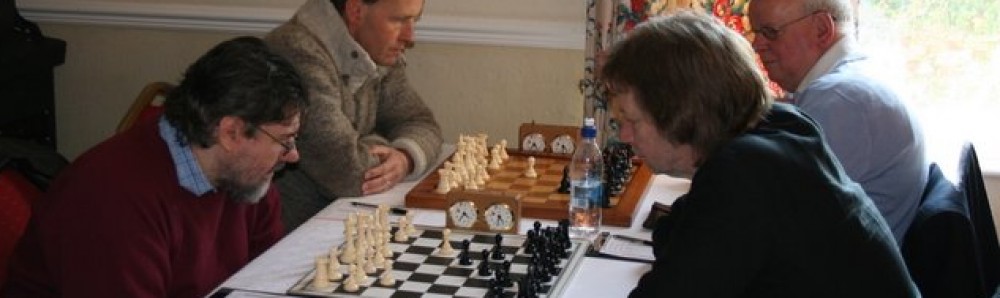
[A Q&A at a coaching session]
A bit of perspective
Your opening choices are determined by:
- Your style: are you a Steady Eddie or a Bonkers Billie?
- Your memory: can you commit the key traps and variations to memory?
- Your study time: can you find and absorb what you need to play this system well?
- Your aims: are you trying to get a playable position? are you trying to
set your opponent problems, so they make a mistake? are you inviting
your opponent to waltz with you blindfold on the edge of a cliff? are
you trying to lure them into unfamiliar territory, or a trap?
Trouble with b6
“I’m having trouble getting …b6 to work against 1.e4”
1.e4 b6
“I’m not surprised!”
Any opening is only as good as the ideas you bring to it. I don’t think
I heard much from you about what your ideas were in playing …b6: what
sort of position do you hope to get to play?
The ideas behind some systems can be pretty straightforward – for
example, I think the Evans Gambit and the French Defence and the Colle
System can be picked up pretty quickly by club players, and the extra
ideas you need as your opponents get better at meeting your new opening
can be added fairly easily. The French Defence in particular often
leads to the same sort of pawn structure (white Pd4 Pe5 vs black Pd5
Pe6), so, even if you don’t recognise the exact variation, you can still
have a good idea about the best plans for both sides.
1…b6 is a rarity – you will struggle to find many books to read, or
games to follow. If you look it up in the books, you will find most of
the lines end in +=. The ideas behind the opening are hard to find or
understand: I think it can be best interpreted as a hypermodern defence,
letting White occupy the centre then hoping to get play later, either by
deciding on your own central setup once you have seen what White has
done, or using the centre as a target. I think it ends up as += because
that is hard to do! Also, you aren’t going to get the same structures
and ideas in each game, and you are going to lose games that you don’t
understand.
My advice: pick something else!
Philidor for Beginners
1.e4 e5 2.Nf3 d6
In some ways, the Philidor is a risky opening to try: there are dozens
of traps that Black can fall into in the first few moves.
*[ http://exeterchessclub.org.uk/content/lessons-philidors-defence ]
But if you learn the right order for your first few moves (especially
3…Nf6), you can usually get to a solid position from which you can
play the middlegame. Yes, White gets a space advantage, but it’s not a
huge one, and space advantages are not so easy to make use of. An extra
piece, or a doubled pawn, or a bare King’s-side, all tell you what to do
next. A space advantage just tells you that, whatever you want to do,
you will probably be able to do it more easily than your opponent.
Philidor inspiration:
The (Hyper)-Accelerated Dragon
Anyone who plays the main line Sicilian Dragon will have met the deadly Yugolav Attack.
White is going to castle long then push the h-pawn.
Maybe it’s not as deadly these days, as Black players have learned how
to fight back, but it’s the most important line in the Dragon and there
are whole books written about it.
If you like the Dragon setup, but are unwilling to take on the task of
learning how to defend against the Yugoslav, then you can try a cunning
move order to head White off.
The Accelerated Dragon goes
1.e4 c5 2.Nf3 Nc6 3.d4 cxd4 4.Nxd4 g6
One of Black’s ideas is that …d7-d5 can be played in one move.
For example,
5.Nc3 Bg7 6.Be3 Nf6 7.Be2 0-0 8.Qd2? d5!
or
8.0-0 d5!
Now, if White tries to set up the Yugoslav Attack, it all goes wrong
5.Nc3 Bg7 6.Be3 Nf6 7.Qd2?! Ng4!
5.Nc3 Bg7 6.Be3 Nf6 7.f3?! 0-0! 8.Qd2 d5!
5.Nc3 Bg7 6.Be3 Nf6 7.Bc4! Qa5! 8.f3? Qb4! 9.Bb3 Nxe4!
an amazing move, but it works!
if 10.Nxc6, Qxc3!
and Black comes out ahead
After 7…Qa5, 8.0-0
must be tried, and then Black has successfully
avoided the Yugoslav. These positions are not ever so promising for
Black – perfectly solid, but perhaps the Qa5 is misplaced, vulnerable
to Nb3 Qc7 and a later Nd5
Black can try one other line to make use of the omission of …d6:
7…0-0
Uogele’s Variation.[
Now Black has the usual bunch of tricks waiting for Qd2 and f3
8.Qd2 Ng4!
or 8…Nxe4 9.Nxe4 d5!
8.f3 Qb6!?
(or 8…e6!?, maybe even 8…d5!?)
So White should play
8.Bb3!
Now Black has one last chance to keep White from setting up a
Yugoslav-style attack:
8…a5!? 9. f3!? d5!?
Black gambits the d-pawn to get active play.
White’s not worse here and may have chances of advantage, but there is
no chance of the standard Yugslav Attack. (I expect White’s best try on
move 9 is 9.0-0, when 9…d6 is OK for Black and 9…a4 is
“interesting”.)
So, Black’s extra pressure against d4 means that White cannot get into the
Yugoslav. You don’t get anything for free in chess, so Black’s missing
pressure against e4 means that White can omit Nc3 and play c4, the
dreaded Maroczy Bind, also a bit less dreaded these days.
The Hyper-accelerated Dragon is the move order with 2…g6.
This avoids problems with 3.Bb5 and also gives you some extra options
against the Maroczy Bind, for example,
1.e4 c5 2.Nf3 g6 3.d4 Bg7 4.c4 Qb6!?
Anti-Sicilians for the Dragon player
Charlie was suspicious about his White opponents who want to play around
with their own move order tricks, avoiding the main lines of the
Accelerated Dragon to play, e.g.
1.e4 c5 2.Nf3 g6 3.Nc3
or
1.e4 c5 2.Nf3 g6 3.c3
or even
1.e4 c5 2.c3
I think
1.e4 c5 2.Nf3 g6 3.Nc3
is not much of a problem: after 3…Bg7
or 3…Nc6, White doesn’t have any clever ways of delaying d4.
If you like to meet
1.e4 c5 2.c3
with
1.e4 c5 2.c3 Nf6
or
1.e4 c5 2.c3 d5 3.exd5 Qxd5 4.d4 e6
then White’s move order with
1.e4 c5 2.Nf3 g6 3.c3
means that you can’t play your preferred line.
The good news is that you can get a perfectly playable game after
1.e4 c5 2.Nf3 g6 3.c3 d5 4.exd5 Qxd5
or perhaps even better
1.e4 c5 2.Nf3 g6 3.c3 Bg7 4.d4 cxd4 5.cxd4 d5!
Now
6.e5 Bg4!
(intending e6, Nge7, and either Qb6 or f6,exf6,Qxf6) gives you an excellent game.
6.exd5
is OK:
6…Nf6 7.Nc3 Nxd5?! 8.Bc4 Nxc3 9.Qb3!
is awkward, but
8…Nb6
is fine, while
6.exd5 Nf6 7.Bb5+ Nbd7
should recover the d-pawn without too much pain, but it’s worth looking up the theory.
Trouble with b3
Ah, since El Presidente’s pursuit of 1.b3, we have all wondered what we should do against it.
I think after 1.b3,1…e5 is generally accepted as the most challenging move. (When Nimzowitsch himself used to play this system now known as the Nimzo-Larsen Attack, he used to start with 1.Nf3 Nf6 2.b3 to avoid …e5.)
After
1.b3 e5,
play can continue
2.Bb2 Nc6 3.e3 d5 4.Bb5 Bd6,
when White has two ways of nibbling the centre, 5.f4 and 5.c4 (with one
idea 5…Nf6 6.c5!?). I expect Black is doing OK in most of these
lines, but I think we can see the Hypermodern approach working well:
Black has set up a big centre, and White is having fun making threats
against it.
A more solid approach is
1.b3 e5 2.Bb2 Nc6 3.e3 d6,
occupying a smaller portion of the centre for a lower cost.
One game from here that created a lot of interest was Minasian-Adams:
4.Bb5 Bd7
When I tried angling for this against Tim, he was happy to play into the
line
4.d4 exd4 5.exd4 d5.
Black can claim that White’s position doesn’t make a lot of sense, with
the Bb2 having a very poor view, but it’s very early days in the game
and Tim has more experience in this line than I do.
I expect the best line in this position for White is
4.Nf3.
after which Black can happily challenge on the long diagonal with
4…g6,
as 5.d4 Bg7 6.dxe5 Nge7! allows Black to get a bit more sorted
before recapturing on e5.
Approaching the Sicilian
Jeremy has discarded the Caro-Kann (quite right too…) in favour of the
Sicilian. He has decided that 1.e4 c5 2.Nf3 d6 makes sense, but
is still making up his mind about what to do after 3.d4 cxd4 4.Nxd4
Nf6 5.Nc3.
Options include:
5…g6 Dragon Variation
5…a6 Najdorf Variation
5…Nc6 Classical Variation
These are some of the most interesting and theoretical variations in
chess. They are also a bit of a challenge to take on: White has some
razor-sharp options like the Sozin, Richter-Rauser and Velimirovic
variations.
6.Bc4
6.Bg5 7.Qd2
6.Be3 7.Bc4 8.Qe2
5…e6 Scheveningen Variation
This is a good deal less hair-raising than the three alternatives above,
and a steady option for Black. I wrote a booklet on this for the
juniors, so let me know if you would like a copy.
I’m going to put in a word for 5…e5, heading for the Sveshnikov (or
Lasker-Pelikan) Variation. It also has a fair amount of theory, but
as some of the structural decisions have been made, you can plan your
approach for development with more certainty. Its reputation as a sharp
and theory-laden line has been balanced by a respect for how solid it
is. Black’s pawn structure maybe looks weak and hard to handle, but
White’s Na3 is out of play and Black has a very solid stake in the
centre, so any of those ‘mad axeman’ attacks with f4/g4/h4 are just
going to bounce. Moreover, most of Black’s strategy for coping with the
messy pawns is ‘lots of activity’ and ‘dump the bad bishop’, which
shouldn’t be too hard for anyone!
Sveshnikov inspiration:
English, Reti, Dutch
Sean ponders moving from the Reti to the English The key challenge to the English Opening is 1.c4 e5; the big plus to approaching the English with 1.Nf3 is that White avoids this line. There are also advantages in leaving the Ng1 at home: the long diagonal is kept open and in particular White can adopt the popular Botvinnik set-up, recomended repeatedly in repertoire books (Soltis 1980, Kosten 1998, Marin 2004). These three books also recommend leaving the Nb1 at home at first, thus:
1.c4 e5 2.g3 Nf6 3.Bg2
as this doesn’t allow Black the well-known equalising lines with
1.c4 e5 2.Nc3 Nf6 3.g3 c6
1.c4 e5 2.Nc3 Nf6 3.g3 Bb4
(White is perhaps best advised to throw in 1.c4 e5 2.Nc3 Nf6 3.Nf3 Nc6 before 4.g3).
Black may take advantage of White’s slow approach by setting up a big
centre. …d5 is restrained, but what about …f5?
1.c4 e5 2.Nc3 f5 3.d4!
is promising for White, but
1.c4 e5 2.g3 Nc6 3.Nc3 f5
is playable
Kosten points out
1.c4 e5 2.g3 Nc6 3.Nc3 f5 4.Bg2 Nf6 5.e3 d5!? 6.cxd5 Nb4!
but is content with
1.c4 e5 2.g3 Nc6 3.Nc3 f5 4.Bg2 Nf6 5.a3 Bc5 6.e3
(I wonder if Black can then escape the Botvinnik with d6/g6.)
Marin has a new approach:
1.c4 e5 2.g3 Nc6 3.Nc3 f5 4.Nf3!
with the idea
4…e4 5.Nh4!
hitting the f-pawn and preparing to go to f4 via g2. It has some links with the Hyper-Accelerated Dragon approach we saw above.
4…Nf6 5.d4 e4 6.Nh4 has the same ideas.
Preparation in club play
Do you prepare to play into your opponent’s main opening system or try
to dodge? Does it even matter at club level?
a. Done badly
“I think Dave knows his openings pretty well, and I don’t really like
playing against the French… I know, I’ll play 1.d4, that will surprise
him! Against 1.d4, he plays some rubbish with …b6, and I can beat that
easily!”
1.d4 f5
“Oh. I forgot he sometimes plays the Dutch. Now what do I do?”
b. Done well
“I think Dave knows his openings pretty well, and he nearly always plays
the French these days. In particular, he plays the Euwe Variation
against the Advance French, and I have a recent book on how to play
that line for White.”