Novel Opening Play

Jonathan wanted to have something on this session thinking about the English Opening, but, in case you don’t play that system, I’ll broaden it out a bit.

The experience of meeting novelty

It needn’t be a completely new move, of course, just new to you. Let’s see if we can create that experience for you. Some examples that we came up with: As White, facing 1.d4 e5!? As White, facing 1.e4 e5 2.Nf3 Nc6 3.Bc4 Nd4!? As Black, facing 1.e4 e5 2.Bc4 Nf6 3.d4!? Some examples for more experienced players, can be found in the SOS volumes.  For example, here are the suggestions from SOS 13: Responses to novelty Emotional responses: suspicion, derision, fear, panic, amusement, complacency, offence, dismissal, distraction… “He must be a duffer”/”He must have studied it and know everything”… “I’d hate to lose quickly, what’s the safest move here?” “What are they up to?” You have to get past those emotional responses as fast as you can and start thinking about the position in front of you right now.  The one strand that is very relevant is that last one: What are they up to?  That’s always a good chess question, because your opponent is always up to something! So, looking for rational responses: it’s just another move.  What’s the idea? — or, more likely, the ideas?  What are your ideas?  What moves are at all plausible for me?  What moves do I want to play anyway? Maybe there is a combative line that is quite theoretical and leads to a clear advantage for your side.  But can you find it while steering clear of any traps? Perhaps more practical is to seek a smaller, safer advantage. Let’s have a look at these approaches in our examples:

Example 1

1.d4 e5!?

This sprightly idea is called the Englund Gambit.  Imagine you are facing this move in the first round of the Bristol Rapidplay against an unknown opponent.

I think it’s clear that after 2.c3 or 2.d5 Bc5 White has abandoned any hope of an opening advantage.  Really the only way forward is to take it


2.dxe5

No qualms here yet I think.

2…Nc6 3.Nf3

Also qualm-free.  A very natural move, one we probably want to play anyway, and one that defends the pawn.

[3.f4 looks like Trying Too Hard.  Maybe it’s good, but with 3.Nf3 available and the clock going, why bother?]

3…Qe7

OK, that is an awkward-looking move.  That may mean that Black really is a bit of a duffer, or this is an unusual move with a point.  One very natural response is:

4.Bf4

But remembering last week (loose piece, exposed King, look at all checks and captures every move) you should instantly spot the point:

4…Qb4+

Now one line that you might be tempted by is 5.Bd2 Qxb2 6.Bc3 (an unnatural move I think, and a Warning Sign) 6…Bb4 7.Qd2 Bxc3 8.Qxc3 Qc1 ‘mate!

That’s not forced of course.  Perhaps White can improve without spending too much thinking time with 6.Nc3 e.g. 6…Bb4 7.Rb1 Qa3 8.Nd5…

However, if your analysis skills aren’t up to all that in rapidplay, I think you should take one look at 4.Bf4, spot 4…Qb4+, and move on to the next most natural move:

4.Nc3

Must be OK.  Let Black have the pawn back, we’ll carry on playing good strong sensible moves.

4…Nxe5

Now, Black still has some problems due to the awkward …Qe7.  It’s not hard to recommend here:

5.e4


White has easy development and a small advantage.  We can look forward to continuing our sensible opening play, perhaps arriving at a position where we have completed development in good order when Black is still trying to get sorted out, and we can then look for a way of seizing the initiative or forcing a weakness.  Perhaps 4.Bf4 leads to a bigger advantage with best play on both sides, but 4.Nc3 and 5.e4 is easier to handle and free from risk.


[5.Nxe5 Qxe5 just solves Black’s problem for them: the Bf8 can now be developed.]

Example 2

As White, facing 1.e4 e5 2.Nf3 Nc6 3.Bc4 Nd4!?

Again there is a fiendish trap: 4.Nxe5 Qg5 5.Nxf7 Qxg2 6.Rf1 Qxe4+ 7.Be2 Nf3# (Blackburne’s Shilling Gambit)

But I’m sure you can spot the suspicious time-wasting by the White Knight.  I think a better move is easy to find:

4.c3! and now after 4…Nxf3+ 5.Qxf3 White has an obvious plus.

Example 3

As Black, facing 1.e4 e5 2.Bc4 Nf6 3.d4!?

The idea is to play the Urusoff gambit: 3…exd4 4.Nf3 Nxe4 5.Qxd4, when White plans Nc3 Bg5 O-O-O and Rhe1. I think 3…exd4 is a move you want to play anyway, but after 4.Nf3 we can find something else. 4…Nc6! transposes into the main lines of the Two Knights’ Defence, which gets us back into what we know.  What’s that? Oh, dear… It turns out not too many of us know the main lines of the Two Knights’ Defence, but we do know the Giuoco Piano. In that case, I think we have no business playing 2…Nf6, and instead, 2…Nc6 is the only way to preserve any hope of getting into known lines.  But if White wanted to play the Giuoco Piano I assume they would have gone for it straight away, so we still need to know another line here (Vienna Game?).  At least after 2…Nc6 there will be no Urusoff. So, the advice when faced with a novel move is:

  • Don’t Panic, and Don’t Sneer
  • Ask yourself, what is the idea?
  • Play natural moves, and moves you want to play anyway, when you can
  • Be suspicious of moves that disobey standard opening guidelines.

“This reminds me of a rule I know very well because I made it up: When you are caught in an opening you don’t know, make good developing moves!” — Bent Larsen in Evans et al.

P.S. GM example appended

The Very Slow King’s-side Attack

I often talk about “clockwork attacks”. They are characterised by:

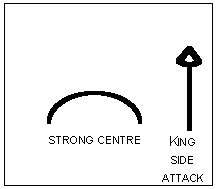
  • closed or at least stable centre
  • King’s-side attack based on stereotyped attacking plan
  • attack based not so much on domination of space and time but on lack of opponent’s counterplay.

These attacking lines are to be found in many openings

You may be able to think of other “system” openings which often yield an easy-to-play attack, like the Colle System, London System and perhaps the Torre system. To some extent the standard h-file attack against a King castled behind a fianchettoed Bishop also fits into this category, as seen in the Dragon Variation of the Sicilian and the Pirc Defence.

  As an attacker, the idea is to keep moving pieces up to the King’s-side until you checkmate your opponent. The reason these often work so well in club play is that the defending side will often play sensible-looking solid moves until is is far to late to stop the defences collapsing. A much more vigorous approach is required in defence.

  So, as defender, you must do at least one of the following:

So, as the attacker, you must keep an eye on your opponent’s counterplay.

  As you see from the links above, you can find examples of these clockwork attacks throughout the Openings handouts, but the examples here should give you the idea:

Kortchnoi,Viktor – Fischer,Robert J (blitz) [E97] 1970

1. d4 Nf6 2. c4 g6 3. Nc3 Bg7 4. e4 d6 5. Be2 O-O 6. Nf3 e5 7. O-O Nc6 8. d5 Ne7 9. Nd2 c5 10. a3 Ne8 11. b4 b6 12. Rb1 f5 13. f3 f4


t+lDsTj+
X-+-S-Lx
-X-X-+x+
+-XpX-+-
-Pp+pX-+
P-N-+p+-
-+-Nb+pP
+rBq+rK-

The centre is completely blocked, and so all the play is going to be on the wings. Any pawn move by White on the King’s-side will leave him with further points of attack for Black , so White persists on the Queen’s-side.

14. a4 g5 15. a5 Rf6 16. bxc5 bxc5 17. Nb3 Rg6 18. Bd2 Nf6 19. Kh1 g4 20. fxg4 Nxg4 21. Rf3 Rh6


t+lD-+j+
X-+-S-Lx
-+-X-+-T
P-XpX-+-
-+p+pXs+
+nN-+r+-
-+-Bb+pP
+r+q+-+k

22. h3 Ng6 23. Kg1 Nf6


t+lD-+j+
X-+-+-Lx
-+-X-SsT
P-XpX-+-
-+p+pX-+
+nN-+r+p
-+-Bb+p+
+r+q+-K-

24. Be1 Nh8 25. Rd3 Nf7 26. Bf3 Ng5 27. Qe2 Rg6 28. Kf1


t+lD-+j+
X-+-+-Lx
-+-X-St+
P-XpX-S-
-+p+pX-+
+nNr+b+p
-+-+q+p+
+r+-Bk+-

28… Nxh3 29. gxh3 Bxh3+ 30. Kf2 Ng4+ 31. Bxg4 Bxg4 0-1


It is easy to understand the appeal of the King’s Indian after such a game.


Fischer,Robert J – Miagmarsuren, Lahmsuran (Sousse) 1967

1. e4 e6 2. d3 d5 3. Nd2 Nf6 4. g3 c5 5. Bg2 Nc6 6. Ngf3 Be7 7. O-O O-O 8. e5 Nd7 9. Re1 b5 10. Nf1 b4 11. h4 a5 12. Bf4 a4


t+lD-Tj+
+-+sLxXx
-+s+x+-+
+-XxP-+-
xX-+-B-P
+-+p+nP-
pPp+-Pb+
R-+qRnK-

This is the same idea, with White. There are differences:

  Black has adopted a more modest central posture than White does in the King’s Indian Defence

  the central pawn structure is more fluid

  Black has gone hard on the Queen’s-side and is starting to make real gains; so, White must pause for a defensive move. White’s next was seen as innovative at the time:

13. a3! bxa3 14. bxa3 Na5

  [14… Nd4 15. Ne3 Ba6 16. c4 dxc4

[Fritz gives 16… Nb3 17. cxd5 Nxa1 18. Qxa1 exd5 19. Nxd5 Bxd3 20. e6 Nf6 21. Nxe7+ Qxe7 22. Ne5 Bg6 23. Nc6 Qb7 24. Bd6]

  17. Nxd4]

15. Ne3 Ba6 16. Bh3 d4


t+-D-Tj+
+-+sLxXx
l+-+x+-+
S-X-P-+-
x+-X-B-P
P-+pNnPb
-+p+-P-+
R-+qR-K-

Which way should White jump?

17. Nf1 Nb6 18. Ng5 Nd5

  White’s Queen has access to h5, which makes Black decide to concede B for N. This leaves White with the idea of assaulting the dark squares.

19. Bd2 Bxg5 20. Bxg5 Qd7 21. Qh5 Rfc8 22. Nd2 Nc3


t+t+-+j+
+-+d+xXx
l+-+x+-+
S-X-P-Bq
x+-X-+-P
P-Sp+-Pb
-+pN-P-+
R-+-R-K-

23. Bf6 Qe8

  [23… gxf6 24. exf6 Kh8]

24. Ne4 g6 25. Qg5 Nxe4 26. Rxe4


t+t+d+j+
+-+-+x+x
l+-+xBx+
S-X-P-Q-
x+-Xr+-P
P-+p+-Pb
-+p+-P-+
R-+-+-K-

They think it’s all over…

26… c4 27. h5 cxd3 28. Rh4 Ra7 29. Bg2 dxc2 30. Qh6 Qf8 31. Qxh7+ 1-0 …it is now.


Psakhis – Kasparov (La Manga) 1990

1. c4 g6 2. Nc3 Bg7 3. g3 Nc6 4. Bg2 d6 5. Nf3 e5 6. d3 f5 7. O-O Nf6 8. Rb1 h6


t+lDj+-T
XxX-+-L-
-+sX-SxX
+-+-Xx+-
-+p+-+-+
+-Np+nP-
pP-+pPbP
+rBq+rK-

The mutual control of d4/d5 means that although the central pawns are not locked, the centre is likely to remain closed. So we have a battle on each wing.

9. b4 O-O 10. b5 Ne7 11. a4 Be6 12. Ba3 Rc8 13. Nd2 b6


-+tD-Tj+
X-X-S-L-
-X-XlSxX
+p+-Xx+-
p+p+-+-+
B-Np+-P-
-+-NpPbP
+r+q+rK-

Again, a prudent measure. White will have to re-arrange to get in a5, so changes tack

14. e3 g5 15. d4 exd4 16. exd4 f4 17. Re1 Bg4 18. Nf3 Qd7 19. c5 Rce8 20. Rc1 Nf5 21. Qd3 Kh8 22. cxd6 cxd6 23. Rxe8 Qxe8 24. Rf1 Qh5


-+-+-T-J
X-+-+-L-
-X-X-S-X
+p+-+sXd
p+-P-Xl+
B-Nq+nP-
-+-+-PbP
+-+-+rK-

There is a dark storm cloud over White’s King.

25. Ne4 Nxe4 26. Qxe4 Bh3 27. Ne5 Bxg2 28. Kxg2 g4 29. Bxd6 Rf6 30. Bb8

Qh3+ 0-1


Rogers,I – Carton,N [A26] London

1. c4 Nf6 2. Nc3 e5 3. g3 g6 4. Bg2 Bg7 5. e4 d6 6. Nge2 Nc6 7. d3 O-O 8. O-O

  This is an interesting formation, kin to the Closed Sicilian. White clamps the centre shut and goes creeping up on the King’s-side. Black’s prospects of successful Queen-side counterplay are less than in the Closed Sicilian because of the pawn on c4. Here Black decides to slug it out toe to toe on the King’s-side, but in this game White’s initiative prevails.

8… Nh5 9. f4 f5


t+lD-Tj+
XxX-+-Lx
-+sX-+x+
+-+-Xx+s
-+p+pP-+
+-Np+-P-
pP-+n+bP
R-Bq+rK-

10. Be3 Be6 11. Nd5 Qd7 12. Qd2 Rae8 13. Rae1 Nf6 14. Kh1 Rf7 15. b3 fxe4 16. dxe4 Bh3 17. Nxf6+ Rxf6 18. Nc3 exf4 19. gxf4 Bxg2+ 20. Qxg2 Rfe6 21. Bd2 Nd4 22. Rd1 b5 23. f5


-+-+t+j+
X-Xd+-Lx
-+-Xt+x+
+x+-+p+-
-+pSp+-+
+pN-+-+-
p+-B-+qP
+-+r+r+k

1-0

Four choices in the opening

Introduction: your four choices

There are four basic choices to be made before sitting down at a chessboard.

You must decide whether to open as White with 1. e4, with 1.d4 or with a Reti/English system

(and have something in mind against each semi-open or Indian defence)

You must decide how to respond to 1. e4 as Black

You must decide how to respond to 1. d4 as Black

You must decide how to respond to the Reti/English system as Black.

What you choose may depend on whether you like to attack or to play more solidly, and whether you prefer to play open or more closed positions.

You should also consider how it fits with what else you have chosen. For example, if you adopt the Dutch or English Defences with the move order 1. d4 e6, you must be prepared to play the French. Or, if you like to play the Slav with …c6, you might feel the Caro-Kann with …c6 is a nice fit.

The commonest – and many would say the best – opening move is 1. e4, and 1. d4 is also a good first move. But almost every other first move has been played and advocated at some time or another, and almost every legal Black move has been tried in reply to 1.e4/1.d4.

I enclose an openings map below. Even if you learned this off by heart, there are still over 1000 more openings, defences and variations listed in the Oxford Companion to Chess. This is a map, not so you can go charging off everywhere, but so if someone shows you something, you can look it up. You should know that each opening has a plan (or if it doesn’t, it’s not a very good opening!) You will easily find things not on this list – either mainstream (e.g. last time I visited a bookshop it had a new book on the Torre Attack 1.d4 Nf6 2.Nf3 and 3.Bg5), and or amongst the ‘fringe’ (e.g. the Vulture 1.d4 Nf6 2.c4 c5 3.d5 Ne4). Moreover, as GM LOMBARDY once said (cited above),

“All openings offer good winning chances in amateur play“.

I used to know a Henry who was known as H.4.Stewart because of his inclination to 1.h4 as an opening move, and I’m sure it saved him a lot of time sweating over the latest line in the Sicilian Dragon. How should you reply to this? If faced with 1.h4, or anything else unusual, just keep playing good chess – keep calm, keep developing, keep your eye on the centre, and keep your wits about you.

The variety of openings can be daunting. I think there is a trick to coping with this, which is expressed in Reti’s famous statement:

“A knowledge of tactics is the foundation of positional play. This is a rule which has stood its test in chess history and one which we cannot impress forcibly enough upon the young chess player. A beginner should avoid Queen’s Gambit and French Defence and play open games instead! While he may not win as many games at first, he will in the long run be amply compensated by acquiring a thorough knowledge of the game” – RICHARD RETI

The development of a chessplayer should naturally progress through stages just as chess has passed through stages in its history. MacDonnell and LaBourdonnais (and even Steinitz and Tchigorin) lashed at each other with the Evans Gambit; by the time Steinitz played Lasker we saw more of the Ruy Lopez. The titanic Capablanca-Alekhin struggle was fought out mainly with the Queen’s Gambit Declined (whereas the era of Steinitz was more concerned with the Gambit Accepted). The Euwe matches saw the French, a Semi-Open defence, and Indian Defences like the Dutch, Grunfeld and Nimzo-Indian adopted as main choices at World Championship level for the first time. By the time of Botvinnik we saw the Caro-Kann, the King’s Indian and the flank openings (Reti and English) appearing in matches, while Karpov and Kasparov seem to have played everything.

From this we can draw up a hierarchy, on each side of the board:

1. Open games and Gambits with 1. e4 e5; Queen’s Gambit Accepted.

2. Ruy Lopez; Queen’s Gambit Declined.

3. French; Dutch, Grunfeld, Queen’s and Nimzo-Indian.

4. Flank openings; King’s Indian.

There is no doubt in my mind that only once you have served your apprenticeship with the earlier and strategically more simple openings should you venture out to play in the jungles of the later ones.

Also, if you do want to move down the list, I think you should not move through dissatisfaction or fear with your current repertoire, but preferably from boredom, or the experience that opponents at your level know all about how to play the openings you practice. One might also remember that Bobby Fischer rarely departed from 1. e4 throughout his career, and that the Giuoco Piano was played by Karpov against Kortchnoi.


Playing Aggressively or Solidly as White and Black

Did I say four choices? There is another choice which you need to make first: do you wish to play solidly or aggressively? Reti and I suggest that you play open games, which more or less obliges an aggressive style. It is in these games that you can practice attacking play and learn to spot tactics, without which there is not much point considering more strategically complex systems. However, if you feel you have been through this apprenticeship, there are some more solid, strategical choices available.

For example, the Italian Game generally results in fewer draws than the English Opening, and more draws than the King’s Gambit, although the percentage score from each opening may be similar, acording to databases I have examined:
Italian Game: 41% White wins, 26% drawn, 33% lost by White (total 54%)
English Opening: 37% White wins, 36% drawn, 27% lost by White (total 54%)
King’s Gambit: 47% White wins, 15% drawn, 38% lost by White (total 54%)

Within the Giuoco Piano alone, playing d2-d4 instead of d2-d3 reduces the proportion of draws by 10%. So, you have quite a lot of influence over the style of the game by your opening choices, although these are always negotiated (as it were) with your opponent!

Here is a sorted list of common opening systems, from which you can make your four choices.

  • Playing White with 1. e4
    • Playing aggressively as White with 1. e4
      • After 1…e5: Danish Gambit, Giuoco Piano with d2-d4/Max Lange, King’s Gambit, Vienna Gambit, Bishop’s Opening (Urusoff Gambit), Ruy Lopez with an early d4
      • Against semi-open defences: early d2-d4, advance variations, transposition to Blackmar-Diemer Gambit or other Gambits (e.g. Morra).
    • Playing solidly as White with 1. e4
      • After 1…e5: Centre Game, Bishop’s Opening/Giuoco Piano with d2-d3, Ruy Lopez with d2-d4 late or never, Vienna Game,
      • Against semi-open defences: advance variations, King’s Indian Attack.
  • Playing White with 1. d4
    • Playing aggressively as White with 1. d4
      • After 1…d5: Blackmar-Diemer Gambit, Queen’s Gambit with Queen’s-side castling,
      • Against Indian defences: King’s-side Pawn storms e.g. Samisch vs. King’s Indian.
    • Playing solidly as White with 1. d4
      • After 1…d5: Queen’s Gambit Declined with O-O, Queen’s Pawn games without c2-c4.
      • Against Indian defences: Queen’s-side Pawn storms e.g. Classical King’s Indian.
  • Playing White with the Reti/English
    • Playing (relatively) aggressively as White with the Reti/English
      • King’s Indian Attack, Botvinnik system of English.
    • Playing solidly as White with the Reti/English
      • Queen’s-side Pawn storms, systems with b2-b3.
  • Playing Black
    • Playing Black against 1. e4
      • Playing aggressively as Black against 1. e4
        • Sicilian, Alekhin’s, Pirc/Modern
      • Playing solidly as Black against 1. e4
        • Petroff or other lines with 1…e5, French, Caro-Kann, Modern with …c6
  • Playing Black against 1. d4
    • Playing aggressively as Black against 1. d4
      • Tarrasch Defence, Budapest Gambit, Benko/Benoni, King’s Indian, Grunfeld
    • Playing solidly as Black against 1. d4
      • Slav Defence, Queen’s Gambit Declined e.g. Tartakower, Nimzo/Queen’s Indian
  • Playing Black against the Reti/English
    • Playing aggressively as Black against the Reti/English
      • Reversed Sicilian, Dutch systems, King’s Indian
    • Playing solidly as Black against the Reti/English
      • Slav, London System

If you don’t know what these openings are yet, you might look them up below, but you will need more information than this to play them properly!


Changing your opening repertoire.


It may be from reading things like this that you are thinking about changing your opening choices. There are some things to consider:

  • Don’t try and change your whole repertoire from a given date. It’s much better to experiment with part of your repertoire at a time, and you don’t have to play your new line in every game.
  • The first thing to do is to get hold of a good verbal summary of the ideas behind the new line(s). [Don’t spend a fortune on specific monographs until you are committed to the line; you are better off owning more general, inclusive titles until you pass 1400 ELO (Class C).] Reuben Fine’s The Ideas behind the chess openings is a great place to start, but it is terribly dated. [He disparages some openings which, fifty years on, are believed to be very playable.] If you have access to this book, and can bend the ear of a couple of players who are a couple of classes or more above you, this is probably all you need.
    There are some brief explanations which are quite nice in “BCO2”, the second edition of Batsford Chess Openings.
    There are also some monographs which cover a variety of openings and which are designed to explain the ideas: some of the best of these are also rather old and out of print like the RHM series “Understanding the …”, or books which cover several openings at once [e.g. The Italian Game, Botterill/Harding].
  • The next thing is to find some example variations and games. BCO2 is fine for variations, and there are game databases on the internet for different openings. All of these are totally unannotated. Play over a few lines or games to get a “feel” for the opening – which squares your pieces often come to, and which side of the board to play on.
    To get hold of annotated games, try magazines, and games collections like, say, Alekhin’s Best games of Chess.
  • So, now you should know the ideas behind the openings, some of the main lines, and have a feel for how the game may go. The next step is to try it out. Play friendly “quick” games using this opening at your club, or on one of the chess servers; it’s nice to find an opponent who will cooperate by agreeing to play your chosen opening. [I say quick rather than blitz: I have a prejudice that 5-minute chess (G/5) is useless for learning openings, but 10-15 minute chess is very useful. Every so often in the opening you will need to stop and think for 2-3 minutes, which you can do at G/10. ]
    This should let you know what the basic variations are that you will meet most often in practice, and the plans most often adopted.
  • Then introduce it into your serious games. Again, you don’t have to play it in every game; I’ve been experimenting with 1. e4 as a replacement for the English 1. c4 in my games, but I still play the English if:
    1. a draw is more important than a win, or
    2. my opponent is a known skilful attacking player who hates slow games, or
    3. my opponent is a junior who is likely to be inexperienced in the English, or
    4. my opponent plays a defence to 1.c4 which I like to play against, or
    5. my opponent plays a defence to 1.e4 which I don’t like, or
    6. I feel like it!
  • Playing a couple of postal games with your new opening is very good practice.

A simple openings map.


Openings without 1.d4 or 1.e4

There are hundreds of tried and untried moves. I recently came across Larsen’s Gambit 59: 1. g3 e5 2. Bg2 d5 3. b4!? Bxb4 4. c4! Stefan Bucker of Norwalde, Germany, has actually invented a little trio of related defensive systems for Black. Amazingly, they occur after some very familiar initial moves:

They are:

The Vulture: 1. d4 c5 2. d5 Nf6 3. c4 Ne4
The Habichd: 1. d4 c5 2. d5 Nf6 3. Nf3 c4
The Woozle: 1. d4 c5 2. d5 Nf6 3. Nc3 Qa5 (idea …b5)

(The “Habichd” comes from the German phrase for “I’ve got you” (maybe we would say in English: Gotcha!), and the “Woozle” comes perhaps from English slang “woozy”, meaning drunk or befuddled.)

There are some morals to be drawn from the existence of these openings: one gloomy, one cheerful.

1. You cannot anticipate everything. Time spent trying to come up with a “complete”, failsafe opening repertoire is doomed to failure. You will get locked inside an arms race where the only winners are the publishers. You are better off studying chess than openings!

2. There is always scope for originality in the opening. Even if you feel yourself being drawn into your opponent’s preparation you may be able to head off into untheoretical territory – not by playing a bad-looking move, but perhaps with an odd-looking one, or a good-looking one that just isn’t in the books. Tartakower used to say, “Unfashionable, therefore playable”!

1. Na3 [unhappy] Durkin Opening (a.k.a. Sodium Attack). Supports c4 but isn’t really going anywhere. I recommend 1…e5 in reply. I can’t guarantee you will emerge equal but it’s a natural way to try.

1. Nc3 [solid] Dunst Opening. One of the better non-standard lines: White can hit out with e4 or go solid with g3.

1. Nf3 [solid] [unhappy] [bookish] Reti Opening. White invites Black to set up a pawn centre; White can follow up with g3/c4. (The [unhappy] is for the difficult and subtle nature of many of the main lines – save it for later in your career. This applies also to other modern openings like the English and Catalan.)

1. Nh3 [unhappy][skull] Amar Opening (Paris Gambit). Usually intending 1.Nh3 d5 2. g3 e5 3. f4 Bxh3 4. Bxh3 exf4. Tartakower played this and even won] but don’t you play it until you’re as good as Tartakower.

1. a3 [solid] Anderssen Opening. A way of reserving options. White may follow up naturally with 2.b3 or 2.b4, transposing.

1. a4 [?!] Meadow Hay Opening. The name is insulting (implying, a yokel opening). Not really going anywhere: 1…e5 equalises.

1. b3 [!?] Nimzo-Larsen Opening a.k.a. Queen Fianchetto Opening. White will allow Black to set up a pawn centre [which can then be used as a target.

1. b4 [!?] Sokolsky Opening a.k.a. Polish Opening a.k.a. Orang-Utan Opening. Black is again allowed a pawn centre, but is not given the freedom of …c5.

1. c3 [solid] Saragossa Opening. A way of reserving options. 1…e5 should equalise.

1. c4 [solid][bookish] English Opening. A major opening complex. Black can reply

1 … c5 – Symmetrical Variation

1 … e5 – Reversed Sicilian

1 … Nf6 – Indian-style variations

1. d3 [solid][smile] King’s Indian Attack, a.k.a. Mieses Opening. The KIA requires a follow-up with Nf3,g3,Bg2,O-O and then e4 or c3/a4. You can also get into it via 1.Nf3 or 1.e4, and these are more common in practice.


Openings with 1.d4

1. d4 [smile]

1. d4 Na6 [skull] (never seen by your inexperienced author: may intend …c5)

1. d4 Nc6 [?!] may transpose into the Kevitz-Trajkovic Defence: 1.d4 Nf6 2.c4 Nc6.

1. d4 Nf6 [bookish][active] leads to various


Indian Defences [e.g…

1. d4 Nf6 2. c4 c5 (with …e6) – Modern Benoni Defence. [active]  1. d4 Nf6 2. c4 d6 – Old Indian Defence.[solid]

1. d4 Nf6 2. c4 e6 3. Nc3 Bb4 – Nimzo-Indian Defence. [active]

1. d4 Nf6 2. c4 e6 3. Nf3 b6 – Queen’s Indian Defence. [solid]

1. d4 Nf6 2. c4 e6 3. Nf3 Bb6 – Bogo-Indian Defence. [solid]

1. d4 Nf6 2. c4 e6 3. Nf3 Ne4 – Dory Defence. [unhappy]

1. d4 Nf6 2. c4 e6 3. g3 – Neo-Catalan Opening. [solid]

1. d4 Nf6 2. c4 e5 – Budapest Gambit. [!?] [trappy]

1. d4 Nf6 2. c4 g6 3. Nc3 d5 – Grunfeld Defence. [active]

1. d4 Nf6 2. c4 g6 3. Nc3 d6 – King’s Indian Defence. [active]

1. d4 Nh6 [skull] (never seen)

1. d4 a5 [?!] (never seen)

1. d4 a6 [!? ] (usually intended as a transposition to …b5 lines)

1. d4 b5 [!?] Polish Defence. Black intends …Bb7 without allowing a block by c4/d5

1. d4 b6 [!?] English Defence. Black tempts c4 and e4 which can be undermined with e.g. …f5

1. d4 c5 [solid] Old Benoni Defence.

1. d4 c6 [solid] (usually transposes to e.g. Slav Defence to Queen’s Gambit)

1. d4 d5 [smile] (leads to main-line Queen Pawn openings)

1. d4 d6 (usually transposes to e.g. King’s Indian Defence)

1. d4 e5 [bomb][trappy] Englund Gambit. (a.k.a. Charlick Gambit) Vigorous but unsound. 1.d4 e5 2.dxe5 Nc6 3. Nf3 Qe7 4. Qd5! += (4.Bf4 Qb4+ can lead to trouble).

1. d4 e6 [solid] (usually transposes [e.g. to Nimzo-Indian or French Defence)

1. d4 f5 [active][smile] Dutch Defence. Black stakes out space on the King’s side.

1. d4 f6 [skull] Onc’s Defence. Intends …Nh6-f7.

1. d4 g5 [skull] (loses a pawn: see 1…h6)

1. d4 g6 [active] Modern Defence. Black invites White to make a centre with c4/e4 which can then be attacked.

1. d4 h5 [?!] (never seen)

1. d4 h6 [?!] Borg Defence. (Grob reversed) Black will play …g5,…Bg7 and probably …c5 or …d5.

1. e3 [solid] Van’t Kruy’s Opening. A way of reserving options.


Openings with 1.e4

1. e4 [smile]

1. e4 Na6 [?!] (never seen – Benjamin and Schiller call it the Lemming)

1. e4 Nc6 [!?] Nimzovitch Defence. Black can counter-punch with …d5 or …e5, sometimes transposing.

1. e4 Nf6 [active] Alekhin’s Defence. Black invites 2.e5 Nd5 3.d4, after which …d6 strikes back at the extended centre.

1. e4 Nh6 [?!] (never seen: may intend …f5)

1. e4 a5 [?!] (never seen)

1. e4 a6 [!?] St.George’s Defence (a.k.a. Baker’s Defence). Black intends …b5, …Bb7 and probably …e6,…c5 and …Nf6

1. e4 b5 [skull] (loses a pawn: see 1…a6)

1. e4 b6 [?!] Owen’s Defence a.k.a. Queen Fianchetto Defence. Black invites White to set up a pawn centre which can then be attacked.

1. e4 c5 [active] Sicilian Defence. Black will exchange if White plays d4.

1. e4 c6 [solid] Caro-Kann Defence. Black will counter-punch with …d5.

1. e4 d5 [solid] Centre Counter Defence a.k.a. Scandanavian Defence.

1. e4 d6 [active] Pirc Defence. Black will develop first] and strike out in the centre later.

1. e4 e5 [smile] (leads to the main King Pawn games)

Defences to 1. e4 other than 1…e5 are generally referred to as

Semi-Open Defences

and include the Alekhin, Sicilian, Caro-Kann, Pirc and French.

1. e4 e6 [solid][smile] French Defence. Black will counter-punch with …d5.

1. e4 f5 [skull] The Fred Defence. Ugh.

1. e4 f6 [skull] Onc’s Gambit. 2.d4 e5 3. dxe5 Nc6 4.exf6 Nxf6. Ugh.

1. e4 g5 [?!] Borg Defence. (Grob reversed). see 1.d4 h6.

1. e4 g6 [active] Modern Defence. (a.k.a. Kotov/Robatsch Defence) Black invites 2.d4; the centre can then be used as a target.

1. e4 h5 [skull] (never seen)

1. e4 h6 [?!] see Borg Defence above.

1. f3 [skull] Barnes Opening. Rude players have even followed this up with 2.Kf2 (known as the Pork Chop).

1. f4 [solid] Bird’s Opening. Not bad; White can play as if playing the Dutch or follow up with 2.b3.

1. g3 [solid] Benko Opening a.k.a. King Fianchetto Opening. Often transposes.

1. g4 [!?] [trappy] Grob’s Opening. Intends a gambit with 1 … d5; 2 Bg2 Bxg4 (2 … c6 is safer) 3.c4!

1. h3 [unhappy] Clemenz Opening. English IM Michael Basman has played this, along with other ‘odd’ moves like a3 and g4/b4 (and the same for Black), as a way of reserving options and tempting opponents to over-commit themselves.

1. h4 [unhappy] Desprez Opening a.k.a. Reagan Opening (‘Thoroughly unmotivated and creates weaknesses with only vague promises of future potential‘ – BENJAMIN and SCHILLER).


Double Queen Pawn Openings

1. d4 d5 [smile] (leads to main-line Queen Pawn openings)

1. d4 d5 2. e3 [smile] Colle System. White is aiming for a 1.e4-style game after Nf3,Bd3,Re1 and e4

1. d4 d5 2. e4 (dxe4 3. Nc3 Nf6 4. f3) [active][bomb] Blackmar-Diemer Gambit. Tricky and with something of a cult following.

1. d4 d5 2. f4 (or 2.e3+ 3.f4) [solid] Stonewall Opening. Playing for a slow K-side attack, but leaves weak points. Not good enough, really.

1. d4 d5 2.Nc3 (2…Nf6 3.Bg5) [!?] Veresov Opening a.k.a. Richter-Veresov. White often aims for e4, sometimes with f3, although can play more quietly.

1. d4 d5 2.c4 [solid] Queen’s Gambit. The main weapon of 1.d4 players

1. d4 d5 2.c4 Nc6 [!?] Queen’s Gambit, Tchigorin Defence. Tricky, trappy difficult chess.

1. d4 d5 2.c4 Nf6 [!?][trappy] Queen’s Gambit, Marshall Defence. Often played by beginners, and not to be rushed at.

1. d4 d5 2.c4 c5 [?!][unhappy] Queen’s Gambit, Symmetrical Defence. White should be able to preserve an advantage.

1. d4 d5 2.c4 c6 [!?][bookish] Queen’s Gambit, Slav Defence. A good defence, combining solidity with possibilities for playing for a win.

1. d4 d5 2.c4 dxc5 [!?][bookish] Queen’s Gambit Accepted. More open and fighting approach than the Orthodox.

1. d4 d5 2.c4 e5 [active][trappy] Queen’s Gambit, Albin Counter-Gambit. A difficult gambit line, usually mistrusted, sometimes tried with success.

1. d4 d5 2.c4 e6 [solid][bookish] Queen’s Gambit Declined, Orthodox Defence. The main highway of the QGD, with many sub-variations.

1. d4 d5 2.c4 e6 3. g3 [solid][unhappy][bookish] Catalan Opening. Slow, solid, subtle.


Double King Pawn Openings

1. e4 e5 [smile] (leads to main-line King Pawn openings)

1. e4 e5 2. Bc4 [active][smile] Bishop’s Opening. Under-rated for many years, now taken more seriously. Often played at GM level in a very solid way, which I don’t think you should imitate until you have a good few years experience.

1. e4 e5 2. Nc3 [solid][smile] Vienna Game and Vienna Gambit (3.f4). Worth a look: not a real kick-and-rush opening but has its points.

1. e4 e5 2. Ne2 [solid] Alapin’s Opening. Intends f4 without loss, but is too slow a move for this stage of the game.

1. e4 e5 2. Nf3 Nc6 3. Bb5 [solid][bookish] Ruy Lopez. Very large opening system: the main weapon of many 1.e4 players. An opening for life.

1. e4 e5 2. Nf3 Nc6 3. Bc4 [smile] (generally) Italian Game. Just the sort of open, tactical chess you should be playing.

1. e4 e5 2. Nf3 Nc6 3. Bc4 Bc5 [active][smile][bookish] Giuoco Piano. A good training ground for your early chess games.

1. e4 e5 2. Nf3 c6 3. Bc4 Bc5 4. b4 [active][smile][bookish] Evans’ Gambit. A sharp and enterprising line, which sadly has not really survived Lasker’s scrutiny.

1. e4 e5 2. Nf3 Nc6 3. Bc4 Be7 [solid][unhappy] Hungarian Defence. Unnecessarily passive, but not bad.

1. e4 e5 2. Nf3 Nc6 3. Bc4 Nf6 [smile][active] Two Knights’ Defence. A good counter-attacking line.

1. e4 e5 2. Nf3 Nc6 3. Be2 [solid] Tayler Opening. Recently explored, but no great discovery.

1. e4 e5 2. Nf3 Nc6 3. Nc3 Bb4 [solid] Three Knights’ Game. A way of trying to avoid the Four Knights. (3…Bc5 is not good)

1. e4 e5 2. Nf3 Nc6 3. Nc3 Nf6 [solid] Four Knights’ Opening. Solid, square, often stodgy.

1. e4 e5 2. Nf3 Nc6 3. c3 [solid] Ponziani Opening. Slow, but some interesting lines if Black stirs things up.

1. e4 e5 2. Nf3 Nc6 3. d4 [smile][solid] Scotch Opening. Fashionable recently, worth looking at.

1. e4 e5 2. Nf3 Nc6 3. d4 exd4 4. c3 [smile] Goring Gambit. Not fashionable [but also worth looking at.

1. e4 e5 2. Nf3 Nc6 3. g3 [solid][smile] King’s Indian Attack. Slow but aggressive: not at its best in this form but often used against the half-open defences such as the French and Caro-Kann.

1. e4 e5 2. Nf3 Nf6 [active] Petroff Defence. Recently very fashionable, enough to make people look at the Bishop’s Opening to avoid it.

1. e4 e5 2. Nf3 d5 [bomb] Queen’s Pawn Counter-Gambit. Unsound.

1. e4 e5 2. Nf3 d6 [solid] Philidor’s Defence. Solid but nothing special: may lead to a slower game than White would prefer.

1. e4 e5 2. Nf3 f5 [bomb] Latvian Counter-Gambit. The line with 3. Bc4 probably wins for White, although 3. Nxe4 Qf6 4. Nc4 is +=

1. e4 e5 2. Nf3 f6 [skull] Damiano’s Defence. Unsound.

1. e4 e5 2. d4 exd4 3. Qxd5 [solid] Centre Game. 3…Nc6 simply gains time and White will struggle to equalise against accurate play by Black.

1. e4 e5 2. d4 exd4 3. c3 [active][unhappy] Danish Gambit. The way to liven up the Centre Game, although Black can decline or return the gambit with good chances.

1. e4 e5 2. f4 [active][smile] King’s Gambit. Bold, vigorous, dangerous. Black can decline or return the gambit pawn, and even offer a gambit with …d5, but in no case can Black avoid a complex game with a full board.


Key

[bookish]= Popular opening [books or other support material readily available

[smile] 🙂 = a good opening for juniors

[!?] = Interesting or tricky]

[?!] = Dubious or difficult]

[bomb] = Too risky

[unhappy] 🙁 = Not recommended

[skull] = Definitely not recommended

Style

[solid] = Solid – won’t get you into trouble

[active] = Active (White) or counterattacking (Black)

[trappy] = Trappy

Ten rules for the opening

  1. Get your pieces out into the centre quickly. The opening  is a race to see who can get their pieces out first while keeping at least a share of control of the centre.
    • This is the main point to remember; all the other rules are just footnotes to this one.  Sortez les pièces!

  2. Get a firm foothold in the centre – a pawn on one of the ‘little centre’ squares e4/e5/d5/d4 – and don’t give it up without good reason
  3. Move your king to safety at the side by castling
  4. Complete your development before moving a piece twice or starting an attack.  By move 12, you should have connected your Rooks, or be about to do so.
  5. More detail on winning the race:
    • move pieces not pawns, and
    • move them to their best squares in one move if you can, and also
    • try to gain time if you can by aggressive moves.
  6. Move your minor pieces out early on generally move Knights before Bishops, and generally straightaway to f3/c3 or f6/c6 (but probably not both, as White)
  7. Don’t move out your major pieces (Q+RR) where they will get chased around by the little guys and possibly trapped.
  8. Don’t grab pawns or attack if you haven’t completed developmen; especially, don’t charge around with your Queen trying to hoover up pawns.
  9. If one side gets ahead in development:

    • If you are ahead in development, start something going and open up lines for your better pieces
    • If you are behind in development, don’t start anything and keep things closed until you have caught up. This is especially true if you have not castled!
  10. Rooks are the hardest piece to develop: “openings should be judged on the prospects they offer to ambitious young Rooks” – PURDY.  To develop your Rooks, open a file; to open a file, bring pawns into a position to swap them off; so after 1.e4, plan to play d2-d4 or f2-f4 soon.
    • In fact, you have to attack the opponent’s centre with pawns to get much chance of an advantage as White (The Four Knights’ Game is next to Old Stodge in drawishness), so d2-d4 makes sense for more than one reason.

Further advice on playing the opening

I’ve collected here some other advice from the grandmasters of the past.

Lasker’s rules for the opening

  1. Do not move any pawns in the opening of a game but the King and Queen pawns.
  2. Do not move any piece twice in the opening, but put it at once on the right square.
  3. Bring out your knights before developing your bishops, especially the Queen’s Bishop.
  4. Do not pin the adverse King Knight (ie. by Bg5) before your opponent has castled.

[cat] COOL TIP: Why should you move the knights first? Well, knights are very much more effective if they are in the centre. (Bishops are more effective here too, but they can work from a distance). For the opening that has to mean Knights moving to c3 and f3 (or c6 and g6). Where should the Bishops go? The White King’s Bishop on f1 could go to b5,c4,d3 or even e2. Which is best? That depends on what your opponent is up to. So, move your knights straight away to the centre, and while you are doing that your opponent’s moves may suggest to you where you should put your bishops.


Reuben Fine on the opening:

  1. In the initial position White, because of the extra move, has a slight advantage. Consequently:
  2. White’s problem in the opening is to secure the better position, while…
  3. Black’s problem is to secure equality.

Fine’s rules for the opening

  1. Open with either the e-pawn or the d-pawn.
  2. Wherever possible, make a good developing move which threatens something or adds to the pressure on the centre.
  3. Develop knights before bishops.
  4. Pick the most suitable square for a piece and develop it there once and for all.
  5. Make one or two pawn moves in the opening, not more.
  6. Do not bring your queen out too early.
  7. Castle as soon as possible, preferably on the king’s side.
  8. Play to get control of the centre.
  9. Always try to maintain at least one pawn in the centre.
  10. Do not sacrifice without a clear and adequate reason, eg.:
    • it secures a tangible advantage in development
    • it deflects the opponent’s queen
    • it prevents the opponent from castling
    • it enables a strong attack to be developed

Fine’s two last questions to be asked before a move is made:

  • How does it affect the centre?
  • How does it fit in with the development of my other pieces and pawns?

Nimzovitch’s Seven Axioms

(from My System)

  1. Development is to be understood as the strategic advance of the troops toward the frontier line (the line between the fourth and fifth ranks).
  2. A pawn move must not in itself be regarded as a devloping move, but merely as an aid to development.
  3. To be ahead in development is the ideal to be aimed for.
  4. Exchange with resulting gain of tempo.
  5. Liquidation, with consequent development or disembarrassment.
  6. The pawn centre must be mobile.
  7. There is no time for pawn hunting in the opening, except for centre pawns.

— NIMZOVITCH


Suetin’s four principles for advanced players

  1. The fight for control of the centre
  2. The striving for the quickest and most active development.
  3. The creation of conditions that permit early castling.
  4. The formation of an advantageous pawn structure

— SUETIN


Hort’s 13 rules for all players

  1. Take advantage of every tempo.
  2. Do not make pawn moves without careful planning.
  3. Begin the game with a centre pawn, and develop the minor pieces so that they influence the centre.
  4. Develop flexibly!
  5. Develop harmoniously! Play with all your pieces
  6. Do not make aimless moves. Each move must be part of a definite plan.
  7. Do not be eager for material gain. The fight for time is much more important than the fight for material, especially in open positions.
  8. A weakening of your own pawns may be accepted only if it is compensated by a more active placement of your pieces.
  9. With the help of your pawns, try to get an advantage in space and weaken your opponent’s pawn position.
  10. Do not obstruct your pawns by grouping your pieces directly in front of them; pawns and pieces must work together.
  11. During the first few moves, pay special attention to the vulnerable KB2 square on both sides.
  12. Remember that the poor placement of even a single piece may destroy the coordination of the other pieces.
  13. With White, exploit the advantage of having the first move and try to gain the initiative. With Black, try to organize counterplay.

This last point is worth particular attention, for, although it contains much wisdom, it is not always applied in current tournament practice. Unfortunately, we belong to a time when White usually tries to gain only a minimal advantage, because to try for more entails the taking of risks. Black, having no sure method of developing counterplay without risk, usually tries to minimise White’s attacking possibilities. The game thus proceeds towards an endgame in which neither side has real winning chances.”  — VLASTIMIL HORT


Portisch on forming a repertoire:

“Your only task in the opening is to reach a playable middlegame.” “…To all players I can recommend the following: simplicity and economy. These are the characteristics of the opening systems of many great masters… A solid opening repertoire fosters self-confidence.” — LAJOS PORTISCH

(LP goes on to discuss the Exchange Ruy Lopez, the Modern Steinitz (as Black), slow lines of the French Winawer, the Classical Pirc, the Closed Sicilian and the King’s Indian Attack against the French (and Sicilian; and on the other side of the board the Exchange Queen’s Gambit and lines of the King’s Indian Defence and Nimzo-Indian)

Choosing an opening repertoire

The Bottom Line {D}

[cool cat says:]

“A knowledge of tactics is the foundation of positional play. This is a rule which has stood its test in chess history and one which we cannot impress forcibly enough upon the young chess player.
“A beginner should avoid the Queen’s Gambit and French Defence and play open games instead! While he may not win as many games at first, he will in the long run be amply compensated by acquiring a thorough knowledge of the game”

– RICHARD RETI, Masters of the Chessboard

See also a recent post.


Comments on openings {C}

(following ECO codes)

A: Irregular openings
– 1. Lines without 1. e4, 1. d4;
– 1. d4 Lines without 1 …d5, 1… Nf6;
– 1. d4 Nf6 2. Lines without 2. c4;
– 1. d4 Nf6 2. c4 Lines without 2… e6, 2… g6
[cool cat says:] Dr.Dave’s advice: Leave these alone except to work out what to do if someone played them against you. Mostly these are good for surprise value, but you can only surprise me once, and next time I’ll be ready for you. The main lines are the main lines because they are the strongest openings. Avoid theory, sure, but don’t handicap yourself.
The honorable exception to this among these openings are the lines of the Reti/English complex (1.Nf3/1.c4), which are slow but deep and strong. I’d still leave them alone until you are sure you know what you are doing. Be prepared to defend against them as Black: I recommend using a Dutch formation.
B: Semi-open games
– 1. e4 Lines without 1… c5, 1… e6, 1… e5
– 1. e4 c5
[cool cat says:] Dr.Dave’s advice: Play these second after you have got the hang of C: Open Games. This section includes some of the most exciting and important openings in chess, like the Sicilian, but they are not IMHO for beginners.
C: Open Games (and French Defence)
– 1. e4 e6
– 1. e4 e5
[cool cat says:] Dr.Dave’s advice: Play these first – this is what Reti advises above. The anomaly is the French – a half-open defence that ECO groups under C. Despite Reti’s admonition, I would not object to a relative beginner playing the French – it is a solid defence in which most of the ideas are easy to understand, and Black’s pieces often come to similar squares in each line.
D: Closed Games (and Grunfeld Defence, a semi-closed line)
– 1. d4 d5
– 1. d4 Nf6 2. c4 g6 + d7-d5
[cool cat says:] Dr.Dave’s advice: Play these last of all; they are among the most demanding of openings. They are slow, which may lead you to think they are safer, but things can go horribly wrong for the novice and there is no point trying these until you are sure you know what you are doing – say, that you are familiar with the material in the ‘Strategy’ section of the canon. There are one or two ‘open’ lines that start 1.d4, like the Colle System.
E: Semi-Closed Games
– 1. d4 Nf6 2. c4 e6
– 1. d4 Nf6 2. c4 g6 ‘ d7-d5
[cool cat says:] Dr.Dave’s advice: Play these third; they are, like the semi-open defences, very tasty, but rather strong meat for inexperienced players. You will need to know what to play against 1.d4 as Black, particularly as you improve, and my recommendation is to adopt a counter-attacking line like the Budapest Gambit or the Stonewall Variation of the Dutch Defence

Putting together a repertoire of variations {B}

What do you hope for when you play 1.e4? Which opening you choose after 1…e5 will depend on what sort of player you are. What I’d like to do below is suggest how you might proceed if Black doesn’t reply 1…e5. First you need to choose a basic plan of campaign:

  • Fast attacking game with pieces
  • Slower attacking game with f4
  • King’s Indian Attack with g3
  • Fast attacking game with pieces
    • Giuoco Piano (my main recommendation for junior players) or
    • Scotch Game
  • Slower attacking game with f4
    • Vienna Gambit or
    • King’s Gambit)
  • King’s Indian Attack with g3
    • KIA with (1. e4 e5 2. Nf3 Nc6 3. g3 or
    • in the Vienna (1. e4 e5 2. Nc3 Nc6 3. g3)

Which sort of player are you? Larry Evans used to say, The Crunch or the Crouch? Hopefully, one of these set-ups appeals to you more than the others: the brisk, the direct, or the more flexible?

[Sadly, the KIA lines haven’t a lot of force and are not very good lines to adopt against 1…e5.]

But the point is, how well does your chosen repertoire fit together? Once I used to play the following lines, together with the King’s Gambit:

Alekhin (1. e4 Nf6)
Chase variation (1. e4 Nf6 2. e5 Nd5 3. c4 Nb6 4. c5 Nd5 5. Bc4 e6 6. Nc3)
Caro-Kann (1. e4 c6)
Panov-Botvinnik Attack (1. e4 c6 2. d4 d5 3. exd5 cxd5 4. c4)
French (1. e4 e6)
Advance Variation (1. e4 e6 2. d4 d5 3. e5)
Pirc/Modern (1. e4 …d6/…g6)
King’s Indian Attack (1. e4 d6 2. d4 Nf6 3. Nc3 g6 4. Nge2 and 5. g3, 6. Bg2)
Sicilian (1. e4 c5)
Chamaeleon Variation (1. e4 c5 2. Nc3 … 3. Nge2)

This was an awful lot to keep track of, but more importantly, it didn’t really combine well. Against the Alekhin I played fast, against the Caro I played medium, against the French and Pirc I played slow; the Panov line is main-line established theory with lots to learn and keep track of, the Chamaeleon is a new and obscure line where you have to think at the board.

Now, I’m sure a better idea, and the right idea, is to play similarly against each opening. For example, if you like gambits and play the Danish Gambit against 1…e5, try and find a gambit against the lot….

Alekhin (1. e4 Nf6)
(1. e4 Nf6 2. Bc4 Nxe4 3. Bxf7+ Kxf7 4. Qh5+ g6 5. Qd5+)
or Blackmar-Diemer (1. e4 Nf6 2. Nc3 d5 3. d4 dxe4 4. f3)
Caro-Kann (1. e4 c6)
Fantasie Variation (1. e4 c6 2. d4 d5 3. f3 e5 4. Nf3 exd4 5. Bc4)
French (1. e4 e6)
Variation, Milner Barry Gambit (1. e4 e6 2. d4 d5 3. e5 c5 4. c3 Nc6 5. Nf3 Qb6 6. Bd3 cxd4 7. cxd4 Bd7 8. O-O Nxd4 9.Nxd4/9.Ng5!?)
Pirc/Modern (1. e4 …d6/…g6)
I don’t know any gambits for White in the Pirc but against the Modern you can try… the Monkey’s Bum! (1. e4 g6 2. Bc4 Bg7 3. Qf3 e6 4. d4 Bg7 5. Nc3 Bxd4) [An invention of Streatham Chess Club, who showed it to one member who said “Well, if that works, I’m a monkey’s bum!”]
Sicilian (1. e4 c5)
Morra Gambit: (1. e4 c5 2. d4 cxd4 3. c3 dxc3 4. Nxc3 or 3. … Nf6 4. e5 Nd5 5. Bc4 Qc7 6. Qe2)

I don’t think the Monkey’s Bum is really any good (2…d6), but at least we’re thinking along the right lines, even if this isn’t the repertoire we settle on.

“ A 1500 player will lose a pawn anyway about every 15 moves, so you might as well invest a pawn to sharpen your tactics.“

— Tim Sawyer

Here’s a repertoire based on pawn advances and space advantages:

Alekhin (1. e4 Nf6)
Four pawns variation (1. e4 Nf6 2. e5 Nd5 3. c4 Nb6 4. d4 d6 5. f4 )
Caro-Kann (1. e4 c6)
Advance Variation (1. e4 c6 2. d4 d5 3. e5)
French (1. e4 e6)
Advance Variation (1. e4 e6 2. d4 d5 3. e5)
Pirc/Modern (1. e4 … …d6/…g6)
Three Pawns Attack (1. e4 d6 2. d4 Nf6 3. c3 g6 4. f4)
Sicilian (1. e4 c5)
Big Clamp Variation (1. e4 c5 2. d3 (…) 3. f4)

Now, what sort of player are you? Whether you like lively piece attacks, slow pawn advances that you can use to force open lines or more flexible systems, there is a repertoire here for you.

Note: I simply haven’t the courage to take on a repertoire which includes the Open Sicilian , and my experience of playing the Black side of the Sicilian is that not many White club players have either! So I’ll leave those lines to you and any time you have to do your own research. I have a feeling it’s something you come to study as your chess improves. Mine has yet to improve enough…

Let’s have a look at some variations that fit together.

Piece attack

Alekhin (1. e4 Nf6) (1. e4 Nf6 2. Nc3 d5 3.exd5 Nxd5 4. Bc4)
Caro-Kann (1. e4 c6)
Main line with 7.Nh3 (1. e4 c6 2. d4 d5 3.Nc3 dxe4 4. Nxe4 Bf5 5. Ng3 Bg6 6. h4 h6 7. Nh3)
French (1. e4 e6)
Alekhin-Chatard Attack (1. e4 e6 2. d4 d5 3.Nc3 Nf6 4. Bg5 Be7 5. e5 Nfd7 6. h4
Pirc/Modern (1. e4 …d6/…g6)
Austrian Attack (1. e4 d6 2. d4 Nf6 3.Nc3 g6 4. f4)
Sicilian (1. e4 c5) Closed: without d4
Rossolimo Variation (1. e4 c5 2. Nf3 and 3.Be2 (idea 4. c3) or 3. Bb5(+))

Slow attack with f4

Alekhin (1. e4 Nf6)
(Irregular) (1. e4 Nf6 2. d3 and 3.f4 (sadly, this line has no real force and is not a very good line to adopt)
Caro-Kann (1. e4 c6)
(Irregular) (1. e4 c6 2. Nc3 d5 3.f4 (a line of the Dunst opening, (1.Nc3)
French (1. e4 e6)
(Irregular) (1. e4 e6 2. Nc3 d5 3.f4 (a line of the Dunst opening, (1.Nc3)
Pirc/Modern (1. e4 …d6/…g6)
(1. e4 d6 2. d4 Nf6 3.Nc3 g6 4. f4 (Austrian Attack)
Sicilian (1. e4 c5) Closed: without d4
(1. e4 c5 2. f4 (Grand Prix Attack) or
(1. e4 c5 2. Nc3 Nc6 3. g3 with 4. Bg2, 5. d3, 6. f4 (Closed Variation)

King’s Indian Attack

Alekhin (1. e4 Nf6)
KIA vs. Alekhin (1. e4 Nf6 2. d3 and 3.g3/Bg2 (sadly, this line has no real force and is not a very good line to adopt)
Caro-Kann (1. e4 c6)
KIA vs. Caro-Kann (1. e4 c6 2. d3 d5 3.Nd2)
French (1. e4 e6)
KIA vs. French(1. e4 e6 2. d3 d5 3.Nd2)
Pirc/Modern (1. e4 …d6/…g6)
King Fianchetto Variation(1. e4 d6 2. d4 Nf6 3.Nc3 g6 4. Nge2 and 5. g3, 6. Bg2)
Sicilian (1. e4 c5) Closed: without d4
KIA vs. Sicilian(1. e4 c5 2. Nf3 and 3.g3)

[cool cat says:] There are some wrinkles to be ironed out of these suggestions, but I hope they set you thinking in the right way.


Playing Black and White {A}

It makes a lot of sense for your Black repertoire to be in keeping with your White one.

The easy way out is to play Black openings in reverse, of which the commonest and best of these is probably the King’s Indian Attack. But psychologically it’s not the same and practically it’s not as effective. (See remarks on the Stonewall Dutch ).

The right idea I think is to play openings which have the same ideas – either the same structure or at least the same attitude. So if you play the English with g3, a line which is structurally similar is the Hyper-Accelerated Fianchetto variation of the Sicilian (1. e4 c5, 2. Nf3 g6), and against 1.d4 the same ‘square game’ can be had in the Nimzo-Indian, although this is structurally very different. There are king’s fianchetto lines in most openings, and strongpoint lines too.

Some suggestions if you are…

  1. An attacking player who plays 1. e4, try:
    • Against 1.d4: Budapest Gambit, Benoni, Grunfeld
    • Against 1.e4: Open Lopez, Petroff, Sicilian Dragon (with …g6)
  2. An attacking player who plays 1. d4/2.c4, try:
    • Against 1.d4: King’s Indian, Dutch
    • Against 1.e4: French Winawer, Closed Lopez,
  3. An attacking player who plays the Colle System, try:
    • Against 1.d4: Semi-Slav Defence or Cambridge Springs (same structure as Colle)
    • Against 1.e4: Sicilian Paulsen (with …e6)
  4. A solid player who plays 1. e4, try:
    • Against 1.d4: Nimzo-Indian, QGD, Tarrasch Defence, Old Indian
    • Against 1.e4: Petroff, Philidor (structure like Old Indian)
  5. A solid player who plays 1. d4, try:
    • Against 1.d4: Slav, Queen’s Gambit Orthodox Defence.
    • Against 1.e4: Caro-Kann, Classical French

I would be interested to know about other’s preferences. I stuck to the same opening repertoire for the best part of ten years: English Opening with g3 as White, Sicilian and English Defence as Black – all aiming to hit at an opponent’s centre, and of course with a strong structural link between the English and Sicilian. The English Defence “feels” more like the English Opening to me than the Queen’s-side defence which is structurally most similar, the Benoni.

I think my current recommendation for myself [which must also be true for you 🙂 ], is two fold:

  1. Be prepared to play any sort of position. To be prepared to play any sort of position [if not any opening] for either colour is the ideal; you may always have strengths and weaknesses, but avoiding certain sorts of positions altogether seems unhealthy. Try them out in friendly and blitz games, and see if the rest of your game improves.
  2. Be prepared to play main lines. They are the main lines because they are the best moves, and you may be surprised to find how many players will avoid a main line ‘on principle’ – perhaps choosing a playable alternative, but often an inferior one.

I find that the combination of the two is quite liberating, at least in friendly games, and I’m sure I’m a more rounded player for it. I haven’t quite had the courage (or foolhardiness) to walk into my opponent’s main lines when titles are at stake, you are going to get my favourite defence, but it’s quite satisfying to invite the club gambiteer to play a gambit and then outplay them in their own game.

Schematic thinking

-+-+-+-+
+-+-+-+-
-+-+jX-X
X-+-+-X-
nL-+-+p+
+-+-+p+p
-+-+-+-+
+-+-+k+-

Recently, I was analysing an endgame with Steve Webb and at one point just pushed a bishop from b4 to d4, obliterating the chances of the Knight at a4 which can now only move to leave a lost K+P ending. Steve was briefly outraged, as I recall, so what made me do that? Well, you have to have seen the pattern before, but obviously …Bb4-d4 is not a legal move. The point is that thinking in this way stops you getting bogged down in move orders, and focuses your attention on what must be done soon.

Schematic thinking 1: Bott and Morrison, The Chess Apprentice

Thomas,G-Monticelli 1933: 1. e4 e5 2. Nf3 Nc6 3. Bb5 a6 4. Ba4 d6 5. Bxc6+ bxc6 6. d4 f6 7. Be3 Ne7 8. Qd2 Ng6 9. Nc3 Be7 10. h4

Thomas-Monticelli, 1933


t+lDj+-T
+-X-L-Xx
x+xX-Xs+
+-+-X-+-
-+-Pp+-P
+-N-Bn+-
pPpQ-Pp+
R-+-K-+r

There some lovely sections in The Chess Apprentice called ‘Winning Advantages’ and ‘The forces move into position’‘, which have lots of these schematic diagrams in. They genuinely changed the way I looked at a chessboard.

10…O-O 11. h5 Nh8 12. O-O-O Nf7 13. Rdg1 Bd7 14. g4 exd4 15. Nxd4 Ne5 16. Qe2 Qc8 17. Nf5 Re8 18. f4 Nf7 19. h6 Nxh6 20. Nxg7 Kxg7 21. Qh2 Nf7 22. Qxh7+ Kf8 23. f5 Bd8 24. Qg6 Ke7 25. Rh7 Rf8 26. Bh6 Be8 27. Qg7 1-0

Schematic Thinking 2: Capablanca

“Once in a lobby of the Hall of Columns of the Trade Union Centre in Moscow a group of masters were analysing an ending. They could not find the right way to go about things and there was a lot of arguing about it. Suddenly Capablanca came into the room. He was always find of walking about when it was his opponent’s turn to move. Learning the reason for the dispute the Cuban bent down to the position, said ‘Si, si,’ and suddenly redistributed the pieces all over the board to show what the correct formation was for the side trying to win. I haven’t exaggerated. Don Jose literally pushed the pieces around the board without making moves. He just put them in fresh positions where he thought they were needed.”

“Suddenly everything became clear. The correct scheme of things had been set up and now the win was easy. We were delighted by Capablanca’s mastery…”

KOTOV, Think like a Grandmaster, tr. Cafferty, pub. 1971 Batsford.

Capablanca – Ragozin (Moscow) [E22], 1936

1. d4 Nf6 2. c4 e6 3. Nc3 Bb4 4. Qb3 Nc6 5. e3 d5 6. Nf3 O-O 7. a3 dxc4 8. Bxc4 Bd6 9. Bb5 e5 10. Bxc6 exd4 11. Nxd4 bxc6 12. Nxc6

This gain of a pawn ultimately decides the game.

12… Qd7 13. Nd4 Qg4 14. O-O Ba6 15. h3 Qh4 16. Nf3 Qh5 17. Re1 Rab8 18. Qa4 Bb7 19. e4 h6 20. Be3

Black is struggling to hold the Queen’s-side.

20… Rfe8 21. Bd4 Nh7 22. Bxa7 Ra8 23. Qb5 Qxb5 24. Nxb5 Rxe4 25. Rxe4 Bxe4 26. Nd2 Bd3 27. Nxd6 Rxa7 28. N6e4 Nf8 29. Nc5 Bf5 30. Nf3 Ne6 31. Rc1 Kf8 32. Nxe6+ Bxe6


-+-+-J-+
T-X-+xX-
-+-+l+-X
+-+-+-+-
-+-+-+-+
P-+-+n+p
-P-+-Pp+
+-R-+-K-

“White’s plan is to prevent the advance of the enemy c-pawn which might make his own pawn at b2 weak, and to control the whole board as far as the fifth rank. This is achieved by playing the King to e3, the Rook to c3, the Knight to d4 and the pawns to b4 and f4. When this has been achieved White will advance his Q-side pawns”

CAPABLANCA, Moscow 1936 Tournament Bulletin, quoted by KOTOV in Play like a Grandmaster, tr. Cafferty, pub. 1978 Batsford.

(“Note – no variations!” KOTOV)

33. Nd4 Rb7 34. b4 Bd7 35. f4 Ke7 36. Kf2 Ra7 37. Rc3 Kd6 38. Rd3 Ke7 39. Ke3 Ra4 40. Rc3


-+-+-+-+
+-XlJxX-
-+-+-+-X
+-+-+-+-
tP-N-P-+
P-R-K-+p
-+-+-+p+
+-+-+-+-

mission accomplished

40… Kd6 41. Rd3 Ke7 42. Rb3 Kd6


-+-+-+-+
+-Xl+xX-
-+-J-+-X
+-+-+-+-
tP-N-P-+
Pr+-K-+p
-+-+-+p+
+-+-+-+-

the Knight is needed on c3 now to support the advance of the Q-side pawns, so we have a little shuffle

43. Ne2 g6 44. Rd3+ Ke6 45. Kd4 Ra6 46. Re3+ Kd6 47. Nc3 f5 48. b5 Ra8 49. Kc4 Be6+ 50. Kb4 c5+ 51. bxc6 Bg8 52. Nb5+ Kxc6 53. Rd3 g5


t+-+-+l+
+-+-+-+-
-+j+-+-X
+n+-+xX-
-K-+-P-+
P-+r+-+p
-+-+-+p+
+-+-+-+-

A slightly desparate-looking move. The Black pawns fall now and the win becomes straightforward.

54. Rd6+ Kb7 55. fxg5 hxg5 56. Rg6 Rf8 57. Rxg5 f4 58. Nd4 Rc8 59. Rg7+ Kb6 60. Rg6+ Kb7 61. Nb5 Rf8 62. Nd6+ Kb8 63. h4 1-0


P.S. “Silman Thinking Technique”, my foot.

Compensation for material?

Mostly, situations of material imbalance are fairly clear. Typically extra material wins: even with an otherwise level position, the extra firepower can make an attack pay, or make the opponent’s defences overstretched.

  Occasionally, normal material values are overturned. This is most obvious in situations of sacrifice: the mutual possibilities of exchange sacrifices Rh1xNh5 and …Rc7xNc3 in the Sicilian Dragon are well-known, if not always easy to judge. The sacrifices remove a key defender and open lines against the King.


-+t+-+j+
+-TlXxL-
x+-X-+x+
Dx+-S-Ps
-+-Np+-+
+bN-Bp+-
pPpQ-+-+
+k+r+-+r

These attacking possibilities are not all we need to know. A while ago, I showed you one of my classier messes:

A tactic appears for you: you see it and analyse correctly, but wrongly assess the outcome.

-+-+tTj+
+xX-+-+-
x+-X-+-X
+-+pLsXd
p+p+nX-+
+-+-+p+p
-P-+qBp+
+r+-R-+k
Ward,D – Regis,D (1994)

26… Bd4 27. Bxd4 Rxe4 28. Qxe4 Ng3+ 29. Kg1 Nxe4 30. Rxe4 Re8 31. Rbe1 Rxe4 32. Rxe4 Qf7 33. Re6 Kh7 34. Rf6

[34. Kh2! …when it’s all a bit tricky!]

34… Qe8 35. Re6 Qxa4 36. Re7+ Kg6 37. Rxc7 Qd1+ 0-1

  The tactic was obvious enough, what I failed to assess was how good White’s pieces would be in the ending. Best was probably to recapture on d4 with the knight on #27.

  What is at issue here are situations which suit particular pieces. Here are some unusual exploitations of material imbalance. Some are exceptions to the usual material rules, but perhaps we should rather think of these as illustrations of some unbroken positional rules – Rooks always need open files.

  Several of these examples I got from Jan Timman’s recent and hugely enjoyable games collection Selected Games (cadogan), where I was struck by several games with a material imbalance. I don’t know if Jan gets these more often than other GMs or just enjoys them more! Anyhow, I hope you get something out of these examples.


The exchange


Compensation for the exchange: Bronstein,David – Boleslavsky,Isaak (Moskva ch_SU, 1961

t+-+-+j+
+-+-+x+-
-+-X-+x+
Px+p+-Bx
-P-+s+-P
+-+-+-+-
-+-+bLp+
+-+-Rk+-
A simple case: an exchange for extra passed Pawns

35. Bxb5 Bxe1 36. Kxe1 Nxg5 37. hxg5 Kf8 38. Bc6 Ra7 39. Kd2 Ke7 40. Kc3 f6 41. gxf6+ Kxf6 42. Kc4 Ke5 43. Kb5 g5 44. Kb6 Rf7 45. a6 g4 46. a7 Rf8 47. Bd7 Kf4 48. b5 h4 49. Bxg4 Kxg4 50. Kc6 1-0


Compensation for the exchange (R v N) Lasker – Janowsky, 1909

-+-+-+j+
+-X-+-+d
x+pX-T-+
+x+pXp+x
-P-S-+-+
+-+r+-Pq
p+-+-+-+
+-+r+-+k
1. Rf1 Qf7

[1… Nxf5 2. Rdf3]

[1… Rxf5 2. Rxf5 Nxf5

[2… Qxf5 3. Qxf5 Nxf5 4. Rf3 Nd4 ? 5. Rf6 Kg7 6. Rxd6 cxd6 7. c7]

3. Rf3]

2. Qg2

  cooperative

[2. Kh2 e.g. 2… Qxd5 3. Qxh5]

2… Rxf5 3. Rxf5 Qxf5 4. Re3

[4. Ra3 e4 5. Rxa6 e3 6. Ra3 e2]

[4. Rd1 Nf3 5. Rf1 e4]

4… Qb1+ 5. Kh2 Qxb4 6. g4 h4

  limiting White’s counterplay

7. Kh3 Qc4 8. Qe4 Kg7 9. Kxh4 Qf1 10. a3

[10. Kg5 Qf6+ 11. Kh5 Qh6#]

10… a5 11. Kg3 Qg1+ 12. Kh3 Qf2 13. g5 b4 14. axb4 axb4 15. Kg4 Qg1+

[15… b3]

16. Kh5 Qh2+ 17. Kg4 b3 18. Re1 Qc2 19. Kh5

[19. Qxc2 bxc2 20. Rc1 Kg6 21. Kh4 e4 22. Kg4 e3 winning]

19… Qxe4 20. Rxe4 Nc2 21. Rxe5 b2

[21… dxe5 22. d6 also wins for Black (Tarrasch), but why bother?]

22. Re7+ Kf8 23. Rxc7 b1=Q 24. Rc8+ Ke7 25. Rc7+ Kd8 26. Rd7+ Ke8 27. Rxd6 Nd4 0-1


Compensation for the exchange: Ljublinsky Victor (RUS) – Botvinnik M (Moscow) [C77], 1943

25. Qc2


-T-T-+j+
+-L-Dx+x
l+x+-+x+
X-X-X-+-
-+p+p+-+
+pN-Bp+-
p+q+-+pP
R-+r+-K-
25… Rd4 26. Ne2?

[26. Bxd4 cxd4 27. Na4 c5 28. Nb2 and with Nd3 White achieves an ideal blockading position.]

26… Bc8 27. Nxd4 cxd4 28. Bf2 c5 29. Rf1 f5


-Tl+-+j+
+-L-D-+x
-+-+-+x+
X-X-Xx+-
-+pXp+-+
+p+-+p+-
p+q+-BpP
R-+-+rK-
The Rooks have no open files, while the Bishops give the King a Hard Stare. The d-Pawn is also a constant danger.

30. Bg3 Bd7 31. Rad1 f4 32. Bf2 g5 33. g4?

  perhaps White intends to seal the King’s-side, but of course Black does not permit this.

[33. a3 and opening a file on the Queen’s-side is essential]

33… fxg3 34. Bxg3 Bh3 35. Rf2 h5 36. Rfd2 h4 37. Bf2 Rf8 38. Rd3 Rf4 39. Kh1 Kh7 40. Rg1 Bd8 41. Qe2 Qf7 42. Qd1 Qh5


-+-L-+-+
+-+-+-+j
-+-+-+-+
X-X-X-Xd
-+pXpT-X
+p+r+p+l
p+-+-B-P
+-+q+-Rk
43. Be3 Qxf3+ 44. Qxf3 Rxf3 45. Bxg5 Rxd3 46. Bxd8 Re3 47. Bb6 Rxe4 48. Bxc5 Re2 49. Rd1 Bg4 50. h3 Bxh3 51. b4 Bf5 52. Bd6 d3 53. bxa5 h3 0-1


Compensation for the exchange: Selesniev Alexey – Alekhin Alexander (Triberg) [A47], 1921

20. Bd3


-T-+-Tj+
+-DsXxL-
l+-X-+xX
X-Xp+-+-
p+p+-+-+
+-+b+nP-
-+qBpP-P
+r+-+rK-
20… Rb4 21. Bxb4 cxb4 22. Nd2 Nc5?!

[22… Rc8]

23. Nb3 Nd7


-+-+-Tj+
+-DsXxL-
l+-X-+xX
X-+p+-+-
pXp+-+-+
+n+b+-P-
-+q+pP-P
+r+-+rK-
Black has great play on the dark squares, especially c5, and a protected passed Pawn. Additionally, the White Pawns at a4 and c4 are targets.

24. c5

  A good bid for counterplay: the Rooks need open lines and the Pawn was blocking the Bishop. However, the Black Queen’s-side Pawns now become very dangerous.

24… Bxd3 25. exd3 dxc5 26. Rfe1 Ne5 27. Re3

[27. Qxc5!?]

27… Rc8 28. Rc1 Qd7 29. d4 Ng4 30. Re4 c4 31. Nc5 Qf5 32. Qe2


-+t+-+j+
+-+-XxL-
-+-+-+xX
X-Np+d+-
pXxPr+s+
+-+-+-P-
-+-+qP-P
+-R-+-K-
32… b3 33. Rxg4 b2 34. Qxb2 Qxg4 35. Rxc4 h5 36. Qc2


-+t+-+j+
+-+-XxL-
-+-+-+x+
X-Np+-+x
p+rP-+d+
+-+-+-P-
-+q+-P-P
+-+-+-K-
The return of the exchange has given White some play…

36… h4

  …but this ushers in a new phase of the game: Alekhin has the initiative, and there is no more dangerous prospect for a player!

[…] 74. Nh3+ Kf1 0-1


A complex exchange sacrifice: Portisch L – Timman J (5, Antwerp) [B06], 1992

-T-T-+j+
X-+-+xLx
-+bP-+x+
+pX-P-+-
-+qX-P-+
+-+-+-+-
-Dn+-+pP
+-+-+rK-
An imbalance of the exchange is overlaid with a fascinating battle between passed d-Pawns.

26. Qxc5 d3 27. Nb4!


-T-T-+j+
X-+-+xLx
-+bP-+x+
+pQ-P-+-
-N-+-P-+
+-+x+-+-
-D-+-+pP
+-+-+rK-
27… d2 28. Nd3 Qb3 29. Nf2 Qa4 30. g3 a6 31. b6 Rdc8 32. b7! Rxc6 33. Qa7 Rxb7 34. Qxb7 Rc1 35. Qf3 Qd4 36. Kg2 Re1! 37. Nd1 Bf8 38. Qf2 Qd5+ 39. Kg1 Rxf1+ 40. Kxf1 f6 41. exf6 Bxd6 42. Qe3 Kf7 43. Ke2 Bc5! 44. Qc3 Qe4+ 45. Kf1 Qh1+ 46. Ke2 Qxh2+ 47. Kf3 Qh1+ 0-1


Queen for Rook and Minor Piece

This is usually a straightforward win. The Queen has problems if it is the only White piece left, and if the defender’s position can hold the Queen off.


The Queen in an open position: Euwe, M – Grunfeld,E (Zandvoort) Q vs. RB, 1936

t+-D-Tj+
+l+-LxXx
x+-+-+-+
+xSnPq+-
-+x+-+-+
+-+-+n+-
pP-+-PpP
R-Br+-K-
18. Nf6+ Bxf6 19. Rxd8 Bxd8


t+-L-Tj+
+l+-+xXx
x+-+-+-+
+xS-Pq+-
-+x+-+-+
+-+-+n+-
pP-+-PpP
R-B-+-K-
In this open position the Queen is boss and White wins quickly by direct attack.

20. Ng5 Bxg5 21. Bxg5 Rfe8 22. Re1 Re6 23. Re3 Rae8 24. h4 h6 25. Bf6 g6 26. Qf4


-+-+t+j+
+l+-+x+-
x+-+tBxX
+xS-P-+-
-+x+-Q-P
+-+-R-+-
pP-+-Pp+
+-+-+-K-
26… Kh7 27. Bg5 f5 28. exf6 0-1


Keres,Paul – Fischer,Robert (Yugoslavia ct Rd: 1 [B99] Q v RN, 1959

t+l+j+-T
+-D-LxXx
x+-XxS-+
+x+-+-+-
-+-NpP-+
+-N-+q+-
pPp+b+pP
+-Kr+-+r
12. e5 Bb7 13. exf6 Bxf3

“so I chopped it off!” – RJF

14. Bxf3 Bxf6 15. Bxa8 d5 16. Bxd5 Bxd4 17. Rxd4 exd5 18. Nxd5 Qc5 19. Re1+ Kf8


-+-+-J-T
+-+-+xXx
x+-+-+-+
+xDn+-+-
-+-R-P-+
+-+-+-+-
pPp+-+pP
+-K-R-+-
20. c3 h5 21. f5 Rh6 22. f6

  conceding (“throwing away” – RJF) a pawn in order to try and keep Black tied up

22… gxf6 23. Nf4 h4 24. Rd8+ Kg7 25. Ree8 Qg1+ 26. Kd2 Qf2+ 27. Ne2 Rg6 28. g3 f5


-+-Rr+-+
+-+-+xJ-
x+-+-+t+
+x+-+x+-
-+-+-+-X
+-P-+-P-
pP-KnD-P
+-+-+-+-
Keres may have been optimistic about this line but Black is sorted out and can plan the win. The Queen in an open position, with play on both wings, is a monster. Black soon obtains a passed Pawn and play against the exposed King.

29. Rg8+ Kf6 30. Rxg6+ fxg6 31. gxh4 Qxh2 32. Rd4 Qh1 33. Kc2 Ke5 34. a4 Qf1 35. Nc1 Qf2+ 36. Kb3 bxa4+ 37. Ka3 Qc2 38. Nd3+ Kf6 39. Nc5 Qc1 40. Rxa4 Qe3 41. Nxa6


-+-+-+-+
+-+-+-+-
n+-+-Jx+
+-+-+x+-
r+-+-+-P
K-P-D-+-
-P-+-+-+
+-+-+-+-
41… f4 42. Rd4 Kf5 43. Nb4 Qe7 44. Kb3 Qxh4 45. Nd3 g5 46. c4 Qg3 47. c5 f3 48. Kc4 f2

  “Bzzzt! Game over, thank you for playing…”

49. Nxf2 Qxf2 50. c6 Qxb2 51. Kc5 Qc3+ 52. Kd5 g4 53. Rc4 Qe5# 0-1


Timman J – Seirawan Yasser (10, Surakarta) [D29] Q v RB, 1983

19. Rd6


-+-T-Tj+
+-+s+x+x
xD-Rx+x+
+xL-Pp+s
-+-+-+-+
+bN-B-+-
pP-+qP-P
R-+-+-K-
19… Bxe3! 20. Rxb6 Bxb6 21. Rd1 Nc5 22. Qf3 Nxb3 23. axb3 Bd4


-+-T-Tj+
+-+-+x+x
x+-+x+x+
+x+-Pp+s
-+-L-+-+
+pN-+q+-
-P-+-P-P
+-+r+-K-
24. Rd3 exf5?! 25. Qd1 Bb6 26. Nd5 Rb8


-T-+-Tj+
+-+-+x+x
xL-+-+x+
+x+nPx+s
-+-+-+-+
+p+r+-+-
-P-+-P-P
+-+q+-K-
Where can White find a winning plan of campaign?

27. Rh3!

[27. Nxb6 Rxb6 28. Rd6 Rfb8 when neither a mating attack nor a passed Pawn seems likely.]

27… Bd8 28. Rxh5 gxh5 29. Qxh5 Kh8 30. Qxf5 Rg8+ 31. Kf1 Rg7 32. Nf4 Kg8 33. e6 Be7 34. Nh5 Rf8 35. Nxg7 Kxg7


-+-+-T-+
+-+-LxJx
x+-+p+-+
+x+-+q+-
-+-+-+-+
+p+-+-+-
-P-+-P-P
+-+-+k+-
White has regained his extra material and should be able to get a win on technique.

36. Qe5+

[36. b4! keeps the Queen’s-side Pawns vulnerable]

36… Kg6 37. Kg2 b4 38. f4 f5 39. Kf3 h5 40. Qe2 h4 41. Qxa6 Rd8 42. Qe2


-+-T-+-+
+-+-L-+-
-+-+p+j+
+-+-+x+-
-X-+-P-X
+p+-+k+-
-P-+q+-P
+-+-+-+-
(Adjourned: how can the White King effect an entry?)

42… Rd6 43. Qe3 Rd8 44. Ke2 Kf6 45. Qe5+ Kg6 46. Qe3 Kg7 47. Qg1+ Kf6 48. h3 Rf8 49. Kd3 Kxe6 50. Qe3+ Kd7 51. Kd4 Rf6


-+-+-+-+
+-+jL-+-
-+-+-T-+
+-+-+x+-
-X-K-P-X
+p+-Q-+p
-P-+-+-+
+-+-+-+-
52. Qg1! Rf8 53. Kd5 Rf6 54. Qg8 Ra6 55. Qb8 Rh6 56. Qb7+ Kd8 57. Ke5 Rf6 58. Qb8+ Kd7 59. Qg8 Rc6 60. Kxf5 Rf6+ 61. Ke5 Rc6 62. Qd5+ Kc7 63. Qa5+ Kb7


-+-+-+-+
+j+-L-+-
-+t+-+-+
Q-+-K-+-
-X-+-P-X
+p+-+-+p
-P-+-+-+
+-+-+-+-
Nearly zugzwang!

64. Qa4 Bf8 65. Qb5+ Kc7 66. Qa5+ Rb6 67. Qa7+ Rb7 68. Qa6 Bg7+ 69. Kd5 Rb6 70. Qa7+ Rb7 71. Qa5+ Kb8 72. Qd8+ Ka7 73. Qxh4 Ka6 74. Qd8 Bxb2 75. f5 Bc3 76. f6 Rh7 77. Kc6 1-0


Ivanchuk Vasily – Timman J [04, Hilversum] [E99] Q v RN, 1991

-T-D-Lj+
+-+l+-+t
xN-X-S-+
P-+pX-+-
-+-+p+p+
+-+-X-+-
-Pr+b+q+
+-Rn+-K-
“The game annotated below does not really come within the confines of what is commonly understood to be top chess.” — Timman

33… Nh5

[33… Bh6!]

34. gxh5+!

  else the Knight comes to f4, winning

34… Rg7 35. Nxd7 Rxg2+ 36. Kxg2 Qxd7 37. Nxe3

  White is getting sorted

37… Bh6!?

[37… Qa4 38. Bf3 Qxa5 39. Nf5 with a blockade]

38. Ng4 Bg5 39. Rc7 Qa4 40. R1c4 Qxa5 Time-control 41. Nf2?

[41. Rc8+ Rxc8 42. Rxc8+ Kg7 43. Rc2]

41… Qe1! 42. Rc8+ Rxc8 43. Rxc8+ Kg7 44. Rc2


-+-+-+-+
+-+-+-J-
x+-X-+-+
+-+pX-Lp
-+-+p+-+
+-+-+-+-
-Pr+bNk+
+-+-D-+-
now the Knight is passive

44… Bh4?

[44… Be3 45. Bf3 Bd4

[45… a5!]

46. Ng4]

45. Bf3 Kh6 46. Re2 Qc1 47. Ng4+ Kg5 48. Ne3 Kf4 49. h6! Qc8 50. Nf5 Qd8 51. Re3


-+-D-+-+
+-+-+-+-
x+-X-+-P
+-+pXn+-
-+-+pJ-L
+-+-Rb+-
-P-+-+k+
+-+-+-+-
51… Bg5?!

  “a groundless winning attempt”

52. h7 Bf6

[52… Qh8 was intended, but 53. Be2 Qxh7 54. Rf3+ Kxe4 55. Bd3+ Kxd5 56. Ne3+]

53. Be2 Bh8 54. Bd3 Qc7 55. Rf3+ Kg5 56. Rg3+ Kf6 57. Rh3 Qc1 58. Nxd6 Qxb2+ 59. Kf1 a5 60. Nc4 Qa1+ 61. Ke2 a4 62. d6 Qd4 63. Rh6+ Kg7 64. Re6 Kxh7 65. Re7+ Kg6 66. d7 Bf6 67. Re6 a3 68. Nd6 Qb6 69. Bc4 a2 70. Bxa2 Qb2+ 71. Kf3 Kh5!!


-+-+-+-+
+-+p+-+-
-+-NrL-+
+-+-X-+j
-+-+p+-+
+-+-+k+-
bD-+-+-+
+-+-+-+-
a miracle has occurred

72. Rxf6 Qc3+ 73. Kg2 Qd2+ 74. Rf2 Qxd6 75. Be6=

  …drawn on move 103!


Queen for two Rooks

Where the Rooks are connected and can cooperate in attacking Pawns, they are clearly stronger, and this is usually the case.


Janowski,D – Lasker,Emanuel (Paris) [C48] Q vs. 2 RR (Q with attack), 1909

-+-+tJ-+
+xXs+x+x
x+-X-P-+
+-+-+-+-
-+-+-P-+
+p+-+q+-
pBp+-KpP
+-+-T-+-
25. Qxb7

[25. Qh5 R1e2+

[25… R8e6 26. f5 R6e4 27. Bc3 R1e3 28. Qh6+ Ke8 29. Qxe3]

[25… R8e4 26. Bc3 R1e3 27. Qxh7 Ke8 28. h4]

[25… R8e3 26. Bc3]

26. Qxe2]

25… R1e2+ 26. Kf3 Rxc2 27. Bd4 a5 28. Qb5 Nc5 29. Qxa5 Nd3

[/\ …Ne1+ and …Rxg2]

30. Be3 d5

[/\ …Ne1+; Qxe1, d4]

31. Bd2 c5 32. Kg3 Nc1

[32… d4 33. f5 (/\ Bh6+ and Qb5) 33… Nc1

[33… Ne5 34. Bh6+ Kg8 35. Qb5 Rd8 36. Qf1 d3 37. Qe1 d2

[37… Nc6 38. Qe3]

38. Bxd2 Rcxd2 39. Qxe5]

34. Bh6+ Kg8 35. Qb5 Rd8 36. Qf1 Nxa2 37. Qf4]

33. Bxc1 1-0

[33. Bxc1 Rxc1 34. Qd2 when the d-pawn falls]


Ivanchuk V – Timman J [13, Tilburg] [A29] Q v RR, 1990

37. R1f7+


-+-+tR-+
+-Qs+rJx
-+-+-+-T
+p+-+-+d
-+-+-+-+
P-N-X-Pl
-+-+p+-X
+-B-+-+k
“White has no choice but to allow this liquidation, but the two Rooks are much stronger than the Queen.”

37… Qxf7 38. Rxf7+ Kxf7


-+-+t+-+
+-Qs+j+x
-+-+-+-T
+p+-+-+-
-+-+-+-+
P-N-X-Pl
-+-+p+-X
+-B-+-+k
39. Qf4+ Kg6 40. Kxh2 Rh5 41. Qd6+ Nf6 42. Kg1 Rf5 43. Qd3


-+-+t+-+
+-+-+-+x
-+-+-Sj+
+p+-+t+-
-+-+-+-+
P-NqX-Pl
-+-+p+-+
+-B-+-K-
43… Kh5?

[43… Ree5!? just fails to mate]

[43… Kg7!]

44. g4+! Kxg4 45. Bxe3 Rg8 46. Kh2 Kh4 47. Bg5+

  (the move Timman had overlooked; the Black King is persistently misplaced)

47… Kxg5 48. Kxh3 Nh5?

“I was getting short of time at this point, and – worse – was still aiming to win.”

[48… Rg6!]

49. Nd5 Rg6 50. Qe3+ Nf4+ 51. Nxf4 Rxf4 52. b6 Kf5 53. Qc5+ Ke4 54. Qe7+ Kf5 55. Qxh7 Re4 56. b7 Re3+ 57. Kh4 1-0


A curiosity

Agust always says that you should teach chess backwards, like the Russians: learn how to mate with the King and two Queens against bare King, then King and Queen, then King and Rook…

  Agust also says he is glad he learned to mate with Bishop and Knight, and sorry he neglected the endgame of Bishop and Rook against Rook. Here’s another that many of us may have neglected…


Timman J – Speelman J (10, Linares) [D35] KBB v KN, 1992

66. Bxb5


-+-+-+-+
+-+-+-+-
-+-+-+-B
+b+k+-+-
-+-+-+-+
+-+-+jS-
-+-+-+-+
+-+-+-+-
66… Nf5 67. Bf8 Ne3+ 68. Kd4 Ng2 69. Kd3 Nf4+ 70. Kd2 Ng2 71. Bc6+ Kf2 72. Bd6 Nh4 73. Bc5+ Kg3 74. Bb6 Ng2 75. Bd5 Nh4 76. Ke2 Kf4 77. Bb3 Nf5 78. Bc7+ Kg5 79. Be5 Kg4 80. Bc2 Ng3+ 81. Kf2 Nf5 82. Bd1+ Kg5 83. Kf3 Nh4+ 84. Ke4 Nf5 85. Ba4 Ne7 86. Bd7 Ng8 87. Bf4+ Kg6 88. Ke5 Nf6 89. Bb5 Kf7 90. Bc4+ Kg6 91. Ke6 1-0

  Timman in his notes regrets that the theory of this endgame indicates a win can be forced only after more than 50 moves, and so there is little incentive, under the restored 50-move rule, to study this type of endgame. He concludes:

“The chess world is becoming dull and superficial” — Timman

Attack and defence

4th_Aug_09 Attack and Defence

Items from the initial list of areas for improvement:

  • – Attacking chess where simplification is not the best option
  • – Defending
  • – When you have to defend something and stop your attack

Fischer-Myagmarsuren Sousse 1967

  • Fischer R. – Miagmasuren L. [A08]

1. e4 e6 2. d3 d5 3. Nd2 Nf6 4. g3 c5 5. Bg2 Nc6 6. Ngf3 Be7 7. O-O
O-O 8. e5 Nd7 9. Re1 b5 10. Nf1 b4 11. h4 a5 12. Bf4 a4 13. a3

“Believe it or not, I actually spent more time on this innocuous
push (15 minutes) than on any other move in the game! I didn’t want to
allow Black to get in …a3 thereby creating ‘holes’ on c3 and a3. On
the other hand, by stopping to meet his positional threat I am forced
to postpone my own schemes for at least one move. Chess is a matter of
delicate judgement, knowing when to punch and how to duck.”

13…bxa3 14. bxa3 Na5 15. Ne3 Ba6 16. Bh3 d4 17. Nf1 Nb6 18. Ng5 Nd5
19. Bd2 Bxg5 20. Bxg5 Qd7 21. Qh5 Rfc8 22. Nd2 Nc3 23. Bf6 Qe8 24. Ne4
g6 25. Qg5 Nxe4 26. Rxe4 c4 27. h5 cxd3 28. Rh4 Ra7 29. Bg2 dxc2 30.
Qh6 Qf8 31. Qxh7+ 1-0

Here’s another classic Fischer game, where the cut and thrust is
more to the fore:

  • Fischer-Rossolimo, USA chp 1965

Successful attack

  • Jepps,G – Regis,D [C00] East Devon Exeter (4), 2005

1.d4 e6 2.e4 d5 3.Be3 dxe4 4.f3 Nf6 5.fxe4 Nxe4 6.Nd2 Nf6 7.Ngf3
Nbd7 8.Bd3 Be7 9.0-0 0-0 10.Qe1 c5 11.Qh4 cxd4 12.Bg5 g6 13.Ne4 Re8
14.Ne5 Nxe4 15.Rxf7 Nxg5 16.Bxg6 Nf3+ 17.gxf3 Bxh4 18.Bxh7+ Kh8 19.Ng6#
1-0

Successful defence

  • Steinitz – Vasques [C11] Havana, 1888
  • [Notes in PGN/Palview]

1.e4 e6 2.d4 d5 3.Nc3 Nf6 4.Bg5 dxe4 5.Nxe4 Be7 6.Nxf6+ Bxf6 7.Bxf6
Qxf6 8.Nf3 0-0 9.c3 b6 10.Ne5 Nd7 11.Ng4 Qf4 12.Be2 Bb7 13.0-0 f5
14.Ne3 Rf6 15.Re1 Rh6 16.Nf1 Nf6 17.Bf3 Ne4 18.Re3 Rf8 19.Qa4 a5
20.Rae1 Rd8 21.Ng3 Qh4 22.h3 Nxf2 23.Bxb7 Nxh3+ 24.gxh3 Rg6 25.Bg2 Rf8
26.Qc4 Kh8 27.Qxc7 f4 28.Rf1 Rxg3 29.Qd6 Rd8 30.Rxf4 1-0

Unsuccessful attack

  • Morgan,J – Southall,C [A40] Club Championship 08/09 (5) 2009
  • [Notes in PGN/Palview]

1.d4 b5 2.Nf3 a6 3.c3 Bb7 4.Bf4 e6 5.e3 Nf6 6.h3 Bd6 7.Ne5 0-0 8.Nd2
Nd5 9.Bd3 Nxf4 10.exf4 f5 11.Rh2 c5 12.Ndf3 Nc6 13.Nxc6 Bxc6 14.Ne5 Bb7
15.g4 cxd4 16.cxd4 Bb4+ 17.Kf1 Bd5 18.a3 Be7 19.g5 d6 20.Nf3 Qb6 21.Be2
Rfc8 22.h4 Ra7 23.h5 Rac7 24.Ne1 a5 25.b4 a4 26.Rb1 Rc3 27.Bf3 Bxf3
28.Nxf3 Rxa3 29.Qe2 d5 30.Ne5 Qxd4 31.Ng6 Kf7 0-1

Lessons from this game:
  • White developed as he intended to, and attacked as he intended
    to, without heed to Black’s actual set-up.
  • Black offers White a target on move 1, which White ignores.
  • gxf5 was a chance to open up lines — perhaps the position is
    still better for Black, but White spends the rest of the game
    unsuccessfully trying to prise open the Black King’s-side.
  • The Move-all-the-pieces-over-and-checkmate plan can work, but it
    works when the centre is either blocked (Fischer’s KIA and Brian’s
    Stonewall) or is owned by the attacking side.
  • White lost some tempi earlier on (c3 and h3) which could have
    been put to better use.
  • The game is an argument for greater flexibility in setting up
    your attacks — if White had spent some time tying Black down to
    defence on the Queen’s-side, a later switch to the King’s-side might
    have been decisive.

Tactical surprises

28th_July_09 Tactical surprises

Tactical surprises: a preliminary sketch

the problem:

Let’s have a look at an example:

+-----------------+
|r+.+r+k+|
|+b1.g.0p|
|p+n+.0.+|
|+p0.H.)n|
|.+.0.).+|
|+.+P+.+P|
|P)PGN!B+|
|$.+.+RI.|
+-----------------+
Stretten-Keen 2009 (W)

The crushing continuation was

1. Bd5+ Kf8

and at the time, Fritz confidently announced:

2. g6!+-

Rather later, Stockfish sees:

2.Nf7+ Kg8 3.Ne6+ +-, winning the Exchange.

Showing this to the group, Bd5+ was the first move suggested, but Charlie reports that he didn’t even consider it! Why the disparity?

Let’s see that position in a bit of context: the previous moves were:

+-----------------+
|r+.+r+k+|
|+b1.gp0p|
|p+n+.+.+|
|+p0.+.)n|
|.+.0.).+|
|+.+P+N+P|
|P)PGN!B+|
|$.+.+RI.|
+-----------------+
Stretten-Keen 2009 (W)

  • Keen C. – Streeter H. [B23]

1. Ne5 f6

2. Bd5+ Kf8

3. g6!

Now we see that, a couple of moves ago, Bd5 was not a legal move, and would not have been check if it was! So, one tip for not being surprised would be:

  • After each move, try to list any new possibilities for each side, particularly newly legal moves.

To anticipate a little the later discussion, you generally have a little list of ‘Moves I would like to make soon’ and ‘Moves I expect my opponent will make soon’, which we might call candidate moves , and you need to be as sure as you can that you aren’t leaving anything important off these lists.

Also, that move counts as an intermezzo , an in-between move: White ignores the apparently forcing threat on the Knight. In fact, only checks are genuinely forcing. This suggests another tip:

  • Before you decide on your move, ask: can I, or can my opponent, ignore the threat?

work in progress: identifying and working on a problem

I (DR) found myself regularly falling for destructive combinations against my French Defence, sacrifices of a piece against my central pawns. Here are a few:

+-----------------+
|r+.+k+.4|
|0p+b+.0p|
|.+.+p+.+|
|+.gp1.H.|
|.+.+.+.+|
|+.HQ+.).|
|P).+.)P+|
|$.+.+RI.|
+-----------------+
Headlong-Regis 2003 (W)

  • Headlong F. – Regis D. [C02]

+-----------------+
|.+r1.4k+|
|+.+b+.gp|
|p+n+p+p+|
|+p+p)n+.|
|.+.+.+.+|
|).HQ+N+P|
|.).+B)PG|
|+.+R+RI.|
+-----------------+
Benson-Regis 2004 (W)

  • Benson P. – Regis D. [C02]

+-----------------+
|.4r+.+k+|
|0.+.+p+p|
|.+n$p+pg|
|+q+p).+.|
|Q+.).+B+|
|+.+.+.+P|
|.+.+N)P+|
|+.+.+RI.|
+-----------------+
Thompson-Regis 2005 (W)

  • Thompson D. – Regis D. [B27]

Diagnosis may be most of the cure here: I should not assume that my long-standing pawn structure is indestructible.

the variety of tactical motifs

  • Take for nothing
  • Checkmate
  • Knight forks
  • Pins
  • Skewers
  • Other forks
  • Discoveries
  • Nets
  • Sacrifice
  • More attackers than defenders
  • Undermining
  • Overloading
  • Double check
  • Queening
  • Clearance
  • Decoys
  • Stalemate
  • Interference

The technician, whose vocabulary has been doubled by Dr. Euwe, will find that White could have saved his soul by a desperado combination. Had this failure anything to do with the fact that Dr. Euwe’s terminology was not yet existent at that time!?

— Reinfeld, to Thomas-Euwe, Carlsbad 1929.

I suggested that you need to be fluent in these motifs. Charlie remarked that this was a ‘big ask’, but I don’t think it’s hugely different to learning a new language — or a new alphabet — which is definitely a challenge but which loads of people do all t he time.

Fluency comes mostly through practice. A while ago I suggested that fluency comes in stages:

  1. I’ve heard of it!
  2. I know it when I see it
  3. I can spot it in simple examples
  4. I can spot it in complex examples and I can use it in my own games

exercising imagination by solving problems

“Let us repeat once more the methods by which we can increase our combinative skill:

“(1) by careful examination of the different types and by a clear understanding of their motives and their premises

“(2) By memorising a number of outstanding as well as of common examples and solutions

“(3) Frequent repetition (in thought, if possible) of important combinations, so as to develop the imagination.”

— Euwe, Strategy and Tactics in Chess

I was rather provoked by the notion that flights of imagination are best developed by leaden rehearsal, but the more I thought about it, the more I liked it.

motifs in combination

+-----------------+
|.+.+r4k+|
|0p+q+.gn|
|.+.0.+p+|
|+.0P+p+.|
|PhP+.+.G|
|+.HB+Q+P|
|.).+.+P+|
|$.+.+RI.|
+-----------------+
(W) I found this one quite surprising.

Some lessons from this example might be:

  • If there is a move you really want to make, try and make it!
  • Look at your intended moves in different orders: one order might unlock the box

other surprising moves

+-----------------+
|.+.+r4k+|
|+b0R+p+.|
|.0q+p!p+|
|0.+.).+p|
|P+P$.+.)|
|+.+.+N+.|
|.+P+.)P+|
|+.+.+.I.|
+-----------------+
Short-Timman 1991 (W)

I enjoyed all your suggestions here, but once you are shown the first move of the continuation, the idea is apparent and amusing.

The surprise lies in breaking a rule: hide your King in the middlegame, use your king actively only in the endgame.

  • All chess rules are really guidelines!

amazing moves

+-----------------+
|.+r+.+.i|
|0b+.1.+P|
|.0.+.+.+|
|+.+P0.+.|
|.+.+p+.+|
|+P+.$.+.|
|PGr!.+P)|
|+.+.+RI.|
+-----------------+
Zukertort-Blackburne 1883 (W)

+-----------------+
|.+.+.+.+|
|+.+.+.+p|
|.+.+.ip+|
|+.+.0.+.|
|p+.+r)R)|
|+.+K+.).|
|.+.+.+.+|
|+.+.+.+.|
+-----------------+
Flohr-Geller 1949 (B)

+-----------------+
|.+.+.+.+|
|+.+.+.+.|
|.+.+k0p+|
|+.+p+b+.|
|p+.+.+.)|
|+.G.+.+.|
|.+.+.+P+|
|+.+.+.I.|
+-----------------+
Topalov-Shirov 1998 (B)

All from Emms’ The Most Amazing Chess Moves Of All Time

A fun way to extend your assumptions about what is possible. It makes Euwe’s advice a pleasure to follow!

candidate moves (KOTOV) and candidate replies

  • “All candidate moves should be identified at once and listed in one’s head.” — Kotov,A Think like a Grandmaster , tr. Cafferty. [1978] (Batsford)
  • Kotov has come in for a lot of stick recently, but I think this is not bad advice. What are you doing that is any better?!

    checks and captures first (PURDY)

    • Examine moves that smite!

    That is, checks and captures.

    every check and every capture? (CHERNEV/REINFELD)

    • Examine every possible check and capture at every move

    Oh, how many games would I have saved by obeying this one!

    I don’t know how many people actually do this either, but again, what do you do that is any better?

    The other side of the coin

    +-----------------+
    |.+.+.+.+|
    |+.+P+.0p|
    |.+.+.+.i|
    |+p+.+.1.|
    |p+.+.+.+|
    |)b)N+.+.|
    |.).H.+.+|
    |+.I.$.+.|
    +-----------------+
    Short-Kasparov 1993 (W)

    I don’t know what made Short miss this line ( 1.Rh1+ Kg6 2.Ne5+ Kf5 3.Nc6)

    You have to notice that the undefended Knight on e5 cannot be taken and then you have to follow two checks with a quiet move… but once you focus on getting a Knight to cover d8, then you didn’t take long to spot it.

    The point of this example is: the other half of the coin of being surprised is missing chances
     

    Work in progress

    Nxe6!, Nxd5! and Qxb5 Qxb5 Rxe6!

    Combination

      …Re3!

    Short surprise

      Kh2!

    Amazing moves

      Qb4, …Kg7, …Nh3

    Exchange sacrifices

    Actively sacrificing a Rook depends on you having an open file and something to aim at. So the best-rehearsed exchange sacrifices are …Rc8xNc3 in the Sicilian, …Rf8xNf3 in the French and to some extent the Dutch, Rf1xf6 against the Sicilian… You need some compensation for your Rook: either a good central pawn, or the weakening of the opposing King’s defences, or all three!

    White sacrifices for attack on f6 in the Sicilian

    Nezhmetdinov R. – Tal M. [B85]

    White sacrifices for attack on h5 in the Sicilian

    Fischer R. – Larsen B. [B77]

    Black sacrifices for attack on c3 in the Sicilian

    Movsesian S. – Kasparov G. [B80]

    Black sacrifices for initiative on c3 in the Sicilian

    Bednarski J. – Lehmann H. [B87]

    Black sacrifices for too little on c3 in the Sicilian

    Devon_Harry – Somerset [B78]

    Black sacrifices for initiative in the King’s Indian

    Pachman L. – Bronstein D. [E67]

    Encore!

    Zita F. – Bronstein D. [E67]

    White sacrifices for all sorts of compensation in the Grunfeld

    Bronstein D. – Boleslavsky I. [D89]

    Another common theme is the ‘passive’ sacrifice of Rook for the opponent’s better Bishop by parking it on the natural outpost on an open file. You get a passed pawn and play against a colour complex.

    Black passively sacrifices for initiative (1)

    Liublinsky V. – Botvinnik M. [C77]

    Black passively sacrifices for initiative (2)

    Selesniev – Alekhin

    Compensation for the exchange

    Lasker – Janowsky

    Rooks don’t like defending against passed pawns

    Pope S. – Regis D. [B22]

    The defensive sacrifice for defensive reasons is particularly associated with Petrosian, and everyone cites this example:

    A defensive sacrifice

    Reshevsky – Petrosian [E58]

    Petrosian is at it again

    Petrosian T – Spassky B [E66]

    The Karpov sacrifice

    Lutz C. – Karpov A. [E12]

    A whole Rook

    Maroczy G. – Tartakower S. [A85]

    Click on […] to see games list.
