Lessons from Bobby Fischer

His book, My 60 Memorable Games, was one of the first adult books on chess I bought, and while it was far too hard for me at the time (and still is, I fear) there is much to be mined in its pages. Each time I come back to it I learn something new, and I have selected some positions below which have taught me something in each phase of the game.

Lessons in the Opening

Fischer,Robert J – Celle,O (Davis sim) [C51] opening attack, 1964

In an old-style opening Fischer gives a terrific display of attacking power against an uncastled King – just the sort of thing you want to see at a simultaneous display.
1. e4 e5 2. Nf3 Nc6 3. Bc4 Bc5 4. b4

Evans’ Gambit, an old favourite.

4… Bxb4 5. c3 Be7 6. d4 d6 7. dxe5 Nxe5 8. Nxe5 dxe5 9. Qh5 g6 10. Qxe5 Nf6 11. Ba3 Rf8 12. O-O Ng4 13. Qg3 Bxa3 14. Nxa3 Qe7!

White has a lead in development, but how can he take advantage of it?

15. Bb5+! c6 (x d6) 16. Nc4 Qe6

17. Rad1!

[17. Qc7 Qd7 18. Nd6+ Ke7 19. Nxc8+ Raxc8 20. Qxd7+ Kxd7]

17… cxb5 18. Qc7 Bd7 19. Nd6+ Ke7 20. Nf5+!

“Material is not what counts now, but open lines”

20… gxf5 21. exf5 Rac8 22. Rxd7+ Qxd7 23. f6+ Nxf6 24. Re1+ Ne4 25. Rxe4+ Kf6 26. Qxd7 Rfd8 27. Qg4 1-0

Petrosian,Tigran – Fischer,Robert (Buenos Aires m [A06] opening, 1971

Many years ago Reti described “Americanism” in the chess of Pillsbury and others, a sort of full-blooded practical-minded style – and in Fischer’s play it is easy to see a parallel.
1. Nf3 c5 2. b3 d5 3. Bb2 f6


Now that’s what I call a move. Having been reared on Chernev’s adulation of Capablanca, I got the idea that you should play in the opening only the most natural and harmonious of moves. Now here is Fischer, in the Candidate’s Final to qualify to play Spassky, and he is declaring his intention to refute his opponent’s opening using three Pawn moves as Black.

This game had a terrible effect on me, I often still can’t resist trying to refute my opponent’s odd moves immediately. Although Petrosian fumbles at the end you can see how Fischer’s grip on the game never relaxes.

4. c4 d4! 5. d3 e5 6. e3 Ne7 7. Be2 Nec6! 8. Nbd2 Be7 9. O-O O-O 10. e4 a6 11. Ne1 b5 12. Bg4 Bxg4 13. Qxg4 Qc8 14. Qe2 Nd7 15. Nc2 Rb8 16. Rfc1 Qe8 17. Ba3 Bd6 18. Ne1 g6 19. cxb5 axb5 20. Bb2 Nb6 21. Nef3 Ra8 22. a3 Na5 23. Qd1 Qf7 24. a4 bxa4 25. bxa4 c4 26. dxc4 Nbxc4 27. Nxc4 Nxc4 28. Qe2 Nxb2 29. Qxb2 Rfb8 30. Qa2 Bb4 31. Qxf7+ Kxf7 32. Rc7+ Ke6 33. g4 Bc3 34. Ra2 Rc8 35. Rxc8 Rxc8 36. a5 Ra8 37. a6 Ra7 38. Kf1 g5 39. Ke2 Kd6 40. Kd3 Kc5 41. Ng1 Kb5 42. Ne2 Ba5 43. Rb2+ Kxa6 44. Rb1 Rc7 45. Rb2 Be1 46. f3 Ka5 47. Rc2 Rb7 48. Ra2+ Kb5 49. Rb2+ Bb4 50. Ra2 Rc7 51. Ra1 Rc8 52. Ra7 Ba5 53. Rd7 Bb6 54. Rd5+ Bc5 55. Nc1 Ka4 56. Rd7 Bb4 57. Ne2 Kb3 58. Rb7 Ra8 59. Rxh7 Ra1 60. Nxd4+ exd4 61. Kxd4 Rd1+ 62. Ke3 Bc5+ 63. Ke2 Rh1 64. h4 Kc4 65. h5 Rh2+ 66. Ke1 Kd3 0-1

Middlegame

Fischer,Robert – Robatsch,Karl (Varna ol final R) [B01] middlegame attack 1, 1962

In one of his games, Fischer describes having the attack on the fianchettoed Black King’s position down to a science: open the h-file, “sac, sac, …mate!”
Once you see it done, you can imitate it with effect. It is less usual for these straightforward attacks to be successful at master level, but among club players my money is on the player with a plan they understand.

1. e4 d5 2. exd5 Qxd5 3. Nc3 Qd8!? 4. d4 g6!?

Two !?s sometimes add up to a ?, sometimes a !

Robatsch’s ideas have a hard reception here.

5. Bf4! Bg7 6. Qd2! Nf6 7. O-O-O c6

8. Bh6 O-O? 9. h4 Qa5 10. h5! gxh5

“Horrible, but Black must keep the h-file closed”

11. Bd3 Nbd7 12. Nge2 Rd8 13. g4! Nf8 14. gxh5 Ne6 15. Rdg1 Kh8 16. Bxg7+ Nxg7 17. Qh6 Rg8 18. Rg5 Qd8 19. Rhg1 Nf5?

[19… Qf8 20. d5! Bd7 21. d6 Nf5 22. Qxf8 Rgxf8

[22… Raxf8 23. Bxf5 Rxg5 24. Rxg5 h6 25. dxe7 Rb8 26. Rg3 Bxf5 27. Rf3]

23. Bxf5 h6 24. dxe7 Rfb8 25. Rg7 Bxf5 26. Rxf7]

20. Bxf5 1-0

Fischer,R – Stein,L (Sousse izt) [C92] middlegame attack, 1967

A far more complex attacking game. Lasker once said that no-one can hope to master chess who does not take on the Ruy Lopez in all its manifestations; Fischer’s games feature many striking successes in a surprising variety of lines, from the Exchange to the Steinitz, and as below, what we now call the Zaitsev, played by the then Soviet Champion.
1. e4 e5 2. Nf3 Nc6 3. Bb5 a6 4. Ba4 Nf6 5. O-O Be7 6. Re1 b5 7. Bb3 d6 8. c3 O-O 9. h3

9… Bb7

[9… Na5 10. Bc2 c5 Tchigorin]

[9… Nb8 10. d4 Breyer]

10. d4 Na5

Heading for d7, the long way round

[10… Nb8 11. dxe5 dxe5 12. Qxd8 and now 12… Bxd8 is best, but awkward]

11. Bc2 Nc4 12. b3 Nb6 13. Nbd2 Nbd7


Made it! But it has taken a lot of time.

14. b4! exd4

going for counterplay, rather than hanging on to e5

15. cxd4 a5 16. bxa5 c5 17. e5! dxe5 18. dxe5 Nd5 19. Ne4 Nb4! 20. Bb1 Rxa5 21. Qe2!

21… Nb6?

A piece possibly better reserved for defending the King.

[21… Re8]

22. Nfg5!

“The threats are beginning to jell.”

22… Bxe4!

[22… h6 23. Nh7!! Kxh7

[23… Re8 24. Nhf6+ Bxf6 25. Nxf6+ Qxf6

[25… gxf6 26. Qg4+ Kf8 27. Bxh6+ Ke7 28. e6 Kd6 29. Qg3+ Kc6 30. Be4+ N4d5 31. exf7 Rh8 32. Bxd5+ Nxd5+- ]

26. exf6 Rxe2 27. Rxe2]

24. Nxc5+ Kg8 25. Nxb7]

23. Qxe4 g6 24. Qh4 h5 25. Qg3 Nc4 26. Nf3?

[26. e6]

26… Kg7 27. Qf4 Rh8 28. e6! f5 29. Bxf5! Qf8

30. Be4?

[30. Nh4! Littlewood 30… Bxh4 31. Qxh4 Qxf5

[31… gxf5 32. Qg5+ Kh7 33. e7 Qe8 34. Re6]

[31… Qf6 32. Qg3]

32. Qe7+ Kg8 33. Qd8+ Kg7 34. Qc7+ Kg8 35. e7]

30… Qxf4 31. Bxf4 Re8?

[31… Rxa2 32. Rxa2

[32. Rad1 Ra7]

32… Nxa2 33. Ne5 g5 34. Bg3 with some initiative but no win yet]

32. Rad1 Ra6 33. Rd7

[33. Bb7!]

33… Rxe6 34. Ng5 Rf6

[34… Ra6 35. Bb1 Kf6 36. Ne4+ Kf7 37. Nxc5]

35. Bf3 Rxf4 36. Ne6+ Kf6 37. Nxf4 Ne5 38. Rb7 Bd6 39. Kf1


winning

39… Nc2 40. Re4 Nd4 41. Rb6 Rd8 42. Nd5+ Kf5 43. Ne3+ (sealed) 43… Ke6 44. Be2! Kd7 45. Bxb5+ Nxb5 46. Rxb5 Kc6 47. a4 Bc7 48. Ke2 g5 49. g3 Ra8 50. Rb2 Rf8 51. f4 gxf4 52. gxf4 Nf7 53. Re6+ Nd6 54. f5 Ra8 55. Rd2! Rxa4 56. f6 1-0

Endgame

Gligoric,Svetozar – Fischer,Robert (Yugoslavia ct ) [B99] endgame, 1959

This was an interesting game for me. I’d got the hang of Pawn weakness and while I knew that having a weakness didn’t mean you should resign, I think it’s fair to say I was much more impressed with Pawns than pieces!
1. e4 c5 2. Nf3 d6 3. d4 cxd4 4. Nxd4 Nf6 5. Nc3 a6 6. Bg5 e6 7. f4 Be7 8. Qf3 Qc7 9. O-O-O Nbd7 10. g4 b5 11. Bxf6 gxf6 12. f5 Ne5 13. Qh3 O-O

“Black’s “ugly” defence is based on sound positional considerations: once he can consolidate, there is strong potential in the two Bishops coupled with the beautifully posted Knight and compact Pawn mass. These assets, in the long run, hopefully should outweigh the temporary weakness of his King and the immobile target on e6. ”

14. Nce2 Kh8 15. Nf4 Rg8 16. Rg1 d5 17. fxe6 dxe4 18. Nd5 Qc5 19. Nxe7 Qxe7 20. Nf5 Qxe6 21. Qh6 Bd7 22. Rd6 Nxg4 23. Rxg4 Qxf5 24. Rxg8+?

[24. Rf4]

24… Rxg8?

[24… Kxg8]

25. Rxf6 Qd5 26. Rd6 Qf5 27. Rf6 Qg5+ 28. Qxg5 Rxg5 29. Rxf7 Bg4 30. Kd2 Bf3 31. Ke3 Rg1 32. Bh3 Re1+ 33. Kf4 Bd1


“Playing, as Dr.Tarrasch wryly put it, “for the loss”. Nowadays I would know better than to try to squeeze a win out of such a simplified position. ”

34. Ke5!

Inviting Fischer to overextend.

[34. Re7 Bxc2 35. Bf5= ]

34… e3 35. Bf5 Rg1 36. Rxh7+ Kg8 37. Rc7 Bg4?

[37… e2 38. Kf6 Kh8 39. Rh7+ Kg8 40. Rc7 Kh8= ]

38. Bxg4 Rxg4 39. Rc3 e2 40. Re3


“Fortunately, Black can still hold the draw”

40… Rg2

[40… Rg7? 41. Kd4]

41. Kd4 e1=Q!

[41… Rxh2 42. Kd3+- ]

42. Rxe1 Rxc2 43. Rb1

43… Kf7!

[43… Rxh2 44. Kc5]

44. a3 Ke6 45. b3 Rxh2 46. Kc5 Kd7 47. Kb6 Ra2 48. Kxa6 Rxa3+ 49. Kb7 Kd6 50. Kb6 Kd7 51. b4 Rh3 52. Rc1

52… Rh8?

“After the game, Olafsson scolded me: “How can you play an ending like this so fast?” (I’d only been taking a few seconds a move for the last dozen moves or so.) “Because there’s no danger. It’s a dead draw,” I replied. ”

[52… Rh5 53. Rc5 Rxc5 54. Kxc5

[54. bxc5?? b4-+ ]

54… Kc7 55. Kxb5 Kb7


with the opposition, a book draw and easy to hold]

53. Kxb5?

“As Olafsson showed me, White can win with 53. Rc7+! It’s hard to believe. I stayed up all night analysing, finally convincing myself and, incidentally, learning a lot about Rook and Pawn endings in the process.”

(Gligoric failed to point it out in his notes to the Bled tournament book.)

[53. Rc7+! This helps keep the Black King away, so the White King can control the Queening square. If the Black Rook checks, White will interpose the Rook. 53… Kd6

[53… Kd8 54. Rc5 Kd7 55. Kb7! Kd6 56. Rxb5]

54. Rc6+ Kd7

[54… Kd5 55. Kxb5 Rb8+ 56. Rb6]

55. Kxb5 Rb8+ 56. Rb6 Rh8 57. Rb7+ Kc8 58. Ka6 Rh6+ 59. Ka7+- ]

53… Rb8+ 54. Ka4 Ra8+ 55. Kb3 Rc8 56. Rxc8 Kxc8 57. Kc4 Kb8!


holding the “distant opposition”

[57… Kb7 58. Kb5 Kc7 59. Ka6 Kb8 60. Kb6 Ka8 61. Kc7 Ka7 62. b5 Ka8 63. Kb6 Kb8 64. Ka6 Ka8

[64… Kc7 65. Ka7]

65. b6 Kb8 66. b7

If you can play to the seventh without check, it’s a win, because the King is on the queening square, and has to move off.

66… Kc7 67. Ka7 Kc6 68. b8=Q]

[now 57… Kb8! 58. Kc5

[58. Kd5 Kb7]

58… Kc7 59. Kb5 Kb7]

1/2-1/2

Fischer,R – Euwe,M (Leipzig ol) [B13] endgame, 1960

1. e4 c6 2. d4 d5 3. exd5 cxd5 4. c4 Nf6 5. Nc3 Nc6 6. Nf3 Bg4 7. cxd5 Nxd5 8. Qb3 Bxf3 9. gxf3 e6 10. Qxb7 Nxd4 11. Bb5+ Nxb5 12. Qc6+ Ke7 13. Qxb5 Nxc3 14. bxc3 Qd7

15. Rb1!

“…Horrible as White’s Pawn structure may be, Black can’t exploit it because he’ll be unable to develop his King’s-side normally. It’s the little quirks like this that could make life difficult for a chess machine.”

15… Rd8?

[15… Qxb5 16. Rxb5 Kd6 17. Rb7 f6 18. Ke2 Kc6 19. Rf7 a5 20. Be3 +/-]

16. Be3 Qxb5 17. Rxb5 Rd7 18. Ke2 f6 19. Rd1! Rxd1 20. Kxd1

20… Kd7 21. Rb8 Kc6 22. Bxa7 g5 23. a4 Bg7 24. Rb6+ Kd5 25. Rb7 Bf8 26. Rb8 Bg7 27. Rb5+ Kc6 28. Rb6+ Kd5 29. a5 f5 30. Bb8

30… Rc8 31. a6 Rxc3 32. Rb5+ Kc4

[32… Kc6 33. Ra5 Bd4 34. Be5?

[34. Ke2]

34… Rc4!= ]

33. Rb7 Bd4

34. Rc7+ Kd3 35. Rxc3+ Kxc3

36. Be5 1-0

Clock control

Or, The Thirty-Third
Piece


A. Introduction

Chess is played not with 32 pieces, but 33: the handling of the
extra piece, the clock, sometimes being the deciding factor.

Time trouble is the most obvious manifestation of clock
difficulties but there are other symptoms: I remember Brian Hewson
being irritated just on principle that I had played an automatic
move in a tense position – after the game it became clear that I
had missed a mate in three at that point.

So, below I’ll talk around time trouble but also time
management in general, and what you might want to do about it.
Often, simply diagnosing a problem is to start curing it.

  • C1. Regis, Hampton, 1993 (Game 2)<h2><a name=”RTFToC2″ id=”RTFToC2″>Or, The Thirty-Third

    Piece</a></h2>

    <hr />

    <H1><a name=”RTFToC3″ id=”RTFToC3″>A. Introduction</a></h1>

    Chess is played not with 32 pieces, but 33: the handling of the

    extra piece, the clock, sometimes being the deciding factor.

    <p>&nbsp; Time trouble is the most obvious manifestation of clock

    difficulties but there are other symptoms: I remember Brian Hewson

    being irritated just on principle that I had played an automatic

    move in a tense position – after the game it became clear that I

    had missed a mate in three at that point.</p>

    <p>&nbsp; So, below I’ll talk around time trouble but also time

    management in general, and what you might want to do about it.

    Often, simply diagnosing a problem is to start curing it.</p>

    <ul>

    <li><a href=”#RTFToC3″>A. Introduction</a></li>

    <li><a href=”#RTFToC4″>B. Time trouble</a></li>

    </ul>

    <ul>

    <li><a href=”#RTFToC5″>B1. Causes of time trouble</a>

    <ul>

    <li><a href=”#RTFToC6″>Inadequate theoretical preparation</a></li>

    <li><a href=”#RTFToC7″>Inadequate practical preparation</a></li>

    <li><a href=”#RTFToC8″>A genuinely complicated game</a></li>

    <li><a href=”#RTFToC9″>Conscious entry into time trouble</a></li>

    <li><a href=”#RTFToC10″>Doubts concerning analysis</a></li>

    <li><a href=”#RTFToC11″>Doubts linked to own style</a></li>

    <li><a href=”#RTFToC12″>Doubts linked to opponent’s style</a></li>

    <li><a href=”#RTFToC13″>Doubts linked to importance of the

    game</a></li>

    <li><a href=”#RTFToC14″>Doubts linked to previous course of the

    game</a></li>

    <li><a href=”#RTFToC15″>Doubts linked to own experience</a></li>

    </ul>

    </li>

    <li><a href=”#RTFToC16″>B2. Effects of time trouble</a>

    <ul>

    <li><a href=”#RTFToC17″>Failure to react to changes in the

    position</a></li>

    <li><a href=”#RTFToC18″>Inclination towards obvious moves</a></li>

    <li><a href=”#RTFToC19″>Seeking exchanges</a></li>

    <li><a href=”#RTFToC20″>Postponing decisions</a></li>

    <li><a href=”#RTFToC21″>Playing safe and solid moves</a></li>

    <li><a href=”#RTFToC22″>Reliance on constant elements of the

    position</a></li>

    <li><a href=”#RTFToC23″>Less strategy, more tactics</a></li>

    <li><a href=”#RTFToC24″>Temptation to blitz the time-troubled

    opponent</a></li>

    </ul>

    </li>

    <li><a href=”#RTFToC25″>B3. Treatment of time trouble</a></li>

    </ul>

    <ul>

    <li><a href=”#RTFToC26″>C. Time management</a></li>

    </ul>

    <ul>

    <li><a href=”#RTFToC27″>C1. Regis, Hampton, 1993 (Game 2)</a></li>

    <li><a href=”#RTFToC28″>C2. Tal-Bronstein 1960 (Game 6)</a></li>

    <li><a href=”#RTFToC29″>C3. Botvinnik-Tal 1960 (Game 7)</a></li>

    <li><a href=”#RTFToC30″>D. References</a>

    <div class=”c1″>

    <ul>

    <li><a href=”#RTFToC31″>Game 1: (59) Korchnoi – Suetin [C83] Moscow

    (XXVII USSR Ch.), 1960</a></li>

    <li><a href=”#RTFToC32″>Game 2: Regis,D (1935) – Hampton,M (1900)

    [E91]</a></li>

    <li><a href=”#RTFToC33″>Game 3: Botvinnik ,M – Tal ,M [E10]: Match,

    Moscow (Russia) Match, Moscow (Russia) (8), 1960</a></li>

    <li><a href=”#RTFToC34″>Game 4: Gligoric,S – Tal,M [A78] Yugoslavia

    ct Yugoslavia ct (4), 1959</a></li>

    <li><a href=”#RTFToC35″>Game 5: Blackstock,L – Webb,S [C09]

    Borehamwood, 1977</a></li>

    <li><a href=”#RTFToC36″>Game 6: Tal, Mikhail, Bronstein, David,

    Baku ch-SU, 1961</a></li>

    <li><a href=”#RTFToC37″>Game 7: Botvinnik,M (2500) – Tal,M [E69] WM

    Moskau, 1960</a></li>

    </ul>

    </div>

    <hr />

    <H1><a name=”RTFToC4″ id=”RTFToC4″>B. Time trouble</a></h1>

    Time trouble is time pressure that you cannot bear or want to be

    rid of: different players have different views about what is

    tolerable. The Grandmaster and psychologist Krogius gives a horror

    show of time trouble examples in his book on chess psychology. He

    classifies the examples as follows:

    <hr />

    <h2><a name=”RTFToC5″ id=”RTFToC5″>B1. Causes of time

    trouble</a></h2>

    <hr />

    <h3><a name=”RTFToC6″ id=”RTFToC6″>Inadequate theoretical

    preparation</a></h3>

    <u>Cures</u>: better theoretical preparation (duh) but also

    improved experience: with more experience of different types of

    position you will have improved general assessment/intuition. It is

    an unrealistic goal to set yourself to be able to play any type of

    position, but if you have a weakness, work on it.

    <p>&nbsp; On the other hand it is not a complete cure: Bronstein

    has encyclopaedic knowledge, wonderful intuition… and a marked

    time trouble habit.</p>

    <hr />

    <h3><a name=”RTFToC7″ id=”RTFToC7″>Inadequate practical

    preparation</a></h3>

    <u>Cures</u>: more practice, practice at speed chess

    <hr />

    <h3><a name=”RTFToC8″ id=”RTFToC8″>A genuinely complicated

    game</a></h3>

    “<em>This is ‘normal’ time trouble and I have no intention of

    giving it up</em>.” – Botvinnik.

    <p>&nbsp; There is no doubt that some good players are prepared to

    put in a good half-hour or so in the early middlegame in the belief

    that the position deserves it and the expectation that it will be

    rewarded by an easier – maybe winning – game later.</p>

    <p>&nbsp; I remember when Kramnik beat Kasparov on the Black side

    of a Semi-Slav he criticised Kasparov for making a move after only

    quarter of an hour or so. He said that this was too fast, and that

    he would have taken what the position deserved – “<em>maybe one

    hour</em>”(!).</p>

    <hr />

    <h3><a name=”RTFToC9″ id=”RTFToC9″>Conscious entry into time

    trouble</a></h3>

    In order to upset the normal run of events. – See Game 1.

    <hr />

    <h3><a name=”RTFToC10″ id=”RTFToC10”>Doubts concerning

    analysis</a></h3>

    “<em>Do not search for objectively the best move because frequently

    there is no such move. In most cases it is simply a matter of taste

    – simply look for a good move!</em>” – Spielmann

    <p>&nbsp; In a complex position, do not always try to resolve it

    tactically, but maybe just play a good positional move.

    (Nimzovitch)</p>

    <p><u>Cure</u>: Have confidence in your own judgement and

    ability, at least the courage to learn from any mistake you might

    be making.</p>

    <hr />

    <h3><a name=”RTFToC11″ id=”RTFToC11″>Doubts linked to own

    style</a></h3>

    In World Championship matches Botvinnik very often fell into time

    trouble in complex, dynamic positions conjured up by those wizards

    of the chessboard, Bronstein and Tal. Bronstein’s time trouble, by

    contrast, was in relatively simple positions where Botvinnik had a

    small – maybe insignificant – positional advantage.

    <p><u>Cure</u>: Go for positions you feel at home in; study

    positions you need to feel at home in.</p>

    <hr />

    <h3><a name=”RTFToC12″ id=”RTFToC12″>Doubts linked to opponent’s

    style</a></h3>

    e.g. against opponent who has a large plus score against you.

    <p><u>Cure</u>: win a game…!</p>

    <hr />

    <h3><a name=”RTFToC13″ id=”RTFToC13″>Doubts linked to importance of

    the game</a></h3>

    e.g. this move is too important, I must be 110% sure…

    <p><u>Cure</u>: put such thoughts aside if you can; play the

    board.</p>

    <hr />

    <h3><a name=”RTFToC14″ id=”RTFToC14″>Doubts linked to previous

    course of the game</a></h3>

    e.g. I should have won earlier: see Game 2

    <p><u>Cure</u>: think about the position in front of

    you!</p>

    <hr />

    <h3><a name=”RTFToC15″ id=”RTFToC15″>Doubts linked to own

    experience</a></h3>

    e.g. a little knowledge dangerously distracting you from your own

    judgement

    <p><u>Cure</u>: Have confidence in your own judgement and

    ability, at least the courage to learn from any mistake you might

    be making.</p>

    <hr />

    <h2><a name=”RTFToC16″ id=”RTFToC16″>B2. Effects of time

    trouble</a></h2>

    <hr />

    <h3><a name=”RTFToC17″ id=”RTFToC17″>Failure to react to changes in

    the position</a><br />

    <a name=”RTFToC18″ id=”RTFToC18″>Inclination towards obvious

    moves</a></h3>

    <u>Cure</u>: Think if you can for a moment longer, try not to get

    in a rut of thinking.

    <hr />

    <h3><a name=”RTFToC19″ id=”RTFToC19″>Seeking exchanges</a><br />

    <a name=”RTFToC20″ id=”RTFToC20″>Postponing decisions</a><br />

    <a name=”RTFToC21″ id=”RTFToC21″>Playing safe and solid

    moves</a><br />

    <a name=”RTFToC22″ id=”RTFToC22″>Reliance on constant elements of

    the position</a></h3>

    e.g grabbing back material too soon

    <p><u>Cure</u>: To combat all of these tendencies, try to

    play the move that you think best meets the requirements of the

    position, not the requirements of your nerves.</p>

    <hr />

    <h3><a name=”RTFToC23″ id=”RTFToC23″>Less strategy, more

    tactics</a></h3>

    <u>Cure</u>: You do need to check for concrete traps, but as Nimzo

    says, you can sometimes short-circuit analysis of variations by a

    good positional move. This is appropriate even in quickplay

    finishes where you do not want to prolong the game.

    <hr />

    <h3><a name=”RTFToC24″ id=”RTFToC24″>Temptation to blitz the

    time-troubled opponent</a></h3>

    Game 3: “<em>I made the last move instantaneously – as if seized by

    the time pressure of my opponent. I had formerly seen that I would

    win the exchange, but I had but to think a little; then I would

    have come up with the absolutely correct idea: the other Rook must

    go to c8 (winning the exchange but keeping the b7 Pawn</em>.)” –

    TAL

    <p>&nbsp; [“<em>Here it is: the hypnotic power of ‘natural’

    moves!”</em> – Krogius]</p>

    <p>&nbsp; “<em>It could be noticed from my opponent’s expression

    that he had been rather surprised by the unexpected turn of events,

    but in spite of intense time pressure he successfully responded to

    the reversal of the conditions and immediately found the best

    continuation</em>.” – Tal</p>

    <p><u>Cure</u>:</p>

    <p>&nbsp; “<em>Instead, thoroughly analyse a plan several moves

    deep and play the moves rapidly</em>” – Krogius</p>

    <p>&nbsp; “<em>Set a trap and play the moves rapidly</em>.” –

    Webb</p>

    <p>&nbsp; It is even possible to use your opponent’s propensity to

    time trouble: see Games 4 and 5</p>

    <hr />

    <h2><a name=”RTFToC25″ id=”RTFToC25″>B3. Treatment of time

    trouble</a></h2>

    “<em>Time trouble is a completely surmountable difficulty… not

    only (through) training in chess technique, but chiefly with

    psychological training</em>.” – Krogius

    <p>&nbsp; Self-control is often a key to success in chess.</p>

    <p>&nbsp; Follow the principal rules about chess thinking: what is

    my opponent’s idea?</p>

    <p>&nbsp; Diagnose your own causes of time trouble, and make a

    conscious attempt to develop your decisions and resilience in those

    circumstances.</p>

    <p>&nbsp; Use your opponent’s time: work out a provisional reply

    for each move, and use your opponent’s time for looking at the

    clock</p>

    <p>&nbsp; Botvinnik recommends playing training games where what

    you are trying to improve is use of time – making it more even or

    at least more appropriate to the position. He says that 90% of time

    trouble addicts can be cured using this method, although Averbakh

    adds “<em>if so, then it seems I am among the remaining 10%… and

    perhaps so is the author of the method…”</em></p>

    <hr />

    <H1><a name=”RTFToC26″ id=”RTFToC26”>C. Time management</a></h1>

    You do see a variety of strategies for the use of time in club

    play: players who routinely use too much or too little time,

    players who have a marked “stop-go” cycle, and players who seem to

    be just haphazard in their use of time.

    <p>&nbsp; Undoubtedly you can’t comment on this without respect to

    the position, but it is worth reflecting on your own patterns of

    chess play. I have routinely marked the times taken by myself and

    my opponent for years – a minor additional distraction and I have

    found it valuable food for thought. I believe it has led to me

    making better use of the clock, which is to say, to use time when I

    need to use it, and get on with it when I don’t.</p>

    <p>&nbsp; There are marked differences in the way people use the

    clock, but I might be permitted a general observation or two:</p>

    <p><strong><em>Better players use more of their time than

    worse ones</em></strong>. Moral: chess is hard, and the longer you

    think the better, provided you have something to think with – that

    is, you have an understanding of that type of position and have

    ideas about the issues at stake.</p>

    <p><strong><em>Better players think when they are supposed

    to</em></strong>: that is, when there is something to think about –

    as opposed to just dithering in a level position. They are better

    at judging the critical moments and turning points of a game, so

    that when they are short of time later, the moves may be easy to

    find because the game is decided by that point.</p>

    <p>&nbsp; Here are a few natural histories of the chess clock:</p>

    <hr />

    <h2><a name=”RTFToC27″ id=”RTFToC27″>C1. Regis, Hampton, 1993 (Game

    2)</a></h2>

    <img alt=”[Graph of Clock Times (1)]” src=”/wp/chessx/clock1.gif” />

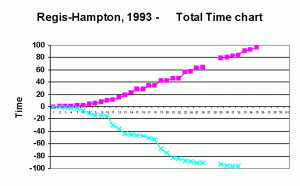
    <p>&nbsp; White’s total elapsed time is shown above, and Black’s

    below; control at 40 moves in 100 minutes. White lost on time at

    move 39.</p>

    <p>&nbsp; This is the only game I have ever lost on time, and some

    of the reasons are to be found in the notes. It was quite in

    Krogius’ class of <strong><em>doubts linked to the earlier course

    of the game</em></strong>.</p>

    <p>&nbsp;</p>

    <p>&nbsp; But on the graph you can also see some interesting

    features of the use of time: Black having some periods of slow

    play, followed by fast play, whereas White’s use is much more even

    – however, White was unable to speed up at the end of the game when

    approaching the time control. It may be the ideal style is more

    even than Black’s and less even than White’s!</p>

    <hr />

    <h2><a name=”RTFToC28″ id=”RTFToC28″>C2. Tal-Bronstein 1960 (Game

    6)</a></h2>

    <img alt=”[Graph of Clock Times (2)]” src=”/wp/chessx/clock2.gif” />

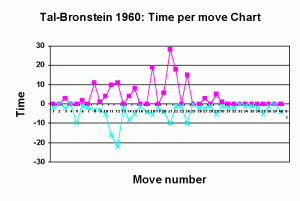
    <p><em>This chart shows the time taken for each move rather

    than total time, and is taken from the Furstenburg/Bronstein title

    “<strong>The Sorcerer’s Apprentice</strong>”. White above the line

    and Black below. Who won?</em></p>

    <p><em>”…Tal played the first seven moves with great

    confidence, accepting my Pawn sacrifice. With his next five moves

    he tried to justify his decision.”</em></p>

    <p><em>”With hindsight one can see that from moves 18 to 24

    Tal used a lot of time, trying to reduce the pressure of the Black

    pieces, but it was in vain. It would have been better to use this

    amount of time, about one hour, to play the opening more

    carefully.”</em></p>

    <p><em>”This is only one example and the reader who is

    interested in this aspect of chess should start recording times; it

    might well be that his chess improves immediately.”</em></p>

    <p>&nbsp;</p>

    <hr />

    <h2><a name=”RTFToC29″ id=”RTFToC29″>C3. Botvinnik-Tal 1960 (Game

    7)</a></h2>

    <img alt=”[Graph of Clock Times (3)]” src=”/wp/chessx/clock3.gif” />

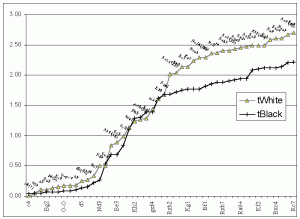
    <p>&nbsp; Move by move, with notes by Tal:</p>

    <p>&nbsp; W13: “The text move is the most precise, but the time

    spent in thinking about it proved that Botvinnik had not played

    competitively for some time. Why was it necessary to waste ten

    minutes out of an allotted two and one-half hours to play the most

    evident and surely the strongest continuation of the previous

    move?”</p>

    <p>&nbsp;</p>

    <p>&nbsp; B14: “Black took a long time to choose which plan he

    would use in the middle game.”</p>

    <p>&nbsp; B18: “A rather long think for this move – sixteen

    minutes. Black was calculating whether or not he should temporarily

    pass on his idea and carry it our later.”</p>

    <p>&nbsp; B23: “It is interesting that Black spent fifteen minutes

    thinking about the move that immediately followed the piece

    sacrifice. &hellip; This is but a confirmation, if it can be

    expressed this way, of an intuitive sacrifice, a confirmation of

    the fact that Black did not calculate all of the variations

    beginning with the sacrifice and ending with mate.”</p>

    <p>&nbsp; B28: “(After disturbance by spectators) I consciously

    chose the less strong but safer continuation.”</p>

    <p>&nbsp; B36: “Beginning with the 26th move, Black has been

    playing lightning chess.”</p>

    <p>&nbsp; B41: “Forty moves had been made but the opponents

    remained in their places. Obviously, Botvinnik considered that

    since Black was playing at such a rapid speed, he must have made a

    mistake somewhere, and as for me, I was still full of energy.”</p>

    <hr />

    <h2><a name=”RTFToC30″ id=”RTFToC30″>D. References</a></h2>

    FURSTENBURG/BRONSTEIN – The Sorcerer’s Apprentice.

    <p>&nbsp; KROGIUS – Psychology in Chess.</p>

    <p>&nbsp; TAL – Tal-Botvinnik 1960: Match for the World

    Championship 1960.</p>

    <p>&nbsp; WEBB – Chess For Tigers.</p>

    <hr />

    <h5><a name=”RTFToC31″ id=”RTFToC31″>Game 1: (59) Korchnoi – Suetin

    [C83] Moscow (XXVII USSR Ch.), 1960</a></h5>

    <strong>1.e4 e5 2.Nf3 Nc6 3.Bb5 a6 4.Ba4 Nf6 5.0-0 Nxe4 6.d4 b5

    7.Bb3 d5 8.dxe5 Be6 9.Qe2 Be7 10.c3 0-0 11.Nd4 Qd7 12.f3 Nc5 13.Bc2

    f6 14.exf6 Bxf6 15.Nxe6 Qxe6 16.Qxe6+ Nxe6 17.Bb3 Rad8 18.Rd1 Ne7

    19.Nd2 Kf7 20.Rf1 c5u</strong>

    <p class=”chessboard”><img alt=”+—————–+” src=”/wp/chessx/tx.gif” /><br />

    <img alt=”|” src=”/wp/chessx/lx.gif” /><img alt=”.” src=

    “/wp/chessx/w.gif” /><img alt=”+” src=”/wp/chessx/b.gif” /><img alt=”.” src=

    “/wp/chessx/w.gif” /><img alt=”4″ src=”/wp/chessx/brd.gif” /><img alt=”.”

    src=”/wp/chessx/w.gif” /><img alt=”4″ src=”/wp/chessx/brd.gif” /><img alt=”.”

    src=”/wp/chessx/w.gif” /><img alt=”+” src=”/wp/chessx/b.gif” /><img alt=”|”

    src=”/wp/chessx/rx.gif” /><br />

    <img alt=”|” src=”/wp/chessx/lx.gif” /><img alt=”+” src=

    “/wp/chessx/b.gif” /><img alt=”.” src=”/wp/chessx/w.gif” /><img alt=”+” src=

    “/wp/chessx/b.gif” /><img alt=”.” src=”/wp/chessx/w.gif” /><img alt=”h” src=

    “/wp/chessx/bnd.gif” /><img alt=”k” src=”/wp/chessx/bkl.gif” /><img alt=”0″

    src=”/wp/chessx/bpd.gif” /><img alt=”p” src=”/wp/chessx/bpl.gif” /><img alt=

    “|” src=”/wp/chessx/rx.gif” /><br />

    <img alt=”|” src=”/wp/chessx/lx.gif” /><img alt=”p” src=

    “/wp/chessx/bpl.gif” /><img alt=”+” src=”/wp/chessx/b.gif” /><img alt=”.”

    src=”/wp/chessx/w.gif” /><img alt=”+” src=”/wp/chessx/b.gif” /><img alt=”n”

    src=”/wp/chessx/bnl.gif” /><img alt=”g” src=”/wp/chessx/bbd.gif” /><img alt=

    “.” src=”/wp/chessx/w.gif” /><img alt=”+” src=”/wp/chessx/b.gif” /><img alt=

    “|” src=”/wp/chessx/rx.gif” /><br />

    <img alt=”|” src=”/wp/chessx/lx.gif” /><img alt=”+” src=

    “/wp/chessx/b.gif” /><img alt=”p” src=”/wp/chessx/bpl.gif” /><img alt=”0″

    src=”/wp/chessx/bpd.gif” /><img alt=”p” src=”/wp/chessx/bpl.gif” /><img alt=

    “+” src=”/wp/chessx/b.gif” /><img alt=”.” src=”/wp/chessx/w.gif” /><img alt=

    “+” src=”/wp/chessx/b.gif” /><img alt=”.” src=”/wp/chessx/w.gif” /><img alt=

    “|” src=”/wp/chessx/rx.gif” /><br />

    <img alt=”|” src=”/wp/chessx/lx.gif” /><img alt=”.” src=

    “/wp/chessx/w.gif” /><img alt=”+” src=”/wp/chessx/b.gif” /><img alt=”.” src=

    “/wp/chessx/w.gif” /><img alt=”+” src=”/wp/chessx/b.gif” /><img alt=”.” src=

    “/wp/chessx/w.gif” /><img alt=”+” src=”/wp/chessx/b.gif” /><img alt=”.” src=

    “/wp/chessx/w.gif” /><img alt=”+” src=”/wp/chessx/b.gif” /><img alt=”|” src=

    “/wp/chessx/rx.gif” /><br />

    <img alt=”|” src=”/wp/chessx/lx.gif” /><img alt=”+” src=

    “/wp/chessx/b.gif” /><img alt=”B” src=”/wp/chessx/wbl.gif” /><img alt=”)”

    src=”/wp/chessx/wpd.gif” /><img alt=”.” src=”/wp/chessx/w.gif” /><img alt=”+”

    src=”/wp/chessx/b.gif” /><img alt=”P” src=”/wp/chessx/wpl.gif” /><img alt=”+”

    src=”/wp/chessx/b.gif” /><img alt=”.” src=”/wp/chessx/w.gif” /><img alt=”|”

    src=”/wp/chessx/rx.gif” /><br />

    <img alt=”|” src=”/wp/chessx/lx.gif” /><img alt=”P” src=

    “/wp/chessx/wpl.gif” /><img alt=”)” src=”/wp/chessx/wpd.gif” /><img alt=”.”

    src=”/wp/chessx/w.gif” /><img alt=”H” src=”/wp/chessx/wnd.gif” /><img alt=”.”

    src=”/wp/chessx/w.gif” /><img alt=”+” src=”/wp/chessx/b.gif” /><img alt=”P”

    src=”/wp/chessx/wpl.gif” /><img alt=”)” src=”/wp/chessx/wpd.gif” /><img alt=

    “|” src=”/wp/chessx/rx.gif” /><br />

    <img alt=”|” src=”/wp/chessx/lx.gif” /><img alt=”$” src=

    “/wp/chessx/wrd.gif” /><img alt=”.” src=”/wp/chessx/w.gif” /><img alt=”G”

    src=”/wp/chessx/wbd.gif” /><img alt=”.” src=”/wp/chessx/w.gif” /><img alt=”+”

    src=”/wp/chessx/b.gif” /><img alt=”R” src=”/wp/chessx/wrl.gif” /><img alt=”I”

    src=”/wp/chessx/wkd.gif” /><img alt=”.” src=”/wp/chessx/w.gif” /><img alt=”|”

    src=”/wp/chessx/rx.gif” /><br />

    <img alt=”+—————–+” src=”/wp/chessx/bx.gif” /></p><p>

    Suetin has gained the advantage and steadily increases the

    pressure. Korchnoi was able to divert his opponent from the

    measured tempo if his play only by provoking his own time

    trouble.</p>

    <p><strong>21.f4 c4 22.Bd1 Nc6 23.Nf3 d4 24.Ng5+ Bxg5

    25.fxg5+ Ke7 26.Re1 Kd6 27.cxd4 Nexd4 28.Bd2 Rde8 29.Rc1 Kd5 30.b3

    Rxe1+ 31.Bxe1 Ne5 32.bxc4+ bxc4 33.Rb1 Rc8 34.Bc3 Nb5 35.Ba1 c3

    36.a4 Nd6 37.Bb3+ Ke4 38.Re1+ Kf5 39.Bc2+ Ke6 40.Bb3+ Kf5 41.Bc2+

    Ke6 42.Re3 Ndc4 43.Rxc3 Rd8 44.h3 g6 45.Bb3 Kf5 46.Kh2 Rc8 47.Rc2

    Rc6 48.Re2 Rb6 49.Bc2+ Ke6 50.Bd4 Rd6 51.Bc3 Rb6 52.Kg3 Kd5 53.Kf4

    Nc6 54.Re1 Rb7 55.Be4+ Kc5 56.Rc1 Rb3 57.Bg7 Nb4 58.Bf8+ Kd4

    59.Rd1+ Nd3+ 60.Rxd3+ Rxd3 61.Bg7+ 1-0</strong></p>

    <p>&nbsp; Suetin incorrectly believed that he had the chance of an

    early win, began to hurry, committed some serious errors and

    lost.This game decided first place in the championship.</p>

    <hr />

    <h5><a name=”RTFToC32″ id=”RTFToC32″>Game 2: Regis,D (1935) –

    Hampton,M (1900) [E91]</a></h5>

    Clock control: Devon vs. Wilts devon vs. wilts, 1993

    <p><strong>1.e4 0m 1…g6 0m 2.d4 1m 2…Bg7 0m 3.c4

    1m</strong></p>

    <p>&nbsp; Black was visibly upset by this move.</p>

    <p>&nbsp; I know from playing the Modern myself that few 1.&nbsp;e4

    players will transfer to a Queen’s-side opening, but that’s always

    been where my heart is.</p>

    <p><strong>3…d6</strong> 1m <strong>4.Nc3</strong> 1m

    <strong>4…Nf6</strong> 2mThe game is now more or less a King’s

    Indian… <em>[4…Nc6 Keeps in independent ‘Modern’

    lines.]</em></p>

    <p><strong>5.Be2</strong> 2m <strong>5…0-0</strong> 2m

    <strong>6.Nf3</strong> 2m <strong>6…c5</strong> 6m</p>

    <p>&nbsp; …or a Benoni. <em>[6…e5 is the King’s

    Indian]</em></p>

    <p><strong>7.d5</strong> 5m <strong>7…Bg4</strong> 10m

    <strong>8.Nd2</strong> 6mOver-eager.In any event, Black now starts

    a phase of thinking for a long while over his moves.</p>

    <p><em>[8.Ng1 Bxe2 9.Ngxe2]</em></p>

    <p><strong>8…Bxe2</strong> 14m <strong>9.Qxe2</strong> 8m

    <strong>9…Nfd7</strong> 14m <strong>10.0-0</strong> 10m

    <strong>10…Na6</strong> 15m <strong>11.f4</strong> 11m

    <strong>11…Qa5</strong> 30m <strong>12.Nf3</strong> 15m</p>

    <p>&nbsp; I was feeling quite pleased here: that I had both a chess

    and a psychological initiative out of the opening. I don’t think I

    have played Benonis any more often than my opponent but have looked

    at this type of position and felt at ease with it.

    <strong>12…Nc7</strong> 36m</p>

    <p><em>[12…Bxc3 13.bxc3 Qxc3 14.Bb2 Qa5 15.e5]</em></p>

    <p><strong>13.e5</strong> 20m <strong>13…a6</strong> 44m

    <strong>14.Bd2</strong> 23m <strong>14…Qb6</strong> 45m

    <strong>15.e6</strong> 29m looks good but perhaps I was not

    sufficiently developed for this…</p>

    <p><em>[15.b3]</em></p>

    <p><strong>15…fxe6</strong> 46m <strong>16.dxe6</strong>

    29m <strong>16…Nf6</strong> 47m</p>

    <p>&nbsp; Black now has another long thinking phase, which leaves

    him in time trouble for the rest of the game.

    <strong>17.Ng5</strong> 35m</p>

    <p><em>[17.Rae1 or 17 b3 17…Qxb2 18.Rb1 Qc2 19.Rxb7 Nfe8

    20.Rc1 Qf5 21.Nd5]</em></p>

    <p><strong>17…d5</strong> 51m <strong>18.cxd5</strong> 35m

    <strong>18…Nfxd5</strong> 53m <strong>19.Qf3</strong> 42m

    <strong>19…Nxc3</strong> 68m <strong>20.Bxc3</strong> 43m

    <strong>20…Bxc3</strong> 75m <strong>21.bxc3</strong> 46m

    <em>[21.Qxc3 Rf6 22.Qh3 h5 23.f5 c4+ 24.Kh1 Raf8 25.Nf7]</em>

    <strong>21…c4+</strong> 83m <strong>22.Kh1</strong> 46m

    <strong>22…h6</strong> 84m <strong>23.Nf7</strong> 56m

    <strong>23…Nxe6</strong> 87m <em>[23…Kg7 24.f5]</em>

    <strong>24.Nxh6+</strong> 58m <strong>24…Kh7</strong> 88m

    <strong>25.f5</strong> 63m</p>

    <p>&nbsp; [25.Qh3 Nxf4 26.Rxf4 Rxf4 27.Nf7+ <em>(27.Re1 Kg7 28.Ng4

    Rf7 29.Qh6+ Kg8-+;</em></p>

    <p><em>27.Nf5+ Kg8 28.Nxe7+ Kg7 29.Nd5 Qb2 30.Rd1u)</em>

    27…Kg8 28.Qh8+ Kxf7[[threesuperior]] 29.Qxa8]</p>

    <p><strong>25…Kxh6</strong> 91m <strong>26.Qh3+</strong>

    64m <strong>26…Kg7</strong> 91m <strong>27.fxe6</strong> ?m saves

    the pawn but now Black has a strong initiative.</p>

    <p>&nbsp; White now starts to consume time in great forkfuls: I

    remember finding it very hard to forget the earlier part of the

    game where I thought I had done enough to win, and couldn’t get on

    and defend.</p>

    <p><strong>27…Rxf1+</strong> m <strong>28.Rxf1</strong> ?m

    <strong>28…Rf8</strong> m <strong>29.Rg1</strong> 79m <em>[29.Re1

    Qf2]</em> <strong>29…Rf2</strong> 93m <strong>30.Qh4</strong> 81m

    <strong>30…Qc5</strong> 95m <strong>31.a4</strong> 83m

    <strong>31…b5</strong> 96m <strong>32.a5</strong> 84m which made

    me think …b5 was wrong <strong>32…Re2</strong> 97m

    <strong>33.Re1</strong> 91m <strong>33…Rf2</strong> m

    <strong>34.h3</strong> 93m <strong>34…Rf6</strong> m

    <strong>35.Qe4</strong> 96m <strong>35…Qf2</strong> m

    <strong>36.Rg1</strong> ?m <em>[36.Qe5 Qf5]</em>

    <strong>36…Qf5</strong> m <strong>37.Qb7</strong> ?m

    <strong>37…Rxe6</strong> m <strong>38.Rd1</strong> ?m

    <strong>38…Qe5</strong> m <strong>39.Qd7</strong> ?m

    <strong>39…Qe2</strong> m <strong>White lost on time</strong>; I

    had even put 36…Qf5 down as a White move and was one out!

    <em>[39…Qe2 40.Qd4+]</em> <strong>0-1</strong></p>

    <hr />

    <h5><a name=”RTFToC33″ id=”RTFToC33″>Game 3: Botvinnik ,M – Tal ,M

    [E10]: Match, Moscow (Russia) Match, Moscow (Russia) (8),

    1960</a></h5>

    <strong>1.d4 Nf6 2.c4 e6 3.Nf3 c5 4.d5 exd5 5.cxd5 g6 6.Nc3 Bg7

    7.Bg5 0-0 8.e3 Re8 9.Nd2 d6 10.Be2 a6 11.a4 Nbd7 12.0-0 Qc7 13.Qc2

    Nb6 14.Bf3 c4 15.Bxf6 Bxf6 16.a5 Nd7 17.Nce4 Be5 18.Qxc4 Qd8 19.Qa2

    f5 20.Nc3 g5 21.Nc4 g4 22.Be2 Qf6 23.Na4 Kh8 24.g3 h5 25.f4 Bd4

    26.Qa3 Rb8 27.Nab6 h4 28.Rad1 Bxb6 29.axb6 Nc5 30.gxh4 Bd7 31.Qc3

    Qxc3 32.bxc3 Bb5 33.Rfe1 Ne4</strong>

    <p class=”chessboard”><img alt=”+—————–+” src=”/wp/chessx/tx.gif” /><br />

    <img alt=”|” src=”/wp/chessx/lx.gif” /><img alt=”.” src=

    “/wp/chessx/w.gif” /><img alt=”4″ src=”/wp/chessx/brd.gif” /><img alt=”.”

    src=”/wp/chessx/w.gif” /><img alt=”+” src=”/wp/chessx/b.gif” /><img alt=”r”

    src=”/wp/chessx/brl.gif” /><img alt=”+” src=”/wp/chessx/b.gif” /><img alt=”.”

    src=”/wp/chessx/w.gif” /><img alt=”i” src=”/wp/chessx/bkd.gif” /><img alt=”|”

    src=”/wp/chessx/rx.gif” /><br />

    <img alt=”|” src=”/wp/chessx/lx.gif” /><img alt=”+” src=

    “/wp/chessx/b.gif” /><img alt=”p” src=”/wp/chessx/bpl.gif” /><img alt=”+”

    src=”/wp/chessx/b.gif” /><img alt=”.” src=”/wp/chessx/w.gif” /><img alt=”+”

    src=”/wp/chessx/b.gif” /><img alt=”.” src=”/wp/chessx/w.gif” /><img alt=”+”

    src=”/wp/chessx/b.gif” /><img alt=”.” src=”/wp/chessx/w.gif” /><img alt=”|”

    src=”/wp/chessx/rx.gif” /><br />

    <img alt=”|” src=”/wp/chessx/lx.gif” /><img alt=”p” src=

    “/wp/chessx/bpl.gif” /><img alt=”)” src=”/wp/chessx/wpd.gif” /><img alt=”.”

    src=”/wp/chessx/w.gif” /><img alt=”0″ src=”/wp/chessx/bpd.gif” /><img alt=”.”

    src=”/wp/chessx/w.gif” /><img alt=”+” src=”/wp/chessx/b.gif” /><img alt=”.”

    src=”/wp/chessx/w.gif” /><img alt=”+” src=”/wp/chessx/b.gif” /><img alt=”|”

    src=”/wp/chessx/rx.gif” /><br />

    <img alt=”|” src=”/wp/chessx/lx.gif” /><img alt=”+” src=

    “/wp/chessx/b.gif” /><img alt=”b” src=”/wp/chessx/bbl.gif” /><img alt=”+”

    src=”/wp/chessx/b.gif” /><img alt=”P” src=”/wp/chessx/wpl.gif” /><img alt=”+”

    src=”/wp/chessx/b.gif” /><img alt=”p” src=”/wp/chessx/bpl.gif” /><img alt=”+”

    src=”/wp/chessx/b.gif” /><img alt=”.” src=”/wp/chessx/w.gif” /><img alt=”|”

    src=”/wp/chessx/rx.gif” /><br />

    <img alt=”|” src=”/wp/chessx/lx.gif” /><img alt=”.” src=

    “/wp/chessx/w.gif” /><img alt=”+” src=”/wp/chessx/b.gif” /><img alt=”N” src=

    “/wp/chessx/wnl.gif” /><img alt=”+” src=”/wp/chessx/b.gif” /><img alt=”n”

    src=”/wp/chessx/bnl.gif” /><img alt=”)” src=”/wp/chessx/wpd.gif” /><img alt=

    “p” src=”/wp/chessx/bpl.gif” /><img alt=”)” src=

    “/wp/chessx/wpd.gif” /><img alt=”|” src=”/wp/chessx/rx.gif” /><br />

    <img alt=”|” src=”/wp/chessx/lx.gif” /><img alt=”+” src=

    “/wp/chessx/b.gif” /><img alt=”.” src=”/wp/chessx/w.gif” /><img alt=”)” src=

    “/wp/chessx/wpd.gif” /><img alt=”.” src=”/wp/chessx/w.gif” /><img alt=”)”

    src=”/wp/chessx/wpd.gif” /><img alt=”.” src=”/wp/chessx/w.gif” /><img alt=”+”

    src=”/wp/chessx/b.gif” /><img alt=”.” src=”/wp/chessx/w.gif” /><img alt=”|”

    src=”/wp/chessx/rx.gif” /><br />

    <img alt=”|” src=”/wp/chessx/lx.gif” /><img alt=”.” src=

    “/wp/chessx/w.gif” /><img alt=”+” src=”/wp/chessx/b.gif” /><img alt=”.” src=

    “/wp/chessx/w.gif” /><img alt=”+” src=”/wp/chessx/b.gif” /><img alt=”B” src=

    “/wp/chessx/wbl.gif” /><img alt=”+” src=”/wp/chessx/b.gif” /><img alt=”.”

    src=”/wp/chessx/w.gif” /><img alt=”)” src=”/wp/chessx/wpd.gif” /><img alt=”|”

    src=”/wp/chessx/rx.gif” /><br />

    <img alt=”|” src=”/wp/chessx/lx.gif” /><img alt=”+” src=

    “/wp/chessx/b.gif” /><img alt=”.” src=”/wp/chessx/w.gif” /><img alt=”+” src=

    “/wp/chessx/b.gif” /><img alt=”R” src=”/wp/chessx/wrl.gif” /><img alt=”$”

    src=”/wp/chessx/wrd.gif” /><img alt=”.” src=”/wp/chessx/w.gif” /><img alt=”I”

    src=”/wp/chessx/wkd.gif” /><img alt=”.” src=”/wp/chessx/w.gif” /><img alt=”|”

    src=”/wp/chessx/rx.gif” /><br />

    <img alt=”+—————–+” src=”/wp/chessx/bx.gif” /></p><p>

    <strong>34.Rc1 Rbc8??</strong> “<em>I made the last move

    instantaneously – as if seized by the time pressure of my opponent.

    I had formerly seen that I would win the exchange, but I had but to

    think a little; then I would have come up with the absolutely

    correct idea: the other Rook must go to c8 (winning the exchange

    but keeping the b7 Pawn</em>).” – TAL</p>

    <p>&nbsp; [“Here it is: the hypnotic power of ‘natural’ moves!” –

    Krogius]</p>

    <p><em>[34…Rec8]</em></p>

    <p><strong>35.Na5 Bxe2 36.Rxe2 Nxc3</strong> “<em>It could

    be noticed from my opponent’s expression that he had been rather

    surprised by the unexpected turn of events, but in spite of intense

    time pressure he successfully responded to the reversal of the

    conditions and immediately found the best continuation</em>.” – Tal

    <strong>37.Rxc3!</strong></p>

    <p><em>[37.Ree1 Ne2+]</em></p>

    <p><strong>37…Rxc3 38.Nxb7</strong> “<em>Black decided he

    still had chances to win</em>…” – Tal

    <strong>38…Rcxe3</strong></p>

    <p><em>[38…Rexe3 is given in some sources]</em></p>

    <p><strong>39.Rxe3 Rxe3 40.Nxd6 Rd3?</strong></p>

    <p class=”chessboard”><img alt=”+—————–+” src=”/wp/chessx/tx.gif” /><br />

    <img alt=”|” src=”/wp/chessx/lx.gif” /><img alt=”.” src=

    “/wp/chessx/w.gif” /><img alt=”+” src=”/wp/chessx/b.gif” /><img alt=”.” src=

    “/wp/chessx/w.gif” /><img alt=”+” src=”/wp/chessx/b.gif” /><img alt=”.” src=

    “/wp/chessx/w.gif” /><img alt=”+” src=”/wp/chessx/b.gif” /><img alt=”.” src=

    “/wp/chessx/w.gif” /><img alt=”i” src=”/wp/chessx/bkd.gif” /><img alt=”|”

    src=”/wp/chessx/rx.gif” /><br />

    <img alt=”|” src=”/wp/chessx/lx.gif” /><img alt=”+” src=

    “/wp/chessx/b.gif” /><img alt=”.” src=”/wp/chessx/w.gif” /><img alt=”+” src=

    “/wp/chessx/b.gif” /><img alt=”.” src=”/wp/chessx/w.gif” /><img alt=”+” src=

    “/wp/chessx/b.gif” /><img alt=”.” src=”/wp/chessx/w.gif” /><img alt=”+” src=

    “/wp/chessx/b.gif” /><img alt=”.” src=”/wp/chessx/w.gif” /><img alt=”|” src=

    “/wp/chessx/rx.gif” /><br />

    <img alt=”|” src=”/wp/chessx/lx.gif” /><img alt=”p” src=

    “/wp/chessx/bpl.gif” /><img alt=”)” src=”/wp/chessx/wpd.gif” /><img alt=”.”

    src=”/wp/chessx/w.gif” /><img alt=”H” src=”/wp/chessx/wnd.gif” /><img alt=”.”

    src=”/wp/chessx/w.gif” /><img alt=”+” src=”/wp/chessx/b.gif” /><img alt=”.”

    src=”/wp/chessx/w.gif” /><img alt=”+” src=”/wp/chessx/b.gif” /><img alt=”|”

    src=”/wp/chessx/rx.gif” /><br />

    <img alt=”|” src=”/wp/chessx/lx.gif” /><img alt=”+” src=

    “/wp/chessx/b.gif” /><img alt=”.” src=”/wp/chessx/w.gif” /><img alt=”+” src=

    “/wp/chessx/b.gif” /><img alt=”P” src=”/wp/chessx/wpl.gif” /><img alt=”+”

    src=”/wp/chessx/b.gif” /><img alt=”p” src=”/wp/chessx/bpl.gif” /><img alt=”+”

    src=”/wp/chessx/b.gif” /><img alt=”.” src=”/wp/chessx/w.gif” /><img alt=”|”

    src=”/wp/chessx/rx.gif” /><br />

    <img alt=”|” src=”/wp/chessx/lx.gif” /><img alt=”.” src=

    “/wp/chessx/w.gif” /><img alt=”+” src=”/wp/chessx/b.gif” /><img alt=”.” src=

    “/wp/chessx/w.gif” /><img alt=”+” src=”/wp/chessx/b.gif” /><img alt=”.” src=

    “/wp/chessx/w.gif” /><img alt=”)” src=”/wp/chessx/wpd.gif” /><img alt=”p”

    src=”/wp/chessx/bpl.gif” /><img alt=”)” src=”/wp/chessx/wpd.gif” /><img alt=

    “|” src=”/wp/chessx/rx.gif” /><br />

    <img alt=”|” src=”/wp/chessx/lx.gif” /><img alt=”+” src=

    “/wp/chessx/b.gif” /><img alt=”.” src=”/wp/chessx/w.gif” /><img alt=”+” src=

    “/wp/chessx/b.gif” /><img alt=”r” src=”/wp/chessx/brl.gif” /><img alt=”+”

    src=”/wp/chessx/b.gif” /><img alt=”.” src=”/wp/chessx/w.gif” /><img alt=”+”

    src=”/wp/chessx/b.gif” /><img alt=”.” src=”/wp/chessx/w.gif” /><img alt=”|”

    src=”/wp/chessx/rx.gif” /><br />

    <img alt=”|” src=”/wp/chessx/lx.gif” /><img alt=”.” src=

    “/wp/chessx/w.gif” /><img alt=”+” src=”/wp/chessx/b.gif” /><img alt=”.” src=

    “/wp/chessx/w.gif” /><img alt=”+” src=”/wp/chessx/b.gif” /><img alt=”.” src=

    “/wp/chessx/w.gif” /><img alt=”+” src=”/wp/chessx/b.gif” /><img alt=”.” src=

    “/wp/chessx/w.gif” /><img alt=”)” src=”/wp/chessx/wpd.gif” /><img alt=”|”

    src=”/wp/chessx/rx.gif” /><br />

    <img alt=”|” src=”/wp/chessx/lx.gif” /><img alt=”+” src=

    “/wp/chessx/b.gif” /><img alt=”.” src=”/wp/chessx/w.gif” /><img alt=”+” src=

    “/wp/chessx/b.gif” /><img alt=”.” src=”/wp/chessx/w.gif” /><img alt=”+” src=

    “/wp/chessx/b.gif” /><img alt=”.” src=”/wp/chessx/w.gif” /><img alt=”I” src=

    “/wp/chessx/wkd.gif” /><img alt=”.” src=”/wp/chessx/w.gif” /><img alt=”|”

    src=”/wp/chessx/rx.gif” /><br />

    <img alt=”+—————–+” src=”/wp/chessx/bx.gif” /></p><p>

    “<em>Adjourned. At first I was extremely optimistic</em>…” –

    Tal</p>

    <p>&nbsp; [40…Kg8 “<em>was better, but Black was under the

    erroneous impression that all was in order</em>”]</p>

    <p><strong>41.Nf7+</strong> (sealed) “<em>I immediately

    resigned</em>.” <strong>1-0</strong></p>

    <p>&nbsp; [41.b7 “<em>during the game I was convinced that this

    guaranteed a win for Black</em>” 41…Rb3 42.Nf7+ Kh7! 43.Nd8 a5

    44.d6 a4 45.d7 a3 46.Ne6 a2-+;</p>

    <p>&nbsp; 41.Nf7+! Kg7 but now <em>(41…Kh7? 42.d6!)</em> 42.b7

    Rb3 43.Nd8 a5 44.d6 a4 45.d7 a3 46.Ne6+!+- “<em>Upon returning home

    my trainer and I had only to investigate the subtleties of this

    rather simple analysis. We began to play through the game and in

    the process of analysis we simultaneously we discovered that Black

    could have forced his win on his 34th move. There was nothing to

    say and we didn’t sleep a wink the whole night</em>.”]</p>

    <hr />

    <h5><a name=”RTFToC34″ id=”RTFToC34″>Game 4: Gligoric,S – Tal,M

    [A78] Yugoslavia ct Yugoslavia ct (4), 1959</a></h5>

    <strong>1.d4 Nf6 2.c4 c5 3.d5 e6 4.Nc3 exd5 5.cxd5 d6 6.e4 g6 7.Nf3

    Bg7 8.Be2 0-0 9.0-0 Re8 10.Nd2 Na6 11.Rb1 Bd7 12.Re1 Rb8 13.b3 b5

    14.Bb2 Nc7 15.Qc2 Qe7 16.Nd1 Bh6 17.f3 Nh5 18.Nf1 Nxd5 19.exd5 Bf5

    20.Qc3 Bg7 21.Qc1 Bxb1 22.Bxg7 Kxg7 23.Qxb1 Nf4 24.Nfe3

    Qe5</strong>

    <p class=”chessboard”><img alt=”+—————–+” src=”/wp/chessx/tx.gif” /><br />

    <img alt=”|” src=”/wp/chessx/lx.gif” /><img alt=”.” src=

    “/wp/chessx/w.gif” /><img alt=”4″ src=”/wp/chessx/brd.gif” /><img alt=”.”

    src=”/wp/chessx/w.gif” /><img alt=”+” src=”/wp/chessx/b.gif” /><img alt=”r”

    src=”/wp/chessx/brl.gif” /><img alt=”+” src=”/wp/chessx/b.gif” /><img alt=”.”

    src=”/wp/chessx/w.gif” /><img alt=”+” src=”/wp/chessx/b.gif” /><img alt=”|”

    src=”/wp/chessx/rx.gif” /><br />

    <img alt=”|” src=”/wp/chessx/lx.gif” /><img alt=”0″ src=

    “/wp/chessx/bpd.gif” /><img alt=”.” src=”/wp/chessx/w.gif” /><img alt=”+”

    src=”/wp/chessx/b.gif” /><img alt=”.” src=”/wp/chessx/w.gif” /><img alt=”+”

    src=”/wp/chessx/b.gif” /><img alt=”p” src=”/wp/chessx/bpl.gif” /><img alt=”i”

    src=”/wp/chessx/bkd.gif” /><img alt=”p” src=”/wp/chessx/bpl.gif” /><img alt=

    “|” src=”/wp/chessx/rx.gif” /><br />

    <img alt=”|” src=”/wp/chessx/lx.gif” /><img alt=”.” src=

    “/wp/chessx/w.gif” /><img alt=”+” src=”/wp/chessx/b.gif” /><img alt=”.” src=

    “/wp/chessx/w.gif” /><img alt=”0″ src=”/wp/chessx/bpd.gif” /><img alt=”.”

    src=”/wp/chessx/w.gif” /><img alt=”+” src=”/wp/chessx/b.gif” /><img alt=”p”

    src=”/wp/chessx/bpl.gif” /><img alt=”+” src=”/wp/chessx/b.gif” /><img alt=”|”

    src=”/wp/chessx/rx.gif” /><br />

    <img alt=”|” src=”/wp/chessx/lx.gif” /><img alt=”+” src=

    “/wp/chessx/b.gif” /><img alt=”p” src=”/wp/chessx/bpl.gif” /><img alt=”0″

    src=”/wp/chessx/bpd.gif” /><img alt=”P” src=”/wp/chessx/wpl.gif” /><img alt=

    “1” src=”/wp/chessx/bqd.gif” /><img alt=”.” src=

    “/wp/chessx/w.gif” /><img alt=”+” src=”/wp/chessx/b.gif” /><img alt=”.” src=

    “/wp/chessx/w.gif” /><img alt=”|” src=”/wp/chessx/rx.gif” /><br />

    <img alt=”|” src=”/wp/chessx/lx.gif” /><img alt=”.” src=

    “/wp/chessx/w.gif” /><img alt=”+” src=”/wp/chessx/b.gif” /><img alt=”.” src=

    “/wp/chessx/w.gif” /><img alt=”+” src=”/wp/chessx/b.gif” /><img alt=”.” src=

    “/wp/chessx/w.gif” /><img alt=”h” src=”/wp/chessx/bnd.gif” /><img alt=”.”

    src=”/wp/chessx/w.gif” /><img alt=”+” src=”/wp/chessx/b.gif” /><img alt=”|”

    src=”/wp/chessx/rx.gif” /><br />

    <img alt=”|” src=”/wp/chessx/lx.gif” /><img alt=”+” src=

    “/wp/chessx/b.gif” /><img alt=”P” src=”/wp/chessx/wpl.gif” /><img alt=”+”

    src=”/wp/chessx/b.gif” /><img alt=”.” src=”/wp/chessx/w.gif” /><img alt=”H”

    src=”/wp/chessx/wnd.gif” /><img alt=”P” src=”/wp/chessx/wpl.gif” /><img alt=

    “+” src=”/wp/chessx/b.gif” /><img alt=”.” src=”/wp/chessx/w.gif” /><img alt=

    “|” src=”/wp/chessx/rx.gif” /><br />

    <img alt=”|” src=”/wp/chessx/lx.gif” /><img alt=”P” src=

    “/wp/chessx/wpl.gif” /><img alt=”+” src=”/wp/chessx/b.gif” /><img alt=”.”

    src=”/wp/chessx/w.gif” /><img alt=”+” src=”/wp/chessx/b.gif” /><img alt=”B”

    src=”/wp/chessx/wbl.gif” /><img alt=”+” src=”/wp/chessx/b.gif” /><img alt=”P”

    src=”/wp/chessx/wpl.gif” /><img alt=”)” src=”/wp/chessx/wpd.gif” /><img alt=

    “|” src=”/wp/chessx/rx.gif” /><br />

    <img alt=”|” src=”/wp/chessx/lx.gif” /><img alt=”+” src=

    “/wp/chessx/b.gif” /><img alt=”Q” src=”/wp/chessx/wql.gif” /><img alt=”+”

    src=”/wp/chessx/b.gif” /><img alt=”N” src=”/wp/chessx/wnl.gif” /><img alt=”$”

    src=”/wp/chessx/wrd.gif” /><img alt=”.” src=”/wp/chessx/w.gif” /><img alt=”I”

    src=”/wp/chessx/wkd.gif” /><img alt=”.” src=”/wp/chessx/w.gif” /><img alt=”|”

    src=”/wp/chessx/rx.gif” /><br />

    <img alt=”+—————–+” src=”/wp/chessx/bx.gif” /></p><p>

    Black has a small advantage, difficult to exploit with regular

    means against an opponent with such a clear logical head.

    <strong>25.Bxb5 Rxb5 26.Nf5+ gxf5!?</strong> Tal chooses a sharp

    hazardous continuation, probably not the strongest but Gligoric

    became confused, thought for a long while, got into time trouble,

    made serious mistakes and lost.</p>

    <p><em>[26…Qxf5 27.Qxf5 gxf5 28.Rxe8

    Nxd5[[threesuperior]]]</em></p>

    <p><strong>27.Rxe5 Rxe5 28.g3 Ne2+ 29.Kf2 Kg8

    30.Ne3?</strong></p>

    <p><em>[30.f4! Re8 31.Qxf5]</em></p>

    <p><strong>30…Nd4 31.f4 Re4 32.g4!? Rxf4+ 33.Kg2 fxg4-+

    34.Nc4 Nf3 35.Qc1 Rf6 36.Qe3 Kf8 37.Qe4 Rb8 38.Qxh7 Re8 39.Qh8+ Ke7

    40.Qg7 Nh4+ 41.Kg1 Nf3+ 42.Kg2 Rg6 43.Qc3 Nd4 44.b4 Kf8 45.Ne3 g3

    46.h3 Rf6 0-1</strong></p>

    <hr />

    <h5><a name=”RTFToC35″ id=”RTFToC35″>Game 5: Blackstock,L – Webb,S

    [C09] Borehamwood, 1977</a></h5>

    <strong>1.e4 e6 2.d4 d5 3.Nd2 c5 4.exd5 exd5 5.Ngf3 Nc6 6.Bb5 Bd6

    7.dxc5 Bxc5 8.0-0 Nge7 9.Nb3 Bb6 10.Re1 0-0 11.Be3 Bf5 12.c3

    Be4</strong>

    <p class=”chessboard”><img alt=”+—————–+” src=”/wp/chessx/tx.gif” /><br />

    <img alt=”|” src=”/wp/chessx/lx.gif” /><img alt=”r” src=

    “/wp/chessx/brl.gif” /><img alt=”+” src=”/wp/chessx/b.gif” /><img alt=”.”

    src=”/wp/chessx/w.gif” /><img alt=”1″ src=”/wp/chessx/bqd.gif” /><img alt=”.”

    src=”/wp/chessx/w.gif” /><img alt=”4″ src=”/wp/chessx/brd.gif” /><img alt=”k”

    src=”/wp/chessx/bkl.gif” /><img alt=”+” src=”/wp/chessx/b.gif” /><img alt=”|”

    src=”/wp/chessx/rx.gif” /><br />

    <img alt=”|” src=”/wp/chessx/lx.gif” /><img alt=”0″ src=

    “/wp/chessx/bpd.gif” /><img alt=”p” src=”/wp/chessx/bpl.gif” /><img alt=”+”

    src=”/wp/chessx/b.gif” /><img alt=”.” src=”/wp/chessx/w.gif” /><img alt=”h”

    src=”/wp/chessx/bnd.gif” /><img alt=”p” src=”/wp/chessx/bpl.gif” /><img alt=

    “0” src=”/wp/chessx/bpd.gif” /><img alt=”p” src=

    “/wp/chessx/bpl.gif” /><img alt=”|” src=”/wp/chessx/rx.gif” /><br />

    <img alt=”|” src=”/wp/chessx/lx.gif” /><img alt=”.” src=

    “/wp/chessx/w.gif” /><img alt=”g” src=”/wp/chessx/bbd.gif” /><img alt=”n”

    src=”/wp/chessx/bnl.gif” /><img alt=”+” src=”/wp/chessx/b.gif” /><img alt=”.”

    src=”/wp/chessx/w.gif” /><img alt=”+” src=”/wp/chessx/b.gif” /><img alt=”.”

    src=”/wp/chessx/w.gif” /><img alt=”+” src=”/wp/chessx/b.gif” /><img alt=”|”

    src=”/wp/chessx/rx.gif” /><br />

    <img alt=”|” src=”/wp/chessx/lx.gif” /><img alt=”+” src=

    “/wp/chessx/b.gif” /><img alt=”B” src=”/wp/chessx/wbl.gif” /><img alt=”+”

    src=”/wp/chessx/b.gif” /><img alt=”p” src=”/wp/chessx/bpl.gif” /><img alt=”+”

    src=”/wp/chessx/b.gif” /><img alt=”.” src=”/wp/chessx/w.gif” /><img alt=”+”

    src=”/wp/chessx/b.gif” /><img alt=”.” src=”/wp/chessx/w.gif” /><img alt=”|”

    src=”/wp/chessx/rx.gif” /><br />

    <img alt=”|” src=”/wp/chessx/lx.gif” /><img alt=”.” src=

    “/wp/chessx/w.gif” /><img alt=”+” src=”/wp/chessx/b.gif” /><img alt=”.” src=

    “/wp/chessx/w.gif” /><img alt=”+” src=”/wp/chessx/b.gif” /><img alt=”b” src=

    “/wp/chessx/bbl.gif” /><img alt=”+” src=”/wp/chessx/b.gif” /><img alt=”.”

    src=”/wp/chessx/w.gif” /><img alt=”+” src=”/wp/chessx/b.gif” /><img alt=”|”

    src=”/wp/chessx/rx.gif” /><br />

    <img alt=”|” src=”/wp/chessx/lx.gif” /><img alt=”+” src=

    “/wp/chessx/b.gif” /><img alt=”N” src=”/wp/chessx/wnl.gif” /><img alt=”)”

    src=”/wp/chessx/wpd.gif” /><img alt=”.” src=”/wp/chessx/w.gif” /><img alt=”G”

    src=”/wp/chessx/wbd.gif” /><img alt=”N” src=”/wp/chessx/wnl.gif” /><img alt=

    “+” src=”/wp/chessx/b.gif” /><img alt=”.” src=”/wp/chessx/w.gif” /><img alt=

    “|” src=”/wp/chessx/rx.gif” /><br />

    <img alt=”|” src=”/wp/chessx/lx.gif” /><img alt=”P” src=

    “/wp/chessx/wpl.gif” /><img alt=”)” src=”/wp/chessx/wpd.gif” /><img alt=”.”

    src=”/wp/chessx/w.gif” /><img alt=”+” src=”/wp/chessx/b.gif” /><img alt=”.”

    src=”/wp/chessx/w.gif” /><img alt=”)” src=”/wp/chessx/wpd.gif” /><img alt=”P”

    src=”/wp/chessx/wpl.gif” /><img alt=”)” src=”/wp/chessx/wpd.gif” /><img alt=

    “|” src=”/wp/chessx/rx.gif” /><br />

    <img alt=”|” src=”/wp/chessx/lx.gif” /><img alt=”$” src=

    “/wp/chessx/wrd.gif” /><img alt=”.” src=”/wp/chessx/w.gif” /><img alt=”+”

    src=”/wp/chessx/b.gif” /><img alt=”Q” src=”/wp/chessx/wql.gif” /><img alt=”$”

    src=”/wp/chessx/wrd.gif” /><img alt=”.” src=”/wp/chessx/w.gif” /><img alt=”I”

    src=”/wp/chessx/wkd.gif” /><img alt=”.” src=”/wp/chessx/w.gif” /><img alt=”|”

    src=”/wp/chessx/rx.gif” /><br />

    <img alt=”+—————–+” src=”/wp/chessx/bx.gif” /></p><p>

    “A non-forcing position: there is little to choose between several

    moves, and Black has such a wide choice of moves that it’s

    impossible to analyse definite lines.”</p>

    <p>&nbsp; “White thought for about half-an-hour here”.</p>

    <p><strong>13.Bxb6 Qxb6 14.Nfd4</strong></p>

    <p>&nbsp; “Again this took him a while – re-thinking what he’d

    thought about on the previous move.”</p>

    <p><strong>14…Nxd4 15.Nxd4 Nc6</strong></p>

    <p><em>[15…a6 16.f3]</em></p>

    <p><strong>16.Bxc6= bxc6 17.Qb3 Qc7</strong></p>

    <p>&nbsp; “It’s better to keep the Queens on anyway, but this is

    also leaves White without a clear plan.”</p>

    <p>&nbsp; “White has used about on hour of his 1 hour 45 to reach

    move 48″.</p>

    <p><strong>18.Qa3 c5 19.Nb3 Rac8 20.Re2</strong></p>

    <p class=”chessboard”><img alt=”+—————–+” src=”/wp/chessx/tx.gif” /><br />

    <img alt=”|” src=”/wp/chessx/lx.gif” /><img alt=”.” src=

    “/wp/chessx/w.gif” /><img alt=”+” src=”/wp/chessx/b.gif” /><img alt=”r” src=

    “/wp/chessx/brl.gif” /><img alt=”+” src=”/wp/chessx/b.gif” /><img alt=”.”

    src=”/wp/chessx/w.gif” /><img alt=”4″ src=”/wp/chessx/brd.gif” /><img alt=”k”

    src=”/wp/chessx/bkl.gif” /><img alt=”+” src=”/wp/chessx/b.gif” /><img alt=”|”

    src=”/wp/chessx/rx.gif” /><br />

    <img alt=”|” src=”/wp/chessx/lx.gif” /><img alt=”0″ src=

    “/wp/chessx/bpd.gif” /><img alt=”.” src=”/wp/chessx/w.gif” /><img alt=”1″

    src=”/wp/chessx/bqd.gif” /><img alt=”.” src=”/wp/chessx/w.gif” /><img alt=”+”

    src=”/wp/chessx/b.gif” /><img alt=”p” src=”/wp/chessx/bpl.gif” /><img alt=”0″

    src=”/wp/chessx/bpd.gif” /><img alt=”p” src=”/wp/chessx/bpl.gif” /><img alt=

    “|” src=”/wp/chessx/rx.gif” /><br />

    <img alt=”|” src=”/wp/chessx/lx.gif” /><img alt=”.” src=

    “/wp/chessx/w.gif” /><img alt=”+” src=”/wp/chessx/b.gif” /><img alt=”.” src=

    “/wp/chessx/w.gif” /><img alt=”+” src=”/wp/chessx/b.gif” /><img alt=”.” src=

    “/wp/chessx/w.gif” /><img alt=”+” src=”/wp/chessx/b.gif” /><img alt=”.” src=

    “/wp/chessx/w.gif” /><img alt=”+” src=”/wp/chessx/b.gif” /><img alt=”|” src=

    “/wp/chessx/rx.gif” /><br />

    <img alt=”|” src=”/wp/chessx/lx.gif” /><img alt=”+” src=

    “/wp/chessx/b.gif” /><img alt=”.” src=”/wp/chessx/w.gif” /><img alt=”0″ src=

    “/wp/chessx/bpd.gif” /><img alt=”p” src=”/wp/chessx/bpl.gif” /><img alt=”+”

    src=”/wp/chessx/b.gif” /><img alt=”.” src=”/wp/chessx/w.gif” /><img alt=”+”

    src=”/wp/chessx/b.gif” /><img alt=”.” src=”/wp/chessx/w.gif” /><img alt=”|”

    src=”/wp/chessx/rx.gif” /><br />

    <img alt=”|” src=”/wp/chessx/lx.gif” /><img alt=”.” src=

    “/wp/chessx/w.gif” /><img alt=”+” src=”/wp/chessx/b.gif” /><img alt=”.” src=

    “/wp/chessx/w.gif” /><img alt=”+” src=”/wp/chessx/b.gif” /><img alt=”b” src=

    “/wp/chessx/bbl.gif” /><img alt=”+” src=”/wp/chessx/b.gif” /><img alt=”.”

    src=”/wp/chessx/w.gif” /><img alt=”+” src=”/wp/chessx/b.gif” /><img alt=”|”

    src=”/wp/chessx/rx.gif” /><br />

    <img alt=”|” src=”/wp/chessx/lx.gif” /><img alt=”!” src=

    “/wp/chessx/wqd.gif” /><img alt=”N” src=”/wp/chessx/wnl.gif” /><img alt=”)”

    src=”/wp/chessx/wpd.gif” /><img alt=”.” src=”/wp/chessx/w.gif” /><img alt=”+”

    src=”/wp/chessx/b.gif” /><img alt=”.” src=”/wp/chessx/w.gif” /><img alt=”+”

    src=”/wp/chessx/b.gif” /><img alt=”.” src=”/wp/chessx/w.gif” /><img alt=”|”

    src=”/wp/chessx/rx.gif” /><br />

    <img alt=”|” src=”/wp/chessx/lx.gif” /><img alt=”P” src=

    “/wp/chessx/wpl.gif” /><img alt=”)” src=”/wp/chessx/wpd.gif” /><img alt=”.”

    src=”/wp/chessx/w.gif” /><img alt=”+” src=”/wp/chessx/b.gif” /><img alt=”R”

    src=”/wp/chessx/wrl.gif” /><img alt=”)” src=”/wp/chessx/wpd.gif” /><img alt=

    “P” src=”/wp/chessx/wpl.gif” /><img alt=”)” src=

    “/wp/chessx/wpd.gif” /><img alt=”|” src=”/wp/chessx/rx.gif” /><br />

    <img alt=”|” src=”/wp/chessx/lx.gif” /><img alt=”$” src=

    “/wp/chessx/wrd.gif” /><img alt=”.” src=”/wp/chessx/w.gif” /><img alt=”+”

    src=”/wp/chessx/b.gif” /><img alt=”.” src=”/wp/chessx/w.gif” /><img alt=”+”

    src=”/wp/chessx/b.gif” /><img alt=”.” src=”/wp/chessx/w.gif” /><img alt=”I”

    src=”/wp/chessx/wkd.gif” /><img alt=”.” src=”/wp/chessx/w.gif” /><img alt=”|”

    src=”/wp/chessx/rx.gif” /><br />

    <img alt=”+—————–+” src=”/wp/chessx/bx.gif” /></p><p>

    “It’s still very difficult for White to decide what he should be

    doing, e.g. which file for which Rook? There’s not much to choose

    between them, but it gives him a nice harmless way of using up

    time.”</p>

    <p><strong>20…Bf5! 21.Rae1 Be6</strong></p>

    <p>&nbsp; “Good all round: securing the d-Pawn and prolonging the

    position where White can’t decide what to do.”</p>

    <p><strong>22.Rd2 h6!</strong></p>

    <p>&nbsp; “Continuing to do nothing until he gets really short of

    time… but a move like …Kh8 would have been a bit obvious!”</p>

    <p><strong>23.Red1 Rfd8 24.h3</strong></p>

    <p>&nbsp; “Les now has about 1 minute left for 24 moves, is

    concentrating hard, and is ready to meet ‘nothing’ moves with

    ‘nothing’ replies – so now is the time to start doing

    something.”</p>

    <p><strong>24…Rd6 25.Qa4 Rb6 26.Nc1 Qb7</strong></p>

    <p class=”chessboard”><img alt=”+—————–+” src=”/wp/chessx/tx.gif” /><br />

    <img alt=”|” src=”/wp/chessx/lx.gif” /><img alt=”.” src=

    “/wp/chessx/w.gif” /><img alt=”+” src=”/wp/chessx/b.gif” /><img alt=”r” src=

    “/wp/chessx/brl.gif” /><img alt=”+” src=”/wp/chessx/b.gif” /><img alt=”.”

    src=”/wp/chessx/w.gif” /><img alt=”+” src=”/wp/chessx/b.gif” /><img alt=”k”

    src=”/wp/chessx/bkl.gif” /><img alt=”+” src=”/wp/chessx/b.gif” /><img alt=”|”

    src=”/wp/chessx/rx.gif” /><br />

    <img alt=”|” src=”/wp/chessx/lx.gif” /><img alt=”0″ src=

    “/wp/chessx/bpd.gif” /><img alt=”q” src=”/wp/chessx/bql.gif” /><img alt=”+”

    src=”/wp/chessx/b.gif” /><img alt=”.” src=”/wp/chessx/w.gif” /><img alt=”+”

    src=”/wp/chessx/b.gif” /><img alt=”p” src=”/wp/chessx/bpl.gif” /><img alt=”0″

    src=”/wp/chessx/bpd.gif” /><img alt=”.” src=”/wp/chessx/w.gif” /><img alt=”|”

    src=”/wp/chessx/rx.gif” /><br />

    <img alt=”|” src=”/wp/chessx/lx.gif” /><img alt=”.” src=

    “/wp/chessx/w.gif” /><img alt=”4″ src=”/wp/chessx/brd.gif” /><img alt=”.”

    src=”/wp/chessx/w.gif” /><img alt=”+” src=”/wp/chessx/b.gif” /><img alt=”b”

    src=”/wp/chessx/bbl.gif” /><img alt=”+” src=”/wp/chessx/b.gif” /><img alt=”.”

    src=”/wp/chessx/w.gif” /><img alt=”0″ src=”/wp/chessx/bpd.gif” /><img alt=”|”

    src=”/wp/chessx/rx.gif” /><br />

    <img alt=”|” src=”/wp/chessx/lx.gif” /><img alt=”+” src=

    “/wp/chessx/b.gif” /><img alt=”.” src=”/wp/chessx/w.gif” /><img alt=”0″ src=

    “/wp/chessx/bpd.gif” /><img alt=”p” src=”/wp/chessx/bpl.gif” /><img alt=”+”

    src=”/wp/chessx/b.gif” /><img alt=”.” src=”/wp/chessx/w.gif” /><img alt=”+”

    src=”/wp/chessx/b.gif” /><img alt=”.” src=”/wp/chessx/w.gif” /><img alt=”|”

    src=”/wp/chessx/rx.gif” /><br />

    <img alt=”|” src=”/wp/chessx/lx.gif” /><img alt=”Q” src=

    “/wp/chessx/wql.gif” /><img alt=”+” src=”/wp/chessx/b.gif” /><img alt=”.”

    src=”/wp/chessx/w.gif” /><img alt=”+” src=”/wp/chessx/b.gif” /><img alt=”.”

    src=”/wp/chessx/w.gif” /><img alt=”+” src=”/wp/chessx/b.gif” /><img alt=”.”

    src=”/wp/chessx/w.gif” /><img alt=”+” src=”/wp/chessx/b.gif” /><img alt=”|”

    src=”/wp/chessx/rx.gif” /><br />

    <img alt=”|” src=”/wp/chessx/lx.gif” /><img alt=”+” src=

    “/wp/chessx/b.gif” /><img alt=”.” src=”/wp/chessx/w.gif” /><img alt=”)” src=

    “/wp/chessx/wpd.gif” /><img alt=”.” src=”/wp/chessx/w.gif” /><img alt=”+”

    src=”/wp/chessx/b.gif” /><img alt=”.” src=”/wp/chessx/w.gif” /><img alt=”+”

    src=”/wp/chessx/b.gif” /><img alt=”P” src=”/wp/chessx/wpl.gif” /><img alt=”|”

    src=”/wp/chessx/rx.gif” /><br />

    <img alt=”|” src=”/wp/chessx/lx.gif” /><img alt=”P” src=

    “/wp/chessx/wpl.gif” /><img alt=”)” src=”/wp/chessx/wpd.gif” /><img alt=”.”

    src=”/wp/chessx/w.gif” /><img alt=”$” src=”/wp/chessx/wrd.gif” /><img alt=”.”

    src=”/wp/chessx/w.gif” /><img alt=”)” src=”/wp/chessx/wpd.gif” /><img alt=”P”

    src=”/wp/chessx/wpl.gif” /><img alt=”+” src=”/wp/chessx/b.gif” /><img alt=”|”

    src=”/wp/chessx/rx.gif” /><br />

    <img alt=”|” src=”/wp/chessx/lx.gif” /><img alt=”+” src=

    “/wp/chessx/b.gif” /><img alt=”.” src=”/wp/chessx/w.gif” /><img alt=”H” src=

    “/wp/chessx/wnd.gif” /><img alt=”R” src=”/wp/chessx/wrl.gif” /><img alt=”+”

    src=”/wp/chessx/b.gif” /><img alt=”.” src=”/wp/chessx/w.gif” /><img alt=”I”

    src=”/wp/chessx/wkd.gif” /><img alt=”.” src=”/wp/chessx/w.gif” /><img alt=”|”

    src=”/wp/chessx/rx.gif” /><br />

    <img alt=”+—————–+” src=”/wp/chessx/bx.gif” /></p><p>

    <strong>27.b3? d4! 28.cxd4?</strong></p>

    <p>&nbsp; With more time White might have found a better move. But

    if he had played a better move here, Black had planned 28…Bxh3!

    “which is impossible to meet with less than a minute for 20

    moves”.</p>

    <p><em>[28.b4!? dxc3 29.Rd8+ Rxd8 30.Rxd8+ Kh7 31.Qc2+ g6

    32.Qxc3;</em></p>

    <p><em>28.Qa3!?]</em></p>

    <p><strong>28…Ra6 0-1</strong></p>

    <hr />

    <h5><a name=”RTFToC36″ id=”RTFToC36″>Game 6: Tal, Mikhail,

    Bronstein, David, Baku ch-SU, 1961</a></h5>

    <strong>1.e4</strong>{0m}<strong>d5</strong>{2m}<strong>2.exd5</strong>{0m}<strong>Nf6</strong>{0m}<strong>3.c4</strong>

    {3m}<strong>c6</strong>{2m}<strong>4.d4</strong>{0m}<strong>cxd5</strong>{0m}<strong>5.Nc3</strong>

    {0m}<strong>g6</strong>{10m}<strong>6.Qb3</strong>{2m}<strong>Bg7</strong>{1m}<strong>7.cxd5</strong>

    {0m}<strong>O-O</strong>{2m}<strong>8.Nf3</strong>{11m}<strong>Nbd7</strong>{3m}<strong>9.Bg5</strong>

    {1m}<strong>Nb6</strong>{3m}<strong>10.Bc4</strong>{4m}<strong>Bf5</strong>{5m}<strong>11.Rd1</strong>

    {10m} <strong>Ne4!</strong> {16m} <strong>12. O-O</strong> {11m}

    <strong>Nxc3</strong> {22m} <strong>13. bxc3</strong>

    {0m}<strong>Rc8</strong>{2m}<strong>14.Bb5</strong>{4m}<strong>h6!</strong>{8m}<strong>15.Bh4</strong>

    {8m}<strong>g5!</strong>{5m}<strong>16.Bg3</strong>{0m}<strong>Qxd5</strong>{1m}<strong>17.Qb4</strong>

    {0m}<strong>Bg4</strong>{4m}<strong>18.Rfe1</strong>{19m}<strong>Bxf3</strong>{5m}<strong>19.gxf3</strong>

    {0m} <strong>e6!</strong> {2m

    <p>&nbsp; “Probably the winning move” – DB}</p>

    <p>&nbsp;

    <strong>20.Bd3</strong>{6m}<strong>Qxf3</strong>{4m}<strong>21.Rd2</strong>{28m}<strong>Rfd8</strong>{10m}<strong>22.Re3</strong>{18m}<strong>Qc6</strong>{1m}<strong>23.Bb5</strong>{0m}<strong>Qd5</strong>{1m}<strong>24.

    Rde2</strong> {15m} <strong>Nc4</strong> {10m} <strong>25.

    Bxc4</strong> {0m} <strong>Rxc4</strong> {0m} <strong>26.

    Qb2</strong>{0m}<strong>Rdc8</strong>{2m}<strong>27.Be5</strong>{3m}<strong>Bxe5</strong>{2m}<strong>28.Rxe5</strong>

    {0m}<strong>Qc6</strong>{1m}<strong>29.R2e3</strong>{5m}<strong>b6</strong>{5m}<strong>30.Qa3</strong>

    {1m}<strong>Rxc3</strong>{1m}<strong>31.Qxa7</strong>{0m}<strong>Rxe3</strong>{2m}<strong>32.Rxe3</strong>

    {0m}<strong>Ra8</strong>{2m}<strong>33.Rc3</strong>{0m}<strong>Qe4</strong>{0m}<strong>34.Qc7</strong>

    {0m}<strong>Rxa2</strong>{1m}<strong>35.Rc1</strong>{0m}<strong>Qxd4</strong>{1m}<strong>36.Qg3</strong>

    {0m}<strong>Kg7</strong>{2m}<strong>37.h4</strong>{0m}<strong>Qxh4</strong>{5m}<strong>38.Qc3+</strong>

    {0m}<strong>Kg6</strong>{1m}<strong>39.Qd3+</strong>{0m}<strong>Kh5</strong>{0m}<strong>40.Qe3</strong>

    {0m} <strong>Ra4</strong> {4m} <strong>0-1</strong></p>

    <hr />

    <h5><a name=”RTFToC37″ id=”RTFToC37″>Game 7: Botvinnik,M (2500) –

    Tal,M [E69] WM Moskau, 1960</a></h5>

    <strong>1.c4</strong> (0h:00) <strong>1…Nf6</strong> (0h:02)

    <strong>2.Nf3</strong> (0h:03) <strong>2…g6</strong> (0h:03)

    <strong>3.g3</strong> (0h:06) <strong>3…Bg7</strong> (0h:03)

    <strong>4.Bg2</strong> (0h:06)<strong>4…0-0</strong> (0h:04)

    <strong>5.d4</strong> (0h:08) <strong>5…d6</strong> (0h:04)

    <strong>6.Nc3</strong> (0h:09) <strong>6…Nbd7</strong> (0h:04)

    <strong>7.0-0</strong> (0h:10) <strong>7…e5</strong> (0h:05)

    <strong>8.e4</strong> (0h:10) <strong>8…c6</strong> (0h:05)

    <strong>9.h3</strong> (0h:11)<strong>9…Qb6</strong> (0h:06)

    <strong>10.d5</strong> (0h:15) <strong>10…cxd5</strong> (0h:08)

    <strong>11.cxd5</strong> (0h:16) <strong>11…Nc5</strong> (0h:09)

    <strong>12.Ne1</strong> (0h:20) <strong>12…Bd7</strong> (0h:13)

    <strong>13.Nd3</strong> (0h:30) <strong>13…Nxd3</strong> (0h:16)

    <strong>14.Qxd3</strong> (0h:30) <strong>14…Rfc8</strong> (0h:32)

    <strong>15.Rb1</strong> (0h:50) <strong>15…Nh5</strong> (0h:41)

    <strong>16.Be3</strong> (0h:53) <strong>16…Qb4</strong> (0h:41)

    <strong>17.Qe2</strong> (0h:59) <strong>17…Rc4</strong> (0h:50)

    <strong>18.Rfc1</strong> (1h:08) <strong>18…Rac8</strong> (1h:06)

    <strong>19.Kh2</strong> (1h:14) <strong>19…f5</strong> (1h:17)

    <strong>20.exf5</strong> (1h:16) <strong>20…Bxf5</strong> (1h:18)

    <strong>21.Ra1</strong> (1h:17) <strong>21…Nf4</strong> (1h:23)

    <p class=”chessboard”><img alt=”+—————–+” src=”/wp/chessx/tx.gif” /><br />

    <img alt=”|” src=”/wp/chessx/lx.gif” /><img alt=”.” src=

    “/wp/chessx/w.gif” /><img alt=”+” src=”/wp/chessx/b.gif” /><img alt=”r” src=

    “/wp/chessx/brl.gif” /><img alt=”+” src=”/wp/chessx/b.gif” /><img alt=”.”

    src=”/wp/chessx/w.gif” /><img alt=”+” src=”/wp/chessx/b.gif” /><img alt=”k”

    src=”/wp/chessx/bkl.gif” /><img alt=”+” src=”/wp/chessx/b.gif” /><img alt=”|”

    src=”/wp/chessx/rx.gif” /><br />

    <img alt=”|” src=”/wp/chessx/lx.gif” /><img alt=”0″ src=

    “/wp/chessx/bpd.gif” /><img alt=”p” src=”/wp/chessx/bpl.gif” /><img alt=”+”

    src=”/wp/chessx/b.gif” /><img alt=”.” src=”/wp/chessx/w.gif” /><img alt=”+”

    src=”/wp/chessx/b.gif” /><img alt=”.” src=”/wp/chessx/w.gif” /><img alt=”g”

    src=”/wp/chessx/bbd.gif” /><img alt=”p” src=”/wp/chessx/bpl.gif” /><img alt=

    “|” src=”/wp/chessx/rx.gif” /><br />

    <img alt=”|” src=”/wp/chessx/lx.gif” /><img alt=”.” src=

    “/wp/chessx/w.gif” /><img alt=”+” src=”/wp/chessx/b.gif” /><img alt=”.” src=

    “/wp/chessx/w.gif” /><img alt=”0″ src=”/wp/chessx/bpd.gif” /><img alt=”.”

    src=”/wp/chessx/w.gif” /><img alt=”+” src=”/wp/chessx/b.gif” /><img alt=”p”

    src=”/wp/chessx/bpl.gif” /><img alt=”+” src=”/wp/chessx/b.gif” /><img alt=”|”

    src=”/wp/chessx/rx.gif” /><br />

    <img alt=”|” src=”/wp/chessx/lx.gif” /><img alt=”+” src=

    “/wp/chessx/b.gif” /><img alt=”.” src=”/wp/chessx/w.gif” /><img alt=”+” src=

    “/wp/chessx/b.gif” /><img alt=”P” src=”/wp/chessx/wpl.gif” /><img alt=”0″

    src=”/wp/chessx/bpd.gif” /><img alt=”b” src=”/wp/chessx/bbl.gif” /><img alt=

    “+” src=”/wp/chessx/b.gif” /><img alt=”.” src=”/wp/chessx/w.gif” /><img alt=

    “|” src=”/wp/chessx/rx.gif” /><br />

    <img alt=”|” src=”/wp/chessx/lx.gif” /><img alt=”.” src=

    “/wp/chessx/w.gif” /><img alt=”1″ src=”/wp/chessx/bqd.gif” /><img alt=”r”

    src=”/wp/chessx/brl.gif” /><img alt=”+” src=”/wp/chessx/b.gif” /><img alt=”.”

    src=”/wp/chessx/w.gif” /><img alt=”h” src=”/wp/chessx/bnd.gif” /><img alt=”.”

    src=”/wp/chessx/w.gif” /><img alt=”+” src=”/wp/chessx/b.gif” /><img alt=”|”

    src=”/wp/chessx/rx.gif” /><br />

    <img alt=”|” src=”/wp/chessx/lx.gif” /><img alt=”+” src=

    “/wp/chessx/b.gif” /><img alt=”.” src=”/wp/chessx/w.gif” /><img alt=”H” src=

    “/wp/chessx/wnd.gif” /><img alt=”.” src=”/wp/chessx/w.gif” /><img alt=”G”

    src=”/wp/chessx/wbd.gif” /><img alt=”.” src=”/wp/chessx/w.gif” /><img alt=”)”

    src=”/wp/chessx/wpd.gif” /><img alt=”P” src=”/wp/chessx/wpl.gif” /><img alt=

    “|” src=”/wp/chessx/rx.gif” /><br />

    <img alt=”|” src=”/wp/chessx/lx.gif” /><img alt=”P” src=

    “/wp/chessx/wpl.gif” /><img alt=”)” src=”/wp/chessx/wpd.gif” /><img alt=”.”

    src=”/wp/chessx/w.gif” /><img alt=”+” src=”/wp/chessx/b.gif” /><img alt=”Q”

    src=”/wp/chessx/wql.gif” /><img alt=”)” src=”/wp/chessx/wpd.gif” /><img alt=

    “B” src=”/wp/chessx/wbl.gif” /><img alt=”I” src=

    “/wp/chessx/wkd.gif” /><img alt=”|” src=”/wp/chessx/rx.gif” /><br />

    <img alt=”|” src=”/wp/chessx/lx.gif” /><img alt=”$” src=

    “/wp/chessx/wrd.gif” /><img alt=”.” src=”/wp/chessx/w.gif” /><img alt=”$”

    src=”/wp/chessx/wrd.gif” /><img alt=”.” src=”/wp/chessx/w.gif” /><img alt=”+”

    src=”/wp/chessx/b.gif” /><img alt=”.” src=”/wp/chessx/w.gif” /><img alt=”+”

    src=”/wp/chessx/b.gif” /><img alt=”.” src=”/wp/chessx/w.gif” /><img alt=”|”

    src=”/wp/chessx/rx.gif” /><br />

    <img alt=”+—————–+” src=”/wp/chessx/bx.gif” /></p><p>

    <strong>22.gxf4</strong> (1h:26) <strong>22…exf4</strong> (1h:23)

    <strong>23.Bd2</strong> (1h:36)<strong>23…Qxb2</strong> (1h:37)

    <strong>24.Rab1</strong> (1h:40) <strong>24…f3</strong> (1h:41)

    <strong>25.Rxb2</strong> (2h:01) <strong>25…fxe2</strong> (1h:41)

    <strong>26.Rb3</strong> (2h:02) <strong>26…Rd4</strong> (1h:43)

    <strong>27.Be1</strong> (2h:08) <strong>27…Be5+</strong> (1h:45)

    <strong>28.Kg1</strong> (2h:08) <strong>28…Bf4</strong> (1h:46)

    <strong>29.Nxe2</strong> (2h:14) <strong>29…Rxc1</strong> (1h:46)

    <strong>30.Nxd4</strong> (2h:17) <strong>30…Rxe1+</strong>

    (1h:46) <strong>31.Bf1</strong> (2h:17) <strong>31…Be4</strong>

    (1h:49) <strong>32.Ne2</strong> (2h:21) <strong>32…Be5</strong>

    (1h:51) <strong>33.f4</strong> (2h:22) <strong>33…Bf6</strong>

    (1h:53) <strong>34.Rxb7</strong> (2h:24) <strong>34…Bxd5</strong>

    (1h:53) <strong>35.Rc7</strong> (2h:24) <strong>35…Bxa2</strong>

    (1h:54) <strong>36.Rxa7</strong> (2h:26) <strong>36…Bc4</strong>

    (1h:55) <strong>37.Ra8+</strong> (2h:27) <strong>37…Kf7</strong>

    (1h:56) <strong>38.Ra7+</strong> (2h:28) <strong>38…Ke6</strong>

    (1h:56) <strong>39.Ra3</strong> (2h:29) <strong>39…d5</strong>

    (2h:05) <strong>40.Kf2</strong> (2h:29) <strong>40…Bh4+</strong>

    (2h:06) <strong>41.Kg2</strong> (2h:29) <strong>41…Kd6</strong>

    (2h:07) <strong>42.Ng3</strong> (2h:35) <strong>42…Bxg3</strong>

    (2h:07) <strong>43.Bxc4</strong> (2h:36) <strong>43…dxc4</strong>

    (2h:07) <strong>44.Kxg3</strong> (2h:36) <strong>44…Kd5</strong>

    (2h:08) <strong>45.Ra7</strong> (2h:40) <strong>45…c3</strong>

    (2h:12) <strong>46.Rc7</strong> (2h:42) <strong>46…Kd4</strong>

    (2h:13) <strong>0-1</strong></p></li></ul>

  • C2. Tal-Bronstein 1960 (Game 6)
  • C3. Botvinnik-Tal 1960 (Game 7)
  • D. References

    B. Time trouble

    Time trouble is time pressure that you cannot bear or want to be
    rid of: different players have different views about what is
    tolerable. The Grandmaster and psychologist Krogius gives a horror
    show of time trouble examples in his book on chess psychology. He
    classifies the examples as follows:


    B1. Causes of time
    trouble


    Inadequate theoretical
    preparation

    Cures: better theoretical preparation (duh) but also
    improved experience: with more experience of different types of
    position you will have improved general assessment/intuition. It is
    an unrealistic goal to set yourself to be able to play any type of
    position, but if you have a weakness, work on it.

    On the other hand it is not a complete cure: Bronstein
    has encyclopaedic knowledge, wonderful intuition… and a marked
    time trouble habit.


    Inadequate practical
    preparation

    Cures: more practice, practice at speed chess


    A genuinely complicated
    game

    “This is ‘normal’ time trouble and I have no intention of
    giving it up
    .” – Botvinnik.

    There is no doubt that some good players are prepared to
    put in a good half-hour or so in the early middlegame in the belief
    that the position deserves it and the expectation that it will be
    rewarded by an easier – maybe winning – game later.

    I remember when Kramnik beat Kasparov on the Black side
    of a Semi-Slav he criticised Kasparov for making a move after only
    quarter of an hour or so. He said that this was too fast, and that
    he would have taken what the position deserved – “maybe one
    hour
    “(!).


    Conscious entry into time
    trouble

    In order to upset the normal run of events. – See Game 1.


    Doubts concerning
    analysis

    “Do not search for objectively the best move because frequently
    there is no such move. In most cases it is simply a matter of taste
    – simply look for a good move!
    ” – Spielmann

    In a complex position, do not always try to resolve it
    tactically, but maybe just play a good positional move.
    (Nimzovitch)

    Cure: Have confidence in your own judgement and
    ability, at least the courage to learn from any mistake you might
    be making.


    Doubts linked to own
    style

    In World Championship matches Botvinnik very often fell into time
    trouble in complex, dynamic positions conjured up by those wizards
    of the chessboard, Bronstein and Tal. Bronstein’s time trouble, by
    contrast, was in relatively simple positions where Botvinnik had a
    small – maybe insignificant – positional advantage.

    Cure: Go for positions you feel at home in; study
    positions you need to feel at home in.


    Doubts linked to opponent’s
    style

    e.g. against opponent who has a large plus score against you.

    Cure: win a game…!


    Doubts linked to importance of
    the game

    e.g. this move is too important, I must be 110% sure…

    Cure: put such thoughts aside if you can; play the
    board.


    Doubts linked to previous
    course of the game

    e.g. I should have won earlier: see Game 2

    Cure: think about the position in front of
    you!


    Doubts linked to own
    experience

    e.g. a little knowledge dangerously distracting you from your own
    judgement

    Cure: Have confidence in your own judgement and
    ability, at least the courage to learn from any mistake you might
    be making.


    B2. Effects of time
    trouble


    Failure to react to changes in
    the position
    Inclination towards obvious
    moves

    Cure: Think if you can for a moment longer, try not to get
    in a rut of thinking.


    Seeking exchanges
    Postponing decisions
    Playing safe and solid
    moves
    Reliance on constant elements of
    the position

    e.g grabbing back material too soon

    Cure: To combat all of these tendencies, try to
    play the move that you think best meets the requirements of the
    position, not the requirements of your nerves.


    Less strategy, more
    tactics

    Cure: You do need to check for concrete traps, but as Nimzo
    says, you can sometimes short-circuit analysis of variations by a
    good positional move. This is appropriate even in quickplay
    finishes where you do not want to prolong the game.


    Temptation to blitz the
    time-troubled opponent

    Game 3: “I made the last move instantaneously – as if seized by
    the time pressure of my opponent. I had formerly seen that I would
    win the exchange, but I had but to think a little; then I would
    have come up with the absolutely correct idea: the other Rook must
    go to c8 (winning the exchange but keeping the b7 Pawn
    .)” –
    TAL

    [“Here it is: the hypnotic power of ‘natural’
    moves!”
    – Krogius]

    “It could be noticed from my opponent’s expression
    that he had been rather surprised by the unexpected turn of events,
    but in spite of intense time pressure he successfully responded to
    the reversal of the conditions and immediately found the best
    continuation
    .” – Tal

    Cure:

    “Instead, thoroughly analyse a plan several moves
    deep and play the moves rapidly
    ” – Krogius

    “Set a trap and play the moves rapidly.” –
    Webb

    It is even possible to use your opponent’s propensity to
    time trouble: see Games 4 and 5


    B3. Treatment of time
    trouble

    “Time trouble is a completely surmountable difficulty… not
    only (through) training in chess technique, but chiefly with
    psychological training
    .” – Krogius

    Self-control is often a key to success in chess.

    Follow the principal rules about chess thinking: what is
    my opponent’s idea?

    Diagnose your own causes of time trouble, and make a
    conscious attempt to develop your decisions and resilience in those
    circumstances.

    Use your opponent’s time: work out a provisional reply
    for each move, and use your opponent’s time for looking at the
    clock

    Botvinnik recommends playing training games where what
    you are trying to improve is use of time – making it more even or
    at least more appropriate to the position. He says that 90% of time
    trouble addicts can be cured using this method, although Averbakh
    adds “if so, then it seems I am among the remaining 10%… and
    perhaps so is the author of the method…”


    C. Time management

    You do see a variety of strategies for the use of time in club
    play: players who routinely use too much or too little time,
    players who have a marked “stop-go” cycle, and players who seem to
    be just haphazard in their use of time.

    Undoubtedly you can’t comment on this without respect to
    the position, but it is worth reflecting on your own patterns of
    chess play. I have routinely marked the times taken by myself and
    my opponent for years – a minor additional distraction and I have
    found it valuable food for thought. I believe it has led to me
    making better use of the clock, which is to say, to use time when I
    need to use it, and get on with it when I don’t.

    There are marked differences in the way people use the
    clock, but I might be permitted a general observation or two:

    Better players use more of their time than
    worse ones
    . Moral: chess is hard, and the longer you
    think the better, provided you have something to think with – that
    is, you have an understanding of that type of position and have
    ideas about the issues at stake.

    Better players think when they are supposed
    to
    : that is, when there is something to think about –
    as opposed to just dithering in a level position. They are better
    at judging the critical moments and turning points of a game, so
    that when they are short of time later, the moves may be easy to
    find because the game is decided by that point.

    Here are a few natural histories of the chess clock:


    C1. Regis, Hampton, 1993 (Game
    2)

    White’s total elapsed time is shown above, and Black’s
    below; control at 40 moves in 100 minutes. White lost on time at
    move 39.

    This is the only game I have ever lost on time, and some
    of the reasons are to be found in the notes. It was quite in
    Krogius’ class of doubts linked to the earlier course
    of the game
    .


    But on the graph you can also see some interesting
    features of the use of time: Black having some periods of slow
    play, followed by fast play, whereas White’s use is much more even
    – however, White was unable to speed up at the end of the game when
    approaching the time control. It may be the ideal style is more
    even than Black’s and less even than White’s!


    C2. Tal-Bronstein 1960 (Game
    6)

    This chart shows the time taken for each move rather
    than total time, and is taken from the Furstenburg/Bronstein title
    “The Sorcerer’s Apprentice“. White above the line
    and Black below. Who won?

    “…Tal played the first seven moves with great
    confidence, accepting my Pawn sacrifice. With his next five moves
    he tried to justify his decision.”

    “With hindsight one can see that from moves 18 to 24
    Tal used a lot of time, trying to reduce the pressure of the Black
    pieces, but it was in vain. It would have been better to use this
    amount of time, about one hour, to play the opening more
    carefully.”

    “This is only one example and the reader who is
    interested in this aspect of chess should start recording times; it
    might well be that his chess improves immediately.”


    C3. Botvinnik-Tal 1960 (Game
    7)

    Move by move, with notes by Tal:

    W13: “The text move is the most precise, but the time
    spent in thinking about it proved that Botvinnik had not played
    competitively for some time. Why was it necessary to waste ten
    minutes out of an allotted two and one-half hours to play the most
    evident and surely the strongest continuation of the previous
    move?”


    B14: “Black took a long time to choose which plan he
    would use in the middle game.”

    B18: “A rather long think for this move – sixteen
    minutes. Black was calculating whether or not he should temporarily
    pass on his idea and carry it our later.”

    B23: “It is interesting that Black spent fifteen minutes
    thinking about the move that immediately followed the piece
    sacrifice. … This is but a confirmation, if it can be
    expressed this way, of an intuitive sacrifice, a confirmation of
    the fact that Black did not calculate all of the variations
    beginning with the sacrifice and ending with mate.”

    B28: “(After disturbance by spectators) I consciously
    chose the less strong but safer continuation.”

    B36: “Beginning with the 26th move, Black has been
    playing lightning chess.”

    B41: “Forty moves had been made but the opponents
    remained in their places. Obviously, Botvinnik considered that
    since Black was playing at such a rapid speed, he must have made a
    mistake somewhere, and as for me, I was still full of energy.”


    D. References

    FURSTENBURG/BRONSTEIN – The Sorcerer’s Apprentice.

    KROGIUS – Psychology in Chess.

    TAL – Tal-Botvinnik 1960: Match for the World
    Championship 1960.

    WEBB – Chess For Tigers.


    Game 1: (59) Korchnoi – Suetin
    [C83] Moscow (XXVII USSR Ch.), 1960

    1.e4 e5 2.Nf3 Nc6 3.Bb5 a6 4.Ba4 Nf6 5.0-0 Nxe4 6.d4 b5
    7.Bb3 d5 8.dxe5 Be6 9.Qe2 Be7 10.c3 0-0 11.Nd4 Qd7 12.f3 Nc5 13.Bc2
    f6 14.exf6 Bxf6 15.Nxe6 Qxe6 16.Qxe6+ Nxe6 17.Bb3 Rad8 18.Rd1 Ne7
    19.Nd2 Kf7 20.Rf1 c5u

    +-----------------+
    |.+.4.4.+|
    |+.+.hk0p|
    |p+.+ng.+|
    |+p0p+.+.|
    |.+.+.+.+|
    |+B).+P+.|
    |P).H.+P)|
    |$.G.+RI.|
    +-----------------+

    Suetin has gained the advantage and steadily increases the
    pressure. Korchnoi was able to divert his opponent from the
    measured tempo if his play only by provoking his own time
    trouble.

    21.f4 c4 22.Bd1 Nc6 23.Nf3 d4 24.Ng5+ Bxg5
    25.fxg5+ Ke7 26.Re1 Kd6 27.cxd4 Nexd4 28.Bd2 Rde8 29.Rc1 Kd5 30.b3
    Rxe1+ 31.Bxe1 Ne5 32.bxc4+ bxc4 33.Rb1 Rc8 34.Bc3 Nb5 35.Ba1 c3
    36.a4 Nd6 37.Bb3+ Ke4 38.Re1+ Kf5 39.Bc2+ Ke6 40.Bb3+ Kf5 41.Bc2+
    Ke6 42.Re3 Ndc4 43.Rxc3 Rd8 44.h3 g6 45.Bb3 Kf5 46.Kh2 Rc8 47.Rc2
    Rc6 48.Re2 Rb6 49.Bc2+ Ke6 50.Bd4 Rd6 51.Bc3 Rb6 52.Kg3 Kd5 53.Kf4
    Nc6 54.Re1 Rb7 55.Be4+ Kc5 56.Rc1 Rb3 57.Bg7 Nb4 58.Bf8+ Kd4
    59.Rd1+ Nd3+ 60.Rxd3+ Rxd3 61.Bg7+ 1-0

    Suetin incorrectly believed that he had the chance of an
    early win, began to hurry, committed some serious errors and
    lost.This game decided first place in the championship.


    Game 2: Regis,D (1935) –
    Hampton,M (1900) [E91]

    Clock control: Devon vs. Wilts devon vs. wilts, 1993

    1.e4 0m 1…g6 0m 2.d4 1m 2…Bg7 0m 3.c4
    1m

    Black was visibly upset by this move.

    I know from playing the Modern myself that few 1. e4
    players will transfer to a Queen’s-side opening, but that’s always
    been where my heart is.

    3…d6 1m 4.Nc3 1m
    4…Nf6 2mThe game is now more or less a King’s
    Indian… [4…Nc6 Keeps in independent ‘Modern’
    lines.]

    5.Be2 2m 5…0-0 2m
    6.Nf3 2m 6…c5 6m

    …or a Benoni. [6…e5 is the King’s
    Indian]

    7.d5 5m 7…Bg4 10m
    8.Nd2 6mOver-eager.In any event, Black now starts
    a phase of thinking for a long while over his moves.

    [8.Ng1 Bxe2 9.Ngxe2]

    8…Bxe2 14m 9.Qxe2 8m
    9…Nfd7 14m 10.0-0 10m
    10…Na6 15m 11.f4 11m
    11…Qa5 30m 12.Nf3 15m

    I was feeling quite pleased here: that I had both a chess
    and a psychological initiative out of the opening. I don’t think I
    have played Benonis any more often than my opponent but have looked
    at this type of position and felt at ease with it.
    12…Nc7 36m

    [12…Bxc3 13.bxc3 Qxc3 14.Bb2 Qa5 15.e5]

    13.e5 20m 13…a6 44m
    14.Bd2 23m 14…Qb6 45m
    15.e6 29m looks good but perhaps I was not
    sufficiently developed for this…

    [15.b3]

    15…fxe6 46m 16.dxe6
    29m 16…Nf6 47m

    Black now has another long thinking phase, which leaves
    him in time trouble for the rest of the game.
    17.Ng5 35m

    [17.Rae1 or 17 b3 17…Qxb2 18.Rb1 Qc2 19.Rxb7 Nfe8
    20.Rc1 Qf5 21.Nd5]

    17…d5 51m 18.cxd5 35m
    18…Nfxd5 53m 19.Qf3 42m
    19…Nxc3 68m 20.Bxc3 43m
    20…Bxc3 75m 21.bxc3 46m
    [21.Qxc3 Rf6 22.Qh3 h5 23.f5 c4+ 24.Kh1 Raf8 25.Nf7]
    21…c4+ 83m 22.Kh1 46m
    22…h6 84m 23.Nf7 56m
    23…Nxe6 87m [23…Kg7 24.f5]
    24.Nxh6+ 58m 24…Kh7 88m
    25.f5 63m

    [25.Qh3 Nxf4 26.Rxf4 Rxf4 27.Nf7+ (27.Re1 Kg7 28.Ng4
    Rf7 29.Qh6+ Kg8-+;

    27.Nf5+ Kg8 28.Nxe7+ Kg7 29.Nd5 Qb2 30.Rd1u)
    27…Kg8 28.Qh8+ Kxf7[[threesuperior]] 29.Qxa8]

    25…Kxh6 91m 26.Qh3+
    64m 26…Kg7 91m 27.fxe6 ?m saves
    the pawn but now Black has a strong initiative.

    White now starts to consume time in great forkfuls: I
    remember finding it very hard to forget the earlier part of the
    game where I thought I had done enough to win, and couldn’t get on
    and defend.

    27…Rxf1+ m 28.Rxf1 ?m
    28…Rf8 m 29.Rg1 79m [29.Re1
    Qf2]
    29…Rf2 93m 30.Qh4 81m
    30…Qc5 95m 31.a4 83m
    31…b5 96m 32.a5 84m which made
    me think …b5 was wrong 32…Re2 97m
    33.Re1 91m 33…Rf2 m
    34.h3 93m 34…Rf6 m
    35.Qe4 96m 35…Qf2 m
    36.Rg1 ?m [36.Qe5 Qf5]
    36…Qf5 m 37.Qb7 ?m
    37…Rxe6 m 38.Rd1 ?m
    38…Qe5 m 39.Qd7 ?m
    39…Qe2 m White lost on time; I
    had even put 36…Qf5 down as a White move and was one out!
    [39…Qe2 40.Qd4+] 0-1


    Game 3: Botvinnik ,M – Tal ,M
    [E10]: Match, Moscow (Russia) Match, Moscow (Russia) (8),
    1960

    1.d4 Nf6 2.c4 e6 3.Nf3 c5 4.d5 exd5 5.cxd5 g6 6.Nc3 Bg7
    7.Bg5 0-0 8.e3 Re8 9.Nd2 d6 10.Be2 a6 11.a4 Nbd7 12.0-0 Qc7 13.Qc2
    Nb6 14.Bf3 c4 15.Bxf6 Bxf6 16.a5 Nd7 17.Nce4 Be5 18.Qxc4 Qd8 19.Qa2
    f5 20.Nc3 g5 21.Nc4 g4 22.Be2 Qf6 23.Na4 Kh8 24.g3 h5 25.f4 Bd4
    26.Qa3 Rb8 27.Nab6 h4 28.Rad1 Bxb6 29.axb6 Nc5 30.gxh4 Bd7 31.Qc3
    Qxc3 32.bxc3 Bb5 33.Rfe1 Ne4

    +-----------------+
    |.4.+r+.i|
    |+p+.+.+.|
    |p).0.+.+|
    |+b+P+p+.|
    |.+N+n)p)|
    |+.).).+.|
    |.+.+B+.)|
    |+.+R$.I.|
    +-----------------+

    34.Rc1 Rbc8?? “I made the last move
    instantaneously – as if seized by the time pressure of my opponent.
    I had formerly seen that I would win the exchange, but I had but to
    think a little; then I would have come up with the absolutely
    correct idea: the other Rook must go to c8 (winning the exchange
    but keeping the b7 Pawn
    ).” – TAL

    [“Here it is: the hypnotic power of ‘natural’ moves!” –
    Krogius]

    [34…Rec8]

    35.Na5 Bxe2 36.Rxe2 Nxc3 “It could
    be noticed from my opponent’s expression that he had been rather
    surprised by the unexpected turn of events, but in spite of intense
    time pressure he successfully responded to the reversal of the
    conditions and immediately found the best continuation
    .” – Tal
    37.Rxc3!

    [37.Ree1 Ne2+]

    37…Rxc3 38.Nxb7 “Black decided he
    still had chances to win
    …” – Tal
    38…Rcxe3

    [38…Rexe3 is given in some sources]

    39.Rxe3 Rxe3 40.Nxd6 Rd3?

    +-----------------+
    |.+.+.+.i|
    |+.+.+.+.|
    |p).H.+.+|
    |+.+P+p+.|
    |.+.+.)p)|
    |+.+r+.+.|
    |.+.+.+.)|
    |+.+.+.I.|
    +-----------------+

    “Adjourned. At first I was extremely optimistic…” –
    Tal

    [40…Kg8 “was better, but Black was under the
    erroneous impression that all was in order
    “]

    41.Nf7+ (sealed) “I immediately
    resigned
    .” 1-0

    [41.b7 “during the game I was convinced that this
    guaranteed a win for Black
    ” 41…Rb3 42.Nf7+ Kh7! 43.Nd8 a5
    44.d6 a4 45.d7 a3 46.Ne6 a2-+;

    41.Nf7+! Kg7 but now (41…Kh7? 42.d6!) 42.b7
    Rb3 43.Nd8 a5 44.d6 a4 45.d7 a3 46.Ne6+!+- “Upon returning home
    my trainer and I had only to investigate the subtleties of this
    rather simple analysis. We began to play through the game and in
    the process of analysis we simultaneously we discovered that Black
    could have forced his win on his 34th move. There was nothing to
    say and we didn’t sleep a wink the whole night
    .”]


    Game 4: Gligoric,S – Tal,M
    [A78] Yugoslavia ct Yugoslavia ct (4), 1959

    1.d4 Nf6 2.c4 c5 3.d5 e6 4.Nc3 exd5 5.cxd5 d6 6.e4 g6 7.Nf3
    Bg7 8.Be2 0-0 9.0-0 Re8 10.Nd2 Na6 11.Rb1 Bd7 12.Re1 Rb8 13.b3 b5
    14.Bb2 Nc7 15.Qc2 Qe7 16.Nd1 Bh6 17.f3 Nh5 18.Nf1 Nxd5 19.exd5 Bf5
    20.Qc3 Bg7 21.Qc1 Bxb1 22.Bxg7 Kxg7 23.Qxb1 Nf4 24.Nfe3
    Qe5

    +-----------------+
    |.4.+r+.+|
    |0.+.+pip|
    |.+.0.+p+|
    |+p0P1.+.|
    |.+.+.h.+|
    |+P+.HP+.|
    |P+.+B+P)|
    |+Q+N$.I.|
    +-----------------+

    Black has a small advantage, difficult to exploit with regular
    means against an opponent with such a clear logical head.
    25.Bxb5 Rxb5 26.Nf5+ gxf5!? Tal chooses a sharp
    hazardous continuation, probably not the strongest but Gligoric
    became confused, thought for a long while, got into time trouble,
    made serious mistakes and lost.

    [26…Qxf5 27.Qxf5 gxf5 28.Rxe8
    Nxd5[[threesuperior]]]

    27.Rxe5 Rxe5 28.g3 Ne2+ 29.Kf2 Kg8
    30.Ne3?

    [30.f4! Re8 31.Qxf5]

    30…Nd4 31.f4 Re4 32.g4!? Rxf4+ 33.Kg2 fxg4-+
    34.Nc4 Nf3 35.Qc1 Rf6 36.Qe3 Kf8 37.Qe4 Rb8 38.Qxh7 Re8 39.Qh8+ Ke7
    40.Qg7 Nh4+ 41.Kg1 Nf3+ 42.Kg2 Rg6 43.Qc3 Nd4 44.b4 Kf8 45.Ne3 g3
    46.h3 Rf6 0-1


    Game 5: Blackstock,L – Webb,S
    [C09] Borehamwood, 1977

    1.e4 e6 2.d4 d5 3.Nd2 c5 4.exd5 exd5 5.Ngf3 Nc6 6.Bb5 Bd6
    7.dxc5 Bxc5 8.0-0 Nge7 9.Nb3 Bb6 10.Re1 0-0 11.Be3 Bf5 12.c3
    Be4

    +-----------------+
    |r+.1.4k+|
    |0p+.hp0p|
    |.gn+.+.+|
    |+B+p+.+.|
    |.+.+b+.+|
    |+N).GN+.|
    |P).+.)P)|
    |$.+Q$.I.|
    +-----------------+

    “A non-forcing position: there is little to choose between several
    moves, and Black has such a wide choice of moves that it’s
    impossible to analyse definite lines.”

    “White thought for about half-an-hour here”.

    13.Bxb6 Qxb6 14.Nfd4

    “Again this took him a while – re-thinking what he’d
    thought about on the previous move.”

    14…Nxd4 15.Nxd4 Nc6

    [15…a6 16.f3]

    16.Bxc6= bxc6 17.Qb3 Qc7

    “It’s better to keep the Queens on anyway, but this is
    also leaves White without a clear plan.”

    “White has used about on hour of his 1 hour 45 to reach
    move 48”.

    18.Qa3 c5 19.Nb3 Rac8 20.Re2

    +-----------------+
    |.+r+.4k+|
    |0.1.+p0p|
    |.+.+.+.+|
    |+.0p+.+.|
    |.+.+b+.+|
    |!N).+.+.|
    |P).+R)P)|
    |$.+.+.I.|
    +-----------------+

    “It’s still very difficult for White to decide what he should be
    doing, e.g. which file for which Rook? There’s not much to choose
    between them, but it gives him a nice harmless way of using up
    time.”

    20…Bf5! 21.Rae1 Be6

    “Good all round: securing the d-Pawn and prolonging the
    position where White can’t decide what to do.”

    22.Rd2 h6!

    “Continuing to do nothing until he gets really short of
    time… but a move like …Kh8 would have been a bit obvious!”

    23.Red1 Rfd8 24.h3

    “Les now has about 1 minute left for 24 moves, is
    concentrating hard, and is ready to meet ‘nothing’ moves with
    ‘nothing’ replies – so now is the time to start doing
    something.”

    24…Rd6 25.Qa4 Rb6 26.Nc1 Qb7

    +-----------------+
    |.+r+.+k+|
    |0q+.+p0.|
    |.4.+b+.0|
    |+.0p+.+.|
    |Q+.+.+.+|
    |+.).+.+P|
    |P).$.)P+|
    |+.HR+.I.|
    +-----------------+

    27.b3? d4! 28.cxd4?

    With more time White might have found a better move. But
    if he had played a better move here, Black had planned 28…Bxh3!
    “which is impossible to meet with less than a minute for 20
    moves”.

    [28.b4!? dxc3 29.Rd8+ Rxd8 30.Rxd8+ Kh7 31.Qc2+ g6
    32.Qxc3;

    28.Qa3!?]

    28…Ra6 0-1


    Game 6: Tal, Mikhail,
    Bronstein, David, Baku ch-SU, 1961

    1.e4{0m}d5{2m}2.exd5{0m}Nf6{0m}3.c4
    {3m}c6{2m}4.d4{0m}cxd5{0m}5.Nc3
    {0m}g6{10m}6.Qb3{2m}Bg7{1m}7.cxd5
    {0m}O-O{2m}8.Nf3{11m}Nbd7{3m}9.Bg5
    {1m}Nb6{3m}10.Bc4{4m}Bf5{5m}11.Rd1
    {10m} Ne4! {16m} 12. O-O {11m}
    Nxc3 {22m} 13. bxc3
    {0m}Rc8{2m}14.Bb5{4m}h6!{8m}15.Bh4
    {8m}g5!{5m}16.Bg3{0m}Qxd5{1m}17.Qb4
    {0m}Bg4{4m}18.Rfe1{19m}Bxf3{5m}19.gxf3
    {0m} e6! {2m

    “Probably the winning move” – DB}

    20.Bd3{6m}Qxf3{4m}21.Rd2{28m}Rfd8{10m}22.Re3{18m}Qc6{1m}23.Bb5{0m}Qd5{1m}24.
    Rde2
    {15m} Nc4 {10m} 25.
    Bxc4
    {0m} Rxc4 {0m} 26.
    Qb2
    {0m}Rdc8{2m}27.Be5{3m}Bxe5{2m}28.Rxe5
    {0m}Qc6{1m}29.R2e3{5m}b6{5m}30.Qa3
    {1m}Rxc3{1m}31.Qxa7{0m}Rxe3{2m}32.Rxe3
    {0m}Ra8{2m}33.Rc3{0m}Qe4{0m}34.Qc7
    {0m}Rxa2{1m}35.Rc1{0m}Qxd4{1m}36.Qg3
    {0m}Kg7{2m}37.h4{0m}Qxh4{5m}38.Qc3+
    {0m}Kg6{1m}39.Qd3+{0m}Kh5{0m}40.Qe3
    {0m} Ra4 {4m} 0-1


    Game 7: Botvinnik,M (2500) –
    Tal,M [E69] WM Moskau, 1960

    1.c4 (0h:00) 1…Nf6 (0h:02)
    2.Nf3 (0h:03) 2…g6 (0h:03)
    3.g3 (0h:06) 3…Bg7 (0h:03)
    4.Bg2 (0h:06)4…0-0 (0h:04)
    5.d4 (0h:08) 5…d6 (0h:04)
    6.Nc3 (0h:09) 6…Nbd7 (0h:04)
    7.0-0 (0h:10) 7…e5 (0h:05)
    8.e4 (0h:10) 8…c6 (0h:05)
    9.h3 (0h:11)9…Qb6 (0h:06)
    10.d5 (0h:15) 10…cxd5 (0h:08)
    11.cxd5 (0h:16) 11…Nc5 (0h:09)
    12.Ne1 (0h:20) 12…Bd7 (0h:13)
    13.Nd3 (0h:30) 13…Nxd3 (0h:16)
    14.Qxd3 (0h:30) 14…Rfc8 (0h:32)
    15.Rb1 (0h:50) 15…Nh5 (0h:41)
    16.Be3 (0h:53) 16…Qb4 (0h:41)
    17.Qe2 (0h:59) 17…Rc4 (0h:50)
    18.Rfc1 (1h:08) 18…Rac8 (1h:06)
    19.Kh2 (1h:14) 19…f5 (1h:17)
    20.exf5 (1h:16) 20…Bxf5 (1h:18)
    21.Ra1 (1h:17) 21…Nf4 (1h:23)

    +-----------------+
    |.+r+.+k+|
    |0p+.+.gp|
    |.+.0.+p+|
    |+.+P0b+.|
    |.1r+.h.+|
    |+.H.G.)P|
    |P).+Q)BI|
    |$.$.+.+.|
    +-----------------+

    22.gxf4 (1h:26) 22…exf4 (1h:23)
    23.Bd2 (1h:36)23…Qxb2 (1h:37)
    24.Rab1 (1h:40) 24…f3 (1h:41)
    25.Rxb2 (2h:01) 25…fxe2 (1h:41)
    26.Rb3 (2h:02) 26…Rd4 (1h:43)
    27.Be1 (2h:08) 27…Be5+ (1h:45)
    28.Kg1 (2h:08) 28…Bf4 (1h:46)
    29.Nxe2 (2h:14) 29…Rxc1 (1h:46)
    30.Nxd4 (2h:17) 30…Rxe1+
    (1h:46) 31.Bf1 (2h:17) 31…Be4
    (1h:49) 32.Ne2 (2h:21) 32…Be5
    (1h:51) 33.f4 (2h:22) 33…Bf6
    (1h:53) 34.Rxb7 (2h:24) 34…Bxd5
    (1h:53) 35.Rc7 (2h:24) 35…Bxa2
    (1h:54) 36.Rxa7 (2h:26) 36…Bc4
    (1h:55) 37.Ra8+ (2h:27) 37…Kf7
    (1h:56) 38.Ra7+ (2h:28) 38…Ke6
    (1h:56) 39.Ra3 (2h:29) 39…d5
    (2h:05) 40.Kf2 (2h:29) 40…Bh4+
    (2h:06) 41.Kg2 (2h:29) 41…Kd6
    (2h:07) 42.Ng3 (2h:35) 42…Bxg3
    (2h:07) 43.Bxc4 (2h:36) 43…dxc4
    (2h:07) 44.Kxg3 (2h:36) 44…Kd5
    (2h:08) 45.Ra7 (2h:40) 45…c3
    (2h:12) 46.Rc7 (2h:42) 46…Kd4
    (2h:13) 0-1

The Great BICS Internet Chess Match

Warwick University Chess Club vs. Exeter
Chess Club

  1. Match results (Exeter players named
    first)
  2. ExeterPlayerA – WarwickPlayerA
  3. WarwickPlayerB – ExeterPlayerB
    (1880)
  4. ExeterPlayerD – WarwickPlayerE
  5. WarwickPlayerD – ExeterPlayerE
  6. warwickg – ExeterPlayerF
  7. WarwickPlayerH – ExeterPlayerG
    (1605)
  8. ExeterPlayerH – Varl (1660)

Match results (Exeter players named
first)

Time control: whole game in 75 minutes each

1a Peter Lane (174) 1/2-1/2 Matt Fletcher
(156)

2b Andrew Pickering (172) 0-1 Richard Maclannan
(88)

3d Ian Ashford (115) 0-1 Simon Gardner
(111)

4e Keith Atkins (112) 1/2-1/2 Joe Sansom
(96)

5f Stuart Cooke (113) 1-0 Tim
(ungraded)

6g Tom Stephenson (100) 1-0 James Humpherson
(ungraded)

7h Alan Maynard (89) 0-1 (time) – Adrian Varley
(ungraded)


Exeter 3 – Warwick 4


ExeterPlayerA – WarwickPlayerA

bics rated standard game bics, University of Warwick, England
(, 1997

1. d4 Nf6 2. c4 g6 3. Nc3 d5 4. Bf4 Bg7 5. e3 O-O
6. Nf3 c5 7. Be2 Nc6 8. O-O cxd4 9. exd4 a6 10. Ne5
Be6


t+-D-Tj+
+x+-XxLx
x+s+lSx+
+-+xN-+-
-+pP-B-+
+-N-+-+-
pP-+bPpP
R-+q+rK-

11. Nxc6 bxc6 12. Qa4 dxc4 13. Bxc4 Nd5 14. Nxd5 cxd5 15.
Bb3 Bd7


t+-D-Tj+
+-+lXxLx
x+-+-+x+
+-+x+-+-
q+-P-B-+
+b+-+-+-
pP-+-PpP
R-+-+rK-

16. Qb4 a5 17. Qd2 Bf5 18. Rac1 Rc8 19. Rxc8 Bxc8 20. Rc1
Qb6


-+l+-Tj+
+-+-XxLx
-D-+-+x+
X-+x+-+-
-+-P-B-+
+b+-+-+-
pP-Q-PpP
+-R-+-K-

21. Rc5 e6 22. Be3 Bd7 23. Qxa5 Qxa5 24. Rxa5 Rc8 25. Ra7
Bb5


-+t+-+j+
R-+-+xLx
-+-+x+x+
+l+x+-+-
-+-P-+-+
+b+-B-+-
pP-+-PpP
+-+-+-K-

26. a4 Bxd4 27. Rb7 Bxe3 28. fxe3 Bd3 29. Kf2 h5 30. Rb4
Kg7 31. Rd4 Be4 32. a5 Rb8 33. Ba4 Rxb2+ 34. Ke1 e5 35. Rd2
Rxd2


-+-+-+-+
+-+-+xJ-
-+-+-+x+
P-+xX-+x
b+-+l+-+
+-+-P-+-
-+-T-+pP
+-+-K-+-

36. Kxd2 d4 37. exd4 Kf6 38. dxe5+ Kxe5 39. g3 f5 40. Bd7
g5


-+-+-+-+
+-+b+-+-
-+-+-+-+
P-+-JxXx
-+-+l+-+
+-+-+-P-
-+-K-+-P
+-+-+-+-

41. h4 gxh4 42. gxh4 Kf4 43. Bc8 Ke5 44. Bd7 f4 45. Be8
Bf3


-+-+b+-+
+-+-+-+-
-+-+-+-+
P-+-J-+x
-+-+-X-P
+-+-+l+-
-+-K-+-+
+-+-+-+-

46. a6 Kd6 47. a7 Kc7 48. Bxh5 Bb7 49. Ke2 Kb6 50. Bf3
Ba6+


-+-+-+-+
P-+-+-+-
lJ-+-+-+
+-+-+-+-
-+-+-X-P
+-+-+b+-
-+-+k+-+
+-+-+-+-

51. Kf2 Kxa7 52. Bd5 Bd3 53. Kf3 Kb6 54. Be4 Bc4 55. h5
Kc7


-+-+-+-+
+-J-+-+-
-+-+-+-+
+-+-+-+p
-+l+bX-+
+-+-+k+-
-+-+-+-+
+-+-+-+-

56. Kxf4 Kd6 57. h6 Bg8 58. Kg5 Ke7 59. Kg6 Kf8 60. Bd5
Bxd5 Game drawn by mutual agreement Q


WarwickPlayerB – ExeterPlayerB
(1880)

bics rated standard game bics, University of Warwick, England
(, 1997

1. e4 c6 2. d4 d5 3. Nc3 dxe4 4. Nxe4 Nf6 5.
Nxf6+ gxf6 6. Be3 Bf5 7. Bd3 Bg6 8. h4 Qc7 9. Qd2 Nd7 10. Nf3
O-O-O


-+jT-L-T
XxDsXx+x
-+x+-Xl+
+-+-+-+-
-+-P-+-P
+-+bBn+-
pPpQ-Pp+
R-+-K-+r

11. O-O-O Kb8 12. Bxg6 hxg6 13. Bf4 e5 14. dxe5 fxe5 15.
Bxe5 Nxe5


-J-T-L-T
XxD-+x+-
-+x+-+x+
+-+-S-+-
-+-+-+-P
+-+-+n+-
pPpQ-Pp+
+-Kr+-+r

16. Qxd8+ Qxd8 17. Rxd8+ Kc7 18. Nxe5 Bh6+ 19. Rd2 Black
resigned 1-0


ExeterPlayerD – WarwickPlayerE

bics rated standard game, bics, University of W, 1997

1. d4 d5 2. c4 dxc4 3. Nc3 g6 4. e3 b6 5. Bxc4
Bb7 6. Nf3 e6 7. Qc2 Nf6 8. Bd3 Nc6 9. a3 Ne7 10. Ne4
Nxe4


t+-DjL-T
XlX-Sx+x
-X-+x+x+
+-+-+-+-
-+-Ps+-+
P-+bPn+-
-Pq+-PpP
R-B-K-+r

11. Bxe4 Bxe4 12. Qxe4 Qd5 13. Qxd5 Nxd5 14. Bd2 c5 15.
dxc5 Bxc5


t+-+j+-T
X-+-+x+x
-X-+x+x+
+-Ls+-+-
-+-+-+-+
P-+-Pn+-
-P-B-PpP
R-+-K-+r

16. e4 Nf6 17. Bc3 Be7 18. Nd2 O-O 19. O-O Nd7 20. f4
Nc5


t+-+-Tj+
X-+-Lx+x
-X-+x+x+
+-S-+-+-
-+-+pP-+
P-B-+-+-
-P-N-+pP
R-+-+rK-

21. f5 Bg5 22. Nf3 Be3+ 23. Kh1 Nxe4 24. Bb4 Rfe8 25. fxg6
hxg6


t+-+t+j+
X-+-+x+-
-X-+x+x+
+-+-+-+-
-B-+s+-+
P-+-Ln+-
-P-+-+pP
R-+-+r+k

26. Rae1 Nf2+ 27. Kg1 Ng4+ 28. Kh1 Bh6 29. Ne5 Nxe5 30.
Rxe5 Bg7


t+-+t+j+
X-+-+xL-
-X-+x+x+
+-+-R-+-
-B-+-+-+
P-+-+-+-
-P-+-+pP
+-+-+r+k

31. Re2 Rac8 32. Ref2 a5 33. Bd6 f5 34. Bg3 e5 35. Rd2
e4


-+t+t+j+
+-+-+-L-
-X-+-+x+
X-+-+x+-
-+-+x+-+
P-+-+-B-
-P-R-+pP
+-+-+r+k

36. Rd6 Kh7 37. Rd7 Rc2 38. Bf2 e3 39. Be1 e2 40. Rg1
Rc1


-+-+t+-+
+-+r+-Lj
-X-+-+x+
X-+-+x+-
-+-+-+-+
P-+-+-+-
-P-+x+pP
+-T-B-Rk

41. g3 Kg8 42. Rd2 Rd1 43. Rc2 Bd4 White resigned
0-1


WarwickPlayerD – ExeterPlayerE

bics rated standard game, bics, University of W, 1997

1. e4 e6 2. d4 d5 3. exd5 exd5 4. Nc3 Bb4 5. a3
Bxc3+ 6. bxc3 Nf6 7. c4 c6 8. Bg5 O-O 9. cxd5 cxd5 10. Nf3
Re8+


tSlDt+j+
Xx+-+xXx
-+-+-S-+
+-+x+-B-
-+-P-+-+
P-+-+n+-
-+p+-PpP
R-+qKb+r

11. Be2 Nc6 12. O-O Bg4 13. h3 Rxe2 14. Qxe2 Nxd4 15. Qd3
Nxf3+


t+-D-+j+
Xx+-+xXx
-+-+-S-+
+-+x+-B-
-+-+-+l+
P-+q+s+p
-+p+-Pp+
R-+-+rK-

16. gxf3 Bxh3 17. Rfe1 Qd6 18. f4 Bd7 19. Bxf6 Qxf6 20. Qg3
Bf5


t+-+-+j+
Xx+-+xXx
-+-+-D-+
+-+x+l+-
-+-+-P-+
P-+-+-Q-
-+p+-P-+
R-+-R-K-

21. c3 Rd8 22. Re5 d4 23. cxd4 h6 24. Rae1 Rxd4 25. Kh2
Be6


-+-+-+j+
Xx+-+xX-
-+-+lD-X
+-+-R-+-
-+-T-P-+
P-+-+-Q-
-+-+-P-K
+-+-R-+-

26. R5e4 Rd5 27. Re5 Rd4 28. R5e4 Rd5 29. Re5 Game drawn by
mutual

agreement Q


warwickg – ExeterPlayerF

bics unrated standard game, bics, University of, 1997

1. e4 c5 2. Nf3 d6 3. Bc4 e6 4. Nc3 Nc6 5. d3 a6
6. a3 b5 7. Bb3 Nf6 8. Bg5 Be7 9. O-O O-O 10. Re1 Bb7


t+-D-Tj+
+l+-LxXx
x+sXxS-+
+xX-+-B-
-+-+p+-+
PbNp+n+-
-Pp+-PpP
R-+qR-K-

11. d4 cxd4 12. Nxd4 Qc7 13. Bxe6 Nxd4 14. Bd5 Nxd5 15.
Nxd5 Bxd5


t+-+-Tj+
+-D-LxXx
x+-X-+-+
+x+l+-B-
-+-Sp+-+
P-+-+-+-
-Pp+-PpP
R-+qR-K-

16. Bxe7 Qxe7 17. exd5 Qf6 18. Re4 Nf5 19. Qf3 Nh6 20. Qe3
Qxb2


t+-+-Tj+
+-+-+xXx
x+-X-+-S
+x+p+-+-
-+-+r+-+
P-+-Q-+-
-Dp+-PpP
R-+-+-K-

21. Re1 Rac8 22. Re8 Qxc2 23. Qe7 Rcxe8 24. Qxe8 Ng4 25.
Re2 Qc1+


-+-+qTj+
+-+-+xXx
x+-X-+-+
+x+p+-+-
-+-+-+s+
P-+-+-+-
-+-+rPpP
+-D-+-K-

26. Re1 Qxa3 27. Qc6 Ne5 28. Qc7 Nd3 29. Rf1 Qc5 White
resigned 0-1


WarwickPlayerH – ExeterPlayerG
(1605)

bics unrated standard game, bics, University of, 1997

1. e4 e5 2. Nf3 Nf6 3. Nxe5 d6 4. Nf3 Nxe4 5. Qe2
Qe7 6. d3 Nf6 7. Qxe7+ Bxe7 8. Bg5 Be6 9. Nc3 Nc6 10. d4
Nb4


t+-+j+-T
XxX-LxXx
-+-XlS-+
+-+-+-B-
-S-P-+-+
+-N-+n+-
pPp+-PpP
R-+-Kb+r

11. O-O-O Nbd5 12. Nxd5 Nxd5 13. Bxe7 Kxe7 14. Bc4 Nb6 15.
Bxe6 fxe6


t+-+-+-T
XxX-J-Xx
-S-Xx+-+
+-+-+-+-
-+-P-+-+
+-+-+n+-
pPp+-PpP
+-Kr+-+r

16. Rhe1 h6 17. Re2 Rhf8 18. Rde1 Rf6 19. b3 Nd5 20. c4
Nf4


t+-+-+-+
XxX-J-X-
-+-XxT-X
+-+-+-+-
-+pP-S-+
+p+-+n+-
p+-+rPpP
+-K-R-+-

21. Re4 Nd3+ 22. Kd2 Nxe1 23. Rxe1 Raf8 24. d5 Kd7 25.
dxe6+ Rxe6


-+-+-T-+
XxXj+-X-
-+-Xt+-X
+-+-+-+-
-+p+-+-+
+p+-+n+-
p+-K-PpP
+-+-R-+-

26. Rd1 g5 27. Rf1 Ref6 28. Ke2 g4 29. Ng1 Re6+ 30. Kd3
Rfe8


-+-+t+-+
XxXj+-+-
-+-Xt+-X
+-+-+-+-
-+p+-+x+
+p+k+-+-
p+-+-PpP
+-+-+rN-

31. f3 gxf3 32. Rxf3 Re1 33. Nh3 R1e2 34. Rf7+ Kc6 35. Nf4
Rf2 36. Kd4 h5 37. a4 h4 38. b4 b6 39. g3 hxg3 40. hxg3
Rg8


-+-+-+t+
X-X-+r+-
-XjX-+-+
+-+-+-+-
pPpK-N-+
+-+-+-P-
-+-+-T-+
+-+-+-+-

41. Re7 Rxg3 42. Nd5 Rd2+ 43. Ke4 Rxd5 44. cxd5+ Kb7 45.
Kf5 Ra3


-+-+-+-+
XjX-R-+-
-X-X-+-+
+-+p+k+-
pP-+-+-+
T-+-+-+-
-+-+-+-+
+-+-+-+-

46. a5 bxa5 47. bxa5 Rxa5 48. Ke6 Rc5 49. Rh7 a5 50. Rh1
a4


-+-+-+-+
+jX-+-+-
-+-Xk+-+
+-Tp+-+-
x+-+-+-+
+-+-+-+-
-+-+-+-+
+-+-+-+r

51. Rb1+ Kc8 52. Ra1 Ra5 53. Kf5 a3 54. Ke4 a2 55. Kd3
Kb7


-+-+-+-+
+jX-+-+-
-+-X-+-+
T-+p+-+-
-+-+-+-+
+-+k+-+-
x+-+-+-+
R-+-+-+-

56. Kc2 Kb6 57. Kb2 Kc5 58. Rxa2 Rxa2+ 59. Kxa2 Kxd5 White
resigned 0-1


ExeterPlayerH – Varl (1660)

bics rated standard game, bics, University of W, 1997

1. e4 d6 2. g3 Nf6 3. d3 g6 4. Bg2 Bg7 5. Nf3 Nc6
6. O-O O-O 7. Nbd2 Bg4 8. h3 Bd7 9. Re1 Re8 10. Nf1 e6


t+-Dt+j+
XxXl+xLx
-+sXxSx+
+-+-+-+-
-+-+p+-+
+-+p+nPp
pPp+-Pb+
R-BqRnK-

11. c3 Ne7 12. e5 Nfd5 13. exd6 cxd6 14. d4 Nf6 15. Bd2
Bc6


t+-Dt+j+
Xx+-SxLx
-+lXxSx+
+-+-+-+-
-+-P-+-+
+-P-+nPp
pP-B-Pb+
R-+qRnK-

16. Qc1 Rc8 17. Bh6 Nf5 18. Bxg7 Kxg7 19. N1h2 Qc7 20. h4
Nd7


-+t+t+-+
XxDs+xJx
-+lXx+x+
+-+-+s+-
-+-P-+-P
+-P-+nP-
pP-+-PbN
R-Q-R-K-

21. h5 e5 22. hxg6 fxg6 23. Qg5 exd4 24. cxd4 Nf6 25. Ng4
Nxg4 26. Qxg4 Qd7 27. Rad1 Rxe1+ 28. Rxe1 Re8 29. Rxe8 Qxe8 30. Ng5
Bxg2


-+-+d+-+
Xx+-+-Jx
-+-X-+x+
+-+-+sN-
-+-P-+q+
+-+-+-P-
pP-+-Pl+
+-+-+-K-

31. Kxg2 Qe7 32. d5 h5 33. Qf4 b6 34. Ne6+ Kh7 35. g4
hxg4


-+-+-+-+
X-+-D-+j
-X-Xn+x+
+-+p+s+-
-+-+-Qx+
+-+-+-+-
pP-+-Pk+
+-+-+-+-

36. Qxg4 Qf6 37. Kh3 Ne7 38. Ng5+ Kg7 39. f3 Qf5 40. Ne6+
Kf6


-+-+-+-+
X-+-S-+-
-X-XnJx+
+-+p+d+-
-+-+-+q+
+-+-+p+k
pP-+-+-+
+-+-+-+-

41. Kg3 Qxg4+ 42. Kxg4 Nxd5 43. Nd4 Nb4 44. a3 Nd3 White
ran out of time

0-1


The Art of Analysis – Part oe

Let us begin with a mistake – what we might call
positional mistake:


“Positional sense should free you from the slavery
of `variations’
.” – Nimzovitch

Statements like this, and one or two other factors, led me to
neglect the analysis of variations – instead preferring to develop
positional assessments – for many years. It is possible to consider
positional judgement and planning as somehow a higher calling,
which avoids the need for grubby heavy analysis. This, however, was
a mistake on my part.

Here is some treatment for people suffering from the same
condition:

“What is the essence of the chess master’s art?
Fundamentally it consists of the ability to analyse chess
positions.

“Home analysis has specific features of its own: you are
not restricted by time, and you can move the men freely. Despite
this difference between home analysis and practical play, there is
much in common between them. It is a well-known fact that almost
all the outstanding chess-players have been first-class analysts.
(…)

“It is useful to publish your individual analytical work.
Then you are subject to objective criticism.” – Botvinnik, 100
SELECTED GAMES.


“So I began to analyse games…” – Timman, THE ART OF
CHESS ANALYSIS 


“I got to know Mark (Dvoretsky) at the very beginning of my chess
career, at one of the sessions of Botvinnik’s chess school in 1974;
in those days, Dvoretsky was Botvinnik’s assistant. (…) 

“We are adherents of the same, analytical, way, and we
believe in the triumph of analytical penetration into the secrets
of a position” – Kasparov, Preface to Dvoretsky’s SECRETS OF CHESS
TRAINING (FIRST PUBLISHED IN RUSSIA AS “THE ART OF ANALYSIS”).


“I selected from tournament books those games in which the greatest
complications had arisen. (Then) set myself the task of thinking
long and hard so as to analyse all the possible variations. I would
sometimes … write down the variations I had examined and then I
would compare them with those of the annotator. (…) 

“Great help can be got from solving studies from a
diagram without setting up the position on the board.” – Kotov,
THINK LIKE A GRANDMASTER


“Analysis, if it is really carried out with a complete
concentration of his powers, forms and completes a chess
player
.” – Polugayevsky 


“Many players, even of a high calibre, will assert,
half jokingly and half seriously, that a difficult labour of
analysis can be replaced by intuition. ‘I played this move in a
flash – it was obvious it couldn’t be bad
‘ is the sort of
thing we often hear in a post-mortem.
“Criticising such a policy is not simple – not after it has just
been successful! <…> Instead of appraising the state of struggle
on the basis of precise calculation, Black makes a move, which on
general considerations, is wholly in the spirit of the position – a
flank attack is countered by a break in the centre. Yet in chess
there are no axioms.”

— ZAK, Improve your chess results.


Two sorts of games should hold a special place in your own study:
(a) Analysis of master games, and (b) analysis of your own games
(especially losses). So, I have an exercise which involves
neither…


I have been privileged to obtain a copy of the six games
from the first match of the Exeter `A’ team this season. I propose
to analyse each game with the coaching group during a session in
the New Year, but I would like you to have a go at analysing them
first. Then we can compare notes…


How do you analyse a chess game?

If it’s someone else’s:
(1) Play through the whole game fairly quickly, seeing what ebb and
flow the game had.
(2) Divide the game up into episodes, even if they are only opening
middlegame and endgame, and try to describe what happened and who
if anyone had the advantage.
(3) Try and find the critical steps, where one or other side made
an important choice (even if it was only to overlook
something!).
(4) Put your account aside for a few days and have a fresh look
later. What other ideas now occur to you? Did you make a too-smooth
moral fable out of a more fluctuating scrap?

If it’s your own:
(1) write down as much as you can remember about what you thought
about at the time, and
(2) any thought your opponent shared during a Post Mortem.
(3) Leave it for a few days and come back fresh, then analyse it as
you would somebody else’s. Be particularly wary of self-serving
interpretations, especially of the “I was winning all the way
through” variety. What did you miss?

Below, Round numbers are board numbers. The Exeter players
(White on even boards) hold BCF grades this year between 171 and
156; Teignmouth between 180 and 130. These are roughly between 2000
and 1600 ELO.

N.B. Games 2 and 5 feature an early loss of material; to
analyse past this point, in Game 5 at least, may not be very
profitable.

Lessons from Lasker

Peter Lane, 30 October 1997

Dr. Emanuel Lasker was not only World Champion for 27 years from 1894 to 1921, but was also one of the great thinkers of the game. He introduced and regularly used many strategical concepts decades before Nimzowitsch’s formulations in `My System’ and `Chess Praxis’. He is known as one of the great fighters, and, in his games, we see no attachment to dogma or `correctness’; the point of a game is to win. I imagine Simon Webb of `Chess for Tigers’ learnt a lot from Lasker.

In particular, club players can learn from Lasker’s approach to each individual move. Often Lasker seemed less concerned with the objective evaluation of a move, and more with the competitive edge it would give him. His skill in defense is reflected in the attitude: `a position can never be so bad as not to offer some means of defense’. Further, he stressed the importance of success in the final rounds in a tournament, when the prizes are decided.

How does Lasker win games? If his opponent made bad opening mistakes, he would gain an advantage and move over to the attack. If a weakness was created, he would fix a hold on that weakness, create a second weakness, and then force a breakthrough. Against passive play, he would work out a blockade of his opponent’s aggressive possibilities, and then force his own attack through. With strong players he would create an ever-widening front of conflict, encouraging his opponent to think of winning, but also opening the possibility that the point could go either way. These four `winning strategems’ are demonstrated in the four games below.

The games here are taken from Fred Reinfeld and Reuben Fine `Lasker’s Greatest Chess Games : 1889-1914′. I initially found the games heavy going, intricate in their strategy. Of help is Nimzowitsch’s `Chess Praxis’, which explains in detail many of the strategic themes.

1. Attack from Strength

2. Accumulating Advantages

3. Taking Control

4. When Only a Win Will Do

Openings in Black and White

References: < 4e0avl$947@newsbf02.news.aol.com >

In article < 4e0avl$947@newsbf02.news.aol.com > mlkienholz@aol.com
 (Mlkienholz) writes:

>
>
>Hi netters,
>
>Does anyone have any advice for selecting an opening system? I have been
>told
>that this is my achilles heel. What I'm looking for is a black and white
>system that has similar objectives, like maybe the Sicilian and the
>English.
>But I'd also like to find something that is flexible, and useful against
>a wide variety of black/white responses. Anyone have some suggestions?


Sounds like you're half-way there:

Hypermodern with g3/g6 and c4/c5
================================
White:              English with g3
Black against 1.e4: Sicilian with ...g6
Black against 1.d4: Benoni

Hypermodern with g3/g6
======================
White:              King's Indian Attack
Black against 1.e4: Pirc/Modern
Black against 1.d4: King's Indian/Modern

Hypermodern with b3/b6
======================
White:              Nimzo-Larsen 1. b3
Black against 1.e4: Owen's Defence 1...b6
Black against 1.d4: English Defence 1...b6

Open game with piece play:
=========================
White:              Lopez with early d4, or Scotch Opening
Black against 1.e4: Two Knights', Open Morphy Lopez
Black against 1.d4: Budapest Gambit, Grunfeld


>I also understand the theory of strongpoint type openings fairly well. Are
>there
>any systems that fit in this framework?

"Flexible" and "strongpoint" seem to me to be a contradiction!

Strongpoint on d4/d5
====================
White:              Colle System or London System
Black against 1.e4: French or Gurgenidze (..g6/...c6)
Black against 1.d4: Slav or Orthodox QGD

Strongpoint on e4/e5
====================
White:              Bishop's Opening
Black against 1.e4: Philidor's Defence
Black against 1.d4: Old Indian, Old Benoni


All this for 2 cents...


D
-- 
May your pieces harmonise with your Pawn structure and
your sacrifices be sound in all variations

D  _       
 / "()/~   Dave Regis  &8^D*         Exeter Chess Coaching Page etc.:
|| \_/|    = DrDave on BICS       http://www.ex.ac.uk/~dregis/DR/chess.html
~\   /                          "...what else exists in the world but chess?"
 _|||__SHEU ~/sheu.html            -- NABOKOV   "Contribute!" -- Doug Attig

Book review: Attack with Mikhail Tal

[This review first appeared in Westward
Ho!
]


Book review: Attack with Mikhail Tal (179pp+index)
Cadogan Press: London.

  Mikhail Tal and Iakov Damsky. [[sterling]]11.99.
Mikhail Tal needs no introduction; the wizard who emerged in the
late 1950s as a force to complement the science of Botvinnik. This
is Mikhail Tal’s last word to the chess world, some of which was
transcribed from tapes made within days of his death in 1994, and
which he did not live to complete. Damsky tells us the planned
title was Everything about attack, and rues the omission
of a planned chapter on the Queen’s-side attack. The nine chapters
completed are listed below.

  Each chapter contains a number of examples, for instance,
the chapter on the eighth rank contains 16 examples from games –
some rather familiar (like Levitsky-Marshall) – with four test
positions and an example complete game with the same back rank
theme. I have another book – Test your Chess IQ by
Livshits – which contains 32 such examples. What extra do you get
from the Tal/Damsky book?

  Livshits’ positions all have a concrete short-term
solution (say, White to play and win in 5 moves), whereas the
examples in this book are nearly all of the sort that Spielmann
calls ‘real’ sacrifices – being genuinely unclear or at least
requiring more judgement than calculation. The first example does
resolve inside 7 moves, but the second only clears up only after 17
moves. This sort of thing is real chess drama, and is great fun to
watch in action. Tal and Damsky also give some chatty annotation
which is mostly illuminating and engaging. Lastly, the themes are
strategic more than tactical – the back rank chapter is the only
one with an explicitly tactical theme. But all the common
sacrificial motifs are present:

1.
The Main Indicator – the King in the Centre :
Ng5xf7, Ng5 or Bc4xe6

2.
Breakthrough in the centre:
breaks e5 and d5

3.
The assault ratio (ie. development advantage):
“launching” in e.g. Nf3-g5 Ng3-h5

4.
Invasion trajectories (ie. lines of approach):
diagonals a1-h8 and b1-h7/a2-f7

5.
Lines of communication (ie. interference):
obstructive sacrifice e5-e6

6.
Outposts:
e.g. N on e5

7.
Eliminating defenders:
Rd1xNd7

8.
At the Royal Court (ie. 7th and 8th ranks):

9.
Destroying the Fortress walls:
Be3xh6, Bc3xg7, Bd3xh7+

Let me say immediately: the book is warm and witty, and the
examples are hugely enjoyable. So, if the material and ideas listed
above are unfamiliar to you, then I’d grab it. Criticisms? It’s
churlish to carp about such an enjoyable book, and since Tal’s
death, a moving one, but I’ll mention one or two.

  It was never going to be everything about
attack
. It is missing the concrete examples (for which see
Livshits), and also the rather slow attacks with a closed centre
that need not require a sacrificial outburst. It also lacks any
reference to the various ‘natural histories’ of attack that have
gone before (for example, the works of Vukovic), and so the
examples may be hard to integrate in your mind. But alongside these
works, AWMT has a place as a modern handbook of examples.

  These are perhaps things that the authors would freely
concede, because they never claimed more for their book. But they
did say their “aim… of suggesting: where and on which paths
in the dense forest of variations are concealed those …indicators
… that will allow you … to switch … to an attack
“. This
is an enticing prospect: to accompany these master physicians in
their diagnoses. How far is this aim realised? My view is that the
book fails here. I got an early impression that these
indicators include, firstly, a lead in development, and
secondly, open lines or the capacity to open them, but after this,
it is all rather post hoc. We meet often comments
like:

  “it turns out that now this is possible”
(p.12)

  “The correct evaluation of the position is only
established by the typical attacking device carried out by the
ex-world champion
” (p.19)

  So, although the examples are rich, the explanations are
not very crisp. Tal says at one point (p.8) “we are talking
here rather abstractly, rather in the spirit of Mikhail
Moiseyevich
” (Botvinnik), and while this book is full of Tal’s
charm, it lacks Botvinnik’s science.

  Lastly, the test positions I often found at once too hard
and too easy. Let me give you an example:

t+-+jL-T
Xx+s+xX-
-DxXx+-X
+-+-P-N-
-+-P-P-+
+-P-+-+-
p+p+q+pP
R-B-+rK-
This is the first test position from the first chapter. It may take
you half a second to spot the only sacrificial idea, namely Nxf7,
it may take you forever to judge it properly. The game is actually
from Tal-Simagin (given below), and clearly his Grandmaster
opponent misjudged the sacrifice. I don’t know if he missed Tal’s
fifteenth move, but the game was not decided until move 45.

  Almost all the examples are, like this one,
successful examples – a sacrificial opportunity arises
and is discovered to be sound. Only by comparing cases where
sacrifices succeed and where they fail will we start to develop the
judgement, and start to identify the indicators, for
ourselves.

  The whole game shows at once the strength and weaknesses
of the book: a wonderfully dramatic attack, but could the reader
emulate it?

  Tal – Simagin 1956: 1. e4 c6 2. d4 d6 3. Nc3 Nf6 4. f4
Qb6 5. Nf3 Bg4 6. Be2 Nbd7 7. e5 Nd5 8. O-O Nxc3 9. bxc3 e6 10. Ng5
Bxe2 11. Qxe2 h6 (DIAGRAM) 12. Nxf7 Kxf7 13. f5 dxe5 14. fxe6+ Kxe6
15. Rb1 (This cheeky move regains some material)15… Qxb1 16. Qc4+
Kd6 17. Ba3+ Kc7 18. Rxb1 Bxa3 19. Qb3 Be7 20. Qxb7+ Kd6 21. dxe5+
Nxe5 22. Rd1+ Ke6 23. Qb3+ Kf5 24. Rf1+ Ke4 25. Re1+ Kf5 26. g4+
Kf6 27. Rf1+ (White’s harrassment picks up a piece. Now Black must
mobilise his rooks before White picks up all the pawns; sadly, he’s
too late.) 27… Kg6 28. Qe6+ Kh7 29. Qxe5 Rhe8 30. Rf7 Bf8 31.
Qf5+ Kg8 32. Kf2 Bc5+ 33. Kg3 Re3+ 34. Kh4 Rae8 35. Rxg7+ Kxg7 36.
Qxc5 R8e6 37. Qxa7+ Kg6 38. Qa8 Kf6 39. a4 Ke5 40. a5 Kd5 41. Qd8+
Ke4 42. a6 Kf3 43. a7 Re2 44. Qd3+ R6e3 45. Qxe3+ 1-0 Superb: Tal
kept the pot boiling throughout.

Lessons from Rubinstein

Game 1 : Rubinstein’s Immortal

Rotlewi vs A.R., Lodz 1907/8, Queen’s Gambit Declined.

1.d4 d5 2.Nf3 e6 3.e3 c5 4.c4 Nc6 5.Nc3 Nf6 6.dxc5 Bxc5 7.a3 a6 8.b4 Bd6 9.Bb2 O-O 10.Qd2?
Only 10.cxd5 exd5 11.Be2/d3 could save the opening.

10. … Qe7! 11.Bd3 dxc4 12.Bxc4 b5 13.Bd3 Rd8 14.Qe2 Bb7 15.O-O Ne5 16.Nxe5 Bxe5 17.f4 Bc7 18.e4 Rac8 19.e5

2rr2k1/1bb1qppp/p3pn2/1p2P3/1P3P2/P1NB4/1B2Q1PP/R4RK1

White is asking for trouble. The open c- and d-files have been left uncontested, and the pawn advances have additionally opened diagonals for the Black bishops. A.R. moves over to a direct attack.
19. … Bb6+ 20.Kh1 Ng4! 21.Be4

Of course 21.Qxg4 Rxd3 is strong. 21.Ne4 Rxd3 22.Qxd3 Bxe4 23.Qxe4 Qh4 24.h3 Qg3 25.hxg4 Qh4 ‘mate begins to reveal the danger White is in.

21. … Qh4 22.g3

2rr2k1/1b3ppp/pb2p3/1p2P3/1P2BPnq/P1N3P1/1B2Q2P/R4R1K

22. … Rxc3! 23.gxh4
if 23.Bxc3 Bxe4+ 24.Qxe4 Qxh2 ‘mate, or 23.Bxb7 Rxg3 24.Rf3 Rxf3 25.Bxf3 Nf7+ 26.Kg1 Ne4+ 27.Kf1 Nd2+ 28.Kg2 Nxf3 29.Qxf3 Rd2+ etc.

23. … Rd2!! 24.Qxd2

if 24.Qxg4 Bxe4+ 25.Rf3 Rxf3 etc, 24.Bxc3 Rxd2 with Rxh2 ‘mate or Bxe4+ ‘mate to follow, or 24.Bxb7 Rxe2 25.Bg2 Rh3! etc.

24. … Bxe4+ 25.Qg2 Rh3! 0-1

‘mate in three follows, 26.Rf3 Bxf3 27.Bd4 Bxd4 and Rxh2 ‘mate.

This game is breathtaking, but Rubinstein also played games in a style which is perhaps more easy to interpret and emulate. The next three I hope come into this category.

Game 2 : Refuting Unsound Opening Play

A.R. vs Dr. Tartakower, Kissingen 1928, Budapest Defense.

1.d4 Nf6 2.c4 e5 3.dxe5 Ng4 4.Bf4 Bb4+ 5.Nd2 Nc6 6.Nf3 f6
Black avoids the mainline, 6…Qe7 7.a3 Ngxe5 8.Nxe5 Nxe5 9.e3 Bxd2+ 10.Qxd2 and White is visibly superior. White’s line is a recommendation of Dr. Bernstein, and designed to retain the two bishops – an important point for A.R., as we will see.

7.exf6 Qxf6 8.g3!

This is the Rubinstein touch – offering back the pawn in exchange for superior development.

8. … Qxb2 9.Bg2 d6 10.O-O O-O

r1b2rk1/ppp3pp/2np4/8/1bP2Bn1/5NP1/Pq1NPPBP/R2Q1RK1

11.Nb3!
This move is quite subtle. Black’s opening is based upon the hope of active piece play, but now his pieces are looking uncoordinated, and White is well developed. In situations of this kind, it is important to gain and keep the initiative, primarily through attacking and removing your opponent’s best pieces. With this in mind, A.R. plans to exchange the Bb4 for a knight, drive back the Ng4, and use his two bishops and central control to break through.

11. … Qf6 12.Ng5 h6 13.Ne4 Qf7

if 13. … Qe7 14.a3 Bc5 (not Ba5 15.Nxa5 and Qd5+) 15.Nexc5 dxc5 16.Qd5+ Be6 17.Qxc5 Qxc5 18.Nxc5 Bxc4 19.Rfc1 Bxe2 20.Nxb7 wins a pawn.

14.a3 Ba5 15.Nxa5 Nxa5 16.h3! Ne5

We begin to see some of Black’s problems: 16…Nf6? 17.Nxf6+ Qxf6 18.Qd5+xa5 or 17…gxf6 18.Bxh6

17.c5!

showing that e5 is not a strong point for the knight, only a cover for the d6 pawn. Notice how Black’s pieces are kept on the run.

17. … g5?

Black should centralise: 17…Nac4 18.cxd6 Rd8 maintains complications.

18.Bd2 d5 19.Nxg5 hxg5 20.Bxa5 Be6 21.Bc3 Nc6

r4rk1/ppp2qpp/2n1b3/2Pp2p1/8/P1B3PP/4PPB1/R2Q1RK1

Now watch A.R. infiltrate with his queen.
22.Qd2 Qf5 23.g4 Qf4 24.Bxd5 Bxd5

of course, 24…Qxd2 25.Bxe6+. Notice the deflection of the overloaded Black queen.

25.Qxd5+ Kh7 26.e3! Qf3 27.Qxg5 Qxh3 28.Qg7 ‘mate

(If 27…Q/Rf7 28.Qh4+ and ‘mate.)

This game demonstrates three very important principles of Rubinstein’s play:

1. Use of the bishops, note the Bf4-d2-c3 manoeuvre, changing the attack point from d6 to g7.

2. Attacking the opponent’s pieces to prevent development and consolidation.

3. By maintaining the initiative in the centre, a weakened king’s side can be punished with a swift kill.

Game 3 : Causing Chaos

A.R. vs Dr. Tarrasch, Hastings 1922, Dutch Defense.

1.d4 e6 2.c4 f5 3.g3 c5
This line looks an active central attack, but creates weaknesses. Nf6 or Bb4+ are superior. Notice how A.R. develops smoothly, not attempting a refutation.

4.Nf3 cxd4 5.Nxd4 Nf6 6.Bg2 Nc6 7.O-O Bc5 8.e3 O-O 9.Nc3 a6

Neither b6 nor d6 are playable due to Nxc6, and Qc7 is met by Nb5, but this passive move gives A.R. the chance to gain some queen side space.

10.a3 Qc7 11.b4 Be7 12.Bb2 Ne5

if 12…d6 13.e4 opens the game to White’s advantage, but this tempting line is flawed. Vukovic gives a useful comment to bear in mind: `the use of force from a weaker position usually prompts a still more forceful reply from one’s opponent’.

13.c5 Nc4

r1b2rk1/1pqpb1pp/p3pn2/2P2p2/1PnN4/P1N1P1P1/1B3PBP/R2Q1RK1

14.Nxf5!
And this is it! Qb3 would follow the capture of the knight, but that is not the full story…

14. … Bxc5 15.bxc5 Qxc5 16.Nh6+

This is the real point. The combination has removed the dark square bishop, wrecked the Black king side, and gained the initiative, at the cost of a pawn. (Note 14…Nxb2 15.Nxe7+ and Qb3 won a pawn, but 15…Nxb2 16.Ne7+ Kf7 17.Qe2 seems no worse than the game, and White has lost a bishop.)

16. … gxh6 17.Bc1 Qe5? 18.Qd3! Qc5

Oh dear, but if 18…Nb6 19.Bb2, or 18…d5 19.e4. Better was 17…d6 or Rb8 to continue developing.

19.a4! d6 20.e4

This is now playable, because his previous move prevented …b5 20. … Kg7 21.Nd1!

Painfully simple chess – the Nc4 must go!

21. … Bd7 22.Ne3 b5 23.Nxc4 bxc4 24.Qd2 Ne8 25.e5!

r3nr2/3b2kp/p2pp2p/2q1P3/P1p5/6P1/3Q1PBP/R1B2RK1

The final disorganisation – a blow in the centre. White’s bishops dominate the board. The Bc1 aims at h6, and threatens to move to a3 at an opportune moment; the Bg2 strikes down to a8, and is anxious to play a bigger role!
25. … Rab8 26.Qxh6+ Kg8 27.Qg5+ Kf7 (if 27…Kh7 28.Qe7!) 28.Bf3! Rg8 29.Qh5+ Kg7 30.Be4! Qxe5

what else? 30…Rh8 31.Bh6+ Kg8 32.Qg5+ Kf7 33.Qf4+ wins.

31.Qxh7+ Kf8

if 31…Kf6 32.Qxg8 Qxe4 33.Bg5+ Kf5 34.Qh7+ etc.

32.Qxd7 Qxe4 33.Bh6+ 1-0

as White wins a rook after 33…Ng7 34.Bxg7+ Rxg7 35.Qxd7+xb8

This game shows the same three characteristics:

1. The bishops reign supreme.

2. Removing the opponent’s better pieces (Be7 and Nc4).

3. Taking the initiative, and not letting it go.

Game 4 : Pawn Storm

A.R. vs Teichmann, Vienna 1908, Queen’s Gambit Declined.

1.d4 d5 2.c4 e6 3.Nc3 Nf6 4.Bg5 Nbd7 5.e3 Be7 6.Nf3 O-O 7.Qc2 b6
Better is 7…c5. For this line to be playable, Black must keep the queen’s knight at home to cover the White squares, and play …h6 in preference.

8.cxd5 exd5 9.Bd3 Bb7 10.O-O-O c5 11.h4

r2q1rk1/pb1nbppp/1p3n2/2pp2B1/3P3P/2NBPN2/PPQ2PPQKR3R

11. … c4?
This move always seems to be a critical error by Black in Queen’s side openings – it blocks the position, and White’s attack is quicker. The position is one of opposite side castling, and the central formation is, at the moment, fixed. Therefore the plan is one of pushing pawns at the opponent’s king. This is not because the pawns make the best attackers – pieces prefer to deliver ‘mate – but because we need to open lines of attack, especially files for the rooks. Black’s plan is therefore indicated: 11…cxd4 to open the c-file, followed with …Rc8…a6…b5

12.Bf5 Re8 13.Bxf6!

This is most instructive. When playing an attack involving a pawn storm every tempo becomes critical, and it is particularly important to prevent your opponent making good defensive moves. In this position Black wants to cover his h7 pawn with the move …Nf8. White’s plan is to push his g-pawn, and for this purpose the Bg5 is an obstruction. It would also be pleasant if the move g5 were to gain a tempo against a Nf6. Therefore this move, which gets rid of the obstruction, prevents the defensive Nf8, and forces Black to keep a knight on f6 ready to be attacked by the advancing pawn. Finding moves like this is necessary if your attack is to keep on rolling!

Finally we must remember to be flexible in attack, if Black had played 12…g6 13.Bxd7 and Bh6 would have followed.

13. … Nxf6 14.g4 Bd6 15.g5 Ne4 16.h5 Qe7

The pawns just keep moving up the board, and Black has yet to move on the queen-side. Note: 16…Nxg5 17.Nxg5 Qxg5 18.Bxh7+ Kf8 19.h6 gxh6 20.Rdg1 and `etc’ say the commentators. After 20…Qf6 21.Rh5 Qe6 22.Rgh1 does look good.

17.Rdg1 a6

r3r1k1/1b2qppp/pp1b4/3p1BPP/2pPn3/2N1PN2/PPQ2P2/2K3RR

This is the crucial point. White has brought all his pieces into optimal places, and the pawns are only a step from the enemy defenses, but how to break through? 18.g6 fxg6 …h6 or 18.h6 g6 will not do. Of course, if the f-g-h pawns were removed, White would be up by two rooks, because the Black rooks cannot shield their king.
Therefore, White is free to sacrifice a piece to prevent any blockade.

18.Bxh7+! Kxh7 19.g6+ Kg8

if 19…fxg6 20.Nxe4 dxe4 21.Ng5+ Kg8 22.Qxc4+ or 21…Kh6 22.Nf7+ Qxf7 23.hxg6+ etc

20.Nxe4 dxe4 21.h6 f6?

Tougher is 21…fxg6 22.Nh4 g5 23.Ng6 Qf6 24.h7+ Kf7 25.h8(Q) Rxh8 26.Nxh8+ Ke7 leaving White to extricate his knight.

A.R. missed 21.Ng5 Bd5 22.gxf7+ Bxf7 23.f3! Bd5 (else 24.fxe4-e4) 24.h6! coupling a central break through with the king-side attack,

e.g. 24…Rac8 25.fxe4 Bxe4 26.h7+ Kh8 27.Qxe4! Qxg5 28.Qxe8+ wins.

22.hxg7 exf3

if 22…Qe6 23.Rh8+ Kxg7 24.Rh7+ and Rgh1 will force ‘mate.

23.Rh8+ Kxg7 24.Rh7+ Kg8 25.Qf5 c3

if 25…Qe6 26.Qh5

26.Rxe7 1-0

as 26…Rxe7 27.Qxf6 and Rh1 ‘mates.

Game 5 : A Clash of Titans

A.R. vs J.R. Capablanca, San Sebastian 1911, Tarrasch Defense.

1.d4 d5 2.Nf3 c5 3.c4 e6 4.cxd5 exd5 5.Nc3 Nc6 6.g3
Black’s opening was held by Tarrasch: `to be the best, although I must add that I am almost completely alone in holding that opinion. It is based upon the undeniably correct idea that in the Queen’s Gambit …c5 is the freeing move for Black, and must therefore be made as soon as possible. With this defense Black gets a fine free game for his pieces, at the cost of isolating his Queen’s Pawn’.

And for those who worry about that `cost’? `He who fears an isolated Queen’s Pawn should give up chess’. (Tarrasch referred to this debate as Tarrasch contra mundum).

A.R.’s enduring contribution was a plan involving a fianchetto of the king’s bishop, bringing it to bear on the pawn at d5. This simple scheme was used by Karpov to defeat Kasparov twice in 1985.

6. … Be6

Capablanca used this line against Marshall in 1909, winning his `most accurate game’, but 6…Nf6 7.Bg2 Be7 8.O-O O-O is preferable.

7.Bg2 Be7 8.O-O Rc8 9.dxc5 Bxc5 10.Ng5!

White can begin an attack while Black still lacks two moves for castling. Notice that the initiative is used to make the most of a development edge.

10. … Nf6 11.Nxe6 fxe6 12.Bh3

Again, the mobile bishop – h3-c8 is now the crucial light diagonal.

12. … Qe7 13.Bg5 O-O

Black has finally caught up in development, but A.R. has been preparing his middle game plans – watch the board explode!

14.Bxf6 Qxf6 15.Nxd5!

2r2rk1/pp4pp/2n1pq2/2bN4/8/6PB/PP2PP1P/R2Q1RK1

15. … Qh6
Of course, 15…exd5 16.Qxd5+ and Bxc8 or 15…Bxf2+ 16.Kg2 Qh6 17.Nf4 and 18.Bxe6+xc8 win quickly for White. Instead Capablanca puts another piece under attack, and prepares to pin the knight: who’s winning?

16.Kg2 Rcd8 17.Qc1!!

A.R. of course! 17…Rxd5 fails to 18.Qxh6 and 19.Bxe6+, so White wins at least a pawn.

17. … exd5 18.Qxc5 Qd2 19.Qb5 Nd4 20.Qd3 Qxd3 21.exd3 Rfe8

3rr1k1/pp4pp/8/3p4/3n4/3P2PB/PP3PKP/R4R2

22.Bg4
Black’s better development make White’s win hard work, at best. 22.Rae1 Nc2 23.Rxe8+ Rxe8 leaves both Nb4 and Ne1+xd3 threatened. White must work up something with his rooks, and try to dislodge that knight on d4. Both players are legends in the endgame, and the following moves unfold an epic battle.

22. … Rd6 23.Rfe1 Rxe1 24.Rxe1 Rb6 25.Re5!

Rooks must be active. 25.b3 Ra6 and 25.Rb1 would be deplorably passive.

25. … Rxb2 26.Rxd5 Nc6

as 26…Nb5 27.Rd8+ Kf7 28.Rd7+xb7 loses and 26..Nc2 leaves the knight out of the game. Now watch the White pieces jockeying for the best places: the rook to attack the pawns on the 7th rank, the bishop to cover the a2 pawn, not forgetting to drive the defending king away!

27.Be6+ Kf8 28.Rf5+ Ke8

if 28…Ke7 29.Bc4 with Rf7 to come.

29.Bf7+ Kd7

The king must come forward now to gain counterplay.

30.Bc4 a6

To prevent Rb5 swapping the rooks, and now White is free to gain some pawns.

31.Rf7+ Kd6 32.Rxg7 b5 33.Bg8 a5 34.Rxh7 a4 35.h4 b4 36.Rh6+

The Black pawns are beginning to look worrying, and White must take counter measures.

36. … Kc5 37.Rh5+ Kb6 38.Bd5? b3?

Missing the chance to play 38…Rxa2! as 39.Bxa2 b3 40.Bxb3 axb3 will queen the pawn, but 39.Bc4 Rc2 40.Rb5+ Kc7 41.Bg8 is still winning.

On White’s side a better line was 38.Bc4 b3 39.Rb5+ Kc7 40.Bxb3 axb3 41.axb3 winning comfortably.

We now get a finely calculated finish.

39.axb3! a3 40.Bxc6! Rxb3

if 40…a2 41.Rb5+ Ka6 42.Rb8

41.Bd5 a2 42.Rh6+ 1-0

because 42…Ka5/a7 43.Rh8-a8, or if 42…Kb5 43.Bc4+ and Ra6.

Play-through games

Castling

From info!dregis Wed Jan 29 13:41:21 GMT 1997
Article: 16115 of rec.games.chess.misc
Newsgroups: rec.games.chess.misc
Path: info!dregis
From: dregis@exeter.ac.uk (D.Regis)
Subject: HELP PLEASE: Unusual castlings
Message-ID: 
Organization: University of Exeter, UK.
Date: Wed, 29 Jan 1997 12:31:18 GMT


I'm compiling a piece about castling and found a couple of nice
examples in a book by Pfleger and Treppner.  They gave only positions
and I wondered if anyone has a genuine whole game scores for a game
where we see an example of the trap e.g. 
  1   ...     Rb8xb2?
  2. Qd1xd8+! Ke8xd8
  3. O-O-O+!  winning the Rook.

 (I've seen it done, but don't have a complete score.)

I would be very grateful if someone could post or forward a score for
this. 


-- 
May your pieces harmonise with your Pawn structure and
your sacrifices be sound in all variations

D  _       
 / "()/~   Dave Regis  &8^D*         Exeter Chess Coaching Page etc.:
|| \_/|    = DrDave on BICS       http://www.ex.ac.uk/~dregis/DR/chess.html
~\   /                          "...what else exists in the world but chess?"
 _|||__SHEU ~/sheu.html            -- NABOKOV   "Contribute!" -- Doug Attig

Article 16494 of rec.games.chess.misc:
From: mattg@indirect.com (Matt Guthrie)
Newsgroups: rec.games.chess.misc
Subject: Adams wins a rook by playing 0-0-0+
Date: Wed, 5 Feb 1997 13:36:14 UNDEFINED
Organization: his hobbithole
Lines: 56
Message-ID: 
NNTP-Posting-Host: phx-ts8-28.goodnet.com
X-Newsreader: Trumpet for Windows [Version 1.0 Rev B final beta #1]

Most Americans are probably unaware that Exeter, the home of frequent r.g.c.m 
contributor Dave Regis, is in Devon, the next county over from Cornwall, 
whence sprang GM Michael Adams.  Clearly a conversation such as the following 
must have taken place at some West Country pub in the last few weeks:

Dave: Mikey, I'm putting together a collection of games where one player 
castles long and attacks a rook on b2.  Do you know of any?

Michael: I can't think of any, but I'm off to Linares next week, so I'll see 
what I can do for you.

Dave: Much obliged, old chap.  I've asked on the internet, but haven't got too 
much response.  Have another pint?

Michael:  Don't mind if I do.

As luck would have it, GM Adams did not have to wait long to fulfill his 
promise.  In the very first round he was paired against GM Alexey Dreev, a man 
with a reputation of never having met a b-pawn he didn't like...

[Event "Linares 1997"]
[Site "Linares, Spain"]
[Date "1997.02.04"]
[Round "1"]
[White "Adams"]
[Black "Dreev"]
[Result "1-0"]

1. e4 c5 2. Nf3 Nc6 3. d4 cxd4 4. Nxd4 Nf6 5. Nc3 d6 6. g3 g6 7. Bg2
Bg7 8. Nxc6 bxc6 9. e5 dxe5 10. Qxd8+ Kxd8 11. Bxc6 Rb8 12. Be3 Rxb2
13. O-O-O+ Kc7 14. Bb5 Rb4 15. a3 Rxb5 16. Nxb5+ Kb7 17. Nxa7 Bf5 18.
Kb2 Ng4 19. Nb5 Rc8 20. Rd2 Ka6 21. a4 e4+ 22. Bd4 Bh6 23. Re2 e5 24.
Ba7 Rc4 25. h3 Nf6 26. Nd6 Rxa4 27. Be3 Bf8 28. Nxf5 Rb4+ 29. Kc1 gxf5
30. c3 Ra4 31. Kb2 Kb5 32. Rd2 Be7 33. Bg5 e3 34. Bxe3 Kc4 35. Ra1
Rxa1 36. Kxa1 Nd5 37. Kb2 Bd8 38. Kc2 Ba5 39. Rd1 h5 40. Bd2 Bb6 41.
Be1 f4 42. Ra1 f3 43. Ra4+ Kc5 44. c4 Nf6 45. Ba5 Nd7 46. Kd3 f5 47.
Bxb6+ Kxb6 48. Ke3 e4 49. Rb4+ Kc6 50. Rb5 Nc5 51. Rb8 Nd7 52. Rh8 Ne5
53. Kd4 Nd3 54. Rxh5
{Black resigned} 1-0

So: Did Dreev simply overlook White's 13th?  Or did he decide that pitching 
the exchange to shatter Adams' Q-side pawns was his best drawing chance?

Clearly for many months Dave Regis has been hiding from us all his major 
influence on the chess world.  He has but to ask, and world-class GMs leap to 
do his bidding!  Dave, can you please ask Kasparov to take up the King's 
Gambit?  Miles to use the Birmingham again?  Fischer to... nah, never mind, 
not even you have that much influence.


		Matt Guthrie


Hark, now hear the sailors cry
Smell the sea and feel the sky
Let your soul and spirit fly into the mystic.   (Thanks, Van)

Lessons from Capablanca

Peter Lane, 22 January 1997

On Studying Master Games – a short digression

Polugayevsky, in the beginning of his book `Grandmaster Performance’, quotes some advice he was given when a young player:

  “If you want to play well, in the first instance study games. Your own and other peoples’. Examine them from the viewpoint of the middlegame and the endgame, and only then from the viewpoint of the opening. This is more important than studying textbooks.”

This advice can be found in many sources, and, as an aspiring player, I am happy to follow it. But how exactly should we “study games”? How to derive the maximum benefit from watching somebody else, given our own knowledge and preferences? A useful start might be the players’ own analysis. However, I find John Nunn opaque at best, Bobby Fischer more teasing than explanatory, and try Capablanca:

[Capablanca-Alekhin, St.Petersburg 1913]
His explanation of 18. Be4 is that it exchanges:

  “the almost useless B for a most valuable Kt. It would take a good many lines to explain this move properly, and then I might not be clearly understood, so I leave the student to work it out by himself“.

Analysis seems more accessible when by the lesser lights: Irving Chernev springs readily to mind, and also writers more involved with teaching, such as Dvoretsky and co. Why is this?

Obviously, the mental makeup of a great player is different to that of a teacher, and their combination is a great rarity. Capablanca’s comment “where you guess, I know” points very clearly at the existence of a gulf in understanding between the average player and the genius. This is all very well, but I still want some guidance on techniques of self-study, especially as printed analysis cannot be all things to all readers.

What we need (any psychologists listening?) is a method to help the individual identify, not only the crucial points of a game, but more those points from which the individual can learn. And this requires a skill at self-evaluation, which the injunction to study your own games is designed to develop. One method I use, with which I invite argument, is derived from a rule in the computer study of intelligence known as Martin’s Law: “You cannot learn anything unless you almost know it already“. In the games below, I have tried to pick out those where it is possible to almost follow what is happening, and it is these where most can be learnt. At each point we must ask: – how does Capablanca assess the features in a position? – how do these features get drawn into a plan for the game?

Janowski

My introduction made the point that we must begin looking at a master’s game when we almost know what is going on, but perhaps we are missing some key feature of the position, or merely uncertain about whether we would make the moves ourselves. My tactic is to work backwards. Take the game above where I have supplied a number of diagrams. Beginning from the opening, we may wonder which of many plans would be most relevant, and despair of finding the answer. Beginning from the end, we should all see the tactics which lead black to resign … so we have our opening into understanding the game. Go back one stage further, and ask whether we understand how to generate the position in which those tactics are playable. As our understanding improves, we can work back further in the game, and begin to see the various elements of strategy leading to the final assault as potentialities out of the opening.

Ragozin

This position, with a clear pawn extra and no worrying counterattack, looks like a trivial win for white, and indeed it should be. But … how many times have such positions ended in draws? The simplicity leaves each move transparent: we do not have to worry about the `why’ of each move, only the `how do we think of it in the first place’. Have you seen the long detailed plans Alekhin gives of some of his endgames (the one against Znosko-Borovsky, Paris 1933 is a case in point)? Ever wondered what happens to the plan if the opponent deviates slightly? What is actually needed is something simpler, confined to the concerns of the present position, and with sufficient flexibility to allow for change. Capablanca has the following to say about this position:

“White’s plan is to prevent the advance of the c-pawn (after which the b-pawn could become weak) and to control the entire board up to the fifth rank. This is achieved by moving the king to e3, and by placing the rook at c3, the knight at d4, and the pawns at b4 and f4. After he has attained such a position, White will be able to advance his Q- side pawns“.

This is what is known as endgame technique, and involves thinking schematically: a concrete assessment of the position, a desired piece configuration, and no variations. I give the sequel in brief. The point is to watch the improvement in piece position – once the pieces are superior, the pawns can move up.

Villegas

Allies

Zugzwang! vs Marshall

Conclusion

To finish off, a few points on Capablanca’s style. First, rather like Tal, he was no opening theoretician. A number of standard Ruy Lopez or Queen’s Gambit Declined positions, but otherwise he plays out of the book fairly quickly. For this reason, his games make good patterns for club players after sound openings, with a minimum of theory. For example, take his game against Tartakover, New York 1924 (yes, with the famous Rook ending!), for a simple and direct way of playing against the Dutch.

Second, there is a good reason why he is known as an endgame expert: a fine feel for piece coordination and clarity in achieving positional objectives are both brought out most starkly when material is reduced. Finally, thinking in small schemes, and making controlled progress towards a goal, but never afraid of the tactical resolution.


Further reading

Capablanca, R.J. My Chess Career (Try the new algebraic edition, which I believe will expand on the analysis, to make it more informative.)

Chernev, I. Capablanca’s Best Chess Endings

The Most Instructive Games of Chess Ever Played

Cozens, W.H. Lessons in Chess Strategy (An excellent introduction to long-term planning.)

Shereshevsky, M.I. Endgame Strategy (One to read after Capablanca’s Best Chess Endings. The best way to learn how to handle the pieces!)

Chapter typical sacrifices