Playing for a draw

Click […] for list of games

P.S. Krogius also comments on final 1951 BB game
Capture_0.PNG

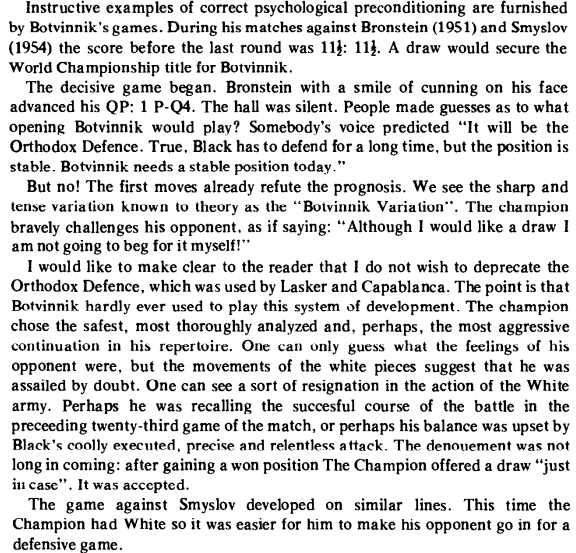
Instructive examples of correct psychological preconditioning are furnished by Botvinnik’s games. During his matches against Bronstein (1951) and Smyslov (1954) the score before the last round was 11 ½:11½ . A draw would secure the World Championship title for Botvinnik.

The decisive game [1951-DR] began. Bronstein with a smile of cunning on his face advanced his QP: 1 P-Q4. The hall was silent. People made guesses as to what opening Botvinnik would play? Somebody’s voice predicted “It will be the Orthodox Defence. True. Black has to defend for a long time, but the position is stable. Botvinnik needs a stable position today.”

But no! The first moves already refute the prognosis. We see the sharp and tense variation known to theory as the “Botvinnik Variation”. The champion bravely challenges his opponent. as if saying: “Although I would like a draw I am not going to beg for it myself!”

I would like to make clear to the reader that I do not wish to deprecate the Orthodox Defence, which was used by Lasker and Capablanca. The point is that Botvinnik hardly ever used to play this system of development. The champion chose the safest, most thoroughly analyzed and, perhaps, the most aggressive continuation in his repertoire. One can only guess what the feelings of his opponent were, but the movements of the white pieces suggest that he was assailed by doubt. One can see a sort of resignation in the action of the White army. Perhaps he was recalling the successful course of the battle in the preceding twenty-third game of the match, or perhaps his balance was upset by Black’s coolly executed, precise and relentless attack. The denouement was not long in coming: after gaining a won position The Champion offered a draw “just in case”. It was accepted.

The game against Smyslov developed on similar lines. This time the Champion had White so it was easier for him to make his opponent go in for a defensive game.

P.S. There are alternative accounts of who offered the draw which do not detract from the main point.

CHRISTMAS BOOK REVIEW: last minute gifts for the unimproved player

Some tips when choosing a Christmas gift for the chess player in your life.

The Ideas Behind Modern Chess Publishing (Gravy Train)

We must first note the misleading title: this is in fact a study of a typical club-players’  bad habits in the opening, which mostly encourages them. Once you have got past the cover, you will find a very brisk and practical approach has been taken here. The reader is shown just the positive points of various opening systems, without confusing them with any tiresome negative features. Black’s best defences, of course, are also carefully given no space at all, thus avoiding unnecessary complications, and even some of the basic replies that you might expect club players to know (or even stumble upon by accident) are omitted. Makes it all look incredibly easy, and created a very strong impression on this reviewer.

P.O.O.R. Chess (Moswhini).

P.O.O.R. Chess of course stands for Pennies Obtained for Old Rope, and this is very much the home ground of our Grandmaster-ringmaster-entertainer-instructor. And R.O.P.E., we discover, stands for Religion, Opinion, Platitudes and Exclamations!! Many readers will find the cutesy tone off-putting, but stick with it, and you may discover some of God’s most wonderful gifts to us, like the ability to skim a book like this through the air like a frisbee (S.A.B.L.T.T.T.A.L.A.F.), to land in the compost heap of a neighbour, maybe two streets away. Perhaps even that is not far enough.

Bluff like a Grandmaster (Putya Koton, trans. Koldout).

This was the book that blew the lid off the secret Soviet training methods, and showed them to be a tissue of lies. A classic, which continues to catch people out.

School of Chess Effluence (Vols.1-19) – (Forgetitsky and Yushudev).

Igor Forgetitsky has for many years been the go-to guy for top-level, in-depth, high-falutin and over-analytical chess training. His famous card indexes of training positions had become over-full during his years in Eastern Europe, and in the West he found a heaven-sent opportunity to capitalise on this rich resource. Indeed, there can hardly be a scrap of material remaining that has not found its way into a book in this extensive series.

The exercises themselves are amazingly detailed and difficult, so much so that you may sometimes forget whatever the point of the chapter was supposed to be, or indeed what is the point of chess study in the first place, or, in some instances, whether life itself has any purpose at all.

A major event in chess publishing. We can all look forward to more of this sort of thing.

The Idiot’s Mind (Sillyman).

This book gives the reader the rare chance to eavesdrop on a celebrated minor master shouting at his dimwitted students. I’m sure we can all identify with their slow, stumbling progress, and their inability to understand the most OBVIOUS things about a position, even when it is explained OVER and OVER again, in PAINFUL detail, you moron! EVERYTHING you think about at the board must be the most basic, the most concrete, and the most rational. What are you, born under an airhead sign or something? No, don’t tell me… Capricorn, you’re a Capricorn, right? Or a Taurus? I’m sure I can smell Taurus somewhere… Perhaps you’re a Cancer? Wait, come back…

Chess for Blokes: A 12-part DVD training guide (Devious, published by ChimpBase).

Some good, plain-speaking, gritty, practical advice from someone who got out of chess years ago to earn some proper money. He’s now realised the potential that exists in the chess DVD market, and is back to show us how it’s done.

You won’t find other Grandmasters giving most of these openings a second thought, so we are truly fortunate to watch Nigel Devious bluster his way past all the theoretical obstacles they they seem to think are so important in their fancy-dan tournaments. And it’s astonishing how even-handed this comprehensive series this is: the Colle is described as a good practical weapon in one DVD and yet is easy to deal with in another; it’s vital to play proper openings one day, but then you should play some corny old club nonsense on the next. And of course, our Northern host has a well-balanced chip on each shoulder. Perhaps only those able to afford the full selection will realise the true value of what’s on offer here.

It’s mostly about openings, of course, because that’s where the quick returns can be made, but Devious also offers DVDs on the practical side of chess playing. So, in other titles, he covers how to play juniors, elders, betters, how to get your own back in a post mortem and how to get the advantage without actually cheating. His study of the ancient Eastern philosophies on the Internet has led him to some surprising conclusions, like, there’s some Indian guy who apparently can survive without food or water for months on end. It’s true, I saw it myself, he’s being tested by scientists and everything. Wait, come back…

Starting out in Publishing Opening Guides (Everyminute Publishing, Onebourne).

The publisher here has re-thought the way chess opening books have been published, and come up with their own revolutionary scheme. For literally hundreds of years, the small square chess diagram has forced a two-column layout upon chess books, minimising the distance between a diagrams and its accompanying text, and minimising the amount of white space in a book. All that has been swept away with refreshing vigour in this groundbreaking series, so you will find much less in these books than you might have feared at first. Also, the exercise in flipping between pages to find the right diagram will keep you very much on your toes.

Although common wisdom suggests that most club players can stumble through no more than a half-dozen moves before forgetting what they have been told, the authors have all been instructed to give whole games here. So, as well as being given a whizz through some of the simpler ideas in an opening, you can look forward to playing over many many more moves in the example games, way past the point where you lose any hope of understanding what the Grandmaster opponents were thinking or indeed past any real interest in the outcome of the game. Thankfully, these long sequences are given mostly without notes, so you have all the excuse you need to omit them.

It will be a poor player who fails to get anything out of these books. And, as the publishers have no doubt realised, there are millions more such players than those who can see through this whole charade.

FOR JUNIORS: The Ten Ways to Succeed in Publishing series (Otiose and Rigid)

The authors have done a remarkable thing here, reducing what the young player needs to know to the absolute bare minimum necessary to survive, then throwing half of that away. Large text and ample spacing means that these books aren’t as small or as cheap as you might expect, and additional space is taken up with some child-friendly cartoons, drawn it seems by a friendly child.

JUST PUBLISHED: Lexicographer’s Lists (Neissman).

Subtitled: the Big Five, the Medium Fifteen, the Tiny Twenty, the Swift Half, and 4978 other Crucial Things you have to Keep In Mind at all Times. These are the few thousand most basic and important of chess tips, culled from decades of work with students, regurgitated onto the Internet, and now re-organised into the most complicated schemes imaginable.

This book should occupy a vital place in anyone’s chess coaching collection: for me, it’s jammed underneath my tottering bookcase, stopping the whole thing falling forwards.


Inspiration: Kingpin.

Skill or knowledge?

Chess is as much a ‘know-how’ skill as a ‘know-that’ body of knowledge.
RB Ramesh said something in an interview that I thought was very wise (and I paraphrase):

“If I want to learn swimming and don’t know how to swim, I buy some DVDs from a famous swimming coach or swimming world champion, who has done a 10-hour course. So I watch this course every day for one month, so I know all the theory, right, and what needs to be done, but if you push me into a swimming pool I will drown!”

Lucky escapes

Simon Webb in his book Chess for Tigers identified the “secrets of swindling”:
(1) Be objective. The first prerequisite to a swindle is to be objective enough to realize early on when you have a lost position and start playing for a swindle while your position still has resources. If you wait until your position worsens and becomes hopeless, it will be too late.

(2) Do not be afraid of losing. “Once you’ve accepted that your position is lost, you should be in a position of psychological strength.” The worst that can happen is that you’ll lose the game. The pressure is on your opponent to win a “won game”, and it is your opponent who will be embarrassed if unable to do so.
(3) Play actively. In a losing position, you cannot passively wait for your opponent to squeeze you to death. To stand a chance of pulling off a successful swindle, it is important to get the initiative, and this may involve sacrificing a pawn or two, or even the exchange, to activate your pieces.
(4) Use the process of elimination. If you have a choice of several possible moves, and you see simple forced wins against all but one of those moves, you should play the one remaining move, and do so quickly. Again, the onus is on your opponent to find a way to win.

Swindling themes:
1 Stalemate
2 Weak back rank
3 Perpetual check
4 Surprise mating attack
5 Bishops of opposite colours
6 Material insufficiency
7 Building a fortress
8 Zugzwang
9 Timing

Wikipedia has an excellent article on swindling, in which some of those examples appear: http://en.wikipedia.org/wiki/Swindle_%28chess%29

Test paper, test positions, and suggested solutions, all attached.

Hopes and fears

I’m going to have to wind into this one from a distance…

Mostly I play chess, but I know how to play some other games, and I’m
sort of generally interested in games in general.

Game theory was much discussed from a mathematical angle when I was in
college, but what interests me more is the thoughts and feelings of game
players, which are usually far from mathematical.

“It seems to us that the theories associated with board reconstruction
experiments represent an idealised picture of master chess which may be
misleading. … So often, as any player will agree, it is hopes and
fears which seem to influence the choice of a move.”
— Hartston and
Wason

So I was more than interested to be sent a link by our former tyrannical
landlord Steven Crane of Clifton Road Games ( http://cliftonroadgames.co.uk/ ):
https://www.wizards.com/Magic/Magazine/Article.aspx?x=mtg%2Fdaily%2Fli%2…

Have a read of that first and see what you think.

Steven commented to me at the time:

“Probably doesn’t apply directly to chess, due to the lack of “hidden” information, but there might be something in the general idea…”

Oh, if only there was nothing hidden in chess!

“You see, but you do not observe. The distinction is clear.” Sherlock Holmes, in A Scandal in Bohemia

What is so limited in chess, is a firm grasp of what is actually there,
and what is so often present, is a paralysing fear of what our opponent
might have seen that we cannot see.

It should all be there laid on the chessboard – indeed, I often say
that’s what I like about the game – but what lies even a short way ahead
is shrouded in mist, if not fog, if not a dense curtain… and our history
of being surprised by our opponents’ replies makes us fearful of what
might happen next.

And even when we see things, we may be also be justly admonished as
was Watson on another occasion:

“Watson, you can see everything. You fail, however, to reason from what you see. ” Sherlock Holmes, The Adventure of the Blue Carbuncle.

I found the discussion of Magic card-counting had parallels with two
discussions I had with young people who had agreed draws in these two
positions. See what you think first, then I’ll tell you what I told
them.

Black offers a draw to White: do you accept?

White offers a draw to Black: do you accept?

To put the question at all to you, suggests that there is something
better to do than shake hands and find the snack stand. An indeed there
was:


I guess I hope there might be some general sort of logic or way of feeling
about the position that would make these promising young players look a
bit harder and longer next time. I certainly found the language used
about the Magic game very familiar, even if the rules and elements were
foreign.

Don’t be afraid of ghosts, look to see what is real.

The Canon, 2020 edition

Some more time at home recently has meant I have been able to do something I’ve been meaning to do for ages, which is tidy up my database of teaching games, which I call the Canon.

https://devonjuniorchess.co.uk/wp/drdaveexeter/wp-content/uploads/sites/5/2026/10/canon2020.pgn

Sorry if you have an earlier version and have had to tidy it yourself.

Why was it such a mess? Well, I’ve been doing this for a long while, and although the early attempts to give chessplayers some useful software were valuable, they were pretty primitive. The first version of Fritz that I owned did allow you to record, store and annotate games, but you couldn’t add variations. Then, you could add a variation, but only one at each move, so if you wanted to show multiple variations, you had to go back one move and add it there…

Also, I usually want to flag a game as being interesting for a reason — like, it’s a good Rook endgame. How do you flag a game? Well, I used to abuse the ECO code field, putting lower-case codes of my own devising in there. I also found you could add things to players’ initials. ChessBase, bless them, later added ‘medals’, so I could tag a whole bunch of games with the green ‘endgame’ medal, but then they took away the facility to add medals to multiple games at once…

And I wanted to produce chess diagrams: so they got spat out in little 8×8 arrays of text, that I could convert into nice diagrams, as long as I avoided using capital letters again…

All this over twenty years and more meant that there was a lot of crud in the database, which I hope I have cleaned up a bit.

But… there is still nowhere to add a note to a game. So… now I’m abusing the Annotator tag. If that offends you, and you use ChessBase, you can edit all the Annotator tags at once and set them to empty.

It’s in ‘new format PGN’ which means ChessBase will import it with diagrams, symbols and colours and arrows.


Dr.Dave’s Adventures at East Devon, 2000

This tournament somehow escaped record until 2016… I was going through a 1.e4 phase in a vain attempt to sharpen my game.

Click on […] to see games list.

R1: It’s always nice to start a tournament with a win. White plays the
theoretically-pointless Exchange French and gets a standard IQP attacking
position out of it. Surprisingly, everything worked out well for me, Black
never getting any counterplay going despite a cheeky Rook manoeuvre.

R2: I remember feeling optimistic then remember losing…

R3: I hadn’t met Graham before… He was visibly disappointed with my opening and with his 13th move.

R4: No comment.

R5: Ian had walked off with our club championship the previous year, so I tried to treat him with respect.

Who would win in a fight between a lion and a bear? (endgame fortresses)

My young colleague Leif enjoys endgames, and has an endless curiosity about unbalanced endgames. So he asks:
can you win with three pawns against a Bishop?
how about a Knight?
what about two Knights?

A pattern we kept running into was:
united pawns on their start squares don’t win against a piece (a)
united and *advanced* pawns win against a piece (b)
but
there are some special cases where the side with the piece can set up a blockade or fortressagainst advanced pawns (c)


So it’s less like that famous Internet question
who would win in a fight between a lion and a bear?
but
who would win in a fight between a fox and a hedgehog?

Anyhow, we ended up looking at a few fortresses, some I knew, some I had
to look up, and some I found out more about.

There are cases where a lone King can be a ‘toad in a stone’, wedged in and impossible to shift.

The Japanese might say a ‘bear in the hole’… Notice that these cases
are all in the corner of the board. Edges and corners are friends of the defending side.

With a pawn to help, the King can resist near a corner without being in
it:

It’s perfectly possible to draw when you are the exchange behind, if you
can keep out the enemy King. That’s another theme: keeping out the
attacking King.

The mighty Queen can be kept at bay, as long as the attacking King can’t
get in:

We played around with variations on that last fortress, and then looked
it up. It’s sort of interesting: if the pawn is advanced, the Queen can
get behind your defences and you lose, but if the pawn is advanced and
on the edge, you are able to hold again.

To break down the defence, you have to use zugzwang to make the Rook
abandon the King.

The same ideas occur in the ‘simple’ Q vs R endgame, which six-times US
champion GM Walter Browne failed to win against a computer in the 1970s,
before looking up the right technique… Try it against your own
computer!

Fortresses in practice

Here’s one from a game I had a year or two ago: I got through, but I
think I shouldn’t have been allowed to.

A couple of well-known ones at GM level: a great swindle by Zsuzsa
Polgar:

Another sad tale of the wrong Rook’s Pawn!

And a spectacular save:

P.S. Foxes are said to eat hedgehogs by rolling them into water, when the hedgehog will unroll to swim, and loses its life.

Jokes

I usually have about my person some positions to amuse young players at the end of an evening.

Here are some of my favourites:

Problems
Hints
Solutions

Problems.

White to play and…

1. Mate in half a move (?)

2. Mate in 6 (Halumbirek)

3. Mate in 2 (?)

The board is the right way around — those are eight pawns ready to promote!

4. Mate Black without taking a pawn (Brown)

5. Mate in 2 (Loyd)

6. Mate in…14!

Hints.

1. Is there a move in chess that you make in two halves?

2. Seriously, if you can’t solve this one, you should give up chess!

3. Two piece moves will give mate — but which piece do you move first?

4. A puzzle inspired by the Iron Cage of Tamerlane.

5. A puzzle called ‘Organ Pipes’: imagine it’s Black to move?

6. With the White King on g6, and Black to move…

Solutions.

1. 1.Ra1-d1 completes Queen’s-side castling.

2. All moves are forced: 1. d4 b5 2. d5 b4 3. axb4 a3 4. b5 a2 5. b6 a1=Q 6. b7# 1-0

3. 1. Nc6! and now e.g. 1…a1=Q 2. Ba6# by discovered check.

Also:
(1… f1=Q 2. Bf5#)
(1… e1=Q 2. Be6#)
(1… d1=Q 2. Bd7#)
(1… b1=Q 2. Bb7#)
(1… c1=Q 2. Be6#)
(1… f1=Q 2. Bf5#)
(1… g1=Q 2. Bg4#)
(1… h1=Q+ 2. Bh3#)

4. 1. Nec6+ dxc6 2. dxe3+ fxe3 3. Rh4+ Be4 4. Rhxe4+ dxe4 5. Be5+ dxe5 6. Rxd8+
Nd5+ 7. Rxd5+ cxd5 8. Nc6# 1-0

5. 1. Qa5 Bb7 2. Nf5# or…

(1… Bd7 2. Qd5#)
(1… Be6 2. Qe5#)
(1… Bf5 2. Nxf5#)
(1… Rd6 2. Qxb4#)
(1… Rd5 2. Qxd5#)
(1… Re5 2. Qxe5#)
(1… Bc5 2. Qa1#)
(1… Bb7 2. Nf5#)

6. 1. Kg7 Qh3 2. Kf8 Qh4 (2… h4 3. Kg7 Ne5 4. Nxe5#) 3. Ke7 Qh3 4. Kd8 Qh4
5. Kc7 Qh3 6. Kc8 Qh4 7. Kd8 Qh3 8. Ke7 Qh4 9. Kf8 Qh3 10. Kg7 Qh4 11. Kg6 Qh3
12. Kxg5 Qh4+ 13. Kxh4 Nc3 14. Nd4# 1-0