A thinking process

I often think, only a correspondence player has the luxury of adopting a genuinely consistent thinking process. The rest of us have to contend with the clock, our emotions, our laziness…

I have struggled with this issue all my life, it seems. There has to be something which balances the thorough with the realistic.

For juniors, I have been playing around with a THINking scheme, which was really driven by the need to correct some common errors; it goes:

  1. Look for your opponent’s threats.  If there is something you have to deal with it, use your dealing with threats routine (*1).
  2. Look for your own opportunities: examine every check and every capture, especially if there are clues that a combination(*2) might be around.  If there is one, play it.
  3. If you haven’t got a move yet, look for one of your pieces that isn’t doing much, and do something to improve the position of your worst-placed piece.
  4. If you can, play with a plan (*3).  Have some idea what you might be wanting to do next, over the next 5 moves.  You can get clues about  what you should be doing by looking at the position (*4).
  5. Check your move before you play it, in case it loses a piece or something.

Because I like acronymns as mnemonics, that works out as THINC (Threats, Hopes, Improvements, Next, Check)

  • (*1) Dealing with threats is ABCD: Avoid, Block, Capture, Defend (actually, it is ABCDX, but using X=counterattack can go badly wrong).
  • (*2) Combinations come in six flavours: MJFNPT (Mates, Jumps, Forks, Nets, Pins and Ties).  If it helps to go through it, you Might Just Find a Neat Powerful Tactic.
  • (*3) Making a plan comes in three stages: Ready, Aim and Fire.  The Ready bit is looking at the position(*4), the Aim bit is deciding what you should be doing, and Fire is finding a move that helps you do that.
  • (*4) Looking at the position comes in six stages: TKWPFLC (Tactics, King safety, Weaknesses, Piece placement, Forcing moves, Lines, Centre/space).  Again, if it helps: To Know What Plan to Follow, Look Carefully.

Beginners, I’m happy if they do just 123 and 5.  If they can’t manage that, then just 1 and 5 will do.  If they can’t manage that, then just do 3…    Anyone who regularly does every step between 1 and (*4) can probably outplay me.

Purdy suggests:

  1. First impressions (which may be left over from earlier thinking): what are my candidate moves?
  2. What did my opponent’s last move change?
  3. What is going on in the position? (he gives a list, which overlaps with mine above)
  4. Is there a combination? (he gives another list)
  5. What is my plan?
  6. Return to decide on a list of candidate moves, analyse and decide on one, then:
    1. Visualise it clearly on the board
    2. Do a safety check

Purdy adds: “Being unmethodical by nature, I have never been able to train myself to use my own system throughout a game!”  Although he adds, having made a list of errors after a tournament, he was convinced that at least half of them would have been avoided had he done so.

Dan Heisman regards organising your thinking as one of the Big Five things to get right.  He also, helpfully, provides us with an example, described in a dozen pages, which I summarise:

  1. Can I checkmate my opponent?
  2. What changed? (New threats or opportunities, Old threats or opportunities that disappeared)
  3. What am I threatened by? (deal with any threats, but until you’re pretty good, don’t counterattack)
  4. What are my candidate moves?
  5. Analyse each line until quiescence, i.e. the position settles down to manoevring, remember what the best move is so far.  Things that help with this include:
  •  does my opponent have a killer threat?
  •  what is my evaluation of the position? e.g. +=
  •  is my evaluation of the situation after my best move so far the same?  i.e. +=
  •  do I have something to achieve, a ‘mini-plan’?
  • Choose, but span style=”text-decoration: underline;”don’t play, your move.
  1. Is there something better?
  2. Try one last sanity check

This is quite a lot, for sure, but he reassures us that a lot of it becomes automatic — it’s not something you go through like military drill.

OK, this all may be too much advice by now.  How can you respond to all that?  In particular, how do you make sense of three overlapping but contradictory schemes?!

Some suggestions:

  1. Reflect on how you decide on a move in various positions. That sort of translates as: try and notice yourself thinking while you’re thinking. Also, reflect on your mistakes.
  • If you’re keen, make a recording of yourself thinking what to play
  • What do you do when you are thinking?  Is there any order to it at all?  Could you organise it better?
  • What’s missing?  Are there things suggested above that would be useful to include, for example, routine blunder-checking?  Try including one or two steps at once, get them rehearsed, build up your habits until your thinking process is complete.
  • Write down some sort of organised scheme for yourself to follow.  Compare it with the schemes above: what steps might you be missing out?  Don’t make it more complicated than you need.
  • Try and stick to this scheme in as much of as many of your games as you can manage.
  • Go back to 1 after a month or three of practice, see how you sound now.

Logical Chernev

I’ve just come across two splendid swipes at Irving
Chernev.

Here is John Nunn, in the introduction to his [i]Grandmaster Chess, Move by Move[/i]. He
quotes a very illuminating annotation by Alekhin, and then goes on to
say:

“Lesser annotators are often fond of propounding grand
general
principles, but these are often totally misleading. A typical
example occurs in [b]Logical Chess,
Move by Move [/b](Simon and Schuster, 1957) by Irving Chernev (I
have converted the descriptive notation to algebraic). His Game 3
…

…

goes [b]1 d4 d5 2 Nf3 Nf6 3 e3[/b]
and we read “Generally, it is dubious strategy to release one Bishop
while shutting in the other”. After [b]3…e6[/b] he says “This deserves
censure because it is a routine developing move which seems to take no
thought of crossing White’s plans”. Yet a little later Game 8
…

…

went [b]1 d4 Nf6 2 Nf3 e6[/b] (“Black
releases his King Bishop and does not commit himself to any specific
line of defence.”) [b]3 e3 d5[/b]
(“Black plants a pawn firmly in the centre.”) Now there is no
censure for Black’s play, only approval, but we have reached exactly
the same position as the earlier game. What then, can we make of
Chernev’s general principle on developing Bishops? Basically,
it’s wrong. Many common openings flout it, such as the Queen’s
Gambit Declined, the Closed Ruy Lopez, the French and several lines of
the Sicilian. Even in 1957, these openings were played by many
World Champions.

“If you are unlucky, the ‘general principle’ being put
forward
may not even apply to the specific position under discussion.
Referring again to [i]Logical Chess
Move by Move[/i], Game 12 goes
…

… [b]1 c4 e5 2 Nc3 Nf6 3 g3 d5! 4 cxd5 Nxd5 5 Bg2 Nb6! [/b](his
exclamation marks) and now we read

“There is another bit of subtlety
in the Knight’s move, one which the modern master frequently utilises.
The Knight takes advantage of the Bishop’s fianchetto development and
bears down heavily on c4, [i]a square
weakened by the Bishop’s absence[/i].” The italics are Chernev’s so he
obviously considered this point important. However, it is absurd. White
will inevitably play d3 (or possibly b3) to develop his c1-bishop, after
which the knight cannot move to c4. Even if it could, it wouldn’t attack
anything and would be instantly driven away again. The game continued
[b]6 Nf3 Nc6 7 0-0 Be7 8 d3 0-0[/b], reaching a standard position. The
d3-pawn covers c4 and did so for the remainder of the game, so this
isn’t even a case of annotation by hindsight. Chernev was trying to
formulate a general principle, this time on the defects of the
fianchetto development, but it’s not one that has any contact with
reality.

“A player of his strength is unlikely to discover new general
principles which somehow eluded great chess thinkers such as Tarrasch,
Nimzowitsch and Reti.

(…)

“Every chess move adheres to some general principles but contravenes
others.”

Ouch.

Exhibit B: here is Master Ron Wieck, in his Foreword to
Purdy’s [b]Action Chess[/b]:


[blockquote]
[ul class=”gm”]
[li]Scheve – Teichmann 0-1 [C53]
[/li]
[/ul]

[b]1. e4 e5 2. Nf3 Nc6 3. Bc4 Bc5 4. c3 Qe7 5. O-O d6 6. d4 Bb6 7. a4[/b]

“… Here Chernev writes,

“A tricky move, but an illogical one. White threatens an attack on
the bishop by 8.a5. If then 8…Bxa5, 9 d5 strikes at the Knight
protecting the Bishop. After the reply 9…Nd8, White captures by
10.Rxa5, winning a piece. Should Black, after 8.a5, play 8…Nxa5, the
continuation 9.Rxa5 Bxa5 10.Qa4+ nets White two pieces for a Rook.”
[b]7…a6[/b].

“Prepares a retreat for the Bishop.” (…) [b]8.a5[/b] “There is just a
wee chance that Black will be tempted to take the pawn.” [b]8…Ba7[/b]
“But Black does not bite!”

“All very charming. It’s as though an affectionate uncle took you by
the hand and made sure you didn’t miss anything.

“Later, however, you happen to pick up a copy of Tarrasch’s book on
the great tournament, St.Petersburg 1914. The game, [i]Gunsberg-Alekhin[/i], repeats these moves,
but on move 8, Alekhin bit: [b] 8… Nxa5 9. Rxa5 Bxa5 10. Qa4+ b5[/b]

(Oops. Maybe he was doing more than prepare a retreat) [b]11. Qxa5 bxc4[/b] … And White did not
have enough for the exchange.

“We return to [i]Logical
Chess[/i]
where Scheve had just played [b]9.h3[/b].

Chernev devotes half a page to castigating this move:

“A coffee-house move! (…)”

“He goes on and on, quoting Tarrasch and Alekhin,
delivering a sermon on the certain damnation that attends any pawn move
in front of a castled King.”

(…)

[p style=”font-weight: bold;”]9…Nf6 10. dxe5

“White exchanges, and opens lines for his pieces.
Unfortunately, this reacts in Black’s favor…” [b][/b]

“[b]10…Nxe5 11. Nxe5 Qxe5 12. Nd2 Bxh3 13. gxh3 Qg3+ … [/b]and the
finish should be fairly obvious.

“You buckle down to some study on the Italian Game and discover that
7.a4 is a perfectly good space-gaining move, and the blunder 8.a5? is
best replaced by the coffee-house 8.h3, a strong move which preserves
the tension in the centre to White’s advantage by preventing …Bg4,
which would strike indirectly at the square d4. White stands well after
8…Nf6 9 Re1, so in retrospect it is apparent that Scheve’s 10.dxe5 was
a terrible howler. The problem is, Chernev was utterly clueless about
the reason for White’s defeat, leaving the definite impression that h3
was the culprit. You end up wishing your patient uncle would take a hike
and learn something about chess.

“I have been terribly harsh with Irving Chernev … but I must insist
that you can’t teach what you don’t know. This is where Purdy is
different: he really understands the positions he discusses.”
[/blockquote]

Ouch squared.

On the other hand…

[b]1. Specifics[/b]

a. Well, we all know people who can’t teach even what they [b]do[/b] know, so I’m happy for people
who can teach to have a go. Chernev was far from a dead loss as a player
(he scored 6/15 in the US Championship in 1942, national master
strength), and if you want to find holes in published analysis, Chernev
isn’t the strongest player ever to leave one[*].

b. In the context of the game given, the move [b]7…a6[/b] [i]does[/i] seem to have been made to provide a
retreat, just as Chernev said (and just as von Scheve, Teichmann and
Gunsburg likely thought).

c. What did Alekhin say, exactly, that he could be quoted by Chernev
in support of his criticism of [b]9.h3[/b]?

“[em]Always try to keep the
three pawns in front of your castled king on their original squares as
long as possible.[/em]”

And indeed, when Alekhin had this position as White, twice, he did
not play 8.h3, but 8.Be3. So this would not be an example of Chernev
inventing a general principle that Alekhin overlooked, but Chernev
quoting and explaining what Alekhin wrote and played.

d. I’m happy to think that Ron Wieck knows players who might seek out
Tarrasch’s tournament book, or who might buckle down to research this
unusual line of the Giuoco Piano. But I have a feeling that Chernev is
instead addressing beginning players who might play as follows:

[ul]

[li][b]1 h3…[/b][/li]
[li][b]1 a3 2 h3…[/b][/li]
[li][b]1 e4 2 h3…[/b][/li]
[li][b]1 e4 2 Nf3 3 h3[/b]…[/li]
[li][b]1 e4 e5 2 Nf3 Nc6 3 Bc4 Bc5 4 d3 h6 5 Nc3 d6 6 h3 a6 7 a3 Nf6 8 b3…[/b][/li]

[/ul]

And if Chernev wants to spend half a page shouting about this habit,
I’m sympathetic, even if it was mistimed. My most detailed information
about the Giuoco Piano is the Batsford offering from Gufeld and Stetsko,
who, after trundling down the main line, comment:

[blockquote]”The h3-pawn is a reasonable place for Black to start
organizing an attack on the king…”[/blockquote]

e. Oh, and let us quote the whole of Chernev’s comment after dxe5:

[blockquote] “White exchanges, and opens lines for his pieces.
Unfortunately, this reacts in Black’s favor, in accordance with the rule
in these cases:

[i]Open lines are to the advantage of the
player whose development is superior.[/i]” [/blockquote]

Maybe mistaken, but not “clueless”. [Selective quoting isn’t fair. If
I wanted Chernev to look better, I would have left out all of Nunn’s
stuff about the English Opening in Game 12. But that wasn’t the whole of
the argument.]

f. Similarly, with regard to Nunn’s discussions of Chernev’s comments
on the Colle: Chernev’s full comment on Game 8 was

[blockquote]”Black plants a pawn firmly in the centre. This move,
together with …e6, blocks in the Bc8.” [/blockquote]

So, not quite so contradictory. I’m forever trying to get juniors to
stop getting unnecessarily cramped and passive positions by making moves
like d3/d6, blocking the lines of their Bishops. I’m going to guess that
Chernev had also seen enough games like:

[ul]

[li][b]1 e4 2 Nf3 3 d3 4
Be2…[/b][/li]
[li][b]1 e4 e5 2 Nf3 Nc6 3
Bc4
d6… [/b][/li]

[/ul]
…to want to encourage players to get the bishops out in a more
organised way. How would you phrase some advice for a
beginner who kept doing that, I don’t know, “[em]Don’t make a pawn move to
release one bishop
if you haven’t got a plan to develop the other one[/em]”? It
could
come out like Chernev’s formula, I guess. I’d
probably also quote Lasker’s (equally mistaken) advice “[i]Do
not move any pawns in the opening of a game but the
King and Queen pawns[/i].” Some other day, I might confuse beginners
with the many
exceptions to this rule … but today, that’s
good advice.

g. With this in mind, I too would prefer to
see my clubmates,
after [b]1 d4 d5 2 Nf3 Nf6 3 e3[/b],
play a move like [b]3…Bf5[/b],
crossing up White’s clockwork plan of Bd3 Nbd2 and e3-e4. [In the
other move order, in Game 8, the issue doesn’t arise.]

[b]2. General[/b]

[blockquote]”[i]”I remember chancing upon it as a frustrated, fumbling
teenage chess novice and being happily amazed to learn that chess
actually had underlying principles I could learn and use. This process
was aided by the simplicity and clarity with which Chernev explained
myriads of previously mystifying master moves and maneuvers. Reading it
was like a having a blindfold removed, waking up from a confused daze,
or having a light turned on in a dark room (not to mention having
several hundred points added to my rating).[/i]” — Taylor
Kingston[/blockquote]

I had exactly the same experience, and so have many
others. I think
Chernev’s book was only the second chess book I had read (the first one
being David Pritchard’s [i]The Right
Way to Play Chess[/i]); and as a second chess book, it was wonderful.

I ordered the book hoping to get maybe a catalogue of chess principles
which I could then apply. When the book arrived, I was actually
frustrated for a moment that this was nothing of the sort, because the
book seemed so flippant and unmethodical, but I was soon delighted and
charmed by what I read. Chernev is so engaging and enthusiastic, and I
have had so much pleasure from reading this and others of his books and
enjoying his selection of games and positions.

[blockquote]”[i]Nimzowitsch became then for me more or less the author
of the only book which could help me get away from these Euwe books,
which, I admit, are very good for the ordinary club player. But once
you’ve reached a certain strength you get the impression that everything
that Euwe writes is a lie.[/i]” — Bent LARSEN, in KEENE,
[b]Nimzowitsch: a reappraisal.[/b]
[/blockquote]

I think
that’s the
heart of it; Chernev is even more careless with the truth than Euwe,
but you have to start somewhere. It took Chernev yelling “Get
your pieces out!” six times a game for 33 games for me to remember it,
and he did so with such variety, with such a sense of wit and good
humour, that I didn’t realise I was being shouted at. You might
say that if I hadn’t started with such enthusiasm for Chernev, I would
be better than the barely-2000 ELO I am now, but GM Maurice Ashley
still
[echo]
recommends Logical Chess
[/echo]
and describes it as his favourite book. There are many other positive reviews online, and
Dan Heisman can’t stop recommending Chernev’s books.)

[/b]

I don’t know the Grandmaster way to coach beginners out of playing 1
a4 2 Ra3 and 1 h4 2 Rh3, but I do try and discourage it. You learn this,
but in fact you overlearn it… so that later (as Larsen pointed out),
you overlook opportunities to develop rooks in this way, when it may be
the most appropriate method. But you can get over these
over-generalisations. [I’m reminded of going into a science lesson for
11-year-olds, and the teacher saying, “[em]All matter is made of atoms,
but the atom also has a structure; here is the nucleus, here are
electrons going around it like the Earth goes around the Sun[/em]”… If
you have a more sophisticated education in science, each statement is
enough to reduce you to tears, but that was my first picture of how
atoms work, too, and it didn’t stop me acquiring a better picture
later.]

OK, yes, Chernev misses things, and yes, he’s over-fond of general
principles, but I’m very much at ease with Chernev being read by people
who haven’t yet done much work on their game. Chernev’s enthusiasm is
infectious, the games are inspiring and well-chosen (Chernev’s
selections have turned up ceaselessly in instructional books published
since), and, if you’re in need of some general principles, I can’t think
of a better way to acquire them. Unless you have ambitions to be a very
much better player than GM Ashley or even postal master Taylor, you
could do worse than make it your second chess book, too.

[*](Aside: I think that particular accolade must go to Garry Kasparov.

Lasker Em
– Steinitz W 1-0 [C62])

Coaching for adults

I’ll be running some more coaching sessions over the summer, which might mean a poke around on the website.

When we first started running coaching sessions in the early 1990s, the set-up was a bit different.  We had lots of handouts on paper, we had a separate room to go and be noisy in, and there wasn’t an awful lot of help available.

Over a decade on, where are we?

Well, one thing that is going to be the same is the self-help feel of the sessions.  I’m not that good a player to pose as an expert and there are lots of skills and knowledge around the room that it would be foolish not to draw on.  Also, I can’t be an expert in what sort of chessplayer you are — only you can find that out — and so, we’re going to need you to take stock of your play and what you might want to work on.  The starting point for thinking about that still needs to be the study of your own games.

The big differences these days are:
1. we don’t have a separate room, so I won’t do sessions until the club championship has finished.

2. lots more people these days have computers and access to the Internet.

3. There is more help available; I couldn’t have imagined the explosion in chess publishing that seems to have happened, filling all sorts of niches that I had to struggle to find examples for.  Special mention must go to the ‘Starting Out…’ and ‘Improving…’ series of over-priced chess books, just the right sort of level in one place, and to Jonathan Rowson’s books about chess ‘The Seven Deadly Chess Sins’ and ‘Chess for Zebras’ (which flatteringly mentions this web site, although I think GM Rowson came here only to raid my quotes collection ).  My own interest in chess psychology for many years had to make do with only de Groot’s classic but rather austere thesis and Krogius’ wonderful collection of essays.  Now, there are more books just about chess psychology than most people ever buy on chess altogether.

4.Also, having plonked all the handouts on a web site thinking this was some sort of contribution, there are now fabulously many other web sites discussing chess improvement and offering materials and advice.  Special mention must go to:

To be honest, it would take me more time than I’ve got to find and assess and make recommendations from the wealth of material out there.  But if you find one you like, do let me know.

I think there are other changes, some of them in me.  In 1993, I was a sparky and ambitious 32 (that’s my age, OK, and not my grade).  In 2007, I am a fairly sparky 46, but my ambitions are distinctly more modest.  I had this secret agenda when running the earlier coaching sessions: I know the best way to learn something is to set yourself the task of teaching it to someone else.  So, I did rather hope for some sort of improvement in my own play.

…Nope.

I came across this discouraging graph recently, which may explain some of the reasons for that:

This would suggest that I’m lucky to have maintained my grade over 15 years, and not have it decline.  I think the other reason is being realistic about study time: my work seems to take more and more of my time and energy, and a lot of the energy I’ve had for chess I have put into producing chess books with Tim Onions and Hardinge Simpole.

I pinched that chart from Elo’s excellent exploration of his own rating system, The Ratings of Chessplayers Past and Present .  It also features this next chart, which is most interesting:

Steps, right?  Now, you would think that young Julian or his mentor at the time, Leonard Barden, could have given some sort of account as to what Julian realised or solved about chess play in order to make these distinct steps forward.  In fact, I think this is not the case, and therefore tells us something about the occasionally mysterious nature of chess improvement.  You may be told something one day, understand it later, put it into practice even later, and actually get the hang of it later still.  And you need to integrate it with whatever else you might be doing with your chess thinking at the time…  I think this should help you keep optimistic, even if you don’t see immediate benefits from your study and practice.

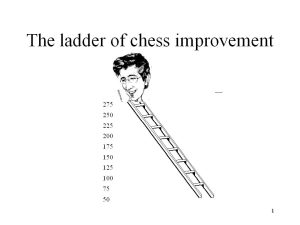
The ‘steps’ metaphor rather suggests a ladder, up which we can climb through study and practice.

I think Glenn Flear once decided when he was graded 170, that he just needed to improve 7 points each year for 10 years, and he’d be a GM.  And so he was…

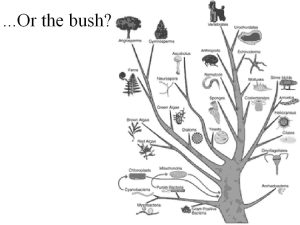
But as a former student of zoology, I am used to discarding ‘ladder’ models in favour of more realistic pictures showing the more complex and contradictory state of nature:

Where are you on the bush?  The ladder suggests that chess is only one thing and there’s only one main route to travel.  I think chess is more complex, and our routes through improvement are more elaborate, than the ladder model suggests.

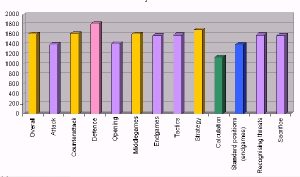
A more helpful model to think about your own chess I think is… Imagine a player graded BCF 100 [ELO 1700 or so? They changed the system and I no longer feel confident about translating grades].  I imagine they would have strengths and also some weaknesses.  In fact, they may perform better than your average 100-grade player at some things, and worse at others.  If there are a dozen or so things you need to get right to be a good chessplayer [*], we might be able to draw up a profile of our player:

So, our player excels at F, G and L, is most deficient in B and E, is far from wonderful at M, and doesn’t even know what J is.  [It may be that I don’t either, but it may be that it doesn’t matter at our level.]

In order to help you think about your own profile, try this:

List the three most important things you try to get right during a chess game, or the three things that you think you are best at.
1 …
2 …
3 …

Now list the three most important things you want to try and improve — perhaps thinking about the three most common reasons why you think you lose chess games.
1 …
2 …
3 …

OK, now compare your answers with those of other people.  Somewhere between you, you might have a list of a dozen things.  [Having looked at (and discussed) this list, you might want to change your mind about your initial two sets of triplets ]

Now take the scoresheets from your last dozen games — slow games, not blitz games on the Internet or against computers, but proper chess with a human opponent and a couple of hours’ thinking time — and think about each game against the list of a dozen things.  Then, come up with a your final sets of triplets, your three strengths and the three things you want to work on.

So, bring your list of things you want to work on to the session next week, and we’ll see if we have any overlap.  Then we can think about a programme.  See you there.

[* Although Dan Heisman says there are five: tactics, activity, time management, thought process, general principles.  Those headings are broad enough to be worth dividing up, I expect.]

Elements of a chess profile

So, last week we launched the summer coaching sessions.  I explained the idea of the profile, and went on to ask everyone to complete the 3+3 exercise described below:

  • Three things I do well (or try to do well)
  • Three things I do badly (or want to do better)

The items were written onto coloured sticky notes, and I arranged these into rough groups on a table.  Doubtless other arrangements were equally legitimate.  The idea was for everyone to to start to build a confident picture of your strengths and weaknesses: try and draw up your own list of what A-M might stand for, and what might be your B and E or your M, and what might be your J!

Well, depending on what level you’re at, different treatments might be appropriate.  I have drawn up a preliminary guide to books — not that you should read all or own any of them, but so that you might find something to move you on, whatever your level and whatever you want to work on.  I expect for every book there is a better one… but it’s a starting point.  I’ll try and supplement this array with some web links soon.  Contributions welcome.


The good Dr.Dave’s comments
GENERAL
Playing a game better now
GENERAL
I am not experienced in chess game enough
The main thing beginners need is practice!
OPENING

  • Opening
  • Try to open well
  • Try not to block any of own pieces during opening
  • Openings that become endings
OPENINGS
Castling

  • I have no schemes of openings
  • Have such a restricted opening repertoire
  • Early development of pieces rather than just pawns
  • Opening
  • Openings
  • Openings, particularly d4…?
  • Openings
  • Not delay castling
  • Remember opening repertoire
I was happy that this didn’t dominate the picture: although in the last game I annotated, I piddled all over their third and fourth moves…
TACTICS

  • Checking
  • Combinational pressure
  • Creating potential pins
  • Piece combinations
  • Avoid gross blunders
  • Try to spot moves
TACTICS

  • Move more slowly and carefully
  • Lose quickly!
  • To look before I commit myself to all the replies
  • Positions with much open space and active queens
  • To avoid loose pieces
  • Protect vulnerable pieces
  • Calculations that go more than a few moves deep
  • Visualisation
  • Use more reverse moves
I don’t agree that chess is 99% tactics, but tactical alertnesss does decide an awful lot of games.

This isn’t just about knowing about tactics, it’s about imagination and vision.  Fortunately, they have the same treatment: doing tactical puzzles.

STRATEGY

  • Strategic position
  • Looking for holes in the opponent’s position (outposts)
  • Active squares
  • Playing closed positions
  • Understanding the value of pieces in the current position
  • Sometimes a good strong attack
  • Passing and not taking
STRATEGY

  • Middle game
  • Learn how to think throughlay ‘small’ (subtle) moves more effectively
  • Manoeuvre more rather than swap pieces
  • Visualising exchanges more efficiently
  • Co-ordinate my pieces better
  • Closed positions (strategic play)
  • Better at planning
  • Thinking ahead structurally
  • Not enough attention on whole board
There’s lots to this, of course; I was interested to hear a theme of ‘exchanges’ coming through.
ENDGAME

  • Simple end games
  • endgame
ENDGAMES

  • Avoid dropping endgames — needless half point
  • Long games
  • Endgame
Traditionally, the ground where weaker players lose to stronger ones.  Are we sure that this isn’t a weakness for more of us? Or does it never matter in our games?
THE CLOCK

  • Time management
  • Time pressure
  • Not move too fast
  • Good position obtained in very good times — against opponents taking a lot longer
  • Use of the clock (playing at the right speed)
THE CLOCK

  • Dealing with time pressure
  • I am usually running out of time
Ah, the 33rd piece is often the final straw…

I would remind a couple of people that there are no points for having time left at the end of the game.

DEFENCE

  • Steady, careful development
  • Cross-cover ever more effectively
  • Good defence
DEFENCE

  • Defence
Again, many would have you believe that club players are worse at this than the rest of their game.
RESOURCEFULNESS

  • Improvisation in new/unseen positions/openings
  • Judging ‘strange’ positions
  • I try to remain mentally positive
  • Play till the end
  • Finding resources to save a lost position
HESITANCY

  • Not attacking enough
  • Exchanging pieces too early
  • Be more aggressive
These aspects of practical play should not be overlooked in the avalanche of available theory.
Topic/Class E D C B A
Opening books Chess Openings for Juniors (Walker)

See also: http://exeterchessclub.org.uk/content/italian-game-beginners and http://exeterchessclub.org.uk/content/colle-system

An Opening Repertoire for the Attacking Player (Keene/Levy) Ideas behind the Chess Openings (Fine) Winning with e4 (Bishop’s Opening)(Emms)

…d4 (QGD Exchange)(Dunnington)

Meeting e4 (Sicilian Four Knights’)(Raetsky)em style=”text-decoration: underline;”>d4 (QGD Tarrasch)(Aagaard/Lund)

See also:

Specialist monographs e.g. Play the French (Watson)

See also: http://www.chesspublishing.com

Tactics Winning Chess (Chernev/Reinfeld)[D] Winning Chess Tactics for Juniors (Hays) Test your Chess IQ (1)Livshitz
See also:
Penguin Book of Chess Positions (Alexander) [D]

span style=”font-style: italic;”>See also: Claus Kaber

Test your Chess IQ (2)Livshitz

See also:

Strategy The Most Instructive Games Of Chess Ever Played (Chernev) [D]
See also: strategy handouts
Simple Chess (Emms) The Middle Game 1/2 (Euwe/Kramer) The Power Chess Program (I/II)(Davies) Secrets of Modern Chess Strategy (Watson)
Endgame Capablanca’s Best Chess Endgames Winning Endgames (Kosten) Endgame Strategy (Shereshevsky) Rate your Endgame (Mednis/Crouch) Batsford Chess Endings (Speelman)
Games collections Logical Chess, move by move (Chernev) Best Lessons of a Chess Coach (Weeramantry) Chess: the Art of Logical Thinking (MacDonald) Understanding Chess, Move by Move (Nunn) Secrets of Grandmaster Play (Nunn/Griffiths)
Practical play Chess for Tigers (Webb) How to Reassess your Chess (Silman) The Amateur’s Mind (Silman) Secrets of Practical Chess (Nunn) The Seven Deadly Chess Sins (Rowson)
Players to study Morphy Tarrasch, Lasker Capablanca Alekhin Botvinnik
[D] = Descriptive notation.

Dr.Dave’s Next Adventures at East Devon

East Devon Update 2001-2006

Well, been a while since I posted one of these.  Dunno who reads them but just for the record…

East Devon Premier 2001  1/4 Something’s rotten…

Well, I’ve never had such a bad start that I qualified for the bye… Something’s not right with my play this year.

Game 1 (1) Cowley,D – Regis,D [A46] 1-0
Game 2 (2) Dunn,A – Regis,D [A46] 1-0
Game 3 (3) Regis,D – Turner,J [A29] 0-1
Bye
Game 5 (4) Regis,D – Parker,J [A15] 1-0

East Devon Premier 2002 1.5/5 No better

This wasn’t hugely more encouraging: it’s not just that I’m losing games, it’s the way I’m losing them that is sometimes discouraging.

Game 5 (5) Regis,D (1744) – Dunn,A (1900) [A26] 1/2-1/2
Game 6 (6) Woodruff,A (1808) – Regis,D (1744) [A40] 1-0
Game 7 (7) Regis,D (1744) – Evans-Quek,S (2160) [A40] 0-1
Game 8 (8) Williams,D (1688) – Regis,D (1744) [C12] 1-0
Game 9 (9) Regis,D (1744) – Ponter,I (1936) [A11] 0-1

East Devon Major 2003 3.5/5 A confidence-booster?

Well, I need to do something to stop the rot, so now that I have a grade low enough to enter a Major or two, perhaps I ought to build myself back up that way.  But it didn’t get off to a good start…

Game 10 (10) Regis – Farina [C24] 0-1
Game 11 (11) Oughton – Regis [A25] 0-1
Game 12 (12) Regis – Dean [D40] 1/2-1/2
Game 13 (13) Sellwood,C – Regis [C12] 0-1
Game 14 (14) Regis – Moreland [A16] 1-0

East Devon Premier 2004 (-)

My partner’s Dad died; first one I’ve missed.

East Devon Premier 2005 1/5 The other tournament from hell…

I was absolutely punch drunk in this tournament, lurching from disaster to disaster.  There were some spells of coherent play but the impression is of someone who can’t hold it together… and sometimes, can’t see as far as the nose on his face.

Game 15 (15) Hutchings,P – Regis,D [C01] 1-0
Game 16 (16) Regis,D – Wright,R [A10] 0-1
Game 17 (17) Taylor,G – Regis,D [C02] 1-0
Game 18 (18) Jepps,G – Regis,D [C00] 1-0
Game 19 (19) Regis,D – Chapman,P [A20] 1-0

East Devon Premier 2006 1.5/5 Some signs of life?

I wouldn’t say this was an unqualified success – in fact, I think it’s the first tournament I’ve played in where I’ve not won a single game – but it feels a bit more together: although I’m still missing things, I’m missing mostly more subtle things, and although I’m still losing games, I don’t think I’m such an easy mark.

Game 20 (20) Regis,D – Helbig,P [A25] 0-1
Game 21 (21) Whymark,D – Regis,D [A37] 1/2-1/2
Game 22 (22) Regis,D – Kneebone,J [A39] 1/2-1/2
Game 23 (23) Page,M – Regis,D [C12] 1/2-1/2
Game 24 (24) Regis,D – Richmond,J [A26] 0-1

Some context

[Did you know I do statistics for a living?]


Year White Black vs. 1.e4 Black vs. 1.d4 Score at East Devon Grading performance Grading over year Games played
2001 English Opening, few Bishop’s Opening etc French Defence, a few Modern Defences English Defence 1/4 130 143 28
2002 English Opening, a few more Bishop’s opening etc French Defence, a more few Modern Defences and Sicilians English Defence 1/5 142 144 ?
2003 English Opening French Defence, occasional Sicilian English Defence 3.5/5 (Major) 150 154 31
2004 English Opening French Defence, occasional Sicilian English/Dutch* (-) (-) 163 23
2005 English Opening French Defence, occasional Sicilian English/Dutch, some other experiments 1/5 114 159 31
2006 English Opening French Defence, occasional Sicilian English/Dutch, some other experiments 1.5/5 140 163 24

* Actually, I seem to get rather few people play 1.d4, and if they do, 1…e6 doesn’t always lead to the Dutch, so although theoretically I play the Dutch as Black, I only get one or two a year.

Discussion and conclusions


  1. I had a fond idea when starting this section of the website, that I would be able to record my reflections about my play and also, maybe, muse smugly on the improvements seen as a result of all this study and navel-gazing.  The reality has been something else.
  2. I have had some really rather poor form in the early  part of this century which has only just shown signs of recovery.  I have won the Club Championship twice, in 2005 and 2006, which might some measure of success (after 15 years of trying) although I had only one strong player to beat in each year and could as easily be interpreted as evidence of a fall in strength in the club!
  3. I conclude: It is not realistic to expect improvements in your play unless have time to devote to improvement and few other demands on your time and energy.  My knowledge of the game, its history, opening and endgame theory, and so on, is probably more than I need, but I’ve not able to put in the hours thinking through things at the board (at home or in tournaments) that I need to in order to improve.  Sometimes I have come to a chess match and looked at the board almost uncomprehending, for my time and energy have been caught up with work or home matters; at other times I have spent the week before a game doing nothing but work on a chess book, yet come to the board absolutely out of form, for all my thoughts have been about  typefaces and paragraph styles.

Cowley, Dennis – Regis, D.

East Devon Premier, 03/02/2001

A painful loss… I have not a lot of respect for White’s chosen opening, but this is my third loss to the Colle without putting up much of a fight. Thinking there was no danger, I overlooked some fairly basic threats….

1.d4 e6 2.Nf3 c5 3.e3 Nf6 4.c3 b6 5.Bd3 Bb7

[5…Ba6]

6.Nbd2 d5

[6…Nc6 7.e4 cxd4 8.cxd4 Nb4 9.Bb1 Ba6]

7.Ne5 Nbd7 8.f4 Bd6

[8…Be7]

9.O-O Qe7 10.Ndf3 Ne4

[10…a6 is a little more thoughtful.]

11.Bb5 Bxe5 12.Nxe5 Nef6 13.a4 O-O 14.Nxd7 Nxd7 15.f5 exf5 16.Rxf5 Nf6 17.a5 Ne4? White’s idea wasn’t that hard to spot.

[17…Qd6]


[17…bxa5 18.Rxa5 c4 19.Qa4 a6 20.Bxa6 Qc7 21.Qb5 Rfb8]

18.a6 Bc8 19.Rxd5 Qh4 20.Qf1 Nf6

[20…Be6 21.Re5 Nd6 22.Bd3 c4 23.Bc2]

21.Rd6 Ne4 22.Bc6 Nxd6 23.Bxa8 cxd4

[23…Bxa6 24.Rxa6 Rxa8 25.dxc5]

24.exd4 Bxa6 25.Rxa6 Rxa8 Black has material equality but no co-ordination.
26.Bf4 Ne4 27.Ra1

[27.d5]

27…g5 28.Be5 g4?? 29.Qf4 Ng5 30.Qf6

1-0

Dunn, Andy – Regis, D.

East Devon Premier, 03/03/2001


1.d4 Not again… Andy Dunn is a fine player but I thought he got away with this one. I just got horribly short of time looking for counterplay that wasn’t there…

1…e6 [

1…c5 2.e3

(2.c3 cxd4 3.cxd4 d5) 2…cxd4 3.exd4 d5 4.Bd3

(4.c4) 4…Nc6 5.c3 Qc7 6.Ne2 Bg4 7.Qb3 Bxe2 8.Bxe2 Rd8 9.Bg5 g6 10.Nd2 Bh6 11.h4 Kf8 12.Nf3 Kg7 13.h5 a6 Polgar,J-Karpov,A/Roquebrune 1992/0-1 (62)]

2.Nf3 c5 [2…Nf6]

[2…f5 Cobb,J-Williams,S/It, Cardiff WLS 1997/ – (61)
3.d5
]

3.e3 Nf6 4.Bd3 [4.c3 1-0 Cowley,D-Regis,D/East Devon Premier 2001 (29)]

4…b6 5.O-O Be7 6.c4 O-O? 7.d5! Aaron Summerscale’s Killer Chess Opening Repertoire has a lot to answer for.
7…exd5 8.cxd5+/- NCO d6 [8…Bb7 9.Nc3+/- Re8 10.e4]

9.Nc3 Ba6 10.Re1 c4 11.Bc2 Nbd7 12.Nd4 Re8 13.e4 Nc5 14.b4 cxb3 15.axb3 Bb7 [15…Bc8]

16.b4 Ncd7 17.f4 a6 White has a winning game here, achieved with the simplest of means.
18.Bb2 [18.Nf5]

18…Rc8 19.Ra3 86/90m 19…b5 20.e5 dxe5 21.fxe5 Nxd5 [21…Bxb4! Not too hard to spot, even in time trouble.
22.exf6 Bxa3 23.Bxa3 Rxc3
]

22.Nxd5 Bxd5 23.Bxh7+ [23.Qd3 Nf8]

23…Kf8 [23…Kxh7 24.Qh5+ Kg8 25.Rh3 f5 26.e6+-]

24.e6 Nf6 [24…Bxb4]

25.exf7 Bxf7 26.Rh3 Bxb4 27.Rxe8+ Qxe8 28.Bf5 Rd8 29.Rh8+ Ng8 Black is holding this, I think.
30.Be6 [30.Bh7]

30…Bc5 31.Kh1 b4 [31…Rd6! 32.Bxf7 Qxf7 33.Qc1 Qf6 34.Nf3-/+]

[31…Bxd4 32.Ba3+]

[31…Rxd4!? was the one he was afraid of while I was thinking, but it’s no good:
32.Bxd4 Bxd4 33.Bxf7 Qxf7 34.Qxd4 Qf1+ 35.Qg1+/-Qf5 36.Rh3 Nf6 37.Ra3 Qe6 38.Qa1+-
]

32.Bxf7 Kxf7 33.Qh5+ Kf8 34.Qxc5+ I was bound to allow something like that: these positions are so much easier to play for the attacker at our level.

1-0

Regis, Dave – Turner, Joseph

East Devon Premier, 03/03/2001

A bit of chess blindness – I didn’t play especially well, but enough to keep making the play up to that point.

1.c4 e5 2.g3 Nf6 3.Bg2 d5 4.cxd5 Nxd5 5.Nc3 [5.Nf3 Chiburdanidze,M-Botsari,A/EuT-ch (women), Pula CRO 1997/1-0 (31)]

5…Be6 6.Nf3 Nc6 7.O-O Be7 8.d4 [8.d3 1-0 Stoliar,E-Winter,I/Worishofen 1992 (16)]

[8.b3 Raddatz,W-Kaaber,N/Bargteheide 1989/1-0 (38)]

[8.a3 Schmitt,C-Lajarige,H/FrTCh, Montpellier FRA 1998/1-0 (44)]

8…Nxc3 [8…exd4 1-0 Havlicek,J-Svabensky/Ostrava 1946 (14)]

[8…Bf6 Backe,P-Bjornsson,A/Hallsberg 1982/1-0 (48)]

9.bxc3 e4 [9…exd4 Gulko,B-Sigfusson,S/Reykjavik,ICE 1996/1-0 (41)]

[9…f6 Backe,P-Sunnebjr,A/Hallsberg 1985/1-0 (67)]

10.Ne1 [10.Nd2 1-0 Filip,V-Szabo,F/corr ch-CR 1995 (25)]

[10.Ne5 Bonaldi,P-Cena,J/La Falda ch-ARG jr 1984/1-0 (42)]

10…Bd5 [10…f5 Backe,P-Angqvist,T/Sundsvall 1989/1-0 (38)]

11.Nc2 f5 12.Ne3 g6 13.Nxd5 Qxd5 14.f3 exf3 15.Bxf3 Qd7 16.Rb1 Na5 White has a nice advantage.
17.Bf4 [17.Bxb7 is a nice Bishop, but Black has no light-squared bishop of his own.]

17…Rb8 18.Be5 Rf8 [18…O-O]

19.e4 [19.Qd3]

19…Nc4 20.Qe2 [20.Bf4 g5 21.Bc1+ / -]

20…Nxe5 21.dxe5 f4 22.Bg4 Qc6 23.gxf4 h5 24.Bxh5 Chess blindness: the f-file had been open so long…
[24.Bh3]

24…gxh5 25.Qxh5+ Rf7 …I thought I could play Qxf7!!??
26.Rbe1 Qe6 27.Re2 Kd7 28.Rd2+ Kc6 29.Rd5 [29.Qd1 Qc4 30.Qf3 Bc5+

(30…Rg8+ 31.Kh1 b6 32.f5)

(30…b6 31.f5 Qc5+ 32.Kh1 Qxe5 33.Rd5 Qg7 34.e5+-) 31.Kh1 Be3-/+

]


29…Rg8+ 30.Kh1 Qg4 31.Qxg4 Rxg4

0-1

Regis, D. – Parker, John

East Devon Premier, 03/04/2001

After a bye, I would have hated to go away without a win at all… This was an unpretty but determined attempt to go away with at least one.

1.c4 e6 2.g3 Nf6 3.Bg2 Be7 4.Nf3 O-O 5.O-O c6 6.b3 h6 7.d4 d5 8.Nc3 Nbd7 9.Bb2 Rb8 10.Qd3 a6 11.a4 Nh7 12.e4 dxe4 13.Nxe4 f5 14.Nc3 Ng5 15.Rad1 Nxf3+ 16.Qxf3 Nf6 17.Rfe1 Bb4 18.Re2 Bd7 19.Qd3 Qc8 20.Na2 Bd6 21.Rde1 Rf7 22.Nc3 Qf8 White has a comfortable advantage.
23.d5

[23.c5]

23…e5

[23…cxd5 24.cxd5 e5]

24.dxc6

[24.Rd2]

24…bxc6

[24…e4]

25.Rd1 White has nothing here.
25…Bc7 26.Nb1 e4 27.Qc3 Bd6 28.Nd2 Bb4 29.Qc2 Re8 30.Nf1 Bc5 White is getting better…
31.Bd4 Bxd4 32.Rxd4 c5 33.Rd1 Bc6 34.Red2 Rd7 35.Rxd7 Nxd7 36.Ne3 Ne5 37.Nd5 Bxd5 38.cxd5 Qd6 39.h4 g6

[39…Nd3! is very good for Black]

40.Bf1 Nf3+ 41.Kg2 f4 42.Qc4 a5 43.Qb5 Rd8 44.Qxa5

[44.Qc6 Qxc6 45.dxc6 Rxd1 46.c7]

44…fxg3 45.fxg3 Nd4 46.Qc3 Rf8 White has slipped again…
47.b4 Rf3 48.Qe1 Nf5 49.bxc5 Rxg3+ 50.Kh1 Qxc5 51.Bg2 Re3

[51…Rg4- +]

52.Qd2 Rd3 53.Qe1 Ng3+ 54.Kh2 Rxd1 55.Qxd1 Qd6 It’s just a big check.
56.Qg4 Ne2+ 57.Kh1 Ng3+ 58.Kh2

[58.Kg1]

58…e3 59.Qxg3 e2 60.Qxd6 e1=Q 61.Qe6+ Qxe6 62.dxe6 Kf8 63.a5

1-0

Regis, D. (1744) – Dunn, A. (1900)

East Devon Premier, 03/01/2002
Round 1 A good scrap, where we each held the advantage at one point or another.

1.c4 e5 2.g3 Nc6 3.Bg2 g6 4.Nc3 Bg7 5.e4 d6 6.Nge2 Be6 7.d3 Qd7 We were both very happy with the opening variation, Andy has played a lot of Closed Sicilians as White.
8.Nd5 I usually forget to play this move.
8…Nce7 [8…f5 1-0 Westerman,H-De Ruiter,T/corr ch-NLD 1990 (19)]

[8…Nd8 1-0 Franco Ocampos,Z-Mantovani,R/8th Valle d’Aosta Open 2000/The Week in Chess 276 (24)]

[8…h6 Panbukczijan,A-Praszak,M/PZU SA Open 1999/1-0 (44)]

[8…Rc8 Gorbatov,A-Tikhonov,A/Novgorod 1995/1-0 (58)]

[8…Nd4 Dichev,N-Dijoux,F/Open 2000/1-0 (70)]

9.Be3 [9.d4 1-0 Timman,J-Bednarski,J/Dieren 1970 (24)]

[9.O-O Amesz,J-Wortel,M/Lost Boys Open 2000/The Week in Chess 302/1-0 (36)]

[9.h3 De Coverly,R-Dunn,A/Folkestone 1991/1-0 (72)]

9…c6 10.Nxe7 Nxe7 11.Qb3 d5 12.exd5 cxd5 13.O-O O-O 14.Bc5 Rfe8 15.Nc3 [15.Bxe7 dxc4 16.dxc4 Rxe7]

15…dxc4 16.dxc4 Qc7 17.Qa3 Logical but not worth the pawn.
[17.Bxe7 Rxe7

(17…Bxc4 18.Bd6+-) 18.Nd5+/-

]


17…Bxc4 18.Rfd1 Nc6 19.b3 Ba6 20.Nd5 Qc8 21.Rac1 Be2 22.Re1 Bg4 23.Bd6 Qf5 24.Ne3 [24.Nc7 Nd4 25.Nxa8 Rxa8

(25…Nf3+ 26.Bxf3 Qxf3) 26.Bxb7 Rd8 27.Bc7 Bf3 28.Qa6 Bxb7 29.Qxb7 Nf3+ 30.Qxf3 Qxf3 31.Bxd8 e4 32.Rc8 f5

]


24…Qh5 25.Nxg4 [25.Rxc6 is risky.]

25…Qxg4 26.Rc4 Qd7 27.Rcc1 Rad8 28.Bc5 Qf5 29.Qa4 Rd2 30.Be3 Red8 31.Be4 Qh3 As usual, Andy is trying to win by a direct attack.
32.Bxc6 [32.Bxd2 Rxd2 33.Bxc6 bxc6 34.Qxc6]

32…bxc6 33.Rxc6 R2d7 34.b4 This is about equal.
34…Qh5 35.b5 Qf3 36.Rcc1 e4 37.Qc4 h5 38.h4 Be5 39.Qe2 Qf5 40.Bc5 [40.Bg5 f6 41.Qxe4]

40…Kh7 41.Qxe4 Qxe4 42.Rxe4 Rd5 43.a4 [43.Bxa7 Rxb5 44.a4+-]

43…f5 44.Rec4 R8d7 45.a5 Rb7 46.b6 [46.a6 Rxb5 47.Bxa7 Ra5 48.Rc6 Kg7]

46…axb6 47.axb6 Kg7 48.Be3 Kf7 49.Rc7+ Rd7 50.Rxd7+ [50.Rxb7 Rxb7 51.Rc6]

50…Rxd7 51.Bf4 [51.Rc6 Rb7 52.Kf1]

51…Bxf4 52.gxf4 Ke7 53.Rc6 Rd6 54.b7 Rd1+ 55.Kg2 Rb1 56.Rxg6 Kf7 There would have been no harm in playing on, but I realised I’d blown most of the advantage.
[56…Kf7 57.Rg5 Kf6 58.Rxh5 Rxb7 59.Rh6+ Kg7]

1/2-1/2

Woodruff, Adam (1808) – Regis, D. (1744)


East Devon Premier, 03/02/2002
Round 2 I was quite pleased with this game although I lost. I just couldn’t settle to a plan in the key phase of the game.

1.d4 e6 2.c4 b6 3.Nc3 Bb4 4.Bd2 Nf6 [4…f5 Gervais,C-Weclawski,D/Duisburg Wch U16w 1992/0-1 (53)]

5.Qc2 [5.e4 Gulko,B-Zvjaginsev,V/New York Open 1997/0-1 (51)]

5…Bb7 6.O-O-O O-O 7.f3 c5 8.a3 cxd4 9.axb4 dxc3 10.Bxc3 I think this ia already easier for Black.
10…Qc7 11.e4 d5 12.Qd2 dxe4 13.Bxf6 gxf6 14.fxe4 Bxe4 Now I have a pawn. As usual, this is my cue to assume the game is won until it becomes obvious that I’m losing…
15.Nh3 Nc6 16.Qc3 Qe5 [16…Rfd8! 17.Qxf6 Rxd1+ 18.Kxd1 Qd8+ 19.Qxd8+ Rxd8+ 20.Ke2 Nxb4]

17.Be2 Qxc3+ [17…a5! 18.b5

(18.Qxe5 Nxe5 19.bxa5 Rxa5 20.Rhf1 Ra1+ 21.Kd2 Rd8+ 22.Kc3 Rdxd1 23.Bxd1 Bxg2 24.Rg1 Kf8 25.Bc2 Rxg1 26.Nxg1 f5) 18…Nb4 19.Qxe5 fxe5 20.Nf2 Bf5 21.g4 Bg6

]


[17…Rac8?! 18.Rhf1 Qxc3+ 19.bxc3 Ne5 20.Rxf6 Nxc4 21.Rd4 Bd5 22.Nf4 Rfe8 23.Bh5 Ne5]

18.bxc3 Ne5 [18…Rfd8]

[18…Kh8!]

19.Rd4 Bg6 [19…Bxg2 20.Rg1]

20.Nf4 Rac8 21.Rf1 Kg7 22.Kb2 Rc7 23.h4 h5 [23…h6= / + 24.h5 Bh7

(24…Bf5)

]


24.Bxh5 Persistent badgering has got some play for White.
24…Nxc4+ 25.Kb3 [25.Ka2 e5]

25…Ne5 [25…Bc2+! 26.Kxc2

(26.Ka2) 26…Ne3+ 27.Kd3 Nxf1- +

]


26.Bxg6 Nxg6 27.Nh5+ Kh6 28.Nxf6 And now he has his pawn back with a good position.
28…Rfc8 29.Rf3 Ne5 30.Rg3 Rc4 31.Ng4+ And now an exchange…
31…Nxg4 32.Rxc4 Rxc4 33.Kxc4 Ne5+ 34.Kb5

1-0

Regis, D. (1744) – Evans-Quek, Suan (2160)


East Devon Premier, 03/02/2002
Round 3 I just rolled over…

1.c4 b6 Ironic: I’ve played a lot of this as Black.
2.d4

[2.Nc3 Bb7 3.e4 e6]


[2.e4 is what I would normally play, but thought I’d be clever…
2…Bb7 3.d3 e6 4.Nc3 Bb4
]

2…Bb7 3.Nc3 f5 4.Nf3

[4.Bg5 1-0 Alekhin Alexander-Rosanov V/St Petersburg nt 1909 (21)]


[4.f3 1-0 Fiedler,W-Kersten,M/Berliner Sommer 1995/EXP 47 (30)]


[4.Bf4 1-0 Von Scheve,T-Seuffert,P/Leipzig 1894 (23)]

4…e6 5.e3 Now I thought I’d play solidly, but Black is easily equal already.

[5.g3 Tillmann,M-Jorns,B/Ambassador Open 2000/The Week in Chess 323/1-0 (37)]

5…Nf6 6.Bd3 Be7 7.O-O O-O 8.b3 Qe8 9.Bb2 Qh5 10.Be2 Qh6 11.d5 Na6 12.Nd4 Bd6 13.g3 Rae8 14.Ncb5

[14.Bf3]

14…Bc5 15.a3 Qh3 White has allowed the Bb7 to become a monster.
16.b4 Bxd4 17.Qxd4 exd5 18.cxd5

[18.Bf3]

18…Bxd5 19.f3 Rf7 20.Qd2

[20.Rf2 “holds” in some sense, but Black has a very easy game to play and an extra pawn.]

20…Ng4 21.Bd1 Rxe3 22.Nc3 Rd3 23.Qc2 Ne3 24.Qf2 Rd2

0-1

Williams, D. (1688) – Regis, D. (1744)


East Devon Premier, 03/03/2002
Round 4 Rabbit Pie. Again, you get to point where you’re at the bottom of the draw and you need a win…

1.e4 e6 2.d4 d5 3.Nc3 Nf6 4.Bg5 Bb4 5.e5 h6 I get very few of thse, although it’s supposed to be my main line defence.
6.Bxf6? gxf6 7.Nf3 c5 8.a3 Bxc3+ 9.bxc3 Nc6 Black has managed to make a mess of the White pawns without missing the two bishops. White can argue that ths dark-squared one was bad, but it makes life easier for Black is a break doesn’t allow such a piece access to all the weak squares in his camp.
10.Qd2 fxe5 11.dxe5 Qc7 12.Bb5 Bd7 13.Bxc6 Bxc6 14.O-O O-O-O 15.Qf4 f5 A standard MacCutcheon trick.
16.Rfe1 Rdg8 17.g3 Rg4 18.Qe3 Qa5 A pincer movement…
19.Nd2 b6 20.Nb3 Qa4 21.f4 h5 22.Kf2 h4 23.Ke2 White panics and runs for it…
23…hxg3 24.hxg3 Rh2+ 25.Kd1 Rg2 26.Rg1 R4xg3 House! 27.Rxg2 Co-operative…

[27.Qxg3 Rxg3 28.Rxg3 Qxf4]

27…Rxe3 28.Rg8+ Kb7 29.Nxc5+ bxc5 30.Rb1+ Ka6 31.Rc8 Rxc3 32.Rb2 Qd4+ 33.Kc1 Qg1+ 34.Kd2 Qe3+ 35.Kd1 Bb5

0-1

Regis, D. (1744) – Ponter, Ian (1936)


East Devon Premier, 03/03/2002
Round 5

1.c4 Nf6 2.g3 c6 3.Bg2?? Again! [3.Nf3]

3…d5 4.cxd5 [4.b3 is the move I want to play, but…
4…dxc4 5.bxc4 Qd4
]

[4.Nf3 is a Gambit which Kosten recommends but which I haven’t studied at all.]

4…cxd5 5.Nf3 [5.d4 Hansen,V-Haahr,T/Aalborg 1965/1-0 (54)]

[5.Nc3 Kowarsch,H-Zahn,W/Bayern chB 1984/1-0 (46)]

5…Nc6 [5…Nbd7 6.d4 g6 7.Nc3 Bg7 8.Bf4 O-O 9.O-O Qa5 10.a3 b5 11.Ne5 e6 12.Nc6 Qb6 13.Rc1 Bb7 14.Ne5 Rfc8 15.Qd3 Vannay,J-Jankovics,I/Zalaegerszeg 1959/1-0 (45)]

[5…Bf5 6.Nc3 h6 7.Qb3 Qd7 8.Ne5 Qd6 9.Qxb7 Qxe5 10.d4 Qxd4 11.Be3 Qe5 12.Bf4 Qd4 13.Qxa8 Qc5 14.Qxb8+ Bc8 15.Qb5+ 1-0 Finegold,R-Halstead,K/Monroe ch-MI op 1986]

6.O-O [6.d4 Groszpeter,A-Horvath/Keszthely 1981/1-0 (40)]

6…e5 [6…Bg4 1-0 Sehner,N-Moehring,G/BL2-W 1991/BL2 (40)]

[6…g6 Bailey,J-Kebrdle,M/Eastpointe ch-MI 1993/1-0 (35)]

7.d3 Bf5 [7…Be7 Schleifer,M-Ochkoos,J/Toronto 1992/1-0 (52)]

8.Qa4 This is a reversed Pirc, or Alapin Sicilian.
8…Bd6 9.Nc3 O-O 10.Bg5 Be7 This ought to be OK for White, he just needs a plan.
11.e4 [11.Qb5 a6!]

[11.Nxe5! Nxe5 12.Qf4 Bxd3 13.Qxe5 Bc4 14.b3 Ba6+ / -]

11…Be6 12.exd5 Nxd5 13.Bxe7 Ndxe7 14.Rfe1 f6 15.Rad1 [15.d4! exd4

(15…Nxd4 16.Nxd4 exd4 17.Rxe6 dxc3 18.bxc3+-) 16.Rxe6 dxc3 17.bxc3+ / -

]


15…Qb6 16.b3 Rad8 Black is nicely centralised while White is vaguely organised.
17.Ne2 [17.d4!= / + Nxd4 18.Nxd4 Rxd4 19.Rxd4 exd4 20.Nb5 d3 21.Nd4 d2 22.Rd1 Rd8 23.Rxd2 Nc6]

17…Rd6 18.d4 Rfd8 19.Rd2 e4 Just hoped something would turn up if I sacrificed a little material, but being so disorganised, of course it did not.
20.Nf4 exf3 21.Nxe6 fxg2 22.Nxd8 Qxd8 23.Kxg2 Kf8 24.Red1 Rd5 25.Qc4 Qd7 26.b4 b5 27.Qc2 Rxd4 28.Rxd4 Nxd4 29.Qxh7 Qd5+ 30.Kh3 Qe6+ 31.g4 [31.Kg2]

31…Ndc6 32.Qh5 Qxa2 33.Qxb5 Qxf2 34.Rf1 Qe3+ 35.Kg2 Qe4+ 36.Kg3 Ne5 37.h3 Qe3+ 38.Kg2 Kf7 39.Qb7 Qd2+ 40.Kg3 Qd4 41.Qa6 Qe3+ 42.Kg2 Nd3 43.Qa2+ Kf8 44.Qc4 Ne1+ 45.Kh2 Qd2+ 46.Kg3 Qg2+ 47.Kf4 Nd5+

0-1

Regis – Farina


East Devon Major, 02/28/2003
Round 1 Yes, the major.

1.e4 e5 2.Bc4

[2.Nc3 Nf6 3.Bc4 Bc5 4.f4 – Short,N-Speelman,J/London, Candidates Match ENG 1991 (14)]

2…Nf6 3.d3 Bc5 4.Nc3 c6 5.Nf3 b5 6.Bb3 Qb6 7.Qe2 d6 8.Be3 Bxe3 9.Qxe3 Qxe3+ 10.fxe3 Nbd7 11.O-O Nc5 12.h3 O-O 13.Nh4 a5 14.a3 Nxb3 15.cxb3 Normally I like to be the one attacking weak pawns…
15…Be6 I decided just to let it go.
16.Nf5 Bxb3 17.Ne7+ Kh8 18.Nxc6 Bc2 19.d4 Nxe4 20.dxe5 Nxc3 21.bxc3 Be4 22.Nd4 dxe5 23.Nxb5 Bd3 24.Nc7 Bxf1 25.Nxa8 Bxg2 26.Kxg2 Rxa8 About the best I could hope for I guessed: a pawn down in a rook endgame.
27.Rb1 f6 28.Kf3 g6 29.Rb7 Rc8 30.Ra7 Rxc3 31.Rxa5 Kg7 32.a4 Ra3 33.Ra7+ Kh6 34.a5 f5 35.Kf2 Kg5 36.Rxh7 Rxa5 One pawn, and all on the same side, but it’s still not good enough…
37.Kf3 e4+ 38.Kg3 Kf6 39.h4 Ra1 40.Kf2 Ra2+ And rather than retreat (or lose the e-pawn) I thought I’d start again tomorrow. So much for warming up my game with against some easier opposition. I usually go through and annotate a game with at least my immediate thoughts on the day of the match, but this one was so disheartening I didn’t bother until I cam to do this web page in 2006.

0-1

Oughton – Regis


East Devon Major, 03/01/2003
Round 2 Nothing dramatic, just make sure you’re never worse.

1.c4 e5 2.Nc3 Nc6 3.g3 f5 4.e3 Nf6 5.Bg2 d6

[5…d5]

6.d3 Be6 7.b3 Qd7 8.Nf3 Be7 9.O-O h6 10.d4 Bf7 11.dxe5 dxe5 12.Qxd7+ Nxd7 13.Bb2 O-O-O 14.Nd5 Bd6 15.Rfc1 Rhe8 16.Ne1 g6 17.Nc3 e4 18.Nb5 Be5 19.Bxe5 Ndxe5 20.Rd1 a6 21.Nc3 Nb4 22.a3 Nbd3 One advantage.
23.Nxd3 Nxd3 24.Bf1 Nc5 25.Rxd8+ Rxd8 26.b4 Nb3 27.Rd1 Nd2 28.c5 Bb3 29.Rc1 Now all my pieces are better than each of his.
29…Nf3+ 30.Kg2 Rd2 31.c6 Ne5 32.cxb7+ Kxb7 33.h3 Nd3 34.Bxd3 exd3 Passed pawn.
35.Ra1 Rc2 36.Nd1 d2

0-1

Regis – Dean


East Devon Major, 03/01/2003
Round 3

1.e4 Thankfully I remember nothing about this game.

1…c6 2.d4 d5 3.exd5 cxd5 4.c4 Nf6 5.Nc3 e6 6.Nf3 Be7 7.Bd3 [7.cxd5 Nxd5 8.Bd3

(8.Bc4)

]


7…O-O 8.O-O dxc4 9.Bxc4 I’ve been trying to persuade myself for a while to master either side of IQP positions.
9…Nc6 10.Re1 [10.a3 1-0 Janosevic,D-Schroeder,W/Dortmund op 1987/TD 87\03 (28)]

[10.Be3]

[10.Bg5 1-0 Tenenwurzel,E-Black,R/New York 1911 (17)]

10…b6 [10…Nb4 11.a3 Nbd5 12.Ne5 Bd7 13.Bd3 Bc6 14.Bc2 Qb6 15.Qd3 Rfd8 16.Bg5 Qxb2 17.Nxd5 Rxd5 18.Bxf6 Bxf6 19.Rab1 1-0 Djurhuus,R-Johannessen,S/Jarleslaget, Trondheim NOR 1997]

11.a3 Na5 12.Ba2 Bb7 13.Bf4 Nd5 14.Bg3 Nxc3 15.bxc3 Rc8 16.Qd3 Bd5 17.Bb1 g6 18.h4 Nc4 19.h5 Determined to follow through the attacking plan, rather than admit I was on the slide.
19…Nxa3 Now an exchange sac to keep some sort of initiative…
20.Rxa3 Bxa3 21.hxg6 fxg6 22.Ne5 Qg5 23.c4 Bb4 24.Re3 Bb7 25.Qb3 Bd6 26.c5 Bd5 27.Qa4 Bxe5 28.dxe5 Rxc5 I can only assume he was short of time or in need of grading points.

1/2-1/2

Sellwood, C. – Regis


East Devon Major, 03/02/2003
Round 4 A cruise after he fell into an opening trap.

1.e4 e6 2.d4 d5 3.Nc3 Nf6 4.Bg5 Bb4 5.e5 h6 6.Bd2 Bxc3 7.Bxc3

[7.bxc3]


[Better is7.bxc3 Ne4 8.Qg4!]

7…Ne4 8.Bb4?

[8.Ba5?! Fischer,R-Petrosian,T/Curacao ct 1962/CAND/ 0-1 (43) The (bad) idea behind 7.Bxc3]

8…c5!= / + NCO 9.dxc5?

[9.Ba3 Qa5+]


[9.Bxc5 Nxc5 10.dxc5 Nd7 11.Qd4 Qc7 0-1 Kovchan,A-Vysochin,S/Bank Zachodni Open 1999 (23)]

9…Nxf2 10.Kxf2 Qh4+ 11.g3 Qxb4 12.Nf3 Qxc5+ 13.Kg2 Nc6 14.c3 Qe3 15.Qe1 Qxe1 16.Rxe1 Bd7 17.Bd3 O-O 18.Rhf1 f6 19.Nh4 Nxe5 20.Bc2 Rae8 21.Rxe5 fxe5 22.Ng6 Rxf1 23.Kxf1 Bb5+ 24.Ke1 e4 25.Bb3 Kf7 26.Nf4 g5 27.Ng2 Ke7! 28.Ne3 Rf8 29.Bd1 Kd6 30.a4 Bd3 31.Bg4 a5 32.b4 axb4 33.cxb4 d4 34.Nd1 e3 35.Bh3 Bc2 36.Nb2 Rf2 37.Nc4+ Kd5 38.Na5 d3

0-1

Regis – Moreland


East Devon Major, 03/02/2003
Round 5

1.c4 An early draw offer suggested Black wasn’t taking the game seriously, but I wanted blood.

1…g6 2.Nc3 Bg7 3.g3 Nf6 4.Bg2 c6 5.e4 d6 6.Nge2 [6.d4 1-0 Laco-Magrin/Milan ch 1968 (22)]

6…O-O [6…Na6 1-0 Welling-Kok,P/Eindhoven 1986 (23)]

[6…Nbd7 1-0 Lobos,M-Martin,V/VII Open 2000/The Week in Chess 296 (25)]

7.O-O Be6 [7…e5 8.d3

(8.d4 1-0 Luque-Vilar/Cordoba 1991 (25)) 8…a5 9.h3 Nbd7 10.Be3 Nc5 11.f4 1-0 Gerber,P-Wiltink,J/Giessen op 1995/GER 11 (25)

]


[7…a6 Watson]

8.d3 Qc8 9.Rb1 Bh3 10.Bg5 Bxg2 11.Kxg2 h6 12.Be3 Ng4 13.Bd2 Nf6 14.f4 Nbd7 15.h3 Qc7 16.Be3 Nb6 17.Qd2 Kh7 Not really trying… White is allowed to build up an attack just as he wishes.
18.Rf2 e6 19.Rbf1 d5 20.e5 Nfd7 21.c5 Nc8 22.d4 White now has a complete lock on the position.
22…b6 23.b4 bxc5 24.bxc5 Ne7 25.g4 Rab8 26.Ng3 Qa5 27.f5 Ng8 28.f6 Bh8 29.h4 Bxf6 30.exf6 Ndxf6 31.g5 Ng4 32.Rxf7+ Still only 3.5 out of 5 against players I might have hoped to beat in each game.
[32.Rxf7+ Rxf7 33.Rxf7+ Kh8 34.h5]

1-0

Hutchings, P. – Regis, D.


East Devon (Exeter), 03/04/2005
Round 1 A nice positional buildup for Black with a firm step on a big banana skin at the end.

1.e4 e6 2.d4 d5 3.exd5 exd5 4.Bd3 Nc6 5.Nf3 Bd6 6.Bg5 f6 7.Bh4 Qe7+ 8.Be2 Already it’s gone wrong for White, although it took some maturity of character to play this move at all.
8…Nh6 9.Nc3 Be6 10.Bg3 Bxg3 11.hxg3 O-O-O 12.Qd2 Nf5 13.O-O-O g5 14.Bb5 Qd6 15.g4 Nfe7 16.Nh2 h5 17.gxh5 Rxh5 18.Nf3 Rdh8 19.Rxh5 Rxh5 20.Re1 g4

[20…Bg4]

21.Ng1 Nf5 22.Nge2 Bf7 23.Bxc6 Qxc6 24.Nf4 Rh2 25.Qd3 Qd7 26.Nd1 Nh4

[26…Nd6]

27.Qg3 A simple fork with the queen wins for White.
27…Nxg2 28.Nxg2 Rh3 29.Qf4

1-0

Regis, D. – Wright, R.


East Devon (Exeter), 04/04/2005
Round 2 A nice positional buildup with a banana skin in the middle.

1.c4 g5 Irritating, but of course that’s the point.
2.d4 h6 3.e4 Bg7 4.Nc3

[4.h4 c5 5.hxg5 Bxd4 6.Nf3]

4…c5 5.Nge2 cxd4 6.Nxd4 d6 7.Be3 Nf6 8.Be2 a6 9.O-O g4 10.f4 gxf3 11.Bxf3 I don’t know why this version of the Maroczy Bind shouldn’t be good for White, but it still needs winning.
11…h5 12.h3 e5 13.Nf5

[13.Nc2]

13…Bxf5 14.exf5 Qd7 15.Qd2

[15.Na4]

15…Nc6 16.Rad1 O-O-O 17.Bb6 I thought I’d got him now.

[17.Na4 Kb8 18.Nb6 Qc7]

17…Bh6 18.Qe2

[18.Qd3 Nb4 19.Qe2 Rde8 20.Ne4 Nxe4 21.Qxe4]

18…Rde8 19.Ne4

[19.Nd5 Nxd5 20.Bxd5]

19…Nxe4 20.Qxe4 Nd4 Now I missed a big one…
21.Bxd4

[21.Kh1]


[21.Bxh5]

21…exd4 22.Qd3 Be3+ Would have been even more serious had I captured the pawn… So, start again, but now it’s tough.
23.Kh1 f6 24.Bd5 Qg7 25.Qa3 Rd8 26.c5 dxc5 27.Qxc5+ Qc7 28.Be6+ Kb8 29.Qxc7+ Kxc7 30.Rd3

[30.g3]

30…h4 Black is simply better, and it’s hard to set him problems. In doing so, I give him opportunities that he is pleased to take…
31.g4 hxg3 32.Kg2 Rh7 33.Kxg3 Rdh8 34.Rh1 Kd6 35.Bb3 Ke5 White is out of ideas and also uncoordinated.
36.Bc2 Rc8 37.Bb1

[37.Rh2 Rg7+]

37…Rg7+ 38.Kf3 Rcg8 39.Rb3 Rg3+ 40.Ke2 Rg2+ 41.Kd3 b5 42.a4 Rd2#

0-1

Taylor, GP. – Regis, D.


East Devon (Exeter), 04/04/2005
Round 3 A nice positional build-up with a banana skin right at the start.

1.e4 Knaak e6 2.d4 d5 3.e5 c5 4.c3 Nc6 5.Nf3 Bd7 6.a3 [6.Be2]

6…f6 [6…c4]

7.Bd3 [7.b4 fxe5 8.Nxe5

(8.bxc5 e4 9.Ng5 Nf6= / +)

(8.dxc5 Nf6 9.Bb5 e4) 8…Nxd4 Nxe5 Nf5

(8…cxd4 exd4)

]


7…Qc7 [7…cxd4 8.cxd4 Nh6 9.Bxh6 gxh6 10.Nh4 Qb6 11.Qh5+ Kd8-/+]

[7…fxe5 8.dxe5 Qc7 9.Qe2 Nh6 10.O-O Nf7 11.Re1 c4 12.Bc2 Be7 13.h4 O-O-O

(13…Bc5 & …Qb6) 14.Bf4 Rdg8 15.Nbd2 Qd8 16.g3 g5 17.hxg5 Nxg5= / +

]


8.O-O [8.Bf4 c4 9.Bc2 O-O-O 10.Nbd2 Nh6 11.Bg3 f5 12.Bf4 Nf7 13.h4 Be7 14.Qe2 g6 15.g3 h6]

8…fxe5 [8…O-O-O is what they all play, but I had a vague idea I could get away with taking the pawn.
9.Bf4

(9.Qe2 h6 10.b4 c4 11.Bc2 f5 12.Nh4 Be8 13.f4 Be7 14.Nxf5 exf5 15.Bxf5+ Kb8 16.Qg4 g5 17.fxg5 hxg5 18.Bxg5 Bh5 19.Qg3 Bxg5 20.Qxg5 Nge7 21.Nd2 Rdg8 22.Qe3 Nxf5 23.Rxf5 Qh7 24.Rf6 Be2 25.h3 Bd3 26.Kh2 Ne7 27.Nf3 Nf5 28.Qf4 Ka8 29.Rg1 Qh5 30.e6 Be4 31.Rf1 Rg3 32.Rxf5 Qxh3+ 0-1 Grischuk,A-Short,N/19th Open 2000/The Week in Chess 284)

(9.g3 fxe5 10.dxe5 c4 11.Bc2 Bc5 12.b4 cxb3 13.Bxb3 Rf8 14.Qe2 Nge7 15.c4 dxc4 16.Bxc4 Rxf3 17.Qxf3 Nxe5 18.Qc3 Bd4 19.Qb3 Bxa1 20.Bf4 N7g6 21.Nd2 Bd4 22.Bxe6 Nxf4 23.gxf4 Bxe6 24.Qxe6+ Qd7 25.Rc1+ Kb8 0-1 Sikorova,O-Taborsky,R/TCh-CZE 2001-2 2002/The Week in Chess 388)

(9.Re1 c4 10.Bf1 Nge7 11.Bf4 h6 12.h4 g5 13.Bh2 f5 14.hxg5 Ng6 15.Nbd2 Be8 16.Be2 Qh7 17.Nf1 Na5 18.b4 Nb3 19.Ra2 Ba4 20.Qb1 Be7 21.gxh6 Qxh6 22.Ne3 Nh4 23.Nxh4 Qxh4 24.Nf1 Bg5 25.g3 Qh3 26.Bf3 f4 27.Bg2 Qh6 28.gxf4 Bxf4 Schneider,D-Smith,B/6th Foxwoods Open 2004/The Week in Chess 493/0-1 (42)) 9…c4

(9…g5? 10.Bg3 g4 11.exf6+ / -) 10.Bc2 h6! 11.h4

(11.Bg3 f5 (11…f5 Knaak 12.h4 Be8 13.Nbd2 Bh5 14.Bf4 Be7 15.Qb1 Rf8 Qd8, g7-g5)) 11…Be8!

(11…f5 12.h5+/-) 12.b3

(12.Nbd2 Bh5 13.Qe1 f5= / +)

(12.Bg3= / + Knaak) 12…cxb3 13.Bxb3 Bh5 14.Nbd2

(14.Qd3 g5 15.Bg3 (15.hxg5 hxg5 16.Bg3 Bxf3 17.Qxf3 (17.exf6 Qf7 18.Qxf3 Qh7- +) 17…Qh7- +) 15…f5 16.hxg5 Bxf3- +) 14…fxe5?

(14…g5! 15.Bg3 (15.Be3 f5-/+) 15…f5-/+) 15.dxe5 Bc5= / + 16.Qb1

(16.Qe1 Nge7 17.Be3) 16…Nge7 17.c4

(17.Bh2 Rhf8 18.Bd1-/+) 17…Rhf8 18.Bh2 Bxf3 19.Nxf3 Rxf3! 20.gxf3 Nd4 21.Kg2

(21.Bd1 Knaak dxc4- +) 21…Nef5 22.Bg3 Qf7! 23.f4

(23.Bd1 Qg6)

(23.cxd5 Knaak Nxh4+ 24.Bxh4 Qxf3+ 25.Kh2 Qh5 26.Qe4 Nxb3- +) 23…g5 24.cxd5 gxf4 25.dxe6

(25.Bxf4 Knaak Nxh4+- +) 25…Qh5 26.e7 Nxh4+ 0-1 Adams,M-Epishin,V/Ter Apel 1992/[Anand]

(26…Nxh4+ 27.Bxh4 Qg4+ 28.Bg3 f3+ 29.Kh2 Qh5+ 30.Kg1 Ne2#)

]


9.dxe5 [9.Nxe5 Nxe5 10.Bf4 Qb6

(10…Bd6 11.dxe5+ / -) 11.Bxe5 Qxb2 12.Qh5+ Kd8-/+

]


9…Nxe5 [9…g6 10.Ng5 Bg7 11.f4 Nge7]

10.Nxe5 Qxe5 11.Re1 Qf6 [11…Qd6 12.Qh5+ Kd8]

12.Qh5+ Kd8?? [12…g6 13.Qxd5 O-O-O and Black’s still very much in the game.]

13.Bg5

1-0

Jepps, G. – Regis, D.


East Devon (Exeter), 05/04/2005
Round 4 You always feel swindled when you lose to one of these gambits: you know they’re not supposed to be good, but that can lead you to think you’re winning before you really are.

1.d4 e6

[

1…d5 2.e4 dxe4 3.Nc3 Nf6 4.f3


]

2.e4 d5 3.Be3 dxe4 4.f3 Nf6 5.fxe4 Nxe4 6.Nd2 Nf6 7.Ngf3 Nbd7 8.Bd3 Be7 9.O-O O-O 10.Qe1 c5 11.Qh4 cxd4 12.Bg5 White has his open lines I guess but I’m happy enough with Black.
12…g6

[12…Qa5]


[12…h6 invites 13.Bxh6 and while Black may still be better, why give him the opportunity to play the game he wants.]


[12…Re8! 13.Ne5? Nxe5 14.Bxf6 Nxd3]

13.Ne4 Typical of these positions: White tries to increase the activity of his pieces without allowing exchanges as they get nearer…

[13.Rae1 After the game we thought this might be better, bringing the last white piece into play when Black is unable to respond in kind.]

13…Re8 14.Ne5 Nxe4 15.Rxf7 Marks for effort!
15…Nxg5 Big think from White here.
16.Bxg6 And without a lot of thought…
16…Nf3+

[16…Nxe5 wins handily]

17.gxf3 Bxh4 18.Bxh7+ Kh8 19.Ng6# Really, what else could White’s idea be? But I didn’t give him the credit for having one. Gary Lane was so impressed with this swindle that he wrote it up for Chess Cafe… I just did a whizz through a database to see how the BDG fared in local games, and out of 100 efforts White won 36 and Black 37. To read Gary’s book, you’d think that gambits like this always bloody win, but of course the losses are usually prosaic and never get into print.

1-0

Regis, D. – Chapman, P.


East Devon (Exeter), 05/04/2005
Round 5 Again, reduced to trying to claw a win from the last round…. fortunately I had an opponent even more demoralised than I was.

1.c4 d6 2.g3 e5 3.Bg2 c6 4.Nc3 Nf6 5.e4 Be7 6.Nge2 O-O 7.O-O a5 8.h3 Na6 9.d3 Bd7 10.a4 Nc7 11.Be3 Ne6 12.f4 Solid play by Black, but as I always say, you do need a plan as well.
12…exf4 13.gxf4 Qc8 14.d4 Nc7 15.f5 Nfe8 16.Ng3 f6 17.Qh5

1-0

Regis, D. – Helbig, P.


East Devon (Exeter), 03/03/2006
Round 1 Not bad, but nowhere near good enough: Black has won this tournament in the past.

1.c4 g6 2.Nc3 d6 3.g3 Bg7 4.Bg2 e5 5.e4 Nc6 6.Nge2 h5 7.h4 Bg4 8.f3 Be6 9.d3 [9.Nd5! 1-0 This is the only way to put pressure on Black’s game… makes you wonder a bit about how good the opening is, then…. Deleyn, G-Acevedo,V/Dubai 1986 (26)]

9…Qd7 10.Be3 [10.Nd5 1-0 Lie,K-Bogdanov,D/Politiken Cup 2004/The Week in Chess 508 (31)]

[10.Bg5 1-0 Syrjanen,J-Maki,V/Pori SM 1986 (38)]

[10.Rb1 1-0 Koenig,D-Gelman,G/USA 1993 (54)]

10…Nd4 11.Qd2 Ne7 12.Rb1 c6 13.O-O O-O 14.f4 Bh3 15.Bf2 Nxe2+ 16.Qxe2 [16.Nxe2]

16…Bxg2 17.Kxg2 exf4 18.gxf4 d5 Revealing White’s lack of pressure. Black is crusing towards a better structure, so I threw in a pawn for a good Knight and some attacking prospects.
19.cxd5 cxd5 20.Bc5 d4 21.Bxe7 Qxe7 22.Nd5 Qxh4 23.Rh1 Qd8 24.Rh3 [24.Rbc1]

24…Re8 25.Qf3 Rc8 26.Rf1 Rc2+ 27.Kh1 Qd7 28.f5 Passers-by were quite impressed with my position, but it’s hard to create real threats.
28…Rec8 29.f6 [29.fxg6 fxg6 30.Rg3 Kh7 31.Rfg1

(31.Qf6) 31…R2c6

]

29…Bf8 30.Rxh5 Rc1 31.Rh2 Bd6 32.Rhf2 [32.Rg2]

32…Rxf1+ 33.Rxf1 Rc2 34.Rf2 Rxf2 35.Qxf2 Qh3+ It’s all gone Pete Tong.
36.Kg1 Qxd3 37.Ne7+ Kf8 38.Qh4 Qe3+ 39.Kf1 Qf3+ 40.Kg1 Qg3+ 41.Qxg3 Bxg3 42.Kg2 Be5 43.Nd5 Ke8 44.Kf3

0-1

Whymark, DW. – Regis, D.


East Devon (Exeter), 03/04/2006
Round 2 Not crisp enough: again, I thought I’d solved the problem of the opening and went to sleep, waking up to find I was in big trouble.

1.Nf3

[1.c4 0-1 Smyslov,V-Fischer,R/Palma de Mallorca izt 1970/IZT (43)]

1…g6 2.c4 Bg7 3.Nc3 c5 4.g3 Nc6 5.Bg2 e6 I’ve liked this position for Black ever since I read Levy’s book on Fischer as a nipper. However, it will be clear that I’m not as good as him…
6.O-O Nge7 7.d3

[Better is7.e3 0-1 Doda,Z-Fischer,R/Havana 1965 (36) Petrosian=:P]

7…d5 8.Rb1 O-O 9.a3 b6 10.Bd2 Easy so far, now I have to think of moves on my own.
10…a5

[10…Bb7 0-1 Petrosian,T-Fischer,R/Belgrade 1970 (66)]

11.Nb5 a4 12.b3 axb3 13.Qxb3 Na5 14.Qc2 dxc4 15.dxc4 Bb7 16.Bf4 Moving to swindle mode… I need a randomiser!
16…e5 17.Bxe5 Bxe5 18.Nxe5 Bxg2 19.Kxg2 Nec6 20.Rfd1 Qe7 21.Nd7 Nd4 Glad to have found that one.
22.Rxd4 cxd4 23.Nxf8 Qxf8 24.Nxd4 Qc5 Had to see that one a while back…
25.Nb3 Qxc4 26.Qxc4 Nxc4 27.Nd4 Rxa3 Whew.

1/2-1/2

Regis, D. – Kneebone, Jeremy


East Devon (Exeter), 03/04/2006
Round 3 I did enough to get a plus but Black wasn’t playing as though he was worse…

1.c4 Nf6 2.Nc3 c5 3.g3 Nc6 4.Bg2 g6 5.Nf3 Bg7 6.O-O O-O 7.d4 cxd4 8.Nxd4 a6 9.h3

[9.Nc2 1-0 Pirc,V-Golombek,H/Hastings 1938 (20)]


[9.c5 1-0 Wojtkiewicz,A-Langenberg,J/Soest 1996 (21)]

9…Qb6

[9…Nxd4 1-0 Basman-Smit/Islington 1976 (31)]

10.Nc2 d6 11.Rb1 Be6 12.Be3 Qd8 13.Nd5 Bxd5 14.cxd5 Ne5 15.a4 Rc8 16.Na3 Ned7 17.Qd2 Nc5 18.a5

[18.b3]

18…Nfd7 19.Rfc1

[19.b4]

[19.b3]

19…Nb3 Oops, missed that one, fortunately it’s not fatal, but now Black has the initiative.
20.Rxc8 Qxc8 21.Qb4 Ndc5 22.Nc4 Qf5 23.Re1

[23.Qe1]

23…Qc2 24.Bf3 Rc8 Drawn 25.Nb6 Rd8 26.Nc4 Bxb2 27.Nxb2 Qxb2 28.Bxc5 dxc5 29.Qxb7 ia a plausible continuation.

1/2-1/2

Page, M. – Regis, D.


East Devon (Exeter), 03/04/2006
Round 4

1.e4 e6 2.d4 d5 3.Nc3 Nf6 4.Bg5 Bb4 5.e5 h6 6.Bd2 Bxc3 7.bxc3 Ne4 8.Qg4 g6 9.Bd3 Nxd2 10.Kxd2 c5 11.h4 Nc6 12.Nf3 Qa5 This is supposed to be my main line defence, but usually White deviates long before now and I’m not that familiar with the positions.
13.Qf4 [13.Rab1 0-1 Gensler,K-Harger,D/Midwest Masters Inv 1989 (24)]

[13.dxc5 Pozo Vera,S-G uia Garcia,J/II Marcelo Salado Cup Gp A 2003/The Week in Chess/0-1 (44)]

[13.Rhe1 Davies-Happel,H/Guernsey 1988/0-1 (51)]

13…cxd4 [13…b6 0-1 Goodger,M-Kiseleva,N/12th Monarch Assurance 2003/The Week in Chess 465 (28)]

[13…Bd7 Matjushin,G-Budnikov,O/Caissa Open 2000/The Week in Chess 284/0-1 (60)]

14.Nxd4 [14.h5 0-1 Terrieux,K-Benitah,Y/18th Touraine Open 2003/The Week in Chess 457 (35)]

14…Nxd4 15.Qxd4 Now, structurally Black has made some gains, but the skeleton of a plan needs a little more piece activity before it can be called alive.
15…Bd7 [15…b6 Sellwood,C-George,I/Camborne Club Championship 2002/[14/4/2002]

/0-1 (46)

]

16.Rhb1 [16.Rab1 0-1 Vuori,H-Tuominen,R/Tampere 1991 (37)]

16…Bc6 [16…b6 Arakhamia,K-Peng Zhaoqin/3rd EIWCh 2002/The Week in Chess 396/0-1 (69)]

17.a4 O-O 18.Rb4 Rac8 19.Rab1 Kg7 20.Bb5 Ironically, White is attacking where I am supposed to attack…
20…Rc7 [20…b6= / + Not too hard to dream up.]

21.f3 Rfc8 22.R1b3 Bxb5 23.Rxb5 Qa6 Now Black is clearly worse.
24.Qf4 Kh7 [24…b6= / +]

25.a5 Qc6 26.Qb4 Rb8 [26…d4! 27.Rxb7

(27.c4 Qxc4) 27…dxc3+ 28.Kc1 Qd7-/+

]

27.Qd6 Qxd6 28.exd6 Rd7 29.Rc5 Rxd6 30.Rc7 Kg7 31.Rbxb7 Rxb7 32.Rxb7 White has seized the seventh as he hoped, but it’s not enough.
32…Ra6 33.Rb5 Kf6 34.Ke3 Rc6 35.Kd3 g5 [35…Rc4 36.Rb7

(36.Rb4 Rc5 37.Ra4 e5-/+) 36…Rxh4 37.Rxa7 Ra4 38.a6? h5 39.Ke3 e5 40.Kf2 Ke6 41.Ke3 f6

]


[35…Rc7]

36.hxg5+ hxg5 37.Rb7 Ra6 38.Rb5 Rc6 39.Rb7 By the time White got his King to b5, my King might be able to do something on g2, so it feels too commital for White to try and win this.

1/2-1/2

Regis, D. – Richmond, J.


East Devon (Exeter), 03/05/2006
Round 5 A good scrap: I didn’t see Black’s idea to win a pawn, then she chose to win it in the worst way. But I never got a grip of the attack…

1.c4 e5 2.Nc3 Nc6 3.g3 g6 4.Bg2 Bg7 5.e4 d6 6.Nge2 Be6 7.d3 Qd7 8.Be3

[8.Nd5 I never remember to play this move… Regis,D-Dunn,A/East Devon Premier 2002/ – (56)]

8…h5 9.h4 Nh6 10.Nd5 Ng4 11.Bd2 Nd4 12.Nxd4 exd4 13.f3 Ne5 14.Bg5 Bxd5 15.cxd5 Qb5

Missed this idea to win a pawn… oh dear, back in swindle mode again! Black actually allows me a lot of activity but I couldn’t find anything concrete.
16.O-O Nxd3 17.a4 Qa6 18.Qc2 Nc5 19.b4 d3 20.Qd1 Nd7 21.Be3 Rooks don’t like defending, so if I am in swindle mode, I’m usually happy to throw in an exchange for some attack.
21…Bxa1 22.Qxa1 O-O-O 23.Bd4 Rhe8 24.Bh3

[24.Qc3]

24…f5 25.b5 Qa5 I was feeling OK at this point, but White’s fun is coming to an end…
26.exf5 Qd2 27.Rd1 Qe2 28.Bf1 Qxf3 29.Rxd3 Qxf5 30.Kh2 Re4 31.Qd1 Rde8 32.Bg2 Re2 Zok!

33.Rd2 Re1 34.Qb3 R8e2 Pow!

35.Rxe2 Rxe2 36.Qd1 Qe4 Splat!

Not a single win, but some better play than previously and against some good opposition. I finished the season on 159, which is higher than I have been recently.

0-1

Lessons from Anand

Anand’s easy manner sits on top of a breathtaking attacking verve and capacity for creative counterplay.

Opening

The imaginative attacking finish seems to belong to an earlier era, while the opening play is all modern. The Scandinavian leads to an early release of central tension, and, if Black can develop smoothly, will have no problems. This line is an attempt to prevent Black from developing smoothly, and no end of rule-breaking goes on to that end.

Not sure if this is exactly encouraging, but the TN on move 23 below shows just how deep opening preparation has become. Anand has a reputation for being a little lazy, but I suggest his is the sort of talent that doesn’t need a lot of work to maintain, and his output of Theoretical Novelties was prodigious. That one was computer-generated, but what if your opponent owns a computer too? Then, among the GMs, the knack was to
try and find a move that your opponent’s computer was likely to misjudge! That is, one where the surface features said one thing, but the longer-term play said another. (Nowadays, says Karjakin, “the idea is to get a playable position and maintain the tension”.)

I doubt that is the record for the latest TN!

Middlegame

Kramnik points out Anand’s skill with Knights attacking on the King’s-side. The long-range power of Queens Rooks and Bishops can take a while to develop, while the dancing Knights can quickly overload a King’s defences.

Anand’s talent for the game has scarcely dulled with age. Caruana fancied his chances on the King’s-side in the next game, but suddenly the position exploded in his face. Kramnik also notes Anand’s endless capacity for finding counterplay; this may be a good example!

Endgame

To win the endgame, you must create a passed pawn.

Opposite coloured bishops draw? By themselves, yes, but when they have pieces to cooperate with, they are hard to resist!

Is there luck in chess?

From The Master Game, Book 2, Jeremy James and William Hartston (1981). London: BBC.


‘Chess,‘ said the Dutch grandmaster, Jan Hein Donner, ‘is as much a game of chance as blackjack; or tossing cards into a top hat.‘

There was a pained silence, then a polite babel of disagreement: it was a game of the utmost skill; a conflict between disciplined minds in which victory would inexorably go to the more perceptive, the more analytical player; a duel of the intellect in which luck played no part. Donner shrugged, lit another cigarette and said: ‘Believe that if you like.‘

Bent Larsen smiled the smile of a man who had heard his friend air such iconoclastic arguments in the past but was quite happy to contest them again, when the score of the fifth game of the World Championship match between Karpov and Korchnoi was brought in. Both men pulled out of their inside pockets the wallet sets all grandmasters seem to carry at all times and began to skim through the moves.

It happened that the teleprinter tape had been torn off after Karpov’s 54th move as Black […]. They studied the position for a few moments, mated Karpov in four moves and were surprised when another whole sheet of moves was brought from the teleprinter.

When they saw Korchnoi’s 55th move – Be4+ – Larsen’s eyebrows went up.

‘There you are,‘ Donner said, quietly and without triumph as though some self-evident truth had been revealed, ‘pure luck‘.

Assess your chess

I am occasionally asked, “What’s the best way to improve my chess?”. Other than practice, I warmed to Kenneth Sloan’s reply to a similar query on the newsgroups:


[cool tip]Article 9288 in rec.games.chess.misc:
Subject: Re: Best Quick Study??
From: sloan@cis.uab.edu (Kenneth Sloan)
Date: 22 Jun 1996 15:00:58 -0500
Organization: Dept of CIS, Univ. of Al at Birmingham

Annotate your last 20 tournament games.
—
Kenneth Sloan

In a book by Dan Heisman called The Improving Annotator he attributes his success to self-study of this sort. If Kenneth’s advice seems not enough to go on, here are some things to look for.

 I think you must look at your games as a whole bunch. It’s no use playing over your best games and looking to see what else needs to be improved, you have to look more at your losses. I know some players who will screw up a score sheet when they lose to a weaker player, when what they should do is go over it move by move, however painful. Soltis’ classification of errors is given below.

  You actually can get a lot of informal, qualitative evidence about your play from your opponent in a “post mortem” after a game. Don’t ever use these to brag, or show how much more you saw – the idea is to learn, not play another game!

 Even better is if you can persuade your local ‘expert’ to have a look at a couple of games that you really didn’t understand – perhaps games where you were sure you were better at some stage but lost.

  Many folk these days have a computer:
Chess-playing programmes can help particularly with looking for tactical shots that you (or your opponent) missed, and checking your ideas and suggesting alternatives. They can miss some good ideas which are just outside their “horizon”, so do push them a move or two along a line if you still think it looks good.
For strategical ideas, database programmes with opening/position searches can help you find games with similar positions, to see what plans are commonly followed in positions like yours.
The free ChessBase demo is able to do both, and I use it for these purposes after every game.

 In Exeter we often use our own games as the basis for discussion in our coaching sessions – we aren’t experts but a second or third opinion can be very illuminating.

Taking stock

Simon Webb, in his excellent Chess for Tigers, has some helpful suggestions for looking at collections of games, by compiling some data to look for patterns. I have extended his account slightly below. The point is, by facing the facts in this way you don’t get a chance to make excuses, and you may spot something that you hadn’t realised before – e.g. that you don’t do very well in an opening that you always thought was right up your street.

Taking stock of your openings

Draw up a table of your games, showing firstly, the outcome of the opening (e.g. +/- or =), and secondly, the outcome of the game (1-0, 1/2 etc.).


_OpeningGame ResultAll
_+-=-+1-01/20-1
Ruy Lopez3422428
Petroff0100101
Open Sicilian25353210
Closed Sicilian0200112
French0110022
Pirc/Modern2103003
Alekhin0100101
TOTAL8145911727

Conclusions:

  1. Ruy Lopez not too successful – maybe try something sharper?
  2. Play well in open Sicilians but must learn more theory
  3. Don’t understand French – must find decent line

During middle-game


typemy position:improved a lotimproved a bitremained about the samegot a bit worsegot much worsetotal
PositionalOpen1252212
_Semi-Open47174133
_Closed0493318
TacticalAttack on King5976633
_Defence of King1354215
_Wild tactics3423113
Middle-game without Queens_0271010
Late middle-game_1497324

N.B. one game may feature as more than one type as it progresses

Conclusions:

  1. Semi-Open positions and tactical positions in general seem to suit me: when there’s an attack on the King or a melee I can often outplay my opponent.
  2. However, in simpler positions and positions without Queens I seem more likely to lose the plot; this is also true of closed positions.
  3. I must study the strategy of the closed positions I get into more thoroughly, and during play must not get complacent in apparently simple positions.

Endgames


_Estimated theoretical resultActual game result
_1-01/20-11-01/20-1All
King and Pawn1101102
Rook3113205
Rook and minor piece2221236
Knights only1001001
Bishops only0100011
Bishops and Knights1231146
Queen0100011

N=22


Conclusions:

The basic King and Rook endings seem handled well, but endings with minor pieces (with or without Rooks) look suspect. Moreover, half the Bishop/Knight endings were probably lost before I had a chance to play – I must see these situations coming earlier.


time-trouble table:


whowhat happened
_my position got worsenormal resultopponent’s position got worse
me362
opponent422
both254

N where i was in TT = 22


Conclusions:

I play OK in time-trouble and the % of games where I get in TT is not too bad. But I am not getting any benefit from my opponent’s time trouble – am I trying to rush them into making mistakes, instead of paying attention to the position?


I hope you get the idea.

 N.B.
statistics like these can be enhanced by consideration of grades, if you have enough games. In BCF terms, you should turn in an extra 10% of avalable points for every 10 points your grade exceeds the average of your opposition. So, scoring 4/5 against 120-grade opposition is no more than a par performance for a player of grade 150. Equally, if you are outgraded by an average of 30 points a game, but make a 40% score, this is a very good performance, as you could have fairly expected only 20%.

 For ELO, I think a superiority of 400 points should yield a harvest of an extra 25% of points viz. 75%.


Error analysis

Without mistakes, there can be no brilliancies, said Lasker. Actually, without mistakes there wouldn’t be any decisive games at all. What mistakes do you make? Vladimir Zak described “typical mistakes by young players”:

  • Hasty moves, and, inconsequence, blunders
  • Learning openings without understanding the ideas
  • Reliance on general principles, without a concrete plan
  • Underestimating the opponent’s combinative chances
  • Disparity between aggressive and defensive ability
  • Miscalculating variations and combinations
  • Inadequate knowledge of basic endgames
  • Implementing the wrong strategic plan
  • The problem of the clock in practical play

Andrew Soltis has classified mistakes in a more detailed way, as follows below: do you make some of these more than others? [I have collected a whole bunch of errors in the Canon.]


  • Tactical errors
    • allowing mate
    • removal of defender
    • double attack in defence
    • faulty tactics
    • weakening castled King’s position
    • overlooking checks
    • overestimating checks
    • overlooking back rank threats
    • ditto, long diagonals
  • Mishandling Pieces
    • development
    • offside piece
    • unccordinated pieces
    • faulty exchanges
    • queen exchange
    • temporary invasion
    • castling into it
    • wrong Rook
  • Analysis
    • faulty assumptions
    • oversights
    • missing bottom line
    • faulty sequence
    • overlooking quiet moves
    • missing desperado
    • stopping analysis one move short
  • Positional errors
    • bad Bishops
    • creating holes
    • backward Pawns
    • opening lines
    • King’s-side advance
    • permitting Pawn advances
  • Strategic errors
    • neglect of centre
    • wrong side
    • onesided
    • unjustified attack
    • failed restraint
    • reduce tension
    • counterplay
    • poor timing
    • passivity
    • giving winning plan
  • Attitude
    • trying for too much
    • changing fortunes
    • letting down
    • believing opponent
    • peer pressure
    • vacillation
    • monomania
    • dogmatism
    • draw-mindedness
    • frustration
  • Practical mistakes
    • hallucination
    • long moves on a big board
    • pretty moves
    • getting fancy
    • overfinessing
    • Lasker’s law
    • missed opportunities
    • bad moves in bad positions
    • desperation and surrender
    • greed
    • negative sacrifice

Point Count Chess

In assessing your games a checklist of points from Horowitz’ Point Count Chess might be useful

  1. Plus Points
    1. Control of the centre
    2. Pawn on fourth rank vs. Pawn on third
    3. Mobile pawn wing
    4. Strong outpost station
    5. Superior development
    6. Greater space
    7. Bishop-pair
    8. Half-open file
    9. Control of useful open file
    10. Rook(s) on the seventh rank
    11. Passed Pawn
    12. Outside Passed Pawn
    13. Protected Passed Pawn
    14. Advanced Pawn
    15. Qualitative Pawn majority
    16. Advanced chain
    17. Advanced salient
    18. Better King position
    19. Offside Pawn majority
  2. Minus Points
    • Weak Pawns
      1. Backward Pawn
      2. Doubled pawn
      3. Isolated Pawn
      4. Hanging Pawns
      5. Hanging phalanx
      6. Crippled majority wing
    • Weak Squares
      1. “Weak square complex”
      2. Holes
      3. Compromised King’s-side
      4. King held in the centre
      5. Cramped position
      6. Bad Bishop

By adding and subtracting points they say you can assess who has the advantage. They also say that five points is a win!

  This whole scheme is impossible to remember and obviously formulaic. The value of the book is really to introduce you to the ideas and how to exploit each sort of advantage.

  A more practical way of doing the same thing is to compare pairs of pieces: compare my King and my opponent’s King, then my Queen and my opponent’s Queen, etc., thereby assessing who stands better.

  Another nice suggestion (which I associate with Chernev) is to add up the legal moves available to the pieces on each side. You can also add up the territory you control: the squares behind your Pawns.

  Another sequence to go through:
to know what plan to follow, look carefully

 To           Tactics: before anything else, see if the game can be decided
                right now!
 Know         King position: mostly in terms of safety, but also near centre
                for endgame
 What         Weaknesses: weak pawns and weak squares (variety as above)
 Plan to      Piece position: centralised or offside, bad Bishop etc.
 Follow,      Forcing moves: tempo, initiative, possibility of breakthrough
 Look         Lines: files, diagonals, ranks; control, or can you open one?
 Carefully    Centre and space

Now, I can remember that a whole lot better than all the point count stuff!

Lessons from Larsen

The best advice you can give a young player is for them to play like Morphy and Tarrasch, and to play the openings they played. But, once your play has reached a certain standard, you need to appreciate more the complex and sometimes contradictory nature of chess. Then you are ready to look at Larsen’s games.

He was clearly the one of the strongest players in the world in the ‘sixties and ‘seventies, and captained the Rest of the World team against the Soviet Union in 1970. And he also has a bold spirit, excellent fighting qualities, superb technique and a fresh approach to the openings. You can learn a lot from a man like that.

Larsen is also a wonderful annotator, and worth reading for his notes alone: for example, his book of the 1978 Karpov-Korchnoi match is excellent reading, and a far cry from the hurried hackwork that usually follows a championship match. His games collection is a joy from start to finish – frank, witty, thorough and the games are full of delights.

Opening

Larsen,B – Lengyel,L [C28] Amsterdam (9), 1964

1.e4 e5 2.Bc4 Nf6 3.Nc3

Not a move to play against everybody: 3…Nxe4! 4. Qh5! may be required.

3…Nc6 4.d3 Bb4 5.Nf3 d6 6.0-0 Bxc3 7.bxc3 Na5 8.Bb3 Nxb3 9.axb3 0-0 10.c4

I remember Michael Stean showing this position and claiming White could play for a win with it, using the extra central Pawn. Larsen had played this before and got just a draw, but wanted to show it was worth a win. But it takes a steady hand…

10…Qe7 11.Nd2 Nd7 12.Qh5 Nc5 13.f4 exf4 14.Rxf4 Qe5 15.Qxe5 dxe5 16.Rf2 Ne6 17.Nf3 f6 18.Be3 a6


19.Nh4 Bd7 20.Nf5 Rae8 21.h3 Rf7 22.Kh2 Nf8 23.g4 Ng6 24.Ng3 Ne7 25.Raf1 Be6 26.Ne2 Nc6 27.Kg3 Nb8 28.Nc3 c6 29.c5 Nd7 30.Na4 Rd8 31.h4 Rdf8 32.Nb2 Rc8 33.Ra1 Kf8 34.Ra4 Ke8 35.Rb4 Rc7 36.c3


36…g6 37.d4 h5 38.g5 fxg5 39.Bxg5 exd4 40.Rxf7 Kxf7 41.cxd4 Nf6 42.Kf4 a5 43.Ra4 Bxb3 44.Rxa5 Ng4 45.Ra3 Be6 46.Nd3 Kg7 47.Ne5 Rc8 48.Be7 Re8 49.Bd6 Nxe5 50.Bxe5+ Kf7 51.Kg5 Bg4 52.Ra1 Re6 53.Rb1 Re7 54.Rf1+ Ke8 55.Kxg6 Kd7 56.Rf4 Be2 57.Bd6 Re6+ 58.Kg5 Bd3 59.Be5 Be2 60.Rf2 Bd3 61.Kf4 Rg6 62.Ke3 Bc4 63.Rf5 Rg1 64.Rxh5 Re1+ 65.Kf4 Bd3 66.Rh7+ Ke6


67.d5+ cxd5 68.exd5+ Kxd5 69.Rd7+ 1-0

Larsen,B – Spassky,B [A03] Amsterdam, 1964

1.f4

“Most masters have no high opinion (of Bird’s Opening), but I chose it for the very reason that they do not play it and do not know it. I know it quite well, and have many original ideas. Now I challenge Spassky with it; let us see what ideas he has to show.”

[Spassky too keeps to his own unusual repertoire including the King’s Gambit, which for him is no frivolous whim, but a deeply-studied system that he knows and trusts. This is just what we all should do: stick to your openings and they will reward you over time.]

1…d5 2.Nf3 Nf6 3.e3 g6 4.b4 Bg7 5.Bb2 0-0 6.Be2 Bg4 7.0-0 c6 8.a4 Nbd7 9.Na3 Bxf3 10.Bxf3 Re8 11.d4


11…Ne4 12.Bxe4 dxe4 13.Nc4 Nb6 14.Na5 Nd5 15.Qe1 Qd7 16.c4 Nf6 17.b5 Qc7 18.Rb1 Ng4 19.bxc6 b6 20.Qe2 f5 21.Nb3 Qxc6 22.d5 Qxa4 23.Bxg7 Kxg7 24.Nd4 Rec8 25.h3 Nf6 26.Rfc1 Qd7 27.g4


27…Kf7 28.g5 Ne8 29.Qa2 Nd6 30.h4 Qe8 31.Ne6 Qh8 32.h5 h6 33.Rb2 gxh5 34.Rh2 hxg5 35.Nxg5+ Ke8 36.c5 Rxc5 37.Rxc5 bxc5 38.Qa4+ Kf8 39.Rg2 Re8 40.Qd7 Qh6 41.Qxa7 Qh8 42.Qd7 Qh6 43.Ne6+ Kf7 44.Ng5+ Kf8 45.Kh2 h4 46.Ne6+ Kf7 47.Ng5+ Kf8 48.Kh3 c4 49.Ne6+ Kf7 50.Ng5+ Kf8 51.Rg1


51…c3 52.Qe6 Qxe6 53.dxe6 Kg7 54.Nxe4+ Kh6 55.Nxc3 Ne4 [55…Rd8] 56.Nxe4 fxe4 57.Kxh4 Ra8 58.f5 Ra2 59.Rg8 Rf2 60.Rf8 1-0

Flohr,S – Larsen,B [A56] Copenhagen, 1966

1.d4 Nf6 2.c4 c5 3.d5 e5

“If (Black) forgets to do something active, then he will be slowly strangled. Playing this system means that I force myself to play aggressively!”

4.Nc3 d6 5.e4 g6 6.Bd3 Bg7 7.Nge2 Nbd7 8.h3 a6

Black waits for the Bc1 to move before playing Nh5.

9.Be3 Nh5 10.Qd2 [10.g4 Nf4 11.Nxf4 exf4 12.Bxf4 Ne5] 10…0-0 11.g4 Nf4 12.Nxf4 exf4 13.Bxf4 Ne5 14.Be2 b5 15.cxb5 axb5 16.Nxb5 Ra4 17.Nc3 Rd4 18.Qe3 Re8 19.Qg3 g5 20.Be3 Ng6 21.Bb5 Rexe4 22.Nxe4 Rxe4

White gets nervous and flees the centre, but this is out of the frying pan and into the fire.

23.0-0? Rb4 24.Bd3 Be5 25.Qf3 Nh4 26.Qd1 Qf6 27.a3 Nf3+ 28.Kg2 Bxg4 29.axb4 Nh4+ 30.Kg1 Bxd1 31.Rfxd1 cxb4 32.Be4 Bxb2 33.Ra8+ Kg7 34.Rb8 Bc3 35.Rxb4 Nf3+ 36.Bxf3 Qxf3 37.Rd3 Be5 38.Rg4 h6 39.Rd2 Qxh3 40.Rg2 f6 0-1

Middlegame

Bronstein,D – Larsen,B [E75] Amsterdam izt, 1964

1.d4 Nf6 2.c4 g6

“A move full of fighting spirit and self-confidence. As a matter of fact I believe that Bronstein knows more about the King’s Indian than I do but — come out and fight!”

3.Nc3 Bg7 4.e4 d6 5.Be2 0-0 6.Bg5 c5 7.d5 e6 8.Nf3 h6 9.Bf4 exd5 10.exd5 Re8 11.Nd2 Nh5 12.Bg3 Bg4 13.0-0 Nxg3 14.hxg3 Bxe2 15.Nxe2 Bxb2 16.Rb1 Bg7 17.Rxb7 Nd7

The next few moves should be showered with annotation marks, but which ones?

18.Nf4 Nb6 19.Re1 Bc3 20.Ne4 Bxe1 21.Ne6 Bxf2+


22.Kxf2 fxe6 23.Qg4 Rf8+ 24.Kg1 Rf6


25.Qh3??

[25.dxe6 Nxc4! (25…Qf8 26.e7 Rf1+ 27.Kh2 Qf5 28.Qxf5 Rxf5 29.Rxa7! Rb8=; 25…h5 draws 26.e7 Rf1+ 27.Kxf1 Ne3+ 28.Ke2 Nxg4 29.exd8Q+ Rxd8-+]

25…Qf8 26.Ng5 Rf1+ 27.Kh2 Rf5 28.Nxe6 Rh5 29.Qxh5 gxh5 30.Nxf8 Rxf8 0-1

A fabulous ding-dong of a game. Donner annotated this game twice in two days, once giving 22.Kxf2? then again with 22.Kxf2! But if he knew about 25…Nxc4, maybe he would have annotated it a third time, and found a third typographical symbol. Larsen thought that Donner had a lot of courage to correct his first analysis so quickly; I agree.

Larsen,B – Petrosian,T [B39] Santa Monica, 1966

1.e4 c5 2.Nf3 Nc6 3.d4 cxd4 4.Nxd4 g6

“I used to have Black in this position!”

5.Be3 Bg7 6.c4 Nf6 7.Nc3 Ng4 8.Qxg4 Nxd4 9.Qd1 Ne6 10.Qd2 d6 11.Be2 Bd7 12.0-0 0-0 13.Rad1 Bc6 14.Nd5 Re8 15.f4 Nc7 16.f5 Na6 17.Bg4 Nc5 18.fxg6 hxg6 19.Qf2 Rf8

“I have several times used this position to illustrate how the right move is sometime found through elimination.”

20.e5!

[20.Bxc5?! dxc5 21.Nf6+ (21.Qxc5 Bxd5 22.Rxd5 Qb6 23.b4 Qxc5+ 24.bxc5 “is drawn” ; 21.Qh4 Bxd5 22.Rxd5 e6 is bad, but inspires the game continuation 21…Bxf6 22.Rxd8 Raxd8 with compensation]

20…Bxe5 21.Qh4 Bxd5 22.Rxd5 Ne6?

[22…e6 is still worth trying]

23.Rf3 Bf6?

[23…f5]

24.Qh6 Bg7


25.Qxg6

The exclamation mark should not be attached to this move, but rather to Rf3; of course it is the current move that makes the previous one possible.

25…Nf4

[25…fxg6 26.Bxe6+ Kh7 27.Rh3+]

26.Rxf4 fxg6 27.Be6+ Rf7 28.Rxf7 Kh8 29.Rg5 b5 30.Rg3 1-0

Endgame

Eliskases,E – Larsen,B [A96] Mar del Plata, 1958

Larsen tells us that one of the most popular chess excuses is “a cold”. Yet this game was played when he had a terrible cold, so what can he say next time? [ Actually Larsen’s comments on this game are much more lengthy and amusing, but I would be a cad to reproduce them here and spoil his punchline. ]

1.d4 f5 2.Nf3 Nf6 3.g3 e6 4.Bg2 Be7 5.c4 0-0 6.0-0 d6 7.b3 Qe8 8.Bb2 a5 9.a3


9…Nbd7 [9…Qh5] 10.Nbd2 Qh5 11.Re1 Ne4 12.e3 Ndf6 13.Nxe4 fxe4 14.Nd2 Qg6 15.f3 exf3 16.Nxf3 Ng4 17.e4 e5


18.Bc3 Bg5 19.Nxg5 Qxg5 20.Ra2 Qh6 21.Bf3? exd4 22.Bxd4 Ne5 23.Bxe5 dxe5 24.Qd3 Be6 25.a4 Rad8 26.Qe3 Qxe3+ 27.Rxe3 Bh3 28.Ra1 Rd2 29.Rb1 h5 30.Bxh5 Rg2+ 31.Kh1 Rff2 32.Bf3 Rxh2+ 33.Kg1 g5 34.Rbe1 Rb2 35.R1e2 Rhxe2 36.Bxe2 Be6 37.Kf1 Kf8 38.Ke1 Ke7 39.Kd1 Kd6 40.Kc1 Ra2 41.Kb1 Rd2 42.Kc1 Rd4


43.Kc2 Kc5 44.Kc3 c6 45.Bf3 Rd8 46.Be2 Rh8 47.Bf3 Rh3 48.Bg2 Rh2 49.Bf3 Bf7


50.Bg4 [50.g4 Be6] 50…Bh5 51.Bc8 Be2 52.Bxb7 Bg4 53.Rd3 Rg2 54.Bxc6 Kxc6 55.b4 axb4+ 56.Kxb4 Rb2+ 57.Kc3 Re2 58.a5 Rxe4 59.a6 Be6 60.Kb2 Rxc4 61.Ra3 Rb4+ 62.Kc3 Rb8 63.a7 Ra8 64.Ra6+ Kd5 65.Kb4 Bd7 66.Ra1 e4 67.Kc3 Bb5 68.Kd2 Kd4 69.Ra3 g4 70.Rb3 Ba6 71.Rb4+ Bc4 72.Ra4 e3+ 73.Kc2 e2 74.Kd2 Kc5 75.Ra1 Kb6 0-1

All games complete and play-through

Lessons from Kramnik

We have entered an era where it is not always obvious what the best
players are doing. They are better than previous generations, they play
all positions well, and they are fighting against players who also do
everything well, and what makes the difference is not apparent to me.

But while Kramnik’s play is subtle and deep, there are games which
makes it look as though what he is doing is as simple as it looks.

Opening

Kramnik brought to several apparently settled opening systems a new
clarity in pursuing White’s main plans. In the Grunfeld, it was White’s
central majority; in the King’s Indian, the Queen’s-side attack.

Middlegame

This is a fine multi-layered game: a stubborn insistence on retaining a
small initiative in the opening, an unexpected pawn sacrifice, and a
switch to attack.

An immensely revealing comment: some positions cannot be treated
lightly. It was always the case that Kasparov should never be allowed to
build up an attacking force on the King’s-side, yet here he falls foul
of the same strategy.

Endgame

Kramnik’s clarity showed itself to good effect in positions with
material inequality. His win against Leko was a model of how to
coordinate a pair of Rooks, and against Kasparov sheer persistence paid off.

A sharp modern game with many phases, which also exemplifies the ancient idea of transformation of advantages.