Otherwise good books…

Otherwise Good Books with a Confidence-Sapping Error in the Very First Diagram:

Gerzadowicz, S – Thinker’s Chess (Thinker’s Press)

McDonald, N – Defence in Chess (Master Class)

Otherwise Good Books with a Confidence-Sapping Cover (before you ever get to a Diagram):

My current favourite is Play Anti-Indian Systems by Egon Varnusz, cover by Pintail Design for Maxwell Macmillan Chess (published in 1991).

Of course, the WHITE Knight is the Indian, and the BLACK Knight is the 7th Cavalry…

A late entry from New in Chess: the spine seen on Sosonko’s Russsian Silhouettes seems superfluously sibilant.

Perhaps the best ever was Batsford’s reprint of Golombek’s book on Reti, which failed to spell correctly the name of the author.


It’s not obvious what is wrong with this one:

Of itself it isn’t a mistake, but the author refers on page xii to “the problem on the front cover”… (authors, what do they know, eh?)

The original cover:
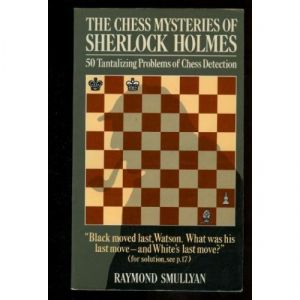
There are actually two problems there: one with bottom right square = h1, one BRS=a8

[If you aren’t sure that either way round it is a problem, see content/going-back-time]

Lastly, I’m not sure if modesty should forbid or compel, but…

It’s ES Tinsley, in fact.

Otherwise OK Books with a Confidence-Sapping Error on the contents page:

The London System by Andrew Soltis advertises a line of the Advance French on the contents page!

Otherwise OK Books with a Confidence-Sapping Error on the title page:


Any more? Or similar?

[I exclude Eric Schiller’s oeuvre from consideration, on fish-barrel-shooting grounds. My esteemed colleague Simon says that dyslexia is the cause, which may be the reason, but does not suffice as an excuse.]

Nice things happen: play-through Italian Game suggestions

Nice email from Robert Janninck:

I am a fan of your site. It helped me getting started with openings. In return I put the Italian game for you in chessbase format. For me when i see things happening on the board it always help, so i thougth maybe that will help others too.

…

My motivation: I like to help youre concept (site) to get better/easier and help others in having more fun in chess. Make it reachable and not for the money.

Thanks a million Robert!

Original handout: https://devonjuniorchess.co.uk/wp/drdaveexeter/1996/04/28/the-italian-game-for-beginners/

Robert’s conversion:

italian.pgn

About Dr Dave

Featured

drdave_sheu

Dr Dave Regis is a researcher in health education working in Exeter, Devon.

He does a bit of chess coaching (in person, over the Internet or by phone), chess publishing and other projects on the side.

He has been talking to adults and children about chess for 20 years and the session notes and free materials that have resulted are all online elsewhere; a couple of examples are on this site.

English Chess Federation Accredited Coach: http://www.englishchess.org.uk/coaches-2/

[If you don’t think the header photo is very good, click on it for another one.]

A moment in the solid Sicilian

I’m thinking about a position in the Scheveningen Sicilian, however you say it…

http://upload.wikimedia.org/wikipedia/commons/5/55/Nl-Scheveningen.ogg

Sicilian = sharp+theoretical

Chess Stars
Easiest Sicilian = Sveshnikov
Safest Sicilian = Taimanov
Sharpest Sicilian = Najdorf

A move order for Black in the Classical:

6…Be7 no reason to delay this
7…0-0 well, you can delay this move!
8…Nc6 the best squares

Now there is a big split here for Black:
9…Qc7 (idea …e5)
9…a6 (idea …b5)
9…Bd7 (idea …Nxd4, …Bc6, …Qd7 and …b5)
9…e5
9…Re8

--------
--nppn-p
pppbbqp-

-kr----r

I think the safest and most solid move is 9…Qc7. It holds back White’s e4-e5 move and threatens to play …e5.

Now, …e5 is often a good idea in the Scheveningen. We have learned that in a lot of Sicilian lines, the d6 pawn is not weak and occupying the d5 square is not much of an achievement. The d6 pawn is difficult to attack and a Knight on d5 can be swapped off, even if it manages to co-ordinate with White’s other pieces.

Meanwhile, Black gets a big pawn in the centre, which is supported (unlike White’s e-pawn). White’s Bishop on d3 or f3 suddenly gets blocked in. Black gets other options, like playing …e5xf4 and …Nf6-f7-e5, with a great Knight outpost. So, although this is complicated and you need to be careful, you shouldn’t be afraid of playing …e5. Spassky even showed us that you can play 9…e5 straight away! But I like 9…Qc7 first.

First of all, I think you will get some White players who will think you have made a mistake and play 10.Ndb5. Of course, you will play 10..Qb8, then 11…a6 and after 12.Nd4, the Queen has moved, the a-pawn has moved, but the Knight is back where it was! So, you have gained two moves, thanks to White, and they are good moves to make; your Queen is still thinking about e5 but can also now support …b5.

Secondly, the most straightforward way to get an advantage

If these positions are a bit too dull for you — f you think they don’t give you enough chances to win with Black — then you need a slightly riskier line. I recommend 9…a6.

The simplest mutual full-point Zugzwangs

Tim came to the club buzzing with these a few weeks ago.

[Skip intro]

A Zugzwang (German: forced move) is a chess position where, if it’s your turn to move, you lose, and if your opponent has the move, you might be OK.

Here’s an example from one of my own games: anything White does loses. We say, White is in Zugzwang.

Black can doodle happily with pawn moves, but any move of a white Pawn or piece loses at least a Pawn. White in fact threw himself on the sword with
43. c4 Ra3+ 44. Kh4 Be7+ 45. Kh5 Rh3#

The simplest Zugzwang position of all is known from the theory of Pawn endgames, with two Kings and one pawn trying to promote.

Black to move loses, but with White to move, it’s a draw.

A mutual or reciprocal Zugzwang is where neither side wants to move, and this position is indeed a mutual Zugzwang.

A mutual full-point Zugzwang (m-f-p-Z) is where both sides are in Zugzwang. In the Pawn endgame, White to move concedes a half-point to Black, but in a m-f-p-Z White loses a whole point. Here’s an example, known as the trebuchet:

All OK? So, these ideas have been around for dickey’s years, but what Tim was enthusiastic about was learning of positions with King each, a Pawn each and a single white piece (Bishop, Knight or Rook), which met the conditions of a m-f-p-Z. In fact, Tim was more mischievous than just to show us: he set us the task of finding the positions! I’ll give you an hour or so now to have a go yourselves…

(…)

Finished? How many did you get?

Solutions for 5-men positions:

Bishop:

A couple with a Knight:

and

Rook:

Nothing so simple exists for a Queen, but if you are prepared to add extra pawns, or an enemy Queen:

and

Here are solutions for 6-men positions with B N or R:

and

or

And if you have a Rook each, we have examples like:

More?

Full set:

http://www.k4it.de/egtb/zugzwang.php/

Article about 6-man tablebases:
http://ticc.uvt.nl/icga/acg12/proceedings/Contribution104.pdf

John Nunn got a bit interested in all these, and I refer you to his excellent books based on comprehensive computer endgame databases, recently updated since the emergence of the 6-man tablebases:

P.S.

Candidates for the Immortal zugzwang game include this classic from Nimzowitsch:

Samisch – Nimzovitch [E06] Carlsbad, 1923

And two he would rather forget:

Nimzovitch,A – Capablanca,J [B12] New York, 1927

Alekhin – Nimzowitsch [C17] San Remo, 1930

All are to be found in the Canon:

P.S. in 2026: a complicated mfpZ

https://chess.stackexchange.com/questions/9062/full-board-with-full-point-mutual-zugzwang

Noam Elkies chipping in tuppence there

Swindles

Diligent explorers of this website may have found a little collection
of the finest swindles that I had perpetrated in my career, up to the
point where I established this website. I pulled off another one
so appalling that I thought it too should be displayed as a dreadful
warning to others. The serendipity of life ensured that a week or
two before, hot new signing Tim Paulden had pulled off a win when a
piece down in an endgame, and a week or two after, I witnessed Ian
Jamieson come out with a win in a position that the most sympathetic
reading would say was unpromising.

Click […] to see list of games

I am reminded of the wise words of Grigory Sanokoev:

“There are no hopeless positions; there are only inferior positions
that can be saved.

“There are no drawn positions; there are only equal ones in which you
can play for a win.

“But at the same time, don’t forget that there is no such thing as a won
position in which it is impossible to lose.”

–Grigory SANAKOEV

[I am grateful to my esteemed former colleague Peter Lane for drawing
my attention to this quote.]

Stone soup

From the FRACTINT documentation


Appendix B Stone Soup With Pixels: The Authors

THE STONE SOUP STORY

Once upon a time, somewhere in Eastern Europe, there was a great
famine. People jealously hoarded whatever food they could find,
hiding it even from their friends and neighbors. One day a peddler
drove his wagon into a village, sold a few of his wares, and began
asking questions as if he planned to stay for the night.

  [No! No! It was three Russian Soldiers! – Lee
Crocker]
[Wait! I heard it was a Wandering Confessor! – Doug Quinn]
[Well *my* kids have a book that uses Russian Soldiers! – Bert]
[Look, who’s writing this documentation, anyway? – Monte]
[Ah, but who gets it *last* and gets to upload it? – Bert]

  “There’s not a bite to eat in the whole province,” he was
told. “Better keep moving on.”

  “Oh, I have everything I need,” he said. “In fact, I was
thinking of making some stone soup to share with all of you.” He
pulled an iron cauldron from his wagon, filled it with water, and
built a fire under it. Then, with great ceremony, he drew an
ordinary-looking stone from a velvet bag and dropped it into the
water.

  By now, hearing the rumor of food, most of the villagers
had come to the square or watched from their windows. As the
peddler sniffed the “broth” and licked his lips in anticipation,
hunger began to overcome their skepticism.

  “Ahh,” the peddler said to himself rather loudly, “I do
like a tasty stone soup. Of course, stone soup with CABBAGE —
that’s hard to beat.”

  Soon a villager approached hesitantly, holding a cabbage
he’d retrieved from its hiding place, and added it to the pot.
“Capital!” cried the peddler. “You know, I once had stone soup with
cabbage and a bit of salt beef as well, and it was fit for a
king.”

  The village butcher managed to find some salt beef…and
so it went, through potatoes, onions, carrots, mushrooms, and so
on, until there was indeed a delicious meal for all. The villagers
offered the peddler a great deal of money for the magic stone, but
he refused to sell and traveled on the next day. And from that time
on, long after the famine had ended, they reminisced about the
finest soup they’d ever had.

When and where to attack

Steinitz became World Champion (more or less) in 1866 by beating Adolf Anderssen in a bloodthirsty match (+8 -6 =0).  His style was very much in the tradition of the Italian school, playing for attack from the word go.  He was awarded the brilliancy prize for this Rook sacrifice:

  • Romantic Steinitz (up to and including 1872) (304)
    • Steinitz W. – Mongredien A. [B01]

His play in the of 1872 was still in this style, but his play in the tournament of 1873 was in marked contrast, playing for small positional advantages in the opening and early middlegame, and converting to a win only later.  Converting to a win might still be a brilliant attack, but it was more likely to be scooping up a few pawns.

  • Scientific Steinitz (after 1973)
    • Steinitz – Fleissig [C00]

    (305)

Steinitz was World Champion for 20 years — because, he said, he was 20 years ahead of his time!  His theories diffused into the chess world through lots of little pieces in newspapers and magazines, as never produced a book or a summary of his theory during his life (he died before he completed The Modern Chess Instructor). Lasker undertook to explain Steinitz to the world after he died, and Tarrasch also wrote a lot about Steinitz’ theories.

  • Scientific Steinitz didn’t forget how to attack! (307)
    • Steinitz – tchigorin [C65]
Steinitz’ elements (after Lasker) Steinitz’ rules of attack
Permanent advantages

1. Material advantage
2. Bad king position
3. Passed pawns in the middlegame
4. Weak pawns for the opponent
5. Strong and weak squares
6. Pawn islands
7. Strong pawn centre
8. Control of a diagonal
9. Control of a file
10. Bishop pair
11. Control of a rank

Temporary advantages

12. Bad piece position
13. Inharmoniously placed pieces
14. Advantage in development
15. Concentration of pieces in the centre (centralization)
16. Space advantage

”

  1. At the beginning of the game the forces stand in equilibrium.
  2. Correct play on both sides maintains this equilibrium and leads to a drawn game.
  3. Therefore a player can win only as a consequence of an error made by the opponent. (There is no such thing as a winning move.)
  4. As long as the equilibrium is maintained, an attack, however skilful, cannot succeed against correct defence. Such a defence will eventually necessitate the withdrawal and regrouping of the attacking pieces and the attacker will then inevitably suffer disadvantage.
  5. Therefore a player should not attack until he already has an advantage, caused by the opponent’s error, that justifies the decision to attack.
  6. At the beginning of the game a player should not at once seek to attack. Instead, a player should seek to disturb the equilibrium in his favour by inducing the opponent to make an error – a preliminary before attacking.
  7. When a sufficient advantage has been obtained, a player must attack or the advantage will be dissipated.”

From David HOOPER, Steinitz’ Theory, British Chess Magazine Vol. 104, p.370, Sept 1984.

Now, where to attack may be obvious, but just in case not: you attack where you are strongest or where your opponent is weakest.

Here’s a quick example:

 Marshall = Kline

weak pawns: creating holes
1913

1. d4 d5 2. c4 e6 3. Nc3 Nf6 4. Bg5 Be7 5. Nf3 Nbd7 6. e3 O-O 7. Rc1 b6 8. cxd5 exd5 9. Qa4 Bb7 10. Ba6 Bxa6 11. Qxa6 c6 12. O-O Ne4 13. Bxe7 Qxe7


    • w – – 0 13 If we compare pieces and pawns, the inequalities are:


White’s plus points Black’s plus points
  • White’s Queen’s Rook on c1 is more active than Black’s Queen’s Rook on a8.
  • White’s Queen on a6 is more active than Black’s Queen on e7
  • Black has a weak pawn on c6 — in fact, Black has a few weak light squares around on the Queen’s-side.
  • Black’s Knight on e4 is more active than White’s Knight on e4


    • This all suggests that White can, should and even must attack on the Queen’s-side.


      • (306)
        • Marshall – Kline [D63]
    • The continuation is also a good example of Lasker’s famous maxim:


“No combination without a considerable plus, no considerable plus without a combination […]”
“In the beginning of the game ignore the search for combinations, abstain from violent moves, aim for small advantages, accumulate them, and only after having attained these ends search for the combination – and then with all the power and will of intellect, because the combination must exist, however deeply hidden.”
LASKER

The Very Slow King’s-side Attack

I often talk about “clockwork attacks”. They are characterised by:

  • closed or at least stable centre
  • King’s-side attack based on stereotyped attacking plan
  • attack based not so much on domination of space and time but on lack of opponent’s counterplay.

These attacking lines are to be found in many openings

You may be able to think of other “system” openings which often yield an easy-to-play attack, like the Colle System, London System and perhaps the Torre system. To some extent the standard h-file attack against a King castled behind a fianchettoed Bishop also fits into this category, as seen in the Dragon Variation of the Sicilian and the Pirc Defence.

  As an attacker, the idea is to keep moving pieces up to the King’s-side until you checkmate your opponent. The reason these often work so well in club play is that the defending side will often play sensible-looking solid moves until is is far to late to stop the defences collapsing. A much more vigorous approach is required in defence.

  So, as defender, you must do at least one of the following:

So, as the attacker, you must keep an eye on your opponent’s counterplay.

  As you see from the links above, you can find examples of these clockwork attacks throughout the Openings handouts, but the examples here should give you the idea:

Kortchnoi,Viktor – Fischer,Robert J (blitz) [E97] 1970

1. d4 Nf6 2. c4 g6 3. Nc3 Bg7 4. e4 d6 5. Be2 O-O 6. Nf3 e5 7. O-O Nc6 8. d5 Ne7 9. Nd2 c5 10. a3 Ne8 11. b4 b6 12. Rb1 f5 13. f3 f4


t+lDsTj+
X-+-S-Lx
-X-X-+x+
+-XpX-+-
-Pp+pX-+
P-N-+p+-
-+-Nb+pP
+rBq+rK-

The centre is completely blocked, and so all the play is going to be on the wings. Any pawn move by White on the King’s-side will leave him with further points of attack for Black , so White persists on the Queen’s-side.

14. a4 g5 15. a5 Rf6 16. bxc5 bxc5 17. Nb3 Rg6 18. Bd2 Nf6 19. Kh1 g4 20. fxg4 Nxg4 21. Rf3 Rh6


t+lD-+j+
X-+-S-Lx
-+-X-+-T
P-XpX-+-
-+p+pXs+
+nN-+r+-
-+-Bb+pP
+r+q+-+k

22. h3 Ng6 23. Kg1 Nf6


t+lD-+j+
X-+-+-Lx
-+-X-SsT
P-XpX-+-
-+p+pX-+
+nN-+r+p
-+-Bb+p+
+r+q+-K-

24. Be1 Nh8 25. Rd3 Nf7 26. Bf3 Ng5 27. Qe2 Rg6 28. Kf1


t+lD-+j+
X-+-+-Lx
-+-X-St+
P-XpX-S-
-+p+pX-+
+nNr+b+p
-+-+q+p+
+r+-Bk+-

28… Nxh3 29. gxh3 Bxh3+ 30. Kf2 Ng4+ 31. Bxg4 Bxg4 0-1


It is easy to understand the appeal of the King’s Indian after such a game.


Fischer,Robert J – Miagmarsuren, Lahmsuran (Sousse) 1967

1. e4 e6 2. d3 d5 3. Nd2 Nf6 4. g3 c5 5. Bg2 Nc6 6. Ngf3 Be7 7. O-O O-O 8. e5 Nd7 9. Re1 b5 10. Nf1 b4 11. h4 a5 12. Bf4 a4


t+lD-Tj+
+-+sLxXx
-+s+x+-+
+-XxP-+-
xX-+-B-P
+-+p+nP-
pPp+-Pb+
R-+qRnK-

This is the same idea, with White. There are differences:

  Black has adopted a more modest central posture than White does in the King’s Indian Defence

  the central pawn structure is more fluid

  Black has gone hard on the Queen’s-side and is starting to make real gains; so, White must pause for a defensive move. White’s next was seen as innovative at the time:

13. a3! bxa3 14. bxa3 Na5

  [14… Nd4 15. Ne3 Ba6 16. c4 dxc4

[Fritz gives 16… Nb3 17. cxd5 Nxa1 18. Qxa1 exd5 19. Nxd5 Bxd3 20. e6 Nf6 21. Nxe7+ Qxe7 22. Ne5 Bg6 23. Nc6 Qb7 24. Bd6]

  17. Nxd4]

15. Ne3 Ba6 16. Bh3 d4


t+-D-Tj+
+-+sLxXx
l+-+x+-+
S-X-P-+-
x+-X-B-P
P-+pNnPb
-+p+-P-+
R-+qR-K-

Which way should White jump?

17. Nf1 Nb6 18. Ng5 Nd5

  White’s Queen has access to h5, which makes Black decide to concede B for N. This leaves White with the idea of assaulting the dark squares.

19. Bd2 Bxg5 20. Bxg5 Qd7 21. Qh5 Rfc8 22. Nd2 Nc3


t+t+-+j+
+-+d+xXx
l+-+x+-+
S-X-P-Bq
x+-X-+-P
P-Sp+-Pb
-+pN-P-+
R-+-R-K-

23. Bf6 Qe8

  [23… gxf6 24. exf6 Kh8]

24. Ne4 g6 25. Qg5 Nxe4 26. Rxe4


t+t+d+j+
+-+-+x+x
l+-+xBx+
S-X-P-Q-
x+-Xr+-P
P-+p+-Pb
-+p+-P-+
R-+-+-K-

They think it’s all over…

26… c4 27. h5 cxd3 28. Rh4 Ra7 29. Bg2 dxc2 30. Qh6 Qf8 31. Qxh7+ 1-0 …it is now.


Psakhis – Kasparov (La Manga) 1990

1. c4 g6 2. Nc3 Bg7 3. g3 Nc6 4. Bg2 d6 5. Nf3 e5 6. d3 f5 7. O-O Nf6 8. Rb1 h6


t+lDj+-T
XxX-+-L-
-+sX-SxX
+-+-Xx+-
-+p+-+-+
+-Np+nP-
pP-+pPbP
+rBq+rK-

The mutual control of d4/d5 means that although the central pawns are not locked, the centre is likely to remain closed. So we have a battle on each wing.

9. b4 O-O 10. b5 Ne7 11. a4 Be6 12. Ba3 Rc8 13. Nd2 b6


-+tD-Tj+
X-X-S-L-
-X-XlSxX
+p+-Xx+-
p+p+-+-+
B-Np+-P-
-+-NpPbP
+r+q+rK-

Again, a prudent measure. White will have to re-arrange to get in a5, so changes tack

14. e3 g5 15. d4 exd4 16. exd4 f4 17. Re1 Bg4 18. Nf3 Qd7 19. c5 Rce8 20. Rc1 Nf5 21. Qd3 Kh8 22. cxd6 cxd6 23. Rxe8 Qxe8 24. Rf1 Qh5


-+-+-T-J
X-+-+-L-
-X-X-S-X
+p+-+sXd
p+-P-Xl+
B-Nq+nP-
-+-+-PbP
+-+-+rK-

There is a dark storm cloud over White’s King.

25. Ne4 Nxe4 26. Qxe4 Bh3 27. Ne5 Bxg2 28. Kxg2 g4 29. Bxd6 Rf6 30. Bb8

Qh3+ 0-1


Rogers,I – Carton,N [A26] London

1. c4 Nf6 2. Nc3 e5 3. g3 g6 4. Bg2 Bg7 5. e4 d6 6. Nge2 Nc6 7. d3 O-O 8. O-O

  This is an interesting formation, kin to the Closed Sicilian. White clamps the centre shut and goes creeping up on the King’s-side. Black’s prospects of successful Queen-side counterplay are less than in the Closed Sicilian because of the pawn on c4. Here Black decides to slug it out toe to toe on the King’s-side, but in this game White’s initiative prevails.

8… Nh5 9. f4 f5


t+lD-Tj+
XxX-+-Lx
-+sX-+x+
+-+-Xx+s
-+p+pP-+
+-Np+-P-
pP-+n+bP
R-Bq+rK-

10. Be3 Be6 11. Nd5 Qd7 12. Qd2 Rae8 13. Rae1 Nf6 14. Kh1 Rf7 15. b3 fxe4 16. dxe4 Bh3 17. Nxf6+ Rxf6 18. Nc3 exf4 19. gxf4 Bxg2+ 20. Qxg2 Rfe6 21. Bd2 Nd4 22. Rd1 b5 23. f5


-+-+t+j+
X-Xd+-Lx
-+-Xt+x+
+x+-+p+-
-+pSp+-+
+pN-+-+-
p+-B-+qP
+-+r+r+k

1-0