from Charlie Keen









from Charlie Keen
36. Ne1?
“Well, well. IM (and correspondence GM) Douglas Bryson once told me that he almost never plays a game that flows smoothly from start to finish; there is always a “moment” of sorts where someone misses a big defensive opportunity or the nature of the position changes more than one might reasonably expect. This was such a “moment”.”
— Jonathan Rowson British Chess Magazine October 1999 p.553
- Good News:
- There is a brand new book out by Ali Mortazavi which is all about swindling
- Bad News:
- The book was strongly criticised when reviewed by Jonathan Rogers in KingPin magazine.
- Good News:
- The review article in itself is very good reading on swindles, and would make a good complement to this document.
- Bad News:
- The diagrams in this document are a bit of a mix – sorry if it’s slow or hard to read. [It looks OK on paper, is my only defence!]
- Good News: Also, Simon Webb’s book “Chess for Tigers” is excellent for swindles.
By swindling I do not mean:
(a) hanging on grimly until your opponent blunders (this is Pure Luck)
(b) setting one last trap (this is Desparation)
(c) defending the position well until the game turns in your favour (this is Proper Grown-Up Defending)
…although swindling contains elements of all of these. Real Swindling is where (1) your position is lost or losing, and (2) your opponent errs because of something you have done. So you do need to be lucky, but you have to make your own luck, or at least stack things a little less in your opponent’s favour. Swindling has a similar appearance to active defence, but has a rather more urgent feel about it. “Setting a trap” is the simplest level of swindling, and in fact swindling is all about setting traps: some tactical, some positional, and some psychological. Successful swindling is also about setting traps well before things are desperate.
Some of the world’s best players have always been great swindlers: Frank Marshall brought off so many that fans coined the term ‘Marshall swindle’, and Lasker won so many ‘lost’ positions that they speculated about witchcraft or hypnotism (psychological play was always a big part of Lasker’s normal game, even if he wasn’t losing).
Let’s have a look at some general points, some simple examples, and then some deeper examples. I’d be happy if everyone had a go at the first two sections, which are mostly common sense, and then gradually work their way through the later parts.
If you are going to turn a game around, you must admit you are losing: be objective, don’t kid yourself about your position, and do something about it before it really is too late.
If you are losing, do something about it: if the game continues normally you will lose.
Doing something about it means playing differently: you must throw the game off-course, and this probably means playing the move that is not objectively the best
Keep your eyes open: you must make the most of any and every opportunity.
You must avoid losing: you can often decide on the right move by a process of elimination. If your opponent is going to win by promoting a passed Pawn in four moves, it’s got to go! But never make simple concessions, make a mess.
Keep playing actively: you must have some activity to give yourself any chance of getting back into the game, or at least set your opponent some sort of problems (without which they will never go wrong!).
These and other principles are explained below:
Timely draw offers: when your counterplay is at its peak, or your opponent has already made one bad mistake, offer a draw in case their confidence has gone
long moves
retreats
geometry (playing off the cushions)
deceptively calm positions (may explode in your face)
deceptively familiar positions (are always slightly different)
reassuring moves (may drop you right in it)
while you are attacking (your opponent also has a right to exist)
after a crisis (danger may not be past)
when victory is in sight (vigilance is required)
This of course is the opposite of the swindling strategy. If your opponent bears a lowly grade, or plays badly or incomprehensibly, don’t assume your position will win itself, keep playing chess.
Health educators are given to considering four different aspects of human mind and activity in promoting healthy choices: knowledge, attitude and behaviour. Here’s some advice on healthy chess from Amazia Avni:
* every game can be lost
* every position can be ruined
* details are important
* constructive paranoia
* self-criticism
* active searching
* thinking for your opponent
* looking for the worst case
* studying positions with counterplay as a main feature e.g. Open Sicilians
1. c4 g6 2. g3 Bg7 3. Bg2 d6 4. Nc3 Nf6 5. e4 O-O 6. Nge2 e5 7. O-O c6 8. d3 a6 9. a4 ANG thought this a mistake 9… a5 10. f4 ?? [10. h3]10… Qb6+ 11. Kh1 Ng4 12. Qe1 Na6 13. Nd1 Nc5 14. f5 Nb3 15. Ra3 Nxc1 16. Nxc1 Bh6 17. h3 Bxc1 18. hxg4 Bxb2
Now, White is absolutely busted here, a Pawn down and haemorrhaging on the Black squares. ‘Sensible’ passive play would be useless here. White must find some way of throwing the game off course: Black must be given a position where he can make a mistake.



19. Qd2!? [19. Ra2 Bc1] 19… Bxa3 20. f6 Kh8 21. Qh6 Rg8 22. Bf3 g5? [22… Bc1!] 23. g5 Qd8 24. Kg2 23. Kg2 Rg6 24. Qf8+ Rg8 25. Qh6 1/2
A very simple example, but it does reinforce points about successful swindling, viz. giving your opponent a chance to go wrong, and playing actively.
To be swindled your opponent must fall into some tactical or positional muddle. We’ll look briefly at both. Here’s how to approach a tactical swindle:

Black has sacrificed a piece to expose the King, but there is no mate (…h5-h4 fails to Qxf7+), so Black is losing. How can one approach a swindle in this position?
Start with: what can go wrong for White?
A. hopes of perpetual check (1) by a standard pattern (…Re1+)


B. hopes of perpetual check (1) by exposing the King (although the White King may escape to the Queen’s-side if the White Queen can interpose)
C. if the Queen does interpose (1) this may lead the Queen into trouble (Kf5 Qe6+)
D. if the Queen does interpose (2) this may leave the Rook loose (…Qh2+)
So, we have four basic swindles to try for. You have to weigh up quickly which is your best chance, and play a move quickly (a) to make your opponent decide, and (b) give them as little time as possible to find what you have found. In this case (B) looks very achievable but uncertain to produce a desired change in fortune; the others are in their own ways certain, but difficult to achieve. You have to decide which is the most likely and go for that.
The actual game was adjourned here, so I resigned(!), but in a game I think I would have played quickly the non-committal …Qf4, when I still have some hope of bringing off (B) and also I have some new chances of (A) (C) or (D). (A reality check suggests that simply Qb7-b4 holds, which is not that hard to find OTB, after which Black has to go for …Rxf3+, but you have to try these things).
The other swindling considerations are positional: you must strive to make your pieces as active as possible and drive or tempt your opponent’s into bad positions.
For example: you need to get from this lost position I had as White one day:

…to this:
27…Rh8 28.Kg2 Kc7 29.Re1 Kd6 30.Re4 Rb8 31.b3 Rf8 32.Ra4 Bc8 33.Rg4 Rf6 34.Rh4 e5 35.Rh8 Kc7 36.Rh7+ Kb6 37.Rh8 Bb7 38.Re8
Black’s King and Bishop have got lost and the White Rook has been going around bullying Pawns… 1/2-1/2 Draw agreed! (a Timely Draw Offer). White has a nasty trap (…Rf5; g4, Rg5?? Kg3! e4) which ensures the win of a Pawn, and Black thought he’d bale out before things got worse! [Black may still be winning but his confidence had gone.]
How do you do this? Like I did: play actively, keep making threats, let your opponent lose the thread.
Thinking about swindles always reminds me of those games played at odds. The fact that you can win a game at Queen odds must give you some hope!
Here’s a vigorous example of odds-play by the great German:
1.e4 e5 2.f4 d6 3.d3 f5 4.Nc3 fxe4 5.dxe4 a6 6.fxe5 dxe5 7.Nf3 Bb4 8.Bg5 Qd6 9.Rd1


Here Tarrasch relies on the opponent to be too greedy to give any material back and simplify.
9…Qg6? [9…Qxd1+!] 10.Rd8+ Kf7 11.Bc4+ Be6 12.Nxe5# 1-0
There are other approaches to chess than Tarrasch’s…
1.b3 e5 2.Bb2 f6 3.e4 c6 4.Nc3 Bb4 5.0-0-0 Bxc3 6.dxc3 0-0 7.Ba3 Re8? 8.Bd6 Qb6 9.Nf3 Qxf2 10.h4 h6 11.Bc4+ Kh7 12.h5
Nimzo plays in blockading style, even at these odds!
12…b5 13.Bf7 Re6 14.Nh4 Rxd6 15.Rxd6 Qc5 16.Rhd1 Qxc3 17.R1d3 Qe1+ 18.Kb2 Qxh4 19.Bg6+ Kg8 20.Re6 1-0
Every so often your opponent just self-destructs. If you don’t resign but hang around and watch this can be fun. When do you do this? When your opponent looks either over-confident or under-confident! Let’s see some examples to clarify this.
1. d4 e6 2. c4 f5 3. g3 Nf6 4. Bg2 Be7 5. Nc3 O-O 6. d5 Bb4 7. Bd2 e5 8. e3 d6 9. Nge2 a6 10. Qc2 Qe8 11. f3 b5 12. Qb3 Bc5 13. cxb5 Bd7 14. Na4 Ba7? 15. b6! Bxa4 [15… cxb6 16. Nxb6 Bxb6 17. Qxb6 is simply winning.]16. b7 Bxb3 17. bxa8=Q Bb6 18. axb3 Qb5 19. Nc3 Qxb3


White is a Rook up: I am tempted to say, simply a Rook up, but Botvinnik complicates matters immediately.
20. Rxa6? Nxa6 21. Qxa6 Nxd5
Now it’s one Pawn for a piece! This ‘simplification’ hardly helped matters.
22. Qa4? [22. Nxd5 Qxd5 23. Ke2] 22… Qxa4 23. Nxa4 Bxe3 Two Pawns… also unnecessary. 24. Bf1 Ra8 25. b3 Bxd2+ 26. Kxd2 Kf8 27. Bd3 g6 28. Rc1
White is still winning but there are some difficulties.
28… Rb8 29. Nc3 Nb4 30. Be2 Ra8 31. Na4 c6 32. Rc4 Rb8 33. Bd1 Ke7 34. Nb2 d5
35. Rh4? [35. Rc5!] 35… h5 36. g4 hxg4 37. fxg4 f4 38. g5 Rf8 39. Rh7+ Kd6 40. Rg7 e4 41. Rxg6+ Ke5 Black may even be better here…! 1/2-1/2
It’s hard to know what is going on here, maybe it’s more than one thing. Perhaps we can get some more insight into it when considering this example:
“For a long time I had regarded my position as a winning one. Thus the whole opening phase of the struggle, when Korchnoi was unable to get out of trouble, had psychologically attuned me to the idea that the ending would be favourable to me … and here comes the oversight 35 Rxh6?? I did not even see the threat …f4-f3, possibly because it was in contrast to Black’s hopeless position. Personally, I am of the view that if a strong master does not see such a threat at once he will not notice it, even if he analyses the position for twenty or thirty minutes.” – PETROSIAN.
Your opponent also has a right to exist… I should add again that here is the value of the ‘write it down and take a fresh look’ advice – you are trying to give yourself a chance to un-stick yourself from any false assumptions.
[See also An important note about Blumenfeld’s rule — DR]
Anyhow, one more example:
“The world no 10 was a little bit too casual in round one and loses a piece and a pawn for little compensation. Unabashed, he carries on as if nothing has happened and somehow wins quite smoothly.” — PEIN
1.e4 e5 2.Nf3 Nc6 3.Bb5 a6 4.Ba4 Nf6 5.Qe2 b5 6.Bb3 Bc5 7.a4 b4? 8.Bxf7+! Kxf7 9.Qc4+ d5 10.Qxc5 Qd6?? 11.Qxc6! Bd7 12.Qxd6 cxd6 13.d3 Rac8 14.c3 h6 15.exd5 Nxd5 16.c4 Bf5 17.Ke2 Nf6 18.Nbd2 Rhe8 19.Re1 Nd7 20.Nb3 d5 21.c5 Nxc5 22.Nxc5 Rxc5 23.Be3 Rc2+ 24.Kf1 d4 25.Bxd4 exd4 26.Nxd4 Bxd3+ 27.Kg1 Rxe1+ 28.Rxe1 Rxb2 29.f4 b3 30.Re3 Bc4 31.Rc3 Bd5 32.g3 Rb1+ 33.Kf2 b2 34.Rc7+ Kf6 35.g4 Rh1 36.g5+ hxg5 37.fxg5+ Kg6 0-1
We can see a lot of the same features here (giving back material, making concessions) as in the BB game.
Not the best way to play but you can sometimes bring it off:
What would you play here as Black?
32…e5!?
This is a filthy move positionally, but a good practical choice. Moves like
[32…Qh7; 32…Qf7] are just awaiting the undertaker: e.g. 32…Qf7 33.Bxh5 gxh5 34.Qh6+ Qg7+ 35.Qxg7+ Kxg7 36.Rxh5]
Although the move chosen exposes the Pawns to attack, it does activate the Black Queen and create some sort of activity in the centre, maybe threatening to open the c-file. White has only a few minutes left: he spots a trap: [33.dxe5 fxe5 34.Qxe5 Qxh3] and avoids it… but falls for:
33.Bxh5 gxh5 34.Rxh5?? Qg4+ 1-0
On reflection:
[34.Qh6+ Qg7+ 35.Qxg7+ Kxg7 36.Rxh5 exd4 37.cxd4 Rc2 is not an easy win because of the activity of the Black Rooks on the c-file, but;
34.dxe5! fxe5 35.Rf3+ Kg8 36.Qxe5 Rg6+ 37.Kh1 is winning [37…Qg4? 38.Rg3]
Another booklet’s-worth, I think, but here’s an example from the borderlands between defending and swindling:
1.d4 d5 2.c4 e6 3.Nc3 c5 4.cxd5 exd5 5.Nf3 Be6 6.e4 dxe4 7.Nxe4 Nc6 8.Be3 cxd4 9.Nxd4 Qa5+ 10.Nc3 0-0-0
“The White Knight on d4 stands badly, and this must be White’s undoing” — TARRASCH
“One of the most famous ‘won’ positions in the story of chess” — EUWE and KRAMER.
What is lost at master level is often worth plugging away in at club level. But the same approaches apply:
11.a3 Nh6? 12.b4 Qe5 13.Ncb5 Nf5! [13…a6 is to play into a characteristic Lasker trap 14.Qc1 axb5 15.Nxc6 bxc6 16.Qxc6+ Qc7 17.Qa6+ Qb7 18.Rc1+ Kb8 19.Bf4+] 14.Rc1!
White’s only hope is counterattack. With vigorous play, an iron nerve and some tactical alertness, Lasker pulls it off.
14…Nxe3 15.fxe3 Qxe3+ 16.Be2 Be7 17.Rc3! Bh4+!? [17…Qxc3+!] 18.g3 Qe4 [18…Qxc3+!?] 19.0-0 Bf6 20.Rxf6! gxf6 21.Bf3 Qe5 22.Nxa7+ Kc7 23.Naxc6 bxc6 24.Rxc6+ Kb8 25.Rb6+ Kc8 26.Qc1+ Kd7 27.Nxe6 fxe6 28.Rb7+ Ke8 29.Bc6+ 1-0
I wouldn’t call that a swindle as such, but there’s no doubt Lasker was a wizard at making his own luck through disrupting sacrifices and active play.
1. Nf3 c5 2. b3 Nc6 3. Bb2 d6 4. e4 e5 5. Nc3 Nge7 6. Bc4 g6 7. Ng5
Black, misled by White’s quiet first move, is more or less lost. I could submit meekly to 7…Be6 and the loss of a Pawn, but the bare light squares would lead inevitably to defeat. Instead: 7… d5!? is a good randomising move. Black is still losing, but White doesn’t yet know how, and has to work it out!
8. exd5 Nd4 9. d6 Nd5 10. Nxd5 Qxg5 11. Bxd4 exd4 [11… Qxg2 12. Nf6+ Kd8 13. Bd5] 12. Nc7+ Kd8 13. Qf3 Bxd6 14. Nxa8
Black has undoubtedly gone from losing at move 7 to being even more lost, but now the rot sets in for White. He is behind in development, beset with choices, and starts eating up clock time.
14…Re8+ 15. Kf1 Bg4 16. Qxb7 Qxd2 17. f3 Bf5 18. Qd5 Re6 19. Qb7 Re7 20. Qc6 10 minutes left! 20… Bf4 21. Qd5+ Bd7 22. Nb6 axb6 23. Qa8+ Kc7 24. Qa7+ Kc6 25. Qa8+ 1/2-1/2
Give yourself a chance!
1. d4 Nf6 2. c4 e6 3. Nc3 Bb4 4. Nf3 b6 5. e3 Bb7 6. Bd3 O-O 7. O-O d5 8. cxd5 exd5 9. a3 Bd6 10. b4 Nbd7 11. Nb5 Be7 12. Ne5 a6 13. Nc3 c5 14. bxc5 bxc5 15. Rb1
15… Qc7?? 16. Nxd7 Nxd7 17. Qb3 Rab8 18. Nxd5 Bxd5 19. Qxd5 Rxb1 20. Bxb1
How Good is Your Swindling?
20… c4! Good Point 1: White now has an important decision to make, which is taxing anyhow… 21. Bxh7+?
[21. Qe4! Nf6 22. Qc2 with the advance of the central Pawns. Note that Black’s position here is worse than if he had chosen 20…cxd, but it’s still 20…c4″!” [20… cxd4 21. exd4 Nf6 22. Qf5 Rd8 is technically better]]
21… Kxh7 22. Qe4+ Kg8 23. Qxe7
with two Pawns, but… 23… c3 … the other result of Black’s 20th is Good Point 2: counterplay. 24. e4
[24. a4 c2 25. Ba3 Rb8 26. Rc1 Qc6 27. h3 Qxa4 which is comfortable for Black]
24… c2 25. d5? Rb8 26. g3 Qc8
Not over yet, but Black’s practical decision has transformed his chances.
27. Qg5 Qc4 28. f3 Rb3 29. Qd2 Rd3 30. Qe2 Ne5 31. Kg2 Rd1 32. Qxc4 Nxc4 33. d6 Kf8 34. a4 Ke8 35. Kf2 Nd2 36. Re1 Nxf3 37. Rf1 Nxh2 38. Re1 Nf3 39. Rf1 Nd2 40. Re1 Nb3 41. Ba3 c1=Q 42. Bxc1 Rxc1 43. Rxc1 Nxc1 0-1
Games like this are often referred to as swindles, but bear many similarities to Proper Grown-Up Defence. Perhaps the difference is in the assessment of the position as lost at move 18: Black is busted.
1. d4 Nf6 2. Nc3 g6 3. e4 d6 4. Bg5 h6 5. Bxf6 exf6 6. f4 Bg7 [6… f5] 7. Nf3 c6?! 8. Bd3 Qb6? “Too extravagant.” 9. O-O! Qxb2 10. Qd2 Qb6 11. Kh1 Bg4 12. Rab1 Qc7 13. Nh4! Nd7!? 14. h3 g5! 15. Nf5! Bxf5 16. exf5 O-O-O 17. Rb3 d5
18. Nb5!!
“A brilliant move which convinced me that it was time to offer a draw.”
[18. Nxd5 Qd6 19. Nc3 Nb6 unclear] 18… cxb5 [18… Qb8 19. Qa5 a6 20. Nd6+!! Qxd6 21. Rxb7!+- “A real piece of Morphy.”] 19. Rc3 a6 20. Rxc7+ Kxc7 21. Qc3+ Kb8 22. a4! Rc8 23. Qb3? [23. Qa5+- ]23… Nb6 24. axb5 a5
“Setting up a temporary defence. From here I had to move at lightning speed to force White through two more time controls and avoid adjudication.”
Black has avoided losing. The next few moves show Black gradually uncoiling while White fiddles about. He gets his dead Bishop out, holds the Queen’s-side and brings his Rooks to the central files.
25. Qa3 a4 26. Qd6+ Ka7 27. Qb4 Kb8! 28. Qd6+ Ka7 29. Qb4 Kb8 30. Qa5 Kc7 31. Ra1? [31. c4! idea Rc1 +-] 31… Bf8 32. Rxa4 Bd6 33. Ra1 Bxf4 34. Qb4 Bd6 35. Qb3 Rhe8 36. Rf1 Kd7
“Suddenly Black is back in the game… White found himself in continuous time pressure and a few more errors sufficed to lose.”
37. Qb1 h5! 38. Re1? Bg3! 39. Rf1 Re7 40. Qd1 h4 41. Qf3 Kd6 42. Kg1 Rce8 43. Rd1 Re1+ 44. Rxe1 Rxe1+ 45. Bf1 Nc4 46. b6 Ne3 0-1
1. d4 e6 2. c4 b6 3. Nf3 Bb7 4. e3 f5 !? 5. Nc3 Bb4 !? 6. Be2 Nf6 7. Qb3 ! 7… a5 (7 … Na6!?) 8. a4 O-O 9. O-O Bxc3 10. bxc3 Qe7[10… Ba6] 11. Ba3 d6 12. c5 Nbd7 13. cxd6 cxd6 14. Ne5 ! (zok) 14… Ne4 15. Rad1 Kh8 16. Bb5! (pow)
Black’s opening set-up has been exposed as a hollow sham. Time for one of those randomising moves:
16… Nec5 17. dxc5 Nxe5 18. c6 (ugh) 18… Nxc6 19. Bxd6
How good is your swindling?
19… Qg5 !?
This hardly conceals its tactical point, but more seriously, Black also steals the initiative. Once White takes a step back he never regains momentum.
20. Bf4
[20. g3 Rfe8 21. Bc7 Rac8 22. Bxb6 Qg4 23. Rd7!? Ne5! 24. Rxb7 Nf3+ 25. Kg2 draws by perpetual 25… Nh4+ 26. Kg1 Nf3+ 27. Kg2]
20… Qg6 21. f3 e5 22. Bg3 f4 23. exf4 exf4 24. Be1 Ne5 25. c4 Rac8 26. Qa3 Qf7 27. Rd6 Nxc4 28. Bxc4 Qxc4 29. Rxb6 Ba6 30. Rf2 Rfe8 31. Rb1 Re3 32. Qa1 Qc5 33. Kh1 ? [33. Rd1 Rce8 34. Qb1 Re2 35. Qa1 Qe3 36. h3] 33… Bd3??
Surprisingly, still enough to win a piece
[33… Rxe1+! 34. Rxe1 Qxf2] 34. Rb7 [34. Rd1 Rxe1+ 35. Rxe1 Qxf2 36. Re7 Rg8] 34… Qe5 35. Qxe5 Rxe5 36. Bc3 ?! 36… h6 ! 37. g3 Rxc3 38. gxf4 Rf5 39. Kg2 Rxf4 40. Kg3 g5 41. Rd2 Kg8 42. Ra7 Rxa4 43. Rb2 Rb4 44. Ra2 Be4 45. R2xa5 Rxf3+ 46. Kg4 Rf4+ 0-1
[46… Rf4+ 47. Kh5 Rh4#] [47. Kh3 Rb3#] [47. Kg3 Rb3#]
Giving up the exchange is often a good idea. It is a good randomising move, unbalancing the position, keeping the piece count the same, often achieving definite short-term compensation, as Rooks are often very hard to develop and use properly..
1. e4 g6 2. d4 Bg7 3. Nf3 d6 4. h3 c6 5. Be3 b5 6. Be2 Nf6 7. Nbd2 Nbd7 8. O-O O-O 9. c3 a5 10. a4 b4? (10… bxa4 11. Rxa4) 11. c4
White has a clear plus; Black has no answer to White’s dominant pawn centre.
11…e5 12. dxe5 dxe5 13. c5 Qe7 14. Rc1 Rd8 15. Qb3 Nf8 16. Bc4 Nh5 (Slightly desparate; more natural is 16… Be6 17. Ng5 Bxc4 18. Nxc4 Ne6 19. Nxe6 Qxe6 20. Qc2 Nh5) 17. Ng5 Be6 18. Nxe6 Nxe6 19. Bxe6 fxe6 20. Rfd1 Nf4 21. Kf1 Rd3 22. Qc2
Now the plausible …Rad8 is met by Nc4-d6.
22…Rxe3 A spanner in the works. 23. fxe3 Nh5 24. Nf3 Rf8 25. Kg1 Bh6 26. Re1 b3 Cheeky… to tempt White’s Q off the second rank. 27. Qc3 (it worked) Now for another exchange sacrifice: 27…Rxf3 28. gxf3 Qh4 29. Qxe5
29…Qxh3?? Sadly I was too short of time to find 29… Nf4! 30. Qb8+ Kf7 31. Qc7+ Kg8 32. Qc8+ Bf8 33. exf4 Qg3+ 34. Kf1 Qxf3+ 35. Kg1 Qg3+ with perpetual check. 30. Kf2 Qh4+ 31. Ke2 Ng3+ 32. Kd3 Qd8+ 33. Kc4 Qc8 34. Qxg3 1-0
White is a Pawn down for nothing.
21. Rfe1 c6 22. bxc6 bxc6 23. Ne2 Qf5 (Black is keen to exchange Queens) 24. Qc3 Ne6 25. Qe3 Bxb2 26. Rxb2
I played for this simplified position hoping that Black would sieze the opportunity to exchange Queens…
26… Qe4+ 27. Qxe4 dxe4 …But now Black has given up his strong Queen and his protected passed Pawn, and has also lost the initiative. 28. Rb6 Nxc5 29. Nc3 Ra6 30. Rxa6 Nxa6 31. Nxe4 Kg7 32. Ra1 Nb4 33. Ra7 Nd3 34. Rc7 c5 35. Nxc5 Nxc5 Q
1. d4 Nf6 2. Bg5 Ne4 3. Bf4 d5 4. e3 Bf5 5. f3 Nf6 6. c4 c5? 7. cxd5 Nxd5 8. Bxb8 oops 8… Nxe3 [8… Rxb8 9. e4 Bxe4 10. fxe4 Nf6] 9. Bb5+ Bd7 10. Bxd7+ Qxd7 11. Qe2 Nxg2+ 12. Qxg2 Rxb8 13. dxc5
Black has a Pawn for the piece. but has given it up in the most awkward way.
13… g6 14. Nc3 Bg7 15. Nge2 Qc6
16. Qg5?
After the f-Pawn falls White’s King will never be safe and Black has definite compensation.
[16. Qf2+- ]
16… Qxf3 17. Rf1 Qh3 18. Rf2 O-O 19. Rd1 Qe6 20. Nd5 Bxb2 21. Qxe7 Qxe7 22. Nxe7+ Kg7
Black has two Pawns for the piece, but now White is running out of candidates for promotion. White returns the piece for two Pawns!
23. c6 Rbe8 24. Rd7 Ba3 25. Nxg6 hxg6 26. cxb7 Rd8 27. Rxd8 Rxd8 28. Rf3
How Good is Your Chess?
28… Bb4+ 29. Kf1 Rd1+ 30. Kg2 Bd6 31. Rb3 Bb8 Black has blockaded the Pawn while keeping the Rook active. Not over yet though: the a-Pawn can support the b-Pawn. 32. a4 Kf6 33. a5 Ra1 34. Rb5 Ke7 35. Rc5 Bd6 36. Rc6 Rb1 37. a6 Rb2 38. Kf3 Rb3+ 39. Kg2 Rb2 40. Kf3 Bxh2 41. Nd4 Kd7 42. Rc8 Rb6 43. Ra8 Rxa6 44. b8=Q Bxb8 45. Rxb8 Only Black can win this ending. 45… Ke7 46. Rb7+ Kf6 47. Rc7 Ra3+ 48. Kf4 g5+ 49. Ke4 Ra4 50. Rc6+ Kg7 51. Ke3 Ra5 52. Rc7 Kf6 53. Rc6+ Kg7 54. Rc7 a6 55. Ne6+ Kg6
56. Nxg5 Simplifying to a known draw. 56… Rxg5 57. Rc6+ Kf5 58. Rxa6 Kg4 59. Kf2 1/2-1/2
The endgame is real swindler’s territory. We have four main weapons:
which we have referred to above. Here’s a perpetual I did bring off in the middlegame:
31…Rxh3? 32.Rxd6 Qxd6 33.gxh3 Rf3 34.Bxg7+ Kg8 35.Bh8 Qg6+ 36.Kh2
36…Rxh3+ 37.Kxh3 Qh5+ 38.Kg3 Qg5+ 39.Kh2 Qh4+ 40.Kg1 Qg4+ 41.Kh2 Qh4+ 42.Kg1 Qg4+ 43.Kh1 Qh3+ 44.Kg1 Qg4+ Game drawn by repetition 1/2-1/2
Here’s an endgame example, from a friendly between Steve Homer (White) and Agust Karlsson:
Maddening!
…which we have also seen above. Here’s another example, from the master of the swindle (rumour has it that “Hewson” is a contraction of “Houdini’s-son”)
1…exf4 2.Bxf4 f5+ 3.gxf5 gxf5+ 4.Kxf5 Bxf4 5.Kxf4 1/2-1/2
…which we have also seen above. Here’s a game – not a swindle, because I think Black may have more than one way to draw this position, but a good example of a resource that is often very useful
24…a5 25.Rd1 a4 26.Rdd7 a3 27.Rxf7 a2 28.Rxg7+ Qxg7 29.Rxg7+ Kxg7 30.Qf6+ Kg8 31.Qg6+ Kf8 32.Qf6+ 1/2-1/2
below!
There are many examples of more complex but still successful blockades. Kotov gives one that very nearly worked at GM level:
“Having played Ng4 I went for a stroll. When I came back to the board I did not understand at first what was happening.”
84… Qg5 85. Rxg5 fxg5 86. Qe3 Rxh4+ 87. Kg3 Rxg4+!! 88. Kxg4 f6
“Now I looked at the board in dismay. How was I going to win? Where could I force an entry?”
In fact, Kotov did get through in the end, but it’s an idea worth knowing: sacrifice for a blockade.
This is what started it all:
Excuses for losing
Dan Scoones wrote:
Here is my off-the-cuff top ten list:
Having started, they came thick and fast:
“What went wrong with your plan?”
“He didn’t follow it!”
— Post mortem by participants after a Korchnoi simul.
“The player who plays best in a tournament never
wins first. He finishes second behind the guy with the most
luck. ”
— Savielly TARTAKOWER
“I have never had the satisfaction of beating a
completely healthy opponent.”
— Amos BURN
“Analysis: irrefutable proof that you could have
won a game that you lost.”
— Boden
“I can see the combinations as well as Alekhin,
but I cannot get into the same positions”
— Rudolf SPIELMANN
Subject: Re: Best Excuses for Losing a Game
From: rook@islandnet.com (Dan Scoones)
A few spares:
Dan
Martin Unger (h8150875@idefix.wu-wien.ac.at)
“I became confused of all the bad moves my opponent
made, and that`s the reason I lost the game. ”
— Nils J Schjelderup
Calvin Loh [lohwengk@iscs.nus.sg (Loh Weng Keong Calvin)]
I find that I am often distracted by my opponent’s time
pressure.
–Duif
If “even a bad plan is better than no plan,” does that mean that
even a poor excuse is better than none? 😉
“j’adoube”
[Made by an opponent of mine when he picked up a piece, then
realised he had to move another one]
[all of these i have heard used (or used myself)]
I was put off by my opponents T-shirt
[The complainant later won his state’s title at the age of 16]
I got confused over which piece was guarded
[made by the same person, when a total of 6 pieces were left on the
board]
I had a won position until I blundered.
I had a won position! It’s in my notebook!
[used by guess who?]
He shouldn’t have played on in a lost position
The tournament director got the draw wrong, I should have played
xxx.
The tournament director got the draw wrong, I should have had
white.
I wasn’t taking the game seriously because it was only a club
match.
I wasn’t taking the game seriously because I couldn’t win a
prize.
I thought it was a different time control.
I don’t like short time controls.
I didn’t want to adjourn.
I’m playing a “swiss gambit”
I was playing for a draw
[and finally a selection which should meet any need…]
too noisy
too quiet
too hot
too cold
too busy to study opening books
too poor to afford ECO
too dark
too bright
all these from Peter Ballard
pballard@radlogic.com.AU Fri Nov 24 05:26:06 1995
And lastly, one of my very own:
“I wanted to adjourn but he made me play a
move.”
As part of a chess program on television an extract from Kotov’s book ‘The White and the Black’ was shown. The scene depicts Alekhin giving a simultaneous display against 30 German officers of the General staff in occupied Prague in 1943. The last game to finish is against Obersturbannfuhrer Spak. ‘I resign’, declares the German officer:
http://www.chessgames.com/perl/chessplayer?pid=10240%3Ekpage=20
[Not the Peterborough Correspondence Chess Society] [NSFW]
Chess has well-known links to mathematics and music, but what about believing six impossible things before breakfast?
Just finished watching the Bobby Fischer film, and how sad it was to see him in the grip of paranoid delusions. Ironically, this son of a Jewish mother and probably a Jewish father, and one of the most creative minds over the chessboard, came to be obsessed by the most dismal and commonplace fantasies of Jewish conspiracy.
I guess it shows that being intelligent doesn’t stop you believing daft things. Being insane helps, but even among the sane, we have other exhibits:
The ARIES Chess Player (Mar.21-Apr.19). True to form the Aries is aggressive, impulsive and a sheer dynamo in life as well as over the chessboard. He is full of enthusiasm for his opening favorites, though that changes from game to game. Always looking for that killer first or second move, he basks in the confusion that his innovations present to his opponent. Is the Aries’ luminescence a wave or a particle? Both. One minute his play pulsates with surprises and tempo gaining moves; next in a series of swift exchanges, a pawn advantage materializes before the opponent realizes his miscalculation. Trigger happy, he has a military leader’s instinct to notice weaknesses in the foe’s game before they are obvious on the board. Focusing his pieces on that spot, the Aries checkmates faster than any other sign. The Aries bravura intimidates before, during and after the game. His air of impenetrability; his highly charged personality; and the way he grips the pieces, especially when capturing, present a formidable challenge. He salivates when playing those in a higher category and like a wolf in sheep’s clothing he’ll act ever so humble before the game begins. But his desire to win can only be masked for so long and soon he is plundering his foe, keeping him off guard with very aggressive, maybe even reckless, moves. His momentum is so powerful that the opponent may be swept under by its sheer force, acting and playing at the Aries’ pace rather than his own. The Aries reserves his most splendid, come from behind, themes for players who have in some way disparaged him in the past. Is the Aries’ playing style one of fury or time pressure an opponent may ask? Does it matter? For in that one nanosecond of doubt the Aries foe capitulates.
The TAURUS Chess Player (Apr.20-May 20). Tempted by the great pleasures of life, the Taurus is a bon vivant whose greatest gratification comes from pricking the egos of others. Picture a confectioner handing out free habit-forming, spiked candy to a chocoholic. That’s the way the Taurus slyly embeds his games with his own distinctive playing style: one of seduction. Taurus is an earth sign and these people tend to play life, and chess, close to the vest. They have their own standards for playing and don’t exhibit the die-hard need to vanquish an opponent… openly. Lulling an opponent with solid, well-known opening lines he’ll often choose variations popular in the 1950s and 1960s. Around moves 13, 14 and/or 15 though, his lullaby turns into a death march as he rolls out a new move for his opening, considered in the past to be unplayable. He is a used bookstore devotee, collecting rare and antiquated chess material with a knowledgeable eye. Obscure, but superb Taurean preparation, often using very old variations challenges his foes to put aside their study and use up precious minutes as the opponent tries to find over the board moves to refute this novelty. A Taurean uses time as if they had a 17th piece on the chessboard. Hoarding, then rushing; dilly-dallying, then slamming the clock with the ferocity he’d like to pummel his opponent with, the Taurus is most inventive when he is in time pressure. Threaten him with just seconds to go and the Taurean’s personal chess muse subconsciously helps him choose the winning move. Taureans have the ability to pull last minute victories from what look like drawn positions. When the sword of Damocles hangs over them they automatically move into an intellectually superior zone and this tension gives them a second wind. They then play with masterly skill, relishing last-minute complications and sacking material as they suck their foes into a deadly, mating whirlpool.
The GEMINI Chess Player (May 21-June 21). Affable, chatty, and with charm dripping from every pore, the Gemini chess player knows instinctively how to work a room, a chess club or a major tournament. Geminis play their opponents far more than they play the board. They notice body language, nervous ticks, etc. and even the way his foe lines up his score sheet and pieces. The Gemini mind is a black hole absorbing all this minutiae and little by little they sense an opponent’s vulnerability. Like a fencer his first moves are meant to mislead, as he feigns one opening and then transposes to another. Geminis adore unusual openings, probably because they have tried so many of them themselves. Solid players bore the Gemini who likes to live by his wits. His impatience alone could rattle the most stoic foe. A tactical genius, the Gemini is known for playing outrageous, lesser-known gambits. Sacking material and setting costly traps the Gemini style features a very peripatetic queen. He loves open positions and again will give away material if this gives him the position his steel-trap mind has planned. In across the board play notice that he will slowly take over more space on the playing table itself, crowding his opponent who doesn’t quite realize why he is feeling cornered both physically and mentally. Action is his middle name and even when doing the deepest middle game analyses, he’ll jump out of his seat, get some water, check his chess bag and look as if he didn’t have anything on his mind. The Gemini is symbolized by the symbol of the twins in astrology, so it can be no surprise that he can do two things at once. What may come as a surprise to his opponents is that he often has Plan A and Plan B in his mind at all times. Just when you think you can squiggle out of his Plan A, his Plan B comes into play and the Gemini’s opponent has to choose Plan R: resignation.
The CANCER Chess Player (June 22-July 22). Endowed with the most natural chess sense of all the signs, the Cancer’s combination of positional memory and sheer tenacity makes him formidable at any age. His repertoire is classical spiced up with a bit of chicanery. Nothing pleases him more than to beat an opponent using the opponent’s favorite opening or gambit. His play is enthralling and foes are torn between admiration and intense dislike. One of the three water signs his hunches are guided by his natural sense of direction. While a foe may joust on one side, the Cancer understands and quietly ridicules this silly, time-wasting ruse. A magus when it comes to brewing up an attacking pattern combining two or more different themes, he’ll strive to keep the position mobile, daring his opponent to close the center. With his hands tied behind his back, he actually covets cramped quarters knowing how to play them to his own advantage. He wants to bait his foe into prematurely tasting victory, though before his opponent has had a chance to smack his lips, the Cancerian’s maneuver becomes all too evident. Cancers play on their own timetable, thinking forever over seemingly no-brainer moves and striding out of the playing room to pace by themselves. You’ll notice a Cancer’s arrival because he’s usually carrying lots of his personal paraphernalia: water, drinks, snacks, pens and/or a box of Kleenex. That a Cancerian has his moods is no surprise, since his ruling body is the moon, ruler of sensation. He’ll either appear very happy or depressed. When he doesn’t emit strong emotions it’s because he’s learned to hide them with an inscrutable, robotic countenance. A chess historian he not only insists on mating his opponent, but in doing so with a position reminiscent of some great game of the past. While making a bit of history for himself.
The LEO Chess Player (July 23-Aug.22). A swashbuckling amalgamation of Luke Skywalker and James Bond, the Leo’s larger-than-life personality diminishes everything in its path including the chess pieces themselves. He poses, he strides, he prevails with seemingly effortless ease. The sign of royalty the Leo feels it is his divine right to win. He hates to watch others, or wait for them as he craves the action of the game. He can actually taste victory, swilling it around in his mind as a wine connoisseur does with a prize vintage. The satisfaction the Leo gets from mating anyone, patzer or master is sublime yet with noblesse oblige he is extremely generous with advice, explaining his chess theories to anyone who will pay him homage. The symbol for Leo is the lion. So, as congenial as the Leo is, as playful, as appealing, as cuddly, he is king of the jungle and will go for the jugular in an instant. Like the big cats he may “toy” with his prey allowing his opponent to make bold moves in the center while he prepares a delicious maneuver. A theatrical player the Leo wants drama. With officials, foes, and by-standers he may flaunt the rules, or challenge them but it is really for show. Actually he is stage managing the game and bringing to bear both chess and psychological weaponry. Anything that turns the limelight on the match thrills him, for he thrives under tense conditions while most foes are rattled. When the position is complicated or unclear he chortles inside, enjoying it when he has to claw his way to a kill. Always the performer, the Leo wraps things up with a flourish. And once again the spotlight falls on this virtuoso proving that he is, indeed, the king.
The VIRGO Chess Player (Aug.23-Sept.22). Deep in the recesses of the Virgo mind lies a binary computer evaluating everything in terms of whether it is something good or bad, positive or negative. The Virgo’s instant, non-stop calculation gives him an analytical edge because this activity is so much a part of his being. Clean, methodical, deceptively simple early play serves as a canvas for him to try out his well-researched ideas. His craft comes to light when he slowly, but steadily chooses subtle space-expanding moves from his palette of options. The Virgo slips in and out of a self-induced hypnotic state, confounding opponents who think they can read the faces of their adversaries. During a match, when the position gets interesting the Virgo starts to fall in love with the game before him. But he is a jealous lover, and at this point he lustfully moves to monopolize and own the game. Suddenly his passions are roused and a friendly game becomes one in which he must annihilate his opponent. Several, long deep breathes signal the Virgo is activating his chi energy, though some may foolishly think he is in retreat. The Virgo motto is: Get me to the end game. He hums through the tricky computations as his foe starts experiencing a Prozac cool down. Whether playing aggressively or strategically, he must control the action. He hates conformity and lives to keep his opponents off-balance often exchanging pieces at what seems an awkward moment. His mating style is one where he entices his opponent into thinking that a lost or difficult position still has winning chances. Betting against a Virgo’s strength at this point is a losing proposition. By the time the Virgo’s wizardry unfolds, and the mating trap is sprung, his opponent should just cash in his chips and vanish.
The LIBRA Chess Player (Sept.23-Oct.23). Spilling charm, class and bonhomie the Libran player turns any chess match into a special occasion. When he shows up, even if playing online, the other players now regard a game, or a tournament as significant. And the Libra? If he’s over the age of ten he always has his personal “to do” list in mind: Look for women; find out if any other women are expected; see if his pals have any women near them; and only then, crush, mangle and annihilate his opponent because his foe might have a woman waiting for him. Fairness is very important to him, afterall his symbol is the scales of justice. He’ll always make the tough, ethical choice and decries any commercialization of the game itself. “Where are your standards?” he’ll declare. His chess toolkit includes the most massive repertoire of drawing maneuvers, and he knows the perfect juncture to make an offer that will be accepted. His tendency to create harmonious, or equal positions may entice his opponent to shake things up a bit more than is safe. Though always an admirer of woman, he’ll swap queens faster and/earlier than any of the other signs. At that point he takes the gloves off turning the game into head to head combat. With the authority of a judge handing down a death sentence he starts to control the show. In the end game he turns into a contrarian player, selecting positions others would shy away from. Many times when it looks as if the Libra is one move away from defeat, he unfurls an avalanche of chess jurisprudence requiring game experts to add a codicil to their notes. His secret strength is the gnarly way he uses his bishop. No one is better. Before you are mislead into thinking this dapper dude is a pushover, don’t forget that he has a hormone-driven agenda and a limbic system hard wired to produce tangible results. Swiftly, the neurons fire off in his brain and the collateral damage to his opponent is lethal.
The SCORPIO Chess Player (Oct.24-Nov.21). Ruled by the planet of power, Pluto, the Scorpio’s nickname could be “the dictator.” And the chess scene presents the perfect backdrop for exercising this birthright. The Scorpion tenacity, calm and venom work together to poison an opponent’s game before the knights come off the first rank. First the Scorpio anesthetizes his quarry with slow play, employing well-analyzed lines and/or leaving the board to look at some other game in progress. Then he surgically and painfully removes whatever scintilla of self-esteem remains. By mocking his foe he causes his victim to think more about him than about the game before them. As he penetrates into enemy territory, a foe will start to see what looks like smokescreen rising from the Scorpio’s side of the board. Beware: the Scorpio’s kundalini life force coiled at the base of his spine in the serpent chakra has awakened, bringing sudden enlightenment about the current position. The opposing player should assiduously avoid making any sound or jarring the Scorpio out of his reverie for this will incite the Scorpio’s anger, which has an impossibly long half-life. The image of the phoenix rising from the dead is another emblem of the Scorpio’s invincibility. If the Scorpio gets in a tough position, he will find the one move that turns the game around. Sudden-death playoffs are his forte. Call him the comeback kid. He prefers to keep the center fluid as he gets a high from the tension of the game. Then before you know it he has blockaded an opponent’s pieces and plucks the foe’s best-placed men with laser precision. Seconds before the post-mortems begin the Scorpio starts staring at his foe’s throat. His eagle eyes notice the almost imperceptible gulps before the opponent chokes conceding the game. At that moment he is no longer the dictator, but the terminator.
The SAGITTARIUS Chess Player (Nov.22-Dec.21). A mental giant, the Sagittarian springs to life when an almost impossible challenge in thrown down before him. He is a thoroughbred racehorse with a stable of chess knowledge that is more diverse than any other sign. A visionary and intellect, often self-taught, he takes the road less traveled. Not for the Sag are the safe lines and the equal openings. The Sagittarius is at the chessboard for two reasons: to have fun and to upgrade his chess skill. Winning? That’s just a by-product for him, unless… someone rudely throws down a gauntlet. This fire sign and speed demon floors the accelerator and rams into his opponent’s territory with lightning speed. The Sag forces his foe to hydroplane from one side of the board to another, each skid unraveling his opponent’s position. In life Sagittarians love to wander. They get enormous pleasure when they venture into foreign territories and this is especially so when playing chess. One trick they use as a matter of course, is from move one they assume that the foe’s side of the board belongs to them. You’ll notice the Sag placing his pieces on the seventh, or using his bishops, and of course his knights, to attack a foe from behind. The Sagittarian memory is unsurpassed, so he learns very quickly but usually solidifies his knowledge by teaching others. He is deceptively open about discussing what he intends to play. But he’ll keep one small, pivotal move to himself and thus stack the deck in his own favor. Sagittarians love to discuss chess unless there’s an obnoxious motor-mouth nearby. The Sag’s command of the language (and often several languages) and his rapier-like wit can quiet a room and/or deflate an opponent leaving no prisoners. When push comes to shove in his chess game, he’ll concentrate in a very unique way. He can envision the chess position in 3 -D and suddenly his mind will become a multiplex unspooling all the possibilities in infinite detail on individual screens. The Sagittarius end game sparkles with a diamond’s incandescence and is as hard to shatter as this precious gem; while his opponent is revealed as a mere zircon bowing to his mastery.
The CAPRICORN Chess Player (Dec.22-Jan.19). The Capricorn is known for being the power behind the throne, the person pulling the strings. His planning is extraordinary, so clever and devious that an opponent doesn’t have the energy to both play and psych him out at the same time. In back rooms, outdoor ventures and/or over the internet Capricorns presents a laid-back style. But, ambition is his middle name. Though the Capricorn admires the chess notables he saves his fealty for Machiavelli. In every great chess player’s individual chart, the planet, Saturn –the destroyer in astrology, is prominent. This celestial body which also gives the Capricorn an especially retentive memory rules Capricorns. Thus Capricorns have an edge when it comes to remembering unusual openings and tough-to-decipher end game positions. He’s the consummate entrepreneur and while playing chess he always has some sideline business or secret, parallel goal in mind. “How can I use this situation?” he asks referring to the chess game and life itself. Practical and precise they do not suffer fools easily. His highly evolved sense of the ridiculous allows him to find humor in everything. From childhood this mirth has been used to put a positive spin on his ruthlessness. At first he seems like the Tooth Fairy or Santa to his opponent, but near or after move 15, his foe sees that the Capricorn has been transformed into a greedy, grabby IRS agent. Each game becomes a case study so how he wins really matters to him. A solid state physicist, not a theoretical one he favors the concrete over the artful. He’s known for resuscitating old, even archaic openings, updating them with a slight hyper-modern twist. His zodiac icon is the mountain goat. Thus a Capricorn is a climber. It’s his nature to walk a tightrope. A climber, it is his nature to walk a tightrope. When pushed to the wall he becomes exhilaratingly imaginative and actually enjoys having to dig himself out. His self-composure comes from his belief, that when it comes to chess, his foe is a parasite and he the host. By marginalizing his opponent this way, his storehouse of energy is unleashed, turning his foe into a tired, chess playing, Sisyphus as once again the Capricorn celebrates victory at the top of the mountain.
The AQUARIUS Chess Player (Jan.20-Feb.18). Sui generis. The iconoclast of the chess world. This maverick futurist is the stuff that myths are made of. It’s no surprise that there are more Aquarians in the Hall of Fame, than any other sign. Simply put: They are standouts at everything they do, especially when it comes gaming. But this is no common Boy Scout for the Aquarian’s curiosity gets him into arenas that less intrepid seekers would avoid. A great improviser he loves chess positions that are completely new to him, relishing the fresh analysis he must do over the board. He instinctively knows and understands game theory and often flirts with other board games as well. For the Aquarian the twists and turns when the initiative switches between him and his foe are thrilling. But mid-game something clicks and he mentally tweaks the two-dimensional chessboard into one continuous Mobius strip where there is only one side: His. Although the most popular sign of all twelve, the Aquarian can be a bit of a snob regarding chess. His low threshold for boredom combined with his disdain for sloppy play makes him very particular, when possible, when choosing his opponents. God forbid if he has to mingle with the hoi polloi, preferring more genuine street people. Everything in chess is about “high-concept” to the Aquarian (the term was probably coined by this sign). At the beginning of the game the Aquarian is an endearing, nonconforming cowboy, eliciting quiet admiration from his foe. The Aquarian doesn’t rush to crush his opponent, preferring to wrangle him to the ground limb by limb. Remember he is the Teflon combatant, nothing gets in his way when he smells blood. In the end game the Aquarian will usually start teasing his opponent, prolonging a mate and letting his foe dangle. But he is a cowboy afterall and if necessary he will use his six-shooter.
The PISCES Chess Player (Feb. 19-Mar. 20). Let it be known that the Pisces has a guardian angel in his corner. Is it good karma or slick maneuvering which propels him through the trickiest of traps? He lies in wait for his opponent to mismanage a critical position. When he’s pushed the envelope a bit too far leaving a piece en prise the fates step in an save him. Ruled by the planet governing miracles, Neptune, the Pisces pulls victory from the jaws of defeat repeatedly. He exudes compassion, empathy and sympathy… away from the chessboard, but when facing those 64 squares he uses these emotive skills to “become” his foe. He can time travel into the opponent’s brain and pick up the themes and future ideas that his foe is contemplating. Many Pisceans find that they have a special affinity for math, computers, music and chess, as the logic in these disciplines is similar. Thus a Piscine uses chess programming with creative panache; inventing or modifying programs faster than others can learn them. Pisceans simply have to be in the presence of titled players to improve. Natural mimics, when they fixate on the chess style of a great master they can elevate their play almost instantaneously. Atmosphere is everything. Through osmosis he can view another game in progress, and immediately he absorbs the nuances of that position and applies them to his own. The symbol for Pisces is “the two fishes” each swimming in opposite directions, so subterfuge is his most lethal device. He’ll confuse his opponents into oblivion. Some days the Pisces will trot out an opponent’s favorite opening and use it against him. Other days the Pisces will make several moves — which look like outright blunders — to psychologically bait his foe into overreaching and under protecting his pieces. The Pisces is known for his prophylactics which more risky players may discount much to their own peril. For the Pisces will sum up his victorious methodology in one word: preparation.
Does chess drive players mad, or, as Bill Hartston suggests, keep the madness at bay? Either way, it is little insulation against Procto-Cranial Colocation Syndrome…
Chess is the art of noticing…
That time I managed 7 Black and 8 white — Can you find an arrangement including the black queen?
Six positions to consider, A-F; pick one, perhaps the one in the top
left (A). Now, I want you not just to think
up a move, but notice how you think it up. You will need to write
down your thoughts, or get someone to write while you think. Off
you go, take as long as you like.
de Groot A. Scholtens C. NLD Ch prelim 1936
Shafritz A. Heisman D. Main line CC Chp G/75 (3) Palm Handheld,
2002
Wind J. de Groot A. Club Competition 1935
NN NN de Groot (2) Ernie, 2010
Pannekoek J. de Groot A. Match (12) 1934
NN NN de Groot (1) Zyme, 2010
I liked
(a) the way Charlie started off with ‘what are my opponent’s threats
(b) Jonathan’s search for a direct forced win
(c) Charlie’s use of a list of candidate moves
I didn’t like so well:
(a) some people didn’t mention the opponent at all!
(b) lists of candidate moves sometimes didn’t include very direct moves
like captures
(c) having spotted a threat, you didn’t check to see if your chosen
move met the threat
(d) some people didn’t check their chosen move at all
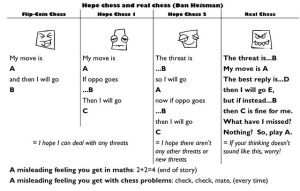
Unless you’re playing Real Chess, every move, you will be
accident-prone. It’s slow for us, I think, when GMs seem to take
in so many tactics at a glance, but the ideas are not complicated, we
just need to be consistent and to be thorough.
Chess is unlike the ‘white to play and win’ problems from books and
magazines, where there is a right answer which you may be able to spot
quickly, and where you might spot the first move almost
instantly.
Mistrust what you think, as your opponent will surely try to find out
what is wrong with it.
“Recently I was invited to the closing ceremony of a team tournament in which candidate masters and first-category players were playing. I asked my audience what they would like me to talk to them about, and I was inundated with requests. Some asked me to demonstrate some
interesting combination, others wanted to know how to play the Sicilian Defence correctly for Black. `But do you know how to analyse variations?’ I asked my listeners, and without giving them time to reply went on, `I will show you how to analyse variations and if I’m wrong, then stop me. Let us suppose that at one point in your game you
have a choice between two moves, R-Q1 or N-KN5. Which should you play?’
You settle down comfortably in your chair and start your analysis silently saying to yourself the possible moves.`All right, I could play R-Q1 and he would probably play B-QN2, or he could take my QRP which is now undefended. What then? Do I like the look of the position then?’ You go one move further in your analysis and then you pull a long face–the Rook move no longer appeals to you.
Then you look at the Knight move. `What if I go N-KN5? He can drive it away by P-KR3, I go N-K4, he captures it with his Bishop. I recapture and he attacks my Queen with his Rook. That doesn’t look very nice … so the Knight move is no good.Let’s look at the Rook move again. If he plays B-QN2 I can reply P-KB3, but what if he captures my QRP. What can
I play then? No, the Rook move is no good. I must check the Knight move again. So, N-KN5, P-KR3, N-K4, B x N, Q x B, R-Q5 No good! So I mustn’t move the Knight. Try the Rook move again. R-Q1 , Q x RP.’At this point you glance at the clock. `My goodness! Already 30 minutes gone on thinking whether to move the Rook or the Knight. If it goes on like this you’ll really be in time trouble. And then suddenly you are struck by the happy idea — why move Rook or Knight? What about B-QN1?’ And without any more ado, without any analysis at all you move the Bishop. Just like that with hardly any consideration at all. My words were interrupted by applause. The audience laughed, so accurate was my picture of their trials and tribulations.”
Positions A-C are taken from de Groot’s PhD study in the 1930s
(published as Thought and Choice in
Chess, 1946), and Dan Heisman has used the other positions in
the
same way, as reported in his recent book The Improving Chess Thinker.
This was Max Euwe’s
approach to position A, which might be a model for how to approach a
fairly lively position.
Algebraic
Euwe’s verbalisation
Comments
First impression: an isolated Pawn; White has more freedom of
movement.
Orientation (de Groot);
Evaluation (Heisman)
…Qxb2
a3
2.Nxd5
a3
f6
e7
…Qxb2
a2
Black threatens…QxNP. Is it worthwhile to parry that? It
probably is; if he takes, then QR3 is also attacked. Can White then
take advantage of the open file? Does not look like it. Still again
2.NxB and then by exchange the Pawn at QR3 is defended by the Queen.
Indirectly in connection with the hanging position of the Knight at KB6
and possibly because of the overburdening of the Bishop at K7. But wait
a moment: no, …QxNP is rather unpleasant after all because the Bishop
at R2 is undefended. Can I do something myself?
Consider opponent’s threats (Heisman)
Threats
f6 & d5
Investigate that first: the pieces on KB6 and Q5 are both
somewhat tied down.
Let us look at the consequences of some specific moves.
Exploration (de Groot)
1.Nxd5, 1.Nxc6
1…Rxc6
1.NxN, possibly preceded by 1.NxB. Then 1…RxN is probably
impossible because of taking on Q5.
Hopes
Black has a number of forced moves, there may be a possibility
to take advantage of that.
It’s not yet quite clear.
1.Bh6 f7
Let us look at other attacks: 1.B-R6 in connection with KB7 –
but I don’t really see how to get at it.
1.b4
1…Nxc3 / 2…Bb5
2.Qxc3
1.P-QN4 in order to parry the threat – but then exchange on
QB3 will give some difficulties in connection with 2…B-N4 – oh, no,
that is not correct, one can take back with the Queen.
1.Nxc6
1.Nxd5
1.Bxd5
1.Bxf6
So far a somewhat disorderly preliminary investigation. Now,
let’s look in some more detail at the possibilities for exchange: 1.NxB
or 1.NxN or maybe 1.BxN/5 or maybe first 1.BxN/6
Investigation (de Groot).
Candidate moves (Heisman).
All forcing moves (Heisman); note the order – the most
positionally desirable first.
1.Nxc6 Rxc6
2.Nxd5 exd5 b2
2…Nxd5 3.Bxd5 Rxc1 / 3…Bxg5
1…bxc6
1.NxB RxN; 2.take on Q5; for instance 2.NxN PxN; wins a Pawn
but there may be compensation for Black on QN2. But better is 2…NxN;
then 3.BxN RxR is nearly forced, no, it is not, he can play 3…BxB as
well. I see no immediate advantage. 1…PxN is not forced therefore;
and even if it were, you couldn’t be quite sure of winning. It’s
happened before that such a position proved less favourable than at
seemed to be. The point Q5 is reinforced by it, that is a disadvantage.
1.Nxc6
(So let’s think about) 1.taking on Q5. 1.NxB at any rate gives
the pair of Bishops; if I don’t find anything better, I can always do
this.
Bookmarking ‘best so far’.
1.Nxd5 Bxd5 d7
2.Bxf6 Bxf6 3.Nd7 Qd8
1.NxN, BxN; is that possible? Q7 is free then. 2.BxN, BxB/3;
3.N-Q7, Q-Q1 can then be done.
1.Nxd5 Bxd5
2.Bxf6 Bxf6
1…Nxd5 2.Bxd5
Bxg5/ c6 / f2-f4
1.NxN, BxN; 2.BxN, BxB/3 will probably yield something.
1…NxN is also possible; maybe better. Then 2.BxN BxB/5 and now there
are the possibilities to take on QB6 or to play something like P-B4;
once again:
1.Nxd5 Nxd5
2.Bxd5 Bxg5
3.Rxc6 2.Bxe7 1…exd5
1.NxN NxN; 2.BxN, BxB/5 – no, nothing then, 3.RxB does not
help any; it is a cute move but at the end of it all everything remains
hanging. Something else: 2.BxB – he just takes back. 1…PxN is very
favourable; he won’t do that; it needn’t be investigated.
1.Nxd5 Nxd5
2.Bxd5 Bxg5
3.Bxc6 Bxc1
1…Nxd5 2.Bh6 Red8 3.Qf3
e8
1.NxN NxN remains. 2.BxN BxN; 3.BxB, BxR is then possible. No,
can find no way to make anything out of this. 1…NxN; 2.B-R6, KR-Q1;
3.Q-KB3 with some threats; if Black now has to play his Bishop back to
K1 then one gets a good position.
1.Bxd5
1.Bxd5 Bxd5
2.Nd7
2…Bc4
1.Bxd5 Nxd5
2.Nxd5
1.BxN/5: this must be looked into. Does that make any
difference? 1.BxN/5, BxB is again impossible because of 2.N-Q7. That is
to say, we will have to look out for 2…B-B5, but that we can probably
cope with: the worst that can happen to me is that he regains the
exchange, but then I have in any case some gain of time. 1.BxN/5, NxB;
2.Same difficulties as just before. No, that is now impossible: 2.NxN
wins a piece.
1.Bxd5 Bxd5
2.Bxf6 Bxf6
3.Nd7 Qd8
4.Nxd5 exd5
1.Bxd5 exd5
f6 / e7 / c6 1.Bxd5
1.BxN/5, BxB; 2.BxN, BxB; 3.N-Q7, Q-Q1.Let’s have a closer
look at that: 4.NxB/5, PxN and I’m an exchange to the good: very
strong. 1.BxN/5, PxB is therefore forced. But that is good for White.
The Knight on KB6 is weak, the Bishop at K7 hangs – and the Bishop on
QB3 stands badly. On positional rounds one could already decide on
1.BxN/5. Is there some immediate gain?
1.Bxd5 exd5
2.Qf3 f6
2…Kg7
1.Bxd5
1.BxN/5, PxB; it looks bad for Black. Probably some more
accidents will soon happen. Much is still up in the air. One plays, for
instance, 2.Q-B3. Defending the Knight on KB6 is not so easy; 2…K-N2
looks very unpleasant. Yes, I play:
1.BxN/5.
Proof (de Groot)
Check
Not sure how good it is, but is sure that it’s
good and is better than the rest! (Heisman)
Euwe discounts the possibility that a
non-forcing move will be any better. (Heisman)
Improve
To be honest, not every GM analysed so long or in such an orderly
manner; you almost got the idea that Fine homed in on Bxd5 in the first
minute or so and spent the rest of the time justifying it! But if
you don’t have his judgment or intuition, try Max’s approach.
Lots of ideas there: candidate moves, bookmarking, looking at
forcing moves and generally desirable moves, trying things in different
orders… Here’s a set of tips.
I think this sort of exercise is useful. Repeat once in a
while, and see if your thinking process gets any better.
“Sight is what you see with your eyes, Vision is what you see with your mind.” http://lessons.chessvision. net/
There is a gap between what is under your nose and what you actually notice. It’s the gap between what is obvious once your opponent lands a punch and what you did failed to see beforehand…
Chess uses a big board and it’s hard to see how things join up sometimes. How can we see things coming before the accident happens? Can we somehow look ahead better? This is sometimes called sight of the board, or chess visualisation, or chess vision… Shall we call it boardsight, rather than eyesight?
I was putting together a set of mixed exercises (below), and came across several exercises for developing your boardsight… Here’s a selection.
There’s a great free online exercise from the Chess Drum with items like:
Chessboard tasks (Martin Gardner)
Knight Dance The famous Czech IQ test:


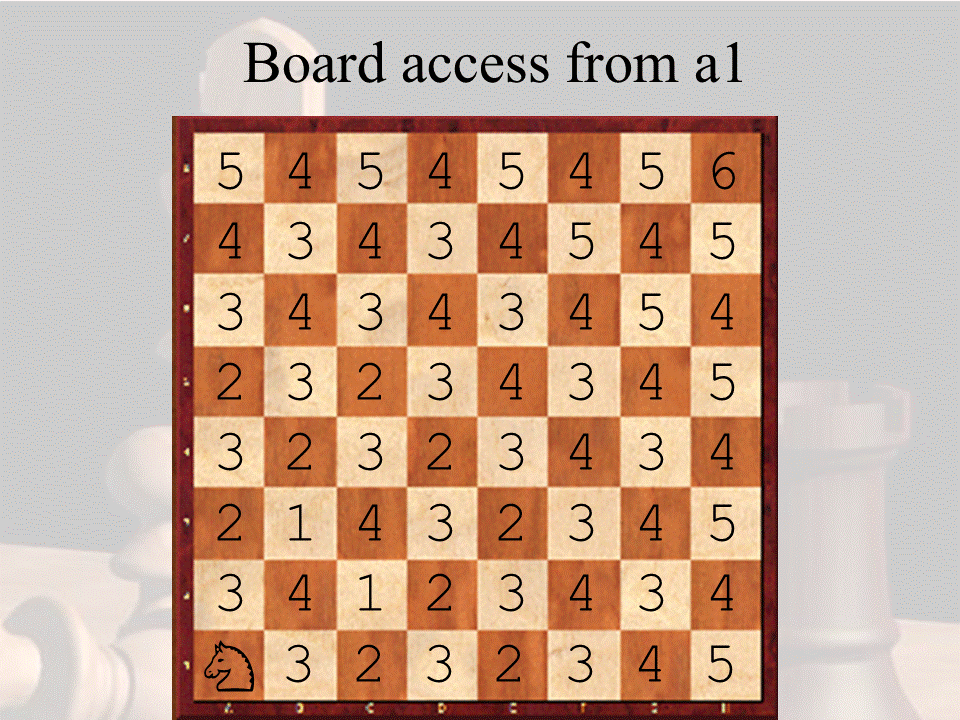
Visit in turn the squares a1, b1, c1…h1, then h2-a2, a3-h3, etc. WITHOUT ever moving to a square occupied or attacked by a Black Pawn. Not too difficult, but can you beat 5 minutes against the clock? Blindfold chess Play chess without the pieces, calling moves out to each other. If you play an illegal move, you lose! You need a referee for this, who does have the pieces! (There’s software too.) Or try it when only one player plays blindfold…
Commercial:
Chess Eye A demo offline/online chess visualisation trainer
Chess Vision trainer You play against the computer on the screen, but the board shows the position two ply behind… If you can manage that, it will hide one quarter of the board!
Professor Chess (Jim Mitch)
Jim offers a sample homework set, with questions like:
In this position:
Count again, picturing the board two moves hence!
What’s the fastest way for a [Knight] to move from [a7] to [a6]?
Which squares are attacked by both [Qd3] and [Nd2]?
Alex Bartashnikov’s chess software A superb suite that includes some try-before-you-buy visualisation training (including blindfold chess). Excellent for youngsters!
Detective Chess (Gerry Quinn) There are White pieces KQRBN at b7,c3,d4,g8 and g5. The squares a4 and e1 are attacked once each, the square g1 is attacked twice, and the square g7 three times. Where is each White piece?
I dunno about playing blindfold or with a partly hidden board: I find playing blindfold a zillion times easier if I have an empty board to look at, and you will never be without a board during a game.
Maybe the simplest idea is: load up a complete game from a database, or open a book of chess games, pick a position half-way through, then imagine the position two moves hence, and count all the possible White checks and captures for each side. Then make the two moves, and check to see if you were right. Slap yourself once for every one you missed. Then pick more complicated positions. Then look further ahead. Then slap harder.
We’re used to doing puzzles which might be mate-in-one (Level I),
mate-in-two (Level II) and so on. Someone asked on Friday, what’s
the highest level you can get? Well, I have heard of a 1220-move
monster by Babson, but that has some peculiar conditions.
The most moves in a forced-mate problem with no conditions is this
one, from Otto Blathy, who published a whole book of such
monsters.
Mate in 290 — best of luck!
SOLUTION:
P.S. I thought that was the record, but when searching on the web
this weekend I found this Level 292 problem (which is also an illegal
position):
[blockquote][em]The longest in a legal position I thought was a
226-mover, sent to me by David Beckwith, but
apparently some computer has found a
[url=http://www.youtube.com/watch?v=wxIaMcO2amE]Level-524
[/url]
puzzle… I expect only a computer could invent or solve that one![/em][/blockquote]
Jonathan Rowson is a young Scottish GM who has written two of the best and most important books of recent years: The Seven Deadly Chess Sins and Chess for Zebras. They are important because they are some of the best discussions about how chess is actually played that I have ever read; often Rowson seems to be writing for the first time about things that have rarely been mentioned, let alone explored in any detail. The books are also confusing, pretentious and irritating by turns.
‘I’m enjoying it – but I don’t like it.’ Geoff Chandler, October 2005
Let’s take them one at a time.
The Seven Deadly Chess Sins is an exploration of chess psychology. There is a psychology of chess, the academic study of what chessplayers do. In fact, chess players have been called the ‘fruit flies of psychology’ because they are such a favourite research subject. Rowson isn’t very interested in all that stuff. He quotes with approval:
“It seems to us that the theories associated with board reconstruction experiments represent an idealised picture of master chess which may be misleading. … So often, as any player will agree, it is hopes and fears which seem to influence the choice of a move.” – Hartston and Wason
It’s the emotional swamp which is Rowson’s territory, seeing it not just as the source of mistakes but a promising route for seeking improvement.
His sins are: Thinking, Blinking, Wanting, Materialism, Egoism, Perfectionism and Looseness. (I’m very amused that Thinking is a sin.) Perhaps some detail would help:
Warming up? The first example in the first chapter (Thinking) shows an example from a GM which obviously provides Rowson with some real inspiration but which might make the rest of us despair…
Wow. Is chess really that hard? Do I really have to be able to come up with ideas like that? Well, no, but if you want to get better, you do need to stop playing the way you do right now. Shaking up your ideas is part of Rowson’s plan.
Black has just offered a draw.
5. Egoism:
6. Perfectionism:
7. Looseness:
These are quite sophisticated mistakes, but I think the same things can be seen at club level as well. (I just made a mental note to myself to find club-level examples of all of these things).
The irritating bit of Rowson’s book is that it is hard going. The examples are hard. He gets distracted when discussing them. Not all the examples are clear. And then he includes a huge variety of anecdotes, quotations and ideas from outside chess, some of which are hard to see the value of, and some of which seem included just to let us know how widely-read is the author.
“When considering whether to use these ideas in the book, I was concerned that it might seem too abstract or contrived for most readers and hard to apply to their real games… So even if I’m not making any sense, or if you only partly understand what I’m saying, the main thing is to have the courage to look at chess with new eyes.”
I like the aim. However, he’s not really achieving it with passages like this:
“There are some striking parallels with quantum theory in the way of viewing chess outlined above, particularly Heisenberg’s Uncertainty Principle … and Bohr’s Principle of Complementarity.” (p.84).
Oh, yeah? One exasperated reviewer concluded:
“It is at best a flawed if earnest effort. At worst it is a pretentious, barely mitigated disaster … The Seven Deadly Chess Sins is strong evidence that to the seven we should add two more: writing this book, and buying it.” http://www.chesscafe.com/text/review274.pdf
Harsh… I understand this love of quotation and pursuit of analogy from Rowson’s point of view; writing something like this, or a PhD, is rather like being in love, everything you read or think about reminds you of what you are doing, and you want to include everything. I did end up wishing that he had a more brutal editor, but it’s a record of his journey and his thinking, and after a while you enjoy the ride with him.
He has a final rather defensive note, entitled The Author’s Redemption, where he says:
“I’ve tried to write about chess as I’ve come to understand it: a complex a rewarding game that lies, tantalisingly, beyond the full grasp of the human intellect. … There is no virtue in giving easy answers to the questions posed by a difficult game. “
And while I think it is not usually given to the author to decide whether he is redeemed or not, I will concede the point. 10% of the book may get up your nose, but the other 90% is witty, informative, thought-provoking, and more likely to focus you on your bad habits of chess than anything else I know.
Chess for Zebras is much more focussed. The examples are just as demanding (you remember that I used one of his examples when we looked at planning in the endgame) and Rowson’s temptation to throw in a quote by ‘my favourite Buddhist writer’ is still there, but where in Sins the author seemed happy to show us a deal of thought-provoking material and let us get on with it, in Zebras Rowson is more helpful in guiding us through the thoughts he hoped to provoke. He is also to be commended for listing our website in the bibliography!
That endgame example is accompanied by a long transcript of exchanges between Rowson and one of his students. I guess that Sins is the result of Rowson thinking about how he got good at chess and how he is going to get better, and Zebras is the result of Rowson trying to teach others to get better. It’s lower-key in many respects but more punchy. I threw a couple of quotes at you last time:
“If you want to get better at chess you need to place much less emphasis on ‘study’ whereby you increase your knowledge of positions, and place more emphasis on ‘training,’ whereby you try to solve problems, play practice games, or perhaps try to beat a strong computer program from an advantageous position.” (25).
“Chess skill emerges from chess playing combined with chess training, where ‘training’ means working things out by yourself. The main skill a chess-player needs is skill in making decisions, so that’s what you need to do and do repeatedly. If you want to become a better player, you need better habits, and you cultivate better habits through training. The best training is the kind that pushes you up against the edges of your comfort zone, where you force yourself to take responsibility for difficult decisions. It is so much easier to read books that give strategic guidelines, hints and tips, etc., but what you need is ‘know how’ and that means learning by doing.”
The contents list is an amusing read in itself:
Oh, and why Chess for Zebras?
‘Thinking like a zebra’ therefore means being more open to experience and less constrained by convention. It means allowing yourself to think differently.”
It’s going to be hard to do more than scratch the surface of what you can find in Zebras, but let’s give another couple of examples, ones that rang a bell with me. The first section of the book is about productive training; we already looked at one from the this section in an earlier session (the Estrin endgame). The second section is about expanding your conceptual toolbox, and the third is about openings from the points of view of White and Black.
Doing and being
Zugzwang Lite
Click […] for list of games
