About DrDave

Retired player, current chess coach, organises chess events in Devon with a group of like-minded elves.

Novel Opening Play

Jonathan wanted to have something on this session thinking about the English Opening, but, in case you don’t play that system, I’ll broaden it out a bit.

The experience of meeting novelty

It needn’t be a completely new move, of course, just new to you. Let’s see if we can create that experience for you. Some examples that we came up with: As White, facing 1.d4 e5!? As White, facing 1.e4 e5 2.Nf3 Nc6 3.Bc4 Nd4!? As Black, facing 1.e4 e5 2.Bc4 Nf6 3.d4!? Some examples for more experienced players, can be found in the SOS volumes.  For example, here are the suggestions from SOS 13: Responses to novelty Emotional responses: suspicion, derision, fear, panic, amusement, complacency, offence, dismissal, distraction… “He must be a duffer”/”He must have studied it and know everything”… “I’d hate to lose quickly, what’s the safest move here?” “What are they up to?” You have to get past those emotional responses as fast as you can and start thinking about the position in front of you right now.  The one strand that is very relevant is that last one: What are they up to?  That’s always a good chess question, because your opponent is always up to something! So, looking for rational responses: it’s just another move.  What’s the idea? — or, more likely, the ideas?  What are your ideas?  What moves are at all plausible for me?  What moves do I want to play anyway? Maybe there is a combative line that is quite theoretical and leads to a clear advantage for your side.  But can you find it while steering clear of any traps? Perhaps more practical is to seek a smaller, safer advantage. Let’s have a look at these approaches in our examples:

Example 1

1.d4 e5!?

This sprightly idea is called the Englund Gambit.  Imagine you are facing this move in the first round of the Bristol Rapidplay against an unknown opponent.

I think it’s clear that after 2.c3 or 2.d5 Bc5 White has abandoned any hope of an opening advantage.  Really the only way forward is to take it


2.dxe5

No qualms here yet I think.

2…Nc6 3.Nf3

Also qualm-free.  A very natural move, one we probably want to play anyway, and one that defends the pawn.

[3.f4 looks like Trying Too Hard.  Maybe it’s good, but with 3.Nf3 available and the clock going, why bother?]

3…Qe7

OK, that is an awkward-looking move.  That may mean that Black really is a bit of a duffer, or this is an unusual move with a point.  One very natural response is:

4.Bf4

But remembering last week (loose piece, exposed King, look at all checks and captures every move) you should instantly spot the point:

4…Qb4+

Now one line that you might be tempted by is 5.Bd2 Qxb2 6.Bc3 (an unnatural move I think, and a Warning Sign) 6…Bb4 7.Qd2 Bxc3 8.Qxc3 Qc1 ‘mate!

That’s not forced of course.  Perhaps White can improve without spending too much thinking time with 6.Nc3 e.g. 6…Bb4 7.Rb1 Qa3 8.Nd5…

However, if your analysis skills aren’t up to all that in rapidplay, I think you should take one look at 4.Bf4, spot 4…Qb4+, and move on to the next most natural move:

4.Nc3

Must be OK.  Let Black have the pawn back, we’ll carry on playing good strong sensible moves.

4…Nxe5

Now, Black still has some problems due to the awkward …Qe7.  It’s not hard to recommend here:

5.e4


White has easy development and a small advantage.  We can look forward to continuing our sensible opening play, perhaps arriving at a position where we have completed development in good order when Black is still trying to get sorted out, and we can then look for a way of seizing the initiative or forcing a weakness.  Perhaps 4.Bf4 leads to a bigger advantage with best play on both sides, but 4.Nc3 and 5.e4 is easier to handle and free from risk.


[5.Nxe5 Qxe5 just solves Black’s problem for them: the Bf8 can now be developed.]

Example 2

As White, facing 1.e4 e5 2.Nf3 Nc6 3.Bc4 Nd4!?

Again there is a fiendish trap: 4.Nxe5 Qg5 5.Nxf7 Qxg2 6.Rf1 Qxe4+ 7.Be2 Nf3# (Blackburne’s Shilling Gambit)

But I’m sure you can spot the suspicious time-wasting by the White Knight.  I think a better move is easy to find:

4.c3! and now after 4…Nxf3+ 5.Qxf3 White has an obvious plus.

Example 3

As Black, facing 1.e4 e5 2.Bc4 Nf6 3.d4!?

The idea is to play the Urusoff gambit: 3…exd4 4.Nf3 Nxe4 5.Qxd4, when White plans Nc3 Bg5 O-O-O and Rhe1. I think 3…exd4 is a move you want to play anyway, but after 4.Nf3 we can find something else. 4…Nc6! transposes into the main lines of the Two Knights’ Defence, which gets us back into what we know.  What’s that? Oh, dear… It turns out not too many of us know the main lines of the Two Knights’ Defence, but we do know the Giuoco Piano. In that case, I think we have no business playing 2…Nf6, and instead, 2…Nc6 is the only way to preserve any hope of getting into known lines.  But if White wanted to play the Giuoco Piano I assume they would have gone for it straight away, so we still need to know another line here (Vienna Game?).  At least after 2…Nc6 there will be no Urusoff. So, the advice when faced with a novel move is:

  • Don’t Panic, and Don’t Sneer
  • Ask yourself, what is the idea?
  • Play natural moves, and moves you want to play anyway, when you can
  • Be suspicious of moves that disobey standard opening guidelines.

“This reminds me of a rule I know very well because I made it up: When you are caught in an opening you don’t know, make good developing moves!” — Bent Larsen in Evans et al.

P.S. GM example appended

Bobby Fischer against the world

Just been to see Bobby Fischer Against the World at the Exeter PictureHouse.

Lots to say about it (I’m a Fischer nut, but there were loads of stills I hadn’t seen, and live footage) but I mentioned one error I thought I noticed:

The breakthrough Game 3 of Spassky-Fischer was indeed notable for its unusual opening play by Fischer, but it was a defence he had played before, contrary to what I think people were saying in the film.

Not until Liz Garbus makes a film about trains or stamps will she find a more
nitpicking audience, I expect.

Trailer: http://www.youtube.com/watch?v=5sWuhpsG2aU
Interview with Director Liz Garbus: http://www.pastemagazine.com/articles/2011/06/catching-up-with-liz-garbu…
Review: http://www.guardian.co.uk/film/2011/jul/14/bobby-fischer-against-the-wor…
Long profile of Fischer: http://www.theatlantic.com/magazine/archive/2002/12/bobby-fischer-rsquo-…

Openings workshop 2011

Four questions from the floor with comments from all

A defence to the Kings Gambit

1.e4 e5 2.f4

Asking around the group for moves for Black at move 2, we collected:

2…f6;
2…d6;
2…Nf6;
2…Nc6;
2…Bc5;
2…exf4;
2…Qh4+;
2…Qf6;
2…Qe7;
2…d5 …

And that probably doesn’t exhaust everything that has been tried, but it will do for now.  All have some logic so let’s work our way through them.

Before we do, it is important to note at the start that White is not yet threatening the Black e-pawn,  Here if 2…a6 3.exf4?? Qh4+ and White is embarrassed.   So actually Black can pretty well do what they like.

* 2…f6 is well motivated but fails to the elementary tactical sequence

3. fxe5 fxe5 4. Qh5+ g6 5. Qxe5+ Qe7 6. Qxh8 Qxe4+ 7. Be2 Qxg2 8. Bf3 …

* 2…Nf6 and 2…Nc6

Both neglect to support the King’s pawn.  After 2…Nc6 3.Nf3 Black has the same problem.

3.fxe4
becomes a threat after 2…Nf6 and the logical sequence:

1.e4 e5 2.f4 Nf6 3.fxe5 Nxe4 4.Nf3 Ng5 (4…Nc6 5. d3 Nc5 6. d4 Ne4) 5.d4
Nxf3+ 6.Qxf3 Qh4+ 7.Qf2 Qxf2+ 8.Kxf2

…as in Fischer-Wade, 1968, gives White an edge.

* 2…d6

Not daft, not bad, but not best.  This move is unkind to the Bf8,
and, as there is no direct threat to the e-pawn, we can go:

2…Bc5 3.Nf3 d6

Now White can try 4.Nc3 and 5.Bc4, or 4.c3, with normal chances of a
small White advantage.

 * Falkbeer/Nimzowitsch

2…d5

White can avoid all dangers

3.Nc3

– however, White is also in no danger of getting an advantage with this
tame move.

3. exd5

Now Black has a choice of counter-gambits, Nimzowitsch’s 3…c6 and
Falkbeer’s 3…e4.

After 3…c6, any mess can be declined with 4.Nc3, reckoned to
be the best line at the moment.

3…e4 is a great idea but I
think White can find a way towards an advantage:

4. d3 Nf6

(4… Qxd5 5. Qe2 Nf6 6. Nd2 Bf5 (6…Bg4 7.Ngf3) 7. dxe4 {idea ?xe4, 8 g4! is very strong.})

5. dxe4 Nxe4 6.Nf3

(6. Be3!? is an idea of Spassky: 6… Qh4+ 7. g3 Nxg3 8.Nf3 Qe7 9.hxg3
and now 9…Qxe3+ 10.Qe2 or 9…Qxh1 10.Qe2)

6… Bc5 7. Qe2 f5

(7… Bf5 8. Nc3+=)

8. Nc3 Bf2+ 9. Kd1 += and
Black’s juggernaut has run into sand.

* The Gambit Accepted and the Cunningham Defence

Turning now to ways of accepting the gambit, after 2…exf4, Black’s threat of playing 3…Qh4+ is most easily met by 3.Nf3. Now Black has another enormous choice here, but I recommend looking first at the Cunningham Defence.

3…Be7 threat …Bh4+

4. Bc4

4.Nc3?! Bh4+ 5.Ke2 may not be terrible, but White probably doesn’t want to go down this line.

But after 4.Bc4, 4…Bh4+ 5.Kf1 may inconvenience Black more than White.

4… Nf6

There are now an encouraging number of mistakes for White to make in the first few moves.

(5. O-O? Nxe4)

(5. Nc3?! Nxe4!)

(5. d3?! d5!)

So, by the process of elimination:

5. e5! Ng4!

Now 6. h3?? Bh4+ is awful for White and 6. d4 d5 7.exd6 Qxd6 looks OK for Black, so

6. 0-0 0-0! 7. h3?! d5! 8. Bb3

[8.exd6 then 8…Qxd6 threatens to win the loose c4-bishop with 9…Qc5+.]

8…c5! 9.c3

[9.hxg4 c4 10.Ba4 b5 11.Bxb5 Qb6+ 12.Kh1 Qxb5 13.Nc3 Qc6 14.d4 Bxg4 15.Bxf4 Nd7 16.Qd2 Bxf3 17.Rxf3 f6 18.exf6 Bxf6 19.Re1 Rf7 20.Rfe3 Nf8 21.Be5? Bg5 …0-1 Kennaugh-Hebden, 1994]

9…c4 10.hxg4

[10.Bc2? loses swiftly to 10…Qb6+]

10…cxb3 11.Qxb3 d4! 12.d3

[12.Nxd4 Bc5 13.Rxf4 Nc6 14.Qc4 Nxe5! 15.Qxc5 Nd3!]

12…Nc6 13.c4 g5! 14.Nbd2 Bxg4 15.a3

[15.Qxb7 Nb4 is horrible for White.]

15…Qc7 16.Re1 Bh5

(idea 17…g4)

17.Ne4 Bxf3 18.gxf3 Nxe5 19.Kg2 f5 20.Nf2 Ng6 0-1 Holmes-Motwani 1994.

Tchigorin’s bust of the Stonewall Attack.

When the Stonewall works, it can feel as simple as shelling peas:

That is very much How Not To Defend Against The Stonewall Attack, although the move order is worth remembering.

However, Black can play more craftily and survive, mostly by not castling into the attack, but also by making a more determined effort to control the light squares and/or the centre.

In a way, White has learned a trick, like Scholar’s Mate is a trick:

1.e4 e5 2.Qh5 Nc6 3.Bc4 Nf6?? 4.Qxf7#

(Actually that was my first ever game in a chess club, and I was Black…)  Once Black has seen the idea it is not so hard to dodge.  Then White needs an opening with more and deeper ideas, that poses Black problems that are not so easy to see coming or to deal with.

Tchigorin worked out a move order that makes nonsense of the whole Stonewall Attack, which Brian (**) is having trouble with:

* Tarrasch-Tchigorin, 1895 [GAME]

Sad to say, there is no answer to this for White.  You either have to hope that Black players don’t know this defence, or you need to trick them with some other move order (3.Nd2!?), or really you need to find a better opening.

By all means start towards it with 1.d4 d5 2.e3 Nf6 but now I suggest 3.Nf3.

After 3…e6 we can play the Colle System and after 3…Bf5 we can play the Slow Slav with 4.c4 – not a hugely inspiring way to play but Kramnik struggled occasionally
in 2006 when faced with it by Topalov in their 2006 match.  (3…Bg4 4.c4 is similar.)
Certainly, White has better chances with these ideas than in the Tchigorin line.

That’s not to say that you should forget all about this formation.  You might find that Black uses a move order in the opening which does not allow Black to play the very best defences.

(1) You might be able to spring a Stonewall Attack after a different start, while playing more mainstream QP openings:

* Portisch-Petrosian, 1974 [GAME]

* Prie-Jablonski , 2003 [GAME]

(2) You can try Bird’s Opening:

* Danielsen-Halldorsson, 2002 [GAME]

(3) And lastly, there is still an enthusiasm for playing the Stonewall Dutch Defence as Black (ask Tim!), perhaps not with such directness as this:

* Glucksberg-Najdorf, 1935 [GAME]

Kramnik famously declared that, with the extra space, the Stonewall Dutch is easier to play with Black than for White!  I was very struck when I got a copy of NCO, to see all the main lines of the Stonewall were given an unadorned “=”.

With recommendations like that, it is hard to dismiss the defence, but of course with greater attention came greater number of ideas for White, and it perhaps is less easy to play the Stonewall for Black than it used to be.

There are a couple of excellent books on the defence around, by Aagaard and by Johnssen et al.

(**) I will just say here that Brian’s adoption of the Stonewall is due to the book How to Think Ahead in Chess, which, whatever its title might suggest, is an opening repertoire book recommending the Stonewall for White.  I note that this book appeared in 1943 while Tchigorin’s bust has been known since the well-known game Tarrasch-Tchigorin, Hastings 1895.  Soltis also suggested the Stonewall for White in 1992, but at least
he had the integrity to mention the problem and suggest a solution. (4. f4 Nb4 5. Nf3 Nxd3+ 6.Qxd3 when Soltis suggests the central control is still worth something.)

Defending against the Ruy Lopez.

Well, if I could guarantee a trouble-free life against the Lopez, I would be able to earn a fortune selling the secret.  It seems the GMs are still working out the details of the Zaitsev and the Marshall and the Moller, but these sophisticated and subtle systems are buried under a mountain of theory, not easily absorbed by club players.

So what are we to do?  Lots of options, but let’s have a look at these two:

* Open Defence
4. Ba4 Nf6 5. O-O Nxe4 6. d4 b5 7. Bb3 d5 8. dxe5 Be6 9. c3

I always liked to see Korchnoi’s progress with this vigorous Defence, favoured by Tarrasch and also adopted by the upright Dr.Euwe.  When I was a boy I had a notion of playing the Dilworth Variation, a complicated line of which the evaluation defends on a
complicated endgame:
9… Bc5
Alternatives are
(9… Be7)
and
(9… Nc5)

Sadly, Korchnoi’s persistence with the line at World Championship level provoked Karpov and his team to develop better anti-Open variations, and these days 9.c3 is discarded in favour of the modern 9.Nbd2.  This is particularly sad for fans of the Dilworth, for although Black is still battling away with 9…Be7 and 9…Nc5, it seems White has a simple small advantage after 9…Bc5.

 * Berlin Defence

Is there any reason to play a line without 3…a6?  Fine showed the superiority of Morphy’s move-order in clear terms in his well-known book, emThe Ideas Behind The Chess Openings./em After strong1.e4 e5 2.Nf3 Nc6 3.Bb5/strong with and without strong3…a6 4.Ba4 /strong

Without …a6 With ….a6
3…Nf6 4.0-0 Nxe4 5.d4 Be7 6.Qe2 Nd6 7.Bxc6 bxc6 8.dxe5 Nb7 9.Nc3+= 4…Nf6 5.0-0 Nxe4 6.d4 b5 7.Bb3 d5 8.dxe5 Be6 9.c3=
3…d6 4.d4 Bd7 5.Nc3 Nf6 6.Bxc6 Bxc6 7.Qd3 exd4 8.Nxd4 Bd7 9.Bg5+= [4…d6 5.d4 b5 6.Bb3 Nxd4 7.Nxd4 exd4 8.Bd5 Rb8 9.Bc6+ Bd7=

You can argue about the moves but I hope the point is made.

Only if you were very keen to avoid the Exchange Variation would it
seem advantageous to omit 3…a6.

However, while Black’s winning chances in the Berlin are not great,
White’s winning percentage is not huge either.  Let’s look at the
main line:

strong3… Nf6 4. O-O Nxe4 5. d4 Nd6 6. Bxc6 (6. dxe5!? Nxb5 7. a4) 6… dxc6 7. dxe5 Nf5 8.
Qxd8+ Kxd8/strong

The Queens come off and White has to try his best in an endgame
where yes, the King’s-side majority is a big asset, but Black has two
Bishops and already a lot of light-square control.

White can point to several advantages but the position is relatively
quiet and the play positional. So what?  Well, Kramnik possibly
owes his World Championship title to the Berlin Defence, where in 2000
Kasparov failed to make effective use of the White pieces:

 1 2 3 4 5 6 7 8 9 0 1 2 3 4 5
 * 1 * . . . . . * 1 . . * . .

so, 2-0 or 8.5-6.5 to Kramnik.  The marked games were draws
where Kramnik played the Berlin and held
it. The Berlin is a smart move against a player with such a marked

reference for complex attacking play.

 * Schliemann Gambit

Just a second suggestion if the Open and Berlin don’t appeal.

The main lines of this variation are long and difficult and probably
better for White.  White has to know them, though!

Lutz,C – Yagupov,I Groningen, 1995

1.e4 e5 2.Nf3 Nc6 3.Bb5 f5 4.Nc3 fxe4
5.Nxe4 d5 6.Nxe5 dxe4 7.Nxc6 Qg5 8.Qe2 Nf6 9.f4 Qxf4 10.Ne5+ c6 11.d4
Qh4+ 12.g3 Qh3 13.Bc4 Be6 14.Bf4 0-0-0 15.0-0-0 Bd6 16.Kb1 Rhf8 17.Rhf1
Kb8 18.a4 Ka8 19.a5 Bxc4 20.Qxc4 Bxe5 21.dxe5 Nd5 22.a6… 

(1-0,60)

Sokolov and others have pointed to 5…Nf6 as a less high-stakesoption, where Black has reasonable chances for the pawn.

A line in the Alapin Sicilian

Charlie asked after the variation:

1.e4 c5 2. Nf3 Nc6 3. c3 d5 4. exd5
Qxd5
…

Now both Charlie’s suggested plans:

5. d4
5. Na3

… look like very reasonable ways of seeking the advantage.  I
don’t know much about this line but I looked it up.  The move
order is not one that you find in all the books, but after 5.d4 we are
into a fairly well-known position where Black can try 5…cxd4, 5…Nf6
or even 5….e5!? with reasonable chances of equality.  5.Na3 has
been tried a couple of dozen times in the last 10 years, with fair
results, although following 5.Na3 the most common sequence has been
5…Bg4 6.Be2 e5, and
I can’t see that White has succeeded in setting Black any problems
after this.

In the search for novel play we should avoid:

* Potze-Van der Elburg, Hoogeveen 2006: 1.e4 c5 2.c3 d5 3.exd5 Qxd5 4.Nf3 Nc6 5.Na3 Bg4 6.Be2 e5 7.0-0 0-0-0 8.Qa4 e4 9.d3 Bxf3 0-1 as 10.gxf3 exd3
11.Bd1 d2 wins a piece.

Otherwise good books…

Otherwise Good Books with a Confidence-Sapping Error in the Very First Diagram:

Gerzadowicz, S – Thinker’s Chess (Thinker’s Press)

McDonald, N – Defence in Chess (Master Class)

Otherwise Good Books with a Confidence-Sapping Cover (before you ever get to a Diagram):

My current favourite is Play Anti-Indian Systems by Egon Varnusz, cover by Pintail Design for Maxwell Macmillan Chess (published in 1991).

Of course, the WHITE Knight is the Indian, and the BLACK Knight is the 7th Cavalry…

A late entry from New in Chess: the spine seen on Sosonko’s Russsian Silhouettes seems superfluously sibilant.

Perhaps the best ever was Batsford’s reprint of Golombek’s book on Reti, which failed to spell correctly the name of the author.


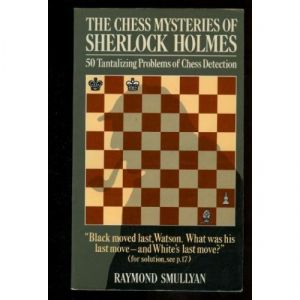
It’s not obvious what is wrong with this one:

Of itself it isn’t a mistake, but the author refers on page xii to “the problem on the front cover”… (authors, what do they know, eh?)

The original cover:

There are actually two problems there: one with bottom right square = h1, one BRS=a8

[If you aren’t sure that either way round it is a problem, see content/going-back-time]

Lastly, I’m not sure if modesty should forbid or compel, but…

It’s ES Tinsley, in fact.

Otherwise OK Books with a Confidence-Sapping Error on the contents page:

The London System by Andrew Soltis advertises a line of the Advance French on the contents page!

Otherwise OK Books with a Confidence-Sapping Error on the title page:


Any more? Or similar?

[I exclude Eric Schiller’s oeuvre from consideration, on fish-barrel-shooting grounds. My esteemed colleague Simon says that dyslexia is the cause, which may be the reason, but does not suffice as an excuse.]

Nice things happen: play-through Italian Game suggestions

Nice email from Robert Janninck:

I am a fan of your site. It helped me getting started with openings. In return I put the Italian game for you in chessbase format. For me when i see things happening on the board it always help, so i thougth maybe that will help others too.
…

My motivation: I like to help youre concept (site) to get better/easier and help others in having more fun in chess. Make it reachable and not for the money.

Thanks a million Robert!

Original handout: https://devonjuniorchess.co.uk/wp/drdaveexeter/1996/04/28/the-italian-game-for-beginners/

Robert’s conversion:

italian.pgn

About Dr Dave

Featured

drdave_sheu

Dr Dave Regis is a researcher in health education working in Exeter, Devon.

He does a bit of chess coaching (in person, over the Internet or by phone), chess publishing and other projects on the side.

He has been talking to adults and children about chess for 20 years and the session notes and free materials that have resulted are all online elsewhere; a couple of examples are on this site.

English Chess Federation Accredited Coach: http://www.englishchess.org.uk/coaches-2/

[If you don’t think the header photo is very good, click on it for another one.]

A moment in the solid Sicilian

I’m thinking about a position in the Scheveningen Sicilian, however you say it…

http://upload.wikimedia.org/wikipedia/commons/5/55/Nl-Scheveningen.ogg

Sicilian = sharp+theoretical

Chess Stars
Easiest Sicilian = Sveshnikov
Safest Sicilian = Taimanov
Sharpest Sicilian = Najdorf

A move order for Black in the Classical:

6…Be7 no reason to delay this
7…0-0 well, you can delay this move!
8…Nc6 the best squares

Now there is a big split here for Black:
9…Qc7 (idea …e5)
9…a6 (idea …b5)
9…Bd7 (idea …Nxd4, …Bc6, …Qd7 and …b5)
9…e5
9…Re8

--------
--nppn-p
pppbbqp-

-kr----r

I think the safest and most solid move is 9…Qc7. It holds back White’s e4-e5 move and threatens to play …e5.

Now, …e5 is often a good idea in the Scheveningen. We have learned that in a lot of Sicilian lines, the d6 pawn is not weak and occupying the d5 square is not much of an achievement. The d6 pawn is difficult to attack and a Knight on d5 can be swapped off, even if it manages to co-ordinate with White’s other pieces.

Meanwhile, Black gets a big pawn in the centre, which is supported (unlike White’s e-pawn). White’s Bishop on d3 or f3 suddenly gets blocked in. Black gets other options, like playing …e5xf4 and …Nf6-f7-e5, with a great Knight outpost. So, although this is complicated and you need to be careful, you shouldn’t be afraid of playing …e5. Spassky even showed us that you can play 9…e5 straight away! But I like 9…Qc7 first.

First of all, I think you will get some White players who will think you have made a mistake and play 10.Ndb5. Of course, you will play 10..Qb8, then 11…a6 and after 12.Nd4, the Queen has moved, the a-pawn has moved, but the Knight is back where it was! So, you have gained two moves, thanks to White, and they are good moves to make; your Queen is still thinking about e5 but can also now support …b5.

Secondly, the most straightforward way to get an advantage

If these positions are a bit too dull for you — f you think they don’t give you enough chances to win with Black — then you need a slightly riskier line. I recommend 9…a6.