About DrDave

Retired player, current chess coach, organises chess events in Devon with a group of like-minded elves.

Nineteenth-century Openings

Article < mattg.66.0C7302D4@indirect.com > of rec.games.chess.analysis

Many of the posts here on r.g.c.a. take the form “what should I play against…” or the related, but very different, “what’s a good line against…“. I’ve been thinking about this a lot lately, both for myself, and, more especially, for my students, who range in strength from beginner to class A, and I’ve come up with some thoughts that I’d like to share and invite feedback on.

I believe it was Reti who first advanced the thesis that the development of the individual should follow the course of the development of chess itself. In other words that a player will first (Greco et al.) learn some cute tactical tricks, then (Morphy, Anderssen) become competent at deeper tactics, and concepts such as rapid development; next (Steinitz, Tarrasch) will come a fairly rigorous learning of positional concepts, etc.

Surprisingly, I have never seen the parallel thesis that A player’s opening repertoire should similarly follow historical trends. Therefore one should start by learning a “19th century” opening repertoire based upon open games, then move on to a “Classical” repertoire, leaning heavily on the Lopez and Queen’s Gambit, and only adopt hypermodern and post-war openings much later. The more I think about this, the more it makes sense. Early in a chess career, tactics predominate, and piece mobilty is the primary strategical consideration. (Remember that pieces lose mobility drastically and permanently if they are captured.) Therefore we should adopt openings that will reward rapid mobilization. (A specific example: after 1.e4 e5 2.Nf3 Nc6 3.Bc4 6 4.Ng5 I have taught several of my students (rated < 1300) to play 4…Bc5!? (*) The result? an absolute 100% success rate, with not a single White King making it to move 25! White always grabs f7 and h8, and then perishes miserably. my players have not memorized reams of analysis, but have instead been shown a couple of key ideas, and then unleashed.)

Once a player has achieved a certain level of competence playing these open games, then she is ready for openings that will teach and reward certain specific types of strategic knowledge. A second rule applies here: The greater the strategical complexity of an opening, the higher rated you need to be before playing it. Again, an example: Two openings frequently recommended to players in about the 1400-1800 range are the Torre Attack and the Stonewall. These recommendations are usually based on the superficial truth that “It’s easy to learn- White plays the same moves no matter what Black does.” However, in the Stonewall, it is almost true to say that there is only one strategical idea at work- “Keep the centre closed, occupy e5, and attack on the K-side“. By contrast, White’s strategical options in the Torre are numerous, and which plan to adopt frequently depends upon fairly subtle understanding of Black’s defensive scheme. Therefore, I believe, despite the fact that White does make the same first half-dozen or so moves against almost any Black setup, the Torre is a very hard opening to learn to play well.

Maybe the hardest openings to play well are those that require not only broad based strategical understanding, but also a willingness to engage in tactical pyrotechnics at the appropriate moment. The systems (predominantly subvariations of the Sicilian, KID and maybe Slav) probably should not be attempted by players lower rated than 2000. The fact that many of these are currently popular at Super-GM level proves the point. After all, if a 2650 is trying to set problems too hard for a peer to solve, the chance of an 1800 understanding anything about the position must be pretty low.

Another, seemingly paradoxical, question that must be asked before an opening is selected is this: “Do I want to win, or do I want to become a better player?” If the primary goal is short-term maximization of results, then a variation should be selected which maximizes those strengths that the player already possesses. However, if the goal is long-term improvement, then the selection task becomes more difficult. It is necessary to evaluate overall playing strengths and weaknesses, choose an appropriate goal (eg. “Learning to play more patiently“) and then select variations which will reward patient play. It is in this area that a higher rated colleague or coach may be of help – both in determining what is an appropriate strategic task to work on, and in selecting variations to help accomplish the task. The short-term results of such an approach may be painful, but the long-term improvement will be worth it.

Conclusions:

1) Selection of an opening repertoire can be a powerful tool for improvement.

2) The question “what should I play against…” cannot be adequately answered without further data. (rating, previously used systems, goals, etc.)

3) There are good reasons to believe that individual progression of opening understanding can and should mirror historical progression.

I welcome any discussion or criticism of the theories I have outlined above, and I hope that the readers of r.g.c.a find this article both interesting and useful.

a

Matt Guthrie (click to mail)

Matt Guthrie is a USCF Master and professional chess teacher. He is Arizona State Champion, and coach of the teams that won both the Primary and Elementary sections of the 1995 All-America Cup.


(*) Wilkes-Barre Variation: see Example Games
WARNING

  These games contain uncut scenes of chess violence. Do not play through them late at night, or in the presence of sensitive adults.

Four choices in the opening

Introduction: your four choices

There are four basic choices to be made before sitting down at a chessboard.

You must decide whether to open as White with 1. e4, with 1.d4 or with a Reti/English system

(and have something in mind against each semi-open or Indian defence)

You must decide how to respond to 1. e4 as Black

You must decide how to respond to 1. d4 as Black

You must decide how to respond to the Reti/English system as Black.

What you choose may depend on whether you like to attack or to play more solidly, and whether you prefer to play open or more closed positions.

You should also consider how it fits with what else you have chosen. For example, if you adopt the Dutch or English Defences with the move order 1. d4 e6, you must be prepared to play the French. Or, if you like to play the Slav with …c6, you might feel the Caro-Kann with …c6 is a nice fit.

The commonest – and many would say the best – opening move is 1. e4, and 1. d4 is also a good first move. But almost every other first move has been played and advocated at some time or another, and almost every legal Black move has been tried in reply to 1.e4/1.d4.

I enclose an openings map below. Even if you learned this off by heart, there are still over 1000 more openings, defences and variations listed in the Oxford Companion to Chess. This is a map, not so you can go charging off everywhere, but so if someone shows you something, you can look it up. You should know that each opening has a plan (or if it doesn’t, it’s not a very good opening!) You will easily find things not on this list – either mainstream (e.g. last time I visited a bookshop it had a new book on the Torre Attack 1.d4 Nf6 2.Nf3 and 3.Bg5), and or amongst the ‘fringe’ (e.g. the Vulture 1.d4 Nf6 2.c4 c5 3.d5 Ne4). Moreover, as GM LOMBARDY once said (cited above),

“All openings offer good winning chances in amateur play“.

I used to know a Henry who was known as H.4.Stewart because of his inclination to 1.h4 as an opening move, and I’m sure it saved him a lot of time sweating over the latest line in the Sicilian Dragon. How should you reply to this? If faced with 1.h4, or anything else unusual, just keep playing good chess – keep calm, keep developing, keep your eye on the centre, and keep your wits about you.

The variety of openings can be daunting. I think there is a trick to coping with this, which is expressed in Reti’s famous statement:

“A knowledge of tactics is the foundation of positional play. This is a rule which has stood its test in chess history and one which we cannot impress forcibly enough upon the young chess player. A beginner should avoid Queen’s Gambit and French Defence and play open games instead! While he may not win as many games at first, he will in the long run be amply compensated by acquiring a thorough knowledge of the game” – RICHARD RETI

The development of a chessplayer should naturally progress through stages just as chess has passed through stages in its history. MacDonnell and LaBourdonnais (and even Steinitz and Tchigorin) lashed at each other with the Evans Gambit; by the time Steinitz played Lasker we saw more of the Ruy Lopez. The titanic Capablanca-Alekhin struggle was fought out mainly with the Queen’s Gambit Declined (whereas the era of Steinitz was more concerned with the Gambit Accepted). The Euwe matches saw the French, a Semi-Open defence, and Indian Defences like the Dutch, Grunfeld and Nimzo-Indian adopted as main choices at World Championship level for the first time. By the time of Botvinnik we saw the Caro-Kann, the King’s Indian and the flank openings (Reti and English) appearing in matches, while Karpov and Kasparov seem to have played everything.

From this we can draw up a hierarchy, on each side of the board:

1. Open games and Gambits with 1. e4 e5; Queen’s Gambit Accepted.

2. Ruy Lopez; Queen’s Gambit Declined.

3. French; Dutch, Grunfeld, Queen’s and Nimzo-Indian.

4. Flank openings; King’s Indian.

There is no doubt in my mind that only once you have served your apprenticeship with the earlier and strategically more simple openings should you venture out to play in the jungles of the later ones.

Also, if you do want to move down the list, I think you should not move through dissatisfaction or fear with your current repertoire, but preferably from boredom, or the experience that opponents at your level know all about how to play the openings you practice. One might also remember that Bobby Fischer rarely departed from 1. e4 throughout his career, and that the Giuoco Piano was played by Karpov against Kortchnoi.


Playing Aggressively or Solidly as White and Black

Did I say four choices? There is another choice which you need to make first: do you wish to play solidly or aggressively? Reti and I suggest that you play open games, which more or less obliges an aggressive style. It is in these games that you can practice attacking play and learn to spot tactics, without which there is not much point considering more strategically complex systems. However, if you feel you have been through this apprenticeship, there are some more solid, strategical choices available.

For example, the Italian Game generally results in fewer draws than the English Opening, and more draws than the King’s Gambit, although the percentage score from each opening may be similar, acording to databases I have examined:
Italian Game: 41% White wins, 26% drawn, 33% lost by White (total 54%)
English Opening: 37% White wins, 36% drawn, 27% lost by White (total 54%)
King’s Gambit: 47% White wins, 15% drawn, 38% lost by White (total 54%)

Within the Giuoco Piano alone, playing d2-d4 instead of d2-d3 reduces the proportion of draws by 10%. So, you have quite a lot of influence over the style of the game by your opening choices, although these are always negotiated (as it were) with your opponent!

Here is a sorted list of common opening systems, from which you can make your four choices.

  • Playing White with 1. e4
    • Playing aggressively as White with 1. e4
      • After 1…e5: Danish Gambit, Giuoco Piano with d2-d4/Max Lange, King’s Gambit, Vienna Gambit, Bishop’s Opening (Urusoff Gambit), Ruy Lopez with an early d4
      • Against semi-open defences: early d2-d4, advance variations, transposition to Blackmar-Diemer Gambit or other Gambits (e.g. Morra).
    • Playing solidly as White with 1. e4
      • After 1…e5: Centre Game, Bishop’s Opening/Giuoco Piano with d2-d3, Ruy Lopez with d2-d4 late or never, Vienna Game,
      • Against semi-open defences: advance variations, King’s Indian Attack.
  • Playing White with 1. d4
    • Playing aggressively as White with 1. d4
      • After 1…d5: Blackmar-Diemer Gambit, Queen’s Gambit with Queen’s-side castling,
      • Against Indian defences: King’s-side Pawn storms e.g. Samisch vs. King’s Indian.
    • Playing solidly as White with 1. d4
      • After 1…d5: Queen’s Gambit Declined with O-O, Queen’s Pawn games without c2-c4.
      • Against Indian defences: Queen’s-side Pawn storms e.g. Classical King’s Indian.
  • Playing White with the Reti/English
    • Playing (relatively) aggressively as White with the Reti/English
      • King’s Indian Attack, Botvinnik system of English.
    • Playing solidly as White with the Reti/English
      • Queen’s-side Pawn storms, systems with b2-b3.
  • Playing Black
    • Playing Black against 1. e4
      • Playing aggressively as Black against 1. e4
        • Sicilian, Alekhin’s, Pirc/Modern
      • Playing solidly as Black against 1. e4
        • Petroff or other lines with 1…e5, French, Caro-Kann, Modern with …c6
  • Playing Black against 1. d4
    • Playing aggressively as Black against 1. d4
      • Tarrasch Defence, Budapest Gambit, Benko/Benoni, King’s Indian, Grunfeld
    • Playing solidly as Black against 1. d4
      • Slav Defence, Queen’s Gambit Declined e.g. Tartakower, Nimzo/Queen’s Indian
  • Playing Black against the Reti/English
    • Playing aggressively as Black against the Reti/English
      • Reversed Sicilian, Dutch systems, King’s Indian
    • Playing solidly as Black against the Reti/English
      • Slav, London System

If you don’t know what these openings are yet, you might look them up below, but you will need more information than this to play them properly!


Changing your opening repertoire.


It may be from reading things like this that you are thinking about changing your opening choices. There are some things to consider:

  • Don’t try and change your whole repertoire from a given date. It’s much better to experiment with part of your repertoire at a time, and you don’t have to play your new line in every game.
  • The first thing to do is to get hold of a good verbal summary of the ideas behind the new line(s). [Don’t spend a fortune on specific monographs until you are committed to the line; you are better off owning more general, inclusive titles until you pass 1400 ELO (Class C).] Reuben Fine’s The Ideas behind the chess openings is a great place to start, but it is terribly dated. [He disparages some openings which, fifty years on, are believed to be very playable.] If you have access to this book, and can bend the ear of a couple of players who are a couple of classes or more above you, this is probably all you need.
    There are some brief explanations which are quite nice in “BCO2”, the second edition of Batsford Chess Openings.
    There are also some monographs which cover a variety of openings and which are designed to explain the ideas: some of the best of these are also rather old and out of print like the RHM series “Understanding the …”, or books which cover several openings at once [e.g. The Italian Game, Botterill/Harding].
  • The next thing is to find some example variations and games. BCO2 is fine for variations, and there are game databases on the internet for different openings. All of these are totally unannotated. Play over a few lines or games to get a “feel” for the opening – which squares your pieces often come to, and which side of the board to play on.
    To get hold of annotated games, try magazines, and games collections like, say, Alekhin’s Best games of Chess.
  • So, now you should know the ideas behind the openings, some of the main lines, and have a feel for how the game may go. The next step is to try it out. Play friendly “quick” games using this opening at your club, or on one of the chess servers; it’s nice to find an opponent who will cooperate by agreeing to play your chosen opening. [I say quick rather than blitz: I have a prejudice that 5-minute chess (G/5) is useless for learning openings, but 10-15 minute chess is very useful. Every so often in the opening you will need to stop and think for 2-3 minutes, which you can do at G/10. ]
    This should let you know what the basic variations are that you will meet most often in practice, and the plans most often adopted.
  • Then introduce it into your serious games. Again, you don’t have to play it in every game; I’ve been experimenting with 1. e4 as a replacement for the English 1. c4 in my games, but I still play the English if:
    1. a draw is more important than a win, or
    2. my opponent is a known skilful attacking player who hates slow games, or
    3. my opponent is a junior who is likely to be inexperienced in the English, or
    4. my opponent plays a defence to 1.c4 which I like to play against, or
    5. my opponent plays a defence to 1.e4 which I don’t like, or
    6. I feel like it!
  • Playing a couple of postal games with your new opening is very good practice.

A simple openings map.


Openings without 1.d4 or 1.e4

There are hundreds of tried and untried moves. I recently came across Larsen’s Gambit 59: 1. g3 e5 2. Bg2 d5 3. b4!? Bxb4 4. c4! Stefan Bucker of Norwalde, Germany, has actually invented a little trio of related defensive systems for Black. Amazingly, they occur after some very familiar initial moves:

They are:

The Vulture: 1. d4 c5 2. d5 Nf6 3. c4 Ne4
The Habichd: 1. d4 c5 2. d5 Nf6 3. Nf3 c4
The Woozle: 1. d4 c5 2. d5 Nf6 3. Nc3 Qa5 (idea …b5)

(The “Habichd” comes from the German phrase for “I’ve got you” (maybe we would say in English: Gotcha!), and the “Woozle” comes perhaps from English slang “woozy”, meaning drunk or befuddled.)

There are some morals to be drawn from the existence of these openings: one gloomy, one cheerful.

1. You cannot anticipate everything. Time spent trying to come up with a “complete”, failsafe opening repertoire is doomed to failure. You will get locked inside an arms race where the only winners are the publishers. You are better off studying chess than openings!

2. There is always scope for originality in the opening. Even if you feel yourself being drawn into your opponent’s preparation you may be able to head off into untheoretical territory – not by playing a bad-looking move, but perhaps with an odd-looking one, or a good-looking one that just isn’t in the books. Tartakower used to say, “Unfashionable, therefore playable”!

1. Na3 [unhappy] Durkin Opening (a.k.a. Sodium Attack). Supports c4 but isn’t really going anywhere. I recommend 1…e5 in reply. I can’t guarantee you will emerge equal but it’s a natural way to try.

1. Nc3 [solid] Dunst Opening. One of the better non-standard lines: White can hit out with e4 or go solid with g3.

1. Nf3 [solid] [unhappy] [bookish] Reti Opening. White invites Black to set up a pawn centre; White can follow up with g3/c4. (The [unhappy] is for the difficult and subtle nature of many of the main lines – save it for later in your career. This applies also to other modern openings like the English and Catalan.)

1. Nh3 [unhappy][skull] Amar Opening (Paris Gambit). Usually intending 1.Nh3 d5 2. g3 e5 3. f4 Bxh3 4. Bxh3 exf4. Tartakower played this and even won] but don’t you play it until you’re as good as Tartakower.

1. a3 [solid] Anderssen Opening. A way of reserving options. White may follow up naturally with 2.b3 or 2.b4, transposing.

1. a4 [?!] Meadow Hay Opening. The name is insulting (implying, a yokel opening). Not really going anywhere: 1…e5 equalises.

1. b3 [!?] Nimzo-Larsen Opening a.k.a. Queen Fianchetto Opening. White will allow Black to set up a pawn centre [which can then be used as a target.

1. b4 [!?] Sokolsky Opening a.k.a. Polish Opening a.k.a. Orang-Utan Opening. Black is again allowed a pawn centre, but is not given the freedom of …c5.

1. c3 [solid] Saragossa Opening. A way of reserving options. 1…e5 should equalise.

1. c4 [solid][bookish] English Opening. A major opening complex. Black can reply

1 … c5 – Symmetrical Variation

1 … e5 – Reversed Sicilian

1 … Nf6 – Indian-style variations

1. d3 [solid][smile] King’s Indian Attack, a.k.a. Mieses Opening. The KIA requires a follow-up with Nf3,g3,Bg2,O-O and then e4 or c3/a4. You can also get into it via 1.Nf3 or 1.e4, and these are more common in practice.


Openings with 1.d4

1. d4 [smile]

1. d4 Na6 [skull] (never seen by your inexperienced author: may intend …c5)

1. d4 Nc6 [?!] may transpose into the Kevitz-Trajkovic Defence: 1.d4 Nf6 2.c4 Nc6.

1. d4 Nf6 [bookish][active] leads to various


Indian Defences [e.g…

1. d4 Nf6 2. c4 c5 (with …e6) – Modern Benoni Defence. [active]  1. d4 Nf6 2. c4 d6 – Old Indian Defence.[solid]

1. d4 Nf6 2. c4 e6 3. Nc3 Bb4 – Nimzo-Indian Defence. [active]

1. d4 Nf6 2. c4 e6 3. Nf3 b6 – Queen’s Indian Defence. [solid]

1. d4 Nf6 2. c4 e6 3. Nf3 Bb6 – Bogo-Indian Defence. [solid]

1. d4 Nf6 2. c4 e6 3. Nf3 Ne4 – Dory Defence. [unhappy]

1. d4 Nf6 2. c4 e6 3. g3 – Neo-Catalan Opening. [solid]

1. d4 Nf6 2. c4 e5 – Budapest Gambit. [!?] [trappy]

1. d4 Nf6 2. c4 g6 3. Nc3 d5 – Grunfeld Defence. [active]

1. d4 Nf6 2. c4 g6 3. Nc3 d6 – King’s Indian Defence. [active]

1. d4 Nh6 [skull] (never seen)

1. d4 a5 [?!] (never seen)

1. d4 a6 [!? ] (usually intended as a transposition to …b5 lines)

1. d4 b5 [!?] Polish Defence. Black intends …Bb7 without allowing a block by c4/d5

1. d4 b6 [!?] English Defence. Black tempts c4 and e4 which can be undermined with e.g. …f5

1. d4 c5 [solid] Old Benoni Defence.

1. d4 c6 [solid] (usually transposes to e.g. Slav Defence to Queen’s Gambit)

1. d4 d5 [smile] (leads to main-line Queen Pawn openings)

1. d4 d6 (usually transposes to e.g. King’s Indian Defence)

1. d4 e5 [bomb][trappy] Englund Gambit. (a.k.a. Charlick Gambit) Vigorous but unsound. 1.d4 e5 2.dxe5 Nc6 3. Nf3 Qe7 4. Qd5! += (4.Bf4 Qb4+ can lead to trouble).

1. d4 e6 [solid] (usually transposes [e.g. to Nimzo-Indian or French Defence)

1. d4 f5 [active][smile] Dutch Defence. Black stakes out space on the King’s side.

1. d4 f6 [skull] Onc’s Defence. Intends …Nh6-f7.

1. d4 g5 [skull] (loses a pawn: see 1…h6)

1. d4 g6 [active] Modern Defence. Black invites White to make a centre with c4/e4 which can then be attacked.

1. d4 h5 [?!] (never seen)

1. d4 h6 [?!] Borg Defence. (Grob reversed) Black will play …g5,…Bg7 and probably …c5 or …d5.

1. e3 [solid] Van’t Kruy’s Opening. A way of reserving options.


Openings with 1.e4

1. e4 [smile]

1. e4 Na6 [?!] (never seen – Benjamin and Schiller call it the Lemming)

1. e4 Nc6 [!?] Nimzovitch Defence. Black can counter-punch with …d5 or …e5, sometimes transposing.

1. e4 Nf6 [active] Alekhin’s Defence. Black invites 2.e5 Nd5 3.d4, after which …d6 strikes back at the extended centre.

1. e4 Nh6 [?!] (never seen: may intend …f5)

1. e4 a5 [?!] (never seen)

1. e4 a6 [!?] St.George’s Defence (a.k.a. Baker’s Defence). Black intends …b5, …Bb7 and probably …e6,…c5 and …Nf6

1. e4 b5 [skull] (loses a pawn: see 1…a6)

1. e4 b6 [?!] Owen’s Defence a.k.a. Queen Fianchetto Defence. Black invites White to set up a pawn centre which can then be attacked.

1. e4 c5 [active] Sicilian Defence. Black will exchange if White plays d4.

1. e4 c6 [solid] Caro-Kann Defence. Black will counter-punch with …d5.

1. e4 d5 [solid] Centre Counter Defence a.k.a. Scandanavian Defence.

1. e4 d6 [active] Pirc Defence. Black will develop first] and strike out in the centre later.

1. e4 e5 [smile] (leads to the main King Pawn games)

Defences to 1. e4 other than 1…e5 are generally referred to as

Semi-Open Defences

and include the Alekhin, Sicilian, Caro-Kann, Pirc and French.

1. e4 e6 [solid][smile] French Defence. Black will counter-punch with …d5.

1. e4 f5 [skull] The Fred Defence. Ugh.

1. e4 f6 [skull] Onc’s Gambit. 2.d4 e5 3. dxe5 Nc6 4.exf6 Nxf6. Ugh.

1. e4 g5 [?!] Borg Defence. (Grob reversed). see 1.d4 h6.

1. e4 g6 [active] Modern Defence. (a.k.a. Kotov/Robatsch Defence) Black invites 2.d4; the centre can then be used as a target.

1. e4 h5 [skull] (never seen)

1. e4 h6 [?!] see Borg Defence above.

1. f3 [skull] Barnes Opening. Rude players have even followed this up with 2.Kf2 (known as the Pork Chop).

1. f4 [solid] Bird’s Opening. Not bad; White can play as if playing the Dutch or follow up with 2.b3.

1. g3 [solid] Benko Opening a.k.a. King Fianchetto Opening. Often transposes.

1. g4 [!?] [trappy] Grob’s Opening. Intends a gambit with 1 … d5; 2 Bg2 Bxg4 (2 … c6 is safer) 3.c4!

1. h3 [unhappy] Clemenz Opening. English IM Michael Basman has played this, along with other ‘odd’ moves like a3 and g4/b4 (and the same for Black), as a way of reserving options and tempting opponents to over-commit themselves.

1. h4 [unhappy] Desprez Opening a.k.a. Reagan Opening (‘Thoroughly unmotivated and creates weaknesses with only vague promises of future potential‘ – BENJAMIN and SCHILLER).


Double Queen Pawn Openings

1. d4 d5 [smile] (leads to main-line Queen Pawn openings)

1. d4 d5 2. e3 [smile] Colle System. White is aiming for a 1.e4-style game after Nf3,Bd3,Re1 and e4

1. d4 d5 2. e4 (dxe4 3. Nc3 Nf6 4. f3) [active][bomb] Blackmar-Diemer Gambit. Tricky and with something of a cult following.

1. d4 d5 2. f4 (or 2.e3+ 3.f4) [solid] Stonewall Opening. Playing for a slow K-side attack, but leaves weak points. Not good enough, really.

1. d4 d5 2.Nc3 (2…Nf6 3.Bg5) [!?] Veresov Opening a.k.a. Richter-Veresov. White often aims for e4, sometimes with f3, although can play more quietly.

1. d4 d5 2.c4 [solid] Queen’s Gambit. The main weapon of 1.d4 players

1. d4 d5 2.c4 Nc6 [!?] Queen’s Gambit, Tchigorin Defence. Tricky, trappy difficult chess.

1. d4 d5 2.c4 Nf6 [!?][trappy] Queen’s Gambit, Marshall Defence. Often played by beginners, and not to be rushed at.

1. d4 d5 2.c4 c5 [?!][unhappy] Queen’s Gambit, Symmetrical Defence. White should be able to preserve an advantage.

1. d4 d5 2.c4 c6 [!?][bookish] Queen’s Gambit, Slav Defence. A good defence, combining solidity with possibilities for playing for a win.

1. d4 d5 2.c4 dxc5 [!?][bookish] Queen’s Gambit Accepted. More open and fighting approach than the Orthodox.

1. d4 d5 2.c4 e5 [active][trappy] Queen’s Gambit, Albin Counter-Gambit. A difficult gambit line, usually mistrusted, sometimes tried with success.

1. d4 d5 2.c4 e6 [solid][bookish] Queen’s Gambit Declined, Orthodox Defence. The main highway of the QGD, with many sub-variations.

1. d4 d5 2.c4 e6 3. g3 [solid][unhappy][bookish] Catalan Opening. Slow, solid, subtle.


Double King Pawn Openings

1. e4 e5 [smile] (leads to main-line King Pawn openings)

1. e4 e5 2. Bc4 [active][smile] Bishop’s Opening. Under-rated for many years, now taken more seriously. Often played at GM level in a very solid way, which I don’t think you should imitate until you have a good few years experience.

1. e4 e5 2. Nc3 [solid][smile] Vienna Game and Vienna Gambit (3.f4). Worth a look: not a real kick-and-rush opening but has its points.

1. e4 e5 2. Ne2 [solid] Alapin’s Opening. Intends f4 without loss, but is too slow a move for this stage of the game.

1. e4 e5 2. Nf3 Nc6 3. Bb5 [solid][bookish] Ruy Lopez. Very large opening system: the main weapon of many 1.e4 players. An opening for life.

1. e4 e5 2. Nf3 Nc6 3. Bc4 [smile] (generally) Italian Game. Just the sort of open, tactical chess you should be playing.

1. e4 e5 2. Nf3 Nc6 3. Bc4 Bc5 [active][smile][bookish] Giuoco Piano. A good training ground for your early chess games.

1. e4 e5 2. Nf3 c6 3. Bc4 Bc5 4. b4 [active][smile][bookish] Evans’ Gambit. A sharp and enterprising line, which sadly has not really survived Lasker’s scrutiny.

1. e4 e5 2. Nf3 Nc6 3. Bc4 Be7 [solid][unhappy] Hungarian Defence. Unnecessarily passive, but not bad.

1. e4 e5 2. Nf3 Nc6 3. Bc4 Nf6 [smile][active] Two Knights’ Defence. A good counter-attacking line.

1. e4 e5 2. Nf3 Nc6 3. Be2 [solid] Tayler Opening. Recently explored, but no great discovery.

1. e4 e5 2. Nf3 Nc6 3. Nc3 Bb4 [solid] Three Knights’ Game. A way of trying to avoid the Four Knights. (3…Bc5 is not good)

1. e4 e5 2. Nf3 Nc6 3. Nc3 Nf6 [solid] Four Knights’ Opening. Solid, square, often stodgy.

1. e4 e5 2. Nf3 Nc6 3. c3 [solid] Ponziani Opening. Slow, but some interesting lines if Black stirs things up.

1. e4 e5 2. Nf3 Nc6 3. d4 [smile][solid] Scotch Opening. Fashionable recently, worth looking at.

1. e4 e5 2. Nf3 Nc6 3. d4 exd4 4. c3 [smile] Goring Gambit. Not fashionable [but also worth looking at.

1. e4 e5 2. Nf3 Nc6 3. g3 [solid][smile] King’s Indian Attack. Slow but aggressive: not at its best in this form but often used against the half-open defences such as the French and Caro-Kann.

1. e4 e5 2. Nf3 Nf6 [active] Petroff Defence. Recently very fashionable, enough to make people look at the Bishop’s Opening to avoid it.

1. e4 e5 2. Nf3 d5 [bomb] Queen’s Pawn Counter-Gambit. Unsound.

1. e4 e5 2. Nf3 d6 [solid] Philidor’s Defence. Solid but nothing special: may lead to a slower game than White would prefer.

1. e4 e5 2. Nf3 f5 [bomb] Latvian Counter-Gambit. The line with 3. Bc4 probably wins for White, although 3. Nxe4 Qf6 4. Nc4 is +=

1. e4 e5 2. Nf3 f6 [skull] Damiano’s Defence. Unsound.

1. e4 e5 2. d4 exd4 3. Qxd5 [solid] Centre Game. 3…Nc6 simply gains time and White will struggle to equalise against accurate play by Black.

1. e4 e5 2. d4 exd4 3. c3 [active][unhappy] Danish Gambit. The way to liven up the Centre Game, although Black can decline or return the gambit with good chances.

1. e4 e5 2. f4 [active][smile] King’s Gambit. Bold, vigorous, dangerous. Black can decline or return the gambit pawn, and even offer a gambit with …d5, but in no case can Black avoid a complex game with a full board.


Key

[bookish]= Popular opening [books or other support material readily available

[smile] 🙂 = a good opening for juniors

[!?] = Interesting or tricky]

[?!] = Dubious or difficult]

[bomb] = Too risky

[unhappy] 🙁 = Not recommended

[skull] = Definitely not recommended

Style

[solid] = Solid – won’t get you into trouble

[active] = Active (White) or counterattacking (Black)

[trappy] = Trappy

Ten rules for the opening

  1. Get your pieces out into the centre quickly. The opening  is a race to see who can get their pieces out first while keeping at least a share of control of the centre.
    • This is the main point to remember; all the other rules are just footnotes to this one.  Sortez les pièces!

  2. Get a firm foothold in the centre – a pawn on one of the ‘little centre’ squares e4/e5/d5/d4 – and don’t give it up without good reason
  3. Move your king to safety at the side by castling
  4. Complete your development before moving a piece twice or starting an attack.  By move 12, you should have connected your Rooks, or be about to do so.
  5. More detail on winning the race:
    • move pieces not pawns, and
    • move them to their best squares in one move if you can, and also
    • try to gain time if you can by aggressive moves.
  6. Move your minor pieces out early on generally move Knights before Bishops, and generally straightaway to f3/c3 or f6/c6 (but probably not both, as White)
  7. Don’t move out your major pieces (Q+RR) where they will get chased around by the little guys and possibly trapped.
  8. Don’t grab pawns or attack if you haven’t completed developmen; especially, don’t charge around with your Queen trying to hoover up pawns.
  9. If one side gets ahead in development:

    • If you are ahead in development, start something going and open up lines for your better pieces
    • If you are behind in development, don’t start anything and keep things closed until you have caught up. This is especially true if you have not castled!
  10. Rooks are the hardest piece to develop: “openings should be judged on the prospects they offer to ambitious young Rooks” – PURDY.  To develop your Rooks, open a file; to open a file, bring pawns into a position to swap them off; so after 1.e4, plan to play d2-d4 or f2-f4 soon.
    • In fact, you have to attack the opponent’s centre with pawns to get much chance of an advantage as White (The Four Knights’ Game is next to Old Stodge in drawishness), so d2-d4 makes sense for more than one reason.

Further advice on playing the opening

I’ve collected here some other advice from the grandmasters of the past.

Lasker’s rules for the opening

  1. Do not move any pawns in the opening of a game but the King and Queen pawns.
  2. Do not move any piece twice in the opening, but put it at once on the right square.
  3. Bring out your knights before developing your bishops, especially the Queen’s Bishop.
  4. Do not pin the adverse King Knight (ie. by Bg5) before your opponent has castled.

[cat] COOL TIP: Why should you move the knights first? Well, knights are very much more effective if they are in the centre. (Bishops are more effective here too, but they can work from a distance). For the opening that has to mean Knights moving to c3 and f3 (or c6 and g6). Where should the Bishops go? The White King’s Bishop on f1 could go to b5,c4,d3 or even e2. Which is best? That depends on what your opponent is up to. So, move your knights straight away to the centre, and while you are doing that your opponent’s moves may suggest to you where you should put your bishops.

Reuben Fine on the opening:

  1. In the initial position White, because of the extra move, has a slight advantage. Consequently:
  2. White’s problem in the opening is to secure the better position, while…
  3. Black’s problem is to secure equality.

Fine’s rules for the opening

  1. Open with either the e-pawn or the d-pawn.
  2. Wherever possible, make a good developing move which threatens something or adds to the pressure on the centre.
  3. Develop knights before bishops.
  4. Pick the most suitable square for a piece and develop it there once and for all.
  5. Make one or two pawn moves in the opening, not more.
  6. Do not bring your queen out too early.
  7. Castle as soon as possible, preferably on the king’s side.
  8. Play to get control of the centre.
  9. Always try to maintain at least one pawn in the centre.
  10. Do not sacrifice without a clear and adequate reason, eg.:
    • it secures a tangible advantage in development
    • it deflects the opponent’s queen
    • it prevents the opponent from castling
    • it enables a strong attack to be developed

Fine’s two last questions to be asked before a move is made:

  • How does it affect the centre?
  • How does it fit in with the development of my other pieces and pawns?

Nimzovitch’s Seven Axioms

(from My System)

  1. Development is to be understood as the strategic advance of the troops toward the frontier line (the line between the fourth and fifth ranks).
  2. A pawn move must not in itself be regarded as a devloping move, but merely as an aid to development.
  3. To be ahead in development is the ideal to be aimed for.
  4. Exchange with resulting gain of tempo.
  5. Liquidation, with consequent development or disembarrassment.
  6. The pawn centre must be mobile.
  7. There is no time for pawn hunting in the opening, except for centre pawns.

— NIMZOVITCH


Suetin’s four principles for advanced players

  1. The fight for control of the centre
  2. The striving for the quickest and most active development.
  3. The creation of conditions that permit early castling.
  4. The formation of an advantageous pawn structure

— SUETIN


Hort’s 13 rules for all players

  1. Take advantage of every tempo.
  2. Do not make pawn moves without careful planning.
  3. Begin the game with a centre pawn, and develop the minor pieces so that they influence the centre.
  4. Develop flexibly!
  5. Develop harmoniously! Play with all your pieces
  6. Do not make aimless moves. Each move must be part of a definite plan.
  7. Do not be eager for material gain. The fight for time is much more important than the fight for material, especially in open positions.
  8. A weakening of your own pawns may be accepted only if it is compensated by a more active placement of your pieces.
  9. With the help of your pawns, try to get an advantage in space and weaken your opponent’s pawn position.
  10. Do not obstruct your pawns by grouping your pieces directly in front of them; pawns and pieces must work together.
  11. During the first few moves, pay special attention to the vulnerable KB2 square on both sides.
  12. Remember that the poor placement of even a single piece may destroy the coordination of the other pieces.
  13. With White, exploit the advantage of having the first move and try to gain the initiative. With Black, try to organize counterplay.

This last point is worth particular attention, for, although it contains much wisdom, it is not always applied in current tournament practice. Unfortunately, we belong to a time when White usually tries to gain only a minimal advantage, because to try for more entails the taking of risks. Black, having no sure method of developing counterplay without risk, usually tries to minimise White’s attacking possibilities. The game thus proceeds towards an endgame in which neither side has real winning chances.”  — VLASTIMIL HORT


Portisch on forming a repertoire:

“Your only task in the opening is to reach a playable middlegame.” “…To all players I can recommend the following: simplicity and economy. These are the characteristics of the opening systems of many great masters… A solid opening repertoire fosters self-confidence.” — LAJOS PORTISCH

(LP goes on to discuss the Exchange Ruy Lopez, the Modern Steinitz (as Black), slow lines of the French Winawer, the Classical Pirc, the Closed Sicilian and the King’s Indian Attack against the French (and Sicilian; and on the other side of the board the Exchange Queen’s Gambit and lines of the King’s Indian Defence and Nimzo-Indian)

Choosing an opening repertoire

The Bottom Line {D}

[cool cat says:]

“A knowledge of tactics is the foundation of positional play. This is a rule which has stood its test in chess history and one which we cannot impress forcibly enough upon the young chess player.
“A beginner should avoid the Queen’s Gambit and French Defence and play open games instead! While he may not win as many games at first, he will in the long run be amply compensated by acquiring a thorough knowledge of the game”

– RICHARD RETI, Masters of the Chessboard

See also a recent post.


Comments on openings {C}

(following ECO codes)

A: Irregular openings
– 1. Lines without 1. e4, 1. d4;
– 1. d4 Lines without 1 …d5, 1… Nf6;
– 1. d4 Nf6 2. Lines without 2. c4;
– 1. d4 Nf6 2. c4 Lines without 2… e6, 2… g6
[cool cat says:] Dr.Dave’s advice: Leave these alone except to work out what to do if someone played them against you. Mostly these are good for surprise value, but you can only surprise me once, and next time I’ll be ready for you. The main lines are the main lines because they are the strongest openings. Avoid theory, sure, but don’t handicap yourself.
The honorable exception to this among these openings are the lines of the Reti/English complex (1.Nf3/1.c4), which are slow but deep and strong. I’d still leave them alone until you are sure you know what you are doing. Be prepared to defend against them as Black: I recommend using a Dutch formation.
B: Semi-open games
– 1. e4 Lines without 1… c5, 1… e6, 1… e5
– 1. e4 c5
[cool cat says:] Dr.Dave’s advice: Play these second after you have got the hang of C: Open Games. This section includes some of the most exciting and important openings in chess, like the Sicilian, but they are not IMHO for beginners.
C: Open Games (and French Defence)
– 1. e4 e6
– 1. e4 e5
[cool cat says:] Dr.Dave’s advice: Play these first – this is what Reti advises above. The anomaly is the French – a half-open defence that ECO groups under C. Despite Reti’s admonition, I would not object to a relative beginner playing the French – it is a solid defence in which most of the ideas are easy to understand, and Black’s pieces often come to similar squares in each line.
D: Closed Games (and Grunfeld Defence, a semi-closed line)
– 1. d4 d5
– 1. d4 Nf6 2. c4 g6 + d7-d5
[cool cat says:] Dr.Dave’s advice: Play these last of all; they are among the most demanding of openings. They are slow, which may lead you to think they are safer, but things can go horribly wrong for the novice and there is no point trying these until you are sure you know what you are doing – say, that you are familiar with the material in the ‘Strategy’ section of the canon. There are one or two ‘open’ lines that start 1.d4, like the Colle System.
E: Semi-Closed Games
– 1. d4 Nf6 2. c4 e6
– 1. d4 Nf6 2. c4 g6 ‘ d7-d5
[cool cat says:] Dr.Dave’s advice: Play these third; they are, like the semi-open defences, very tasty, but rather strong meat for inexperienced players. You will need to know what to play against 1.d4 as Black, particularly as you improve, and my recommendation is to adopt a counter-attacking line like the Budapest Gambit or the Stonewall Variation of the Dutch Defence

Putting together a repertoire of variations {B}

What do you hope for when you play 1.e4? Which opening you choose after 1…e5 will depend on what sort of player you are. What I’d like to do below is suggest how you might proceed if Black doesn’t reply 1…e5. First you need to choose a basic plan of campaign:

  • Fast attacking game with pieces
  • Slower attacking game with f4
  • King’s Indian Attack with g3
  • Fast attacking game with pieces
    • Giuoco Piano (my main recommendation for junior players) or
    • Scotch Game
  • Slower attacking game with f4
    • Vienna Gambit or
    • King’s Gambit)
  • King’s Indian Attack with g3
    • KIA with (1. e4 e5 2. Nf3 Nc6 3. g3 or
    • in the Vienna (1. e4 e5 2. Nc3 Nc6 3. g3)

Which sort of player are you? Larry Evans used to say, The Crunch or the Crouch? Hopefully, one of these set-ups appeals to you more than the others: the brisk, the direct, or the more flexible?

[Sadly, the KIA lines haven’t a lot of force and are not very good lines to adopt against 1…e5.]

But the point is, how well does your chosen repertoire fit together? Once I used to play the following lines, together with the King’s Gambit:

Alekhin (1. e4 Nf6)
Chase variation (1. e4 Nf6 2. e5 Nd5 3. c4 Nb6 4. c5 Nd5 5. Bc4 e6 6. Nc3)
Caro-Kann (1. e4 c6)
Panov-Botvinnik Attack (1. e4 c6 2. d4 d5 3. exd5 cxd5 4. c4)
French (1. e4 e6)
Advance Variation (1. e4 e6 2. d4 d5 3. e5)
Pirc/Modern (1. e4 …d6/…g6)
King’s Indian Attack (1. e4 d6 2. d4 Nf6 3. Nc3 g6 4. Nge2 and 5. g3, 6. Bg2)
Sicilian (1. e4 c5)
Chamaeleon Variation (1. e4 c5 2. Nc3 … 3. Nge2)

This was an awful lot to keep track of, but more importantly, it didn’t really combine well. Against the Alekhin I played fast, against the Caro I played medium, against the French and Pirc I played slow; the Panov line is main-line established theory with lots to learn and keep track of, the Chamaeleon is a new and obscure line where you have to think at the board.

Now, I’m sure a better idea, and the right idea, is to play similarly against each opening. For example, if you like gambits and play the Danish Gambit against 1…e5, try and find a gambit against the lot….

Alekhin (1. e4 Nf6)
(1. e4 Nf6 2. Bc4 Nxe4 3. Bxf7+ Kxf7 4. Qh5+ g6 5. Qd5+)
or Blackmar-Diemer (1. e4 Nf6 2. Nc3 d5 3. d4 dxe4 4. f3)
Caro-Kann (1. e4 c6)
Fantasie Variation (1. e4 c6 2. d4 d5 3. f3 e5 4. Nf3 exd4 5. Bc4)
French (1. e4 e6)
Variation, Milner Barry Gambit (1. e4 e6 2. d4 d5 3. e5 c5 4. c3 Nc6 5. Nf3 Qb6 6. Bd3 cxd4 7. cxd4 Bd7 8. O-O Nxd4 9.Nxd4/9.Ng5!?)
Pirc/Modern (1. e4 …d6/…g6)
I don’t know any gambits for White in the Pirc but against the Modern you can try… the Monkey’s Bum! (1. e4 g6 2. Bc4 Bg7 3. Qf3 e6 4. d4 Bg7 5. Nc3 Bxd4) [An invention of Streatham Chess Club, who showed it to one member who said “Well, if that works, I’m a monkey’s bum!”]
Sicilian (1. e4 c5)
Morra Gambit: (1. e4 c5 2. d4 cxd4 3. c3 dxc3 4. Nxc3 or 3. … Nf6 4. e5 Nd5 5. Bc4 Qc7 6. Qe2)

I don’t think the Monkey’s Bum is really any good (2…d6), but at least we’re thinking along the right lines, even if this isn’t the repertoire we settle on.

“ A 1500 player will lose a pawn anyway about every 15 moves, so you might as well invest a pawn to sharpen your tactics.“

— Tim Sawyer

Here’s a repertoire based on pawn advances and space advantages:

Alekhin (1. e4 Nf6)
Four pawns variation (1. e4 Nf6 2. e5 Nd5 3. c4 Nb6 4. d4 d6 5. f4 )
Caro-Kann (1. e4 c6)
Advance Variation (1. e4 c6 2. d4 d5 3. e5)
French (1. e4 e6)
Advance Variation (1. e4 e6 2. d4 d5 3. e5)
Pirc/Modern (1. e4 … …d6/…g6)
Three Pawns Attack (1. e4 d6 2. d4 Nf6 3. c3 g6 4. f4)
Sicilian (1. e4 c5)
Big Clamp Variation (1. e4 c5 2. d3 (…) 3. f4)

Now, what sort of player are you? Whether you like lively piece attacks, slow pawn advances that you can use to force open lines or more flexible systems, there is a repertoire here for you.

Note: I simply haven’t the courage to take on a repertoire which includes the Open Sicilian , and my experience of playing the Black side of the Sicilian is that not many White club players have either! So I’ll leave those lines to you and any time you have to do your own research. I have a feeling it’s something you come to study as your chess improves. Mine has yet to improve enough…

Let’s have a look at some variations that fit together.

Piece attack

Alekhin (1. e4 Nf6) (1. e4 Nf6 2. Nc3 d5 3.exd5 Nxd5 4. Bc4)
Caro-Kann (1. e4 c6)
Main line with 7.Nh3 (1. e4 c6 2. d4 d5 3.Nc3 dxe4 4. Nxe4 Bf5 5. Ng3 Bg6 6. h4 h6 7. Nh3)
French (1. e4 e6)
Alekhin-Chatard Attack (1. e4 e6 2. d4 d5 3.Nc3 Nf6 4. Bg5 Be7 5. e5 Nfd7 6. h4
Pirc/Modern (1. e4 …d6/…g6)
Austrian Attack (1. e4 d6 2. d4 Nf6 3.Nc3 g6 4. f4)
Sicilian (1. e4 c5) Closed: without d4
Rossolimo Variation (1. e4 c5 2. Nf3 and 3.Be2 (idea 4. c3) or 3. Bb5(+))

Slow attack with f4

Alekhin (1. e4 Nf6)
(Irregular) (1. e4 Nf6 2. d3 and 3.f4 (sadly, this line has no real force and is not a very good line to adopt)
Caro-Kann (1. e4 c6)
(Irregular) (1. e4 c6 2. Nc3 d5 3.f4 (a line of the Dunst opening, (1.Nc3)
French (1. e4 e6)
(Irregular) (1. e4 e6 2. Nc3 d5 3.f4 (a line of the Dunst opening, (1.Nc3)
Pirc/Modern (1. e4 …d6/…g6)
(1. e4 d6 2. d4 Nf6 3.Nc3 g6 4. f4 (Austrian Attack)
Sicilian (1. e4 c5) Closed: without d4
(1. e4 c5 2. f4 (Grand Prix Attack) or
(1. e4 c5 2. Nc3 Nc6 3. g3 with 4. Bg2, 5. d3, 6. f4 (Closed Variation)

King’s Indian Attack

Alekhin (1. e4 Nf6)
KIA vs. Alekhin (1. e4 Nf6 2. d3 and 3.g3/Bg2 (sadly, this line has no real force and is not a very good line to adopt)
Caro-Kann (1. e4 c6)
KIA vs. Caro-Kann (1. e4 c6 2. d3 d5 3.Nd2)
French (1. e4 e6)
KIA vs. French(1. e4 e6 2. d3 d5 3.Nd2)
Pirc/Modern (1. e4 …d6/…g6)
King Fianchetto Variation(1. e4 d6 2. d4 Nf6 3.Nc3 g6 4. Nge2 and 5. g3, 6. Bg2)
Sicilian (1. e4 c5) Closed: without d4
KIA vs. Sicilian(1. e4 c5 2. Nf3 and 3.g3)

[cool cat says:] There are some wrinkles to be ironed out of these suggestions, but I hope they set you thinking in the right way.


Playing Black and White {A}

It makes a lot of sense for your Black repertoire to be in keeping with your White one.

The easy way out is to play Black openings in reverse, of which the commonest and best of these is probably the King’s Indian Attack. But psychologically it’s not the same and practically it’s not as effective. (See remarks on the Stonewall Dutch ).

The right idea I think is to play openings which have the same ideas – either the same structure or at least the same attitude. So if you play the English with g3, a line which is structurally similar is the Hyper-Accelerated Fianchetto variation of the Sicilian (1. e4 c5, 2. Nf3 g6), and against 1.d4 the same ‘square game’ can be had in the Nimzo-Indian, although this is structurally very different. There are king’s fianchetto lines in most openings, and strongpoint lines too.

Some suggestions if you are…

  1. An attacking player who plays 1. e4, try:
    • Against 1.d4: Budapest Gambit, Benoni, Grunfeld
    • Against 1.e4: Open Lopez, Petroff, Sicilian Dragon (with …g6)
  2. An attacking player who plays 1. d4/2.c4, try:
    • Against 1.d4: King’s Indian, Dutch
    • Against 1.e4: French Winawer, Closed Lopez,
  3. An attacking player who plays the Colle System, try:
    • Against 1.d4: Semi-Slav Defence or Cambridge Springs (same structure as Colle)
    • Against 1.e4: Sicilian Paulsen (with …e6)
  4. A solid player who plays 1. e4, try:
    • Against 1.d4: Nimzo-Indian, QGD, Tarrasch Defence, Old Indian
    • Against 1.e4: Petroff, Philidor (structure like Old Indian)
  5. A solid player who plays 1. d4, try:
    • Against 1.d4: Slav, Queen’s Gambit Orthodox Defence.
    • Against 1.e4: Caro-Kann, Classical French

I would be interested to know about other’s preferences. I stuck to the same opening repertoire for the best part of ten years: English Opening with g3 as White, Sicilian and English Defence as Black – all aiming to hit at an opponent’s centre, and of course with a strong structural link between the English and Sicilian. The English Defence “feels” more like the English Opening to me than the Queen’s-side defence which is structurally most similar, the Benoni.

I think my current recommendation for myself [which must also be true for you 🙂 ], is two fold:

  1. Be prepared to play any sort of position. To be prepared to play any sort of position [if not any opening] for either colour is the ideal; you may always have strengths and weaknesses, but avoiding certain sorts of positions altogether seems unhealthy. Try them out in friendly and blitz games, and see if the rest of your game improves.
  2. Be prepared to play main lines. They are the main lines because they are the best moves, and you may be surprised to find how many players will avoid a main line ‘on principle’ – perhaps choosing a playable alternative, but often an inferior one.

I find that the combination of the two is quite liberating, at least in friendly games, and I’m sure I’m a more rounded player for it. I haven’t quite had the courage (or foolhardiness) to walk into my opponent’s main lines when titles are at stake, you are going to get my favourite defence, but it’s quite satisfying to invite the club gambiteer to play a gambit and then outplay them in their own game.

Thinking about thinking

13th_July_2010: Thinking

A thinking task (de Groot)

Six positions to consider, A-F; pick one, perhaps the one in the top
left (A).  Now, I want you not just to think
up a move, but notice how you think it up.  You will need to write
down your thoughts, or get someone to write while you think.  Off
you go, take as long as you like.

de Groot A. Scholtens C. NLD Ch prelim 1936


[White to move]- – 0 17

Shafritz A. Heisman D. Main line CC Chp G/75 (3) Palm Handheld,
2002


[White to move]- – 0 17

Wind J. de Groot A. Club Competition 1935


[Black to move]- – 0 29

NN NN de Groot (2) Ernie, 2010


[White to move]- – 0 1

Pannekoek J. de Groot A. Match (12) 1934


[Black to move]- – 0 17

NN NN de Groot (1) Zyme, 2010


[White to move]- – 0 1

Comments:

I liked
(a) the way Charlie started off with ‘what are my opponent’s threats
(b) Jonathan’s search for a direct forced win
(c) Charlie’s use of a list of candidate moves

I didn’t like so well:

(a) some people didn’t mention the opponent at all!
(b) lists of candidate moves sometimes didn’t include very direct moves
like captures
(c) having spotted a threat, you didn’t check to see if your chosen
move met the threat
(d) some people didn’t check their chosen move at all

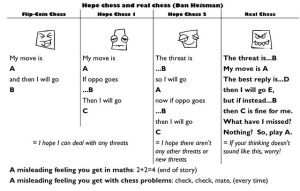
Flip-Coin Chess, Hope Chess and Real Chess (after Dan Heisman)

Unless you’re playing Real Chess, every move, you will be
accident-prone.  It’s slow for us, I think, when GMs seem to take
in so many tactics at a glance, but the ideas are not complicated, we
just need to be consistent and to be thorough.

Chess is unlike the ‘white to play and win’ problems from books and
magazines, where there is a right answer which you may be able to spot
quickly, and where you might spot the first move almost
instantly.
Mistrust what you think, as your opponent will surely try to find out
what is wrong with it.

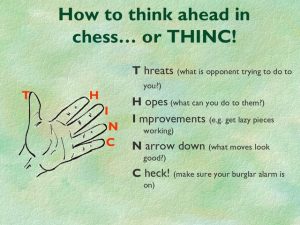
A thinking mnemonic (the least we have to do)

A thinking process (the best you can do)

Do you know how to analyse?

“Recently I was invited to the closing ceremony of a team tournament in which candidate masters and first-category players were playing. I asked my audience what they would like me to talk to them about, and I was inundated with requests. Some asked me to demonstrate some
interesting combination, others wanted to know how to play the Sicilian Defence correctly for Black. `But do you know how to analyse variations?’ I asked my listeners, and without giving them time to reply went on, `I will show you how to analyse variations and if I’m wrong, then stop me. Let us suppose that at one point in your game you
have a choice between two moves, R-Q1 or N-KN5. Which should you play?’
You settle down comfortably in your chair and start your analysis silently saying to yourself the possible moves.

`All right, I could play R-Q1 and he would probably play B-QN2, or he could take my QRP which is now undefended. What then? Do I like the look of the position then?’ You go one move further in your analysis and then you pull a long face–the Rook move no longer appeals to you.
Then you look at the Knight move. `What if I go N-KN5? He can drive it away by P-KR3, I go N-K4, he captures it with his Bishop. I recapture and he attacks my Queen with his Rook. That doesn’t look very nice … so the Knight move is no good.

Let’s look at the Rook move again. If he plays B-QN2 I can reply P-KB3, but what if he captures my QRP. What can
I play then? No, the Rook move is no good. I must check the Knight move again.  So, N-KN5, P-KR3, N-K4, B x N, Q x B, R-Q5 No good! So I mustn’t move the Knight. Try the Rook move again. R-Q1 , Q x RP.’

At this point you glance at the clock. `My goodness! Already 30 minutes gone on thinking whether to move the Rook or the Knight. If it goes on like this you’ll really be in time trouble. And then suddenly you are struck by the happy idea — why move Rook or Knight? What about B-QN1?’ And without any more ado, without any analysis at all you move the Bishop. Just like that with hardly any consideration at all. My words were interrupted by applause. The audience laughed, so accurate was my picture of their trials and tribulations.”

Think
Like A Grandmaster
, Alexander KOTOV (Tr. Cafferty)
A good model

Positions A-C are taken from de Groot’s PhD study in the 1930s
(published as Thought and Choice in
Chess
, 1946), and Dan Heisman has used the other positions in
the
same way, as reported in his recent book The Improving Chess Thinker.
This was Max Euwe’s
approach to position A, which might be a model for how to approach a
fairly lively position.

(G5; A) S: MAX EUWE E: DE GROOT
T = 15 MINUTES DECEMBER 15, 1938
(
Italics
are
for
tactual
clarity
and
do
not
represent
G5’s
emphases.)


Algebraic


Euwe’s verbalisation


Comments


First impression: an isolated Pawn; White has more freedom of
movement.

Orientation (de Groot);
Evaluation (Heisman)

…Qxb2
a3

2.Nxd5
a3
f6
e7
…Qxb2
a2

Black threatens…QxNP. Is it worthwhile to parry that? It
probably is; if he takes, then QR3 is also attacked. Can White then
take advantage of the open file? Does not look like it. Still again
2.NxB and then by exchange the Pawn at QR3 is defended by the Queen.
Indirectly in connection with the hanging position of the Knight at KB6
and possibly because of the overburdening of the Bishop at K7. But wait
a moment: no, …QxNP is rather unpleasant after all because the Bishop
at R2 is undefended. Can I do something myself?

Consider opponent’s threats (Heisman)


Threats

f6 & d5

Investigate that first: the pieces on KB6 and Q5 are both
somewhat tied down.


Let us look at the consequences of some specific moves.

Exploration (de Groot)

1.Nxd5, 1.Nxc6

1…Rxc6

1.NxN, possibly preceded by 1.NxB. Then 1…RxN is probably
impossible because of taking on Q5.


Hopes


Black has a number of forced moves, there may be a possibility
to take advantage of that.


It’s not yet quite clear.


1.Bh6 f7

Let us look at other attacks: 1.B-R6 in connection with KB7 –
but I don’t really see how to get at it.


1.b4
1…Nxc3 / 2…Bb5

2.Qxc3

1.P-QN4 in order to parry the threat – but then exchange on
QB3 will give some difficulties in connection with 2…B-N4 – oh, no,
that is not correct, one can take back with the Queen.


1.Nxc6
1.Nxd5
1.Bxd5
1.Bxf6

So far a somewhat disorderly preliminary investigation. Now,
let’s look in some more detail at the possibilities for exchange: 1.NxB
or 1.NxN or maybe 1.BxN/5 or maybe first 1.BxN/6

Investigation (de Groot).

Candidate moves (Heisman).

All forcing moves (Heisman); note the order – the most
positionally desirable first.

1.Nxc6 Rxc6
2.Nxd5 exd5 b2
2…Nxd5 3.Bxd5 Rxc1 / 3…Bxg5
1…bxc6

1.NxB RxN; 2.take on Q5; for instance 2.NxN PxN; wins a Pawn
but there may be compensation for Black on QN2. But better is 2…NxN;
then 3.BxN RxR is nearly forced, no, it is not, he can play 3…BxB as
well. I see no immediate advantage. 1…PxN is not forced therefore;
and even if it were, you couldn’t be quite sure of winning. It’s
happened before that such a position proved less favourable than at
seemed to be. The point Q5 is reinforced by it, that is a disadvantage.


1.Nxc6

(So let’s think about) 1.taking on Q5. 1.NxB at any rate gives
the pair of Bishops; if I don’t find anything better, I can always do
this.

Bookmarking ‘best so far’.

1.Nxd5 Bxd5 d7
2.Bxf6 Bxf6 3.Nd7 Qd8

1.NxN, BxN; is that possible? Q7 is free then. 2.BxN, BxB/3;
3.N-Q7, Q-Q1 can then be done.


1.Nxd5 Bxd5
2.Bxf6 Bxf6

1…Nxd5 2.Bxd5
Bxg5/ c6 / f2-f4

1.NxN, BxN; 2.BxN, BxB/3 will probably yield something.
1…NxN is also possible; maybe better. Then 2.BxN BxB/5 and now there
are the possibilities to take on QB6 or to play something like P-B4;
once again:


1.Nxd5 Nxd5
2.Bxd5 Bxg5
3.Rxc6 2.Bxe7 1…exd5

1.NxN NxN; 2.BxN, BxB/5 – no, nothing then, 3.RxB does not
help any; it is a cute move but at the end of it all everything remains
hanging. Something else: 2.BxB – he just takes back. 1…PxN is very
favourable; he won’t do that; it needn’t be investigated.


1.Nxd5 Nxd5
2.Bxd5 Bxg5
3.Bxc6 Bxc1

1…Nxd5 2.Bh6 Red8 3.Qf3
e8

1.NxN NxN remains. 2.BxN BxN; 3.BxB, BxR is then possible. No,
can find no way to make anything out of this. 1…NxN; 2.B-R6, KR-Q1;
3.Q-KB3 with some threats; if Black now has to play his Bishop back to
K1 then one gets a good position.


1.Bxd5
1.Bxd5 Bxd5
2.Nd7
2…Bc4

1.Bxd5 Nxd5

2.Nxd5

1.BxN/5: this must be looked into. Does that make any
difference? 1.BxN/5, BxB is again impossible because of 2.N-Q7. That is
to say, we will have to look out for 2…B-B5, but that we can probably
cope with: the worst that can happen to me is that he regains the
exchange, but then I have in any case some gain of time. 1.BxN/5, NxB;
2.Same difficulties as just before. No, that is now impossible: 2.NxN
wins a piece.


1.Bxd5 Bxd5
2.Bxf6 Bxf6
3.Nd7 Qd8
4.Nxd5 exd5
1.Bxd5 exd5
f6 / e7 / c6 1.Bxd5

1.BxN/5, BxB; 2.BxN, BxB; 3.N-Q7, Q-Q1.Let’s have a closer
look at that: 4.NxB/5, PxN and I’m an exchange to the good: very
strong. 1.BxN/5, PxB is therefore forced. But that is good for White.
The Knight on KB6 is weak, the Bishop at K7 hangs – and the Bishop on
QB3 stands badly. On positional rounds one could already decide on
1.BxN/5. Is there some immediate gain?


1.Bxd5 exd5

2.Qf3 f6
2…Kg7

1.Bxd5

1.BxN/5, PxB; it looks bad for Black. Probably some more
accidents will soon happen. Much is still up in the air. One plays, for
instance, 2.Q-B3. Defending the Knight on KB6 is not so easy; 2…K-N2
looks very unpleasant. Yes, I play:

1.BxN/5.

Proof (de Groot)
Check

Not sure how good it is, but is sure that it’s
good and is better than the rest! (Heisman)

Euwe discounts the possibility that a
non-forcing move will be any better. (Heisman)
Improve

To be honest, not every GM analysed so long or in such an orderly
manner; you almost got the idea that Fine homed in on Bxd5 in the first
minute or so and spent the rest of the time justifying it!  But if
you don’t have his judgment or intuition, try Max’s approach.

Tips for thinking

Lots of ideas there: candidate moves, bookmarking, looking at
forcing moves and generally desirable moves, trying things in different
orders…  Here’s a set of tips.

  • Unhelpful thinking habits
    • Overlooking key features of the position
    • Thinking for yourself, not your opponent
    • Playing without a plan (and playing by general principles more
      than the position in front of you, and playing openings without
      understanding the ideas)
    • Endgames are boring and complicated
    • Wishful thinking (also anxiety, haste, vagueness, confusion and
      simple-mindedness)
  • Helpful thinking habits
    • List all the candidate moves to start with and look at them all
      quickly first
    • Look at forcing moves first
    • Try different move orders
    • Check moves before you play them (this doesn’t mean go round in
      circles – decide first, then check!)
    • Exchanges are just moves: don’t prefer or avoid them without a
      reason
    • Good positions don’t win games – good moves do
    • “Play a move which improves your position no matter what.” –
      SILMAN
    • Expect your opponent to play the best move
    • Take nothing for granted
    • Set priorities:
      • Opponent’s threats rather than your dreams
      • Pieces rather than Pawns
      • Sooner rather than later
      • Flexible rather than committal
      • Central rather than wing play
      • Preventable before inevitable

Instead of a conclusion:

I think this sort of exercise is useful.  Repeat once in a
while, and see if your thinking process gets any better.

The Secret of Not Losing

With my newly published plumetting grading, it is clear that I haven’t yet got the hang of this… Anyhow, in the Introductory Session in June this year, I asked everyone to name the three main reasons you lose chess games. These turned out to be:

GENERAL ATTITUDE

  • Moving rather than taking more time
  • Poor psychology: making mistakes and then making worse ones
  • Letting my opponent off when I was ahead on material with a better position

EXAMPLE GAMES:

  • I fail to win with an extra piece:
    • Watson C. – Regis D. [A40]
  • I manage to lose with the exchange:

    General advice:

    This is a list of symptoms, not diseases. The disease may be… relaxing? …wishful thinking? But it needs a good hard look at yourself to find the disease, which may be a long step towards curing it. Why are you making these mistakes, what are you doing that is wrong, what are you not doing that would be right? Is there a point you can identify in a game where you chose a wrong move or plan, and can you recall what you were thinking or saying to yourself at the time?

    Further study:

    Try WEBB: Chess for Tigers

    • Regis D. – Seipel H. [D14]

THINKING PROCESS

  • EXAMPLE GAMES for analysis and playing out:

    • Blunders — mainly after 1 hour+ — due, I suspect, to lack of recent practice
    • Careless loss of material
    • Miscalculation (poor vision)
    • Playing a middlegame sequence in the wrong order
    • Running out of time
  • Positions for analyis:
    • britton – nunn i. [B06]
    • polugaevsky – nunn [A77]
  • Positions for playing out:

    General advice:

    [This set of symptoms may be related to themes in the last and the next category.]

    I struggle with this issue constantly myself; I expect I do best when I practice, with slow games against real people, and faster games against computers who of course are utterly unforgiving of errors…

    The main thing to do with blunders is to look: make the first and last thing you think about be, what are they threatening? and having chosen a move, what do they threaten now?  You might have a look at some of the thinking schemes laid out by Purdy and Silman, reviewed in last year’s programme: 17th July 2007: A thinking process

    The other thing I think makes a difference is getting a tournament in early in the season, so I’m up to speed when I take on the less frequent club and county games. There aren’t very many books which particularly focus on analysis (as opposed to the ‘spot the bonecrusher’ tactics books); Dvoretsky recommends ‘playing-out’ positions chosen from fiendishly complicated games, and points to a couple from Nunn.

    Further study:

    KOTOV: Think like a Grandmaster

    NUNN/GRIFFITHS: Secrets of Grandmaster Play

    JACOBS: Analyse to win

    Simon I know likes flexing his analytical muscles against the deceptively simple-looking compositions of endgame studies.

    • borkowski – nunn (NUNN&GRIFFITHS/DVORET [B09]
    • corden – nunn b. [C55]
  • John Nunn’s favourite study: a whole-board tactics workout!One naturalistic approach is found in the ‘How Good is Your Chess’ features in Chess magazine, where you are thrown a sequence of strategic and analytical decisions, rather like a real game.  Dvoretsky’s famous Secrets of Chess Tactics throws you a succession of problems and exercises in a rather unstructured way; you might find some of the examples too chewy.
    • RB – BB

Further study:

TROITZKY: 360 Brilliant and Instructive End Games

BARDEN: How Good Is Your Chess

KING: How Good Is Your Chess

DVORETSKY: Secrets of Chess Tactics

EGOISM

EXAMPLE GAME: Short-Belyavsky (Helpmate in 2)

General advice:

In a sense, if you could cure this problem, itwould be impossible to lose a game of chess.  Underestimating your opponent or their resources is really the only mistake we ever make… So this is going to be a tricky one to solve!

However, there are some useful routines to get into.  A junior player might do well just to say to themselves as the FIRST and LAST thing they think about when it’s their turn: “What can my opponent do to me now? What can they do to me if I make this move?”  Adults might have a look at some of the thinking schemes laid out by Purdy and Silman, reviewed in last year’s programme: 17th July 2007: A thinking process

Further study:

Try PURDY: The Search for Chess Perfection

or SILMAN: Reassess your chess

STRATEGY

EXAMPLE GAME: Pope (not that one) -Regis

  • Moving without working out what my opponent can do in reply
  • Not seeing the opponent’s intended move
  • Not being completely aware to what my opponent up to
  • Short N. – Beliavsky A. [C48]
  • Lack of strategy
  • Not looking for outposts enough
  • Moving pieces which leave holes in my position
  • Failure to spot strategic weaknesses early enough
  • A masterly example:
    • Kramer – Euwe [E28]
  • Read and learn:
    • pope m. – regis d. [A25]

A game for playing-out:

General advice:

I am inclined to think that simple strategy is easier to teach than tactics; the general structural feaures of a position hang around for a long while and club players seem quite good at listing these features when asked.  The hard thing is making your knowledge work in a real game.  The main things are to learn to identify the key features, to make a reasonable plan, and develop enough technique to exploit an advantage.  Silman has done some interesting work in ‘playing-out’ of strategical positions with his students, which you could try for yourselves.

Further study:

Try CHERNEV: Logical Chess

EUWE/KRAMER: The Middlegame Vol.1

SILMAN: Reassess your chess

GOLOMBEK: Capablanca’s Best Games

OPENINGS

EXAMPLE GAMES:

  • Alekhin A. – Euwe M. [A48]
  • Opening inaccuracy
  • Inferior opening preparation
  • Poor openings
  • In opening, occasionally make over-easy moves which weaken my position
  • The worst opening I ever had:
    • Headlong T. – Regis D. [D40]

Maybe the best:

  • Regis D. – Lane P. [A26]

General advice:

It’s as simple as ‘Study and practice your openings’.  Study with books (the fewer the better) and practice at the club or online or against a machine. Find a player who uses your favourite openings and play over some games by them; I like Botvinnik.

I would be delighted to give your repertoire an MOT.

Further study:

Under 100

Try WALKER: Chess openings for juniors

KEENE/LEVY: An opening repertoire for the attacking player (1977) (Scotch Gambit, Pirc, and Benko Gambit)

100-125

1.e4 Try

    KEENE/LEVY: An opening repertoire for the attacking player (1994) (Scotch Game, Scandinavian, and Tchigorin Defence)

    EMMS: Attacking with 1.e4 (Bishops’ Opening, Closed Sicilian, French KIA)

    RAETSKY: Defending against 1.e4 (Sicilian Four Knights’)

1.d4 Try KEENE: An opening repertoire for White (Queen’s Gambit Exchange Variation)

    SUMMERSCALE: A killer opening repertoire (Colle-Zukertort)

    DUNNINGTON: Attacking with 1.d4 (Queen’s Gambit Exchange Variation)

    AAGAARD/LUND: Defending against 1.d4 (Tarrasch Defence)

125-150

Try three single-volume opening books on your main White or Black openings.  I rely on KOSTEN: English Opening, WATSON: Play the French and WILLIAMS: Play the Classical Dutch. (I would eschew a video [poor value] but CDs are fine if you get on well with screens.)

There are opening books out there which I don’t recommended:

GUFELD: An opening repertoire for the attacking player (Vienna, Sicilian Dragon and Leningrad Dutch) [a maze of complex variations suitable only for a computer or a GM]

BAKER: A startling opening repertoire for White (Scotch Gambit/Max Lange, Sicilian sidelines and French Two Knights’) [again, very variation-heavy, I can’t imagine anyone going through all this detail and retaining any of it.]

COLLINS: A White opening repertoire (Scotch Game, Alapin Sicilian and Advance French) [unforgivably careless [p.15: exactly how do you reply to 15…Be6 16.O-O Nc4?*], and someone should shoot the editor too] (* P.S. I discover he reveals all(?) in his book on the c3 Sicilian for Gambit)

ALBURT et al.: Chess Openings for White, Explained (Scotch Game, Sicilian Grand Prix and Classical French) [“The main point is not that so many of the lines the authors have given us above are bad, or ineffective, although that is certainly an issue. Rather, it’s the lack of integrity throughout.” — WATSON]

ALBURT et al.: Chess Openings for Black, Explained (Accelerated Dragon and Nimzo-Indian) [I can’t guarantee this is any better.]

ATTACK AND DEFENCE

EXAMPLE GAMES: first, preparation to the max!

  • Hayes R. – Juhasz M. [A02]

well, it was Kriegspiel…

  • Playing unsound attacks
  • I can be over-keen to attack, i.e. launch an attack before I’ve prepared the necessary back-up
  • Over-extension in the middle-game (trying too hard to win)
  • Getting shafted on the diagonals
  • The attack works (1):
    • Lane P. – Regis D. [A42]
  • The attack works (2):
    • Regis D. – Helbig P. [A42]

General advice:

The affliction needs only be named for a treatment to suggest itself: “Set up your attacks, so that when the fire goes out, it isn’t out!” (Pillsbury).  However, it might not be so easy to learn how to do that… Playing over example games in the usual intructional books I’m sure will go a way to giving you a feel for it, as well as games by great attackers like Pillsbury, Marshall, Tal, Fischer, Stein and even Nezhmedtinov.  [These GM games will be more close to call than anything we play, of course.]

Further study:

Try WALKER: Attacking the King

CHERNEV: Logical Chess

COZENS: Lessons in Chess Strategy

VUKOVIC: The art of attack

BIBLIOGRAPHY

I was glad you all had an opinion about what were the most common reasons that you lose games.  Self-criticism, or at least self-awareness, is the starting point for improving.

“I’m going to stop saying I’ll kill him, and kill him!” — Sid James as Sid Abbott in Bless This House

Turning intention into action is a puzzle I have been battling with personally and professionally all my life…

“Ask yourself the following question, “Of all the games I have lost recently, what percent were lost because of something I did not know, and what percent were lost due to something I already knew, but were not careful to look for?” ” — HEISMAN

ZNOSKO-BOROVSKY: How NOT to play chess

HARDING: Why you lose at chess

SOLTIS: Chess Mistakes

HEISMAN: The Improving Annotator

BAKER: Learn from your chess mistakes

SILMAN: The Amateur’s mind

ROWSON: The Seven Deadly Chess Sins

Click […] for list of games

Openings Workshop 2010

[Games are appended]

The simpler and more specific queries were dealt with first:

Some introductory remarks

Some signs of trouble:

EG: Two recent dismal examples – Exeter Chess Club [D10]

A problem in the Stonewall Attack

Maybe the answer is a different system!

EG: Stonewall Attack – Dilemma [D05]

Defending against the King’s Gambit

Some ideas for Black

EG: King’s Gambit – Suggestions for Black [C35]

The Sicilian for beginners

The Sicilian is not for beginners!

EG: Starting out with – the Sicilian [B92]

The Slav for beginners

Learn at least a few moves of an opening to play against 1.d4

EG: Queen’s Gambit – Slav for Beginners [D48]

Benonis

There is no guaranteed route to happiness…

EG: Approaching the – Benoni [A43]

The Reversed Sicilian

If the Sicilian is the best defence, why isn’t the English the best opening?

EG: English Opening – Sicilian Reversed [A29]

Defences that work against 1.d4 and 1.c4

The Tarrasch and the Stonewall Dutch

EG: English Opening – Stonewall Dutch T. [A90]

Click on […] to see games list.

The initiative

20th_July_2010: Initiative

[Fixed 30 Apr 2020 – replaced PalView games with inline PGN]

Half a story

Some things in chess are very concrete and visible — checkmate, or
a
knight fork, perhaps, or as we get better, we can also see superior
development or pawn weaknesses.  There are more abstract features
of a chess game which are less easy to see, at least at a glance, and
you can appreciate best over a whole game or a part of a game. 
Annotators often talk about a player’s ‘feel for the initiative’, which is
at least a warning that this is not going to be an easy session.

Half a story

For a long while, I understood only half the story of chess. 
From the introduction to Michael Stean’s excellent little book Simple Chess:

“Don’t be deceived by the title–chess is
not a simple game–such a claim would be misleading to say the
least–but that does not mean that we must bear with the full brunt of
its difficulty. When faced with any problem too large to cope with as a
single entity, common sense tells us to break it down into smaller
fragments of manageable proportions. For example, the mathematical
problem of dividing one number by another is not one that can in
general be solved in one step, but primary school taught us to find the
answer by a series of simple division processes (namely long division).
So, how can we break down the ‘problem’ of playing chess?

“Give two of the uninitiated a chessboard, a set of chessmen, a list of
rules and a lot of time, and you may well observe the following
process: the brighter of the two will quickly understand the idea of
checkmate and win some games by 1. e4 2. Bc4 3. Qh5 4. Qxf7 mate. When
the less observant of our brethren learns how to defend his f7 square
in time, the games will grow longer and it will gradually occur to the
players that the side with more pieces will generally per se be
able to force an eventual checkmate. This is the first important
‘reduction’ in the problem of playing chess–the numerically superior
force will win. So now our two novices will no longer look to construct
direct mates, these threats are too easy to parry, but will begin to
learn the tricks of the trade for winning material (forks, skewers,
pins, etc.), confident that this smaller objective is sufficient. Time
passes and each player becomes sufficiently competent not to shed
material without reason. Now they begin to realize the importance of
developing quickly and harmoniously and of castling the king into
safety.”

“So what next? Where are their new objectives? How can the problem be
further reduced? If each player is capable of quick development,
castling and of not blundering any pieces away, what is there to
separate the two sides? This is the starting point of Simple Chess.
It
tries
to
reduce
the
problem
still
further
by
recommending
various
positional
goals
which
you can work toward, other things (i.e.,
material, development, security of king position) being equal. Just as
our two fictitious friends discovered that the one with more pieces can
expect to win if he avoids any mating traps, Simple Chess will
provide him with some equally elementary objectives which if attained
should eventually decide the game in his favor, subject to the
strengthened proviso that he neither allows any mating tricks, nor
loses any material en route. “

“Essentially, Simple Chess aims to give you some of the basic
ideas for forming a long-term campaign. It also shows you how to
recognize and accumulate small, sometimes almost insignificant-looking
advantages which may well have little or no short-term effect, but are permanent
features of the position. As the game progresses, the cumulative effect
begins to make itself felt more and more, leading eventually to more
tangible gains. Combinations and attacks are shelved for their proper
time and place as the culmination of an overall strategy. Given the
right kind of position it is not so difficult to overwhelm the
opposition with an avalanche of sacrifices. The real problem is how to
obtain such positions. This is the objective of Simple Chess.”

These permanent (or at least long-term) features of the position
that he discusses are things like open files, outposts, colour
complexes, space.  We might think about different levels of chess:
Scholar’s Mate (Level 1), tactics (Level 2), opening principles (Level
3), and now positional elements (Level 4).

With this firmly in mind, how can we explain Alekhin’s 9th move here?

Alekhin 
–
Poindle
[C67]
(simul.)
1936

1.e4 e5 2.Nf3 Nc6 3.Bb5 Nf6 4.0-0 Nxe4
5.d4 Nd6 6.dxe5 Nxb5 7.a4 Nd6 8.exd6 Bxd6 9.Ng5

This move is not possible to understand in terms of the first four
levels of chess.  In fact, it directly contradicts the opening
principles that we have learned, like don’t
move
any
piece
twice
until
you
have
move
every
piece
once
. 
Alekhin judges that straightforward
development (e.g. Re1+) would have allowed Black time to get sorted out
– this move
denies Black that time.  Threat follows threat, and Black can
never settle.

    EG:

  • Alekhin – poindle [C67]

Alekhin-Poindle

So, brace yourself for Level 5: dynamic chess.

The Initiative: definition and
description

The initiative is the capacity to
make threats
.

“As the pieces are set on the board
both
sides have the same position and the same amount of material. White,
however, has the move, and the move is this case means ‘the
initiative’, and the initiative, other things being equal, is an
advantage. Now this advantage must be kept as long as possible, and
should only be given up if some other advantage, material or
positional, is obtained in its place. White, according to the
principles already laid down, develops his pieces as fast as possible,
but in so doing he also tries to hinder his opponent’s development, by
applying pressure wherever possible. He tries first of all to control
the center, and failing this to obtain some positional advantage that
will make it possible for him to keep on harassing the enemy. He only
relinquishes the initiative when he gets for it some material advantage
under such favorable conditions as to make him feel assured that he
will, in turn, be able to withstand his adversary’s thrust; and
finally, through his  superiority of material, once more resume
the initiative, which alone can give him the victory. This last
assertion is self-evident, since, in order to win the game, the
opposing King must be driven to a position where he is attacked without
having any way to escape. Once the pieces have been properly developed
the resulting positions may vary in character. It may be that a direct
attack against the King is in order; or that it is a case of improving
a position already advantageous; or, finally, that some material can be
gained at the cost of relinquishing the initiative for a more or less
prolonged period.”

— Capablanca in Chess Fundamentals, Chapter 4.

Examples: from initiative to attack

“The
main objective of initiative play is not so much to force the win but
rather to prevent your opponent from equalising.” — Colin
Crouch, Attacking Technique.

EG:
Akesson-Morozevich.

  • Akesson R. – Morozevich A. [D02]

EG: Tal-Simagin.

  • Tal – simagin [B07]

Quieter forms of the initiative

This is much less exciting, but Black
may also struggle to equalise in quieter positions

  • Hort V. – Polugaevsky L. [B22]

EG: Hort-Polugaevsky

Relinquishing initiative

I
haven’t found it so easy to find examples of this feature, which seems
so obvious.
  Anyone?

EG: Winawer-Zukertort

  • Winawer S. – Zukertort J. [C49]

EG: Capa – allies

  • Capablanca – Salwe and allies [C83]

I know
a young nman who often loses the initiative, having got a winning
material advantage, and the consequences are sometimes painful to watch:

EG: Malam-Slade

  • Malam J. – Slade T. [C02]

The foundations of initiative
(activity, King safety, structure and space)

Initiative based on
superior piece Activity

We’ve seen Moro on the rampage, here’s a simpler one:

EG:

  • Kramer – Busek [D94]

Kramer-Busek

Initiative based on
opponent’s unsafe King

EG: Lasker-Pirc

  • Lasker – Pirc [B85]

Initiative based on superior
Structure

EG: NN-NN

Initiative based on Space

Another form of structural advantage, I guess.  Many games won
on the basis of space can be thought of as having an element of
initiative to them: the side with the extra space can organise threats
much more easily, even if they can’t at first break through.

EG:
Fischer-Gheorghiu

  • Fischer R. – Gheorghiu F. [C42]

Losing the initiative when you have more space is awful; you’re
defending a much longer line, that is well within reach of your
opponent.

EG:
Webb-Hartston

  • webb – hartston u. [A31]

You will notice that I have so far drawn example from master play;
club
games tend to be cluttered with so many errors in tactics and strategy
that the issue of the initiative is lost in the fog.   But
among the top county players you can see the pursuit of a persistent
initiative in
good style, and I watched one this year:

Mackle,D – Edgell,B [E18]

Devon vs Gloucestershire (1), 2009

1.d4 Nf6 2.Nf3 e6 3.c4 b6 4.g3 Bb7 5.Bg2 Be7 6.Nc3 Ne4 7.Nxe4 Bxe4 8.0-0 0-0 9.Bh3 d6 10.Nd2 Bb7 11.e4 c5 12.d5 exd5 13.cxd5 Bf6 14.Re1 Nd7 15.Bf1 a6 16.a4 Ne5 17.f4 Ng6 18.Nc4 b5 19.axb5 axb5 20.Rxa8 Bxa8 21.Ne3 c4 22.b3 cxb3 23.Qxb3 Qa5 24.Re2 Rc8 25.Rc2 Rxc2 26.Nxc2 Bd8 27.Bxb5 Bb6+ 28.Kg2 Bb7 29.Qc4 Ne7 30.f5 Bc5 31.Qd3 f6 32.Bd2 Qa2 33.Bc4 Qb1 34.Ne3 Qb2 35.Nd1 Qa1 36.Bc3 Qc1 37.Bb2 Qg5 38.h4 Qh5 39.Qe2 Qxe2+ 40.Bxe2 Kf7 41.g4 h6 42.Nf2 Nc8 43.g5 hxg5 44.hxg5 fxg5 45.Bh5+ Kf8 46.Nh3 Ne7 47.Nxg5 Bc8 48.f6 gxf6 49.Bxf6 Bd7 50.Kf3 Nc8 51.Bg6 Ba3 52.Nh7+ Kg8 53.Bd4 Ba4 54.Nf6+ Kf8 55.Bf5 ½-½

The psychological initiative

Jonathan Rowson is always interesting to read, and he does not
disappoint in his chapter on the initiative (Chess for Zebras).  However,
he ends up folowing Suba in saying that the initiative is largely
psychological in nature.  I don’t deny that the initiative has
strongly psychological elements, but there is something on the board
too. 

Rowson (and I) find this easiest to see in those games where White
tries to attack Black’s position from the first move, say, in the sharp
main lines of the Najdorf.  Black can always find a defence after
the game, but during a game it’s not so easy.

The struggle for the initiative in
the opening

Alekhin’s
defence:
1.e4 Nf6 “White has
his initiative
to defend” — Tartakower.


The opening can be played to seek an
advantage in development, or space, or both, but some lines cannot be
understood except as a struggle for the initiative.  In many
modern variations this makes for very sharp play, and some ‘unnatural’
moves.
  The main lines
of the Najdorf, an opening we looked at earlier, have this quality.

EG: Sicilian Najdorf

EG: Fischer-Tal

  • Fischer R. – Tal M. [C17]

The initiative can be more
important than general opening guidelines

EG: Alekhin-Wolf

  • Alekhin – wolf [D34]

The initiative
can be more important than material

Kasparov did some video interviews a while ago, and John Watson
commented in his review “Kasparov
also believes
that the new generation of the 90s plays a different kind of chess than
that of the 80s, believing that ‘initiative can be worth material’.
”
This
comment
is
utterly
lacking
in
historical
subtlety. 
Alekhin’s
quest
for
the
initiative often took precedence over material, and I can
think of a few of Capablanca’s games where his initiative won out over
a lost pawn. More recently, Alexei Suetin’s book Modern Chess Opening Theory,
translated by our very own David Richards, gave many examples of
material sacrifice for the initiative.  Perhaps the top players of
the 1990s extended the range and daring of such sacrifices for the
initiative, but it is hardly a new insight. 

EG: Marshall-Capa

  • F.J. Marshall – J.R.C. [D64]

EG: Nimzo-Capa

  • Nimzowitsch A. – Capablanca J. [C62]

EG:

  • Modern Chess Opening Theory – NN [B34]

initiative in the
opening & a pawn sacrifice for White (Suetin)

EG:

  • Kasparov G. – Petursson M. [D15]

a pawn sacrifice for initiative in the
opening for White (Kasparov: Geller-Tolush gambit)

EG: a pawn sacrifice for initiative in the
opening for Black (Browne: Benko gambit)

  • Lorinczi P – Browne Walter S [A58]

EG: other sacrifices of material for
initiative (Bronstein: exchange sac in the Grunfeld)

  • Bronstein D. – Boleslavsky I. [D89]

EG: not enough initiative

  • Novopashin A. – Kortschnoj V. [B97]

(Korchnoi:
Poisoned pawn)

“I like to coax my opponents
into attacking, to let them taste the joy of the initiative, so they
may get carried away, become careless and sacrifice material.”

— Korchnoi

The
struggle for the initiative in the middlegame

EG: Spassky-Tal

  • Spassky B. – Tal M. [E31]

The initiative can be more
important than structure

A revealing moment:

EG: Fischer-Larsen

  • Fischer R. – Larsen B. [B77]

Defending against the initiative


Defence is another session or three, but to some extent it depends on
your style: do you prefer to defend in an active, enterprising,
opportunistic, counter-attacking style (Lasker, Kasparov, Korchnoi) or
is it more your style to be solid, gritty and patient? (Capablanca,
Petrosian, Karpov)  Of course, all the best players can play how
they like, and it’s hard to put the latest generation (Kramnik,
Topalov, Anand, Carlsen) into pigeonholes.

I mentioned last time Karpov’s tenacity in defence: strengthening his
position where he can, challenging and exchanging his opponent’s strong
pieces, making progress with his own ideas when given a chance; here’s
an example.

EG: Timman-Karpov

  • Timman J. – Karpov A. [E30]

Defensive sacrifices

I was very struck, following the first Karpov-Kasparov encounter, in
how many games Kasparov sacrificed a pawn.  We have seen an
example of him doing so when trying to win, but he also uses the same
device when trying to get enough counterplay to hold the balance.

EG:

  • Karpov A. – Kasparov G. [D87]

  • Karpov A. – Kasparov G. [D55]

Karpov-Kasparov 85

Turning points of a game


…may be seen in the transfer of the initiative.  John Watson in Secrets of Modern Chess Strategy

talks for a while about the ebb and flow of initiative in modern chess,
but without an example to support his highfalutin talk.  It is
difficult to find games where the initiative is exchanged as a result of good play based on
the features of the position, rather than losing the initiative because of a
second-rate move.  Anyhow, here is a game where we see an exchange
of the initiative; play it through and see if you can ‘feel’ who is
pressing.

EG:

  • Karpov A – Kasparov G [D97]

Karpov-Kasparov 87

At club level it’s even harder to find games where the initiative might
go back and
forth as a result of something other than errors, but try this one,
perhaps:   

EG: Regis-Littlejohns

  • Regis D. – Littlejohns D. [B14]


Further reading
:

Dvoretsky in School of Chess
Excellence, vol.3
, says something characteristically sniffy
along the lines of ‘annotators often
mention the initiative, so you can tell it’s important, but hardly
anybody
has written anything good about it…
‘ and then offers a couple
of
chapters of his own.  But don’t start there!  His books
feature a
succession of very complicated examples which I expect are just the
thing that aspiring IMs should study if they want to be GMs, but are
generally hard to make use of if you aren’t that good yet. 

Nonetheless, I think an understanding of the initiative is useful
for
club players.  Fortunately, Dvoretsky is quite wrong to say that
there
is nothing worth reading on the subject; besides the references
mentioned above, Max Euwe
dealt very well with it in his Middlegame
books with Kramer, and Hansen’s more recent chapter in Improve your Positional Chess uses
very much the same framework.  I’ve also noticed (but not read) a
long chapter by Beim in How to Play
Dynamic Chess
.  Suba talks a lot about initiative in Dynamic Chess Strategy, a book that
I have struggled to get much out of; again, the talk floats a little
too high above the evidence.

[…] for game list; click H8 for help

A course in chess tactics

Short, violent games of chess, organised by theme


A bird’s eye view of repertoires

I’ve compiled a spreadsheet of recommended White repertoires from
Various books, websites and other sources; it is interesting that some sort of
consensus emerges, at least for the 1.e4 player, even though no one
book recommends the complete

  • st:
    • Main system: Scotch Four Knights’
    • Alekhin (1…Nf6): Exchange
    • Caro-Kann (1…c6): Panov-Botvinnik
    • French (1…e6): Tarrasch
    • Pirc/Modern (1…g6): 150 Attack
    • Scandinavian (1…d5): Main
    • nes
    • Sicilian (1…c5): Alapin 2.c3

    There’s some sort of theme there about looking for regular structures:
    there are IQP/hanging pawns structures around in several of the lines.
    I’d be interested to hear of any additions (or corrections — I don’t own all this stuff so I’ve had to take some of it from reviews and BB comments).

    repertoires
