…or thwim, as my old man used to say.
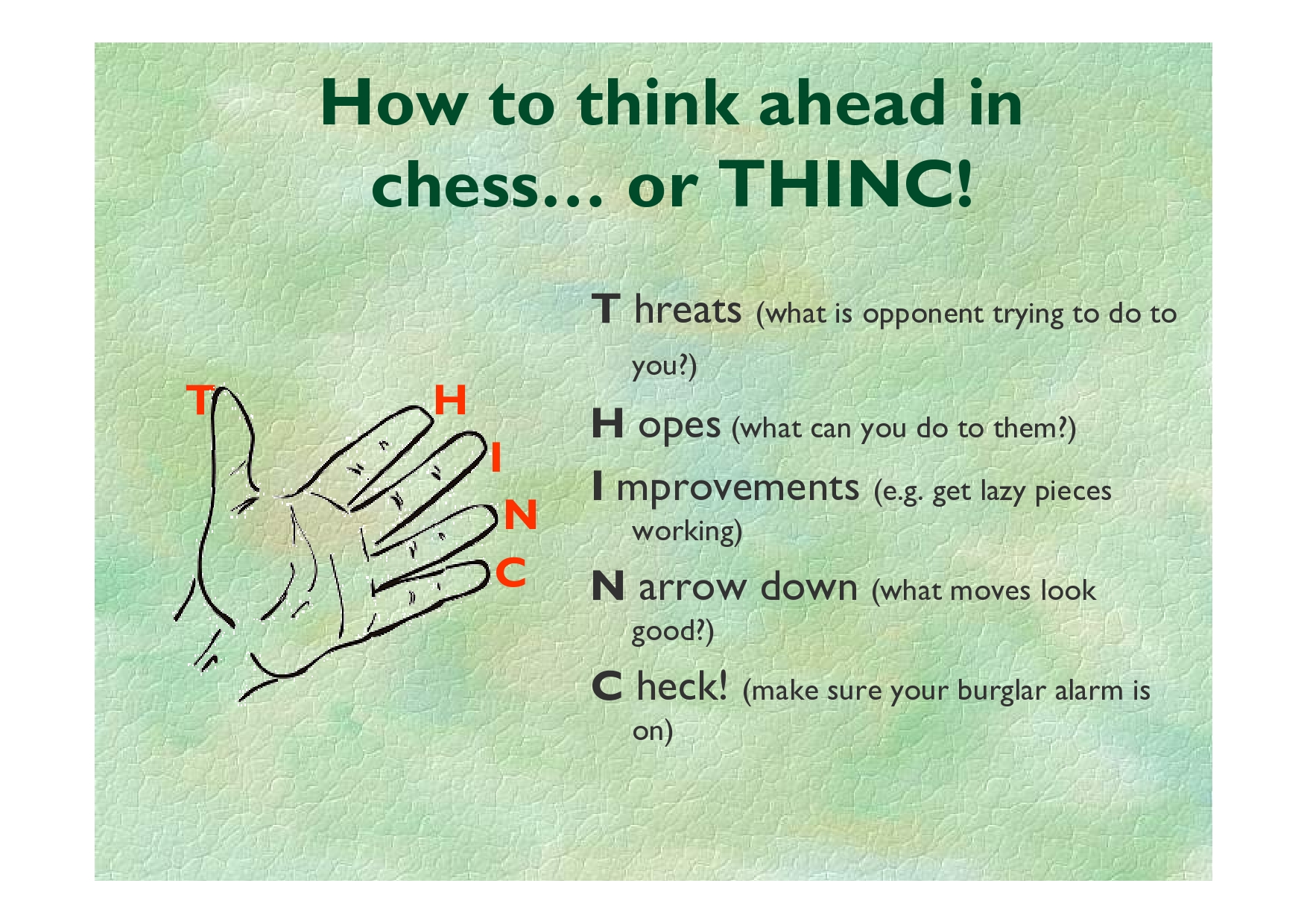

…or thwim, as my old man used to say.
I played at the East Devon Chess Congress earlier this year alongside my
longstanding friend and team-mate Charlie Keen. During a break between
games, we went over one of his encounters, looking for tips for next
time. The critical position was this one:
You might get more out of the discussion below, if you try and decide
for yourself what you would play here.
Decided? Now read on…
This was the game to that point:
Later I got this email:
“Please see attached, You had wondered if 23. fg was wrong, but in fact
it turns out that 20. g4 was wrong, and the annotated variation starting
20. Be2 is the way to play this position. 20. g4 cost 150cp and nearly
the game, but for the clock. You did not think twice about g4, nor did I.
How to spot this sort of error in advance?”
Never one to let a rhetorical question lie, let’s have a look, shall
we?
This was the game continuation:
This was Fritz’ recommendation, a pawn-and-a-half better in outcome,
according to Charlie:
[I will say my feeble old version of Fritz gives Charlie’s move as +1.0
and the alternative as +1.5.]
1. Just to remark before getting stuck in, no chess player can be
expected to get very far if they don’t “think twice” about their moves,
unless it is “QxQ checkmate”. There are pros and cons about many moves,
and often you have to take risks to beat opponents of a similar calibre
to your own, so thinking more than once is recommended on occasion.
(Chess is the art of creating positions that are too hard for your
opponents, but if your opponent is as good as you are, there’s probably
an element of risk involved…) On the other hand, the clock is ticking,
and there is pressure to play promptly, so let’s make the natural moves
quickly and think only when we have to…
2. Hindsight is a great teacher. Let’s look at the pros and cons of
that move 20.g4:
PRO:
Grabs space on the King’s-side
Prepares to grab more space on the King’s-side
Prepares to open lines on the King’s-side
Gains time by attacking the Knight
Forcing (so easy to analyse)
CON:
Abandons pawn control of f4
Prepares to open lines on the King’s-side (they are two-way streets!)
We can see with hindsight that the cons of the game continuation did
become manifest on the board. Thinking this way, hindsight today might
become foresight tomorrow. We might, indeed, spot the error in advance.
3. Is there anything general, and generalisable, that we can say about
the incorrect text move? And is there anything general, and
generalisable, about the correct Fritz suggestion?
If you had to describe the theme of the game, we might file it under
Attacking the King castled on the same side, which presents
problems when we are trying to open lines.
We can see in the Fritz line that Black got some counterplay when the
Black Queen was able to occupy the h-file before White.
Moreover, if you contrast the White and Black campaigns, you might say
Attacker and Defender. But let’s refine this to:
Attacking with Bishops and Defending with Knights.
In the game, Black’s Knight, solidly placed on f4, was a real nuisance
to White. We can also see in the Fritz line something of the generally
recommended strategy for fighting with Bishop(s) against Knight(s),
namely, the Knights must be denied stable squares. Here’s the technique
in a fairly pure form, although Steinitz later chose to swap the
advantage of Bishop over Knight for other chances:
With that discussion in mind, the strength of the Fritz line, and the
principles that underlie it, becomes clear. White builds up more slowly,
denying the Knight a place to squat, and not opening the position to the
risk of our own King. And, I hope, this sort of reflection is what might
help us spot such errors in advance.
4. What, in the end, is the lesson of this game? Perhaps it’s more than
something about Bishops and Knights, viz.:
just as rehearsing tactical examples widens the variety of tactical
opportunities (and mistakes) that we are likely to notice at the board,
familiarity with a wide variety of strategical examples is likely to do
the same thing for our positional decisions.
Comments invited!
“The unexamined life is not worth living” – Socrates
“The unexamined game is not worth playing” – Dr.Dave
Play through this game and see what you think. I have omitted the final
moves, which are left as an exercise for the reader.
A critical decision, which affected the whole course of the rest of the
game, was 12…g5.
To help us understand this move, let us look at some other positions
where Black throws in …g5, and see what we think.
Here are the other examples:
#2
#3
#4
#5
#6
#7
#8
I think if you had to put them in some sort of order of merit, they might go:
Best – 6 4 3 2 8 5 7 – Worst
#7 is a rank blunder (1…g5?? 2.Nxg5). “Why did you play it, then?” I
guess I thought that it was a quiet, stodgy position, and so I didn’t
have to look out for my opponent’s tactics. I am here to inform you,
ladies and gentlemen, there is no such position…
6 and 4 very thematic tries (!), nibbling away on the long diagonal with
hope of using some pawn ‘levers’ to open lines, thanks to White’s
earlier pawn moves. 4 in fact reproduces the famous plan from
Fischer-Andersson, 1970. [Examples 4 and 6 also arose from this same
line of the English opening as our game.]
#2 is a poor move: there is no reason why Black should be entitled to
attack White’s solid and well-developed position with the Queen’s-side
still asleep. White immediately blew up the centre, and won with… a
King’s-side attack!
#5 looks simply weakening to me; the Knight gratefully hops into f5, and
after an exchange (or even a pawn sacrifice) on f5, White will own the
32 light squares.
#8 is a try for some play in a poor position; Black’s set-up is not
inspiring, but if left alone White is going to take apart the
Queen’s-side with d4-d5 and/or c4-c5 (options White doesn’t have in
#6). [This also arose from the same line of the English.]
#3 is a French Defence, and a good example of a modern chess opening
variation; the tension in the centre has spread to the wings. With a
closed centre, Black’s King is safe enough for now, and …g5 is both a
simple threat to win a pawn (which can be simply dealt with) and also a
bid for King’s-side concessions, which is not so easily rebuffed. I
think the verdict on this move is currently += and so !? at best (even
?!), but a while ago it was !? and ~, and it might become ~, = or even
=+ if someone comes up with a good idea for Black.
And finally:

Dr Dave Regis is a researcher in health education working in Exeter, Devon.
He does a bit of chess coaching (in person, over the Internet or by phone), chess publishing and other projects on the side.
He has been talking to adults and children about chess for 20 years and the session notes and free materials that have resulted are all online elsewhere; a couple of examples are on this site.
English Chess Federation Accredited Coach: http://www.englishchess.org.uk/coaches-2/
[If you don’t think the header photo is very good, click on it for another one.]
From Evolution to Intelligent Design by Ish Ramdewar
How can I get better at chess? This is the question that most players
in any club are asking. One answer is to play games. Playing games
gives experience, and is an essential element of improvement. But
simply playing games with no reflection on mistakes made is tantamount
to evolution: A very effective process that produces amazingly advanced
and adapted results. If given millions of years!
So, how then to reflect on your own chess in order to move from trial
and error to a systematic system where you build the game you want to
build? Of course, the answer is far from simple and must be adapted for
the player and stage in his or her development. Essentially, you need
to know two things: Where am I? And… How can I move on to the next
stage? Many people attempt to do the second one before the first. If
you think of your talent as a tube of toothpaste, when you first take
up chess, it doesn’t matter where you squeeze, you’ll get some
toothpaste (improvement) out. Later, though, you might find yourself
making less progress than you might as you’re squeezing areas where
you’re already relatively strong. This session is dedicated to helping
you reach your potential through self-reflection. I hope you find some,
or all of these tips useful, they work for me! I’m not saying that my
way is right in any way, and if you think it’s a load of rubbish, feel
free to ignore everything I say.
So how to find out where you are? One simple, easy way is to get a
book. There is at least one excellent one about: Chess Exam and
Training Guide by Igor Khmelnitsky. This book will give you an overview
of your chess. Be willing to spend around 10-20 hours working through
the problems and solutions. It will then give you an overall elo
rating, and break this down into opening, middlegame, endgame, tactics,
strategy, calculation and more.
My second recommendation is to play a lot of longplay games. You can
then analyse them thoroughly (more on this later). After this is done,
you can affect some change. What works for me is to keep all of my
games together in one book. A 100-game hardback scorebook will set you
back about a fiver and should last 2-10 years; depending on how often
you play. Not bad for a hobby, eh? I still go back to my old one when
I’m feeling bad about my current chess. It shows me how far I’ve come.
h3Gathering Information/h3
pMy next piece of advice is to write down the amount of time left on
your clock when you write your moves down. You might be surprised at
how you use your time. The long and short of it is that you should be
aiming to use almost all your time in a game (leaving, say, 10 mins to
spare so that you’re not in time-trouble). The reason for this is that
we all play better moves when we take time to check our decisions and
our opponent’s possible responses. Playing too fast or too slow is easy
to see when you spend only 10 mins on a longplay game, or 30 mins on
one non-critical move. Put a star by the critical moves after your
game. Did you spend long enough on them? Once you’ve gone through your
game, you can easily see whether you blundered by rushing. I put a
dashed line on my annotation after I run out of ‘book’. This provides a
quick-fire way of telling how deeply you know this particular opening.
h3
How to Analyse Your Games
/h3
If you can, go over your game with your opponent. They often have
ideas that you missed or interesting insights, even if they are
‘weaker’. Play the moves out on the board with him and analyse
variations. Pick out where you think you went wrong, both strategically
and tactically. If you can, write notes. If you can’t get to go over
the game with your opponent, or even if you can, go over the game in
your own time, without a computer. What you’re looking for are flaws in
your own psychology. “I blundered a piece” is not good enough. Why did
you blunder it? Were you in a tough position because of earlier
positional mistakes? Did you rely on intuition too much? Did you rush?
Were you overconfident in your own position? Every game should be
looked at with this in mind.
Next, go over the game with computer assistance. There are now some
very strong programs around. The strongest currently is called Rybka 3,
with an estimated elo of 3000 on your average PC. Rybka not only plays
tactical positions well, it can also play positionally. You can pick up
a copy for around £30-£70 depending if you want the
multiprocessor version and opening books… OR you can use a free copy of
Rybka 2 (which still beat Michael Adams 5.5-0.5 in a match). This is
available here:
http://www.rybkachess.com/index.php?auswahl=Demo+version
Dave has also asked me to point out that there are other options:
Download and install the free version of Fritz 5:
http://freechess.50webs.com/fritz.html
And Winboard:
For doodling, download and install Winboard:
http://ftp.gnu.org/gnu/winboard/winboard-4_2_7b.exe
I know Simon also likes SCID.
Fritz or Chessmaster are other good options, but Rybka is the best in
my opinion.
After you’ve done the analysis on your own, you’re ready for
computer assistance. The computer will often see things that you won’t.
I suggest running automatic analysis for a couple of hours. Computers,
just as humans, play better when they have more time. Fritz,
Chessmaster and Aquarium all have their own versions of this.
When this is done, check your own notes against the ‘answers’. The
longer you give your computer to ‘think’, and the stronger engine you
use, the more you can rely on its analysis. Where your analysis agrees,
you can be happy that you’ve come to the objective truth. Where you
disagree in your analysis, or you’ve missed something, go over the
position in infinite analysis mode. Remember that sometimes you might
be right! The computer is not an all-knowing oracle, it’s just better
than us on average. Champion your side and play the computer’s ‘best
response’. Try to come to some objective truth and note this down. Do
this for both your moves and your opponents. It will help you to
analyse objectively in your own games.
By the end of the season, you should have lots of information on
individual games. It might be worth your time to classify this. Using
stats, as in the example I’ve done can help you gain insights in where
you often go wrong, and where to focus your efforts. In my case, it
appears to be on the early middlegame, and the Sicilian Defence for
both sides. The first thing to do is to list your openings and opening
outcomes. This shows you which openings are going well and which
aren’t. Your self-analysis and computer analysis will make this a
breeze. It took me about 30 mins to knock up a season’s worth of stats-
well worth doing!
Then, I suggest you classify your early and late middlegame outcomes.
This will show you whether your positions improved, got worse, or
stayed the same on average. For me, the numbers were telling. You can
break it down further by keeping it per-opening, but I personally
lumped the lot together to get an overview.
You can then do the same with your endgames. You can break them down by
piece too. (e.g. Queen Endings, Rook and Pawn, etc.) I personally
scored very well during endgame play this season, and have decided to
focus my efforts elsewhere.
These methods were suggested by Simon Webb and adapted by myself. I
know it all sounds time-consuming, but pick and choose the bits you
like most. Sometimes you can get a feel for your mistakes just by
analysis without a computer and with no stats. Personally, I like the
hard data and find it not too hard to produce.nbsp;
Lastly, ask other members where they think your weak points are. I’m
sure they will have some good insights.
In all your analysis be very hard on yourself. You want to root out the
problems in your thinking, don’t you? Happy hunting!
By using some, or all of these methods, you should have a good idea
about your own chess. Now you know where to focus, there are some
excellent options to choose from on where to improve.
My top books:
Winning Chess Tactics, Winning Chess Strategies, Winning Chess Endgames
Chess for Tigers (easy-reads).
Van Perlo’s Endgame Tactics, Chess Combination as a Fine Art, Reassess
Your Chess, (medium reads).
Think Like a GM, Play Like a GM, Dvoretsky’s Endgame Manual (Hard Reads)
Top exercises:
Chess Tactics Server
http://chess.emrald.net/
Memorising positions and playing them blindfolded.
Playing blindfold games.
Doing puzzle books (e.g. Chess Exam).
Doing deep analysis of positions and comparing with commentator and
computer analysis. Draw a ‘tree of analysis”.
Analyse GM games using the same methods as described for your own games.
Good luck!
p
Ish also offered a thorough review
of his games from the last season, which is included
here
I’ll soon fix that…
First, we discussed some statements from Jonathan Rowson (
Chess for
Zebras
), who very nearly said:
Chess
is more a game of skill than
a game of knowledge.
He did indeed say:
Improvement
begins at the edge of your
comfort zone” (p.14)
[
Vygotsky
!
shouted Ish.]
“If you want to get better at chess you
need to place much less emphasis on ‘study’ whereby you increase your
knowledge of positions, and place more emphasis on ‘training,’ whereby
you try to solve problems, play practice games, or perhaps try to beat
a strong computer program from an advantageous position.” (p.25).“Chess skill emerges from chess playing
combined with chess training, where ‘training’ means working things out
by yourself.nbsp; The main skill a chess-player needs is skill in
making decisions, so that’s what you need to do and do
repeatedly.
If you want to
become a better player, you need better habits, and you cultivate
better habits through training. The best training is the kind
that pushes you up against the edges of your comfort zone, where you
force yourself to take responsibility for difficult decisions.
It is so much easier to read books that give strategic guidelines,
hints and tips, etc., but what you need is ‘know how’ and that means
learning by doing.” (p.29)“…
The
main function of chess trainers should be to guide the training of
their students, rather than to teach them directly. The best
thing you can do for a student is to select interesting positions for
them and analyse them carefully so you can see the kinds of things that
the student is missing. The trouble with this approach is
prosaic, but real. Chess tutors are normally paid by the hour,
and this tends to make you think that you should be showing the
students certain things, imparting knowledge, giving hints and tips,
etc. This is understandable, but much more useful, I think, is to
give the student difficult positions to solve, to be there in a
supportive role as they solve them, and then carefully consider what
the student missed and why.” (p.66)We also did a little exercise, under review (watch this space),
designed to find your discomfort zone, by giving a grid of
progressively harder positions to solve. I soon discovered that
while there are 4798 puzzle books on Tactics, there are only 3 puzzle
books I’ve seen on strategy
and a few more that are mixed in approach, and bugger all on the
opening.But mainly we tried to identify some things to work on. So,
name three things you do well, three things you don’t do so well…
GOOD
BAD
PRACTICAL PLAY
– Keeping up pressure in position
– Going for simplest winning continuation
– Limiting enemy counterplay
– Playing moves that will annoy my opponent
PRACTICAL PLAY
– Using all of my time available
– Keeping mobility
* Piece chemistry/coordination
* Making practice (at club and at home) really helpful
in terms
of improvementOPENINGS
– Open positions/tactics in the opening
– When I have the centre
– Black is OK!
– Gambit openings (e.g. Danish)
OPENING
– Too narrow an opening repertoire
* Sicilian (one who plays for, one against!)
ATTACKING
– Sacrifices to get a position with advantage
– Spotting possibilities for tactical combinations
– Attacking positions
* TACTICS
– Calculating all the tactics out (relying too much on
intuition
i.e. Laziness)– I’m not good at spotting opponents’ tactical sequences
well in
advance (too many surprises for me OTB)* Attacking chess where simplification is not the best
option– Defending
– Complicated games where no pieces have been taken on
the board– When you have to defend something and stop your attack
STRATEGY
– Spotting my opponent’s weaknesses
– I’m OK with closed positions
STRATEGY
– Formulating strong/sophisticated plans in
closed/tacticalositions
– Strategy: pawn structures and the like
[
http://exeterchessclub.org.uk/content/pawn-formations
http://exeterchessclub.org.uk/content/pawn-mobility
http://exeterchessclub.org.uk/content/whos-afraid-big-bad-minority-attack]– Endgame
ENDGAME
– I know very little about principles of endgame play
[
http://exeterchessclub.org.uk/content/general-advice-endgame
]DR comments:
As this is the third time I think I’ve tried to kick us off in this
way, you may well want to:a. reflect on people’s responses from 2007 and 2008
http://exeterchessclub.org.uk/content/coaching-adults
http://exeterchessclub.org.uk/content/summer-coaching-2008
b. ask yourself: are these the same things I wrote down last year?
c. ask yourself: have I seen any improvement in the things I wrote down
last year? and if not, why not?Some of these topics I’ve covered before, perhaps a while ago [see
links].If you don’t think the links help, I’ll have another go of course.
I’ve picked out a mix of themes(*) from your list of improvement
targets,
some old and some new, and suggest something along these lines:Jun 30: DR away (volunteer?/video?)
July 07: DR away (volunteer?/video?)July 14: Tactics
July 21: Attack/Defence
July 28: Co-ordination
Aug 04: Sicilian Defence [Complicated positions]
Comments/Suggestions/Volunteers invited!
The wisest things anybody ever said about chess improvement:
| “ | …Almost all players lose the overwhelming majority of their games not because of things they don#8217;t know, but because of not consistently applying things they do know. | “ | |
| — Dan HEISMAN | |||
| “Chess is more a game of skill than a game of knowledge”
” <> If you want to get better at chess you need to place much less emphasis on ‘study’ whereby you increase your knowledge of positions, and place more emphasis on ‘training,’ whereby you try to solve problems, play practice games, or perhaps try to beat a strong computer program from an advantageous position <> .” (25). |
|||
| — Jonathan ROWSON | |||
| A knowledge of tactics is the foundation of positional play. This is a rule which has stood its test in chess history and one which we cannot impress forcibly enough upon the young chess player. A beginner should avoid Queen’s Gambit and French Defence and play open games instead! While he may not win as many games at first, he will in the long run be amply compensated by acquiring a thorough knowledge of the game./em | |||
| — Richard RETI | |||
| One of the main aims has been to highlight the differences in approach between a Grandmaster and a weaker player, and to try and narrow the gap. To some extent this comes down to technical matters – more accurate analysis, superior opening knowledge, better endgame technique and so forth; but in other respects the difference goes deeper and many readers will find that they need to rethink much of their basic attitude to the game. One example of this would be the tremendous emphasis which is placed on the dynamic use of the pieces, if necessary at the expense of the pawn structure, or even of material. This is no mere question of style; it is a characteristic of the games of all the great players. | |||
| — Peter Griffiths | |||
| If you have any doubt what to study, study endgames. Openings teach you openings. Endings teach you chess/em. | |||
| — Stephan GERZADOWICZ | |||
The Most Common OTB Mistakes:
|
|||
| — Dan HEISMAN | |||
| ..we are all occasionally guilty of underestimating the richness of ideas which lie beneath the surface of even the simplest, quietest-looking positions. |
|||
| nbsp;– Mark DVORETSKY | |||
| If you want to get better, you have to change. | |||
| Jan Przewoznik and Marek Soszynski | |||
| Don’t play for traps! Don’t hope that your opponent does something stupid! … After deciding on the move you intend to play, ask yourself, “What wonderful thing does my move do for my position?” | |||
| nbsp;– Jeremy SILMAN | |||
| “The most important feature of the chess position is the activity of the pieces. This is absolutely fundamental in all phases of the game (opening, middlegame and strongespecially endgame). The primary constraint on a piece’s activity is the Pawn structure. | |||
| — Michael STEAN | |||
| Deux fous gagnent toujours, mais trois fous, non! | |||
| — Alexander ALEKHIN, on the advantage of the Two Bishops at amateur level, and perhaps a reminder to walk before we can run |
Any more wise words out there?
A recent email:
I’ve never annotated a game. Could be interesting. Perhaps you could
send me a game and I’ll try to annotate it without computer. Might show
you my thinking.
The games that are most valuable to annotate are your own games, (but maybe in future it might be a good exercise to look at somebody else’s). I think it’s a good discipline to look at all of your serious games at least briefly after the game with your opponent, then again at home with some software, and record your thoughts.
I’m happy for people to use a computer to reveal any tactical points. The aim is to get you to show yourself what you were thinking about during the game, what you think with hindsight, and, from any mismatch, see if there’s anything you can learn from or smarten up in future.
Never annotated before? You do it how you like, but the way I do it is: Fritz looks over my shoulder as I trot through the moves of a game, giving me a running assessment of the balance of the position (+0.31,+0.2, +0.2, +0.3, 0.0, -0.87). If you plotted this assessment on a chart, it would wander up and down around 0.0, taking an occasional lurch as one side or the other missed something, maybe settling at a new level after a particularly classy or duff move. A good annotation would comment on the assessments while they are stable (The features of the position are… which is balanced or one side is better because…) and the lurches (This makes Black’s position worse because… Here White overlooks…) and the mismatches (At the time I thought X and my opponent thought Y but really Z) and give some sort of overview of the game (White did this well, Black did that well but this not so well… I’ve made this mistake before, so… Lessons for next time might be…).
The point of doing an annotation for training purposes is to compare what happened with what should have happened (the computer can do) but also to compare what you were thinking with what you should have been thinking. [I’ve got a bunch of my own games with my own comments here if you want to see what sort of mess I make of this task.]
I usually feel free to ignore my computer when it disagrees with me about exactly which side of 0.0 we are, except when the difference starts to get to be the size of half a pawn, when I worry that I’ve mis-assessed the position. [Either it is or I am bad at positional sacrifices; I played a pawn sac against Ivor on Saturday which I thought was just killing, but my computer reckoned I was losing all the way through.]
And always remember, you’re trying to find the turning points, and not just noting mistakes but trying to find improvements. While you’re digging deeper, finding better moves for yourself or your opponent I have hopes that you’re learning. When you’re just describing what’s happening and not pointing out better moves I worry that you’re not getting the most out of the exercise.
Jacob Aagaard throws in a how-to guide for annotating your own games in his Excelling at Positional Chess. He describes a number of different levels of work, depending on your capacity for work:
“
Write down three things you have learned from the game.
Always write down the time you spent during the game
< li style=”font-weight: bold;”> Check the opening theory
Write down the critical moments of the game, the things you saw during the game and what you think went wrong. Do this the same evening.
Analyse the game yourself. Only when finished should you refer to [computers].
Check for structural assistance [from your computer] to gain additional insight. “[This is a database search based on pawn structure and maybe ECO codes, to find similar games and find out how other people handled the position from either side.]
“Tournament reports and diagnosis of weakness. …Make a list of all my mistakes from my games, and describe them.” [The idea is to find your typical mistakes, things that you often get wrong.]
Training based on tournament reports. … For every weakness there is a remedy.”
I’ll be running some more coaching sessions over the summer, which might mean a poke around on the website.
When we first started running coaching sessions in the early 1990s, the set-up was a bit different. We had lots of handouts on paper, we had a separate room to go and be noisy in, and there wasn’t an awful lot of help available.
Over a decade on, where are we?
Well, one thing that is going to be the same is the self-help feel of the sessions. I’m not that good a player to pose as an expert and there are lots of skills and knowledge around the room that it would be foolish not to draw on. Also, I can’t be an expert in what sort of chessplayer you are — only you can find that out — and so, we’re going to need you to take stock of your play and what you might want to work on. The starting point for thinking about that still needs to be the study of your own games.
The big differences these days are:
1. we don’t have a separate room, so I won’t do sessions until the club championship has finished.
2. lots more people these days have computers and access to the Internet.
3. There is more help available; I couldn’t have imagined the explosion in chess publishing that seems to have happened, filling all sorts of niches that I had to struggle to find examples for. Special mention must go to the ‘Starting Out…’ and ‘Improving…’ series of over-priced chess books, just the right sort of level in one place, and to Jonathan Rowson’s books about chess ‘The Seven Deadly Chess Sins’ and ‘Chess for Zebras’ (which flatteringly mentions this web site, although I think GM Rowson came here only to raid my quotes collection ). My own interest in chess psychology for many years had to make do with only de Groot’s classic but rather austere thesis and Krogius’ wonderful collection of essays. Now, there are more books just about chess psychology than most people ever buy on chess altogether.
4.Also, having plonked all the handouts on a web site thinking this was some sort of contribution, there are now fabulously many other web sites discussing chess improvement and offering materials and advice. Special mention must go to:
To be honest, it would take me more time than I’ve got to find and assess and make recommendations from the wealth of material out there. But if you find one you like, do let me know.
I think there are other changes, some of them in me. In 1993, I was a sparky and ambitious 32 (that’s my age, OK, and not my grade). In 2007, I am a fairly sparky 46, but my ambitions are distinctly more modest. I had this secret agenda when running the earlier coaching sessions: I know the best way to learn something is to set yourself the task of teaching it to someone else. So, I did rather hope for some sort of improvement in my own play.
…Nope.
I came across this discouraging graph recently, which may explain some of the reasons for that:

This would suggest that I’m lucky to have maintained my grade over 15 years, and not have it decline. I think the other reason is being realistic about study time: my work seems to take more and more of my time and energy, and a lot of the energy I’ve had for chess I have put into producing chess books with Tim Onions and Hardinge Simpole.
I pinched that chart from Elo’s excellent exploration of his own rating system, The Ratings of Chessplayers Past and Present . It also features this next chart, which is most interesting:

Steps, right? Now, you would think that young Julian or his mentor at the time, Leonard Barden, could have given some sort of account as to what Julian realised or solved about chess play in order to make these distinct steps forward. In fact, I think this is not the case, and therefore tells us something about the occasionally mysterious nature of chess improvement. You may be told something one day, understand it later, put it into practice even later, and actually get the hang of it later still. And you need to integrate it with whatever else you might be doing with your chess thinking at the time… I think this should help you keep optimistic, even if you don’t see immediate benefits from your study and practice.
The ‘steps’ metaphor rather suggests a ladder, up which we can climb through study and practice.
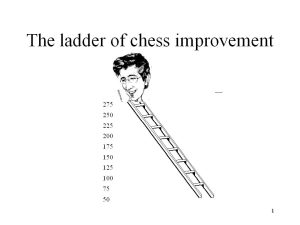
I think Glenn Flear once decided when he was graded 170, that he just needed to improve 7 points each year for 10 years, and he’d be a GM. And so he was…
But as a former student of zoology, I am used to discarding ‘ladder’ models in favour of more realistic pictures showing the more complex and contradictory state of nature:
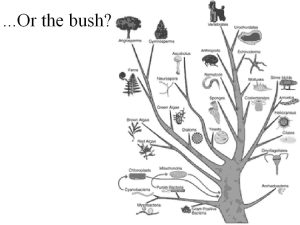
Where are you on the bush? The ladder suggests that chess is only one thing and there’s only one main route to travel. I think chess is more complex, and our routes through improvement are more elaborate, than the ladder model suggests.
A more helpful model to think about your own chess I think is… Imagine a player graded BCF 100 [ELO 1700 or so? They changed the system and I no longer feel confident about translating grades]. I imagine they would have strengths and also some weaknesses. In fact, they may perform better than your average 100-grade player at some things, and worse at others. If there are a dozen or so things you need to get right to be a good chessplayer [*], we might be able to draw up a profile of our player:
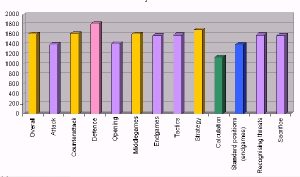
So, our player excels at F, G and L, is most deficient in B and E, is far from wonderful at M, and doesn’t even know what J is. [It may be that I don’t either, but it may be that it doesn’t matter at our level.]
In order to help you think about your own profile, try this:
List the three most important things you try to get right during a chess game, or the three things that you think you are best at.
1 …
2 …
3 …
Now list the three most important things you want to try and improve — perhaps thinking about the three most common reasons why you think you lose chess games.
1 …
2 …
3 …
OK, now compare your answers with those of other people. Somewhere between you, you might have a list of a dozen things. [Having looked at (and discussed) this list, you might want to change your mind about your initial two sets of triplets ]
Now take the scoresheets from your last dozen games — slow games, not blitz games on the Internet or against computers, but proper chess with a human opponent and a couple of hours’ thinking time — and think about each game against the list of a dozen things. Then, come up with a your final sets of triplets, your three strengths and the three things you want to work on.
So, bring your list of things you want to work on to the session next week, and we’ll see if we have any overlap. Then we can think about a programme. See you there.
[* Although Dan Heisman says there are five: tactics, activity, time management, thought process, general principles. Those headings are broad enough to be worth dividing up, I expect.]
So, last week we launched the summer coaching sessions. I explained the idea of the profile, and went on to ask everyone to complete the 3+3 exercise described below:
The items were written onto coloured sticky notes, and I arranged these into rough groups on a table. Doubtless other arrangements were equally legitimate. The idea was for everyone to to start to build a confident picture of your strengths and weaknesses: try and draw up your own list of what A-M might stand for, and what might be your B and E or your M, and what might be your J!
Well, depending on what level you’re at, different treatments might be appropriate. I have drawn up a preliminary guide to books — not that you should read all or own any of them, but so that you might find something to move you on, whatever your level and whatever you want to work on. I expect for every book there is a better one… but it’s a starting point. I’ll try and supplement this array with some web links soon. Contributions welcome.
| The good | Dr.Dave’s comments | |
| GENERAL Playing a game better now |
GENERAL I am not experienced in chess game enough |
The main thing beginners need is practice! |
OPENING
|
OPENINGS Castling
|
I was happy that this didn’t dominate the picture: although in the last game I annotated, I piddled all over their third and fourth moves… |
TACTICS
|
TACTICS
|
I don’t agree that chess is 99% tactics, but tactical alertnesss does decide an awful lot of games.
This isn’t just about knowing about tactics, it’s about imagination and vision. Fortunately, they have the same treatment: doing tactical puzzles. |
STRATEGY
|
STRATEGY
|
There’s lots to this, of course; I was interested to hear a theme of ‘exchanges’ coming through. |
ENDGAME
|
ENDGAMES
|
Traditionally, the ground where weaker players lose to stronger ones. Are we sure that this isn’t a weakness for more of us? Or does it never matter in our games? |
THE CLOCK
|
THE CLOCK
|
Ah, the 33rd piece is often the final straw…
I would remind a couple of people that there are no points for having time left at the end of the game. |
DEFENCE
|
DEFENCE
|
Again, many would have you believe that club players are worse at this than the rest of their game. |
RESOURCEFULNESS
|
HESITANCY
|
These aspects of practical play should not be overlooked in the avalanche of available theory. |
| Topic/Class | E | D | C | B | A |
| Opening books | Chess Openings for Juniors (Walker)
See also: http://exeterchessclub.org.uk/content/italian-game-beginners and http://exeterchessclub.org.uk/content/colle-system |
An Opening Repertoire for the Attacking Player (Keene/Levy) | Ideas behind the Chess Openings (Fine) | Winning with e4 (Bishop’s Opening)(Emms)
…d4 (QGD Exchange)(Dunnington) Meeting e4 (Sicilian Four Knights’)(Raetsky)em style=”text-decoration: underline;”>d4 (QGD Tarrasch)(Aagaard/Lund) See also: |
Specialist monographs e.g. Play the French (Watson)
See also: http://www.chesspublishing.com |
| Tactics | Winning Chess (Chernev/Reinfeld)[D] | Winning Chess Tactics for Juniors (Hays) | Test your Chess IQ (1)Livshitz See also: |
Penguin Book of Chess Positions (Alexander) [D]
span style=”font-style: italic;”>See also: Claus Kaber |
Test your Chess IQ (2)Livshitz
See also: |
| Strategy | The Most Instructive Games Of Chess Ever Played (Chernev) [D] See also: strategy handouts |
Simple Chess (Emms) | The Middle Game 1/2 (Euwe/Kramer) | The Power Chess Program (I/II)(Davies) | Secrets of Modern Chess Strategy (Watson) |
| Endgame | Capablanca’s Best Chess Endgames | Winning Endgames (Kosten) | Endgame Strategy (Shereshevsky) | Rate your Endgame (Mednis/Crouch) | Batsford Chess Endings (Speelman) |
| Games collections | Logical Chess, move by move (Chernev) | Best Lessons of a Chess Coach (Weeramantry) | Chess: the Art of Logical Thinking (MacDonald) | Understanding Chess, Move by Move (Nunn) | Secrets of Grandmaster Play (Nunn/Griffiths) |
| Practical play | Chess for Tigers (Webb) | How to Reassess your Chess (Silman) | The Amateur’s Mind (Silman) | Secrets of Practical Chess (Nunn) | The Seven Deadly Chess Sins (Rowson) |
| Players to study | Morphy | Tarrasch, Lasker | Capablanca | Alekhin | Botvinnik |